and its Relations with Japanese Settlers in
Papua and New Guinea, 1919-1940
著者
IWAMOTO Hiromitsu
journal or
publication title
南太平洋研究=South Pacific Study
volume
17
number
1
page range
29-81
Japanese Southward Expansion in the South Seas
and its Relations with Japanese Settlers in
Papua and New Guinea, 1919-1940
Hiromitsu I
WAMOTO1)Abstract
Japanese policies toward nan’yo(the South Seas) developed rapidly in the inter-war period (1919-1940). After
the invasion in China in the early 1930s, trade-oriented nanshin(southward advancement) policies gradually
gained aggressiveness, as the military began to influence making foreign policies. Behind this change, nanshin-ron
(southward advancement theory) advocates provided ideological justification for the Japanese territorial expansion
in the South Seas. In these circumstances, Japanese settlers in Papua and New Guinea were put in a peculiar position: the emergence of militaristic Japan probably stimulated their patriotism but it also endangered their presence because they were in the colony of Australia−the nation that traditionally feared invasion from the north.
However, as the Australian government continued to restrict Japanese migration, numerically their presence became marginal. But, unproportional to their population, economically they prospered and consolidated their status as ’masters’(although not quite equal to their white counterparts) in the Australian colonial apparatus. In this
paper, I shall analyse how this unique presence of the Japanese settlers developed, examining its relations with the Japanese expansion in the South Seas and the Australian policies that tried to counter the expansion.
Key words: inter-war period, Japanese settlers, Papua and New Guinea, nanshin, Australia
Introduction
The Australian civil administration was established in 1921 and inherited policies estab-lished during the military period. The administration continued to restrict Japanese migra-tion to New Guinea and also trading for several years. Consequently Japanese influence became marginal: by 1940 their population had shrunk to about 40. Besides, Komine Isokichi(the leader of the Japanese community in New Guinea)(1)
died in 1934. The nature of the community also changed. They were mostly businessmen, unlike the earlier period when most Japanese were artisans or labourers.
1. Japan, Australia and New Guinea in international politics
The international situation changed rapidly in the interwar period. Bargaining and ap-peasement were arrayed in the process of constructing and de-constructing the international collective security systems. Imperial powers’ struggle continued to secure their colonies. Australia recognised the increasing strategic value of New Guinea, while Japan was Japanising Micronesia.
At the Paris Peace Conference (1919-1921), the victors of World War I bargained to
divide German colonies, and tried to secure their spoils through the League of Nations. A new colonial map was drawn in the Pacific-Asia region−German colonies vanished but
more colonies accrued to Japan and Australia.
To Japan, the Conference was a milestone, in that the western powers accepted her as a major colonial power: she was counted as one of the Five Powers(with Britain, France, the
US and Italy). In Japan newspapers reported daily discussions of Japanese delegates with
their western counterparts and excited the public. Similarly, the Conference was significant to Australia: her representation as a Dominion represented the acknowledgment of nation-hood.(2)
As a result, discussions concerning Japan and Australia were affected by the pride and prestige as young modern nations. This reinforced their mutual perceptions: the image of racist Australians was imprinted on Japanese memories, while Australians increased their suspicion of expansionist Japanese looking at every opportunity to take white men’s lands. Although silent on European affairs, the Japanese were vocal on Pacific-Asia matters: especially the cession of German rights in Shantung Province, their claim to German Micronesia and the abolition of racial discrimination. Of those three, the Shantung Province was the issue of which they were most determined not to compromise. The province was a gateway to Japanese expansion in East Asia and a shield against the Russian southward expansion. The government instructed its delegates not to sign the treaty if their claim was rejected.(3)
The Japanese also had a strong claim to German colonies north of the equator, reinforced by a secret treaty made with Britain during the war. The Japanese insistence on the insertion of a racial equality clause in the charter of the League of Nations was weaker than those two claims. It was a matter of prestige that: they saw the discriminatory treatment of Japanese in the US, Canada and Australia as a disgrace; and that they should be treated equally as their western counterparts, as citizens of a modern independent nation, not like other Asians colonised by western powers.(4)
Against those claims, the leading Australian delegate, William Hughes, strongly opposed the last two, because both challenged the essence of Australian defence and foreign polic y−the White Australia Policy. However, his main opponent in the German territory issue
was not the Japanese but the US President, Woodrow Wilson, who proposed the mandatory system in which all countries should have the same right of access. Wilson’s proposal was based on his idealistic Fourteen Points, but in effect it was also aimed at countering other colonial powers’ expansion in the Pacific. Hughes thought that this proposal would threaten Australia’s exclusive right to German New Guinea, as it would allow Japanese access. To
Hughes, New Guinea was a buffer against Japan’s southward expansion: ’The ring of these South Pacific islands encompasses Australia like a chain of fortresses... and any Power which controls New Guinea, controls Australia.(5)
’ He vigorously resisted Wilson’s proposal. The Japanese also objected, although less vigorously, being concerned about their commer-cial rights in New Guinea. After lengthy discussions and compromise, agreement was reached finally: Class ’C’ Mandates−virtually exclusive colonies−were applied to all
German Pacific territories.
In the eyes of Hughes, the Japanese proposal of racial equality was closely associated with the mandate issue. He thought that the Japanese were trying to manipulate in order to send migrants to New Guinea as well as to Australia.(6)
Hughes frantically opposed it, because he thought that ’to allow coloured immigration was to risk social suicide, to jeopardise a society.’(7)
Although the Japanese ’had no wish to dispatch immigrants’ to Australia and their proposal was ’essentially a matter of prestige’,(8)
Hughes was relentless despite the objection of Edmund Piesse, the Director of the Pacific Branch in the Prime Minister’s Department. Piesse suggested that:
But even if there are reasons for maintaining racial discriminations against Asiatics, we must face the facts that these discriminations give great offence in Japan, and to a less extent in other Asiatic countries, that they contribute to the maintenance of strained relations between Japan and the white races, and they are used in Japan as a justifica-tion for armaments−the existence of which contribute in turn to the maintenance of
armaments in Australia and other white countries. Are racial discriminations so vital to us that it is worthwhile to maintain them when they produce these results? Surely the answer is that they are not.(9)
However, the White Australia Policy was a sacred cow which most Australians would not sacrifice for anything. John Latham, one of the delegates, wrote:
The principle of White Australia is almost a religion in Australia. Upon it depends the possibility of the continuance of white democracy−indeed, of any democracy, in a
real sense−in this continent. Any surrender of the policy is inconceivable−it rests
upon the right of every self-governing community to determine the ingredients of its own population. If that right is surrendered, the essence of self-government disappears.(10)
It was a ’moral imperative’ for Hughes to scrap the Japanese proposal, even if it was watered down eliminating any reference to migration.(11)
Finally, the Japanese gave up their pro-posal, and used it only as a bargaining chip for western acknowledgment of Japanese rights in Shantung.(12)
Thus the Australian objection facilitated the Japanese expansion in China. Similarly, the Australian objection consolidated Japanese exclusive control of Micronesia, as the Japanese could use the same argument to prevent non-Japanese from entering. As
Nelson rightly argues, it was a dilemma for Australians that ’every time they asserted the right to keep what they held and to impose their unfettered right on their new possessions, they were by implication strengthening the case of the Japanese to have their way in Micronesia.’(13)
The Paris Conference led to the establishment of the so-called ’Washington System’ in which major western powers and Japan concluded several treaties at Washington in 1921 and 1922. It reinforced the ’Pax Anglo-Saxonica’, establishing a collective security system to maintain the status quo set at the Paris Conference.(14)
Limitations on naval armaments were agreed, although they in reality gave Japan naval superiority against the US in the Pacific. And the Four-Power Pact was concluded among the US, Britain, France and Japan, replacing the Anglo-Japanese Alliance which had been antagonising the US.
In concluding the treaties, Japan was obliged to cooperate with the western powers because of the ’dual’ nature of the development of her imperialism: militarily Japan was catching up with the west but economically she was still heavily dependent on the US and Britain for raw materials and markets.(15)
At this stage Japan needed to avoid conflict with the western powers in order to develop its economy.
On the abolition of the Anglo-Japanese Alliance, Australia(although not represented at
the Conference) initially objected, fearing that Britain would not be able to restrain
Japanese from expanding in the Pacific. However, seeing the collective security system established, Hughes(then the Prime Minister) ratified the treaties, saying,
This Treaty establishes an equilibrium in the Pacific. As far as any action of man can do so, it insures peace for the next ten years for Australia.(16)
Hughes’s optimism proved right. In the 1920s Japan and Australia enjoyed relatively relaxed relations. Their trade steadily grew and the shift of the destination of Japanese emigration to South America mitigated the Australian fear of the ’Yellow Peril’. Piesse observed that ’the danger to Australia from an increase of population in Japan seems remote, and should not affect Australia’s attitude toward her’.(17)
Indeed the mid-1920s was a tempo-rary ’golden period’ in Japan-Australia relations.(18)
However, the Great Depression of 1929 initiated the collapse of the Washington System. ’Have not’ nations such as Japan, Germany and Italy began to challenge the System set up by ’have’ nations such as Britain, the US and France. Those ’have not’ nations sought opportunities to expand their colonies in order to overcome their economic stagnation. In the 1930s, Japan sent troops to Manchuria. So did Germany to the Rhineland. And Italy invaded Ethiopia. But until the end of the decade, Britain, the US and France exercised ’appeasement’ policies against those aggressive actions, attempting to maintain the colonial map drawn in Paris.
The London Naval Treaty of 1930, which aimed at balancing the naval strength of major powers (including Japan), resulted in a vain attempt to keep international peace. In the
League of Nations, which was supposed to assure collective security, was useless to stop Japanese aggression: it did not take any concrete measures except condemning the action and recommending withdrawal from China. In Japan, some navy and army staff and right wingers expressed their indignation against the western objection to Japanese rule in Manchuria. They began to gain public support and gradually influenced foreign policy. Consequently Japan left the League of Nations in 1933 and the London Naval Treaty in 1936, demonstrating her apparent denial of the Pax Anglo-Saxonica.
In Australia, fear of Japan increased and was manifested in her foreign policies. First, Australians followed Britain’s appeasement policy toward German aggression in Europe, presuming that open hostility, which might result in a British pact with Russia against German aggression in Poland, would make Japan cooperate closely with Germany, because Japan had been perceiving Russia as her most likely enemy in northeast Asia. In the Australian view, appeasement would prevent ’a war in the Pacific simultaneously with one in Europe−a situation in which Britain could not send sufficient strength to Singapore, and
Australia would be left to defend itself.’(19)
Australians applied a similar appeasement policy against Japanese aggression in China, based on the optimistic assumption that so long as Japan was occupied in China, she would not advance south and would not threaten Australian security.(20)
But the situation changed when the Washington System collapsed in 1936 by the Japanese abrogation of the London Naval Treaty. Then Australians attempted to neutralise the Japanese threat by establishing a collective security pact in the Pacific.(21)
They proposed the ’Pacific Pact’ in 1937 and lobbied Russian, Chinese, French, Dutch, American and Japanese ambassadors in London and their governments to no avail.
In the late 1930s, the Australians desperately began to pressure Britain to reinforce the garrison at Singapore, seeing her defence capability as insufficient against possible Japanese invasion in the South Pacific. The government also adopted the ’trade diversion policy’ which favoured British textile manufacturers and impeded Australia-Japan trade in wool and textiles. It was in an attempt to cajole Britain into diverting its military strength to the Pacific. But the policy was an ’irrational exercise in economic nationalism’, as Australia-Japan trade was growing and was substantially in Australia’s favour.(22)
More significantly, the policy undermined Japanese good feelings towards Australia and ’revived anti-Australian sentiment in Japan where feelings bred of hostility to Hughes had apparently been softening.’(23)
In 1938 the Japanese government declared the Toa shin chitsujo [New Order in East
Asia] to find a solution to the prolonged war in China, but the declaration failed to alleviate
Chinese resistance and invited US economic sanctions. And Japanese isolation intensified. Then the government concluded the Tripartite Pact with Germany and Italy in 1940. The pact was aimed at facilitating southward aggression in Southeast Asia, presuming that the US would diminish her desire to be involved in Asian affairs and thereby Japan could avoid a head-on collision with the US.(24)
The Japanese military also predicted that German victories in Europe would prevent Britain, France and Netherlands from being involved in
conflicts in Pacific-Asia if Japan invaded their colonies.
Micronesia was another reason for Japan to conclude the Tripartite Pact. Germany in the late 1930s, under Hitler’s dictatorship, began to reclaim territorial rights in former colonies. At that time the strategic importance of Micronesia to Japan was increasing because of the possibility of naval operations in the south-west Pacific: Japan was building bases on the islands. The Japanese secretly negotiated with the Germans on a ’scheme for a public Japanese acknowledgment of the right of Germany to her former colonies accompanied by an agreement on Germany’s part to sell her former Pacific islands mandated to Japan to the latter power.(25)
’ In later negotiations, the Japanese insisted upon their exclusive control of the South Seas and even proposed the division of Australian territories−Papua to Japan and
New Guinea to Germany.(26)
In the end, although excluded from the clauses of the Pact, verbal agreement was made: Japan would retain Micronesia; other former German Pacific territories would be returned to Germany after the war; and then Germany would sell some territories to Japan.(27)
Meanwhile the Australians rebuffed the German claim. Pearce, then the Minister for External Affairs, said:
British policy, including Australian policy, is based on peace and international law and order, for which the League[of Nations] offers the only safe foundation. Therefore,
any re-adjustment or general settlement in the interests of world peace must be within the framework of international justice and order, and not the result of a demand of right...In effect, it[re-adjustment] amounts to a submission to blackmail−the
tem-porary buying-off of any aggressive nation. For this reason alone, it is unthinkable that Australia should even consider the handing over of any territory.(28)
The Australians faithfully adhered to the non-militarisation clause set to the mandate territory.
By contrast, the Japanese military was planning operations from Southeast Asia to the South Pacific. In Micronesia they secretly built bases. At the same time the government was making last ditch efforts to derive US concessions over China. However, the Tripartite Pact hardened US attitudes contrary to Japanese expectation, and the US reinforced its embargo on oil and froze Japanese assets. That was a severe blow to Japan which was heavily dependent on the US for oil supplies−essential fuel for naval operations. Thus, Japan had
to find alternative sources of oil and other raw materials. Resource-rich Southeast Asia became a primary target. Consequently, shortly after the declaration of the Dai toa kyoei ken (Greater East Asia Co-prosperity Sphere), Japan launched her attack against Pearl
2. Maturation of nanshin
The acquisition of German Micronesia made nanshin no longer a mere theory and it gave a new concept to intellectuals, policy makers and businessmen: ’Micronesia and Taiwan would function as bases for the advance to Southeast Asia.’(29)
A new geographical conce pt−’Southeast’(30)
−also appeared in a school text book in 1919, reflecting increased
atten-tion to Southeast Asia. Similarly new terms−uchi or ura-nan’yo (inner or back south Seas:
Taiwan and Micronesia) and soto or omote-nan’yo (outer or front South Seas: India,
Southeast Asia, Australia, Melanesia and Polynesia)−emerged around this time, showing
the development of the Japanese conception of the South Seas that placed Japan in the centre of the south-west Pacific.
Numerous intellectuals advocated Japan’s southward advance and the military joined their advocacy in the late 1930s. The military had to gain natural resources in Southeast Asia(particularly oil in Dutch East Indies) in order to continue their war in China, as the
US and Britain imposed embargoes, responding to the Japanese aggression in China. At the same time the government introduced policies to facilitate Japanese trade with Southeast Asia, and included nanshin in the national policy in the late 1930s. Private companies and migrants followed this southward tide. The public was agitated by the bombardment of
nan’yo literature, which increased drastically: even for general references, the number
increased fourfold from 99 in 1920-29 to 405 in 1930-39.(31)
The main reason for the upsurge of Japanese interest in nan’yo, particularly Southeast Asia, was economic: new sources of raw materials and markets were needed for the devel-opment of heavy industry in order to catch up with western economies, and to diversify export markets to rectify heavy dependence on US and Chinese markets.(32)
The government led the commercial promotion, which was demonstrated in the number of government publications. Taiwan sotoku kanbo chosa ka(Research Section of the Chief Secretary of
Taiwan Governor-General), the leading government research institution of the South Seas,
published about a hundred reports (Minami-shina oyobi nan’yo cho sa [Survey of South
China and the South Seas] series) on trading, investment, management of plantations,
fishery, mining and so on.
In the mid-1920s the Department of Foreign Affairs took an initiative. In 1926 the Department held the Nan’yo Boeki Kaigi(South Seas Trade Conference), inviting officials
of other departments and representatives of various industries, to promote South Seas trade. The main items on the agenda at the Conference were investment, trade, transport, customs and commercial treaties. It was a significant milestone showing the beginning of the gov-ernment’s involvement in that it was the Department of Foreign Affairs not private organisations such as the South Seas Society or the Chamber of Commerce and Industry that took the lead.(33)
In 1928 the Department of Foreign Affairs presented a report entitled Boeki, kigyo oyobi
imin yori mitaru nan’yo [The South Seas in view of trade, companies and
organisations to facilitate export and investment, and a special fund to assist emigration. Although none of the proposals were put into practice, the report was signifi-cant.(34)
The necessity for national commitment was acknowledged, as the Department used the term ’nan’yo kokusaku’(national policy towards the South Seas) for the first time in
official reports.(35)
Nanshin-ron advocates raised their voices in the early 1930s, responding to the collapse
of the Washington System. They began to focus on the strategic argument, that nan’yo was Japan’s life line, although carefully emphasising the necessity to avoid conflict with western colonial powers. Fujiyama Raita, Vice-President of the Nan’yo Kyokai (South Seas
Society), argued:
Nan’yo is our life line. It is at the forefront of our national defence. We should always
consider this concept in our southward advance. However, we should not misunder-stand. The Omote-nan’yo is all western colonies...The western rule of Southeast Asia assures our national defence, and the development of their economies and relations with us facilitates the security of our life line and thereby our national defence.(36)
The mid-1930s was the most significant period for the development of nanshin-ron. It began to turn militaristic, as the navy set out with a concrete nanshin plan. In 1935 the aggressive group, ’han-joyaku ha’(anti-[London] Treaty faction), set up the Tai Nan’yo H
osaku Kenkyu-kai(Study Committee for Policies towards the South Seas). The Committee
studied both economic and military expansion; it advocated the promotion of trade and emigration through the Takumu sho(Department of Colonial Affairs) and the Nan’yo Ko
hatsu Kaisha (South Seas Development Company) and emphasised the military role of
Taiwan and Micronesia as advance bases.(37)
The navy was already militarising Micronesia. In the early 1930s, after the western powers restricted Japanese naval capability at the London Treaty of 1930, the navy secretly started building bases in Palau, Tinian and Saipan. In order to evade the western powers’ monitoring, they were camouflaged as places to dry fishing nets or farms, and the South Seas Development Company assumed the responsibility for construction.(38)
Although the Study Committee at this stage avoided to express outright hostility against western powers, it strongly argued for the opening of markets and natural resources in Southeast Asia, particularly in the oil-rich Netherlands East Indies.(39)
In 1936 the government took a crucial step. It integrated the nanshin in the national policy. After abrogating the London Naval Treaty in January, the government held the Five Ministers Conference (attended by the ministers of the departments of Prime Minister,
Foreign Affairs, Finance, Navy and Army) in August and announced ’the Guidelines for
National Policy’ that included resolution to advance south ’peacefully’:
particularly in the outer South Seas, avoiding threats to other nations, and will expand our influence progressively by peaceful measures in order to reinforce national strength with the construction of Manchukuo.(40)
In November the policy was executed. The Nan’yo Takushoku Kabushiki Kaisha(South
Seas Colonisation Company), a giant national company comparable to the Taiwan
Colonisation Company, was established. The company’s main venture was the development of phosphate mining on Angaur and Fais.
Coinciding with the government declaration, some intellectuals began to focus on Japan’s long historical connection with nan’yo, starting from the 17th century’s trading, called
Goshuinsen bo eki,(41)
to the Meiji explorer-traders. Iwao Seiichi, a historian and professor of the Taipei University(the leading academic institution in South Seas studies), played a
central role. In 1936, he wrote Kinsei shoki nihonjin nan’yo hatten no rekishi [History of Japanese development in the South Seas in early modern
times].(42)
In 1939, he published an article ’Nan’yo ni okeru nichi-o kankei no suii [The
change of Japan-European relations in the South Seas]’ in which he contrasted western
colonisation, which was strongly backed up by their governments, with Japanese emigration which had no government support.(43)
Then in 1940, Iwao published the best-known book in the study of Japan-South Seas relations, Nan’yo nihon machi no kenkyu[Study on
Japanese towns in the South Seas]. He wrote in the introduction:
Japanese development in the South Seas, which started in early modern times, is an epochal phenomenon in our national history...It is a topic to be examined thoroughly to understand the current international relations in the South Seas where Occidentals and Orientals are in conflict.(44)
Other historian-writers are Irie Toraji and Kakei Kiyosumi. Irie, a former archivist of the Foreign Ministry, wrote two volumes of Hojin kaigai hatten shi [History of Japanese
overseas development] about Japanese emigration since 1868, in which he devoted a
considerable section to the South Seas.(45)
Kakei, although not a well-known writer, wrote
Nanpo shoho ni okeru o seki nihon jin no katsuyaku [Japanese activities in the southern
area in old times].(46)
Although all those pieces are purely academic and have few refer-ences to government policies, the timing of their publication precisely coincides with the beginning of Japanese military actions in the late 1930s.
The navy initiated the military nanshin. In February 1939, naval forces occupied Hainan Island, an iron ore-rich island, on the pretext to cut off the southern support route to Chiang Kai-shek, then in March the Spratly Islands. Both islands were strategic bases for the advance to Southeast Asia. The navy’s actions were quickly followed by the cabinet’s policy statement: the Konoe cabinet expressed ’the Outline of the Basic National Policy’, declaring ’the construction of the New Order in Greater East Asia based on the solid consolidation of Japan, Manchuria and China’ on 26 July in 1940.(47)
the ’New Order in East Asia’ of 1938, included the South Seas.(48)
Shortly after the cabinet decision, the Imperial Headquarters announced nanshin by force. On 27 July, it produced ’the outline of measures taken in response to changing international situation.’ Under the clause of ’the use of force against southern area’, it stipulated that ’in case China problem cannot be solved, ...the use of force is possible in order to solve the problem in the southern area.’(49)
The outline was the unambiguous endorsement of the military invasion of Southeast Asia.
The army saw its best opportunity when Germany defeated France and Netherlands in Europe in mid-1940. In September the army quickly sent forces to occupy the northern French Indochina in order to secure the naval base in Camranh Bay and the airfield at Pnompenh. Thus the army, the traditional advocate of the northward advance, finally joined
nanshin.
In the last year before the outbreak of the war, intellectuals completed the justification for
nanshin on three main grounds: independence from the western economies, national
defence and nationalism. Iizawa Shoji explained in Nanpokyo ei ken[South Co-Prosperity
Sphere] in 1940 on the economic independence:
Because there are correlations and interdependency between the continental policy and southward advancement policy, it would be impossible to implement both policies simultaneously if we attempted to achieve each policy individually. Japan has been deploying forces on the continent and their military supplies come from Japan: they are not available locally as expected initially. And most supplies are dependent on imports from the US and Britain. We have been clearly shown that this is a grave obstacle to our war efforts. If we were freed from this dependency, we would be able to complete our continental policy. The reason why people look at the south is that the region is rich in the resources which are in short supply on the continent. Therefore, the policy to gain those resource must be considered an essential matter to implementing the continental policy.(50)
The Nihon Keizai KenkyuKai (Japanese Society of Economic Studies) emphasised
na-tional defence:
Colonisation by western countries was motivated mainly by territorial desire or by the desire to acquire precious metals and pepper. They did not hesitate to go to war to gain territories. On the contrary, Japanese expansionism was based entirely on national defence not on such purposes as territorial expansion or acquisition of economic interests. Japanese southward advancement was indeed the manifestation of this kind of[defensive] expansionist policy.(51)
Some nationalists stimulated anti-western feelings in their publications. Goto wrote in the introduction titled ’For the freedom of the South Seas’:
A new stage of the century is set up on the land of the South Seas, being spotlighted from the East. The stage that the Western Imperialists tried to achieve world hegemony is now going to show their fall. This is nothing but historical inevitability.(52)
In Goto’s view, the liberator from the western imperialism would, of course, be the Japanese. Thus nanshin-ron matured ideologically, integrating a basic premise−economic
development−to nationalism. However, it was a different form of nanshin-ron from the
one that Enomoto and other Meiji nanshin-ron advocates asserted about half a century earlier: they were fundamentally non-militaristic free-trade advocates. But those Meiji
nanshin-ron advocates were exploited by their later counterparts. The new nanshin-ron
advocates ’deformed’ the Meiji nanshin-ron, by exalting the Meiji advocates as national heroes despite the fact that the nanshin-ron had attracted far less attention in the Meiji period, and created the image that the Japanese had had long-term interaction with the South Seas.(53)
Meanwhile, Japan’s economic relations with the South Seas developed steadily. The growth of the overall Japanese economy, government promotion of South Seas trade and the international situation facilitated Japanese investment in the South Seas. As Table 1 shows, between 1919 and 1941, 78 companies were established. It was a remarkable increase, compared to only 32 companies established between 1870 and 1918. Most companies were in Southeast Asia and directed toward resource-development such as minerals, oil, rubber, lumber, jute, cotton, copra and fishery, reflecting the general focus of interest of
nanshin-ron advocates and the government.
The timing of the investment, which concentrated in the 1930s, shows the association with the international situation: the US and Britain raised tariffs against Japanese products in the early 1930s; China, the second largest trading partner after the US, began to boycott Japanese products after the Japanese invasion in 1931; and the prolonged war in China forced Japan to find alternative sources of raw materials to meet increasing military de-mands.
Consequently Japan-South Seas trade increased dramatically. As Table 2 shows, total exports increased from 252.5 million yen in 1920 to 474.2 million yen in 1937 and imports from 188.3 million to 540.4 million. Southeast Asia was the largest trading area, followed
Table 1. The number of Japanese companies established in the South Seas, 1919-1941
Source:南洋団体連合会 1942. 大南洋年鑑 . 797∼828頁, 東京. [The Federation of South
Seas Organisations(ed.) 1942. Year book of the South Seas. p.p.797-828 , Tokyo.]
Micronesia Southeast Asia South Pacific Taiwan unknown total
1919 1920-29 1930-39 1940-41 total 1 2 21 − 24 4 11 23 5 43 0 − 3 − 3 1 − 3 − 4 − 1 3 − 4 6 14 53 5 78
by Australia and New Zealand, while Micronesia remained marginal. However, the propor-tion of the South Seas trade in the total Japanese trade remained small; it only increased from 10.2 percent in 1920 to 14.5 percent in 1937.(54)
Similarly, the position of Japan in the total South Seas economy remained marginal. In 1939, the proportion of the trade with Japan was only 6.7 percent, while the US, Britain, China, and Netherlands occupied about 90 percent.(55)
The Mitsubishi Research Institute of Economies admitted: ’the fundamental reason[for the low profile in South Seas economy]
is...the result of our [underdeveloped] industrial strength’ compared to western
economies.(56)
Emigration to the South Seas increased more than threefold from 31,811 in 1919 to 95,528 in 1936 (Table 3), although the proportion in the total Japanese emigration
Table 2. Japanese trade with the South Seas from 1920 to 1937(million yen)
n.a. no data available
*The countries of Southeast Asia varied by year due to the availability of statistics: 1920: British Malaya, Dutch East Indies, French Indochina, the Philippines and Thailand
1930, 1937: British Malaya and Borneo, Dutch East Indies, French Indochina, the Philippines and Thailand
Source: data from内閣統計局 1931. 大日本帝国統計年鑑 . 168頁, 東京;1938, 204∼
209頁. Naikakuotkei-kyoku 1931 : 168, 1938 : 204-209, Kokusei-in 1921 : 142 [Statistical Bureau of the Cabinet 1931. Statistical yearbook of the Great Japan Empire. p.168; 1938. p.p.204-209]
国勢院 1921. 大日本帝国統計年鑑 . 142頁, 東京. [Statistical Bureau 1921. Statistical
yearbook of the Great Japan Empire. p.142]
Micronesia Southeast Asia* Australia & New Zealand total
export import export import export import export import
1920 1930 1937 0.03 0.06 0.3 0.09 0.2 1.2 184.8 133.0 382.6 125.9 130.4 325.4 67.7 28.6 91.3 62.4 94.6 213.8 252.5 161.6 474.2 188.3 225.2 540.4
Table 3. Japanese population in the South Seas, 1919 to 1941
*Southeast Asia includes British Malaya, Borneo, Sarawak, India, Burma, Sri Lanka, Netherlands East Indies, the Philippines, and Guam
Source: 1919-1925:石川 友紀 1972. 「統計よりみた日本出移民史 3」 地理科学 . 27∼28
頁, 地理科学学会, 広島. [Data from ISHIKAWAT. 1972. ’Emigration history in the view from
statistics’, Geographic Science. p.p.27-28, Vol.16, Chiri kagaku gakkai, Hiroshima.] Southeast Asia*
Micronesia Australia, New Zealand
& South Pacific Islands Total
1919 1925 1930 1936 23,740 21,359 35,240 36,375 1,791 7,331 19,835 55,948 6,280 3,883 3,984 3,205 31,811 32,573 59,059 95,528
remained marginal: it was only 8 percent in 1936.(57)
The increase was mainly due to emigration to Micronesia that drastically increased in the 1930s. The government assisted the emigration: the Nan’yo cho(South Seas Government), the Japanese colonial
admini-stration in Micronesia, leased land and the Nan’yo Kohatsu Kaisha (South Seas
Development Company), the private company part-funded by the government, recruited
thousands of labourers for its sugar plantations. Emigration increased especially after Japan resigned from the League of Nations in 1933.
Emigration to Southeast Asia remained largely static in the 1920s, because the govern-ment adopted a foreign policy to cooperate with other powers in the framework of the Washington System and discouraged emigration to Southeast Asia, which might cause friction with the western powers. This attitude was articulated in the statement of the Foreign Minister, Shidehara Kijuro, at the South Seas Trade Conference of 1926. He stated, ’the agenda of this conference does not include immigration issues.’(58)
Although emigration began to increase in the 1930s, the increase was far less dramatic than in Micronesia. The main reason was that there was little demand for Japanese labourers unlike in Micronesia, as cheap labour was locally available. As a result, migrants were mainly company employ-ees and their numbers were subject to fluctuations of economy.(59)
Also the Dutch admini-stration applied restrictions on foreign labourers from 1935. The Japanese population in Australia, New Zealand and South Pacific islands declined, as Australia continued to restrict Asian migration and this affected most Japanese in this region.
3. Japanese perceptions of Papua and New Guinea
Corresponding to the rise of the militaristic nanshin-ron, Japanese interest in Papua and New Guinea increased in the late 1930s. The number of publications demonstrates this. As Table 4 shows, most publications appeared in the same period. Only one book was pub-lished before 1923, according to Zoho nanpo bunken mokuroku[Biography of the South
Table 4. The number of South Seas publications, 1923 to 1941
Source: 日本拓殖協会編 1944. 増補南方文献目録 . p.p.233-235,
大同書院, 東京. [Japan Colonisation Society (ed.) 1944. Bibliography
of the South Literature, revised edition. p.p.233-235, Daido-shoin, Tokyo]
number number 1923 1924 1932 1933 1937 3 1 1 3 4 1938 1939 1940 1941 total 10 7 4 9 42
Literature, revised edition]. However, interest in Papua and New Guinea was merely a
trickle compared to Southeast Asia. In Zoho nanpo bunken mokuroku, the list of publica-tions on Southeast Asia occupies 144 pages, while that of Papua and New Guinea occupies only 3.
Although marginal, the increase of the information on Papua and New Guinea was dramatic. The government was the initiator. In 1938 the Department of Foreign Affairs published Eiryo papua [British Territory of Papua] and Goshu inin tochi ryo nyuginia [Australian Mandated Territory New Guinea], and the Department of Colonisation
pub-lished a book with the same title.(60)
Then in 1939 the administration in Micronesia pub-lished two massive volumes−400-pages long Nyuginia jijo (goshu inin tochi ryo) [The
situation in New Guinea (Australian Mandated Territory)] and 145-pages longNyuginia jijo(papua ryo hen)[The situation in New Guinea(Territory of Papua)].(61)
Those books introduced history, population, religion, education, climate, hygiene, geogra-phy, politics, etc. And they were based on information from English sources such as New
Guinea Handbook, Pacific Island Year Book, Pacific Islands Monthly, Rabaul Times, Gazette of Papua, Annual Report of Papua, Papuan Courier and the ordinances of the
Australian administrations.
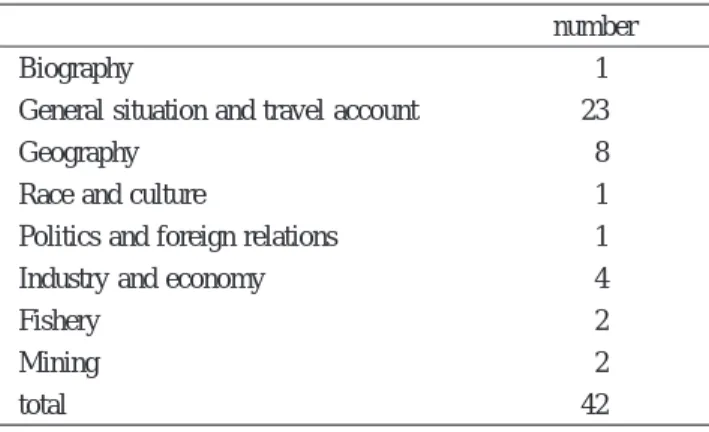
A sharp contrast to Japanese interests in Southeast Asia can be seen in the contents of the publications. The Japanese were not so interested in the economy of Papua and New Guinea. Table 5 shows that almost half of the publications were about the general situation and travel, and only 8 out of 42 were on industry and natural resources.
Until the early 1930s, Japanese perceptions of Papuans and New Guineans remained the same. Tatsue Yoshinobu, who travelled with Komine in the early 1900s, wrote that ’fierce natives’ were impeding development,(62)
and Miyoshi Hoju called New Guinean women the ugliest in the world.(63)
However, in the late 1930s perceptions sharpened. The government Table 5. Classification of publications on Papua and New
Guinea, 1923 to 1941
Source: 日本拓殖協会編 1944. 増補南方文献目録 . p.p.2
33-235, 大同書院, 東京. [Japan Colonisation Society (ed.) 1944. Bibliography of the South Literature, revised edition. p.p.233-235, Daido-shoin, Tokyo]
number Biography
General situation and travel account Geography
Race and culture
Politics and foreign relations Industry and economy Fishery Mining total 1 23 8 1 1 4 2 2 42
publications presented the ’tribal’ diversity (e.g. coastal people were peaceful but inland
people were still rebellious),(64)
and the effectiveness of Australian rule through administra-tion and missions which produced some educated Christian natives.(65)
The introduction of New Guinean artefacts also improved the stereotyped perceptions. The Minami no kai(Society of the South) published Nyuginia dozoku hin zushu[Illustrated
New Guinean artefacts] which introduced collections of artefacts and their relations with
native religions and customs. Interestingly Matsue Haruji, the Directing-Manager of the South Seas Developing Company, was the owner of the collections in the book, and he had bought them from Komine.(66)
A similar book was written by Fujiki Yoshihiro, an anthro-pologist. His book, Nyuginia sono fukin to sho no dozoku hin[Artefacts of New Guinea and
adjacent islands], had introductory sections written by artists and anthropologists who
appreciated the high quality of the artefacts and commented favourably such as ’New Guinean artefacts are excellent’ or ’New Guineans are artists.’(67)
Although weak, there was some government interest in the economy. Muramatsu Kaoru, an official of the Research Section of the Department of Foreign Affairs, compared the economic potential of Australian New Guinea with Dutch New Guinea, and pointed out that ’Australian New Guinea was superior to Dutch New Guinea in various points’ such as in copra planting and coastal shipping.(68)
The Nan’yo Keizai Kenkyu Sho(Research Institute
of the South Seas Economy), a government research organ specialising in the economy of
the South Seas, reported the oil search in Papua.(69)
The Institute also reported the shortage of labour, industries and the Australian exploration in the highlands.(70)
But all those publi-cations seem to be mere translations from English sources.
The government was also aware that Australians placed great strategic importance on Papua and New Guinea. Nagatsuka Jiro argued that Australians had always regarded Papua and New Guinea as an important defence line, pointing out that their attempt to annex Papua and New Guinea was the manifestation of this recognition.(71)
The increase in references to Japanese migrants was an important trend from the mid-1930s. It stressed the fact that Japanese had had a long linkage with New Guinea. It was a significant change because until then nobody had demonstrated much interest. Government publications, such as the ones of the Department of Colonisation and the South Seas Government, devoted many pages to the history of Japanese migration (mainly about
Komine) and commercial activities.(72)
Although the information was a plain description of events and accounts of the migrants, it was the first time that the migrants were taken up by officials with such intensity.
Nanshin-ron advocates played a more important role. They exalted Komine as a national
hero. In 1935 Sande mainichi[Sunday Everyday], a popular weekly magazine, published
an article titled ’Showa no Yamada Nagamasa, Nihon-to o sasagete tanshin doku-kan o ikedoru: Nan’yo no kaitaku-sha Komine Isokichi’[Yamada Nagamasa of the Showa period
Isokichi].(73)
The article began with a comment: ’This is the story that impressed Debuchi Gen, a special envoy to Australia, who said "This is the most appropriate episode to pro-mote Japan-Australia relations.’’’ The article emphasised Komine’s relations with Germans and Australians dramatically. It described how bravely he rescued the German governor who was being attacked by natives on a jungle track: ’Mr Komine jumped off a seven-meter high cliff like a bird into the fighting and saved the life of the governor by a close shave.’ The article said that the capture of the Komet was proposed by frustrated Komine who saw the Australians unable to do anything because they were unfamiliar with the local geogra-phy, and that Komine organised the expedition and when he found the Komet, he climbed onto the deck by himself just carrying a Japanese sword and successfully persuaded the German commander to surrender. Because of this feat, he was given the compass of the
Komet and a title of both naval and army captain. The article also emphasised that Komine
was a good friend of the German captain and looked after his family at Rabaul while the captain was imprisoned by Australians, and later the captain thanked Komine, saying ’Now I have learnt the greatness of the Japanese.’ Most accounts in the article were exaggerated.(74)
No other written records and oral evidence can confirm that Komine carried a sword or the German captain thanked him (generally the Germans resented Komine’s
action). At the time of writing the article, Komine was already dead and nobody (except
for those who actually knew about Komine) could challenge the accuracy of the accounts.
Thus the writer could say almost anything to dramatise the events.
More significantly, the article was reintroduced in April 1941. Captain Kamijo Fukashi wrote Sensen ichi-man kairi: zen taisen ji nan’yo no rekishi[The war front of ten thousand
miles: the history of the South Seas during World War I] and inserted the article fully in
his book.(75)
Kamijo added a detailed account of the capture of the Komet, although the addition seems to be his translation from MacKenzie’s The Australians at Rabaul which had been published in 1927. Similarly, in August 1941 the Nanpo sangyo chosa kai(Society of
the South Seas Industry Research) published Nyuginia, a book introducing general
informa-tion on Papua, Australian New Guinea and Dutch New Guinea, and repeated the story about Komine’s feat, although briefly.(76)
Thus just before the outbreak of the Pacific War, the government and nanshin-ron advocates began to popularise the Japanese in New Guinea, obviously intending to propagate and justify the nanshin. The Japanese in New Guinea, who had attracted little public attention in Japan, were suddenly and comprehensively integrated into the vast scheme of Japanese expansionism.
4. Japanese in Papua
Australians scarcely noticed the small number of Japanese. An official report in the late 1930s stated that ’with regard to the Territory of Papua, there are no Japanese.’(77)
The smallness of the Japanese population was one reason. The limited activi-ties of the Japanese was another. Japanese business operations were too small to threat Australian interests, and they were confined in Milne Bay and had little interaction with the Japanese in New Guinea.(78)
Consequently no reports about the Japanese appeared in the
Papua Annual Report or the Government Gazette between the two wars.
However, Australians were concerned about the Japanese who attempted to enter the territory. In 1939 Nan’yo Boeki Kaisha (South Seas Company) sent trade envoys to
Samarai and Port Moresby and entertained the residents with films of Japanese industries and tourist attractions. The Pacific Islands Monthly reported the visit uneasily: ’in spite of wars and the echoes of wars, and the manifest distrust of all British communities in the Central and South Pacific, the Japanese continue with their program of commercial penet ration−part of their campaign to secure economic domination of the Pacific.’(79)
There was another incident involving Nan’yo Boeki. The company purchased the steamer
Papuan Chief, wrecked and lying on a reef near Port Moresby, and sent Japanese crew to
salvage it. The entry of the crew to Port Moresby was granted in July 1941, but the Department of Defence Co-Ordination had strongly objected, insisting that: ’the view of the Department of the Army is that it is undesirable for Japanese at Port Moresby, particularly having regard to movement of troops and other defence measures now taking place’.(80)
However, the Department of Foreign Affairs supported admission provided that the crew stay at Port Moresby for a limited period. Finally the Prime Minister decided to grant entry and advised the Administrator, Murray: ’No doubt you will be able to restrict movement of crew at Port Moresby to a minimum, without this being obvious to the crew.’(81)
It was a delicate time just before the outbreak of the war. Prior to that, there was an incident which embarrassed the Australian government and could have worsened its rela-tions with Japan. In June 1937, the Australian patrol boat Larrakia ’wrongfully and without lawful authority, and by force of arms seized and took possession’ of the Japanese fishing vessel New Guinea Maru on the high seas in the Arafura Sea and imprisoned the captain and the crew.(82)
The Japanese appealed to the Supreme Court of the Northern Territory, which ordered the Australian government to pay compensation.(83)
Possibly the incident affected the attitude of the Department of Foreign Affairs and made it more diffident in the case of the Papuan Chief.
Australians were concerned about the possible effect of the war on Papuans. Australians feared that their authority would be undermined by war against a non-white race. Just one month before the war, the government anthropologist, F.E. Williams, wrote explicitly anti-Japanese articles in his newspaper The Papuan Villager which circulated among Australian-educated Papuans. The article introduced the Japanese as ’not white men...[and]
very warlike people...[who] have made a number of cruel wars against their neighbour,
China,’ and concluded that:
Japan is like a very snappy little dog, barking at three big dogs that just lie down and look at her. The three big dogs are Great Britain, America and Russia. If this little dog ever begins to bite, then the three big dogs will jump at her and tear her to pieces.(84)
The pre-war Japanese population was last recorded by the administration in 1920: six lived in the Eastern Division and one in the South-Eastern Division.(85)
From 1921 to 1948, the administration did not record the non-Papuan coloured population. Although the 1947-48 Annual Report(published in 1949) listed the coloured population, statistics were only
for 1921 and 1933 and no Japanese were recorded in either years.(86)
The only available data are the 1933 census by the Australian government that listed two Japanese in the category of ’not able to read and write English, but able to read and write a foreign language’ and 14 Japanese ’classified according to race.’(87)
The two Japanese are undoubtedly Tanaka and Murakami. The 14 Japanese were most likely mixed-race Japanese.
Information about the Japanese in this period can also be derived from oral evidence. According to them, most of early Japanese settlers died between the two wars, and their mixed-race children took over their trade. The children continued to keep Japanese names and their businesses and mostly prospered.
Jimmy Koto died at an unknown date in the inter-war period. His son George inherited Jimmy’s trade and became a trader, boat builder and planter. He was the only boat builder on Misima Island and had large plantations (Palanean plantation in Motorina island and
another in Kimuta Island). He started boat building on Motorina. He also dived for trochus
shells, sea cucumber and turtle. His trading covered Milne Bay, having a business partner-ship with Tanaka Taichiro.(88)
Jimmy’s good relations with Mrs Mahoney seem to have been continued by his daughter, Florence. Mrs Mahoney once took her for a trip to Sydney.(89)
Tanaka Taichiro made a success of his trading business and owned six luggers by the outbreak of the war.(90)
Murakami Heijiro moved from Naiwara, a village at the end of Milne Bay, to Kuyaro, a village opposite Samarai to work in the plantation owned by Whitten Brothers before 1927. In 1927, his son Kalo left Kuyaro to attend the mission school at Dogura in Goodenough Bay. Honor, a daughter of Tanaka Shigematsu, was in the same school. After schooling, Kalo came back to Kuyaro then went to Samarai to work for a freezing company. In 1939 he went to Misima to look for a job in the gold mine.(91)
Tamiya Mabe tried to return to Japan by himself some time before the Pacific War, but died on the way. His three sons−Tetu, Hagani and Namari−all became boat builders. Tetu
worked with Hagani in Kanamadawa village on Basilaki Island, and they also dived for shell and traded. Tetu married a Basilaki woman and Hagani married a woman from East
Cape.(92)
Namari married a woman from Wagofufu village on East Cape and stayed there and built boats by himself. He owned a sailing boat and named it Papua. Later he returned to Basilaki and died there around 1930.(93)
All informants(including local elders who are not related to the Japanese) relate that the
Japanese kept amicable relations with Australians, Papuans and other Asians. Kalo Murakami recalls that Charley Wisdel (an Australian), who also worked for Whitten
brothers in Samarai, was a good friend of his father. Also a Chinese cook called Maxim, and some Filipinos, were good friends of Japanese. But no informants suggest that the Japanese kept a high profile in the community.
5. Japanese in New Guinea
Officials in Melbourne perceived the Japanese in New Guinea very explicitly as part of Japanese expansionism. Atlee Hunt, a member of the Royal Commission on Late German New Guinea (and the Secretary of the Department of Territories), regarded the
develop-ment of Japanese commercial activities in Taiwan, India, Dutch East Indies and the Philippines as ’no doubt part of a vast system’.(94)
At this time there was a diplomatic dispute about the Australian restriction on direct trade between Rabaul and Japan. The Australian government stopped the Japanese trading in New Guinea from 1919 to 1920 on two grou nds−to retaliate against Japanese restriction on Burns Philp’s trade in Micronesia and to
monopolise trade in New Guinea. In 1919, the government refused to grant permission to the Japanese vessel Nanking Maru to ship copra, discharge and load cargo at Rabaul. Similarly in 1920, the government refused the application of the Madras Maru to discharge cargo at Rabaul. The Japanese government protested and the Japanese press condemned the Australian actions.(95)
As a result, diplomatic relations were strained, and rude behaviour by the Australian military staff at Rabaul who received the Japanese crew of Madras Maru added to the tension. It was alleged that Australian soldiers, under the influence of alcohol, abused and used violence against the Japanese returning to the ship.(96)
Hearing of the incident, the administrator immediately reported to the Prime Minister, who quickly expressed regret to the Japanese Consul-General in Sydney, saying ’I shall be obliged if you will be good enough to inform the Japanese Government of the regret of the Commonwealth Government at this occurrence.’(97)
The soldiers were punished and the Japanese government did not take up the matter publicly.
Nevertheless the Australian government kept a firm attitude on the trade issue, in spite of Piesse’s suggestion that hard-line policies would affect diplomatic relations:
I would suggest for consideration that the Commonwealth might suffer no serious loss, if, in the period before the mandate is issued, during which our legal right to restrict trade is doubtful, we ceased to hinder Japanese ships from engaging in this trade. Such
a policy would avoid our getting deeper into a position which we have difficulty in making good, diplomatically; it might be regarded by Japan as a friendly act, and it might even make easier the securing of Japan’s concurrence in the issue of the man-date.(98)
However, Hughes bluntly replied to the Japanese official protest:
Although there is no intention on the part of Commonwealth Government to exclude Japanese vessels from having access to the port of Rabaul, any more than there is any intention to exclude British, French, or American vessels, we claim the right to make such laws in respect to trade as we please, and trade includes navigation; therefore cannot give undertaking in this respect.(99)
And Hunt thought that all those Japanese activities were ’calculated to bring about one result i.e. grave embarrassment to Australia...[by] making Australia’s position as difficult
as possible.’(100)
Japanese traders sought in vain for a loophole. The Osaka Shosen Kaisha (Osaka
Merchant Ship Company) applied for permission to open trade with the Solomons.
Probably the company planned to purchase copra from a Japanese trader, Okaji, in Bougainville, thinking that he would act as a middle man between Rabaul and Japan. But the application was refused, for Australian officials thought that ’it seems obvious that Japanese frequentation of ports in the British Solomons is as dangerous to Australian interests as Japanese trade with Rabaul.’(101)
Regarding the Japanese residents in New Guinea, the Royal Commission recognised ’the desirability of adopting any policy which would free the Territory from Japanese influence’ and considered MacKenzie’s proposal to purchase all Japanese proper-ties.(102)
However, the Commission turned down that proposal on the ground that:
The result of the sale of Komine’s properties to the Government would simply be that he would part his present interests and would be provided with capital which, after liquidating his liabilities to the Japanese Company named or otherwise, would be available for the purchase of other interests, so that the general situation would be left much as it was before.(103)
From the late 1920s, officials in Canberra began to consolidate their perceptions of fear of Japanese attack. They suspected that Japanese migrants in the South Pacific and Southeast Asia were part of government-organised Japanese expansionism. The Australian Navy was monitoring the activities of the Japanese in New Guinea, Netherlands East Indies and Thursday Island intensively.(104)
Similarly, Australian officials thought that Japanese fishing vessels operating illegally in waters north of Australia had some connection with espionage. Naval Intelligence collected detailed reports of Japanese poaching in the Gulf of Carpentaria, Ninigo Group, Solomon Islands, and so on.(105)
Australian Navy predicted ’the landing of the[Japanese] armed force somewhere on Cape
York Peninsula’ in the event of war.(106)
And a naval expert pointed out the significance of Micronesia as Japanese advanced bases and emphasised the vulnerability of Rabaul, com-paring the distance:
Rabaul to Sydney−1850 miles.
Rabaul to Darwin−1736 miles.
Rabaul to Singapore−3186 miles.
The proximity of the Japanese Mandated islands−which can be used by the Japanese
as an intermediate base−to the Australian Mandated Islands in not generally realised.
The distance from Truk, in the Caroline Islands, to Rabaul is only a matter of 800 miles.(107)
Australian fear increased towards the end of the 1930s. The Prime Minister’s Department studied Japan’s southward advancement policy.(108)
The Department monitored the entry of every agent of Japanese companies in New Guinea, when the giant Nippon Mining Co. sent a geologist to investigate the copper ore deposit in the Nakanai District on north-west coast of New Britain in 1937 and the Nanyo Boeki Kaisha sent four Japanese to investigate the goldfields at Wau in 1939. Their activities were thoroughly reported to the Department by the administration at Rabaul, although none of those activities could not be substantiated as spying.(109)
The acting administrator reported: ’It is believed that every Japanese is a poten-tial intelligence officer for Japan, but unfortunately it is not practicable to substantiate that belief by quoting incidents in support.’(110)
The Australians at Rabaul were also alarmed by the development of Japanese Micronesia. The secrecy of the Japanese administration aroused their suspicion. The seriousness of their concerns was illustrated by a long report in the Rabaul Times by Gordon Green, an Australian traveller who made a trip to Japan via Micronesia in 1929.(111)
He reported in detail high tariffs imposed on imported goods and strict restrictions on his travel by the police.
The Australian concerns turned to fear in the 1930s, when they learnt that the Japanese population in Micronesia was increasing rapidly, and when militarisation was rumoured. Numerous articles about Japanese Micronesia in The Rabaul Times, which were mostly long and detailed, indicate their fear. In 1932, the newspaper reported:
Japanese had fortified the more strategic points in the Carolines, and was also Japan-ing the natives of her mandated territory in a wholesale manner by inter-marriage with the women of the islands. In 1920 there were some 3,600 Japanese; when the 1930 census was taken the number increased to nearly 20,000 !(112)
waters,(113)
the editor immediately wrote an alarming article:
The ever-smiling little Jap has become a force in the Pacific with whom the nations of the world must reckon at present time...The once urbane Jap-man, now that he has thoroughly mastered the intricacies of western civilisation by out-westerning the West, resembles nothing so much as a youth strutting about with his first loaded revolver eager to display his prowess with his instrument of slaughter.(114)
A month later, the editor repeated the alarm: ’Japan is endeavouring to present an amicably-inclined face to the nations of the world’, and criticised the inability of the League of Nations to keep Japan and Germany in the League.(115)
Rabaul’s anxiety increased when a well-known German journalist, Herbert Rittlinger, stopped at Rabaul from his trip to Micronesia but declined to comment about the fortifications. The Rabaul Times reported, ’Perhaps he has seen things, and has given his word not to divulge the information which he has collected’.(116)
Their anti-Japanese feelings were heightened by anger against the frequent appearances of Japanese poachers in New Guinea waters. At the same time they felt that Canberra was neglecting to protect them, and condemned the Federal Government.(117)
However, Rabaul’s fear seems to have been directed mainly towards Japanese in Micronesia and Japanese poachers(not to the local Japanese residents). Economically the
local Japanese hardly threatened Australian interests. Griffiths reported to Melbourne:
There[sic] businesses are so small compared with the large Companies here, and they
are so few in numbers that they are not seriously considered as business competitors. They have been most successful against all competition in shell-fishing, because they bring skilled divers to carry on the work, and give the work their close personal attention.(119)
The Rabaul Times did not express any hostility against the local Japanese except for one
article about the death of a Japanese suspected of spying. The article was very brief(one
paragraph) compared to the articles about Japanese Micronesia or poachers. The whole
article says:
A prominent Japanese merchant by the name of Y. Nishimura, died here suddenly whilst in a detective’s office undergoing questioning. Other prominent Japanese have been questioned and later deported. Many documents have been seized and it is rumoured that a gigantic espionage system has been discovered.(119)
But it is doubtful that Nishimura was a spy. If any gigantic espionage system had existed, the incident must have attracted the attention of Canberra or Naval Intelligence, but there
was no official record in Australian sources.(120)
The name of Nishimura cannot be found in the list of passports issued for travellers bound for New Guinea in the Japanese Foreign Ministry record or Japanese literature. Oral evidence have no information, either. This suggests that he was a merchant based outside New Guinea. Possibly he acted somehow suspiciously in the eyes of some Australians and was caught by the police, then his sudden death provoked a rumour that he was a spy. The incident may simply show the nervousness of Australians in Rabaul against non-local Japanese.
Despite its anxiety about Japanese expansion, The Rabaul Times wrote about the local Japanese in a respectful and friendly way. The editor praised Komine’s carpenters’ ’very clever piece of work’ to shift Burns Philp’s bungalow without causing much disturbance.(121)
When the arrest of a New Guinean called ’Komini’ for stealing was in the news, the editor noted ’not our esteemed Japanese fellow townsman’.(122)
At the death of Komine in 1934 he was written about as one held in high esteem: he was ’one of the oldest and best-known identities in the Territory’ and ’the whole[Rabaul] community extends its
deep sympathy’ to his widow.(123)
The Rabaul Times’ warm comments on the film show held by the Rabaul branch of Nan’y
o Boeki suggest that personally Australians remained friendly to the local Japanese even after the outbreak of war in Europe. The branch was run by Tashiro Tsunesuke, a long time resident. The show was held twice in October and December 1939. The newspaper reported that the ’films showing the industrial and agricultural life [of Japan] were exceedingly
interesting’ and that ’a crowded house fully appreciated the interesting portrayal of Japanese social and industrial life.’ The second show was even combined with fund raising by local white women(Ethel Smith and Tootsie Hamilton) for the Red Cross.(124)
The absence of hostility was probably because of the smallness of the local Japanese population and their long personal acquaintance with white residents.
The Japanese population declined gradually under Australian migration regulations, particularly due to the clause that: unless Japanese men were married when they first came to New Guinea, they could not bring their wives.(125)
This regulation effectively reduced the number of Japanese who were mostly single males on two-to-three year contract. Also the restriction not to allow the population to increase higher than the number in 1914 stopped new Japanese from migrating. Some left New Guinea and even fewer came in. As Table 6 shows, the number decreased by about half from 87 in 1921 to 38 in 1940. The decline of the female population was high, suggesting that quite a few married couples left New Guinea.
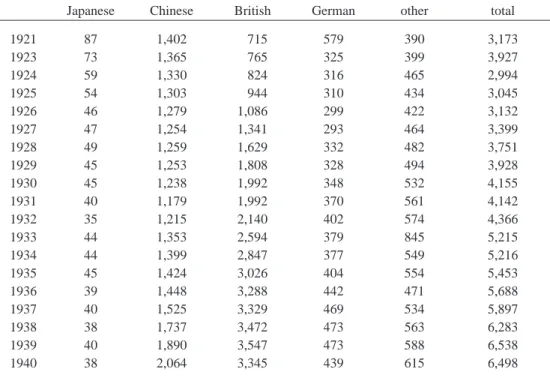
Consequently, in terms of numbers, the Japanese became an extremely marginal group. As Table 7 shows, they were far fewer than other non-indigenous groups and their propor-tion among these groups declined from 2.7 percent in 1921 to 0.5 percent in 1940.
The occupational composition also changed. As Table 8 shows, by 1938 artisans
Table 6. Population of Japanese by gender in New Guinea, 1921-1940
Source: Report to the League of Nations on the Administration of the Territory of
New Guinea, 1922, p.139; 1924, p.94; 1925, p.68; 1926, p.54; 1927, p.40; 1928,
p.90; 1929, p.69; 1930, p.98; 1931, p.108; 1932, p.106; 1933, p.96; 1934, p.116; 1935, p.104; 1936, p.98; 1937, p.101; 1938, p.128; 1939, p.131; 1940, p.129; 1941, p.131
male female total male female total
1921 1923 1924 1925 1926 1927 1928 1929 1930 1931 69 59 51 46 40 41 42 37 38 33 18 14 8 8 6 6 7 8 7 7 87 73 59 54 46 47 49 45 45 40 1932 1933 1934 1935 1936 1937 1938 1939 1940 29 38 37 38 33 38 35 36 36 6 6 7 7 6 2 3 4 2 35 44 44 45 39 40 38 40 38
Table 7. Population of Japanese and other non-indigenous groups in New Guinea, 1921-1940
Source: Report to the League of Nations on the Administration of the Territory of New Guinea, 1922, p.139; 1924, p.94; 1925, p.68; 1926, p.54; 1927, p.40; 1928, p.90; 1929, p.69; 1930, p.98; 1931, p.108; 1932, p.106; 1933, p.96; 1934, p.116; 1935, p.104; 1936, p.98; 1937, p.101; 1938, p.128; 1939, p.131; 1940, p.129; 1941, p.131
Japanese Chinese British German other total
1921 1923 1924 1925 1926 1927 1928 1929 1930 1931 1932 1933 1934 1935 1936 1937 1938 1939 1940 87 73 59 54 46 47 49 45 45 40 35 44 44 45 39 40 38 40 38 1,402 1,365 1,330 1,303 1,279 1,254 1,259 1,253 1,238 1,179 1,215 1,353 1,399 1,424 1,448 1,525 1,737 1,890 2,064 715 765 824 944 1,086 1,341 1,629 1,808 1,992 1,992 2,140 2,594 2,847 3,026 3,288 3,329 3,472 3,547 3,345 579 325 316 310 299 293 332 328 348 370 402 379 377 404 442 469 473 473 439 390 399 465 434 422 464 482 494 532 561 574 845 549 554 471 534 563 588 615 3,173 3,927 2,994 3,045 3,132 3,399 3,751 3,928 4,155 4,142 4,366 5,215 5,216 5,453 5,688 5,897 6,283 6,538 6,498
company agents and fishermen increased. The increase of those two occupations is impor-tant when the total population decreased by more than half. As a result, the proportions of traders and trading company agents and fishermen increased respectively from 3.8 percent in 1921 to 13.9 percent in 1938 and from 7.7 percent to 23.2 percent.
The change in the occupational structure was caused by the emergence of new small businessmen. The largest company, Komine’s Nan’yo Sangyo, was liquidated in 1931 and some of his business was bought by Nagahama. At the same time, small fishing companies and a new branch of a trading company were established. Consequently, as Table 9 and 10 show, the number of businesses increased from 2 in 1919 to 12 in 1940. Those new compa-nies did not require many employees, except for Nagahama’s plantations, because they were Table 8. Occupation of the Japanese in New Guinea, 1921 and 1938(number and
percent-age)
*
This seems to be labourers in boat building yard. **
This includes 13 accompanied family members(mostly wives and children). ***
These figure from the Japanese source contradicts those from the Australian source in Table 6. The Japanese figures seem to be accurate, because they are more detailed about the occupational classification than the Australian ones.
Source:南洋庁長官官房調査課 1939. p.p.318-319, ニューギニア事情 (濠洲委任統治領) .
コロール [Research Section of the Secretary-General of the South Seas Government 1939. The
situation in New Guinea(Australian Mandated Territory). p.p.318-319, Koror.] trader & trading company’s agent planter & plantation manager boat builder carpen-ter sawyer fisher-man barber factory
hand* other total
1921 no. % 1938 no. % 4 3.8 6 13.9 27 26.2 13 30.2 10 9.7 7 16.2 12 11.6 0 0 3 2.9 0 0 8 7.7 10 23.2 3 2.9 3 6.9 11 10.6 0 0 25** 24.2 4 9.3 103*** 100.0 43 100.0
Table 9. Japanese businesses in New Guinea in 1919
Source:外務省通商局 1919. 在外本邦実業者調 . p.213, 東京. 外交史料館所蔵文書, 通
189 「在外本邦実業者調, 大正8年」 [Bureau of Commerce, Department of Foreign Affairs
1919. Zaigai honpo jitsugyo sha shirabe. p.213, Tokyo. In: Japanese Diplomatic Record(hereafter JDR), Tsu189, ’Report on overseas Japanese businessmen 1919’]
name of businessmen company name type of business capital(yen)
1. Komine Isokichi
2. Okaji Santaro
Nan’yo Sangyo
Okaji Company
general store, boatbuilding, fishery, copra planting general store, copra planting
1,000,000