II. Seasonal Abundance, Habitat and
Development
著者
TAYUTIVUTIKUL Jiraporn, KUSIGEMATI Kanetosi
journal or
publication title
南太平洋研究=South Pacific Study
volume
13
number
1
page range
37-89
Biological Studies of Insects Feeding on the Kudzu
Plant, Pueraria lobata (Leguminosae)
II. Seasonal Abundance, Habitat and Development
Jiraporn Tayutivutikul* and Kanetosi Kusigemati*
Abstract
The seasonal abundance and habitat of 18 insect and 1 mite species from among the 62 Kudzu feeding species in the Kagoshima area and reported in Part I under the same title are described. They belong to 14 insect families of 4 orders and 1 mite family. Distribution within the plant of 4 leafminers and development and reproduction of 3 selected species are also mentioned, and the information is evaluated for possible biological control of the Kudzu plant.
Key words: Kudzu plant, feeding species, seasonal abundance, habitat, development
Contents
Abstract 37
Introduction 38
Materials and methods 39
Results and discussion 41
1. Seasonal abundance and habitat 41
1.1 Geisha distinctissima (Walker) 41
1.2 Orosanga japonicus (Melichar) 42
1.3 Homoeocerus unipunctatus (Thunberg) 43
1.4 Chauliops fallax Scott 44
1.5 Megacopta punctatissima (Montandon) 45
1.6 Anomala lucens Ballion 47
1.7 Trachys auricollis E. Saunders 47
1.8 Pagria signata (Motschulsky) 49
1.9 Episomus turritus (Gyllenhal) 50
1.10 Eugnathus distinctus Roelofs 50
1.11 Pitydiplosis sp 51
1.12 Genus sp. (Cecidomyiidae) 52
1.13 Japanagromyza tristella (Thomson) 53
1.14 Hedylepta misera (Butler) 54
1.15 Matsumuraeses falcana (Walsingham) and/or M. vicina Kuznetzov 55
Department of Entomology, Chiang Mai University, Chiang Mai, Thailand
Plant Pathology and Entomology, Faculty of Agriculture, Kagoshima University, Kagoshima 890, Japan
1.17 Neolithocolletis hikomonticola Kumata 58
1.18 Spulerina dissotoma (Meyrick) 60
1.19 Tetranychus kanzawai Kishida 62
1.20 Summary 63
2. Distribution of leafminers within the plant 65
2.1 Japanagromyza tristella (Thomson) 66
2.2 Liocrobyla lobata Kuroko 66
2.3 Neolithocolletis hikomonticola Kumata 67
2.4 Spulerina dissotoma (Meyrick) 68
2.5 Summary 69
3. Development and reproduction 69
3.1 Homoeocerus unipunctatus (Thunberg) 69
3.2 Hedylepta misera (Bulter) 73
3.3 Matsumuraesesfalcana (V/alsingham) 77
3.4 Summary 82
4. Evaluation of feeding species for possible use in a biological control program 82
4.1 Species composition 82
4.2 Food and feeding habits 83
4.3 Summary 84
General remarks 84
Acknowledgments 85
References 86
Introduction
Pueraria lobata (Willd.) Ohwi, called Kudzu or Kudzu plant and belonging to
Legumino-sae, is one of the most serious weeds in Japan and other countries (Dickens, 1974; Kasahara, 1982; Kitamura and Murata, 1979; Sasek and Strain, 1990) despite its use as a food, medicine, in textiles and as an anti-erosion plant (e.g., Kubo et al., 1977; Patterson, 1976).
The Kudzu plant may also play an important role in crop insect pest management in the sense of the argument made by van Emden (1965, 1981) since many insects and mites associated with the plant feed on various crops in Japan.
A preliminary survey on these associated insects was carried out in Yamaguchi, Japan
(Kaneko, 1986), primarily to determine species composition. Thereafter the first author began biological studies on the dominant phytophagous bugs of the plant in the same area in 1986-1987 and reported the biology of two species (Tayutivutikul and Yano, 1989, 1990). She has continued this study in Kagoshima City for the past three years, and the first segment of the results appeared as Part I of this title (Tayutivutikul and Kusigemati, 1992).
Part I listed the feeding speices of the plant found by field surveys in the Kagoshima area as well as literature. A total of 109 species belonging to 46 families of 6 insect orders and 2 species of Acarina, both from published records and newly found species, was listed. In the Kagoshima area, 61 species of Insecta and one species of Acarina were observed feeding on the plant.
studied for their seasonal abundance and habitat and the findings are presented here as the
second part of this study. These insect species are: 5 species of Hemiptera, 5 species of
Coleoptera, 3 species of Diptera and 5 species ofLepidoptera. Four leafminers among them
—Japanagromyza tristella, Liocrobyla lobata, Neolithocolletis hikomonticola and Spulerina
dissotoma—were studied for their distribution within the plant. The development andreproduction of three other species—Homoeocerus unipunctatus, Hedylepta misera and
Matsumuraeses falcana—were studied since these were dominant in the area.
Together with Part I, the overall study covers: (1) composition of Kudzu-feeding species,
(2) seasonal abundance and habitat of selected species, (3) biology and distribution within the
plant of the four leafminers, and (4) developmental data of the three dominant species.
The data obtained allow evaluation of Kudzu-feeding species for future biological control
programs since the species studied are expected to be candidates as biological control agents.
Materials and Methods
1. Sampling procedure
The sites of field studies and samplings of feeding species were referred to in Part I
(Tayutivutikul and Kusigemati, 1992). Additional notes on the method of sampling for
seasonal abundance are described here.Newly developed branches were selected for this phenological study.
Leaves of the top,
middle and basal strata, classified based on the growing parts from a single main stem (Fig.
1), were sampled from twenty plants at Korimoto graveyard and ten plants at Toso. Thirty
ternate compound leaves from each stratum were randamly selected at one week intervals,
namely 90 compound leaves containing 270 leaflets from two sites were sampled.
Number
of individuals per 90 leaflets are generally illustrated in the figures.
Leaves with insects were put into plastic bags and brought back to the laboratory, and the
total number of insects (eggs, larvae, adults and galls) and mites were recorded. Samplings
were made throughout the growing period of the Kudzu plant. Flying insects such as
Japanagromyza tristella were counted at sight before brunch samplings.
2. Number of Larval instars
The head capsule with of the four leafminer species mentioned was measured to find the
number of larval stages.
Ten to twenty larvae of each species collected from the Korimoto
graveyard were studied once a week from April to September, 1990.
3. Distribution study
The distribution patterns of leafmining species on the plant were surveyed at the Korimoto
graveyard from late March to early December in 1989. Whole leaves of ten randomly
selected plants were surveyed each week.
All mines containing larvae and pupae found on
the leaves were recorded.
1 branch 2° branch ' 3° branch " 4" branch " 5° branch Fig. 1. Diagram of Kudzu branching structure.
6° branch
branch was designated as the primary branches (1°), branches originating from the 1° branch
were secondary branches (2°), branches from the 2° branch were the tertiary branches (3°),
and so on up to the hexanary branches (6°) (Fig. 1). The exact position of branches and the
leaves on each branch were recorded in the distribution study.
4. Rearing and developmental study
Rearing of one phytophagous bug, H. unipunctatus, and two phytophagous moths, H.
misera and M. falcana, was done in the spring of 1988 using field collected adults of the
former and larvae of the latter two as initial materials.
Rearing was carried by feeding
Kudzu plants under four different temperature conditions (15°C, 20°C, 25°C and 30°C±1°C)
with illumination by fluorescent light and a photoperiod of 14:10 (L: D). The population of
M. falcana was successively used in the developmental study after identification, and was not mixed with M. vicina as in the phenological study.
For developmental studies at each constant temperature, newly laid eggs were removed
daily from oviposition cases, which were glass cylinders (15x20 cm) the end of which was
covered with a fine mesh cloth, set on Kudzu planted pots in the laboratory.
Eggs were
placed in petri dishes (9.5 cm diameter) lined with moist filter paper, and were checked daily
for hatching.First instar nymphs of H. unipunctatus were reared individually in cases similar to the
oviposition cases described.
Larvae of H. misera and M. falcana were placed individually in
the petri dishes mentioned and fed on young fresh Kudzu leaves which were changed daily.
The time required for complete development to the adult stage was determined. Because of
larval mortality, however, the number of individuals used at each larval stadium differed slightly.
Developmental rates (1/number of days for development) were determined from the
rearing data.
Data for larval and pupal development at constant temperatures were
obtained from individuals surviving to the adult stage.Linear relationships were figured by regression of mean developmental rate on tempera
ture, and linear equations were determined for each developmental stage.
The total
effective temperature and developmental zero (threshold temperature of development) of
both sexes were calculated by each regression.
For the studies on fertility and longevity, all newly emerged adults were removed daily and
paired, and each pair was placed in the same type of case used for nymphal rearings of H.
unipunctatus at respective temperatures.
Adults of H. unipunctatus were fed the same sort
of food as the nymphs.
Adults of H. misera and M. falcana were fed on cotton swabs with a 10% honey solution.
Insects were transferred daily to a cylinder case containing a Kudzu plant. Eggs laid on the
plant were removed and counted daily, and the date of death was recorded for each adult.
Whenever one of a pair died, the remaining individual was supplied with another partner of
the other sex so that pairs were maintained as long as possible.
The longevity of the adults
and the period of preoviposition and oviposition were also observed.
The time required for development and data of fertility and longevity were analyzed by an
analysis of variance with Duncan's new multiple range test for differences between the sexes
at the same temperature and between temperatures in the same sex.
Results and Discussion
1. Seasonal abundance and habitat
Seasonal abundance and habitat on the plants of 19 feeding species observed in the two
study sites are presented here. Species are: 2 species of Homoptera, 3 species of
Heterop-tera, 5 species of ColeopHeterop-tera, 3 species of DipHeterop-tera, 5 species of Lepidoptera and 1 species of
Acarina.
Habitat of each species is described based on its stratum location, top, middle and basal.
Each stratum of a main stem has branches with leaves growing at different degress. In the
following pages, however, leaves of the top stratum are referred to as younger and those of
the basal as older. This reflects a tendency, rather than absolute degrees of growth strictly
speaking.
1.1 Geisha distinctissima (Walker) (Hemiptera: Flatidae)
1.1.1 Seasonal abundance
Seasonal abundance of nymphs and adults on the plants is illustrated in Fig. 2. The
nymphs appeared in April, increased rapidly in May and reached a peak in June and July,
then collapsed in late July.
Adult populations appeared from early June to October, and
were abundant from July to September.
These data clearly indicate one generation a year
on the plant. Ishihara (1968) stated that overwintered eggs of this polyphagous species
t o -♦-> o> CO O <T3 - o •r— > •r— O O Fig. 10 1988 ^-fa-^>i^~<0^" * T TIIIB 0 N D 1989
2. Seasonal abundance of Geisha distinctissima on Pueraria lobata.
(•—•: nymph; O-O: adult)
hatch in early summer and adults emerge in late July, but no locality names were given.
The present result shows an earlier occurrence of this species.
1.1.2 HabitatThe largest number of nymphs and adults was found on the middle stratum.
Out of 137
nymphs, 48.9% (67 nymphs) were found on the middle stratum, 35.8% (49) on the basal
stratum and 15.3% (21) on the top stratum. Out of85 adults, 67.1% (57 adults) were found
on the middle stratum, 17.6% (15) on the top stratum and 15.3% (13) on the basal stratum.
Both stages usually feed on the petiole or the stem. This result suggests that both nymphs
and adults feed mainly on the middle stratum rather than other strata.
1.2 Orosanga japonicus (Melichar) (Hemiptera: Ricaniidae) 1.2.1 Seasonal abundance
Seasonal abundance ofnymphs and adults of O. japonicus on the plant is illustrated in Fig.
3. Nymph populations appeared from May toJuly and from August to October, though few
nymphs were found after October in 1989.
Adults were found from June to November,
suggesting that this species probably occurs twice a year on Kudzu judging from the data
obtained in 1988.
Avidzba and Bobokhidze (1982) and Dzhashi et al. (1982) reported that this species
feeding bay (Laurus nobilis), tea, grape vine and other crops overwinters in the egg stage and
spends one generation a year in the southern USSR.
The latter authors also mentioned that
nymphs of this species hatch in mid April and adults occur in July-October. Ishihara
(1968) stated that this species overwinters in the egg stage and adult emergence is late July in
the western Japan. These published records as well as the present data indicate a rather
<T3 (L> O CTi «3 T3 • r -> •r— - a c •r— O O Fig. 1988 N D 1989 3. Seasonal abundance of Orosanga japonicus on Pueraria lobata. (•—•: nymph; O-O: adult)
1.2.2 Habitat
Out of 208 nymphs, 48.6% (101 nymphs) were found on the middle stratum and 47.1% (98) were found on the basal stratum. Only 4.3% (9) were found on the top stratum. Out of 91 adults, 62.6% (57 adults) were found on the middle stratum, 31.9% (29) on the basal
stratum and 5.5% (5) on the top stratum. Nymphs thus feed mainly on middle and basal strata rather than on the top stratum, while adults prefer the middle stratum.
Avidzba and Bobokhidze (1982) reported that adult damage was seen on all parts of bay
showing rather similar tendency seen in the present data.
1.3 Homoeocerus unipunctatus (Thunberg) (Hemiptera: Coreidae)
1.3.1 Seasonal abundance
Seasonal abundance of eggs, nymphs and adults on Kudzu is illustrated in Fig. 4. Adults
were found throughout April to November, eggs from late April to October, and nymphs from late May to October with a marked peak in July, 1989. These data are not clear and it
is difficult to determine the life cycle of this species on the plant. Laboratory studies on
development described later, however, indicate two generations a year through the Kudzu growing season in the Kagoshima area. Overwintering in the adult stage is suspected in this
1.3.2 Habitat
Individuals of each developmental stage were found on different strata with the largest
number of eggs found on the middle stratum. Out of 50 eggs, 56% (28 eggs) were found on
the middle stratum, 36% (18) on the basal stratum and only 8% (4) on the top stratum.
Nymph populations were highest on the middle stratum followed by top and basal strata. Out of 102 nymphs, 56.9% (58 nymphs) were found on the middle stratum, 25.5% (26) on
t o d) 03 CD o 3 •o • r -> •r— •r— O O N D 1989 Fig. 4. Seasonal abundance of Homoeocerus unipunctatus on Pueraria lobata.
(A •: egg; •—#: nymph; O-O: adult)
the top stratum and 17.6% (18) on the basal stratum. Adults were found mainly on the top
and middle strata. Of 148 adults, 43.9% (65 adults) were found on the top stratum, 31.8%
(47) on the middle stratum and 24.3% (36) on the basal stratum. Adults thus feed on all
strata, but rather prefer younger leaves. They usually oviposit on the intermediate leaves.
Most eggs were found on the underside of the leaves: about 66%, 24% and 10% on the
underside, petiole and upperside, respectively. About 74% of nymphs were found on the underside of the leaves and adults were found on all parts of the plant. Takasu and Hirose
(1986) reported that the egg parasitoid Ooencyrtus nezarae produced a large number of
progeny on eggs of this species on Kudzu, but no egg parasitoids were found during the present study.
1.4 Chauliops fallax Scott (Hemiptera: Lygaeidae) 1.4.1 Seasonal abundance
Seasonal abundance of eggs, nymphs and adults on Kudzu is illustrated in Fig. 5. Adults were found throughout the Kudzu growing season with 3 peaks in May to June, mid August
and September to October, though the second peak in August was small. The egg
occurrence pattern was similar to that of adults, though the peaks occurred earlier than thoseof adults in 1989. Nymphs were found from May to October with 2 peaks in June to July and August to September. The data suggest that this species may have two generations a year on the plant. Comparison of the seasonal abundance of this species in the Yamaguchi area reported earlier (Tayutivutikul and Yano, 1989) shows patterns in the two areas to be similar, though the adult occurrence seen in 1989 in Kagoshima has more distinct peaks.
CD CD O CT> 2 40i o o 1988
Fig. 5. Seasonal abundance of Chauliops fallax on Pueraria lobata.
(•—•: egg; •—•: nymph; O—O: adult)
N D
1989
1.4.2 Habitat
Eggs, nymphs and adults were found mainly on the basal stratum. Out of 409 eggs, 85.8% (351 eggs) were found on the basal stratum and 14.2% (58) on the middle stratum. From 335 nymphs, 85.4% (286 nymphs) were found on the basal stratum and 14.6% (49) on the middle stratum. In the same way, out of 503 adults, 83.7% (421 adults) were found on the basal stratum and only 16.3% (82) on the middle. No individuals in any stages were found on the top stratum* This supports the results of Tayutivutikul and Yano (1989) who observed the biology of this species in the Yamaguchi area.
These authors found three egg parasitoids, Ooencyrtus nezarae Ishii, and Ooencyrtus sp. of
Encyrtidae, and Telenomus sp. of Scelionidae, but no egg parasitoids were observed during the present study. The leaves attacked by this species show numerous minute yellowish specks with a loss of chlorophyll content as reported by Lal (1975).
1.5 Megacopta punctatissima (Montandon) (Hemiptera: Plataspidae)
1.5.1 Seasonal abundance
Seasonal abundance of each stage on Kudzu is shown in Fig. 6. A rather large population of adults was found from April to mid June, early July to late August and September to October. A large number of eggs was found from April to June and late July to September. The first peak of nymphs was seen from May to July and the second one from late August to October. This species may thus have two generations a year as Hibino and Ito (1983) observed in the Aichi Prefecture, though Ishihara (1968) mentioned one generation a year in the western Japan. These two published records also mentioned that this species overwin ters in the adult stage which is also intimated by the present data.
CD o CT> to 'to 3 - o •r— > • i — - a c • r - *♦-o o 100 50 i\ i i ; \ *£>
UfifiP?, n&ffftvir-t.
1988 UU' 50-0fc
^
*-A
A M 0 N D 1989Fig. 6. Seasonal abundance of Megacopta punctatissima on Pueraria lobata.
(^—•: egg; #—•: nymph; O-O: adult)
based on field surveys and developmental studies in the laboratory (Tayutivutikul and Yano, 1990). As mentioned above, data from Kagoshima area rather clearly show two
generations a year, and two different peaks found in egg numbers strongly support two
generations.1.5.2 Habitat
Females laid eggs in egg-masses with an average of 31.7 eggs/egg-mass. Eggs were found
abundantly in the top stratum.
Out of 529 eggs, 62.6% (331 eggs) were found on the top
stratum, 25.7% (136) on the middle stratum and 11.7% (62) on the basal stratum.
Nymphs
were found mainly on the middle and top strata. Of 507 nymphs, 50.1% (254 nymphs) were found on the top stratum, 49.1% (198) on the middle stratum and 10.8% (55) on the basal stratum. Adults were primarily on the top and middle strata like nymphs. Out of 584 adults, 39.9% (233 adults) were found on the top stratum, 40.2% (235) on the middle stratum and 19.9% (116) on the basal stratum. These orders of habitat preference in
nymphs and adults are different from those observed in the Yamaguchi area (Tayutivutikul
and Yano, 1990). The general tendency, however, is the same, and the feeding habit of
nymphs preferring young to old parts of the branches was seen in both areas. Adults of this
species aggregate on Kudzu as reported by Fujisaki (1977). Hibino and Ito (1983) reported
that the rate of sexual encounters between males and females is higher in larger aggregations, but no such behavior was observed in Kagoshima. Takasu and Hirose (1985), and
Tayutivutikul and Yano (1990) reported that eggs of this species were heavily parasitized by Ooencyrtus nezarae, but no parasitization was found in the present study.
1.6 Anomala lucens Ballion (Coleoptera: Scarabaeidae) 1.6.1 Seasonal abundance
Few adults of this species were found on Kudzu throughout the field survey (Fig. 7).
Adults were first found in mid May and appeared until mid September suggesting the species
may have one generation a year like A. cuprea (Hope).
10 (/) +-> CD r -5 CD • — O CT» ^ 0 CO CTJ 13 - a •r— 10 > •r— •a c •r— O 5 • O o-cf \ p p-o-o-o O-Q / \ / \ 9 % % % % % ■♦-•-^■^■^^-^^-•-♦■^•^■♦■^ 0 W < 8 81 8j(^ ^>^ V A M -fe-rf-J J A S 0
Fig. 7. Seasonal abundance of adult Anomala lucens on Pueraria lobata.
1988
N D
1989
1.6.2 Habitat
Almost all the adults were found on the middle stratum. Out of 31 adults, 93.5% (29
adults) were found on the middle stratum and only 6.5% (2) on the basal stratum; none was found on the top stratum. This suggests that adults feed mainly on leaves of intermediate growth rather than those in other growth stages.
1.7 Trachys auricollis E. Saunders (Coleoptera: Buprestidae)
1.7.1 Seasonal abundance
Seasonal abundance of larvae, pupae and adults of this leafmining buprestid species on Kudzu is presented in Fig. 8. Adults were found for a long period from April until October without a remarkable peak in population. Larvae in mines appeared from June to Septem ber and pupae from July to October suggesting that adult oviposition occurs in late May and June. According to these data, one or two generations a year on the plant may be indicated (cf. following lines). Measurement of the head capsule width of larvae collected periodically from the field in 1990 shows that there are four larval stages (Fig. 9). Mean head capsule
width and standard deviations are given in Table 1.
U) +J CD i — 5 Q) > — O CX> \ 0 t o r — <0 13 • p - 10 > • r -- a c • r -o 5 . o 20 CD 10 p-o
\* >DT^N ,0-q/ /aV^oV-cTaA V \ \ A*
. Q.
1988 p/"Va^j
« ^ * ^ ^ « « ^ -K V fr^Vi »Vi M 0 N 0 1989Fig. 8. Seasonal abundance of Trachys auricollis on Pueraria lobata.
(•—•: larva; A---A: pupa; 0--0: adult)
Table 1. Measurements of larval head capsule width of Trachys
auricollis.
No. larvae
Head capsule width (mm) Mean ( + SD) Range 1 27 0.31+0.018 0.29-0.35 2 38 0.41+0.016 0.37-0.45 3 38 0.50 + 0.018 0.47-0.55 4 35 0.61+0.021 0.58-0.67 P i _SLJOL 0.3 0.4 ® m ® m ® H H Klt3 Bit I l l H I 0.5 & K4 \k & txK3fafa a a a E g a , il 0.6
Head capsule width (mm)
Fig. 9. Frequency distribution of larval head capsule width of Trachys auricollis.
l l i gSSffg Instar i 1--1 Instar i i
Wmm Instar i n £?3 Instar IV
mm Pupa
Fig. 10. Seasonal changes in the number of each immature stage of Trachys auricollis.
and the data of seasonal abundance mentioned above suggest that this species may have two
generations a year.
1.7.2 Habitat
Out of 29 larvae, 82.8% (24 larvae) were found on the middle stratum and 17.2% (5) were
found on the basal stratum. Pupae were more numerous in the basal stratum. Out of 12 pupae, 83.3% (10) were found in the basal stratum and 16.7% (2) on the middle stratum.
This tendency in pupae should be confirmed by further surveys since the number of individuals examined was small. Adults were found mainly on the middle stratum. Out of 49 adults, 65.3% (32 adults) were found on the middle stratum and 34.7% (17) on the basal stratum. Thus all stages of this species inhabit primarily the leaves intermediate in growth.
Adults feeding on the intermediate leaves chew from the leaf edge (Fig. 41). Females oviposited on the surface of the leaves. Larvae mined inside the leaves forming blotch mines, and fed on the palisade parenchyma from the beginning until pupation which took place in the same mines. Larvae were often found mining in the edge of the leaves and made mines across the veins. This behavior is similar to that of Trachys sp. (possibly T. virescens Kerr.) the larvae of which are leafminers; adults usually feed on the margins of
tender leaves of okra in India (Rawat and Jakhmola, 1969).
1.8 Pagria signata (Motschulsky) (Coleoptera: Chrysomelidae)
1.8.1 Seasonal abundance
Seasonal abundance of adults of this chrysomelid species on Kudzu is illustrated in Fig. 11. Adults appeared from April to November until the time their population was seen on the plant. A clear difference is seen in the mode of seasonal abundance between 1988 and 1989, and the probable cause is assumed to be biological factors in addition to sampling errors, but, not climate factors. Though it is not possible to determine the number of generations from
CD O CT> 10 CO > •r— - a 5 20 o o 10 „o •••a
\
A
-•MfeA^aAMOH+aA-P^ O b" .or \> * cf ^ '«—O sO cf p-o. o^ 8m.o-</ VwO„ 1988 r-o-Q. A M J J A S O N D 1989Fig. 11. Seasonal abundance of adult Pagria signata on Pueraria lobata.
1.8.2 Habitat
The largest number of adults was found on the middle stratum.
Out of 121 adults, 71.1%
(86 adults) were found on the middle stratum, 28.1% (34) on the basal stratum and only
0.8% (1) on the top stratum. These figures indicate that adults feed on the intermediate
leaves rather than on young or mature leaves.1.9 Episomus turritus (Gyllenhal) (Coleoptera: Curculionidae)
1.9.1 Seasonal abundance
Data on the collection of adults from Kudzu is presented in Fig. 12. Few adults were
found from late April to September with a slight difference between the two years. It is
difficult to estimate the number of generations from the available data.1.9.2 Habitat
Out of 18 adults, 83.3% (15 adults) were found on the middle stratum and 16.7% (3) on the basal stratum. No adults were found on the top stratum. The activity site of adults on
the plant is therefore usually intermediate branches rather than young or mature branches.
1.10 Eugnathus distinctus Roelofs (Coleoptera: Curculionidae)
1.10.1 Seasonal abundance
Only 3 adults were found after August in 1988, and 2 adults in May and June in 1989 at the
Toso field site (Fig. 13). No adults were found at the Korimoto graveyard suggesting that the occurrence of this species on Kudzu in the Kagoshima area is rare, though the species is known to be rather common in Japan. The number of generations was not estimated by
10i A3 5 CD O cr>
2
10
> o o 9 9 9 9 • nf 9 \ • • 9 • 9 / H A * ^ • • • • • • • • i t n i 1988 P-Q, a t • • • / V W i • « ^ eA
* . « « - « ^ 4 - « « - « - « ^ « - * * > « ^ « - « a » « a 10 +-> CD^
5
CD O "O o o 10, A M J J A S OFig. 12. Seasonal abundance of adult Episomus turritus on Pueraria lobata.
N D
1989
1988
A M
J J A
S O
N D
1989 Fig. 13. Seasonal abundance of adult Eugnathus distinctus on Pueraria lobata.
1.10.2 Habitat
All adults were found on the middle stratum indicating a preference for the intermediate
leaves, though this requires further confirmation.
1.11 Pitydiplosis sp. (Diptera: Cecidomyiidae)
1.11.1 Seasonal abundance
rd CD o cr> • r -> "O c: • r -O O 75 0 150 75 Fig. 14. M ^«£*«^*i * * -S 0 1988
n ""
b
1989 Seasonal abundance of galls produced by Pitydiplosis sp. on the leaves of Pueraria lobata.the leaves of Kudzu (excluding fallen leaves). Midge-galls were most abundant in late May, reached a peak in early June, and gall populations remained on the plant until September. Yukawa (1987), based on his observations on Kudzu, reported that this species is univoltine: adults emerge in April to June, larvae mature in summer and galls drop to the ground with the leaves during October to December. The present data on Kudzu also clearly show one generation a year.
1.11.2 Habitat
Midge-galls were found in the basal and middle strata. Out of 984 midge-galls, 56.7% (558 galls) were found on the basal stratum and 43.3% (426) on the middle stratum. None
was found on the top stratum. The oviposition of this species thus seemed not to synchro nize with the shooting period of the top stratum because, in general, the species lays its eggs on those parts of the plant, where cell division is actively observed, i.e., buds, shoots or
flower bud.
The gall is concave on the upper surface and convex on the under surface of the leaf (Figs.
45 and 46) and has a disc-shaped larval chamber in its center. Only a single midge larva
inhabits this chamber.
1.12 Genus sp. (Diptera: Cecidomyiidae)
1.12.1 Seasonal abundance
This species has not been identified, but is thought to be a new species of the supertribe Cecidomyiidi (Yukawa and Ikenaga, unpublished).
Seasonal changes in the number of galls produced by this species on the leaves of Kudzu are shown in Fig. 15 and suggest the possibility of two generations a year. Finding of the
CD <0 CD O CT> (0 3 "O > •r— "O O 50 25 50 25 Fig. 15. » + -1988
*£*—
• • • • • • • m A M J J A S OSeasonal abundance of galls produced by a cecidomyiid sp. on the leaves of Pueraria lobata.
N D
1989
in 1989 may support this. 1.12.2 Habitat
A remarkable number of midge-galls was found on the basal stratum. Out of 369
midge-galls, 66.4% (245 galls) were found on the basal stratum and 33.6% (124) on the
middle stratum. None was found on the top stratum. As with the preceding species,oviposition of this species also does not appear to synchronize with the growth of the top
stratum. All galls were found on the underside of the leaves (Fig. 47).
1.13 Japanagromyza tristella (Thomson) (Diptera: Agromyzidae)
1.13.1 Seasonal abundance
Seasonal abundance of larvae and adults on Kudzu in 1988 and 1989 is presented in Fig. 16. Four adult peaks were recognized in mid April, early June, late June to early August
and late August to September. Larvae were found from April to November with several
fluctuations. Since larval abundance was variable through the period surveyed, it is difficult
to predict the number of generations of this species. The above data on adults, however, suggest that the species may have at least four generations a year on the plant.
1.13.2 Habitat
Larvae were found mostly on the middle stratum. Of 140 larvae, 88.6% (124 larvae) were
found on the middle stratum, 6.4% (9) and 5.0% (7) were found on the basal and top strata, respectively. This result indicates that larvae feed mainly on intermediate leaves rather than
on new or old leaves.
The larvae made blotch type mines on the surface of young leaves (Fig. 42). The mining of a larva proceeded directly into the chlorophyll containing parenchyma of the leaf and the
N D
1989
Fig. 16. Seasonal abundance ofJapanagromyza tristella on Pueraria lobata. (•—•: larva; O—O: adult)
to the outside of the mines for pupation. No larvae were found in mature or fallen leaves
suggesting that mature larvae moved out of these leaves to pupate for overwintering on the
ground. LaBoNTE and Lipovsky (1967) reported that Japanagromyza viridula (Cog.) larvae formed blotch type mines on red oak, Quercus rubra, and white oak, Q. alba, and that the adult ovipositor pierced the upper epidermis of young leaves for their feeding which was not
observed in this species.
1.14 Hedylepta misera (Butler) (Lepidoptera: Pyralidae) 1.14.1 Seasonal abundance
Figure 17 shows the seasonal abundance of larvae on Kudzu and suggests that three
generations a year may develop. The first generation began increasing in late April, reached
a peak in late May and decreased towards late June. The second generation required about
one month for development and the third generation began from August to October.
Laboratory studies on the development, however, suggest that there could be four genera
tions during the Kudzu growing season in the Kagoshima area based on the total effective
temperature and developmental zero mentioned in later. The difference in the number of
generations between the field and laboratory data is probably due to overlapping of the later
generations in the field during August to November, and also to the low density of field
populations.
1.14.2 Habitat
Larvae were found mainly on the middle stratum. Out of 118 larvae, 60.2% (71 larvae)
were on the middle stratum and 39.8% (47) on the top stratum. None was found on the basal stratum. This result shows that larvae of this species feed on intermediate leaves
+•> CD CD O 20i 10 N D 1989 Fig. 17. Seasonal abundance of Hedylepta misera larvae on Pueraria lobata.
1.15 Matsumuraeses falcana (Walsingham) and/or M. vicina Kuznetzov (Lepidoptera:
Tor-tricidae)
Two closely related tortricid species were found on Kudzu in this study, Matsumuraeses
falcana (Walsingham) and M. vicina Kuznetzov. It was difficult to distinguish the larvae
of these species in these phenological and habitat studies.
The following data thus combines
the two species.A M J J A S O
Fig. 18. Seasonal abundance of Matsumuraeses falcana and/or M. vicina larvae on Pueraria lobata.
N D
Figure 18 illustrates the seasonal abundance of larvae on Kudzu in the field showing three
generations a year on the plant. Three relatively large larval populations were found from
April to June, June to August and August to September.
However, the laboratory studies
on the development of M. falcana suggest that there could be five generations through the
Kudzu growing season in the Kagoshima area based on the total effective temperature and developmental zero. The difference in the number of generations between the field and
laboratory data may be due to the overlapping of generations, to the low density of the later
generations or to mixed populations of M. vicina and/or M. falcana in the field data. Oku
et al. (1983) reported that two generations of M. falcana and M. vicina developed on the
soybean after July in the Tohoku district of Japan.
Razowsky and Yasuda (1975) assumed
that M. falcana may have three or four generations a year from early April to late November
in Japan.
The present data obtained on Kudzu in southern Kyushu provide additional data on the
life cycle of this species group.
1.15.2 Habitat
Larvae (Fig. 44) were found mostly on the top stratum.
Out of 337 larvae, 90.2% (304
larvae) were found on the top stratum and 9.8% (33) on the middle stratum. None was
found on the basal stratum.
Larvae of this species thus feed mainly on young leaves and few
feed on the intermediate leaves.
1.16 Liocrobyla lobata Kuroko (Lepidoptera: Gracillariidae)
1.16.1 Seasonal abundance
Seasonal abundance of larvae and pupae in mines on Kudzu leaves is illustrated in Fig. 19,
- o c: o o 20i
10-*!•• a i . . • . . . **-. . . .^^-rrvT . v^"?*^ l t i ,
0 N D 1989- 100 <n S-rd
I
80
CD rd b 60 "6 w 40 rd 13 "O £ 20 - a ci
o
o ex Fig. 1 , . . i; g Instar I Instar II Instar III Instar IV Instar V M J J A S 199020. Seasonal changes in the number of each larval instar of Liocrobyla lobata.
Head capsule width (mm)
Fig. 21. Frequency distribution of larval head capsule width of Liocrobylalobata.
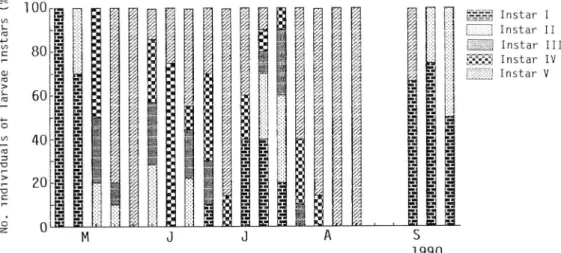
and seasonal changes in the individual numbers of each larval instar in Fig. 20 indicating that
there are three or four generations a year. The first and second generations seem to occur
between April and August and the following two generations between September and November. This species probably overwinters in the pupal stage since mature larvae were found in late November, and no immature individuals were found on fallen leaves. Measurements of the head capsule width of larvae collected periodically from the field indicate that there are five larval stadia (Fig. 21). The mean widths of the larval head capsule and standard deviations are given in Table 2.
1.16.2 Habitat
Larvae were found on the middle and basal strata. Out of 153 larvae, 54.9% (84 larvae) and 45.1% (69) were found on the basal and middle strata, respectively. Only 7 pupae were
Table 2. Measurements of larval head capsule width of Liocrobyla
lobata.Instar No. larvae Head capsule width (mm)
Mean (±SD) Range 1 35 0.17 + 0.011 0.15-0.18 2 23 0.24 + 0.008 0.23-0.26 3 16 0.29 + 0.009 0.28-0.31 4 21 0.34 + 0.011 0.32-0.37 5 41 0.43 + 0.024 0.38-0.47
both intermediate and mature leaves, and only a few of them became pupae on a leaf. Most
larvae might pupate on the ground or pupae might have fallen to the ground since mines
contained no pupae as mentioned below.
This species makes mines between the epidermis of the leaf (Fig. 48). The early instar
larvae first make a linear mine feeding on spongy parenchyma, then later instar larvae make
a blotch mine under the upper surface of the leaf, probably because the palisade parenchyma
provides them with more food than the spongy parenchyma does.
Larvae feed inside the
mines until they reach the pupal stage, although since no pupae were found inside the mines.
Pupation may take place outside the mines. No larvae or pupae were found in the fallen
leaves suggesting that this miner probably overwinters in the pupal stage.
1.17 Neolithocolletis hikomonticola Kumata (Lepidoptera: Gracillariidae)
1.17.1 Seasonal abundance
This species may have four generations a year judging from the seasonal abundance of
larvae and pupae in mines on Kudzu leaves (Figs. 22 and 23). Relatively large populations
200i CO +-> 0) CO o to • r -> 100' 0 - 200 o o
100-^..^^^rV*^
1988, N D 1989Fig. 22. Seasonal abundance of Neolithocolletis hikomonticola on Pueraria lobata. (• •: larva;
^•••A: pupa)2 100 re 80 60 40 Z0 n Fig 0 .23 M J J
Seasonal changes in the number ofeach
I W
gggg Instar I-II
W^i Instar III
S B Instar IV E5K] Instar V WM Instar VI fTftitttl Pupa A S 1990
immature stage of Neolithocolletis hikomonticola.
Head capsule width (mm)
Fig. 24. Frequency distribution of larval head capsule width of Neolithocolletis hikomonticola.
of larvae were found from late May to early June and also from late October to November. The last one (October-November) consisted of the fourth generation larvae for overwinter ing, and the first one (May-June) was apparently produced by adults derived from the overwintered larvae. Each of the summer generations (peaks in middle June and early September) required about one month to develope. The first generation in the spring required a slightly longer period than did the summer generations because of lower tempera ture, and the fourth generation in the fall required nearly six months including diapause during the winter. Frequency distribution of head capsule width of larvae collected from the field shown in Fig. 24 indicates that there are five or six larval stadia. Two larvae with the samllest head capsule width may represent the first stadium (six stadia in this case) or belong to the following population (five stadia in this case). The mean widths of the larval head
tis hikomonticola.
Instar No larvae Head capsule width (mm) Mean ( + SD) Range 1-2 81 0.15 + 0.012 0.10-0.16 3 49 0.20 + 0.011 0.17-0.21 4 84 0.25 + 0.014 0.22-0.27 5 36 0.30 + 0.012 0.28-0.32 6 55 0.35 + 0.011 0.33-0.38
capsule and standard deviations are given in Table 3 where the two larvae with the smallest head capsule width are represented as the first stadium.
1.17.2 Habitat
Larval and pupal populations were mostly found on the basal stratum throughout the survey period. Out of 2862 larvae, 62.6% (1792 larvae) were found on the basal stratum and 37.4% (1070) on the middle stratum. Similarly, out of 210 pupae, 71.0%? (149) and 29.0% (61) were found on the basal and middle strata, respectively. No larvae were found on the top stratum, suggesting that larvae feed mainly on the mature leaves and develop inside leaves until pupation.
The larvae make short blotch type mines inside the undersurface of the leaf (Fig. 50), and live in the spongy parenchyma which contains primarily liquid substances. They cannot cross the mid or side veins of the leaves, and therefore form mines restricted to within veins. In late autumn, the larvae make flat cocoons inside the mine which serves solely for overwintering. A larva remains inside the mine even after the leaf has fallen, and after hibernation it pupates in the mine the following spring.
1.18 Spulerina dissotoma (Meyrick) (Lepidoptera: Gracillariidae)
1.18.1 Seasonal abundance
Figures 25 and 26 illustrating the seasonal abundance of larvae on Kudzu and the seasonal changes in the number of individuals in the larval stage show that this species has at least four generations a year. The first population began increasing in May, reached a peak in early June and collapsed by the end of the month. Both the second and third generations in summer (July-September) each required only a month for development. The last genera tion seemed to start from the end of September, and required about six or seven months including the overwintering period of pupae. Measurement of the head capsule width of larvae collected from the field in 1990 indicates that there are five larval stadia (Fig. 27). The mean widths of the head capsule and standard deviations are given in Table 4.
1.18.2 Habitat
Out of 97 larvae, 45.4% (44 larvae) and 54.6% (53) were found on the middle and basal strata, respectively. None was found on the top stratum and no pupae were found on any strata throughout the survey period. This suggests that larvae of this species feed on the intermediate and mature leaves, and do not pupate on or in the leaf.
N D 1989
Fig. 25. Seasonal abundance of Spulerina dissotoma larvae on Pueraria lobata.
** 100n ^m Instar I
mm Instar II
Instar III Instar IV Instar V
the number of each larval instar of Spulerina dissotoma.
Table 4. Measurements of larval head capsule width of Spulerina
dissotoma.
No. larvae
Head capsule width (mm) Mean ( + SD) Range 1 35 0.20 + 0.007 0.18-0.20 2 41 0.24 + 0.014 0.21-0.25 3 38 0.29 + 0.013 0.26-0.31 4 31 0.34 + 0.012 0.32-0.36 5 48 0.40 + 0.013 0.37-0.43
blotch mines within the palisade parenchyma. They are able to cross the secondary and tertiary veins of the leaf. Pupation takes place outside of the mines. No larvae or pupae
20 CJ
I 10
c r 0^ 0.2 m m 0.3 0.4 0.5Head capsule width (mm)
Fig. 27. Frequency distribution of larval head capsule width of Spulerina dissotoma.
1.19 Tetranychus kanzawai Kishida (Acarina: Tetranychidae)
1.19.1 Seasonal abundance
Figure 28 presents the seasonal abundance of adults on Kudzu. They appeared from
April to July and from September to early December, and the population density was low during summer. The overlapping development makes it difficult to determine the number of generations on the plant.
in 4-> CD O 400 200« 0k *P-o M i 8 8 ft I 8 ^<i i m • a rrgi8 n er 1988 r 400
X
1
- a o o 11 200 ,°-o"° mmmma£m A o Y>-0' \/ V
^(i> fii a na n aifl-Q "O-Co-O^O.*«*8"*-*»
N D
1989
1.19.2 Habitat
Out of 2974 adults, 65.0% (1934 adults) were found on the basal stratum and 35.0% (1040) on the middle stratum. No adults were found on the top stratum. Individuals were found on the underside of the leaves (Fig. 43). This species appears to feed mainly on mature leaves.
1.20 Summary
1.20.1 Seasonal occurrence
The number of generations of the Kudzu feeding species shows a tendency according to the taxa to which they belong, especially the orders. Species belonging to Hemiptera, Coleop tera and Cecidomiidae of Diptera have one or two generations a year, while species belonging to Lepidoptera and Agromyzidae of Diptera have several generations and most of the latter group are leafminers. Seasonal abundance of some species was not clearly determined due to the low density or assumed overlapping of generations.
The period of occurrence of the species feeding on Kudzu described in the preceding pages is illustrated in Fig. 29, and reveals that all the developmental stages of the species occur on the plant during its growing period. Many species are found throughout the Kudzu growing period, while others appear only during part of it. This is probably because of the successive growth pattern of the Kudzu plant mentioned.
Geisha distinctissima Orosanga japonicus Homoeocerus unipunctatus Chauliops falla.x Mcgacopta punctatissima Anomala lucens Trachys auricollis Pagria signata Episomus turritus Eugnathus distinctus Pitydiplosis sp. Cecidomyiidae (Genus sp.) Japanagromyza tristella Hcdylepta misera
Matsumuraeses falcana and/or M. vicina
Liocrobyla lobata
Neolithocolletis hikomonticola
Spulerina dissotoma Tetranychus kanzawai
0 N D
Fig. 29. Seasonal occurrence of selected feeding species on Pueraria lobata in Kagoshima City (1988-1989) (for details, see text).
Figure 29 does not explain the microhabitat of these species such as the different strata of branches and different plant parts affected, but it does show a superficially uniform temporal pattern on Kudzu.
1.20.2 Habitat
The remaining species were largely on the basal stratum (7 species) or top stratum (2 species). The middle stratum was selected as the second preference by 9 species. Thus may species prefer leaves from Kudzu branches in the intermediate growth stage for thier food and/or resting place.
Only 2 species were found most numerous on the top stratum, and this was the second preference of only 1 species. This is rather unexpected but the reason could be that Kudzu is a vine plant and grows too rapidly for the insects to follow its growth.
Feeding species are grouped here according to the plant part affected.
Leaf, petiole and stem feeding species:
Homoeocerus unipunctatus, Episomus turritus, Eugnathus distinctus Leaf and flowerhead feeding speices:
Chauliops fallax, Anomala lucens Leaf and young stem feeding species:
Matsumuraeses falcana, M. vicina Leaf feeding species:
Pagria signata, Hedylepta misera, Tetranychus kanzawai
Leafmining species:
Trachys auricollis, Japanagromyza tristella, Liocrobyla lobata, Neolithocolletis hikomon ticola, Spulerina dissotoma
Gall-making speices:
Pitydiplosis sp., Genus sp. (Cecidomyiidae)
Petiole and stem feeding species:
Geisha distinctissima, Orosanga japonicus
Flowerhead, petiole and stem feeding species: Megacopta punctatissima
Next, they are grouped according to habitat preference or stratum of the branch with which they are mainly associated. The stratum on which about 70% of total individuals are
found is designated as the affected part here. Species found mainly on the top stratum:
Megacopta punctatissima, Matsumuraeses falcana, M. vicina Species found mainly on the middle stratum:
Geisha distinctissima, Orosanga japonicus, Homoeocerus unipunctatus, Anomala lucens, Trachys auricollis, Pagria signata, Episomus turritus, Eugnathus distinctus, Japanagromy za tristella, Hedylepta misera, Liocrobyla lobata
Species found mainly on the basal stratum:
Chauliops fallax, Pitydiplosis sp., Genus sp. (Cecidomyiidae), Neolithocolletis hikomon ticola, Spulerina dissotoma, Tetranychus kanzawai
The above grouping shows that many species feed on the same stratum of the branch.
Considering their different developmental time and microhabitat on the plant, however, even
2. Distribution of leafminers within the plant
Among the feeding species mentioned in the preceding pages, five leafminer species were surveyed for their detailed distribution within the Kudzu leaves.
Before describing the leafminer distribution, seasonal changes in the Kudzu leaves are
reviewed.
Seasonal changes in the number of Kudzu leaves attached to different branches (l°-6° branches) on 10 plants during the growing season in 1989 are shown in Fig. 30 on the 1°
branch, Kudzu leaves first appeared in late March. The number increased gradually in May,
and reached a peak of 388.8 leaves that month when the 2° branch started developing.
The
number of leaves on the 2° branch reached a maximum in June and thereafter declined
gradually until December.
The 3°, 4°, 5° and 6° branches were first found in June, July,
August and September, respectively. The number of total leaves decreased slightly in August because of a typhoon. The maximum number of leaves was 1407 per 10 plants in
July. All the leaves were dead or had fallen by late December.
The distribution pattern of five leafminer species—Neolithocolletis hikomonticola, Lio
crobyla lobata, Spulerina dissotoma (Lepidoptera, Gracillariidae); Japanagromyza tristella
(Diptera, Agromyzidae); Trachys auricollis (Coleoptera, Buprestidae)—was studied by
counting the number of mines containing larvae on the leaves of different branches. Noleafminers of T. auricollis were found throughout the field survey in this distribution study.
Results of the four remaining species are presented as follows:
+-> ctf CI. O o 1500 1000 500 0 M M A 0
111 1° branch
2° branch 3° branch 4° branch 5° branch[JvT] 6° branch
N D 19892.1 Japanagromyza tristella (Thomson)
Seasonal changes in the mean number of larvae per leaflet on the different branches are presented in Fig. 31. This species was found only in younger leaves 2 to 5 weeks after the sprouting of Kudzu. The first leafminer was found in the first week of April. The date of
the first distinct peak in the mean number was April 10on the 1° branch. A few larvae then
appeared from May to July on the 2° branch, from June to August on the 3° branch, and
from July to August on the 4° branch.
The leafminers of this speices were not seen on the 5°
or 6° branches and after September. The result shows that the miners attack the newly
growing branches as the season progresses.
0) QJ CD «3 > S-rt3 03 <D 0.10 0.08 0.06 0.04 0.02 0 l • — •
-<x<
1 branch; o —O: 2 branchx
3° branch; A---A: 4° branch J
5° branch; • —•: 6° branch/
A
AA S 0 N D
1989
Fig. 31. Seasonal changes in the mean number of larvae of Japanagromyza tristella per leaflet on different aged branches of Pueraria lobata.
As mentioned with regard to seasonal abundance (p. 53), the larval mines of this species were seen from April to November. The reason no larvae were found after September may be that the samll sampling numbers and/or the survey site in this study.
2.2 Liocrobyla lobata Kuroko
Seasonal changes in the mean number of larvae per leaflet are shown in Fig. 32. The
larvae were found mainly in May and June on the 1° branch with a peak on June 12. On the 2° branch, they were found from early June until early August with a peak on July 11, and on the 3° branch from middle July until early September. They increased in number again on the 5° branch in October and November. No larvae were found on the 4° or 6° branches.
The first generation was abundant on leaves of the 1° branch and the second generation was found on the 2° and 3° branches. A small number of third generation larvae developed on the 3° branch also, and the fourth generation was found only on the 5° branch. Because
0.08 03 QJ - 0.06 CD 03 > «3 n3 CD 0.04 0 M A M 23- ^±±*. A
^ ^
0 N 1989 Fig. 32. Seasonal changes in the mean number of larvae of Liocrobyla lobata per leaflet on different agedbranches of Pueraria lobata (for symbols, see Fig. 31).
D
of the low population density, no damage by this miner was found on the 4° or 6° branches
throughout the survey period.
2.3 Neolithocolletis hikomonticola Kumata
Seasonal changes in the mean number of larvae and pupae per leaflet are illustrated in Fig.
33. The leafminer's activity on the 1° branch, as indicated by the presence of the mines, was
first noticed on May 1 six weeks after observation began. The population increased in May
and June with a peak on May 29. A second peak was found on the 2° and 3° branches on
03 CD CD o3 Q. Z3 a . - o c 03 CD 03 > S-o3 O C 03 CD N D 1989
Fig. 33. Seasonal changes in the mean number of larvae and pupae of Neolithocolletis hikomonticola per leaflet on different aged branches of Pueraria lobata (for symbols, see Fig. 31).
July 17, a third on the 3° branch again on August 28, and a fourth between October and November on the 5° branch when lesser peaks also occurred on the 3°, 4°, 6° and 2° branches.
These results coincide with the phenological data obtained from the field surveys at Toso and Korimoto (Fig. 22).
As can be noted in Fig. 33, this species in the fourth generation attacks most branches except the 1° branch, though in differing intensities. This differs from the two preceding
species, and this behavior creates a large population after October.
The small population in the third generation was due to a strong typhoon that caused
defoliation of the Kudzu leaves.
2.4 Spulerina dissotoma (Meyrick)
Seasonal changes in the mean number of larvae per leaflet on different branches are shown in Fig. 34. Only a few larvae were found from May to early September, but from the middle of September to the middle of November the population increased rapidly. The first larva
was found on May 15 on the 1° branch, and a few larvae appeared in June and July. They were found on the 2° and 3° branches from July until early December. On the 4° and 5° branches, larvae were found from August to December and on the 6° branch they appeared one month later than on the 4° and 5° branches.
The tendency to attack all branches except 1° after September as shown in Fig. 34 is similar to that of N. hikomonticola where, however, the first generation was also abundant on the 1°
branch. 0.5i CD S 0.4 £ 0.3 > s-03 O 03 CD 0.2-0.1
0 > . » . . . idfru run t . t i i A4-flhain
MA
M
J
Aa-n-o-n
0 N D
1989
Fig. 34. Seasonal changes in the mean number of larvae of Spulerina dissotoma per leaflet on the different aged branches of Pueraria lobata (for symbols, see Fig. 31).
The reason few miners of this species were seen on the 1° branch is unknown, but may be due to the site characteristics in the Korimoto graveyard.
2.5 Summary
Distribution of the four leafminers on branches in different growing stages changed
successively from spring to autumn. Mines of all four species were found on the 1° branch in spring with the exception of S. dissotoma of which the first generation on the 1° branch was
very low in density. In later seasons, mines were found on branches that developed
subsequent to the 1° branch.
This indicates that these species first make their mines on newly developed leaves, namely in their first generation, and then make them on successive branches according to the progress of the season in following generations.
This tendency is complemented by the results obtained in habitat studies. Mines were mostly found on the basal stratum and then on the middle stratum except those of
Japanagromyza tristella.
The mines of J. tristella were primarily on the middle stratum, and a few on the basal
stratum. This does not correlate well with the results of the distribution studies where mines were found on the 1° branch in spring. The reason for this contradiction is unknown, but
may have to do with the different number of sites used in the two studies.
3. Development and reproduction
Development and reproduction data of the following three species are described here. Those of two other species, Chauliops fallax and Megacopta punctatissima, reported earlier (Tayutivutikul and Yano, 1989, 1990) are also pertinent.
3.1 Homoeocerus unipunctatus (Thunberg)
3.1.1 Development
The survival of eggs and nymphs at four constant temperatures is shown in Table 5.
Percentage of egg hatching at 15°C was only 36%, significantly lower than those at 20°C, 25°C and 30°C. Percentage of nymphal survival was the greatest at 25°C (67.12%) followed by those at 20°C and 30°C. No nymphs survived to adults at 15°C. Percentage of egg hatching
was greater than that of nymphal survival at all temperatures.
Table 5. Percentage survival of eggs and nymphs of Homoeocerus unipunctatus at 4 constant temperatures.*
Temp. KT % No. first No. nymphs c/ • ,
(.C) V No. eggs
hatched
ins(ars
surviving to adult
%surv,val
15 100** 36.00a 36 20 93 88.17b 82 25 77 94.80b 73 30 102 90.20b 92 46 56.10a 49 67.12ab 47 51.09ac
* Figures followed by the same letter are not significantly different at the 5% level of Chi-Square
test.
significant difference between sexes in the duration of each nymphal stage or of total
nymphal stage at any temperature except the first stage at 20°C.
Table 6. Duration of nymphal stages of Homoeocerus unipunctatus at 3 constant tempera
tures. Temp. (°c) Sex No. individuals Mean 1 duration in days Instar 2 + SD* 3
20 M 22 5.90 + 0.29a 7.73 + 0.46a 11.36±0.66a
F 24 6.46 + 0.59b 7.62 + 0.49a 11.25 +0.79a 25 M 23 3.65 + 0.71c 5.91+0.67b 7.96 + 0.64b F 26 4.04 +0.82c 5.92 + 0.56b 8.08 + 0.74b 30 M 25 2.48 + 0.51d 4.16 + 0.37c 5.40 + 0.50c F 22 2.64±0.66d 4.27 +0.46c 5.41+0.50c Temp. (°c) Sex No. individuals Mean 4 duration in days Instar 5 + SD* 1-5
20 M 22 15.32 + 0.48a 18.32 + 0.72a 58.64+1.14a
F 24 15.42±0.65a 18.85 + 1.01a 59.12+1.62a
25 M 23 8.78 + 0.60b 11.96 + 0.64b 38.30+1.02b
F 26 8.92±0.63b 11.88 + 0.71b 38.85 +1.01b
30 M 25 7.40 + 0.51c 10.00 +0.64c 29.48+1.12c
F 22 7.41±0.50c 9.82±0.50c 29.56+1.40c
* Figures followed by the same letter are not significantly different at the 5% level (Duncan's new multiple range test).
Developmental zero and total effective temperature are shown in Table 7 and Fig. 35 and
reveal highly positive r2 values.
This analysis demonstrates that the developmental zero for
eggs is 13.55°C, and those for nymphs varied from 7.51°C to 12.95°C for males and from 7.68°C to 13.40°C for females. The developmental zero for development during the preovi position period is 10.49°C.
Development from egg of one generation to egg of the following generation required 884.44 day-degrees in females. Egg development required an average of 108.22 day-degrees, which was about 12% of the total effective temperature. The nymphal period of both sexes required 591.72 day-degrees which was 67% of the total effective temperature. The preoviposition period required 184.50 day-degrees which was 21% of the total effective temperature.
The first and second nymphal instars completed their development faster than other nymphal instars and required only 42.74 and 90.09 day-degrees for males and 44.54 and 97.28 day-degrees for females, respectively, about 5% and 10% of the total effective temperature for nymphal development. The fifth instar required the largest amount of total effective temperature, followed by fourth and third instars. The effective temperatures required for the development of third, fourth and fifth instars was about 12%, 16% and 24% of total effective temperature for nymphal stage, respectively.
Table 7. Developmental zero and effective temperatures for development of Homoeocerus unipunctatus.
A. Male
Stage Regression equation r r2
Developmental z e r o (°C) Effective temperature (day-degrees) Egg (M + F) Y=-0.1234 + 0.0092X 0.998 0.997 13.35 108.225 1st Y=-0.3029 + 0.0234X 0.998 0.996 12.95 42.735 2nd Y=-0.0979 + 0.0111X 0.987 0.974 8.82 90.094 Nymph 3rd Y=-0.1100 + 0.0097X 0.992 0.984 11.32 102.881 4th Y=-0.0682 + 0.0069X 0.974 0.948 9.87 144.718 5th Y= -0.0341 +0.0045X 0.987 0.975 7.51 220.264 lst-5th Y=-0.0166 + 0.0017X 0.999 0.998 9.81 591.716 B. Female
Stage Regression equation r r2
Developmental z e r o (°C) Effective temperature (day-degrees) 1st Y=-0.3007+0.0224X 0.995 0.990 13.40 44.543 2nd Y=-0.0790+0.0103X 0.988 0.976 7.68 97.276 Nymph 3rd Y=-0.1075+0.0096X 0.988 0.976 11.19 104.167 4th Y=-0.0712+0.0070X 0.981 0.962 10.16 142.653 5th Y=-0.0378 + 0.0047X 0.989 0.978 8.02 212.314 lst-5th Y= -0.0378 + 0.0047X 0.999 0.999 9.93 591.716 Preoviposition Y= -0.0569 + 0.0054X 0.984 0.968 10.49 184.502 Egg(s+?) Nymph 1st 2nd 3rd 40 •
,
•X-r
A
A
20 >> 03 o • r — +-> 03 S-40 4 t h 5 t h l s t - 5 t hV
20^x
>.
10 20 30 10 20 30 10 20 30 10 20 30 0.4 0.2 Temperature (° C)Fig. 35. Development of Homoeocerus unipunctatus.
Developmental period; •—•: male, A—A: female Duration; •—#: male, o — O: female
0 . 4 03 0.2 3? 03 o3 +-> CD E Q_ O CD > CD Q
Fertility of this species reared at three constant temperatures is shown in Table 8. The
difference in the number of eggs per mated female was significant between 20°C and higher
temperatures.
The daily number of eggs laid per female is shown in Fig. 36.
Preoviposi-Table 8. Fertility of Homoeocerus unipunctatus.
Temperature
(°C) No. females
No. eggs laid per female Mean ( + SD)* Range 20 25 30 11 14 14 4.45 + 2.11a 9.79 + 5.55b 8.86 + 4.47b 2- 7 3-22 3-14
Figures followed by the same letter are not significantly different at the 5% level (Duncan's new multiple range test).
CD <U O s-<v E
\
(n = 11)20° Ct,..\i
' t x i i I,. v » / ; \ a/ v \ 25° C (n = 14) 4 8 12 16 20 24 28 32 36 40Days after emergence
Fig. 36. Daily fertility and survival of adult female of Homoeocerus unipunctatus. ( : eggs laid; adult survival)
100
50
100
50