Using Cultural and Linguistic Interdependency
in English Communication Classes
著者(英)
Ayed HASIAN, Mariko KAWASAKI
journal or
publication title
Shoin ELTC Forum
number
8
page range
13-18
year
2019-03
Using Cultural and Linguistic Interdependency in English
Communication Classes
Ayed Hasian Department of English as an International Language Osaka Shoin Women’s University
Mariko Kawasaki Department of Human Welfare Studies
Kwansei Gakuin University
Introduction
In traditional language learning classroom settings, students are generally provided with target vocabulary and grammar, and then tasked with demonstrating their comprehension by answering test questions or recreating some kind of social scenario in which the target language is used. In terms of language communication, this approach basically asks the students what they are able to build with the new tools provided for them. As a proposed alternative, the Interdependency Project utilized a form of task-based learning, which requires students to use their previously acquired language ability in order to elicit the necessary information from their partners. In other words, learners of two different target languages have to work together to understand one another, teach one another, and accomplish their task. This project is designed to encourage students to use both their receptive and productive language skills. Furthermore, in having native speakers of their target language as counterparts, the learners are able to engage in genuine communication practice. Rather than rehearsing and memorizing a simulated conversation or speech, they are required to use their language ability to adapt to the situation as it unfolds. As an added benefit, students have the opportunity to learn new words and phrases from their counterparts as the necessity arises naturally in conversation.
Research
1. Purpose of the Project
This was a special English Communication Class project designed for two purposes. The first goal was to encourage language learning through the mixing of classes of two different target languages. Second, this project aimed to use cultural and linguistic interdependency to promote communication.
2. Joint Lessons
For this project, American students of Japanese and Japanese students of English worked together to tackle specific tasks in three different English Communication classes. In Class 1, students were divided into groups of five or six people, with students of both target languages divided as evenly as possible among each group. Next, they were given their scenario and task: An evil wizard was on the loose turning students at various universities into frogs, and the authorities needed the students’ combined cultural and linguistic knowledge to decipher clues that would allow them to save the next potential victim. Each student was given a list of 20 “clues”, which were trivia questions specific to America or Japan. The students would take turns reading questions in their target language to the native speakers, and only the native half of each group was likely to know the answer. Once the correct answer was determined, it could be used to unlock the next question on the list, which they would ask in return. Each question could only be understood and answered once the correct answer for the previous one was given.
For Class 2, the visiting American students joined a different class of Japanese students and broke up into similar groups. This time, their task was one of negotiation. In this scenario, each group would be moving into a shared apartment together, and the soon-to-be roommates were required to negotiate everything about their living situation. This included issues such as who would get which room, how much each person was required to pay, what everyone was and was not allowed to do in the apartment, and so on.
addition to the language barrier, the challenge this time was the difference in culture and humor. The students had to use their communication skills to introduce an idea, explain the humor behind it, and finally work as a team to produce a comic strip. For all three classes, cameras were also placed at each group to record the students’ interactions with one another.
3. Measurement and Analyses
A questionnaire modeled after FLCAS (Foreign Language Classroom Anxiety Scale) was given to the participating students. The FLCAS used was a Japanese version reported by Yashima, et al. (2009) which was based on a validated and hence reliable instrument by Horwitz (1986). The participants (N=66) completed the 5-point Likert scale items (33 items) before and after the joint session. As part of the post-questionnaire, students were asked to write comments on whether they corrected the American students’ Japanese language, either spoken or written, and the reasons for doing or not doing so. The responses before and after the joint session were compared by t-tests.
Results from FLACAS Questionnaire and Written Comments
The t-test results (Table 1) show significant positive changes in the attitudes of the students in Class 1 regarding their reservations about language classes. Students in Classes 2 and 3 expressed reduced anxieties about passing their classes. However, students in Class 2 felt more anxious about not having enough skills to communicate. Class 3 students became more worried about being laughed at by their classmates for their mistakes.
Table 1. t-Test results between pre- and post-questionnaire (*Starred items showed reduced anxiety.)
Class M (SD) Pre M (SD) Post t (p) 外国語の( を )
1 3.5(1.19) 3.1(1.01) 2.21(0.036) * 授業では、緊張のあまり、知っていたことも忘れてしまうとき がある。 1 3.0(1.06) 2.6(1.04) 2.31(0.029) * クラスで当たりそうになると胸がどきどきする。 1 3.5(0.87) 3.1(0.79) 2.44(0.022) * クラスに向かうとき自信をもてるしリラックスしている。 1 3.5(1.16) 3.4(1.16) 2.44(0.022) * ネイティブに会うときおそらくリラックスしていられると思 う。 2 2.5(1.08) 3.2(0.95) (0.001)-3.87 授業で先生の言っていることが理解できないととても不安だ。 2 4.5(0.68) 3.9(1.20) 2.65(0.016) * 単位を落としたときの影響が心配だ。 2 2.0(0.78) 2.4(0.81) (0.047)-2.12 授業の予習を十分にしていても心配になる。 2 2.2(1.04) 2.7(0.96) (0.038)-2.23 授業の予習をよくしないといけないというプレッシャーは感じ ない。 2 3.6(0.93) 2.7(0.96) 2.17 (0.042) * 常に他の学生の方が外国語で話すのが上手だと感じている。 2 2.3(0.96) 3.0(1.02) (0.012)-2.75 話すために多くの文法規則を勉強しないといけないので圧倒さ れる。 3 3.6(0.82) 3.4(1.00) 1.31(0.204) * 授業で先生の言っていることが理解できないととても不安 だ。 3 4.6(0.89) 4.1(1.12) 2.27(0.035) * 単位を落としたときの影響が心配だ。 3 3.2(1.15) 2.6(1.05) 3.27(0.004) * クラスは進むのが速いのでついていけるかどうか心配であ る。 3 2.2(0.89) 2.8(1.11) (0.036)-2.26 私が話すと他の学生が笑うのではないかと思う。
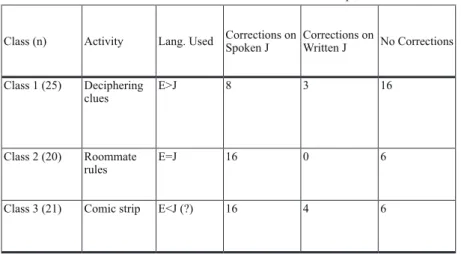
The students’ written comments revealed how they corrected or assisted each other differed among the classes. More students in Class 2 responded that they corrected Japanese learners’ utterances but not written errors. The students in Class 3 also corrected Japanese language use, but they also corrected written Japanese. On the contrary, more than a half of Class 1 students did not. This may have been due to the nature of activities or the proficiency levels.
Table 2. Number of Corrections made on American Students’ Japanese
Class (n) Activity Lang. Used Corrections on Spoken J Corrections on Written J No Corrections Class 1 (25) Deciphering
clues E>J 8 3 16
Class 2 (20) Roommate
rules E=J 16 0 6
Class 3 (21) Comic strip E<J (?) 16 4 6
Conclusion
After observing the interaction of both groups of students together and reviewing the feedback data, the outcome of this project was considered to be a success. The student participants showed an increased interest in language learning, which was apparent in the teamwork they displayed during the project, as well as in their questionnaire answers and comments. A comparison between pre and post-project data showed an overall drop in the level of anxiety they had towards learning English. In addition, the individual activities in each of the three classes were generally successful in encouraging the students to communicate and teach each other using a combination of both target languages. As they worked, the students
were seen asking each other questions, confirming comprehension, and in some cases, correcting the mistakes of their counterparts. However, the greatest limitation of this project as it was conducted was that it was only a one-day event. It proved to be successful as a tool to reduce anxiety toward learning English and increasing motivation, but would require repeated classes to test its effect on practical language learning and its efficiency as a language teaching practice.
References
Horwitz, E. K. (1986). Preliminary evidence for reliability and validity of a foreign language anxiety scale. TESOL Quarterly, 20, 559-562.
Yashima, T., Noels, K. A., Shizuka, T., Takeuchi, O., Yamane, S. & Yoshizawa, K. (2009). The Interplay of Classroom Anxiety, Intrinsic Motivation, and Gender in the Japanese EFL Context. 『外国語教育研究』17, 41-64.