
近畿大学学術情報リポジトリ
27
0
0
全文
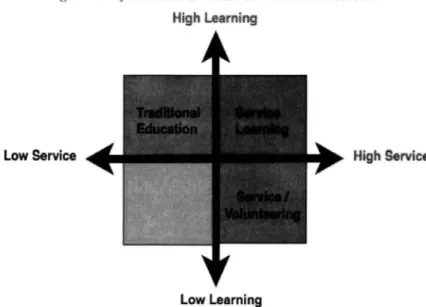
(2) Academic Service Learning: An Overview. Academic Service Learning is a teaching and learning method that can be applied in a variety of educational levels and settings. As the name suggests, the strength of this method comes from the integration of community service with learning. Students engaged in service learning not only provide service to the community, but also learn about the context in which the service is provided, the connection between their own learning and development objectives, and their role as citizens. The figure below (adapted from Geiger, 2001 ) helps to illustrate the relationship between service and learning in service learning. The ultimate goal for students and educators is to develop projects that are both high on learning and high on service. These projects can be initiated by educators to match the curriculum goals or by students to research individual interests.. High Learning. Low Service. Low Learning. Figure 1: Relationship between learning and service. (2). [ 103J.
(3) Types of Service Learning. There are basically four types of service learning activities that can be differentiated by who is being served and how they are being served.. Direct Service This type of service is generally the most rewarding as it requires personal contact with the individual (s) or community in need. Students receive immediate feedback on the service they provide and learn the importance of taking responsibility for their own actions. Some examples of direct service are reading English storybooks to young children or feeding the homeless.. Indirect Service In indirect service. the students channel resources to the problem. but rarely have contact with the individual (s) or community in need. This type of service works well with groups of students and it tends to enhance students' teamwork and organizational skills. Examples of indirect service include collectirig food for the homeless or gathering educational materials for students in need.. Advocacy In advocacy. students make efforts using their voices and talents to raise awareness and eliminate the causes of a specific problem. Giving presentations and making and distributing literature or videos about the problem or need are common activities in this form of service learning. Advocacy provides students with opportunities to present their concerns and practical solutions in a concise and clear manner.. Examples of. advocacy include producing and sharing a movie about pollution or giving a presentation about child soldiers in Uganda.. [ 102J. (3).
(4) Community-Based Research (CBR) This type of service learning involves the collaboration of students, faculty and community partners with the objective of solving community problems or addressing community needs. Examples of CBR include initiating a city carpooling project or developing a downtown park for families. The choice of utilizing one or more service learning approaches over the others depends largely on who will be served, the educational objectives, the educational level of the students, and the resources that are available. Direct and indirect service, advocacy, and community-based research are all clearly different, but they do share common benefits for students, teachers and the community.. The Benefits of Service Learning. A growing body of research (Astin & Sax, 1998; Cohen & Kinsey, 1994; Eyler & Giles, 1996; Gray et al, 1996, Kendrick, 1996; Markus, Howard & King, 1993) is showing that service learning has multiple, proven benefits for students, faculty members, learning institutions and communities.. Benefits to Students Service-learning projects allow students to develop in numerous ways that can have lifelong benefits . Service learning can make curricula more relevant to students' lives, promote community and civic responsibility, foster social and personal development, and develop critical thinking and problem solving skills. Through practical experience, service learning puts theory into practice and as a result makes it more relevant to their lives. This practical experience also provides students with opportunities to learn. (4). [101 ].
(5) in a variety of ways (Lee, Bush, and Smith 2005) . Sax and Astin (1997) showed that service learning enhances student engagement with and commitment to school. Others have also praised service learning by noting that service connected to specific curricular content can enhance the learning of the course content. This process enables students to "gain further understanding of course content, a broader appreciation of the discipline, and an enhanced sense of civic responsibility" (Bringle & Hatcher, 1996, p. 222) . Service learning has the potential to be a great tool for bringing books to life and life to books. Eyler (2002) listed many aspects of academic learning and cognitive development that she thought would be enhanced by service learning. These include "the ability to identify complex, ill-structured problems and come up with strategies to pursue solutions, or the transfer of learning in the application of knowledge to new problems, and the ability to make sense of ambiguous conflicting information" (p. 9-10) . Service learning has also been shown to have a powerful impact on students' social and emotional development (Eyler & Giles, 1996; Eyler & Giles, 1999; Kendrick, 1996; Ostrow, 1995; Rhoads, 1997) . Thoits and Hewitt found it to enhance five aspects of personal well-being: happiness, life satisfaction, sense of control over life, physical health, and positive mood (2001 ). Furthermore, those who engage in shared tasks such as community service feel greater life satisfaction, personal control, vitality, and social support later in life (Harlow and Cantor 1996). Service Learning is also a vehicle of empowerment for students as it prepares them for further education, careers, and for community involvement. Many researchers have shown that it is a powerful tool for preparing students to be contributing citizens in their broader communities (Giles & Eyler, 1994; Eyler & Giles, 1996; Markus, Howard & King, 1993; Kendrick, 1996) . It has been shown to enhance knowledge. [100 ]. (5).
(6) and skills and to improve self-esteem when students enter the workforce (Lee, Bush, and Smith 2005). One of these important skills is the ability to switch from being receivers of information to being seekers of information and taking responsibility for their learning. This is one essential part of education that many institutions fail to provide for their students. Benefits for the Faculty and the Learning Institution The benefits of service learning extend further than just the students. By incorporating service learning into their curricula, faculty and institutions also benefit greatly. Service learning has to potential to revitalize teaching efforts by providing exciting new ways to teach familiar material eventually leading to greater job satisfaction. Service learning also offers opportunities for faculty to develop close, interactive, mentoring relationships with their students. These strong relationships have the capability to make teaching more rewarding and fulfilling. Service learning also enables faculty to engage in meaningful interactions with the community and reminds them of the direct consequences of their teaching on society. For learning institutions, having students and faculty investing time and energy into serving others can help to build reciprocal partnerships with the local community. Many institutions offer programs that are out of touch, out of date and unresponsive to society's needs. Service learning, however, is a way for universities to meet a community's needs by combining students and academic resources to address local problems. Service learning has the potential to spark the creation of new areas of research and in turn enhance the educational reputation of institutions. As in-class studies alone fail to fully prepare students for the challenges they will face in the workforce, more opportunities for hands on experience are essential. Incorporating these experiences into the curriculum through service learning will lead to stronger graduates. (6). [99 ].
(7) and inevitably increase the trust and confidence companies have in Kinki University and in hiring our graduates.. Benefits for the Community. Community agencies and community members benefit in a number of ways from service learning partnerships. While many agencies lack resources to provide adequate services to the community. service learners can help agencies by strengthening their productivity. contributing new knowledge. opening up avenues for increased publicity. providing opportunities for evaluative reports and also by developing access to campus facilities and resources. These partnerships foster positive multigenerationaL cross-cultural and campus-community interactions. which provide the community with access to faculty experts and creative ideas for solving local problems. These partnerships lead to opportunities for community agencies and members to participate in student learning and feel assured and satisfied that they contributing to their own community by cultivating future generations of engaged citizens by instilling the values of cooperation and collaboration.. The Four Stages of Service Learning. The process of service learning involves four important interdependent stages. Preparation. action. reflection and demonstration constitute a process that is essential for the effectiveness and success of the service-learning project. Although each of these four stages are seen as separate, they are often linked together and used simultaneously throughout the process of service learning.. Stage #1: Preparation. The service learning process starts with the preparation stage.. [98 ]. (7).
(8) Preparation usually includes research and collaboration between students, teachers and in some cases community partners to identify a community need. Once a need or problem is identified, students do further research through books, the Internet, surveys, interviews, field trips and media sources to expand their knowledge. This research along with discussions, investigation and analysis will help students to further understand the underlying community need. This will lead to plans for action. Stage #2 Action Action is the second stage and it is the direct result of solid preparation. The action plan that is developed in the preparation stage can be carried out over the course of an academic year, semester, a couple of weeks, a single day or a even a few hours. During the action stage, students continue to build on their knowledge and understanding as they meet new people and have new experiences. This knowledge and understanding helps students to recognize the connection between their learning in the classroom and their lives and the lives of others. Throughout the action stage, students raise questions that lead to deeper understanding eventually helping them to identify themselves as community members. This stage allows students to use their own talents, ideas, skills, enthusiasm, knowledge and concern to transform a plan into action. Stage #3: Reflection Reflection is a key and ongoing component in service learning. In this stage, students are able to consider how the experience, knowledge and skills they are acquiring are connected to their own lives and their communities. This stage can be seen as a pause button allowing students to explore the impact of what they are learning and how it affects their. (8). [ 97J.
(9) thoughts and future actions. Reflection may occur before, during or after the action through the use of various approaches and strategies. Teachers can set up structured reflection at specific times using fixed approaches or the reflection can occur spontaneously by a student comment or class discussion. Through questioning. comments. discussions and feedback. the reflection stage has the potential to be a transforming experience. It can elevate students' ability to observe. question. and apply their accumulated knowledge to other situations while at the same time helping them to devise their own strategies for reflection. Stage #4: Demonstration. Demonstration is the final stage of service learning and it is used to provide evidence of what the students have gained or accomplished through their involvement. This learning experience or growth can be exhibited through displays. performances. presentations. lessons. or letters to editors. while drawing on the preparation. action and reflection stages of their service learning. This stage not only allows students to present their findings. but also to identify and acknowledge to themselves what they have learned and how they learned it. The demonstration stage also allows students to be recognized and appreciated for the contributions. possibly helping them to feel more as an important part of the community and a stakeholder.. Speeches and Interviews Course "In everyone's life, at some time, our inner fire goes out. It is then burst into flame by an encounter with another human being. We should all be thankful for those people who rekindle the inner spirit. " (Albert Schweitzer, German Philosopher). Do you remember the first time you tied your shoes. rode your. [96 ]. (9).
(10) bicycle, applied for a job or apologized to a friend? Much of what we've come to know and understand in life has been communicated to us by others. Others being teachers, friends, family, complete strangers, books and media. Fortunately, this knowledge and understanding is passed on from generation to generation and from culture to culture. Regardless of age, we should all have a student mindset and be open to learning from new experiences and the experiences of others. In the first semester of 2010, the author was responsible for teaching a course titled Speeches and Interviews to seventeen students from the Department of Language and Intercultural Communications at Kinki University. Using an academic service learning approach and a curriculum theme of Japan's ageing population, the students formed video project teams and interviewed 8 unique individuals over the age of 60 in hopes of expanding their perspective and adding to their knowledge of life. The idea for this service learning project called Take a Walk in My Shoes was influenced by two inspiring individuals who rekindled the author's inner spirit.. Inspiration for Course Innovation. As a result of inspiration from the author's Grandmother, Shirley Thorpe and film director, David Lynch, a mental roadmap for the servicelearning project called Take a Walk in My Shoes was developed. Who were these people and how did they influence this course? Shirley Thorpe was a strong, educated and artistic woman who stood true to her beliefs and rarely showed emotion. Her facial expressions were mere suggestions or glimpses of the true emotions that were stirring around inside of her. I can't recall her laughing hysterically, getting angry or raising her voice, and only once, at my grandfather's funeral, did I see her teary-eyed. She was not one to initiate a hug or kiss, but her smile and. (10). [95 ].
(11) undisguised eyes were enough to know that she loved her family with all of her heart and was proud of us all. She was a talented oil painter, loved to play cards with her close friends, enjoyed knitting, donated her time to many charitable organizations, and undisputedly made the most delicious pancakes and blueberry pies I have ever eaten. I guess you could say she was one of many perfect grandmothers in this world. My grandmother had battled with her breathing for a number of years, but it was during my visit home to Canada in the summer of 2009, when her health took a turn for the worse and she was admitted to a hospital for the last time. I was fortunate to be back in Canada that summer to spend some valuable time with her before her passing. During numerous visits to the hospital. my father and I kept her company, caught up on lost time and shared stories that I now hold close to my heart. These stories were often interrupted by bouts of coughing, the occasional nap. bland hospital meals and efforts to get her head around the bewildering array of medicine she was instructed to take. With the vast assortment of colors, shapes and sizes, it amazed me how she could still know what each pill was for and which medicine to secretly hide in the drawer of her bedside table. In addition to being a perfect place to hide medicine. the bedside table also served as a place to display the countless flowers. cards and gifts her friends and family had bought for her to encourage her to a quick recovery. Amongst all of these gifts was her portable voice recorder that instantly caught my attention and curiosity. After asking her what she was recording. she told me that with all of the free time on her hands, she thought that it would be nice to dig into the past and record some stories and memories when they came to mind. She shared pieces of these precious stories with my father and I during our visits, but I know we only received a taste of the experiences she had hoped to share with us. I wondered why after all of these healthy years together. she hadn't. [94 ]. (ll).
(12) told us about these amazing experiences and more importantly why we hadn't asked. I feel fortunate to have had these memorable visits with my grandmother before her passing, but deep down inside I wish I could have heard more about her life first hand. I consider her eloquent stories as some of my life lessons and appreciate her for rekindling my inner spirit. Shortly after my grandmother's passing it became more obvious that encounters with grandparents, parents, siblings, teachers, friends or even complete strangers have the potential to rekindle our inner spirit, but sometimes we miss out on these valuable and life changing opportunities for various reasons. Educators have a responsibility to inspire their students with their own knowledge, stories and experiences, and at the same time, share the wisdom of others they have learned from. The fear of losing out on potential wisdom like I did with my grandmother and the hope that my students would benefit from learning from the experiences of others triggered the cultivation of the service-learning project in the Speeches and Interviews course. David Lynch's work also influenced the further development of this project. He is known globally for his work in directing films and TV and highly respected for his talent as a visual artist and musician. While he has been involved in many interesting and famous projects, the Interview Project is truly an inspiring video project that instantly sparked my. interest and aided in the further development of Take a Walk in My Shoes. The Interview Project is a 121-part documentary series, which showcases interviews with ordinary people in America discussing their lives. The interviewers drove over 20,000 miles around America over 70 days for 121 interviews. The interviews were edited to approximately 5 minutes and put online for viewing. Thanks to both David Lynch's Interview Project and my. (12). [ 93J.
(13) grandmother's lessons in life, the service-learning project called "Take a Walk in My Shoes", came to formation to enrich the learning of my students through the experiences of others and provide a service to the community with a curriculum focus on Japan's Ageing Society.. Japan's Ageing Society While a lot of attention is focused on how Japan's ageing population negatively affects the national pension systems, medical care and longterm care programs, very little attention is paid to the positive aspects of Japan's ageing population. The elderly in Japan are an asset and they play many important roles for society. One of these roles is to pass on their experiences and wisdom to younger generations. How can this be done without the elderly people feeling like they are lecturing or coming across as pretentious? The answer is a service-learning project called "Take a Walk in My Shoes".. Course Process The Speeches and Interviews course followed an eight-step process over 15 weeks from early April to mid-July in 2010 and covered the 4 essential stages of service learning previously outlined above. Each step in this process is explained below and the service learning stages that were covered for each step are summarized in Appendix 1.. Step 1 (Week 1) - Project Explanation The first step of the course included an overVIew of academic service learning which covered the different types, benefits and stages. A brief introduction to the course theme, an ageing population, was then introduced by illustrating some related statistics and sharing some of the experiences I had had with my grandmother. An outline of the curriculum. [ 92 ]. (13).
(14) roadmap and goals for the Take a Walk in My Shoes service learning project were provided and a few samples of David Lynch's Interview Project were shown for inspiration. At the end of the class, the students decided on their project teams of seven pairs and one group of three.. Step 2 (Week 2 and Week 3): Exploring the Theme In the second step, students explored the course theme of an ageing population by reading and summarizing articles related to the theme, sharing their summaries in discussion groups of 4 or 5 students and then expressing their opinions through discussions.. Step 3: (Weeks 4 and 5): Initial Meeting Preparation This step involved a number of small tasks. In their project teams, students brainstormed questions they wanted to ask their interviewee. Each project team then shared their list of questions with the rest of the class and a list of approximately 20 interview questions was compiled in both English and Japanese. See Appendix 2 for the compiled list of questions. In addition to the list of questions, each project team wrote a letter to their interviewee, which included an explanation of the project, a video interview request form and a consent form to put the video on a website solely for educational purposes.. Step 4 (Week 5) - Initial Meeting with Interviewee For this step, each project team was required to meet with their interviewee to build a trusting relationship, find out more about them before the actual video interview, explain the details of the service learning project and get their written consent to video the interview and put it online.. (14). [91].
(15) Step 5 (Weeks 6, 7 and 8) - Video Interview Preparation Based on their initial meeting with their interviewee, each project team revised their list of video interview questions and then constructed a video storyboard to keep their interview organized and facilitate the editing process. The project teams also practiced video and interviewing techniques that were taught in class and they also made sure all of their video equipment was working properly.. Step 6 (Weeks 9 ~ 12) -Interview and Video Editing In step 6, the project teams conducted their video interviews and then uploaded their video footage to Apple's iMovie software to be edited. After the movies were edited, they were exported to Apple's iDVD software and burnt to DVDs. The project teams that conducted their interviews in Japanese were also asked to do a transcription of the edited interview and then translate the script into English. See Appendix 3 for an example of the translated script. After finishing the editing, transcription and translation process, all of the project teams got together to share and reflect on their interview experiences.. Step 7 (Weeks 13 and 14): Speeches and Video Viewing For step 7, each project team was required to deliver two speeches about their interviewee and show their edited video. One of the two required speeches was delivered during class to the other students in the Speeches and Interviews course, and the other required speech was done at lunchtime on one of four scheduled days and open to anyone who wanted to attend. Posters outlining the project, interviewees and speakers were placed throughout the School of Literature, Arts and Cultural Studies at Kinki University to attract students and faculty to the lunchtime speeches and video viewing events. This poster can be seen in Appendix 4.. [90 ]. (15). - - '"1.
(16) Step 8 (Week 15) -Letters of Appreciation and Survey The last step in this course included two tasks. The first task was for each project team to send a letter of appreciation along with a copy of their edited video to their interviewee. Surprisingly, three of the interviewees sent thank you letters back to the students. The final task was to evaluate the course and their experiences with the service-learning project by answering a survey consisting of five questions.. Course Evaluation Method and Results In the final week of the course, a survey in Japanese was distributed to all of the 17 students who took the author's Speeches and Interviews course. The purpose of this survey was to determine the students' level of satisfaction with their academic service learning experience. The questions and results of the survey are illustrated below. Question #1: Was this your first time to use academic service learning in a course? Yes. No. Yes. No. o. 2. 3. 4. 5. 6. 7. 8. 9. 10. 11. 12. 13. Number of Respondents. Figure 2: Experience with service learning (16). [ 89 ]. 14. 15. 16. 17. 18.
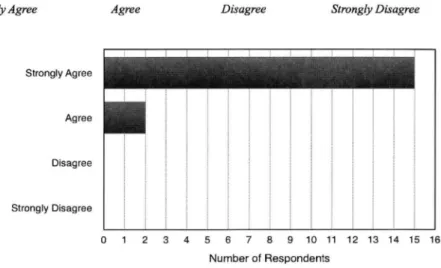
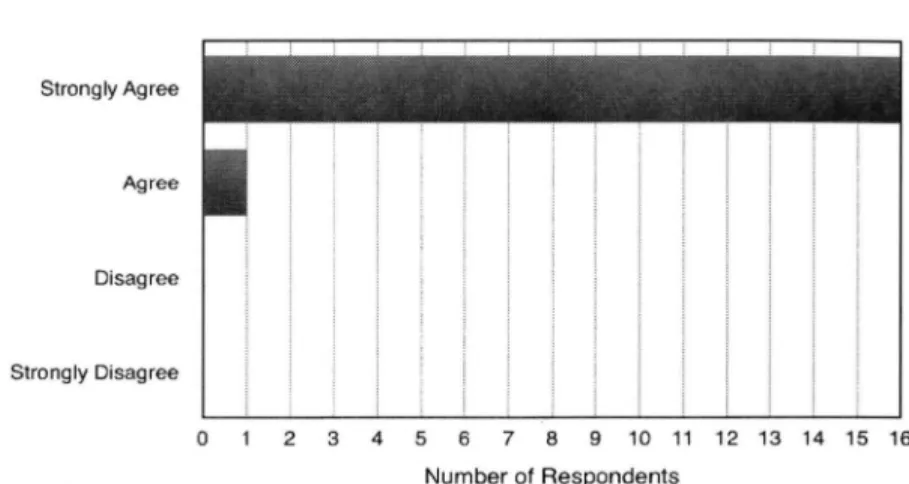
(17) Question #2: Overall, I was satisfied with my service-learning project. Disagree. Agree. Strongly Agree. Strongly Disagree. Strongly Agree. Agree. Disagree. Strongly Disagree. o. 2. 3. 4. 5. 6. 7. 8. 9. 10. 11. 12. 13. 14. 15. 16. Number of Respondents. Figure 3: Service-learning project satisfaction Question #3: Service learning projects should be used more often in courses at Kinki University. Strongly Agree. Agree. Strongly Disagree. Disagree. Strongly Agree. Agree. Disagree. Strongly Disagree. o. 2. 3. 4. 5. 6. 7. 8. 9. 10. 11. 12. 13. Number of Respondents. Figure 4: Using service-learning in courses. [88 ]. (17). 14.
(18) Question #4: I learn course content best when connections to real-life situations are made. Strongly Agree. Agree. Disagree. Strongly Disagree. Strongly Agree. Agree. Disagree. Strongly Disagree. o. 2. 3. 4. 5. 6. 7. 8. 9. 10. 11. 12 13. 14 15. 16. Number of Respondents. Figure 5: R eal-life situations for learning Question #5: I would have learned more from this course course if the time spent doing service had been spent in the classroom.. Agree. Strongly Agree. Disagree. Strongly Disagree. Strongly Agree. Agree. Disagree. Strongly Disagree. o. 2. 3. 4. 5. 6. 7. 8. 9. 10 11 12 13 14 15 16 17 18. Number of Respondents. Figure 6: L earning Pref erence (18). [ 87 ].
(19) Conclusion The teaching and learning method of academic serVIce learning can combine academic study with real-life experiences in a variety of educational levels and disciplines . Course projects designed around this approach have the potential to realize many of t he objectives of teaching and learning by helping students become empowered and active participants in society. The service-learning project, Take a Walk in My Shoes, is just one example of how this teaching method can be used to. integrate community service into the curriculum in a meaningful way. The author encourages other educators to explore this approach to realize their curriculum goals and to add real-life experiences to their students' research interests. References Albert Schweitzer. (n.d.) . BrainyQuote.com. Retrieved October 2. 2013. from BrainyQuote. com Web site: http://www.brainyquote.com/ quotes/ quotes/ a/ albertschw 105225.html Astin. A. W. & Sax. L.. J. (1998). How undergraduates are affected by service. participation. Journal of College Student Development, 39 (3) . 251-263. Bringle, R. G.. & Hatcher. l A (1996). Implementing service learning in higher education. Journal of Higher Education, 67 (2). 221-239. Cohen, l & Kinsey, D. (1994). 'Doing good' and scholarship: A service-learning study. Journalism Educator, 4-14. Eyler, l, Giles, Jr., D.E., & Schmiede, A (1996). A practitioner 's guide to reflection in service-learning: Student voices and reflections. Nashville, TN: Vanderbilt University. Eyler,. J.. & D. E. Giles,. J. (1999). Wh ere's the Learning in Service-L earning? San. F rancisco: J ossey-Bass. Eyler, l (2002). Reflection: Linking service and learning-linking students and communities. Journal of Social Issues, 48 (3), 517-534. Giles, D.EJr., & Eyler, l (1994) . Theoretical roots of service learning in John Dewey: Toward a theory of service learning. Michigan Journal of Community Service Learning, Fall, 77-85. Gray, M., Feschwind, S., Ondaatje, E., Robyn, A , Klein, S., Sax, L.. Astin. A. & Astin. H. (1996). Evaluation of Learn and Serve American, Higher Education: First year Report, 1. Santa Monica. CA: RAND Corporation.. [86 ]. (19).
(20) Greiger. E. (2001 ). Service-Learning Toolbox: Work Pages and Checklists to Help You Get. Started and Keep You Going. Portland. ORNothwest Regional Educational Laboratory. Download from nwrel.org/ ruraled/ learnserv I resources/ SL_Toolbox.pdf Harlow. R. and Cantor. N. (1996) Still participating after all these years: A Study of Life Task Participation in Later Life. Journal of Personality and Social Psychology, 71 (6) : 1235-1249. Kendrick. J. R. (1996) . Outcomes of service-learning in an introduction sociology course. Michigan Journal of Community Service Learning, 3, 72-81. Lee. JW .. Bush. G.. & Smith. E.W. (2005) . Service-learning: Practical learning experiences in sport and physical education. STRATEGIES, January/ February. 11-13. Markus. G.. Howard. J.. and King. D. (1993). Integrating community service and classroom instruction enhances learning: results from an experiment. Educational Evaluation and Policy Analysis, 15 (4) . 410-419. Ostrow. J. (1995) . Self-consciousness and social position: on college students changing their minds about the homeless. Qualitative Sociology, 18.357-375. Rhoads. R. (1997). Community service and higher learning: Explorations if the caring self Albany. NY: State University of New York Press. Sax. L. & Astin. A. (1997 ) . The benefits of service: Evidence from undergraduates. Educational Record, 78. 25-32. Thoits. P.A. and Hewitt. L.N. (2001) Volunteer Work and Well-Being. Journal of Health and Social Behavior, 42 (2) : 115-131.. (20). [85 ].
(21) Appendix 1: Course Process and Covered Service Learning Stages Service Learning Stages. Course Week Process Step #. Lesson. Stage 1. Stage 2. Stage 3. Project explanation and formation of student groups. 0. Readings about the socia l and eco nomic consequences of Japan's ageing population. 0. 0. 3. Discussion about the social and economic consequences of Japan's ageing population. 0. 0. 4. 3. Brainstorm possible interview Q's & write a letter to the interviewee requesting an interview. 0. 0. 5. 4. Meet with interviewee to explain the interview project. 0. Revise the lis t of interview Q's and make a video storyboard. 0. Practice video interviewing techniques. 0. 8. Practice video interviewing techniques. 0. 9. Conduct Video Interviews. 0. 1. 1. 2 I-----. 2. 6. Stage 4. Preparation Action Reflection Demonstration. 0. 0. 0. I-----. 7. 5. I-----. 0. 0. I-----. 10. r----. -. 6. Interview Reflections Video Editing. 11. 12. Video Editing. 13. Presentations. 14 15. 7. 8. Presentations Appreciation Letter and Survey. [84 ]. 0 0 0 0 0. 0 0. C. 0. (21 ).
(22) Appendix 2: Compiled list of interview questions 1. iJijlWc~cte!rJtg~?JtiZ. -Cf~\;) o What is your name, age, and where you are from?. 2. *1i*~= -J\;)-C?JtiZ. -CT ~ Please tell us about your family. \;) 0. 3. *E~t=~-::> t.::*H~~?JtiZ. -CT~. \;) 0. Please tell us the circumstances that led to your marriage.. 4.. 1±~H=. -J\;)-C?JtiZ. -CT ~. \;) 0. Please tell us about your work.. 5. rfjto)~O)1W: ~ ~n~~=~~-::> -C\;).:6 .: c !± ? Please tell us something about your childhood that has left a lasting impression. ~ ~ -C\;q:- J: ;7j~-? t..: c,~ -J .: c I± ? What has made your life worth living?. 6.. 7. XbyW1 C 4'0);@;\;)1± ?. What are some of the differences of when you were are child an now?. 8. ~~~=-J\;)-C?JtiZ. -CT~ \;) 0 Please tell us about your best friend.. 9. 4'i -c'-c'1W: ~ *;7j~ -? t..:': c. 1±1PJ-c'T;7j~ ? What is the most difficult thing you have experienced in life?. lO. 4'i -c'-c'-iI};tf. L;7j~-? t..:': c!± ? What is the saddest thing you have experienced in life? 11. A~-c'M:r-iI}ij'i* l) i Lt.::ip ? What is something you did in life that feel you did your best at? 12. 4'i -c'O)A~~=iJ\;)-C1~'I4lJ!±d0l) i Do you have any regrets?. (22). T;7j~. ?. [83J.
(23) 13. jiy tj t.: 0) ;f 1) ~ - Ii ? What are some of the rules you live your life by? 14. jiy tj t.:iJ'{~ ~ ~=}~, J -: t ,i{ijJ-c'-tiJ' ? What is something that you are proud of? 15. H~ tj8~'i ? What is your favorite word? 16. A~O)~tJfi ? Did you have any turning points in your life? 17. jiytjt,:~~'zt.:*-?A~=--:)v'-c~'z -CTtsv' o Please tell us about a book or person that influenced your thinking.. 18.. A~ ~?~~-::t~-c'~-t. t Lt.: G ?. If you had to choose one Chinese character to represent your life. what would it be?. 19.. §5tO)A~~=,9:iJ:~--:)lt6. t. Lt.:G?. If you had to give your life a score so far. what would it be? 20. 4-0)~~~=1jjJiJ'8v't.:v'-: t 'ijiy ~ 1-tiJ'? Do you have any words of advice for today's youth?. [82 J. (23).
(24) Appendix 3: English translation of interview script A =Interviewer B= Interviewee A May I ask your name, age and where you come from? B: My name is. . I am 80 years old. I'm from Nakakawachi-gun in Osaka. - - - -. A Could you tell me about your family? B: My family consists of my wife and one daughter and son. I have five grandchildren, two of which are girls and they are my daughter's children. The other three are my son's children, all of which are boys. That's all. (Pointing at a picture) This is my daughter and my son is next to her. AIn her childhood, what kind of a child was she? B: My daughter? She was selfish. A How about your son?. B: So was he. I was very worried about him. (Pointing at a picture) This is my first grandchild. She is my daughter's first child. A When she was born, how did you feel? B: I was very glad. (Pointing at a picture) This is my daughter's second child. A What kind of a child was she? B: When she was young, she was very quiet. A Thank you very much. What was the most impressive thing when you were a child? B: It was a long time ago when I was a child and my household was poor even when I was young because my father could not work due to his sickness. This led my three brothers and me to help our uncle, who was involved in agriculture.. (24). [81 ].
(25) APlease tell me about your job. B: I worked at a plumbing factory and I was involved in working with water pipes, appliances and water supply. During this time, I was involved in setting up the plumbing for the construction of Kinki University's medical school in Sayama. Arm sure your job was difficult, but what was the hardest part of your life? B: I was working for a subcontracting company for the construction of water taps for hygiene and after 20 years, the president of the company passed away. The idea that I should move on to another company occurred to me, but after second thoughts, I was already 30 or around 40, so I decided to start my own company. For about 3,4 or 5 years, I ran it by myself. However, private company cost me a lot such as public loan expenses, so I changed my company to a Business Corporation. A Then, what was the thing you worked hardest at? B: I founded my own company and during the bubble economy, my company's situation was better, but the burst of the bubble caused me to have fewer jobs to do and lower wages. At that time, I hired ten employees, but it was a small water tap company and it was too hard to pay them their salary, so I worked much harder to get jobs. It was the hardest time for me. A Please evaluate your experienced life. B: I give my own life 60 or 70 points. The other 30 to 40 percent is that I could not study hard. Both my father and my mother passed away when I was an elementary school student. My family was very poor and I helped my uncle in his field and rice paddy after school. I was really tired and went to bed early because I went to the field after school. Looking back, I could have stayed up late to study but I went to bed early because I was a kid. Arm sure you have more free time as you get older. What do you do in your free time? B: Pardon me? A What do you do in your free time?. [SO]. (25).
(26) B: I exercise in the morning. A What do you wear when you exercise? B: Well, I wear clothes like this. I wake up at 5 and the radio calisthenics start at 6:30. It takes about 1 hour to prepare because I am an elderly man. I leave home at 6 and it takes about 10 or 15 minutes to reach the park. And then I do the first and second radio calisthenics, which start at 6:30 and end at 6:40. I arrive home at around 7. A If you were young, what would like to do? B: If I were young, I would like to be a child in a normal household because my parents passed away so early and I had experienced hard times. Looking back, I couldn't do anything for my parents on Mother's Day and Father's Day like children in normal families do. Now I suppose if I could come back to my days as a child and I would like to have my parents live for at least 40 or 50 years. AHow did you feel when your parents passed away so early? B: A t that time, I felt sad because this happened when I was a child during my second or third year of elementary school. Above all, however, I couldn't think about anything other than playing with my friends. Even when my friends played, I couldn't play with them because I had to help my uncle in the field. Sunday was an exception and my uncle allowed me to play with my friends instead of helping him, so I looked forward to Sunday when I could visit Yamatogawa to swim, play baseball and catch fish. This was the most enjoyable time for me. AFinally, do you have any messages for today's youth? B: Well, our time and today's are different, but above all. they have their own life, so. I encourage them t o go straight to their destination without going astray. A Thank you for your time.. (26). [79 ].
(27) Appendix 4: Take a Walk in My Shoes Poster. 11388 (2tl A~O);\;II. , ,. 71398. (~l. A~O)?t.. C. A~O)$til. ~. t. , t ,. A~ O)$tll. A~O);til. , , t ,. 713] 58 (2tl A~O);t.. (. f. ( Room: A-101. 7.§] 38 (!kl. A~O)$t¥. A ~O)j'c.. (. Time: 12:15 - 13:00 (Bring your lunch!) [78J. (27).
(28)
図
関連したドキュメント
Standard domino tableaux have already been considered by many authors [33], [6], [34], [8], [1], but, to the best of our knowledge, the expression of the
Examples for the solution of boundary value problems by fixed-point meth- ods can be found, for instance, in Section 2.5 below where boundary value problems for non-linear elliptic
The only thing left to observe that (−) ∨ is a functor from the ordinary category of cartesian (respectively, cocartesian) fibrations to the ordinary category of cocartesian
Moving a step length of λ along the generated single direction reduces the step lengths of the basic directions (RHS of the simplex tableau) to (b i - λd it )... In addition, the
Moving a step length of λ along the generated single direction reduces the step lengths of the basic directions (RHS of the simplex tableau) to (b i - λd it )... In addition, the
1 Miko laj Marciniak was supported by Narodowe Centrum Nauki, grant number 2017/26/A/ST1/00189 and.. Narodowe Centrum Bada´ n i Rozwoju, grant
Applications of msets in Logic Programming languages is found to over- come “computational inefficiency” inherent in otherwise situation, especially in solving a sweep of
Our method of proof can also be used to recover the rational homotopy of L K(2) S 0 as well as the chromatic splitting conjecture at primes p > 3 [16]; we only need to use the
