INTRODUCTION
Many glandular tissues including salivary gland, lung, pancreas, and prostate are formed via the branching morphogenesis (BM), which is regulated
under the epithelial-mesenchymal interaction (1, 2). Many investigators have analyzed the molecular mechanism of such salivary BM, and reported the involvement of various growth/differentiation factors and extracellular matrix (ECM) in this developmen-tal process (3). The roles of EGF/FGF signaling have been investigated well in the organ culture sys-tem using mouse submandibular gland (SMG) ru-diments, however, other growth/differentiation fac-tors including activin, BMP, IGF, PDGF, and TGFβ have also been shown to play important roles in the
MINI-REVIEW
Salivary gland development : its mediation by a
subtilisin-like proprotein convertase, PACE4
Tetsuya Akamatsu
1, Ahmad Azlina
1, Purevjav Javkhlan
1, 2, Takahiro Hasegawa
1,
Chenjuan Yao
1, and Kazuo Hosoi
1 1Department of Molecular Oral Physiology, and2
Department of Periodontology and Endodontology, Institute of Health Biosciences, the University of Tokushima Graduate School, Tokushima, Japan Abstract : The submandibular gland (SMG) develops under the epithelial-mesenchymal interaction. Its process is regulated by various growth/differentiation factors, which are synthesized as inactive precursors and activated via the limited proteolysis at their multi basic amino acid site(s) such as Arg-X-Lys/Arg-Arg. Although many of these processing steps are elucidated to be catalyzed by subtilisin-like proprotein convertases (SPCs), lit-tle is known about the role of SPCs in the SMG development. Here, we focused upon the physiological role of PACE4 (SPC4), a member of SPC family, in the SMG development. In the organ culture system of rat embryonic SMG (E15), Dec-RVKR-CMK, a potent in-hibitor for SPCs, inhibited the salivary branching and the expression of an exocrine gland type water channel, AQP5. However, other peptidyl-CMKs and inhibitors for trypsin-like serine proteases including leupeptin did not affect the salivary branching and AQP5 ex-pression. Dec-RVKR-CMK also suppressed the expression of PACE4, but not furin, an-other member of the family. The specific antibody for the catalytic domain of PACE4 sup-pressed the salivary branching and AQP5 expression similarly. These inhibitory effects of Dec-RVKR-CMK were partially rescued by the addition of recombinant BMP2 whose precursor is a candidate for the physiological substrates of PACE4. Further, the tran-scriptional silencing of PACE4 by its specific siRNAs caused the suppression of both the salivary branching and AQP5 expression in the present organ culture system. These ob-servations strongly support the idea that PACE4 mediates the SMG development. J. Med. Invest. 56 Suppl. : 241-246, December, 2009
Keywords : subtilisin-like proprotein convertase, PACE4, branching morphogenesis, water channel, AQP5, SMG, development
Received for publication November 4, 2009 ; accepted Novem-ber 11, 2009.
Address correspondence and reprint requests to Kazuo Hosoi, Department of Molecular Oral Physiology, Institute of Health Biosciences, the University of Tokushima Graduate School, Kuramoto cho, Tokushima 770 8504, Japan and Fax : + 81 88 -633 - 7324.
salivary gland development and/or salivary acinar differentiation (Table 1). TGFβ-related growth/dif-ferentiation factors are synthesized as inactive pre-cursors and are converted to their active forms by the limited proteolysis at multiple basic amino acid sites such as Arg-X-X-Arg and/or Arg-X-Lys/Arg-Arg (4). Additionally, some ECM proteins including collagen families also need the proteolytic removal of their propeptides at least at the similar site for compatible fibrillogenesis (Table 1). In general, such processing is catalyzed by subtilisin-like proprotein convertase (SPC) family proteases (5-7), however, little is known about the role of SPCs in the salivary gland development. In this review, we will describe the physiological role of PACE4 (SPC4), which is one of the member of SPC family, in the salivary gland development.
SALIVARY GLAND DEVELOPMENT
In mammalians, there are three major salivary glands ; parotid, submandibular, and sublingual glands. The parotid glands develop from near the corners of the stomodeum. The SMG develops from the side of the root of the tongue, and the sublingual gland develops from the lateral part of the submandi-bular primordia. All salivary glands originate from
the ectodermal epithelium as a result of interacting with the neural crest-derived mesenchyme (8, 9). The thickening of the oral epithelium, which is an initial sign of salivary gland formation, is observed around E12 in case of the formation of the rat SMG. Then, the oral epithelium downgrows into the un-derlying mesenchyme, and continually develops by the repeated dichotomous branching of the distal ends of the epithelial buds, generally called “branch-ing morphogenesis (BM)”. Dur“branch-ing this process, the elongated branches differentiate into the ducts, while the terminal epithelial buds differentiate into the acini. The epithelial-mesenchymal interaction and BM, which is the important and fundamental developmental process seen in many organogene-sis of glandular tissues, is a cascade conorganogene-sisting of various signaling molecules including growth/differ-entiation factors, receptors, cell adhesion molecules, and ECM proteins (3, 10).
SUBTILISIN-LIKE PROPROTEIN
CONVER-TASE (SPC) FAMILY PROTEASE
Mammalian subtilisin-like proprotein convertases (SPCs), which have the catalytic domain similar to bacterial subtilisin (subtilisin-like catalytic domain ; SCD), have been identified and characterized as processing proteases catalyzing the limited prote-olysis at the multiple basic amino acid sites (5-7). This processing is significant to generate and/or activate various signaling molecules including pep-tide hormones, growth/differentiation factors, cell adhesion molecules, receptors, and ECM proteins. SPCs are classified into 3 subgroups. The first group is secretory granule convertases consisting of PC2/SPC2, PC1/PC3/SPC3, and PC4/SPC5. They are localized in secretory granules and in-volved in the processing of peptide hormones. The second group is membrane-bound convertases con-sisting of furin/PACE/SPC1 and LPC/PC7/PC8/ SPC7. These members are localized at trans-Golgi network and cell membrane via their C-terminal transmembrane domain, and activate various pro-proteins. The third group consists of PACE4/SPC4 and PC5/PC6/SPC6. These convertases have been shown to bind heparin, an experimental indicator of the physiological interaction with heparan sulfate proteoglycans in the ECM (11). Therefore these members are classified as ECM-bound convertases. Previous studies have been shown that PACE4, fu-rin, and PC6 are candidate SPCs responsible for the
Table 1 Activation site of pro - growth/differentiation factors and other pro - proteins
pro - growth/ differentiation factor P6 P4 P2 P1 P1’ P2’ MouseβNGF T H R S K R S S human TGFβ1 S S R H R R A L human TGFβ2 N R R K R R A L human TGFβ3 G Q R K R R A L mouse BMP2 H K R E K R Q A rat BMP4 R R R A K R S P human Activin A H R R R R R Q A other pro - protein
human IGF receptor P E R K R R D V human Integrinα3-chain P Q R R R R Q L mouse E- cadherin L R R Q K R D W human fibrillin R G R K R R S T humanα1(V) Collagen A S R T R R N I mouse/ratα1(XI) Collagen P K K T R R H T human BMP1 R S R S R R A A Arrow between the position 1 (P1) and position 1’ (P1’) indicates the cleavage site, and the important basic amino acids at P1, P2, P4, and P6 on the processing of each precursor are underlined.
activation of growth/differentiation factors includ-ing TGFβ-related molecules (12-14), which also play important roles in the BM of various glandular tissues (1, 2).
EXPRESSION AND LOCALIZATION OF
SPCs IN THE SALIVARY GLAND
DEVEL-OPMENT
Farhadi, et al. first reported the expression and localization of furin in the mouse SMG during post-natal development ; i.e., furin was widely expressed in the SMG, but especially in the duct cells, and co-localized with NGF in the granular convoluted tu-bule cells (15). They also revealed that PC2 mRNA was expressed in the parasympathetic neurons of intralobular ganglia, but not in any other cell type, within the SMG (15).
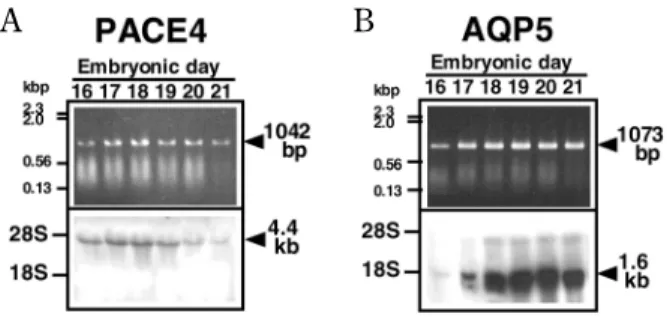
Previously, we showed the expression and local-ization of PACE4 in the rat SMG through develop-ment (16). PACE4 was intensely expressed in the submandibular epithelium-derived cells including proacinar, terminal tubular, and presumptive duc-tal cells in the prenaduc-tal SMG. By means of RT-PCR and Northern blot analyses, its expression was in-tense during the stages in which the prominent BM progresses (Fig. 1A). After birth, PACE4 was ex-pressed still intensely in the terminal portion of the SMG containing proacinar and terminal tubular cells, whereas its expression in the ductal cells was obviously decreased. Additionally, acinar cells that
do not express PACE4 appeared and their numbers increased following postnatal development, suggest-ing the apparent association of PACE4 with the pro-liferation, differentiation, and establishment of func-tional salivary acinar cells.
EXPRESSION AND LOCALIZATION OF
AN EXOCRINE TYPE WATER CHANNEL,
AQUAPORIN 5 (AQP5) IN THE SALIVARY
GLAND DEVELOPMENT
One of the important physiological functions of salivary glands is saliva secretion. As the key mole-cules, which are responsible for water movement across the cell membrane in secretory and absorp-tive cells, aquaporin family transmembrane proteins have been identified. In the salivary gland, AQP5 was first identified to be localized at the apical mem-branes of the salivary acinar cells (17). Involvement of this water channel in saliva secretion was revealed by the fact that AQP5 KO mice and AQP5 mutant rats show decreased and viscous hypertonic saliva secretion (18, 19). Previously, we reported the ex-pression and localization of AQPs (AQP1-AQP5) in the course of development of rat SMG (20). Inter-estingly, AQP5 expression is dramatically increased in the prenatal SMG in good accordance with the acinar differentiation (Fig. 1B), although its molecu-lar mechanism is still unclear.
ROLE OF PACE4 IN THE SALIVARY GLAND
DEVELOPMENT
To elucidate the physiological role of PACE4 in the salivary gland development, we investigated the effects by inhibition and transcriptional silencing of PACE4 in the organ culture system of rat embryonic SMG rudiments (21). We first analyzed the effects of protease inhibitors in the organ culture system. Based on the above mentioned amino acid sequence at the cleavage site of various proproteins including growth/differentiation factors, decanoyl-Arg-Val-Lys-Arg-chloromethylketone (Dec-RVKR-CMK) is generally used as a potent and useful inhibitor for SPC family. As expected, the SMG rudiments cul-tured in the presence of Dec-RVKR-CMK clearly showed the inhibition of the BM of SMG in the or-gan culture system as compared with the control culture (Fig. 2A, B), and the finding is well coin-cided with the report by Uchida, et al. showing the A
A BB
Fig. 1 Expression of PACE4 (A) and AQP5 (B) mRNAs in the prenatal rat SMG.
Expression of PACE4 and AQP5 mRNAs was analyzed by RT-PCR (upper) and Northern blotting (lower). One - microgram and ten - microgram samples of total RNA from rat embryonic SMG were used for RT- PCR and Northern blotting, respectively. Each transcript was detected by using each specific DIG - labeled an-tisense riboprobe. The arrowheads with their correct size indicate the position of each RT- PCR product or transcript. The size mark-ers from aλDNA-Hind III digest and the position of ribosomal RNAs are shown on the left. Modified from Akamatsu, et al. (20, 21).
inhibition of prostatic branching by Dec-RVKR-CMK (22). In these SMG rudiments, it was revealed that the expression level of AQP5 was not increased as compared with the control culture without the inhibitor, suggesting the retardation of the differen-tiation of the salivary cells. Interestingly, the expres-sion level of PACE4, but not furin, was also sup-pressed similarly, suggesting the participation of PACE4 in the differentiation of the salivary cells. Based on the amino acid sequence, Dec-RVKR-CMK can probably inhibit various trypsin-like serine proteases, however, leupeptin and soybean trypsin inhibitor, which can inhibit general trypsin-like ser-ine proteases, showed no inhibitory effects in the present organ culture system. Additionally, other peptidyl-CMK affected neither BM of SMG rudi-ments nor the expression levels of AQP5 and PACE4 in the same culture system. These results suggest the involvement of SPCs, especially PACE4, in the salivary gland development. To verify the pos-sible involvement of PACE4 in regulating BM of and AQP5 expression in the SMG rudiments, we initially analyzed the effects of specific antibody for the cata-lytic domain of PACE4 in the present organ culture system. As a result, this antibody showed similar
inhibitory effects caused by Dec-RVKR-CMK, sug-gesting the validity of PACE4 participation in the gland development (Fig. 2C). Further, the rescue experiment by using recombinant growth/differen-tiation factors revealed that BMP2 is a candidate im-portant regulator to restore the Dec-RVKR-CMK-caused inhibition of BM and decrease in AQP5 pression, especially for the recovery of AQP5 ex-pression. The significance of this BMP2 signaling in regulating both the BM and AQP5 expression was furthermore confirmed by the experiment in which the neutralizing monoclonal antibody for BMP2 suppressed the BM of and AQP5 expression in the SMG rudiments in the present organ culture sys-tem. These observations strongly suggest the valid-ity of PACE4-mediated development of the salivary gland. We finally conducted RNAi experiment to cor-roborate aforementioned observations. The tran-scriptional silencing of PACE4 in the organ culture system was efficiently caused by plural siRNAs spe-cific for various region of PACE4, and reliably re-duced both the BM of and AQP5 expression in the SMG rudiments in the present organ culture sys-tem (Fig. 2D). In contrast, siRNAs for furin and PC6 did not show such inhibitory effects at present. A A B B C C D D
Fig. 2 Effects of Dec- RVKR- CMK, anti - PACE4 (SCD) IgG, and siRNA for PACE4 on the branching morphogenesis of cultured rat SMG rudiments. The SMG rudiments extracted from E15 rat embryos were placed on polycarbonate membrane floated on BGJb medium containing 10% FCS. Then they were cultured in the presence of nothing (A ; Non), Dec- RVKR- CMK (B ; RVKR- CMK, 10 μM), specific antibody for the subtilisin-like catalytic domain (SCD) of PACE4 (C ; SCD IgG, 0.36 mg/ml), and specific siRNA for PACE4 (D ; siRNA, 1μM), respectively. Modified from Akamatsu, et al. (21).
Among SPCs, some members frequently play redun-dant roles (12, 14, 23), however, the inhibition and transcriptional silencing of PACE4 undoubtedly causes the reduction of both the BM of and AQP5 expression in the SMG rudiments. This fact indi-cates that the physiological role of PACE4 is very critical for SMG development and neither furin nor PC6 could restore the lost function of PACE4 in the SMG development.
In conclusion, the SMG development is regulated by a subtilisin-like proprotein convertase PACE4
via the activation of proproteins involved in salivary
branching and/or salivary acinar differentiation. The precursor of BMP2 is one of the candidate physi-ological substrates of PACE4, and BMP2 signaling may upregulate the expression of an exocrine type water channel AQP5 in the SMG development.
ACKNOWLEDGEMENTS
This work was supported in part by grants from the program Grants-in-Aid for Encouragement of Young Scientists, The Ministry of Education, Science, Sports, and Culture of Japan (16791126, 18791369).
REFERENCES
1. Davies JA : Do different branching epithelia use a conserved developmental mechanism? Bioes-says 24 : 937-948, 2002
2. Hu MC, Rosenblum ND : Genetic regulation of branching morphogenesis : lessons learned from loss-of-function phenotypes. Pediatr Res 54 : 433-438, 2003
3. Patel VN, Rebustini IT, Hoffman MP : Salivary gland branching morphogenesis. Differentiation 74 : 349-364, 2006
4. Khalil N : TGF-β : from latent to active. Mi-crobes Infect 1 : 1255-1263, 1999
5. Seidah NG, Chrétien M : Proprotein and pro-hormone convertases : a family of subtilases generating diverse bioactive polypeptides. Brain Res 848 : 45-62, 1999
6. Scamuffa N, Calvo F, Chrétien M, Seidah NG, Khatib AM : Proprotein convertases : lessons from knockouts. FASEB J 20 : 1954-1963, 2006 7. Seidah NG, Mayer G, Zaid A, Rousselet E, Nassoury N, Poirier S, Essalmani R, Prat A : The activation and physiological functions of
the proprotein convertases. Int J Biochem Cell Biol 40 : 1111-1125, 2008
8. Klein RM : Development, structure, and func-tion of the salivary glands. In : Avery JK, Steele PF, Avery N, eds. Oral development and his-tology (3rd ed.), New York, Thieme, 2002, pp. 292-330
9. Tucker AS : Salivary gland development. Semin Cell Dev Biol 18 : 237-244, 2007
10. Kleinman HK, Philp D, Hoffman MP : Role of the extracellular matrix in morphogenesis. Curr Opin Biotechnol 14 : 526-532, 2003
11. Tsuji A, Sakurai K, Kiyokage E, Yamazaki T, Koide S, Toida K, Ishimura K, Matsuda Y : Se-cretory proprotein convertases PACE4 and PC6A are heparin-binding proteins which are localized in the extracellular matrix. Potential role of PACE4 in the activation of proproteins in the extracellular matrix. Biochim Biophys Acta 1645 : 95-104, 2003
12. Constam DB, Robertson EJ : Regulation of bone morphogenetic protein activity by pro do-mains and proprotein convertases. J Cell Biol 144 : 139-149, 1999
13. Constam DB, Robertson EJ : SPC4/PACE4 regulates a TGFβ signaling network during axis formation. Genes Dev 14 : 1146-1155, 2000 14. Cui Y, Jean F, Thomas G, Christian JL : BMP-4
is proteolytically activated by furin and/or PC6 during vertebrate embryonic development. EMBO J 17 : 4735-4743, 1998
15. Farhadi H, Pareek S, Day R, Dong W, Chrétien M, Bergeron JJ, Seidah NG, Murphy RA : Pro-hormone convertases in mouse submandibular gland : co-localization of furin and nerve growth factor. J Histochem Cytochem 45 : 795-804, 1997
16. Akamatsu T, Purwanti N, Karabasil MR, Li X, Yao C, Kanamori N, Hosoi K : Temporospa-tially regulated expression of subtilisin-like pro-protein convertase PACE4 (SPC4) during de-velopment of the rat submandibular gland. Dev Dyn 236 : 314-320, 2007
17. Raina S, Preston GM, Guggino WB, Agre P : Molecular cloning and characterization of an aquaporin cDNA from salivary, lacrimal, and respiratory tissues. J Biol Chem 270 : 1908-1912, 1995
18. Ma T, Song Y, Gillespie A, Carlson EJ, Epstein CJ, Verkman AS : Defective secretion of saliva in transgenic mice lacking aquaporin-5 water channels. J Biol Chem 274 : 20071-20074, 1999
19. Murdiastuti K, Purwanti N, Karabasil MR, Li X, Yao C, Akamatsu T, Kanamori N, Hosoi K : A naturally occurring point mutation in the rat aquaporin 5 gene, influencing its protein pro-duction by and secretion of water from salivary glands. Am J Physiol Gastrointest Liver Physiol 291 : G1081-G1088, 2006
20. Akamatsu T, Parvin MN, Murdiastuti K, Kosugi-Tanaka C, Yao C, Miki O, Kanamori N, Hosoi K : Expression and localization of aquaporins, members of the water channel fam-ily, during development of the rat submandi-bular gland. Pflügers Arch Eur J Physiol 446 : 641-651, 2003
21. Akamatsu T, Azlina A, Purwanti N, Karabasil MR, Hasegawa T, Yao C, Hosoi K : Inhibition and transcriptional silencing of a subtilisin-like
proprotein convertase, PACE4/SPC4, reduces the branching morphogenesis of and AQP5 ex-pression in rat embryonic submandibular gland. Dev Biol 325 : 434-443, 2009
22. Uchida K, Kanai M, Yonemura S, Ishii K, Hirokawa Y, Sugimura Y : Proprotein conver-tases modulate budding and branching mor-phogenesis of rat ventral prostate. Int J Dev Biol 51 : 229-233, 2007
23. Mori K, Imamaki A, Nagata K, Yonetomi Y, Kiyokage-Yoshimoto R, Martin TJ, Gillespie MT, Nagahama M, Tsuji A, Matsuda Y : Subtil-isin-like proprotein convertases, PACE4 and PC8, as well as furin, are endogenous proalbu-min convertases in HepG2 cells. J Biochem (Tokyo) 125 : 627-633, 1999