† 原稿受理 平成29年2月24日 Received February 24,2017
* 総合デザイン工学科 (Department of Integrated Design Engineering)
Using Interviews to Explore L2 Motivation: Its Emerging Opportunities
†Mikio Iguchi
* ○○○○○第二言語習得における学習動機(L2 motivation)は主として調査票を用いた量的研究に より発展してきた。一方でインタビューを用いた質的研究も第二言語習得における学習動機を 研究する上で徐々に用いられるようになってきた。調査票は量的研究方法論に基づいている。 一方で、インタビューも質的研究方法論に基づいており、計画・実施・分析にあたっては研究 方法論に即した厳密性が求められる。本稿では実際に実施したパイロット・インタビューとそ のデータの分析をもとにインタビューの特徴を省察的に考察・網羅し、今後の第二言語習得に おける学習動機を研究する上でインタビューが果たし得る役割について論じた。○○○○○Key words:L2 motivation, Questionnaire, Interview, Transcription, Analysis
1 Introduction
Almost all universities in Japan make it compulsory to teach English as a foreign language (EFL) to first and second year students regardless of their majors. However, past survey results show that one of the issues regarding English language teaching (ELT) at university level in Japan is the learners’ overall lack of motivation. Takefuta and Suiko (2005: 14 – 15) quote a survey issued by Japan Association of College English Teachers (JACET) in 2003 which got 787 respondents, all of whom were English language teachers at universities in Japan. The remarkable outcome was that when asked to point out problems in ELT at Japanese universities, the top response was the demotivation and deterioration of language proficiency, which 64.5% of the respondents chose. It far outweighed other factors such as quality of teachers (29.7%), excessively high expectation towards ELT (22.7%), national policy on foreign language education (22.1%) and curriculum (21.9%) in which respondents were allowed to give multiple answers.
Therefore, research on Japanese university students’ attitudes and motivations in learning EFL is vital, which should clarify the motivating factors or the demotivating factors. Richards (2003: 3 – 4) points out that research is purposeful, and it needs to be carefully and thoughtfully designed in order to make any reasonable claim. Likewise in a project, plan-do-see, or plan-do-check-action is an essential procedure. This applies to research since both project and research have specific purposes, in which justifiable process is essential to reach valid outcomes. I will introduce two major ways of collecting data so as to aptly embark on researching attitudes and motivations.
2 Research on attitudes and motivations 2・1 Paradigm and method
When doing research on attitudes and motivations, one should be aware of the paradigm and the method that is to be used, so as not to mix them up which leads to loss of consistency. According to Richards (2003: 12), a paradigm is “[a]t the highest level, representative of a set of basic beliefs” such as positivism and constructivism, whereas a method refers to “a means of gathering, analysing and interpreting data using generally recognised procedures” such as questionnaires and interviews. What is worth highlighting about second language (L2) motivational research is that it stands on the boundary between positivism and constructivism, and research can be done on either side of the spectrum, or even in the middle using mixed methods approach (Dörnyei, 2001: 241 – 244; 2007: 47).
Having said that, researchers do not necessarily need to decide which paradigm to adopt before starting an inquiry. Richards (2003: 41) argues that researchers should be aware of which paradigm they stand on, but that is not a required procedural step. In fact, it is our desire to solve a particular problem, or an issue raised by our research that determines which paradigm is suitable (Muijs, 2004: 10; Richards, 2003: 41).
For instance, if you were to test the hypothesis such as, “If English as a second language (ESL) learners have an opportunity to learn from teachers who are native speakers, they will achieve higher marks in English tests”, it would make sense to adopt experimental research which is positivistic. Researchers can compare the language achievement between ESL learners who learned from native
speakers by labelling them as the experimental group, and those of ESL learners who learned from non-native speakers by labelling them as the control group. In contrast, if you were to focus on particular overachievers to investigate why they were able to outperform others without any predetermined hypothesis, it would make sense to adopt classroom observations and interviews which are based on constructivism. To sum it up, research questions come first, then methods which entail paradigms should follow.
2・2 Questionnaires and positivism 2・2・1 Planning questionnaires
Questionnaires are one of the representative data collection methods adopted when there are predetermined hypotheses, which is compatible to research on attitude, belief and motivation from a quantitative perspective (Muijs, 2004: 2, 10). Furthermore, Dörnyei (2001: 189) declares that in L2 motivational research, “the most common data collection method has been the use of attitude/motivation questionnaires with primarily closed items”. In order to collect data on learners’ attitudes and motivations in learning English, we can develop questionnaires that ask the participants to rate a number of statements using Likert scales.
Fig. 1 An example of an item in questionnaires. For instance, using the question in Figure 1, coding frames can be created so that SPSS can calculate and measure the degree of L2 motivation. By coding ordinal variables as exemplified in Figure 2, a rating such as 5 (Strongly agree) can become greater than 4 (Agree), which signifies that there is a measurable order amongst the ratings (Muijs, 2004: 97 – 98). This enables to transform phenomena that do not naturally exist in quantitative forms into quantifiable data.
Fig. 2 An example of a coding frame for a questionnaire item.
2・2・2 Analysing questionnaires
In mainstream L2 motivational research, quantitative social psychology has been the most influential field (Dörnyei, 2001: 47 – 49, 192; 2003: 3 – 7). Researchers have primarily used correlational research which has typically verified whether motivation has any correlation with language achievement, such as quantifiable test scores (Gardner and Lambert, 1959; 1972). SPSS will analyse and summarise data using inferential statistics to make bivariate analyses (Muijs, 2004: 142 – 158). If there is a positive correlation between two variables, it is normally illustrated in a chart shown in Figure 3 below.
Fig. 3 An example of two variables which have positive correlation derived from questionnaires.
However, I would like to indicate three weak points in research using questionnaires. Firstly, I believe that most positivist researchers who used questionnaires assumed as an axiom that language achievement is the ultimate goal, and learners were moulded into an oversimplified cause and effect between motivation and language achievement. The downside of such a view is that it provided a fragmentary view which labelled certain overachievers as motivated learners, and underachievers as merely demotivated learners respectively.
Secondly, analyses using questionnaires tend to omit context which is extremely difficult to quantify. They are also inclined to exclude the process in which attitude/motivation are formed as individuals interact with the social context. Thus, questionnaires produce results that lacks a holistic point of view.
And lastly, results drawn from questionnaires tend to reflect just one point of time which does not explain the dynamic nature of motivation, which changes according to the time the data are elicited, such as motivation before learning L2, motivation whilst learning, and motivation after finishing a course. As Dörnyei (2001: 41 – 45, 82 – 84; 2003: 17 – 21) argues, momentary assessment of motivation does not provide the full picture, and thus a process-oriented approach is necessary to capture the temporal and dynamic nature of motivation which evolves over time. It is
risky to conclude the effect of motivation and language achievement, should data be taken only at one point of time.
To compensate for these flaws, I recommend using interviews which enable more holistic and context-bound perspectives. However, I do not deny the significance of using questionnaires, for they are instrumental in providing quantifiable data. Also, researchers should be aware of the paradigmatic standpoint when using questionnaires, which is explained in the next section.
2・2・3 Positivism
The paradigm that underpins research using questionnaires is positivism, which is also known as realism. Silverman (2006: 403) defines positivism as “a model of the research process which treats ‘social facts’ as existing independently of the activities of both participants and researchers.” Positivists contend that there is a true reality that is single, external, observable and stable, and that the nature of knowledge is hard, objective, real, measurable and tangible (Cohen, Manion and Morrison, 2000: 5 – 10; Muijs, 2004: 4).
Within this paradigm, analytic categories are defined by the researcher prior to the research, and data collection methods are predominantly quantitative (Dörnyei, 2001: 192 – 193; Muijs, 2004: 4). The other point about doing research based on positivism is that results need to be generalisable (Cohen et al. 2000: 8 – 9; Hitchcock and Hughes, 1995: 23; Muijs, 2004: 64, 83). Silverman (2006: 303) argues that “[g]eneralizability is a standard aim in quantitative research and is normally achieved by statistical sampling procedures.”
2・3 Interviews and constructivism 2・3・1 Planning interviews
When research questions do not have predetermined hypotheses to test, but rather have exploratory questions to uncover deep reasons behind phenomena, interviews might be useful. Interviews are one of the representative data collection methods to explore issues on lived human experience, often done in phenomenological research (Richards, 2003: 13, 18 – 20). According to Wellington (2000: 72), purposes of interviews are to “probe a respondent’s views, perspectives or life-history.” Richards (2003: 64) argues that the purpose of the qualitative interview is to deepen understanding instead of merely accumulating information. Above all, interviews are suitable to investigate attitude and
motivation from a qualitative perspective (Dörnyei, 2001: 193, 238 – 241).
There are four types of interviews, which are further explained below: structured interviews; unstructured interviews; semi-structured interviews; and focus group interviews (Dörnyei, 2001: 238; 2007: 134 – 136, 144 – 145; Wellington, 2000: 74 – 75).
1. Structured interviews: In this type, a pre-prepared, elaborate interview schedule and interview guide are provided, which can be applied to collect data from multiple interviewees (Dörnyei, 2007: 135). This format is similar to questionnaires, and will be suitable when researchers are aware what needs to be probed (ibid: 135). However, it should be noted that this type is regarded as quantitative rather than qualitative (Richards, 2003: 48).
2. Unstructured interviews: In contrast to structured interviews, this type does not require any detailed interview guide, which allows maximum flexibility to follow interviewees in any direction with minimal intervention from the interviewee (Dörnyei, 2007: 135 – 136). This is appropriate to focus on the deep meaning of a particular phenomenon (ibid: 136).
3. Semi-structured interviews: This is the eclectic type, which stands in between structured and unstructured interviews. There is a set of pre-prepared guiding questions and prompts using interview guides, but the format is open-ended, and interviews should be exploratory (ibid: 136). This is suitable when researchers have sufficient knowledge of phenomena under investigation and are capable of developing open-ended questions to induce relevant answers, but do not wish to use closed questions which limit the depth and breadth of interviewees’ answers (ibid: 136).
The three types of interviews which are made on one-to-one bases are summarised in the figure below.
Fig. 4 Styles of one-to-one interviews (Wellington, 2000: 75)
4. Focus group interviews: This is normally practiced in semi-structured style, in which an interviewer moderates discussion with group members which normally consists of 6-12 interviewees
(Dörnyei, 2007: 144). Its synergistic environment enables deep and insightful discussion which can produce high-quality data, particularly when it is used for programme evaluation to assess what was beneficial, and what was not (ibid: 144 – 146).
Once research questions are set and an interviewing structure is chosen, an initial sampling plan needs to be finalised and ethical guidelines need to be established. Then a detailed interview guide that consists of relevant questions is necessary, which should be followed by piloting (ibid: 137). I will discuss the interview guide and piloting in details in Section 3. Once piloting is done and questions are refined and elaborated, the next step is to select representative samples and set up the time and venue for interviews.
2・3・2 Executing interviews
When actual interviews are to take place, interviewers will first conduct briefing to introduce themselves, to discuss data recording, to assure that anonymity and confidentiality will be preserved, and that data will be protected. Then actual questioning will begin. Dörnyei (2007: 141) emphasises that interviewers need to be neutral in the sense that they should create reasonable space for the interviewees to freely share their experiences, no matter how socially undesirable their statement may be. Similarly, Richards (2003: 96) argues that interviewers should maintain a neutral response and avoid distortions in order to elicit full talk.
Richards (ibid: 55 – 57) highlights 5 question types (e.g. opening, check / reflect, follow-up, probe, structuring) which are illustrated below:
Fig. 5 Interview question types (Richards, 2003: 57) 1. Opening: A warm-up question such as, ‘Tell me your typical working day from the morning till the evening” will be useful to provide a natural springboard for further questions.
2. Check / Reflect: When interviewers are not sure of the statements made by interviewees, they can check it or reflect on it to encourage further talk.
3. Follow-up: Interviewers can follow up a topic when interviewees raised something or implied that there is more to be revealed. Simple encouragement from interviewers to go on may be sufficient, but explicit invitation such as, “I want to ask more on …” may be necessary.
4. Probe: There are two ways to probe interviewees’ statements to get deeper into discussion. Firstly, interviewers can use direct probes using Wh-questions to inquire details or how they structure their understanding. The drawback of this type is that, when it is overused it may suffocate interviewees and it can produce a staccato effect. Secondly, indirect probes can be used when topics are sensitive. For instance, in order to probe interviewees’ view on a sensitive matter, an indirect question such as, ‘What do people think about X?’ can replace a blunt question such as ‘What do you think about X?’.
5. Structuring: It may be necessary to mark a shift of topic using statements such as, “Can we move on to…”, or “If we could go back to…”. This may prompt interviewees to make additional comments before the topic is changed.
There are two golden rules in interviews. Firstly, Richards (ibid: 53) accentuates a golden rule for all interviewing: “Always seek the particular.” He emphasises that interviewers should seek specific and precise information, not abstract or ambiguous. The other golden rule that majority of researchers stress is that listening is more important than asking or speaking (Bogdan and Biklen, 2007: 105; Dörnyei, 2007: 140 – 142; Kvale, 1996: 132 – 135; Richards, 2003: 53, 65).
Dörnyei (2007: 138) points out that we should use final closing questions such as, “Is there anything else you would like to add?” or “What should I have asked you that I didn’t think to ask?” before ending interviews. These questions not only give opportunity for interviewees to make final statements, but also give chance for rich data to be elicited. Lastly, rounding up will be made, gratitude will be expressed, and future contact will be discussed.
2・3・3 Transcribing and analysing interviews Richards (2003: 81) points out that the “first step to any adequate analysis of interview data must be transcription.” Kvale (1996: 88) positions transcription as the necessary stage after
interviewing is done, and prior to analysis. Oral speech becomes written texts in order to be analysed by researchers.
Richards (2003: 84 – 86) presents 4 criteria to analyse interview data:
1. Questions:
How can questioning technique be improved? There may be a lack of variety, failure to pick up on opportunities, and tendency to close things down prematurely which all need further improvement.
2. Distortions:
Is the interviewer making any unwarranted assumption?
Is the interviewer taking anything for granted? Is there any evidence of bias?
Is there any evidence of interviewers leading the interviewee?
Unsuspected bias and unwarranted assumptions distort our questioning, close down options or even lead interviewees toward a particular standpoint, all of which should be spotted and eliminated in order to improve our interviewing.
3. Relationships:
What signals are interviewers sending out? How are identities and relationships
established and negotiated in the interview? What are the implications of this for analysis? Richards (2003: 85, 97) points out that depending on the context, there may be situations in which an interviewer’s identity is taken over by other identities such as a friend, or a teacher, which will result in eliciting different types of data from interviewees. Similarly, Block (2000: 761 – 762) argues that interview data are co-constructed, and that interviewers need to examine who they are perceived as in an interviewee’s mind.
4. The interviewee:
How do interviewees present themselves? What are the implications of this for analysis? Interviewers should take a close look at how interviewees present themselves because this might have an important bearing on the way they represent things.
There are three crucial stages during data analysis, namely coding, categorisation and thematization (Murray, 2009:52-56; Holliday, 2010:102-109). Firstly, chunks of textual data need to be coded into key words or phrases such as ‘confidence’, ‘achievement’ or ‘future expectation’. Secondly, similar codes should form higher categories such as ‘self-perception as an overachiever’. And finally, categories should further be grouped into higher
themes, such as ‘self-perception’. Constant comparative method proposed by Glaser and Strauss (1967) provides the basis of this technique, in which textual data are constantly compared with other categories and grouped into higher themes until researchers believe that they have reached the point of theoretical saturation.
It is vital for researchers to be aware of the paradigmatic standpoint when using interviews. The following section explains the research paradigm that is often contrasted with positivism
2・3・4 Constructivism
The paradigm that is at the basis of research using interviews is constructivism, which is also labelled ‘constructionism’ or ‘subjectivism’. Silverman (2006: 400) defines constructivism as “a model which encourages researchers to focus upon how phenomena come to be what they are through the close study of interaction in different contexts.” Within constructivism, reality is relative and is in part constructed by us and by our observations (Muijs, 2004: 4).
Under the umbrella of constructivism, analytic categories are not set prior to research, but are set only during research (Dörnyei, 2001: 193). Also, data collection method is preponderantly qualitative, as Muijs (2004: 4) contends, “[i]f one looks at research from a quantitative versus qualitative perspective, qualitative researchers are subjectivists.”
While quantitative research results need to be generalisable, it is debatable whether this applies to qualitative research. Richards (2003: 287 – 290) claims that the bottom line is that research has to have relevance to others outside its setting. However, it is disputable to label it as ‘generalisability’. He notes that researchers’ response ranges from fully accepting the usage of the term ‘generalisability’ to those who deny it at all, and in the middle are those who would rather use the term ‘transferability’ instead.
3 Pilot interviews
Based on theories of interviewing discussed so far, I would like to discuss how I prepared and carried out pilot interviews for my doctoral thesis (Iguchi, 2011). I chose to use interviews for three reasons. Firstly, I wanted an in-depth account of what motivates or demotivates L2 learners, and why. Secondly, I wanted a context-bound perspective in which I can get to know facts based on each context. And lastly, I wanted to know how attitudes and motivations
change over time. Considering all these factors together, interviews seem to be the best of all.
I adopted semi-structured interview because I know the basic framework of L2 motivation, such as the dichotomy of extrinsic motivation and intrinsic motivation, and also instrumental motivation (i.e. reasons for learning reflecting the more utilitarian value of linguistic achievement, such as benefiting in an occupation) and integrative motivation (i.e. willingness to learn about and interact with people from the target language community, to the point of eventually being accepted as a member of that group) (Gardner and Lambert, 1959; 1972). Based on Dörnyei’s recommendation (2007: 136) I decided that semi-structured interview is the most suitable one because the basic framework of L2 motivation is clear to me, and broad questions on this topic should be enough to elicit deep and yet broad data. Thus, I needed an interview guide to navigate through interviews.
3・1 Interview guide and planning piloting Dörnyei (2007: 134) points out that a typical one-shot interview lasts about 30 – 60 minutes, and Richards (2003: 67) describes the burdensome nature of an hour-long interview. Thus, I chose to interview Japanese speaking university students who are learning, or have learned EFL at university levels between 30 – 60 minutes. Also, it is better to establish rapport before interviews (Richards, 2003: 67 – 68; Wellington, 2000: 77). Therefore, I chose to interview friends to save time for effective piloting.
Prior to the interview, I prepared an interview guide as researchers recommend (Dörnyei, 2007: 136 – 137; Kvale, 1996: 88, 129 – 131; Richards, 2003: 69 – 71; Wellington, 2000: 76). The interview guide is attached as Appendix 1 at the end of this article.
I followed Kvale (1996: 129) who points out that an interview guide in a semi-structured type will cover an outline of topics to be covered along with suggested questions. I first brainstormed to come up with key topics, key words, and key questions that I want to investigate (Wellington, 2000: 76), which consist of 6 domains, attitudes, motivation, integrative motivation, instrumental motivation, intrinsic motivation and extrinsic motivation. The details are given in ‘A) Domain to be covered’ in Appendix 1. Secondly, the 6 domains were classified and allocated to clusters of 12 questions as shown in ‘C) Question wordings’ in Appendix 1.
Based on Anderson (1998: 185), I have written down 5 types of questions to avoid, which are: double
barrelled questions; two-in-one questions; restrictive questions; leading questions; and loaded questions.
Fig. 6 Five types of questions to avoid (Anderson, 1998: 185)
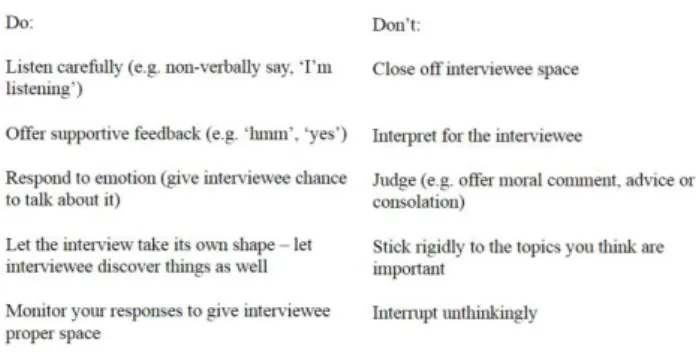
I also followed Richards’ guideline (2003: 54) of the things interviewers should carry out, and things not to do so.
Fig. 7 Interview responses: some do’s and don’t’s (Richards: 2003: 54)
3・2 Executing piloting
Wellington (2000: 77) points out 3 elements that need to be discussed with the interviewees prior to the interview:
1. Interviewers must ask for permissions from interviewees if interviews will be recorded.
2. Interviewers must ensure that anonymity and confidentiality of interviewees will be guaranteed.
3. Interviewees should be notified of the vital information about the research itself, such as the purpose, reason for selecting the individual for research, duration of the interview, and how the notes and recording will be handled afterwards.
I made two pilot interviews with university students whom I have known personally. Prior to interviews, I gave them a document which explains the above 3 points (see Appendix 2). Note that
communication was done in Japanese, be it written or spoken.
Both interviewees gave me permission to record the interviews, so I used two digital recorders (dictaphones) to evade risk of data loss. I took notes as interviewees talked. At the end of each interview, I used final closing questions following Dörnyei’s recommendation (2007: 138) (see ‘E) Some comments to bear in mind’ in Appendix 1). I would like to give a brief description of how each piloting was done, and make a critical reflection in Section 4.
3・2・1 1st pilot interview
The first interviewee was an undergraduate student in his fourth year, who already finished learning EFL at an university.
Name (pseudonym): Shinji Interview spot: classroom Interview duration: 40 minutes Age: 23
Sex: Male
L1 (First language): Japanese
Major: Modern literature (not English literature), 4th year
Richards (2003: 65) stresses the importance of rapidly learning the uniqueness of how interviewees speak in the actual interview. Shinji was a very expressive and a voluble interviewee and had a great deal of thoughts to share. With a simple question, he would give me more than a yes/no reply, and would illustrate his answer with many examples. Thus, I had no risk of failing to elicit sufficient data.
Extract 1 (Part of the 1st pilot interview) 01 02 03 04 05 06 07 08 09 10 11 12 13 14 15 16
Mikio: Let me see:: um. (3.0) Then, do you have any thought about using English to obtain some sort of certificates in the future? Shinji: Um. Do you mean now?
Mikio: Yeah. Now, or it can be about future. Shinji: To start telling you from my past, when
I was a primary school student, I wanted to become an interpreter or a translator of movie subtitles. You can say that it was a child’s dream, but I wanted to use foreign languages, because of what happened when I was twelve. Because of that, I wanted to use foreign languages as a professional, or take up a job that enables direct communication with foreigners. (1.0) Gradually, those ideas, or what I wanted to do changed.
17 18 19 20 21 Mikio: Um-hum.
Shinji: Right now, I don’t have any interest in a certificate itself.
Mikio: Um-hum.
Thus, I quickly judged that it was impossible to ask prepared questions from the beginning to the end in my interview guide (see Appendix 1), and adapted to his speech style by listening most of the time and making check / reflect questions, follow-ups and probes. I knew that I would not even be able to cover all the questions, for he would talk on and on.
His main motivation to learn English was integrative motivation, because he experienced a setback of not being able to communicate with Koreans during his sojourn in Korea when he was twelve (implied in Lines 11-12). Since then, his motivation to learn foreign languages was to be able to communicate with foreigners. He also emphasised his interest in people, and that one of the big motivating factors was quality of teachers. If he liked teachers, he would be motivated to learn. He also had rare opportunities to use English outside classrooms by attending an English speaking church on Sundays, and by interacting with people in English there. Thus, instrumental motivation such as studying English to obtain certificates (see Lines 19-20), and to get good marks did not motivate him at all.
3・2・2 2nd pilot interview
The second interviewee was an undergraduate student in the second year, who was in the midst of learning EFL at an university.
Name (pseudonym): Daisuke Interview spot: café
Interview duration: 29 minutes Age: 21
Sex: Male L1: Japanese
Major: Information and communication engineering, 2nd year
He was amiable and cooperative, but in contrast to the first interviewee, he was rather reserved and made brief statements and did not get too sidetracked. Because of this, I had more control than the previous interview. He paused after talking and left some space for me to probe effectively.
Extract 2 (Part of the 2nd pilot interview) 01 02 03 04 05 06 07 08 09 10 11 12 13 14
Mikio: Let me see. Okay, university… I want to ask you about classes at university. Daisuke: Yes.
Mikio: Are classes, say, attractive? Daisuke: They are, er, not attractive.
Mikio: They aren’t. (4.0) Why do you think so?
Daisuke: (3.0) They are boring. Um, they are somewhat, er (2.0) below my expectation… which may sound somewhat arrogant.
Mikio: Umm.
Daisuke: (3.0) I think they can do something more about classes.
He had more instrumental motivation than integrative motivation, for he does not have native speakers to interact with outside classrooms, and he would rather study English to get high marks in Test of English for International Communication (TOEIC) in order to get better jobs. His initial motivation to study English was to able to communicate in English, but classes were so unattractive that he eventually got demotivated during the first year (see Lines 08–11, 13-14).
Now, I would like to assess and evaluate my own pilot interviews to refine my data collection method.
4 Critical reflection of my pilot interviews 4・1 Establishing win-win relationship with interviewees
Kvale (1996: 129 – 130) argues that interview questions can be evaluated with thematic and dynamic dimension. Questions are thematic in that they faithfully relate to the topic of inquiry, whereas they are also dynamic in that they should promote a positive interaction to keep the conversation flowing. This was a dilemma for me, for in order to investigate L2 motivation of interviewees, I needed to try to ask the prepared questions as much as possible. On the other hand, semi-structured interviews should give interviewees more time to talk, and interviewers should be more of a listener than a talker. Richards (2003: 65) contends that interviewers should focus on the interviewees instead of the programme, and that “all questioning is hollow unless accompanied by attentive listening.” Bogdan and Biklen (2007: 105) go so far as to declare that the most important rule in interviews is the need to listen to interviewees carefully. Therefore, questions needed to be dynamic,
ad hoc and ad lib to let them talk freely.
Sometimes, these two criteria seemed contradictory because when I tried to follow the questions on the guideline and started thinking which question to ask next, I sometimes lost concentration on the interviewee’s talk. In addition, asking a prepared question had the risk of cutting off what the interviewee wanted to mention, especially when it was different from the ongoing topic, although I did not do this.
In contrast, when I let the talk go on freely it sometimes got sidetracked. To show an example from the first interview with Shinji, I asked a prepared opening statement which did not ring the bell for him, so I asked him an impromptu question that actually drifted the topic away from ELT to general education.
Extract 3 (Part of the 1st pilot interview) 01 02 03 04 05 06 07 08 09 10 11 12 13 14 15 16 17 18 19 20 21
Mikio: First of all, after becoming a university student, or to be precise, before becoming a university student, what kinds of expectations did you have towards English language teaching?
Shinji: Is it what I expected towards English language teaching at university?
Mikio: Um-hum.
Shinji: Um (4.0). I don’t think I had any expectation specifically for English language teaching. I had some vague expectation towards the university as a whole, but I don’t think I had much expectation towards English language teaching.
Mikio: Um-hum. (2.0) Then, what kind of expectation did you have towards university education as a whole?
Shinji: Regarding university education, I had big expectation to be able to study things that are not compulsory, but to be able to study spontaneously.
The topic drifted away from ELT for nearly 6 minutes altogether. In spite of this, Bogdan and Biklen (2007: 106) argue that “[t]he goal of understanding how the person you are interviewing thinks is at the center of the interview. While a loose interview guide might provide some structure for the encounter, getting all the questions answered or all the areas covered is not the purpose of the interview.” However, this argument seems inadequate from the perspective of validity. All researchers need to ask, ‘Is this research finding out what it is supposed to?’, as Kvale (1996: 88) contends that “validity means
whether an interview study investigates what is intended to be investigated.” For example, a research study that is supposed to find out the students’ satisfaction level of e-learning cannot produce data of interviewees making comments on how they enjoyed picture card activities in classrooms. From the interviewees’ perspective, it is vital to be given freedom of speech, and to be able to express their genuine opinions freely. At the same time, from the interviewers’ point of view, it is essential to gain rich and relevant data that makes the research valid. To sum it up, establishing a win-win relationship between the two, in the sense that interviewers can collect relevant and valid data, and that interviewees can freely express their genuine thoughts and feelings is the most important aspect in research interviews. I have illustrated this in Figure 8 below. The bigger the crossover between the two, the better.
Fig.8 Win-win relationships in interviews
Shinji in the first interview was so voluble that I decided to go with the flow following his talk. However, I realised that I have not asked the basic questions I prepared (e.g. ‘Do you like learning English?’ and ‘Do you think learning English is important?’) that should have revealed his basic attitudes towards learning English. Thus in the second interview with Daisuke, I decided to check the question sheet during the interview in order to ensure that I have not missed out certain parts of questions. This was effective, for I was able to cover all questions, and made sure that I did not miss out certain parts of domains that needed to be covered.
4・2 Strengths of my interviews
Firstly, Bogdan and Biklen (2007: 104) point out that “good interviews are those in which the subjects are at ease and talk freely about their points of view”.
I had no problem establishing rapport as I knew the interviewees personally. I also informed them both orally and through written explanation sheet that there are no wrong or undesirable answers, and that they are totally at liberty to express their opinions freely. Thus, I succeeded in making the interviewees relax and talk freely.
Secondly, “good interviews produce rich data filled with words that reveal the respondents’ perspectives” (Bogdan and Biklen, 2007: 104). The responses I obtained from the interviewees were rich and diverse (See Extract 1). This is due to my belief that an interviewer must be a listener in the first place, and that asking or speaking comes next.
Thirdly, despite my role as an active listener, I made some effective probing when necessary.
Extract 4 (Part of the 2nd pilot interview) 01 02 03 04 05 06 07 08 09 10 11 12 13 14 15 16 17 18 19
Daisuke: First of all, when you take up a job in the future, to be able to speak English will become, um… beneficial or what do you say (3.0) what is it… um, a weapon ((laughs)). Mikio: I see. Um-hum.
Daisuke: There are those aspects::: If you speak English, you can talk to many people, er, people from many countries.
Mikio: I see, ((takes breath)) I see. Then, what you said was that, when you take up a job there is advantage when you can speak English, and that the other advantage is that you can speak with many people.
Daisuke: Yes, yes.
Mikio: So there are two types of advantages. If you were to choose one, which is better… which do you think is more important? Daisuke: (4.0) ((Takes breath)) I say job
((laughs)).
Probing in Lines 15–17 was effective as it elicited his priority of instrumental motivation (e.g. to master English to get better jobs) over integrative motivation (e.g. to be able to communicate with others). After this, he introduced his plans to study for TOEIC to get better jobs in the future.
4・3 Weaknesses of my interviews
Firstly, it is time-consuming to set up and conduct interviews (Dörnyei, 2007: 143). It took me several hours to write the interview guide because I had to comprehend the theory behind interviews such as formulating research questions and turning them into
interview questions. I also needed to find suitable interviewees for my piloting, who needed to be university students whose mother tongue was Japanese, and make appointments with them. Interviews had to be done where it was quiet enough, and I had to secure either unused classrooms or cafés/restaurants where I can record the talk. It is even more time-consuming to transcribe the interviews for analysis, in which an hour-long interview should take about 5 – 7 hours to transcribe (Dörnyei, 2007: 246). Furthermore, translating interviews done in Japanese to English doubled or tripled the workload.
In order to devise a countermeasure, I think it is important to have a robust plan, and do enough piloting in order to avoid the worst scenario of redoing interviews from the beginning, which will multiply time to be spent. I believe this is a realistic plan because interviewing is after all time-consuming, and little can be done apart from getting used to it. The point is, it is better off to start planning early and have a robust plan, rather than blindly rushing into actual interviewing which may lead to redoing the whole thing and hence wasting time.
Secondly, my research question was vague and too exploratory. Thus, I prepared questions that covered broad domains that included attitudes, instrumental motivation, integrative motivation, extrinsic motivation and intrinsic motivation. This was one of the main reasons why I had dilemma of balancing the talk within my thematic dimension and at the same time allowing dynamic dimension. In other words, had I narrowed down my domains to say, two of them, I would not have been anxious during my interview about covering the whole question I prepared, and simultaneously letting the interviewee talk freely and dynamically which sometimes went beyond my scope of inquiry. I realised the importance of refining and clarifying my research questions so that the interview questions will be narrower and deeper.
5 Conclusion
I have discussed data collection methods to research on learners’ L2 motivation. Two major methods were covered, questionnaires and interviews, which represent quantitative and qualitative research respectively.
There is an option of integrating them by adopting a mixed methods approach, instead of treating them as mutually exclusive. In fact, the combined use of questionnaires and interviews seems to be complementary to research on attitudes and L2
motivation. Questionnaires provide broad, quantifiable, static and generalisable data, whereas interviews provide deep, context-bound, dynamic and holistic data.
Furthermore, semi-structured interviews are the most suitable method so long as researchers have sufficient overview of the domain in question. My pilot interviews were rich in data as participants revealed their episodes regarding how their motivation changed over time, and what their thoughts and feelings are in relation to their context. With appropriate implementation of interviewing, I believe it will reveal hidden treasures deep inside participants’ minds.
References (参考文献)
1) Anderson, G. (1998) (Second Edition) Fundamentals of Educational Research. London: Falmer Press.
2) Block, D. (2000) ‘Problematizing Interview Data: Voice in the Mind’s Machine?’. TESOL Quarterly 34 (4): 757 – 763. 3) Bogdan, R. C. and S. K. Biklen (2007) (Fifth Edition)
Qualitative Research for Education: An Introduction to Theories and Methods. Boston: Pearson Education.
4) Cohen, L., L. Manion, and K. Morrison (2000) (Fifth Edition) Research Methods in Education. London: RoutledgeFalmer. 5) Dörnyei, Z. (2001) Teaching and Researching Motivation.
Harlow: Pearson Education.
6) Dörnyei, Z. (2003) ‘Attitudes, Orientations, and Motivations in Language Learning: Advances in Theory, Research, and Applications’. Language Learning 53: 1 – 32.
7) Dörnyei, Z. (2007) Research Methods in Applied Linguistics: Quantitative, Qualitative, and Mixed Methodologies. Oxford: Oxford University Press.
8) Gardner, R. and W. Lambert (1959) 'Motivational Variables in Second-Language Acquisition'. Canadian Journal of Psychology. 13 (4): 266 – 272.
9) Gardner, R. and W. Lambert (1972) Attitudes and Motivation in Second-Language Learning. Rowley: Newbury House. 10) Glaser, B. G. and A.L. Strauss (1967) The Discovery of
Grounded Theory: Strategies for Qualitative Research. New York, NY: Aldine de Gruyter.
11) Hitchcock, G. and D. Hughes (1995) (Second Edition) Research and the Teacher: A qualitative introduction to school-based research. London: Routledge.
12) Holliday, A. (2010) Analysing Qualitative Data. In B. Paltridge and A. Phakiti (Eds.), Continuum Companion to Research Methods in Applied Linguistics (pp. 98-110). London, England: Continuum.
13) Iguchi, M. (2011) Integration, identity and beyond: A narrative case study of two Japanese women living in Britain (Doctoral thesis, The University of Warwick, UK). Retrieved from http://wrap.warwick.ac.uk/55925/
14) Kvale, S. (1996) InterViews: An Introduction to Qualitative Research Interviewing. Thousand Oaks, California: Sage Publications.
15) Muijs, D. (2004) Doing Quantitative Research in Education with SPSS. London: Sage Publications.
16) Murray, G. (2009) Narrative Inquiry. In J. Heigham and R. A. Croker (Eds.), Qualitative Research in Applied Linguistics: A Practical Introduction. (pp. 45-65). Basingstoke, England: Palgrave Macmillan.
17) Richards, K. (2003) Qualitative Inquiry in TESOL. Basingstoke: Palgrave Macmillan.
18) Silverman, D. (2006) (Third Edition) Interpreting Qualitative Data: Methods for Analyzing Talk, Text and Interaction. London: Sage Publications.
19) Takefuta, Y. and M. Suiko (eds.). (2005) Korekara no Daigaku Eigo Kyouiku [College English Language Education for Future (My translation)] Tokyo: Iwanami Shoten.
20) Wellington, J. (2000) Educational Research: Contemporary Issues and Practical Approaches. London: Continuum.
Appendix 1: The interview guide
A) Domain to be covered
1. Attitudes (e.g. like, dislike, respect, disrespect)
2. Motivation (e.g. willing to study, unwilling to study, making effort, not making effort)
3. Integrative motivation (e.g. presence of native English speakers) 4. Instrumental motivation (e.g. English as a tool to reach one’s goals)
5. Intrinsic motivation (e.g. enjoyment of the learning activity itself)
6. Extrinsic motivation (e.g. motivated to learn English because of external forces)
B) Template for the opening statement.
1. “How about telling me how it was like before you started learning English at your university?”
2. “And how did you find it after you started learning it?”
C) Question wordings.
1. “Do you like learning English?” [Corresponding to Domain 1.] 2. “Do you think learning English is important?” [Corresponding to Domain 1.]
3. “What motivates you to learn English?” [Corresponding to Domain 2.]
4. “What demotivates you to learn English?” [Corresponding to Domain 2.]
5. “Would you learn English if it was an optional subject?” [Corresponding to Domain 2.]
6. “What is the proportion of studying time you put in for studying English?” [Corresponding to Domain 2.]
7. “Do you use English for communication?” “What for?” “With whom?” [Corresponding to Domain 2.]
8. “Do you have any native speakers to interact with using English?” “How does that affect you?” [Corresponding to Domain 3.]
9. “Do you think mastering English will be beneficial for your future?” [Corresponding to Domain 4.]
10. “Does the learning activity attract you?” [Corresponding to Domain 5.]
11. “How does the teacher influence your willingness to study English?” [Corresponding to Domain 6.]
12. “Do test scores matter to you?” “What if the teacher says there won’t be any tests?” [Corresponding to Domain 6.]
D) Useful probe questions.
- “Please tell me what you mean by that.” - “Could you give me some examples?”
E) Some comments to bear in mind. Closing:
- “'Is there anything else you would like to add?”
- “'What should I have asked you that I didn’t think to ask?” - Give thanks.
Appendix 2: Handout given to interviewees prior to interviewing
本日はインタビューにご協力頂いて誠にありがとうございます。 [Thank you very much for your cooperation for the interview today.]
このインタビューの目的はウォーリック大学における研究の練 習のために行われます。日本語母語話者に対する英語教育にお ける学習意欲、及び動機に関するインタビューを実施すること が主目的です。
[The aim of the interview is to practice doing research at the University of Warwick. The main purpose is to carry out an interview about Japanese native speakers’ attitudes and motivations for learning English.]
従いまして、日本語を母語とする大学生を対象に 30 分ほどのイ ンタビューを執り行いたいと思います。
[Therefore, I would like to make an interview about 30 minutes to university students whose native language is Japanese.]
インタビューに際しては正確なデータ収集と分析を実施するた め、許可が頂けるならば録音機を使用したいと思っております。 収集したデータは筆者、及びウォーリック大学のみ責任をもっ て研究のために保持するものとして、第三者には譲渡いたしま せん。なお、参加者の方のご氏名は匿名にして、個人が特定さ れることは致しません。
[I would like to ask for your permission to use recorders during the interview in order to collect and analyse data accurately. Data will only be kept by the present writer and the University of Warwick for research purpose only, and will not be assigned or transferred to th ird parties. Also, participants’ names will be anonymous and individual names will not be specified.]
なお、インタビューに際してはリラックスして、ありのままを 述べて頂ければ幸甚です。正解や望ましい回答などというもの はありません。
[Meanwhile, please relax during the interview. You are welcome to tell the truth, and there are no right answers or desirable answers.]
ご協力に深謝致します。
[Thank you very much for your cooperation.]
井口幹夫 [Mikio Iguchi]