CASE REPORT
Anastomotic recurrence after laparoscopic distal gastrectomy
with delta-shaped anastomosis : report of a case
Daichi Ishikawa, Kozo Yoshikawa, Jun Higashijima, Masaaki Nishi, Hideya Kashihara, Chie Takasu, and Mitsuo Shimada
Department of Surgery, Tokushima University, Tokushima, Japan
Abstract : Delta-shaped anastomosis is nowadays an increasingly performed reconstruction method in laparo-scopic distal gastrectomy for early gastric cancer. To date, anastomotic recurrence at the delta-shaped anas-tomotic site has not been reported. Surgery for this disease is more complicated than anasanas-tomotic recurrence at the site of conventional Billroth-I anastomosis. A 68-year-old female was referred to our institute with early gastric cancer on the posterior wall of the antrum. She underwent laparoscopic distal gastrectomy with del-ta-shaped Billroth-I anastomosis. Follow-up gastrofiberscopy 16 months after the operation revealed suspected anastomotic recurrence, and gastric biopsy revealed signet-ring cell carcinoma. Open total gastrectomy with reconstruction with the Roux-en-Y method was performed. At the distal part of the previous anastomosis, an adequate length of the duodenum was dissected from the pancreas. Then, the duodenum was transected 3 cm distal to the anastomosis using a linear stapler. The patient recovered well and was discharged on postoperative day 14. The patient is alive without re-recurrence 3 years postoperatively. We successfully treated a patient with anastomotic recurrence of gastric cancer after delta-shaped anastomosis. Adequate resection of the duodenal stump was performed without any residual tumor or injury to the pancreas. J. Med. Invest. 67 : 211-213, February, 2020
Keywords : gastric cancer, anastomotic recurrence, distal gastrectomy, delta-shaped anastomosis
BACKGROUND
Recently, laparoscopic distal gastrectomy (LDG) has become popular for the treatment of early gastric cancer because of its minimal invasiveness and better cosmesis. In 2002, Kanaya et al first introduced intracorporeal delta-shaped anastomosis, which is a Billroth-I side-to-side anastomosis of the posterior walls of the remnant stomach and the duodenum using a lap-aroscopic linear stapler (1). Delta reconstruction after LDG is a safe and effective procedure that is less time consuming, and is associated with a favorable postoperative course and a better quality of life (2), whereas long-term outcome of the delta recon-struction has not yet been reported. Another report demonstrat-ed that compardemonstrat-ed with extracorporeal Billroth-I anastomosis, delta-shaped anastomosis is a safe and feasible procedure, with significantly reduced blood loss, time to oral intake, and postop-erative hospitalization (3).
To date, no reports have described anastomotic recurrence after delta-shaped Billroth-I anastomosis and its successful sur-gical resection. We present here the first such case.
CASE REPORT
A 68-year-old female who developed early gastric cancer on the posterior wall of the antrum was referred to our institute. She underwent LDG with delta-shaped Billroth-I anastomosis.
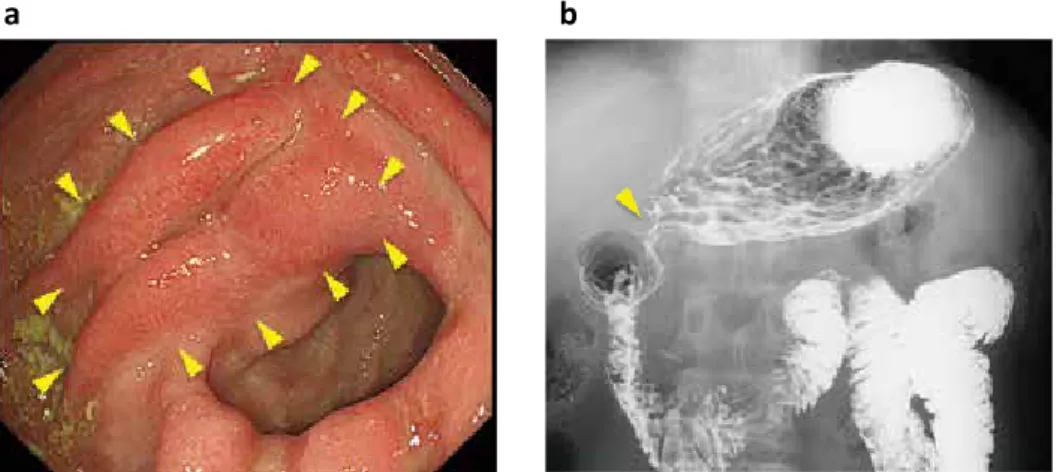
D1+ lymph node dissection was performed. The diagnosis of signet-ring cell carcinoma was confirmed by histology and the lesion was confined to the mucosa (Tis) without lymph node metastasis. No malignant cells were identified in both the prox-imal and distal stumps. The tumor stage was pT1N0M0. Fol-low-up gastrofiberscopy 16 months after the operation revealed suspected anastomotic recurrence, and gastric biopsy revealed signet-ring cell carcinoma (Figure 1a). Laboratory findings at the time of admission to our hospital demonstrated a hemoglobin level of 11.6 g/dl. Carcinoembryonic antigen (CEA) and cancer antigen (CA) 19-9 levels were not elevated (1.1 mAU/ml and 10 mAU/ml, respectively). An upper gastrointestinal series showed stenotic changes (Figure 1b) and wall thickening at the anasto-mosis. Open total gastrectomy was performed for the remnant gastric cancer. Intraoperative findings showed severe adhesion of the omentum and gallbladder at the previous anastomotic site, which was dissected sharply (Figure 2a). An adequate length of duodenum was dissected from the pancreas at the distal part of the previous anastomosis. Then, the duodenum was transected 3 cm distal to the anastomosis using a linear stapler (Figure 2b). Reconstruction was performed with a Roux-en-Y esophago-jeju-nal anastomosis. The operation lasted for 236 min, with blood loss of 30 ml. Histology revealed T1N0M0 signet ring-like cell carcinoma that was confined to the mucosa, with no malignant cells on the stump (Figure 2c). The patient recovered well post-operatively without any complications and was discharged from the hospital on postoperative day 14. The patient is alive without
The Journal of Medical Investigation Vol. 67 2020 LIST OF abbreviations
LDG : Laparoscopic distal gastrectomy CEA : Carcinoembryonic antigen CA 19-9 : Cancer antigen 19-9
Received for publication August 31, 2017 ; accepted January 6, 2020. Address correspondence and reprint requests to Daichi Ishikawa, Department of Surgery, The University of Tokushima 3-18-15 Kuramoto, Tokushima City, Tokushima, 770-8503, Japan and Fax : +81-88-631-9698.
212
D. Ishikawa, et al. Anastomotic recurrence after delta methodre-recurrence more than 3 years postoperatively.
DISCUSSIONS
This case report is the first to describe anastomotic recurrence at the anastomotic site after delta-shaped anastomosis in LDG and successful resection of the tumor.
With the increasing incidence of early gastric cancer and the development of surgical techniques and endoscopic devices, laparoscopic gastrectomy is being carried out more and more frequently all around the world. In Japan, according to gastric cancer treatment guidelines 2014 (4), laparoscopic distal gastrec-tomy is performed for cStageI gastric cancer in case an enough oral margin from the tumor at the resection can be obtained. Billroth-I anastomosis following distal gastrectomy has the physiological advantage of allowing food to pass through the du-odenum, and hence, is widely used as a standard reconstruction method. Previously, the anastomosis was usually completed by hand-sewing or circular stapling, both of which, however, are dif-ficult to duplicate laparoscopically. Kanaya et al first introduced the technique of intracorporeal delta-shaped anastomosis, which is a Billroth-I side-to-side anastomosis of the posterior walls of the remnant stomach and the duodenum using a laparoscopic
linear stapler (1). During the anastomosis, the staple line is in a “V” shape, which turns into a triangular shape after the anas-tomosis is closed ; hence, the name “delta-shaped anasanas-tomosis”. With increasing application of laparoscopic techniques in the radical treatment of distal gastric cancer, delta-shaped recon-struction has been widely adopted around the world.
As for the recurrence pattern of gastric cancer, Sasako et al reported that after initial complete resection of gastric cancer, 45.2% of recurrences occurred as peritoneal dissemination, followed by hematogenous recurrence (32.1%), lymph node me-tastasis (24.4%) and local recurrence (7.6%) (5). Anastomotic recurrence is considered as local recurrence, which means it is relatively rare. The incidence of early gastric cancer in the rem-nant stomach was previously reported as 1.8%, 53% of which de-veloped at the suture line (6). Another report showed that 57.1% of remnant gastric cancers occurred at the anastomotic site, most of which were advanced cancers (7). In the present case, the anastomotic recurrence has occurred although it was pT1N0M0 and no residual malignant cells were identified on the margin. Early gastric cancer has a favorable prognosis with 5-year survival rates of over 90% (8), however, it must be remembered that a few early gastric cancer have recurrence after curative gastrectomy. Wu et al reported that recuurence was observed in 30 out of 245 patients (12.2%) in early gastric cancer after cura-Figure 1. Preoperative examination. (a) Gastrofiberscopy showed the red-colored hypertrophic mucosa
on the delta shaped anastomosis indicated by arrowheads. Biopsy revealed signet-ring cell carcinoma and moderately inflamed gastric mucosa with regenerative epithelium. (b) Upper gastrointestinal series showed stenotic change at the anastomosis indicated by an arrowhead.
Figure 2. Intraoperative finding and resected specimen. (a) There was scarring at the delta-shaped anastomosis. Tumor was not exposed at the serosa. (b) Resected specimen. Yellow dotted line indicates the stapler made on the previous operation. (c) Pathological finding. Histology revealed T1N0M0 signet ring-like cell carcinoma.
213
The Journal of Medical Investigation Vol. 67 February 2020
tive resection(9). They described that 13 cases were confined tomucosa (Tis) and 26 cases had no lymph node metastasis, which was same as our case. A possible cause was micrometastasis at the time of operation.
Surgery for anastomotic recurrence after reconstruction by the Billroth-I method is technically difficult. Particularly in cases with delta-shaped anastomosis, an adequate length of the duodenum must be dissected from the pancreas in order to secure the margin from the tumor.
In cases with recurrence at the conventional Billroth-I anas-tomotic site, the duodenum can be simply resected immediately distal to the site of anastomosis. However, in cases of anastomot-ic recurrence after delta-shaped anastomosis, the resection line shifts distally by about 3 cm, because staples are placed on the posterior wall of the duodenum during the previous operation. This makes the operation for anastomotic recurrence after delta anastomosis more complicated. The duodenum around the anas-tomotic site should be adequately dissected from the pancreas and enough length of the duodenum must be secured for the resection. In our case, the remnant cancer was at an early stage and dissection of the duodenum could be performed without much difficulty, although adhesions were present around the anastomosis. However, when dissection of the duodenum is diffi-cult due to tumor invasion or more severe adhesions, pancreato-duodenectomy should be considered for complete resection of the tumor. In conclusion, we described the first case of anastomotic recurrence after delta-shaped anastomosis that was success-fully treated surgically. Gastrointestinal surgeons should be aware that cases of anastomotic recurrence at the delta shaped anastomosis will increase in the coming years as laparoscopic gastrectomy continues to become more widely adopted. The con-ventional remnant gastrectomy for the anastomotic recurrence at delta-shaped anastomosis can be performed at least for the early cancer for which the long margin is not required.
CONSENT FOR PUBLICATION
Written informed consent was obtained from the patient for the publication of this report and any accompanying images.
HUMAN RIGHTS
All procedures followed have been performed in accordance with the ethical standards laid down in the 1964 Declaration of Helsinki and its later amendments.
CONFLICT OF INTERESTS
None of the authors has any potential financial conflicts of interest related to this manuscript.
ACKNOWLEDGEMENTS
NoneREFERENCES
1. Kanaya S, Gomi T, Momoi H, Tamaki N, Isobe H, Katayama T, Wada Y, Ohtoshi M : Delta-shaped anastomosis in to-tally laparoscopic billroth i gastrectomy : New technique of intraabdominal gastroduodenostomy. J Am Coll Surg 195(2) : 284-287, 2002
2. Kitagami H, Morimoto M, Nozawa M, Nakamura K, Tanimura S, Murakawa K, Murakami Y, Kikuchi K, Ushigome H, Sato L, Yamamoto M, Shimizu Y, Hayakawa T, Tanaka M, Hirano S : Evaluation of the delta-shaped anastomosis in laparoscopic distal gastrectomy : Midterm results of a comparison with roux-en-y anastomosis. Surg Endosc 28(7) : 2137-2144, 2014
3. Hu GY, Tao F, Ji KW, Wang W : Comparison of delta-shape anastomosis and extracorporeal billroth i anastomosis after laparoscopic distal gastrectomy for gastric cancer : A sys-tematic review with meta-analysis of short-term outcomes. PLoS One 11(9) : e0162720, 2016
4. Japanese Gastric Cancer A : Japanese gastric cancer treat-ment guidelines 2014 (ver. 4). Gastric Cancer 20(1) : 1-19, 2017
5. Sasako M, Sakuramoto S, Katai H, Kinoshita T, Furuka-wa H, Yamaguchi T, Nashimoto A, Fujii M, Nakajima T, Ohashi Y : Five-year outcomes of a randomized phase iii trial comparing adjuvant chemotherapy with s-1 versus surgery alone in stage ii or iii gastric cancer. J Clin Oncol 29(33) : 4387-4393, 2011
6. Takeda J, Toyonaga A, Koufuji K, Kodama I, Aoyagi K, Yano S, Ohta J, Shirozu K : Early gastric cancer in the rem-nant stomach. Hepatogastroenterology 45(23) : 1907-1911, 1998
7. Li F, Zhang R, Liang H, Zhao J, Liu H, Quan J, Wang X, Xue Q : A retrospective clinicopathologic study of remnant gastric cancer after distal gastrectomy. Am J Clin Oncol 36(3) : 244-249, 2013
8. Sano T, Katai H, Sasako M, Maruyama K : The manage-ment of early gastric cancer. Surg Oncol 9(1) : 17-22, 2000
9. Wu B, Wu D, Wang M, Wang G : Recurrence in patients fol-lowing curative resection of early gastric carcinoma. J Surg Oncol 98(6) : 411-414, 2008