
アンモニア水溶液より晶出せるハロゲン化銀及びハロゲン化タリウムの結晶成長について
14
0
0
全文
(2) Vol. 5, No. I Joimral of Hokkaido CnAugei University (B) Feb., 1954. On the Crystal Growth of ^ Silver and Thallium Halide from Ammonium Hydroxide Solution. Masaaki YANAGISAWA. The Study of Chemistry, Asahiyawii Brancli, Hokknido Crakugei University.. WRiEng : 7^-i^-r-A^vk^ ^SW^^^^'r'y\m{~)kV ^ p /r- y^ ^ y ^ AO^rffir^'Mr--oi.^-c:. SYNOPSIS From the point of view of growth velocity, the numbers of nuclei have been determined and generally observable crystal planes have been (.111) for Silver Halide. and (110) for Thallium Halicle. Hillock figures have been observed as three or two-fold symmetry in accordance with the geometry of respective crystal plane and the conditions of dendiitic growth have been inspected, and, furthermore, the effects of co-existed substance on the. crystal habits have been investigated.. INTRODUCTION. The author reported on the crystal growth of Silver Chloride and Thallium Halide from liquid phase and from solid phase i. e. recrystallization phenomena, and determined the orientation of their defoimed structure.')-5). On the above heading-, crystal growth, the number of nuclei of crystal grains, the ciystal habits, the etching figure and hillockes produced on the crystal surfaces of. Silver Chloride, Silver Bromide, Thallium Chloride and Thallium Bromide crystallized from Ammoniacal solutions have been studied. In this reports, method of calclation of nuclei would be discussed and be compared with the experiments performed.. DETERMINATION OF THE NUMBER OF NUCLEI. The formation of new phase from a mother solution can be considered as involving two processes, the existence of three dimensional nuclei, and the growth of these. critical nuclei to macroscopic dimensions. The nuclei themselves are difficult to observe and count, and it appeares necessary to develop them to an observable size by growth.. As it is probable that number of nuclei is the function of the temperature .and the concentration of soiulion, let A?o be the number of nuclei which exist in the mother solution at time /o. At some later time t'-^l + dt some of these nuclei have grown to cri stcil, in other words, same number of nuclei have diminished and new crystals have. — 16 —.
(3) M.isaaki Yanarisywa born.. If the rate of loss of these nuclei i, e' the rate of growth of crystals is proportional to the number of nuclei -dn/. 'dt.. =tcN. •. (. 1. ). where k is the constant,. Hence N= t\',, exp ( - kt) ( 2 ) where No is the number of the nuclei which exist at time 1=0 If the linear rate of growth of crystals depends only on the function of the super.. saturation S, we can put. dr/dt-^f(s). ^. (3). where T is an average dimension of the crystal, which for iaometric crystals may be considered as the radius,. In regards to the function f'is~'i, under conditions must be satisfied when s>'0 , d-i'/dtX) (Crystal growth) . } when s=0 , cl'i'/i].t=() CEquilibrium state) \ (4) when s>0 , d]'/dt< 0 CCrystal dissolution) Substuting for / from (.3) to (2 ,\ we get. /V=/V,,exp(-./q-//(.)) Thus we can obtain N, by plotting log N against f from the equation. loyA^loy^-Aj-//(,s) (5) As the value of / s Ik. can be obtained from the other treatment,, the slope of log N — T line can be inspected.. Now, let u'Cr) be the weight of a crystal whose diameter is '( and A/Cf) be the number of crystals above stated.. Hence the total weights of crystals whose diameter are r become. (FO-)^VO>O-) (6) It the shape of a crystal may 'be glove, its weight become 4 7T)'3J/3, and may be cylinder, its weight become ni'2ho. where d is specific gravity and h is the height of cylinder. It has been found that the relation between h and T h-'.f-s (.for Silver Chloride ). (7). h' .const. Gfor Silver Bromide) form the experiment as described later, we get. ff7(r) - N, exp ( - k,/A s~) ^fd ( 8 ) where b:=2.8 for Silver Chloride and b= 2 for Silver Bromide. 17 —.
(4) On the Crystal CTi'owtli of Silver and Tlialllmn Halifle from Aiuinonuun Hydroxicle &lntion.. EXPERIMENTAL. (D 0.1 c.c. of Ammonium Hydroxide solution which contain 0.348, 0.174, 0.087, 0.044 or 0.022 mol/L. Silver Chloricle, and saturate, 0.122, 0.061, 0.030, 0.015 or 0.007 mol/L. Silver Bromide has dropped on a deck glass and spreaded on the area 1.5 X 1.5 cm2, and has been kept at constant temperature 15°, 20°, 30°. 40°, 50°, or 60°C respectively,. The particle size distribution has been observed by means of the phase contrast microscope.. Thus the number of crystals N(r) which have had radii between 1". Wi. and ";'+(/)' can be determined and. therefore W\T,i has been also determined,. By plotting \V^r~) against r, we, can get the curve which have maximum as illustrated schematicaly in Fig. 1 The position of the maximum on these W\.~() against T curve is. corresponds to the differential cofficient equal zero in eqn. (8). Let the radius which corresoond to the maximum point be fu shown to be. Il'ig. 2 -5,0. r^bf^/k.. observation of Silver Chloride crystal. /. 1o^. (9). On the value of b, from the. /. -<;!. grains which had been enclosed by. /•. -t>.2. and 7'm is easily. (Ill) crystal planes as illustrated in. /. Photo. 1, their massive shape might. /e. be reduced to cylindrical form and by plotting log 1' against log h, the. -?.3. linear relation could be obtained as shown in Fig. 2 and thus v/e get /i=r°'8, therfore 6=2.8 for Silver. -54. Chloride. As for Silver Bromide, their shape iT -S-4-. -u. -^.2. are hexag-onal or trig-onal plane -fc.T. -?. 18 —. which correspond to 011) plane and.
(5) Masaaki Yanagisan'a. interferance colours have been observed whithout distinction of size of crystal, therefore we may treat the height of crystal is relatively constant for two dimenslohnal plane; then we may take b=2 for Silver Bromide.. Hence ;-,,,^2.8/(s)/& for Silver Chloride. (10). ;-,,>=2/(s)/A . for Silver Bromide. Putting- the experimental value of rm into above eqn, C9), it is found that the value of f^s~)/!{ as shown in Table 1 and 2 are almost constant when the initial concentration Table. u cone. . ~-. 20°. 12°. I 40°. 30°. 60°. 50°. mol./L 0.348. 1.04 x 10-i. 1.04 x io-i. 1.34 x I0-i. 1.04 x 10-'. J.19+ I0-i. 1.04x 10⁻⁴. 0.174. 1.04. //. 1.04. //. 1.04. //. 1.04. //. 1.16. //. 1.04. //. 0.087. 1.04. //. 0.74. //. 1.04. v. 0.74. //. 0.89. v. 1.04. //. 0.044. 0.74. //. 0.45. v. 0.74. //. 0.74. //. 0.87. //. 0.55. //. 0.022. 0.74. //. 0.45. //. 0.45. v. 0.45. //. 0.45. //. 0.53. f/. Table c. cone.. mol/L. 15°. 20°. 2. 30°. •-10°. 60°. .50°. 2.31 x IO-4. 2.31 x 10-'). 1 87 x 10-<. 2.31 x 10--1. //. 1.89. //. 1.89. v. 1.89. v. 1.47. //. 1.04. //. 1.04. //. 1.04. //. 1.04. f/. 0.63. //. 0.63. //. 1.04. //. 0.63. v. 0.63. //. 0.63. f/. 0.63. //. 0.63. //. 0.63. //. 0.63. //. 2.73 x 10-'. 0.122. 2.73 x 10⁻⁴. 0.061. 2.31. //. 1.89. 0,030. 1.04. ,7. 1.04. 0.015. 0.63. ,7. 0.008. 0.63. //. v. Table 3 (J. 50°. 60°. w. 5.10x I Os. 4.08 xl0». 4.81 x. 468x10''. 2.00 x 10⁷. 1.95 x 10⁷. 1.6Sx IO?. 1.49x 10". 2.00 x 10". 2.34 x 10". 2.40 x 10". 2.7.3 x 10". 2.95x10". 3.1.0 x 10r>. 2.44 x 10". 4.00 // 10.'-. 4.15x 10". 3.50 x 10". 40°. 50°. 60°. 12°. 20°. 30°. 0.348. 5.76 x 10s. 2.04 x 1 QS. 3.09 x 10s. 4.08 x. 0.174. 2.70 x 10?. 4.68 x 10⁷. 3.47 x 10⁷. 4.17x 10⁷. 0.087. 1.78x. 1.39x 10?. 0.044. 1.63 x 10". 0.022. 1.82x 10r'. cone.. -.... moI/L. w. 40°. w. Table 4 °c uonc. - -. mol/L. 15°. 20°. 30°. ?. 1.05 x 10⁶. 0.122. 2.63 x 10⁵. 1.55 x i 05. 1.39x 10". 1.24x 10r'. 1.60 x. 0.061. 1.95X 10-i. 6.67 x lO'i. 7.60 x 1C". 4.28 x 10<. 4.90 x 10'<. 5.38 x IC'». 0.030. 5.38 x 10⁴. 7.77 X lO'l. 4.27 x 10'!. 2.89 x 10⁴. 3.02 x 10⁴. 3.63 x. 0.015. 2.46 x lO'i. 3.47 x 1C"!. 0.83 x 10⁻¹. 2.40 x. 1.70 x lO-i. 1.78x 101. 0.008. 6.80 x 10³. 4.08 x 10³. 5.14x 10s. 15.2x 10³. 9.55 x. 3.02 x 10'. 19 —. w. 10.--. w.
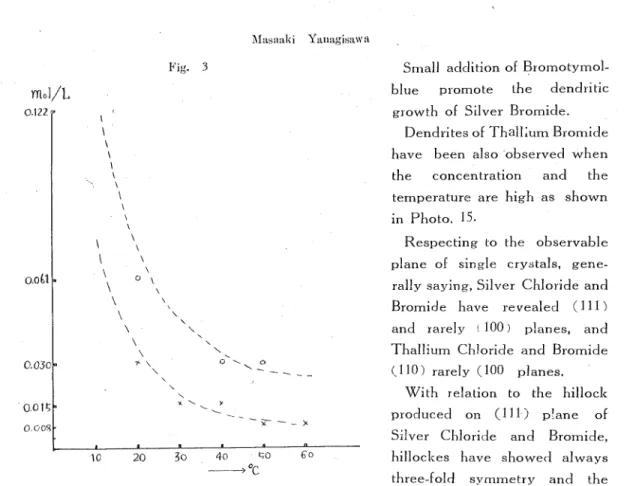
(6) On the Crystal (-i-rowth of Silver and Tlialliuin Halide from Anunonium IIydroxide Solution.. is constant and that the higher the concentration becomes, the more the /(s)/^ increases.. In the eqn. (5). from f(.s~)lk as described above, the intercept of log TVi.r) against log- T line with the ordinate for Y=o gives a value of A/, The results obtained are shown in Table 3 & 4 and it is found that the higher the concentration, the more the number of nuclei increases.. EXPERIMENTAL (ID Silver Halicle and Thallium Halide may easily produce complex salt with Arnmonium Hydroxide, and as it is necessary to decide if the crystal deposited as described above are complex or not, X-ray Debye-Scherrer method has been applied to these crystals.. Phto. 3 ~ 6 show the cliffraction rinss vi'-hich have been obtained under conditions ; tube current is 7 mA., tube voltage 50 K.V., camera cliaineter SO m.m., and Copper. target and Nickel filter were usec!, As for Silver Chloride and Silver Bromide which belong- to Soc!ium Chloride type crystal lattlce, cliffraction ring's are (111), G200), (220), ............ from the inside and as. for ihallium Chloride and Thalliurn Bromide which belong to Cesium Chioricle type crystal lattice, diffraction rings are ClOO'1, (^110), ............... from the inside, and all. cliffraction rings are in agreement \\rith the theoretical value of Silver Chloricle, Silver Bromide, Thallium Ch!oricle and Thallium Bromide, respectively, as to the position and their intensity.. DENDRITIC GROWTH AND CRYSTAL HABITS. Generally saying, crystal planes which have slower growing velocity become. observable, but have the higher one become Lo be put out of sight- by the former planes, and, under proper condition, growth to the special direction begin to predominate. and thus the crystal have the dendritic form. This phenomena is very remarkable in metals and alloys(i)—8) when solidfied from the molten state, and for ionic crystals the author has reported before. '>1;5'> In the present experiment, some of the crystals have shown the denclntic growth.. As for Silver Chloricle, dendritie growth have not been observed but by the small adittion of Fucshine, Safranine, or Methyl-violet, dendritic growth whose directions are CIOO^I have been observed as illustrated in Photo. 7 & 8. As for Thallium Chloride, by evaporating its Ammonium Hydroxicle solution or the same solutions with small aclittion of Lead ion, or Phenol-phthalein, clendritic g-rowth have been observed as illustrated in Photo. 9, 10 & 11. As for Silver Bromide, rlenclrites have been observed when the concentration and the evaporating temperature are high and single crystals only have been observed. when the both- factors are low, and the middie range has not reproclucibility displaying denclrites in some case and single crystals in another case, as this relation is revealed. in Fig. 3. Dendrites whose directions arc 012^) are shown in Phlo. 12, 13 & 14. - 20 -.
(7) Masaaki Yanagisawa. Table 5 Bromotvmolblne. Metyl-orange. i~'afr!inine. Observable. (Ill) very. (Ill). (Ill), rarely. Silver. Crystal Plane. clearly. clearly. (100).. Chloride. Dendritic Growth Observable. Silver Bromide. not. not. observed. observed. (Ill). (111). Clear Hillock.. Ciystal Plane Dentlritic ai'on'th Observable. Thai Hum. Crystiil Plane. Cliloricle. Dendritif Hrowlli. observed. observed. nnshapely. Litnins. (Ill) not observed. (Ill). not. not. not. observed. observpil. observed. irreKulnr. irreRUlar. inconsidcralile. small. clear (110), rarely (100).. nnsliaiiely.. not. not. observed. oliserved. Ot)sorvnt)Ic. (110),. irregular and. ( 110)somewh;u. (110). Tlinlliuin. Crvstnl Plane. rarely (100). very small. unsliapcly. uucertainlv.. Bt'omicle. Deiiih'it.ic (Ti'onth. not. not. not. not. observed. observed. observed. observed. Mctliyl violet. Phenolphthlein. Brucine. I* luorescein. Silver Cliluriile. Obseryable. (Ill). Crvstal Plane. Very clear. Dendrkic Growth Observable. Silver. Crystal Plane. Bromitle. Demlritic Uron'th Observnhle. Thalliuin. Crystal Plane. Cliloride. Dendritic Orowlh. (Ill) not. olisrrved. (Ill). (in), rarely (100). small hnt remarkable. (Ill) but. not. not. ohyerved. observed. (HI). (Ill). unshsipely nut. slightly. observed. nnshapely. (100) and. (110). not. observeil. ohscrved. Observable. (100) and. ThaUitun. Crystal Plane. (110).. Bromitle. Dendritic Growth. (Ill). (110). remarkiihle. not. (1.12). observed. (100) ;ind. jirohabely. (110). (100). obsencil. unshnpely. observed,. probably (110). (110) & (100) pro) mb I y (III). not. not. not. not. observed. observeil. oliserved. oliserveil. — 21 —.
(8) On the Crystal Growth of Silyer sunl Tiiallium Halide froni Ammoninin Hydroxide Solution.. Alizariuered. (11II) large an'd. Metvl-red. Eosine. (Ill). (Ill). Joiloeosinc. Maliichiteyreeu. (HI). (Ill). regular not obeerved. (!•11) very. not observed. not observed. (HI). (Ill). clear. observed. (Ill), somewhat. Hill ock. nnshapely*. not. not. not. not. observed. observed. obKuervecl. unsliapelv. nnsliapely. ilHBhapely. (110) and (100).. nnsluqiely. not. not. not. not. observed. ohKerved. observed-. unsliapely. nnslinpely. uusha^ely. unshapely. not. not. not. not. observed. observed. observed. observed. Aniline oranye. Alizarine. Tymol blue. Fuchsine. (I) I ^comparatively. not observed. observed. reratively. unshapely. observed. (1)1), clear. ovseryed. liH-SG. not. not. (Hi), (ioo). (Ill). sliglitly. Urea. (Ill). (11.1). (1 CO). not observed. (Ill). not. remarkable. not. observed. (110). observed. not observed. (Ill). (Ill). (Ill). (Ill). clearly not. not. not. not. ohserved. observed. ohsGi'ved. observed. unsliapfily. nnsliapely. nnshapely. oiiserved. comparatively. Hnshapely. unshupely. not observed. observed. (110) proliably. comparatively. (100) observed, probably. (110). — 22 —. nnsliapely. not. not. observed. observed. BniilH, probillily. (110). not ol iservcd. (110). unsliupelli not. not. observed. cbserveil.
(9) Musanki Yaiiaglsan'!l. Fig. 3 Small addition of Bromotymolblue promote the dendritic. rriol/L. growth of Silver Bromide.. 0.122 r. \ Dendrites of Thalllum Bromide \. have. been. also. observed. when. ^ the concentration and the \ ^ temperature are high as shown \. \. in. Photo.. 15.. \ Respecting to the observable plane of single crystals, geneo.oM. \ \ rally saying, Silver Chloride and •-^ Bromide have revealed (111) \ \ and rarely (100) planes, and \ \^ Thallium Chloride and Broinide. 0.030. ^\ ""^---^ (.110) rarely (100 planes.. \ With relation to the hillock 0.01>; o.ow,. ^- . >. ~i<~ ~ - x. J!_I—. 9—a-. produced on (111) plane of Silver ChloriL4e and Bromide,. 10 20 3o 4o TO So hillockes have showed always °c. three-fold symmetry and the. direction of lines which, form above figure of hillocks are generally C1103> next C1123 and rarely C12-D as illustrated in photo. 16, 17, 18, 19, 20 and 2), and these directions agree with-the order of atomic density on (111) crystal plane of Soclium Chloride type lattice. On the (110) plane of Thallium Chloride and Biomide, hillocks have not produced clearly and have been observed two-fold symmetrical figure fcuntly. Furthermore, the effects of co-existed organic substances, Methylvioiet, Phenolphtalein,. and etc., for the above crystals have been studied and the results obtaincl are summarized in Table 5, where some of co-existed substances promote the clenclritic growth or another ones promote to make an appearance of abnormal crystal pianes.. CONCLUSION. From the present investigation, the author concludes as follows : C 1 .) The numbers of nuclei have been calclated at the point o.f view of growth velocity and it has been found that they increased with the concetrantion of the solution. C 2 ) That Silver Chloride or Bromide, and Thallium Chioride or Bromide deposited, respectively, from the Ammonium Hydroxide solution was not the complex, has been inspected by means of X-ray Debye-Scherrer method-. C 3 ,) Dendritic growth has been observed on these crystals except Silver Chloride in the case of evaporating their Ammonium Hydroxide solution, and the higher the temperature and the concentration become, the more the clendritic crystals grow-. (, 4 ) Ordinarily observable crystal plane is (,111) for Silver Chioricle and Bromicle, and (.110) for Thallium Chloride and Bromide, but rarely ClOO) come out for these both — 23 —.
(10) On [lie Crystal CTi-on'th of Silver and Thalliiirn H;i1i(le i'rom AininDiilnm Itydroxide Solution. type crystals-. C5) Three-fold symmetrical hillock figures have been observed on (111) plane of Silver Chloride and Bromide, and two-fold symmetrical figures on (110) plane of Thallium Chloride and Bromide, and lines which form three-fold symmetrical figure. are C110), 0123 or C1233 C 6 ) The effects of co-existed organic and inorganic substances have been examined, and some of these substances have the remarkable effects, for example, Lead ion clarify (.110) plane of Thallium Chloricle and Fuchsine promote the dendritic growth of Silver Chloride which generally grow to the single crystalsAcknowledgment. A part of tlie expense of tliis investigation was del'rayetl I'rom tlie Scientific Kesearuh Expenditure of tliu Miuistry of E(lncatit>n. The author wishes tu express liis sincere (hiinks to Messers T. Igaraslu ami M. Kaiuogan'a for tlieir assistance ou u purt of tills inveBtigation.. LITERATURE CITED ( 1 ) M. Yanagisawa, Bull. Inst. Cliem Res Kyoto 27 (1951) 51. (2) Ibid. 28 (1952) 13 (3) Ibid. 31 (1953) 20. (4) J. App. Phys. Japan 21 (19.52) 16. (5) Mem. Holvkaido Lkl. Arts Univ. 4 (1953) (6) D. Lavender, Eisenliiittenwes. 23 (1952) 39. (7) K. Loberg. Z. Metalk. 43 (!952) 50. (8) M. Yanagisiiwn. Mem. Bliiga Univ. 2 (1953) 25.. 24 -.
(11) Masaaki Yanagisnwa vl>'*/ .•<. R?''-.^^,..^" >;^-;fyl<l'->'^'.r-w'. r/^w:".l'.:<^'":-',-<'1. l^;'^ • •. ,..'•.,6 ^' '• Ip.". •'. ^-. r^.~ • '..'•).. ,-.. -. .1'". •','. Sy V'^-.-;•'''* 4kl. Photo. 2.. Photo. I.. Distribution of Silver Chloricle. Distribution of Silver Bromide. Crystals.. Crystals.. Photo. 3. Diffraction rings of Silver Chloride. Plioto. 4. Dift'raction rings of Silver Broinide.. Photo. 5. Diffraction rings of Thallium Chloride.. — 25 —.
(12) On tlie Crystal CTi'owtIi of Silver and Thiillium Halide from Aminoninm Hytlroxide Solution.. Photo. 6. Difi'raution rinRS of Tjiallium Broinide.. ^ -; ..gyv&.-f *• •• :iS'". . "Wfi&y. •A. <!- «i;i;i't^. ' 5!^ '<%(>>, .N. .y' ..^^/frm^'. .a<S^K , '"i ' *?. yy. ii*. :yy;. <%,.,»rf!. Photo. 7.. Photo. 8.. Dendrite Crystals of Silver. Dendrite Crystals of Silver. Cllloride by the small aclittion of. Chloride by the small adittion. Fucshine.. of Fucbliine.. Photo. 10.. RIioto. 9.. Dendrite Crystals of TIialliiun. Dendrite Crvstiils of Tliallium. Cliloridc.. Cliloride.. — 26 —.
(13) Masaaki Yunagisawa.. Iffl.%!yll!j?S8BSII. Photo. 11.. Photo. 12.. Dendrite Crystals of Thullinm. Dendrite C'rystals of Silver. C'tilorule.. Brnmide.. Photo. 13.. Plioto. 14.. Demlrite Crystals of Silver. Demlrite Crystals of Silver. Bromide.. Bromide.. maa-\v. Photo. 15.. Photo. 16.. Hilloclc figure on (111) plane. Dendrite Crystals of Tlinlllum Bromide.. of Silver Chloride.. — 27 -.
(14) On the Crystal Growth of Silver and Thallium Halicle from Ammonium Hydroxide Solution.. ^ V- *. b."i <<. "N. ^. .^&. f^-M. C^'4^. w>. :°9A^a. Photo. 18.. Photo. 17.. Hillock figure on (111) plane. Hillock figure on (111) plane. of Silver Bromide.. of Silver Bromide.. lli:ts/ -'^'ms'^ss's. l-^^Y'^.l^l;ligig. l&wiS&?ISBI! ^WSS'SK. j*'./2&;l-';:,.^l,'i''''^"s:>;. MitSiliSlr^i'. <t!' -;;;:&^ •l.i'vHS®-^. "st0&-)-". Photo. 20-. .Plioto. 19.. HHIodi figure on (HI) plane. Hillock rigure on (111) plane. of Silver Bromide.. of Silver Broinnle.. Photo. 21.. Hillock figure on (111) plane of Silver Bromitle.. — 28 —.
(15)
図
関連したドキュメント
An easy-to-use procedure is presented for improving the ε-constraint method for computing the efficient frontier of the portfolio selection problem endowed with additional cardinality
It should be noted that all these graphs are planar, even though it is more convenient to draw them in such a way that the (curved) extra arcs cross the other (straight) edges...
Now we are going to construct the Leech lattice and one of the Niemeier lattices by using a higher power residue code of length 8 over Z 4 [ω].. We are going to use the same action
Then it follows immediately from a suitable version of “Hensel’s Lemma” [cf., e.g., the argument of [4], Lemma 2.1] that S may be obtained, as the notation suggests, as the m A
In the case of the KdV equation, the τ -function is a matrix element for the action of the loop group of GL 2 on one-component fermionic Fock space, see for instance [10, 20, 26]..
The proof uses a set up of Seiberg Witten theory that replaces generic metrics by the construction of a localised Euler class of an infinite dimensional bundle with a Fredholm
Rostamian, “Approximate solutions of K 2,2 , KdV and modified KdV equations by variational iteration method, homotopy perturbation method and homotopy analysis method,”
Using the batch Markovian arrival process, the formulas for the average number of losses in a finite time interval and the stationary loss ratio are shown.. In addition,
