A model of Senegalese FSWs
著者
Ito Seiro
権利
Copyrights 日本貿易振興機構(ジェトロ)アジア
経済研究所 / Institute of Developing
Economies, Japan External Trade Organization
(IDE-JETRO) http://www.ide.go.jp
journal or
publication title
IDE Discussion Paper
volume
677
year
2017-08
INSTITUTE OF DEVELOPING ECONOMIES
IDE Discussion Papers are preliminary materials circulated to stimulate discussions and critical comments
Keywords: sex work, stigma, registration, impacts JEL classification: I12, I15, I18
* Director, Microeconomics Study Group, Development Studies Center, IDE ([email protected])
IDE DISCUSSION PAPER No. 677
A model of Senegalese FSWs
Seiro Ito*
August 2017
Abstract Sex workers supply sex acts out of bare necessity for survival. They are
often stigmatised of their profession and worry about being known to others. Effectiveness of registration policies that intend to reduce harms of sexually transmitted infections may be reduced by such stigma. To understand the responses of sex workers to a registration policy, we develop a model of sex worker supply with stigma under a simple labour supply framework. We show that sex workers with lower asset levels decide to register and they supply more sex acts. In the extension of the base model, we consider effects of other earning opportunity, STD infection risks and their treatment possibilities, and presence of different client types (occasional and regular). Results of the base model are shown to be maintained.
The Institute of Developing Economies (IDE) is a semigovernmental, nonpartisan, nonprofit research institute, founded in 1958. The Institute merged with the Japan External Trade Organization (JETRO) on July 1, 1998. The Institute conducts basic and comprehensive studies on economic and related affairs in all developing countries and regions, including Asia, the Middle East, Africa, Latin America, Oceania, and Eastern Europe.
The views expressed in this publication are those of the author(s). Publication does not imply endorsement by the Institute of Developing Economies of any of the views expressed within.
INSTITUTE OF DEVELOPING ECONOMIES (IDE), JETRO 3-2-2, WAKABA,MIHAMA-KU,CHIBA-SHI
CHIBA 261-8545, JAPAN
©2017 by Institute of Developing Economies, JETRO
No part of this publication may be reproduced without the prior permission of the IDE-JETRO.
A model of Senegalese FSWs Revised August 22, 2017
Seiro Ito*2
AbstractSex workers supply sex acts out of bare necessity for survival. They are often
stigma-tised of their profession and worry about being known to others. Effectiveness of registration
policies that intend to reduce harms of sexually transmitted infections may be reduced by such stigma. To understand the responses of sex workers to a registration policy, we develop a model of sex worker supply with stigma under a simple labour supply framework. We show that sex workers with lower asset levels decide to register and they supply more sex acts. In the exten-sion of the base model, we consider effects of other earning opportunity, STD infection risks
and their treatment possibilities, and presence of different client types (occasional and regular).
Results of the base model are shown to be maintained.
1
Introduction
Many countries have been banning prostitution on moral and public health grounds. Such ap-proach is broadly considered as criminalisation of prostitution. Criminalisation is considered to be less effective than policymakers intended, because a ban that criminalises offenders often does not reduce the demand for it due to lux enforcement, while illegalisation pushes the sex industry to un-derground that public health officials cannot easily approach. It is thus natural that harm reduction and more controled approach to prostitution is widely discussed both in policy and academic arena (Rekart,2005).
Harm reduction imposes regulations and provide assistance to minimise harms (Ritter and Cameron, 2006). It is often proven to be effective to curve HIV infection under an injection drug user (IDU) context focused on needle syringe programs (Cook et al., 2016). Under the sex work context, it involves regulations on sex work and assistance to sex workers. To keep activities under the regulatory purview, it is essentially coupled with partial decriminalisation. In Senegal, brothels are illegal and criminalised. While decriminalisation does not penalise sex workers who comforms with medical checks and carrying cards, it does criminalise brothel owners/managers. Consequently, sex workers who intend to supply many sex acts need to solicit clients in more noticeable places.
There is a wide spectrum of regulations, from location, venues, hours, to registration and period-ical testing of sexually transmitted diseases. Assistance includes free distribution of condoms, free medical and psychological counselling, and access to free medical care. There is, however, little research that indicates how the sex work will be affected by regulatory and assistance policies.
In this paper, we use Senegal as an example and model how a decriminalisation policy may affect the sex work supply. Senegal is a predominantly muslim country that decriminalised sex work in the 1960’s and keeps the HIV prevalence rate to the second lowest level in Africa. The base of policy is registration: A sex worker must register at a public health facility to be issued a card, and is required to visit a clinic every month to check health conditions. If one fails to carry a valid card when soliciting a client, one faces a risk of an arrest and may be sentenced to a fine or a prison term. Not all the sex workers decide to register. There is a strong fear and stigma among the sex workers about being known by family members and friends about their sex work. The card is easily noticed by others about the sex work, and all sex workers show unwillingness to carry a card.
There are two types of location: Public and private. Public places include bars, clubs, and streets. Private places are mostly residences. Arguablly, in the public places, market size is bigger and
*2Development Studies Center, IDE, Chiba, Japan. I would like to thank Aur´elia L´epine, Carole Treibich for their
comments on the earlier draft and their generousity to share the survey data from Senegal. I would also like to thank partiticipants at the IDE Workshop on Trade and Development, 2017, for their comments. I would like to thank Akiko Sasaki, Hiroshi Fukai, and Junko Shimazoe for their administrative supports. All the remaining errors are mine.
clients are a mix of occasional and regulars. In contrast, in private places, market size is almost fixed and more regular clients are found. Sex workers in the private places often choose not to register, because they are less likely to be spotted by police and they have a higher risk of being seen by family members and friends. Sex workers in public places tend to register because they are more visible and easily noticed by police.
In the following sections, we will model the sex act supply in the spirit of traditional labour supply framework. We will show that low income induces sex workers to register, and take more clients.
2
A model
2.1
Facts and modeling ideas
In the descriptive statistics section of the companion paper (Ito et al., 2017), we have seen that the registered FSWs differ from nonregistered FSWs in the following aspects: Work at more visible location, take more clients, take more occasional clients, earn larger incomes, take more risks, and feel more stigmatised. In addition,Figure1shows that they are less educated, less likely to live with children or other family members. From these, we can see that one of the advantages of registration is a bigger market size. In fact, as in Table A1 in the below shows, nonregistered FSWs charge a higher prices on average to both occasional and regular clients, yet earn less incomes from them than registered FSWs (Figure2). This suggests that they supply less amount of sex acts. We take this empirical regularity in our data to conjecture that registered FSWs are more in need of earning cash incomes, and they enjoy a smaller repercussion of their supply behaviour on prices in a big market rather than facing a downward sloping demand curve in a small market. We also note that the clients do not ask to show the registration card, so FSW registration status does not directly affect the terms of sex act transactions once the clients and FSWs started negotiation. Indeed, unlike
Edlund and Korn (2002);Immordino and Russo (2015), we do not model the demand side or any strategic interactions to keep the model tractable. This is also in line with the facts that our focus on the decision making process of FSWs, not the market equilibria, and that our data only provide information of clients but not the potential clients which are necessary to empirically analyse client’s self-selection process.
Table 1: Mean prices charged, by registration status and client type (tail 5% are trimmed) type min 25% median 75% max mean std n
registered, occasional 3500 6000 10000 17500 35000 12550.7 7559.2 227 registered, regular 4000 7000 12500 20000 45000 14787.5 9869.8 240 not registered, occasional 3500 7500 12500 17500 40000 14187.5 8702.7 168 not registered, regular 4000 7625 13125 20000 57500 16458.7 11154.6 266 Note: An occasional client refers to clients that came once or a few times but someone you don’t
know or you wouldn’t recognize the face. A regular client is all other clients. Source: Summarised from data collected by L´epine and Treibich.
2.2
A setup
A FSW is endowed with an asset A ∈ R, lives with n children, and faces a unit price w > 0 for a sex act. We assume that n is exogenously given. She chooses the number of acts a to maximise her utility. There is a probability Pr[k = 1] = δD ∈ (0, 1) of being known by someone close that she is working as a FSW, an event denoted as k = 1. This probability is assumed to be increasing in both
a and n, and further assume that it is differentiable up to second order and the cross derivative is
nonnegative. She feels stigma g= g(A), g′ > 0 of working as a FSW once she is found by someone close. We assume that stigma is increasing in the asset level A based on the presumption that, the wealthier one gets, the more worried of the bad reputations stemming from engaging in a commercial sex work, or A is positively related to social class. So this may also be termed as extrinsic stigma, as
0 10 20 30 Sw aziland Lesotho Botsw ana South Afr ica Zimbabw e Namibia Zambia Mozambique Mala wi Uganda K en y a Equator
ial Guinea Tanzania Cameroon
Gabon CAR Cote dIv oire Niger ia Rw anda South Sudan T ogo
Angola Chad Gambia Ghana Guinea
Mali Sierr a Leone Benin Liber ia Bur undi Cape V erde Maur itius Bur kina F aso DRC Er itrea Maur itania Niger Senegal Madagascar country percent
adult prevalence rate
Source: Data from UNAIDS 1990-2015.
Figure 1 Adult HIV prevalence rate estimates
0 500000 1000000 0 500000 1000000 not registered registered 20 30 40 50 60 age per month earning by age
Source: Data collected by L´epine and Treibich.
we call it so later.*3 We also assume:
u′(c)> 0, u′′(c)⩽ 0 ∀c ∈ R++. Her utility is given by
U = u(c) − δD(a|n)g(A). So her problem is max {a} u(c)− δ D (a|n)g(A) s.t. wa+ A = c (p0)
Assuming an interior solution, FOC is:
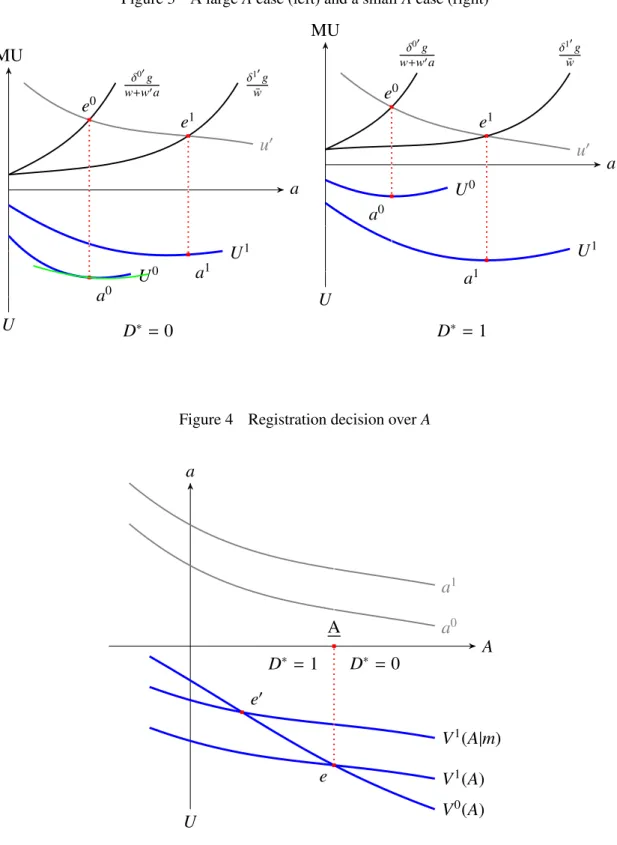
F ≡ u′(wa∗D+ A)w− δD′(a∗D|n)g(A) = 0. (1) We assume the second order condition for a maximum is satisfied.*4 This relationship in (1) is depicted in the Figure 3 as an intersection e1 between u′ and δD′g
¯
w . She chooses a to equate the
increase in marginal consumptive utility and the increase in expected marginal costs of stigma. The value of realised utility U1 is depicted in the lower half of the figure, and it reaches its maximum
at a1∗. It can be argued, and we will assume so hereafter, that registration D = 1 as a FSW at the government increases the probability of being known from δ0(a|n) to δ1(a|n) for all a and n,
δ1(a|n) > δ0(a|n). Because g(A) > 0, the optimal acts a1∗ decreases from a0∗ and, as long as
δ0(a0∗|n) ⩽ δ1(a1∗|n), so does the maximised utility from V0 = u(wa0∗ + A) − δ0(a0∗|n)g(A) to
V1 = u(wa1∗+ A) − δ1(a1∗|n)g(A), so she will not register.
Let us consider the effects of A and n. We can show that da∗D/dA ⩽ 0, da∗D/dn ⩽ 0.*5 A
represents an asset to be consumed. But this also captures the consumption needs by other family members, or some form of tax on sex work earnings. When a FSW has more number of dependents, then we can express it as a low value or as a negative value of A which limits the consumption for oneself. In a way, A also represents the preferences which considers other member’s consumption as if one’s own.*6 A negative A can also be considered as a lump sum tax on FSW earnings. A also works to magnify the fear of being known.
2.3
Registration
It takes some penalty of nonregistered status D = 0 or benefits of registered status D = 1 to induce registration given the increased chanceδ1 > δ0 of being known under registration than non-registration. Registration can bring three benefits: First, one can access a bigger market to take more
*3We can allow stigma to be nonzero even when not being found out. I normalise this baseline stigma level to zero
for simplicity. We can also allow for stigma to be variable with a by letting b1a+ b2Ak. It does not change results
qualitatively. I set b1= 0 for simplicity. *4
u′′w2− δD′′g(A)< 0 at a = aD∗
The sufficient condition for SOC δD′′ ⩾ 0 is satisfied at small values of δDfor a commonly used density, such as logistic distribution atδD⩽ 1/2.
*5By totally differentiating FOC (1), we have
da∗ dA = − u′′w− δD′g′ u′′w2− δD′′g ⩽ 0, da∗ dn = δD ang u′′w2− δD′′g ⩽ 0, if δ D′′ ⩾ 0,
δD′′ ⩾ 0 is implied in the second order condition as we assumed in*4.
*6One can extend this to incorporate other-regarding preference by changing it to u(c, z) where u(·, z) measures the
other-regarding utility and the budget is changed to wa+ A = c + z. 4
clients. This corresponds to the finding in our data that registered FSWs do not take clients in the obscure corners of the town but in the public places such as streets, bars, clubs, and hotels. In some respect, FOC in (1) is analogous to the textbook monopolist behaviour in which the monopolist must take declining marginal revenues and increasing marginal costs into account. In our case, the FSW must take declining marginal utility stemming from declining marginal revenue (and concave utility), while contrasting it to the marginal costs of being known. We will follow the analogy of price takers to contrast the registered status with the nonregistered, and assume w is fixed in the registered FSW market. Second, she will be able to use the health care services at a lower cost. This reflects the characteristics of the actual regime in place in Senegal and other countries which adopt the harm reduction approach. Our data also confirms that registered FSWs acknowledge the health care cost advantages. Third, registered FSWs will not be arrested by the police. Again, this is another characteristics of the regime in place which is also given by the registered FSWs as the benefits of registration. We will consider the first two aspects in the following.
Let us assume that under D = 0, one faces a smaller market such that w = w(a) with w′ < 0. On the contrary, under D= 1, one becomes a price taker and w = ¯w for ∀a ∈ R+. Then, the Lagrangian under D= 0 is L0 = u(c) − δ0 (a)g(A)+ λ0[w(a)a+ A − c] while under D= 1 is L1 = u(c) − δ1 (a)g(A)+ λ1[ ¯wa+ A − c]
Assume the following:
Assumption 2.1 1. w(0)= ¯w 2. δ1 (0)= δ0(0). 3. δ0′
(a)⩾ δ1′(a)∀a ∈ R+.
1 is a normalisation assumption to make the comparison between two problems easier. One can relax it and allow w(a)= ¯w + z for a, z > 0 small and maintain a1 ⩾ a0 in the equlibrium, which may be more consistent with our data. 2is another normalisation assumption which may be justified on the ground that a zero sex act would not reveal anything. Again, this can be relaxed and may not be necessary for A small as they will choose aD > 0. 3is a sufficient condition for the nonregistered
status to induce a greater expected marginal stigma by a. This may be justified with a smooth density, as there is a discrete jump fromδ0(a) toδ1(a), it requiresδ0 to increase more rapidly thanδ1. Note this holds if d2δD/da2 = 0.*7
Assuming a> 0, FOCs are L0
c = u′− λ0 = 0, L0a = −δ0
′
(a)g+ λ0[w(a)+ w′(a)a]= 0, L1 c = u′− λ 1 = 0, L1 a = −δ 1′ (a)g+ λ1[ ¯w]= 0.
*73may look like a strong assumption but asδ1(a) jumps more as a becomes positive, we haveδ1(a) > δ0(a) for all
a∈ R+. Then we can expectδ0′to be larger asδ0(a) catches up onδ1(a), orδ1′(a) can stay lower thanδ0′(a). However, it is a too strong assumption for our purpose because we only needδ0′−δ1′to be in pace with w′a, ord
( δ0′ w+w′a−δ1 ′ ¯ w ) da ⩾ 0.
In fact, our results hold if we assume w0 = ζw1forζ ∈ [0, 1] which holds if FSWs have to pay a part of wage to the law enforcement to deter arrests.
The Lagrange multipliers are given by λ0 = δ0 ′ g w(a)+ w′(a)a, λ 1 = δ1 ′ g ¯ w .
Denote the value function under D as VD(A). Then the slope of the value function is given by λD − δD∗g′ using the envelope theorem and, under the assumptions we have made, we know that
λ0 > λ1 > 0 at all A ∈ R. For a small A, we assume the following:
Assumption 2.2 For a small enough A, the following inequality holds:
V0(A)= u{w(a0)a0+ A}− δ0(a0)g(A) < u{wa¯ 1+ A}− δ1(a1)g(A)= V1(A).
Equivalently, this is to assume that stigma when being known by someone close g(A) is small enough for a small A to satisfy the following inequality: An extra utility obtained by working in a bigger market is larger than the increase in difference of expected stigma of being known.*8
{ δ1( a1)− δ0(a0)}g(A)< u(wa¯ 1+ A)− u{w(a0)a0 + A}. We note that { δ1( a1)− δ0(a0)}g(A)> 0 and u(c1)− u(c0)⩾ 0.
hence V1 − V0 ≷ 0. So (2.2) assumes that, for a small A, {δ1(a1)− δ0(a0)}g(A) is small and
u(c1)− u(c0) dominates. Then we can show that there exists A such that A < A implies V1(A) >
V0(A) so registration is superior.
The optimal a0∗is given by the intersection e0 in the Figure3. The optimal a1∗ under registration is given by e1. In the left figure, V0(a0∗) > V1(a1∗) so nonregistration is optimal. The converse is true for the right figure. The switch from D = 1 to D = 0 is induced by the increased level of A. The realised utility is depicted in the lower panel of the Figure3, and its value is maximised at a∗D. Under the assumption2.2, the maximal level of utility is greater for V0 under the large A case in the left figure and V1under the small A case in the right panel. In Figure4, we show this dependency of
D∗on A which induces the heterogenous response in registration, explained by the relative positions of the value functions V0(A), V1(A) over A.
One can also infer about the mental status of the registered FSWs relative to nonregistered FSWs. As a increases under D = 1 and registration is accompanied with a jump in δ, the probability of being known δ1 increases both discretely and continuously from δ0, hence the expected extrinsic stigma δ1g increases for a given A. On average, the registered FSWs will feel more stigmatised despite their
larger earnings.
One can also incorporate intrinsic stigma deriving from the commercial sex act itself. This can be distinct from the extrinsic stigma of being known as a FSW which is derived in an external, social context. The intrinsic stigma may be argued to be more strongly rooted to the feeling of self esteem than the extrinsic stigma. Let us continue to denote the extrinsic stigma as g and denote the intrinsic stigma asξ which we assume to be increasing ξ′(a)> 0 for all a. Then the utility is modified as
U = u(wa + A) − δD(a)g(A)− ξ(a).
*8In other words, there exists a large enoughδ > 0 such that δ1(a1)− δ0(a0)> δ, and/or small enough w > 0 such that
¯
wa1− w(a0)a0< w that allows the inequality in (2.2) to hold. 6
Figure 3 A large A case (left) and a small A case (right) a U MU u′ δ0′g w+w′a δ1′g ¯ w U0 U1 e0 e1 a0 a1 a U MU u′ δ0′g w+w′a δ1′g ¯ w U0 U1 e0 e1 a0 a1 D∗ = 0 D∗= 1
Figure 4 Registration decision over A
A U a a1 a0 V1(A) V0(A) V1(A|m) e e′ A D∗ = 0 D∗= 1
This adds an extra marginal psychological cost to a thus decreases a relative to the case in which we do not consider the intrinsic stigma. Upon registration, a increases and so does the intrinsic stigma.
We summarise these results in the following proposition:
Proposition 2.1 Under the assumptions2.1,2.2:
1. a1 ⩾ a0 for all A.
2. The decision to register D switches from 1 to 0 as A becomes large. That is, V1(A) > V0(A) for A⩽ A and V1(A)< V0(A) for A> A.
δ0g for a given A.
4. Registration induces larger intrinsic stigmaξ(a1) > ξ(a0).
We can include other fixed costs m of registration that is not related to number of acts (e.g., being asked to report regularly) as another source of heterogeneity in D. The smaller the m, the later the switch from D = 1 to D = 0 as A increases. As m can be different among FSWs, it introduces heterogeneity in the registration decision. Formally, there can be two ways to modify the utility. First is to subtract costs directly:
U = u(c) − δD(a)g− mD, m > 0. (2) Introduction of registration cost shifts the value function of registered FSW to shift vertically in Figure4. This does not affect aD∗.
The second way is:
U = u(c − mD) − δD(a)g, m > 0. (3) This shifts up u′ in Figure 3for D = 1, so it increases a1. Despite the increased activity level, it reduces the realised utility value so U1shifts toward zero just as in the first modification in Figure4. In either way of cost considerations, V1(A) shifts toward zero. This induces the relatively poor FSWs not to register as m becomes large. An increase in fixed costs of registration poses a problem in controlling STI among FSWs as the fraction of registered FSW becomes smaller.
Let us consider a reduction of registration cost. First, we see that the utility cost of registration in (2) does not affect aD for given D. However, it increases A which prompts some FSWs to register. This increases a for the switched FSWs, hence the net effect on the total number of sex acts is positive. Second, the reduced pecuniary costs in (3) have more nuanced impacts. Ir reduces a1 in the intensive margin while also induces the marginal nonregistered FSWs to switch from D = 0 to 1. By switching, they increase a, so the extensive margin of sex acts of registered FSWs increases. As a result, the combined effects on the total number of acts are ambiguous. In both cases, there will be substitution of sex acts from the nonregistered to the registered.
Although we have not incorporated STI in the analysis, it is worth mentioning the impacts of reduced registration costs on STI control. In (2), even if the sex act by registered FSWs is less risky, the increased total sex acts can undermine the control on STI. In (3), it reduces the total nonregistered sex acts which may be helpful in STI control, yet the change in total registered sex acts is ambiguous, hence it is not certain if it helps to curve STI.
In terms of FSW welfare, the substitution in both cases should make the FSWs better off when we do not consider the health damages of infection, because the reduction in costs should be beneficial for existing registered FSWs and the switch to register is voluntary. If we consider the health dam-ages, then the reduction in costs may harm the FSWs if it increases the chance of infection. Impacts on health need to be considered in an extension that incorporates the health utility explicitly into the analysis.
Proposition 2.2 Under the same set of assumptions:
1. Greater the cost of registration, lower the A. 2. When m is a utility cost, a reduced m:
a. Increases a1 in extensive margins. b. Increases the total number of acts.
c. Increases average A and increased number of acts among the registered FSWs. 3. When m is a pecuniary cost, a reduced m:
a. Decreases a1 in the intensive margin yet increases in the extensive margin. 8
b. Impacts on total number of acts are ambiguous. c. Increases average A among the registered FSWs.
4. A reduced m induces substitution of sex acts from the nonregistered and registered.
3
Extensions
3.1
Other incomes
Let us consider that FSWs have an earning opportunity other than sex work. To do so, let us redefine the sex acts in terms of hours used in sex work. Assume that an FSW is endowed with one unit of time, and supply a fraction l ∈ [0, 1] of time endowment to sex work. It will give sex work earning of w(l)l with w′ > 0 for all l. The remaining fraction 1 − l is used for other earning opportunity whose earning is denoted byθih(1− l) with h′ > 0, h ⩽ 0 for all l ∈ [0, 1] and θi ∈ [θ, ¯θ]
is a positive valued, productivity term. The maximisation problem is then:
max {l} u(c)− δ D(l)g(A) s.t. w(l)l+ θih(1− l) + A = c (p0) Corresponding Lagrangian is LD = u(c) − δD (l)g(A)+ λD[w(l)l+ θih(1− l) + A − c] . Assuming l> 0, FOC is F ≡ u′ ·(w′l+ w − θih′ ) − δD′ g(A)= 0. (4)
We assume the following:
Assumption 3.1 lim l→0 { w′(l)l+ w(l) − θih′(1− l) } > 0.
This ensures that the marginal pecuniary returns to sex act is positive at the limit, so everyone can become a FSW when A and/or θi is small. We further assume the SOC is satisfied.*9 We assume the
following inequality to hold for a small A, an assumption analogous to2.2:
Assumption 3.2 For a small enough A, the following inequality holds:
V0(A)= u{w(l0)l0 + A + θih ( 1− l0)}+ v0− δ0 ( l0)g(A) < u{wl¯ 1 + A + θih ( 1− l1)}− δ1(l1)g(A) = V1(A). *9At a= aD∗, w′′ ⩽ 0, h′′ ⩽ 0, δD′′ ⩾ 0, hence u′′·(w′l+ w − θih′)2+ u′·(w′′l+ 2w′+ θih′′)− δD ′′ g(A)< 0.
Note that Fl =SOC, FA = u′′− δD ′ g′ ⩽ 0, Fθi = u′′h− u′h′ ⩽ 0, so dlD∗ dθi = − Fθi Fl ⩽ 0.
Using the Envelope theorem, we can see
dVD∗ dθi
= dLD∗
dθi
= u′h> 0.
Given that u′(c1)⩽ u′(c0) or c1 ⩾ c0 and l1 ⩾ l0, we see that
u′(c1)h(1− l1) < u′(c0)h(1− l0),
so whenθi increases, the upward shift of value function is greater for V0 than V1for a given A. This
reduces the relative merit of registration. This follows because aθi increase will reduce A as the V0
shift is larger than the V1 shift. The consumption under nonregistration is smaller, hence the same multiplicative increase on other earnings gives a larger impact on (indirect) utility.
With the same reason, for two FSWs i, j with θi > θj and same A, we have lDi ∗ < lDj∗for D= 0, 1.
In addition, we can see that Ai < Aj, so even with the same A, it is possible to have Di = 0 and
Dj = 1. If we consider θi as the human capital, the less educated who earns less in other activities
tends to register more.
Proposition 3.1 Under the assumptions2.1,2.3,2.4:
1. With a given asset level A, greater theθi, smaller the supply of sex acts l.
2. Greater theθi, smaller the threshold asset level A.
3. FSWs with different marginal returns θi > θj have the threshold asset levels Ai > Aj for i, j.
3.2
Health
One natural extension of the base model is to incorporate health. Let us consider the health capital
h which gives the utility v(h0). We assume that a FSW is endowed with health capital of h0 > 0. For
simplicity of exposition, let us assume that health utility is linear in health*10and write health utility
as v0 = v(h0), v1 = v(h1).
Through a sex acts, there is a probabilityπ(d = 1|a) = π(a) ∈ [0, 1] that she will be infected with an STD, an event denoted as d = {0, 1}, with π′ > 0 for all a ∈ R++. If infected, the health capital will be reduced to v1 < v0. For simplicity, we assume that a FSW chooses a first and finds out the
infection status after completing a acts, rather than sequentially, confirming the status one act after another. This is consistent with the situation where FSWs get checked up only occasionally, such as once in a month as required under the Senegalese regulation regime.
We also assume the STD is a curable disease that the damaged health can be recovered if treated, or a manageable disease like HIV/AIDS that may not affect the health condition severely if treated according to a standard regimen. We therefore assume that the health capital recovers to βv0 if
treated, with the cure rate β ∈ [0, 1]. β measures the extent of treatment effectiveness. Denote ¯
πD(a)= 1−πD(a), ¯v = v
0−v1, then the expected health utility is given asπD{(1−D)v1+Dβv0}+¯πDv0 =
v0− πD{(1 − Dβ)¯v + D(1 − β)v1}. Her problem becomes:
max {a} u(c)+ v0− π D(a){(1 − Dβ)¯v + D(1 − β)v 1} − δD(a)g(A) s.t. wa+ A = c (p2)
*10This can be relaxed at the cost of more tedious algebra.
Corresponding Lagrangian is
LD = u(c) + v
0− πD(a){(1 − Dβ)¯v + D(1 − β)v1} − δD(a)g(A)− λD[wa+ A − c].
FOC is:
F ≡ u′· (w′a+ w) − πD′ · {(1 − Dβ)¯v + D(1 − β)v1} − δD
′
(a)g(A)= 0 Again, we assume SOC to hold so Fa < 0. We can see that FA⩽ 0, Fβ ⩾ 0, F¯v⩽ 0. Then
daD∗ dA ⩽ 0, daD∗ dβ ⩾ 0, daD∗ d ¯v ⩽ 0.
The second of these comparative static results shows the moral hazard induced by the treatment possibility, and the third shows the negative response to an increased health loss. As in the previous sections, we assume the following:
Assumption 3.3 For a small enough A, the following inequality holds:
V0(A)= u(c0∗)+ v0 − π0 ( a0∗)¯v− δ0(a0∗)g(A) < u(c1∗)+{1− π1(a1∗)(1− β)}v0− δ1 ( a1∗)g(A)= V1(A)
This is to assume thatβ is close to 1 or ¯v is large. 2.5is also more likely to hold ifπ0(a0) > π1(a1)at
large a0, a1, which holds if STI prevention is more effective with the registered FSWs. As A becomes large and aD decreases, so does πD(aD) which makesπD(aD) terms to become ignorably small in
2.5, hence V1 < V0 results. We can show dV1 dβ > 0, dV0 d ¯v < 0, dV1 d ¯v = 0,
hence both an increase inβ and ¯v increase A. We also note that λ0 = π 0′(a0∗)¯v+ δ0′(a0∗)g w′a0+ w , λ 1 = π 1′(a1∗)(1− β)v 0+ δ1 ′( a1∗)g ¯ w , and λ0 > λ1 is likely if π0′(a0∗) ⩾ π1′(a1∗), (1− β)v 0 ⩽ ¯v and δ0 ′
(a) ⩾ δ1′(a) in assumptions2.1.
The first condition holds if the marginal infection prevention effort is no smaller for the registered relative to the nonregistered FSWs: use of condoms, risk implications of venue and client choice, risk implication of sex acts under intoxication, and choice of sex acts contents. This, however, is not true in our data as we have observed in the descriptive statistic section that the registered FSWs tend to engage in riskier acts more often, and we need to resort to other conditions forλ0 > λ1 to hold. The second condition can be rewritten asβv0 ⩾ v1, which states that the treatment cure rateβ needs
to be no smaller than no treatment.
Proposition 3.2 Under the assumptions2.1,2.5:
1. If an increase in infection probability by each additional act is no larger for the registered, or π0′(a)⩾ π1′(a), with minimal treatment effectiveness βv
0 ⩾ v1, a1 > a0.
2. Greater the cure rateβ, greater the a1.
3. Greater the damage ¯v, smaller the a0.
1implies that number of sex acts continues to be larger with registered FSWs, even if the treatment is only minimally effective, as long as an additional act is equally risky between registered and nonregistered FSWs. The statement holds if the marginal infection prevention effort is the same between the registered and nonregistered FSWs. Since our data shows a1 > a0 holds in general, which impliesλ0 > λ1, one can conjecture thatβ in our data is relatively close to unity.
When the health checks and treatments regularly provided under registration is efffective, an in-creased activity level may not necessarily increase the remaining incidence, defined as incidence after the registered FSWs have received a treatment, of STI at any given time. If the effectiveness of treatment is sufficiently high, the increased activity level after registration can decrease the remain-ing incidence of STI. This is what we find in our collected data. Together with a1 > a0and the model
we constructed, we conjecture that the treatment is more than minimally effective (β relatively close to unity).
2 predicts the moral hazard among the registered FSWs. Registered FSWs will increase a1 in response to an increase in the cure rate β. At the extreme of perfect cure rate β = 1, STI will not affect the sex act supply and the supply behaviour will be reduced to our baseline case.3is a mirror image response by nonregistered FSWs that the prospect of severer health damage reduces a0 when the treatment is not available.
4shows that the prospect of health damage and its treatment for registered FSWs make registration more attractive. The relative merit of treatment under registration is expected to induce FSWs to register.
One notes that both the increased treatment effectiveness and increased damage size lead to in-creased registration. Both of these induce substitution of sex acts from a0 to a1, which may be beneficial for STI control. Effects on the total number of sex acts are different, however. An increase in β increases total sex acts, while the increase in ¯v decreases it. These have implications on STI incidence. If β increases, a1 in both extensive and intensive margins increase, thereby dampen the impacts of improved treatment effectiveness. When ¯v increases, a1 decreases in intensive margin yet increase in the extensive margin both under treatment provided by the government, thereby dampen-ing the impacts of increased health damage. To see the impacts of relative merit more explicitly, we will consider the differences in the quality and costs of medical care between D status in the below.
Assume that the cure rate under D = 0 is γ ⩽ β and there is a medical cost e ⩾ 0. Denote c0 as
consumption without treatment, c1 as consumption with treatment. Noting ¯π{u(c0)+ v0} + π{u(c1)+
(1− D)γv0+ Dβv0} = πu(c1)+ ¯πu(c0)+
[
1− {1 − γ + D(γ − β)}]v0, the problem is:
max {a} π¯ D (a)u(c0)+ πD(a)u(c1)+ [ 1− πD(a){1 − γ + D(γ − β)}]v0− δD(a)g s.t. wa+ A = c0 wa+ A = c1 + (1 − D)e (p4)
This specification implies ¯u0 = u(c00)− u(c01)> u(c10)− u(c11) = u(c10)− u(c10) = 0 = ¯u1. As in the previous sections, we assume the following:
Assumption 3.4 For a small enough A, the following inequality holds:
V0(A)= ¯π0(a0∗)u(c0∗0 )+ π0(a0∗)u(c0∗1 )+[1− π0(a0∗)(1− γ)]v0− δ0 ( a0∗)g(A) < ¯π1( a1∗)u(c10∗)+ π1(a1∗)u(c11∗)+[1− π1(a1∗)(1− β)]v0− δ1 ( a1∗)g(A)= V1(A)
cDd denotes the consumption under infection status d and registration status D.
This is likely to hold when β > γ, or when the expected consumptive utility is greater for the registered at low A, E[u(c1)] > E[u(c0)].*11 Again, as A becomes large and aD decreases, so does
*11This can be due toπ0(a0∗)⩾ π1(a1∗)in theory, but, in the case of our data, the greater risk taking among the registered
πD(aD)which makesπD(aD)terms to become ignorably small in2.5, hence V1 < V0results.
Denoting ¯uD= u(cD1)− u(c0D), her FOC is:
F ≡ πD′[¯uD− {1 − γ + D(γ − β)} v0 ] − δD′ g+{πDu′(c1)+ ¯πDu′(c0) } (w′a+ w) = 0. (5) We assume SOC for a maximum to hold. Note that Fβ = π1′v0 > 0, we have da
1∗
dβ = − Fβ
Fa > 0 as
before.
Given ¯u0 > ¯u1 = 0, β ⩾ γ, and assumptions2.1,2.6: E[u′|D = 0]= π 0′{¯u0+ (1 − γ)v 0 } + δ0′g w′a+ w ⩾ π1′(1− β)v 0+ δ1 ′ g ¯ w = E [ u′|D = 1]= u′0|D = 1,
which requiresπ0′(a0∗)⩾ π1′(a1∗) for sufficiency, which we assume to hold, although this inequality is likely to hold without it given β ⩾ γ, ¯u0 > 0 and ¯w > w′a+ w. These show the condition for a1 ⩾ a0. Then we see that c11 = c01 ⩾ c00 > c01, so under a small asset A, D= 1 is preferred. Again, as
A increases, a decreases,πD(a) approaches to zero, g(A) increases, and FSWs will eventually switch to D= 0.
We can see that Fγ= π0′v0 > 0, Fe= π0
′ u′1− π0u′′1 > 0 hence da0∗ dγ = − Fγ Fa > 0, da0∗ de = − Fe Fa > 0,
so just as with the registered FSWs, treatment effectiveness induces more sex acts hence moral hazard, and treatmet cost induces nonregistered FSWs to supply more sex acts to cover for possible medical expenses.
To see the changes in treatment effectiveness on registration decision, we consider an infinitesimal increase inβ and γ. This shifts V0, V1 away from zero, and their shifts are given by
∂V0 ∂γ = π0 ( a0∗)v0, ∂V 1 ∂β = π1 ( a1∗)v0.
The relative extent of shifts depends on the relative infection probabilitiesπ0(a0∗), π1(a1∗). Hence a marginal improvement in treatment effectiveness leads to A to increase if π1(a1∗)⩾ π0(a0∗). One also notes that this extent of shfits is not uniform across A or aD. As a lower A corresponds to a larger aD, the shifts are larger for smaller A’s. This implies that the slopes of value functions flatten as they shift upward in response to an increase inβ and γ. This is likely to increase A.
Given the differences in treatment effectiveness and its cost benefits under D = 1, it is possible a FSW chooses to register yet works in a smaller market that is subject to a downward sloping demand curve. Then her problem is:
max {a} u(c)+ [ 1− π1(a) (1− β)]v0− δ1,s(a)g s.t. w(a)a+ A = c (p5) FOC is: F ≡ u′· (w′a+ w) − π1′(1− β) v0− δ1,s ′ g= 0.
The corresponding Lagrangian multiplier λ1,s, whose superscript indicates D = 1 yet works in a small market, is λ1,s = π1 ′ (1− β) v0 + δ1,s ′ g w′a+ w .
Provided that π0′(a0∗) ⩾ π1′(a1∗), we see λ0,s = π
0′{¯u0+(1−γ)v
0}+δ0′g
w′a+w > λ
1,s hence it increases a, or
a1,s > a0,s and V1,s(A) > V0,s(A), so nonregistration is strictly inferior if working in a small market under the current setting. This implies that all FSWs choose to register, but that does not imply that all FSWs work in a large, publicly visible market. This seemingly surprising result is a natural consequence of the policy that subsidises sex acts and risk taking. This can be seen more explicitly in the following inequality:
V1,s = u(c) +[1− π1(a1,s)(1− β)]v0 − δ1,s ( a1,s)g(A) ⩾ ¯π0( a0,s)u(c0,s0 )+ π0(a0,s)u(c0,s1 )+[1− π0(a0,s)(1− γ)]v0− δ0 ( a0,s)g(A)= V0,s(A). Given u(c)> E[u(c0,s)], this is likely to hold either one or all of the following hold: β − γ is large, π0(a0,s) ⩾ π1(a1,s), δ0(a0,s)− δ1,s(a1,s) is nonnegative. If working in a small market allows us to
assume the detection probabilityδ1,s = δ0, as it happens when FSWs do not have to carry an obvious ID card, then it is even more likely the inequality to hold. On the other hand, this inequality needs to reconcile with the fact that there are nonregistered FSWs. One way to do so is to incorporate registration costs m as we considered in the previous subsection.
So far, we have assumed that an STD-positive FSW will choose to get treated by spending e. However, it is possible that they choose not to get treated if the resultant consumption c1 is small
enough to forgo the prospect of getting healthier. Denote the treatment as t= {0, 1}. Then her utility is given by: U(A|d = 1, t = 1) = u(wa0∗+ A − e)+ γv0− δ0 ( a0∗)g, U(A|d = 1, t = 0) = u(wa0∗+ A)+ v1− δ0 ( a0∗)g,
and when she makes such a choice, we must have:
U(A|d = 1, t = 0) − U(A|d = 1, t = 1) = ¯u0− (γv0− v1)> 0, (6)
with ¯u0 = u(wa0∗+ A)− u(wa0∗+ A − e)> 0. (6) holds if e is large enough relative to wa+ A that makes ¯u large and/or γ is small. This may hold if the medical services are costly or have limited effectiveness in the area where nonregistered FSWs reside.
We note that the prospect of infection leaves a nonregistered FSW worse off in the ex ante sense, before finding out the infection status, for two mutually exclusive reasons: Health disutility of in-fection if left untreated and the uncertainty in consumptive utility if treated. Provided that there is a probability that a STD-positive FSW does not get a treatment, the average physical health is worse for nonregistered FSWs relative to the registered FSWs even ifβ = γ.
Proposition 3.3 Under the assumptions2.1,2.6:
1. If an increase in infection probability by each additional act is no larger for the registered, or π0′(a)⩾ π1′(a), with a treatment effectiveness difference β ⩾ γ, a1 > a0.
2. Greater the cure rateγ, greater the a0.
3. Greater the treatment expense e, greater the a0.
4. A marginal improvement in treatment effectiveness leads A to increase if π1(a1∗) ⩾ π0(a0∗),
hence delays the switch to D= 0 as A increases. The contrary is true for π1(a1∗)⩽ π0(a0∗). 5. A nonregistered FSW may not choose to get treated for infection if ¯u− (γv0 − v1) > 0, or
when the treatment cost e is large enough relative to wa+ A that makes ¯u large and/or when γ is small.
6. Nonregistration is strictly inferior in the absence of registration costs. 14
3.3
Client types
It is worth noting that a FSW has some control over the choice of clients. With a given price, it is conceivable that not all the clients receive the same acceptance. This choice can be prompted by the appearance or the knowledge of the client. Consider that there are two types of clients, occasional
o and regular r. An occasional client is typically a total stranger that the FSW does not have any
knowledge about. A regular client is an individual who shows up repeatedly, with an intention to be matched with a specific FSW. We assume that the regular clients have a lower risk of carrying STD virus, otherwise he will fall out of favour and will not retain his “a regular” status. In contrast, an occasional client has an elevated level of infection risk. To be concrete, we assume that the aggregate impact of sex acts with occasional and regular clients onπ(`a) is given by:
`a = ar+ mao, m ⩾ 1,
where aris the number of sex acts with the regular clients, aois the total number of sex acts with the
occasional clients, and m is an elevated risk factor. Analogously, we also assume that an aggregate impact onδ(˜a) as
˜a = ar+ ˜mao, m˜ ⩾ 1.
˜
m⩾ 1 is justified in the following way. In the event of being known by someone close, regular clients
can be subtle in negotiating and reaching an agreement while occasional clients have to show, in an understandable manner to at least one FSW, an intention that he is looking for a sex act. This makes having an occasional client more visible to others about the commercial sex work. We assume that a FSW cannot price discriminate between the occasional and regular clients, although this can be relaxed at the cost of more tedious conditions.
Then her problem is
max
{ao,ar}
u(c)+[1− πD(a){1 − γ + D(γ − β)}]v0− δD(˜a)g(A)
s.t. w(ar+ ao)(ar + ao)+ A = c
`a= ar+ mao
˜a= ar+ ˜mao
ar ∈ [0, ¯ar]
(p6)
Corresponding Lagrangian is:
L = u(c) +[1− πD(a){1 − γ + D(γ − β)}]v0− δD(˜a)g+ λ[w(ar+ ao)(ar+ ao)+ A − c] + µ[¯ar− ar].
KT-FOCs are, assuming c, ar > 0, budget is used up:
Lar ≡ λ(w ′a r+ w) − πD ′ {1 − γ + D(γ − β)} v0− δD ′ g(A)− µ = 0. Lao ≡ λ(w ′a o+ w) − mπD ′ {1 − γ + D(γ − β)} v0− ˜mδD ′ g(A)⩽ 0, ao ⩾ 0, aoLao = 0. Lc ≡ u′− λ = 0. Lλ ≡ wr(ar)ar+ w(ar+ ao)(ar+ ao)+ A − c = 0. Lµ ≡ ¯ar− ar ⩾ 0, µ ⩾ 0, µLµ = 0.
Denote the corresponding multiplier asλ when ar < ¯ar, and ˜λ when the reserve of regulars is used
up ar = ¯ar. Then, given w(ar)ar+ w(ar)> w′(¯ar+ ao)(¯ar+ ao)+ w(¯ar+ ao) andµ > 0,
λ(ar, 0|A) = π D′{1 − γ + D(γ − β)} v 0 + δD ′ g(A) w′(ar)ar+ w(ar) < πD ′ {1 − γ + D(γ − β)} v0+ δD ′ g(A)+ µ w′(¯ar+ ao)ao+ w(¯ar+ ao) = ˜λ(¯ar, a0|A).
Figure 5 Discontinuity inλ and value function a O MU λ ¯ar ˜ λ u′(large A) e1 u′(small A) e2 A O U ˜ A VD e1 e2
This indicates that the marginal cost curve jumps upward at a = ¯ar. The choice of a is depicted in
Figure5for two FSWs, namely, a person with a small asset and a person with a large asset. A FSW with a large enough asset will choose ar < ¯ar, so the intersection is withλ, while a FSW with a small
asset finds it optimal to supply beyond ¯arhence ao > 0, thus the intersection is with ˜λ. When a FSW
takes occasional clients, we have
˜ λ(¯ar, ao|A) = mπD′(ar+ γao){1 − γ + D(γ − β)} v0 + ˜mδD ′ (ar+ ˜γao)g(A) w′(¯ar+ ao)ao+ w(¯ar+ ao) . (7) When m= ˜m, we have ˜λ(¯ar, a0)= mωλ(ar, 0) > λ(ar, 0) where ω = w
′(ar)ar+w(ar)
w′(¯ar+ao)ao+w(¯ar+ao) > 1.
*12
Assumption 3.5 For a small enough A, the following inequality holds:
V0(A)= u(c0)+[1− π0(`a0)(1− γ)]v0− δ0(˜a)g(A)
< u(c1
)+[1− π1(`a1)(1− β)]v0− δ1(˜a)g(A)= V1(A)
From the previous discussions that the optimal a can be written as a decreasing function of A, one can show there is a threshold asset level ˜A that only FSWs with A < ˜A would take occasional
clients. Hence the poorer FSWs are more likely than the non-poor FSWs to take clients beyond ¯ar
and accept o, despite the elevated level of infection and exposure risks. This means that the value functions under D = 0, 1 show a jump at ˜AD, because bothδD, πD jump discretely upward once ao
becomes strictly positive. We can see that ˜A1 ⩽ ˜A0 because the wage is smaller with D = 0 at the optimum. If we continue to assumeβ ⩾ γ, then the jump is larger for V1 than V0.
Proposition 3.4 Under the assumptions2.1,3.1:
1. There is a threshold asset level ˜A such that a FSW with A⩾ ˜A only takes regular clients, given
the upperbound of the number ¯ar of regular clients.
*12It is possible that there is no intersection becauseλ and ˜λ are discontinuous at a = ¯a
rand u′curve can pass through
the range of discontinuity. Should this be the case, the FSW chooses ar = ¯ar, a0= 0 for all A that satisfy λ(¯ar, 0|A) <
u′{w(¯ar)¯ar+ A} < ˜λ(¯ar, 0|A) where ˜λ(¯ar, ao|A) is given in (7).
Figure 6 A variety of registration decisions A O U ˜ A0 ˜ A1 V1 V1 V0 V0 e A A O U ˜ A0 ˜ A1 V1 V1 V0 V0 e A A O U ˜ A0 ˜ A1 V1 V1 V0 V0 e A A O U ˜ A0 ˜ A1 V1 V1 V0 V0 A O U ˜ A0 ˜ A1 V1 V1 V0 V0 e1 A1 e2 A2 A O U ˜ A0 ˜ A1 V1 V1 V0 V0 e1 A1 e2 A2
2. There can be multiple switches due to the jumps created by ¯ar.
In the last panel ofFigure6, a sex worker starts with being registered, switches to non-registered, switch back to registered, and then end with non-registered as asset level rises.
4
Concluding remarks
In this paper, we modeled decision processes of a sex worker under a variety of conditions. We consider sex act supply as risky labour supply. The foremost risk we consider is a risk of being known by others that one is working as a sex worker. Sex act supply is determined while balancing the marginal income gains against the marginal social costs of being known. Probability of being known is greater if registered with the government. In the base model, we show poorer FSWs choose to get registered and supply more sex acts. We also showed that there is a threshold asset level that a FSW with a larger asset decides not to register.
In the extension of the base model, we considered effects of other earning opportunity, of STD infection risks and their treatment possibilities, and of presence of different client types (occasional and regular). The basic results of the base model are maitained and registration increases the number of sex act supplies. Under the heterogeneity in client types, we derived that there can be multiple asset level thresholds because a limited number of regular clients induces jumps in FSW value func-tions.
References
Cook, Catherine, Rick Lines, and David Wilson, “A no-brainer for ending AIDS: the case for a harm reduction decade,” Journal of the International AIDS Society, 2016, 19 (1).
Edlund, Lena and Evelyn Korn, “A Theory of Prostitution,” Journal of Political Economy, 2002,
110 (1), 181–214.
Immordino, G. and F. F. Russo, “Regulating prostitution: A health risk approach,” Journal of
Public Economics, 2015, 121, 14 – 31.
Ito, Seiro, Aur´elia L´epine, and Carole Treibich, “The effect of becoming a legal sex worker in Senegal on health and wellbeing,” 2017.
Rekart, Michael L, “Sex-work harm reduction,” The Lancet, 2005, 366 (9503), 2123 – 2134. Ritter, Alison and Jacqui Cameron, “A review of the efficacy and effectiveness of harm reduction
strategies for alcohol, tobacco and illicit drugs,” Drug and Alcohol Review, 2006, 25 (6), 611–624.
No. Author(s) Title
676 Seiro ITO, Aurelia LEPINE, Carole TREIBICH
The Effect of Becoming a Legal Sex Worker in Senegal on Health and
Wellbeing 2017
675 Shintaro HAMANAKA The Future Impact of TPP’s Rule-making Achievements: The Case
Study of E-commerce 2017
674 Kazuhiko OYAMADA Production Patterns of Multinational Enterprises: The
Knowledge-Capital Model Revisited 2017
673 Takayuki HIGASHIKATA and Yoshihiro HASHIGUCHI
The Causal Effect of Urbanization on Rural Poverty Reduction:
Quasi-Experimental Evidence using Indonesian Urban Area Data 2017
672 Yoshihiro HASHIGUCHI and
Takayuki HIGASHIKATA Human Capital Externalities in Indonesian Cities 2017
671 Kazue DEMACHI TVET as the Last Educational Chance: Employability and Family
Background of Ethiopian Urban Youth 2017
670 Motoki TAKAHASHI
Enterprise Promotion in the Road Construction Sector in a Conflict-ridden Area in Kenya: a Solution for the Nexus of Developmental Problems?
2017
669 Kazunobu HAYAKAWA Effects of Labor Standard on Trade: Evidence from U.S. Imports of
Coffee and Tobacco 2017
668 Bo MENG, Ming YE, Shang-Jin
WEI Value-added Gains and Job Opportunities in Global Value Chains 2017
667 Kiyoyasu TANAKA Trade and Investment in Cambodia 2017
666 Kiyoyasu TANAKA and Yoshihiro HASHIGUCHI
Agglomeration Economies in the Formal and Informal Sectors: A
Bayesian Spatial Approach 2017
665 Jiyoung KIM, Satoshi NAKANO, Kazuhiko NISHIMURA
Japan–Korea Trade Liberalization Revisited: The Role of Armington
Elasticities 2017
664 Jiyoung KIM Korean Flow-of-Funds and Policy Evaluation: Comparison between
Monetary Stabilization Bonds and Korean Treasury Bonds 2017
663 Yoko UCHIDA and Kazuhiko OYAMADA
Evaluating the Asian International Input-Output Table in Comparison with the Three Major Multiregional Input-Output Tables 2017
662 Miki HAMADA Bank Capital and Bank Lending in the Indonesian Banking Sector 2017
661 Akiko YANAI Current Issues on the AGOA 2017
660 Shinya IMAIZUMI The Application of Islamic Law in Thailand 2017
659 Izumi CHIBANA The Electoral System and Issues in the Philippines 2017
658 Isao KAMATA, Hitoshi SATO and Kiyoyasu TANAKA
The Internationalisation of Firms and Management Practices: A
Survey of Firms in Viet Nam 2017
657 Byeongwoo Kang, Yukihito Sato,
and Yasushi Ueki Mobility of highly skilled retirees from Japan to Korea and Taiwan 2017
656 Tsubasa SHIBATA Optimal Energy Policy for a Carbon Tax in Japan 2017
No. Author(s) Title
655 Tomohiro MACHIKITA and Hitoshi
SATO A Model of Temporary and Permanent Jobs and Trade 2017
654
Kaoru Nabeshima Mila Kashcheeeva Byeongwoo Kang
The Impact of Import vs. Export Competition in Technology Flows
between Countries 2017
653 Hirotake ISHIGURO Utilising the Judiciary to Reject the Popular Will? Legal Mobilization
after the Arab Uprising in Kuwait 2017
652
William SEITZ, Andrea PRESBITERO, and Alberto ZAZZARO
Sanctions and Public Opinion: The Case of the Russia-Ukraine Gas
Disputes 2017
651 Chie KASHIWABARA Rural Bank Mergers/Consolidations in the Philippines: A Preliminary
Study 2017
650 Yasushi HAZAMA The Impact of Exports on Income Inequality in Developing Countries 2017
649 Yoshihiro HASHIGUCHI, Norihiko YAMANO, and Colin Webb
Economic Shocks and Changes in Global Production Structure:
Methods for Measuring Economic Resilience 2017
648 Ryoichi HISASUE The Presidents of the Bank of Taiwan and Their Times: Background,
Management and Business Development: 1899–1925 2017
647 Toshitaka GOKAN, Ikuo
KUROIWA, and Kentaro Nakajima Location of Clusters, and Co-location and Productivity of Firms 2017
646 Yuya KUDO, Abu S. SHONCHOY, and Kazushi TAKAHASHI
Short-term Impacts of Solar Lanterns on Child Health: Experimental
Evidence from Bangladesh 2017
645 Kumiko MAKINO Between Global Governance and State Sovereignty:
A Case Study of HIV/AIDS Policy in South Africa 2017
644 Kaoru NABESHIMA and Etsuyo
MICHIDA Trend in Tea Trade and the Role of Supply Chain 2017
643 Aya SUZUKI and Vu Hoang NAM
Better Management Practices and Their Outcomes in Shrimp Farming: Evidence from Small-scale Shrimp Farmers in Southern Vietnam
2017
642 Lei LEI Effects of Standards on Tea Exports from Developing Countries:
Comparison of China and Sri Lanka 2017
641 Li ZHOU and Lei LEI Can money always talk? Implication for environmental compensation
by international agribusiness 2017
640 Lei LEI and Li ZHOU Avian Influenza, Nontariff Measures, and the Poultry Exports in the
Global Value Chain 2017
639 Ikumo ISONO and Satoru KUMAGAI
Geographical Simulation Analysis of the Development of Thilawa and
Myanmar 2017
638 Yuning GAO , Yufeng LU, Bo MENG, and Miao YU
Genuine Output and Genuine Productivity of China’s Provinces: A
Multiregional Input–Output Analysis 2017
637 Hao XIAO, Jiemin GUO, Bo MENG, Tianyang SUN
Topology of Global Value Chains: Focus on the Manufacturing
Industry, 2000–2015 2017
636 T. Gokan, I. Kuroiwa and K.
Nakajima Agglomeration economies in Vietnam: A firm-level analysis 2017
635 S. Kumagai, I. Isono, S. Keola, K. Hayakawa, and K. Tsubota
Checking the Validity of Simple Replicator Dynamics of Population
for Selected Asian Countries 2017
634 Shoko WATANABE Imperiarism, Islam, and the Transformation of Self 2017
633 Hisatoshi HOKEN Development of Off-farm Employment and its Determinants in Rural