Trade and productivity in formal and informal
firms : panel data evidence from Cambodia
著者
Tanaka Kiyoyasu
権利
Copyrights 2020 by author(s)
journal or
publication title
IDE Discussion Paper
volume
771
year
2020-03
INSTITUTE OF DEVELOPING ECONOMIES
IDE Discussion Papers are preliminary materials circulated to stimulate discussions and critical comments
Keywords: Trade, productivity, formal, informal, Cambodia JEL classification: F13, F14, D24, E26, L67
* Research Fellow, Economic Integration Study Group, Development Studies Center, IDE ([email protected])
IDE DISCUSSION PAPER No. 771
Trade and Productivity in Formal and Informal
Firms: Panel Data Evidence from Cambodia
Kiyoyasu TANAKA*
March 2020
Abstract
The impact of trade on productivity is a crucial policy question for development, but prior work predominantly focuses on the formal sector. This paper constructs new panel data on formally registered and unregistered establishments in Cambodia. For identification, I exploit a natural experiment from Cambodia; the EU’s reform in rules of origin for the EU Generalized System of Preferences provided a positive export shock to the garment industry and a negative import shock to the textile industry. I find significant productivity improvements for both formal and informal establishments in the garment industry during the post-reform period. Positive export shocks promote productivity for both formal and informal firms.
The Institute of Developing Economies (IDE) is a semigovernmental, nonpartisan, nonprofit research institute, founded in 1958. The Institute merged with the Japan External Trade Organization (JETRO) on July 1, 1998. The Institute conducts basic and comprehensive studies on economic and related affairs in all developing countries and regions, including Asia, the Middle East, Africa, Latin America, Oceania, and Eastern Europe.
The views expressed in this publication are those of the author(s). Publication does not imply endorsement by the Institute of Developing Economies of any of the views expressed within.
INSTITUTE OF DEVELOPING ECONOMIES (IDE), JETRO 3-2-2, WAKABA,MIHAMA-KU,CHIBA-SHI
CHIBA 261-8545, JAPAN
©2020 by author(s)
No part of this publication may be reproduced without the prior permission of the author(s).
1
Trade and Productivity in Formal and Informal Firms:
Panel Data Evidence from Cambodia
†Kiyoyasu Tanaka§
(Institute of Developing Economies) March 2020
Abstract
The impact of trade on productivity is a crucial policy question for development, but prior work predominantly focuses on the formal sector. This paper constructs new panel data on formally registered and unregistered establishments in Cambodia. For identification, I exploit a natural experiment from Cambodia; the EU’s reform in rules of origin for the EU Generalized System of Preferences provided a positive export shock to the garment industry and a negative import shock to the textile industry. I find significant productivity improvements for both formal and informal establishments in the garment industry during the post-reform period. Thus, I provide evidence that positive export shocks promote productivity for both formal and informal firms in an export industry.
Keywords: Trade, productivity, formal, informal, Cambodia JEL Classification: F13, F14, D24, E26, L67
† This research is conducted for the project “Firm Productivity and Internationalization” funded by the
Institute of Developing Economies, JETRO. I acknowledge the financial support of JSPS Grant-in-Aid for Young Scientists (B) Grant Number 16K17129 and for Scientific Research (A) 18H03637. All remaining errors are my own.
§ Research fellow, Institute of Developing Economies, JETRO; address: 3-2-2 Wakaba, Mihama-ku,
2 1. Introduction
A considerable attention has been paid on a question of whether trade promotes productivity and growth from academic and policy perspectives (Frankel and Romer, 1999; Rodriguez and Rodrik, 2001; Alcalá and Ciccone, 2004; Badinger, 2008; Harrison and Rodríguez-Clare, 2010). The prior literature examines the impact of trade liberalization on productivity in developing economies and generally shows a positive impact of lower trade barriers on productivity (Fernandes, A. M., 2007; Topalova and Khandelwal, 2011; Jongwanich and Kohpaiboon, 2017). However, prior studies predominantly focus only on the formal sector, thereby missing a vast number of unregistered small enterprises in developing economies (Schneider and Enste, 2013; La Porta and Shleifer, 2014). Because systematic panel data on both formal and informal firms are not readily available, the impact of trade on the formal and informal sectors remains largely unclear.1
In this paper, I seek to investigate the impact of trade on productivity by using newly constructed panel data on formally registered and unregistered establishments in Cambodia. For an empirical strategy, a key issue is an endogenous relationship between trade and productivity.2 This paper exploits a natural experiment from the EU’s reform in rules of origin (ROO) under the EU generalized-system-of-preferences (GSP) scheme: a policy shock involving Cambodia’s garment exports to the European Union (EU). The European Union (EU) granted Cambodia with duty-free and quota-free access under the Everything But Arms (EBA) scheme in 2001, and simplified restrictive origin requirements for the EU GSP after January 2011. After the EU’s reform, garment exporters could use imported fabric from any third country and still maintain preferential treatment. Consequently, garment exports from Cambodia to the EU markets increased sharply after 2011, which coincided with a surge in textile imports to Cambodia from China. The policy shock was substantial for the Cambodian economy as the garment industry accounted for 77.7% of total commodity exports in 2014 (UN COMTRADE). Thus, I seek to identify the productivity effects of trade by exploiting a positive export shock to the garment industry and a negative import shock to the textile industry.
To guide an empirical assessment, I discuss theoretical mechanisms through which trade shocks due to the EU’s reform in ROO affect productivity for formal and informal firms in the garment and textile industries. First, simplifying ROO should reduce the costs of garment production through the better mix of inputs and lower documentation costs of
1 As data on employment in the formal and informal sectors tend to be more readily available for
research, a growing number of studies examine the impact of trade liberalization on formal and informal employment (Aleman-Castilla, 2006; Becker, 2018; Heid et al., 2013; Heid, 2016; Paz, 2014).
3
proving origin, which would translate into an efficiency improvement in garment production during the post-reform period. Meanwhile, garment exporters must obtain a certificate of origin (CO) document to obtain preferential treatment. Since the government issues the CO document only for legally established enterprises, preferential market access is open only to formal firms. For these reasons, the export shock due to the EU’s reform should have a positive direct impact on productivity in formal garment firms. Second, formal garment exporters may outsource garment orders beyond their capacity to informal garment factories, and provide imported inputs and technical knowledge for their informal subcontractors. The export shock may also lead to productivity improvements in informal garment firms through horizontal export spillovers.
Third, the EU’s reform in ROO removed the local input requirements for preferential access to the EU markets, which consequently intensified import competition in the textile industry with imported textiles from competitive third markets. If formal textile firms were supplying to formal garment manufacturers in the pre-reform period, the import competition affects their productivity through several channels, including a loss of scale economies, pro-competitive effects, and demand shocks to local textile production. These conflicting effects suggest an ambiguous prediction for the overall net impact of import competition on productivity in formal textile firms. Finally, informal textile firms should serve low-income consumers in a local market, so that their textile products differentiate sufficiently from imported textiles. This implies an unclear impact of import competition on informal textile firms.
To assess these hypotheses, this paper adopts a standard difference-in-differences (DID) method and constructs a new panel dataset at the establishment-level in Cambodia. It is generally very hard to construct a nationally representative panel data on both formal and informal firms because it is difficult to track informal small establishments (Rand and Torm, 2012; Demenet et al., 2016). To fill this gap, I use the Economic Census in 2011 (EC2011) and the Inter-censal Economic Survey in 2014 (ES2014). These surveys cover virtually all the establishments and enterprises over the entire territory of Cambodia, without any threshold of establishment size. Based on face-to-face interviews, these surveys ask all establishments about their registration with the Ministry of Commerce and official license/approval from other ministries and agencies. I exploit these questions to define the formal sector as the business activities of the establishments that have formal registration or official license/approval. I define the other establishments as the informal sector. Thus, my data allow for a systematic assessment of post-reform trade impacts on both formal and informal firms during the period 2011 and 2014.
4
The main findings are summarized as follows. Labor productivity increased significantly by 75% for the garment industry during the post-reform period, but did not change significantly for the textile industry. Separating these overall net impacts between formal and informal firms, I find productivity improvements for both formal and informal establishments in the garment industry. Formal establishments in the textile industry do not exhibit any productivity improvements. Thus, these findings are consistent with the predicted impacts of trade shocks due to the EU’s reform in ROO. Additionally, the main results are robust to alternative clustering in standard errors and an alternative measure of economic performance. Additionally, I construct a transition matrix of establishments between formality and informality during 2011 and 2014, and find that the vast majority of establishments remained either formal or informal during the period. While previous work such as Becker (2018) indicates that trade liberalization may induce formal firms to switch to the informal sector for survival, there is little evidence on the transition effects on productivity.
The main contribution in this paper is to present new evidence of positive export effects on productivity for both formal and informal firms. As prior work predominantly focuses only on large formal firms, productivity effects of trade remain largely unclear for developing economies with the large presence of informal businesses. This paper demonstrates that better access to export markets can improve productivity in both formal and informal sectors, thereby supporting a crucial role of trade in promoting economic growth. In terms of import competition effects induced by trade liberalization, related studies exploit either panel data on large firms (Topalova and Khandelwal, 2011; Doan et al., 2015) or repeated-cross section data on large and small firms (Nataraj, 2011). Because it is largely unexplored whether import shocks affect productivity for small informal firms, this paper sheds new light on this linkage between trade and productivity.
The rest of this paper is organized as follows. Section 2 presents background for the EU’s reform in ROO and discusses implications for garment exports and textile imports in Cambodia. Section 3 discusses theoretical mechanisms through which trade shocks due to the EU’s reform in ROO affect productivity for formal and informal firms. Section 4 explains a difference-in-differences method to identify the causal impact of trade shocks on productivity. Section 5 describes data sources and a basic feature of my panel data. Section 6 presents estimation results and robustness checks. Finally, section 7 concludes.
2. Background
To explain background, I briefly describe the EU’s reform processes in rules of origin (ROO) for preferential market access. I present descriptive evidence of large changes in
5
garment exports and textile imports in Cambodia after 2011.
2.1. The EU’s Reform in Rules of Origin
Garment products have been a leading export commodity in the Cambodian economy since 2000s.3 The EU markets are a key destination market for garment exports in Cambodia since Cambodia became a beneficiary country under the EBA initiative in 2001. As part of the EU GSP, the EBA scheme grants least developing countries with duty-free and quota-free access for all tariff lines except for arms and ammunition. To obtain duty-free access, exporters in beneficiary countries must meet the origin-conferring conditions in the EU GSP. In the previous ROO for garment products, garment producers were generally required to use domestically produced fabric and/or imported fabric in restrictive conditions to qualify for duty-free access to the EU markets. In principle, garment exporters must conduct double transformation, i.e., manufacture from yarn, to obtain preferential market access to EU.
The European Commission (EC) adopted a Green Paper on ‘the future of rules of origin in preferential trade arrangements’ in 2003 to assess the issues in the previous ROO. The EC launched a consultation process to evaluate interests at stake from EU members, private sectors, industry associations, and civil society. This consultation led to the conclusion that an effective preferential trade policy needs simplification and relaxation of the origin rules and procedures. The EC adopted a communication on ‘the rules of origin in preferential trade arrangements: orientations for the future’ in 2005. By setting general principles of simplification and development-friendliness, the EC supported a draft regulation for the reform of GSP origin rules. On November 18, 2010, the EC adopted a new regulation on the ROO for EU GSP, which came into effective on January 1, 2011.4
The EU’s reform has two significant implications for analysis. First, the EC simplified the origin requirements for garment products from double to single transformation, i.e., manufacture from fabric.5 To meet the product-specific origin requirements, garment producers were only required to manufacture garments from fabric, implying that they
3 Garment manufacturing industry started to develop since Cambodia obtained the
most-favored-nation (MFN) status from the U.S. in 1996 and the generalized-system-of-preferences (GSP) status from the EU in 1997 (Bargawi, 2005; Yamagata, 2006; Asuyama et al., 2013). Garment exports in HS Chapters 61 and 62 accounted for 69.3% of total commodity exports in 2000, which increased to 77.7% in 2014 (UN COMTRADE).
4 For details, see Commission Regulation (EU) No. 1063/2010 of 18 November 2010 amending
Regulation (EEC) No. 2454/93 laying down provisions for the implementation of Council Regulation (EEC) No. 2913/92 establishing the Community Customs Code.
5 As Inama (2011) explains major changes of origin requirements in the new regulation, the EC also
6
can use imported fabric produced anywhere and still obtain preferential treatment. Because domestic textile industry is largely underdeveloped in Cambodia, garment producers typically specialize in cut, make and trim (CMT) tasks while they use imported intermediate inputs such as yarn, fabric, and accessories (Bargawi, 2005; Yamagata, 2006; Asuyama et al., 2013). Because the double-transformation requirement effectively prevented these producers from using preferential access, the EU’s reform could substantially promote Cambodia’s garment exports.
Second, EBA beneficiary countries such as Cambodia had no direct influence in determining specific revisions in origin rules applicable to EU GSP. The policy report by the Royal Government of Cambodia (2014, p. 44) indicates that “the rules of origin applicable to GSP and DFQF (duty-free quota-free) programs are determined unilaterally by the countries offering Cambodia those programs. Cambodia has no influence over these rules, except through moral suasion.” It is reasonable to consider that the EU’s reform in the GSP ROO is an exogenous policy change for garment and textile industries in Cambodia.
2.2. Garment Exports and Textile Imports in Cambodia
From a theoretical point of view, the EU’s reform in ROO should reduce production costs of garment exports in Cambodia. In the previous ROO, garment exporters could not use the most competitively priced inputs from third markets to qualify for preferential access. As the binding ROO constrain the choice of inputs in garment manufacture, the unit cost of production must increase with the restrictiveness of the origin requirements (Krishna, 2006). Additionally, garment exporters must obtain a certificate of origin (CO) document to prove the origin of their garment products. This procedure involves documentation of sourcing to keep track of the origin of inputs and their usage, thereby increasing the production costs.
Since simplifying ROO should reduce these extra production costs to use preferential access, garment exports from Cambodia would increasingly enter the EU markets under duty-free treatment after 2011. To confirm this prediction, Figure 1 presents quarterly garment imports in the EU markets from Cambodia for the period 2008-2014.6 Using the EUROSTAT database, I show the value of garment imports in HS Chapters 61 and 62 from Cambodia eligible for duty-free access in the EU markets. Diamond and circle markers indicate the imports that actually entered under duty-free and MFN rates, respectively. With seasonal fluctuations, duty-free imports started to increase sharply after
6 While this section does not aim to establish a causal relationship between the reform and trade,
7
2011. This pattern accords well with the fact that the new ROO in the EU GSP became effective in January 2011. Additionally, MFN imports remained similar in value during the period, implying that unobserved positive shocks to garment imports in the EU markets would not account for a sharp increase in the duty-free imports. Thus, the EU’s reform in ROO led to a substantial increase in garment imports from Cambodia to the EU markets.
---Figure 1 here---
Was the trade shock quantitatively large in the Cambodian economy? If an increase in garment exports from 2011 to 2014 were small as compared with other export products, the trade shock would yield only a minor influence on productivity in the garment industry. To this end, Figure 2 presents the top 10 export goods for 2011 and 2014 according to the total value of exports for these periods (UN COMTRADE).7 Garment products are the largest export goods, with an increase in the value of garment exports from 3.9 billion USD in 2011 to 5.3 billion USD in 2014. The second largest export goods is miscellaneous manufacturing products, but its value declined in these periods. As the third largest export goods, the value of footwear exports increased from 0.27 billion USD in 2011 to 0.42 billion USD in 2014. The value of exports in the other products is significantly smaller. Thus, an increase in garment exports was substantially larger than other export products.
---Figure 2 here---
Did the EU’s reform in ROO bring about any significant impact on textile imports? As described in Natsuda et al. (2010) and Staritz (2011), China is a key import market for yarn, fabric, and accessories used for garment production in Cambodia. Since the EU’s reform could increase sourcing from highly competitive textile industries in China, I predict a large increase in textile imports.8 To check this prediction, Figure 3 presents the top 10 import goods according to the total value of imports in 2011 and 2014. The largest import goods is textile products. The value of textile imports increased from 2.1 billion USD in 2011 to 3.7 billion USD in 2014. The second and third largest goods are petroleum and road vehicle products. The import value of these products decreased for these periods. The other import goods show the import value of less than 0.5 billion USD. Thus, the textile imports significantly increased during the study period.
---Figure 3 here---
7 The goods category is based on the 2-digit standard international trade classification, revision 4. 8 Appendix Figure 1 shows a trend in textile imports from China in Cambodia. Consistent with the
8 3. Conceptual Framework
This section presents a conceptual framework to discuss theoretical mechanisms through which trade shocks due to the EU’s reform in ROO affect productivity in formal and informal firms. I discuss the theoretical prediction in the garment industry, followed by the textile industry.
A sharp increase in garment exports to the EU after 2011 supports that the pre-reform ROO in the EU GSP were binding on garment exporters in the choice of imported inputs to qualify for preferential treatment. Simplifying ROO should reduce the costs of garment production through a better mix of inputs and lower documentation costs of proving origin. As a result, a reduction in production costs would translate into an efficiency improvement in garment production. This prediction is consistent with the prior literature to show that imported inputs from foreign markets increase productivity (Amiti and Konings, 2007; Kasahara and Lapham, 2008; Halpern et al., 2015).
In developing economies, a dualistic distinction between the formal and informal sectors is crucial for considering theoretical mechanisms through which imported inputs affect productivity. Specifically, garment exporters must obtain a CO document to certify the origin of their products shipped. In the case of the EU GSP, the CO is required for the goods upon entering the EU markets. Generally, the government issues the CO document only for legally established enterprises, so that exporters must first establish a formally registered enterprise to apply for the CO documents. In this respect, preferential market access to EU is open only to formally registered firms. Therefore, I predict that formally registered firms would benefit directly from productivity effects of simplifying ROO through imported inputs of higher quality and lower price.
Hypothesis 1. Trade shocks due to the EU’s reform in rules of origin would lead to a productivity improvement for formally registered firms in the garment industry.
A formal institution for trade policy may pose an institutional barrier to informal firms because they are not able to directly export to the EU under preferential treatment. Nevertheless, informal firms may benefit from a positive export shock through an indirect channel of export growth. For instance, an inter-firm linkage between formally registered exporters and informal firms can play a mediating role in productivity improvements for informal firms.9 Garment exporters may outsource garment orders beyond their capacity to other domestic garment factories in the informal sector. To meet the specification of
9 Consistent with my discussion, Moreno-Monroy et al. (2014) show the positive linkage between
9
garment orders from foreign buyers, garment exporters may provide imported inputs such as textiles and accessories for informal subcontractors. They may also provide technical training for workers in the informal subcontractors to improve the quality of garment products. The provision of imported inputs and technical knowledge can contribute to productivity improvements in informal garment factories.10 While informal garment producers do not directly engage in exporting, the positive export shock may affect productivity in the informal sector through a contracting relationship with formal exporters. Additionally, alternative channels of indirect export effects include technology and information spillovers, re-sale of imported intermediate and capital goods, and a pooling of workers with industry-specific skills. These unobserved channels may also contribute to improve productivity in informal garment factories. Thus, my second hypothesis is as follows.
Hypothesis 2. Trade shocks due to the EU’s reform in rules of origin would lead to a productivity improvement for informal firms in a garment industry through an indirect export effect.
While imported intermediate inputs for garment production is a key source of productivity improvements in the garment industry, this mechanism may produce a contrasting effect on productivity in the textile industry. Under the previous ROO, rules of cumulation allowed garment exporters in Cambodia to use imported fabrics from such markets as EU and ASEAN. Meanwhile, origin requirements in preferential treatment provided an incentive for local production of textile inputs. Since the EU’s reform in ROO removed the local input requirements for preferential treatment in the EU markets, it would also reduce an incentive for a local supply of textile inputs. As a result, simplifying ROO would translate into stronger import competition in domestic textile production through a massive import of textiles from competitive third markets.
Given that formally registered firms in the textile industry were supplying to formal garment manufacturers in the pre-reform period, stronger import competition due to the EU’s reform affects their productivity through several possible channels. First, they may face a decline in their output and an increase in average production costs for a loss of scale economies. This translates into a decline in productivity. Second, a pro-competitive effect may induce them to improve their production efficiency because they seek to
10 This channel is similar to the idea of horizontal export spillovers in the trade literature (Alvarez and
10
continue local production of textile inputs.11 Third, rising import competition produces a stronger pressure on smaller unproductive textile firms. A reduction in output prices drive these firms to shrink or exit, which shifts an output share from least productive firms to more productive firms (Pavcnik, 2002). Remaining firms in a textile market may improve their productivity for an output expansion. Additionally, an export expansion of garment products should increase an aggregate demand for textile inputs. If imported textiles may not fully meet an expansion of input demand, this demand shock can encourage local textile production, and thus improve productivity for remaining formal textile suppliers. Overall, theoretical predictions are not clear-cut as to a direction of import-competition effects on productivity. Prior work also provides mixed evidence on productivity effects of import competition (Nataraj, 2011; Topalova and Khandelwal, 2011; Doan et al., 2015).
Finally, informal firms in the textile industry would produce textile goods of low quality and price for low-income consumers in a local market. Because textiles of high quality are used to manufacture garment products for foreign markets, informal textile producers are not likely to supply to formal garment manufacturers. Given that their textile products are differentiated from imported textiles, import competition would not have a substantial impact on productivity in informal firms in the textile industry. Taken together, my third hypothesis is as follows.
Hypothesis 3. Trade shocks due to the EU’s reform in rules of origin would have ambiguous impacts on the productivity of formal and informal firms in a textile industry.
Taken together, theoretical discussions provide a guide for an empirical specification to estimate the trade effects on productivity. Specifically, I highlight a key distinction between garment and textile industries to account for the impact of the trade shocks on productivity. Within these industries, possible linkages between trade and productivity may differ between formally registered and informal firms. Thus, another distinction between the formal and informal sectors is also a crucial dimension of analysis in developing economies.
4. Empirical Framework 4.1. Empirical Model
To examine the hypotheses in the previous section, I adopt a standard difference-in-differences (DID) method. Specifically, I seek to identify the causal impact of trade
11
shocks on productivity by exploiting two sources of variation in productivity: (i) a difference in productivity between treatment and control industries, and (ii) a difference in productivity between pre- and post-periods. To account for other observable determinants of productivity, I specify a benchmark model for firm i, industry j, and year t:
𝑌𝑌𝑖𝑖𝑖𝑖𝑖𝑖 = 𝛼𝛼 + 𝛽𝛽1𝐺𝐺𝑖𝑖× 𝑃𝑃𝑖𝑖+ 𝛽𝛽2𝑇𝑇𝑖𝑖× 𝑃𝑃𝑖𝑖+ 𝑿𝑿′𝑖𝑖𝑖𝑖𝝅𝝅 + 𝑓𝑓𝑖𝑖+ 𝑓𝑓𝑖𝑖+ 𝜀𝜀𝑖𝑖𝑖𝑖𝑖𝑖 (1)
where 𝑌𝑌𝑖𝑖𝑖𝑖𝑖𝑖 is a measure of productivity for firm i in industry j and year t, which is explained in section 5.3. 𝐺𝐺𝑖𝑖 is a dummy variable that takes on unity for a garment industry, and zero otherwise. 𝑇𝑇𝑖𝑖 is a dummy variable that takes on unity for a textile industry, and zero otherwise. As my dataset includes the years 2011 and 2014, 𝑃𝑃𝑖𝑖 takes on unity for 2014, and zero otherwise. 𝑋𝑋𝑖𝑖𝑖𝑖 is the firm-level characteristics for firm i in year t, including registration/license status and area of business place. The latter variable is included as a proxy for capital stock under the assumption that larger size of business place is associated positively with the greater amount of capital stock. 𝑓𝑓𝑖𝑖 is unobserved time-constant fixed effects for industry j. 𝑓𝑓𝑖𝑖 is year fixed effects. Finally, 𝜀𝜀𝑖𝑖𝑖𝑖𝑖𝑖 is an error term.
Coefficients, 𝛽𝛽1 and 𝛽𝛽2, are of my interest. These coefficients should capture the impact of trade shocks on productivity changes in the garment and textile industries during the post-reform period, respectively. Hypotheses 1 and 2 indicate that a positive export shock should lead to productivity improvements in the garment industry, suggesting that the coefficient 𝛽𝛽1 should be positive in sign. On the other hand, Hypothesis 3 suggests that rising import competition would have both positive and negative effects on productivity in the textile industry. While the overall net impacts are measured by the coefficient, 𝛽𝛽2, the predicted sign is not clear. By estimating equation (1), I seek to estimate the impact of these trade shocks on productivity in the garment and textile industries during the post-reform period.
A concern in equation (1) is unobserved firm-level heterogeneity, which may have a large influence on productivity growth during the period. While the firm-level characteristics in 𝑋𝑋𝑖𝑖𝑖𝑖 should help to isolate the firm-level determinants of productivity, it is difficult to control for all the relevant factors in individual firms, including entrepreneurship, management know-how, inter-firm relationships, and so on. If the unobserved firm characteristics correlate significantly with the variables, 𝐺𝐺𝑖𝑖× 𝑃𝑃𝑖𝑖 and 𝑇𝑇𝑖𝑖× 𝑃𝑃𝑖𝑖, there may be an omitted-variables bias in the estimated coefficients, 𝛽𝛽1 and 𝛽𝛽2.
To address this concern, I extend the benchmark model by explicitly accounting for firm-level fixed effects:
12
where 𝑓𝑓𝑖𝑖 is unobserved time-constant fixed effects for firm i. Equation (2) should reduce the possible omitted-variables bias due to unobserved firm heterogeneity that is largely constant during the period.
Estimating equations (1) and (2) gives the overall net impact of the trade shock in the garment and textile industries during the post-reform period. However, the estimated trade effects may mask potential heterogeneity in the formal and informal sectors. Since these specifications do not allow me to examine the hypotheses 1 and 2 separately, it is not clear whether the overall net impact is due to both formal and informal firms, or whether only formal firms benefit from the trade shock. These questions are largely unexplored in the literature, making it ever more important to distinguish between formal and informal firms. To address this issue, I estimate equations (1) and (2) separately for two samples. Specifically, the first sample excludes the garment and textile establishments that did not have formal registration and license in 2011 or 2014. Since only formal firms in the garment and textile industries remain in the sample, the variables, 𝐺𝐺𝑖𝑖× 𝑃𝑃𝑖𝑖 and 𝑇𝑇𝑖𝑖× 𝑃𝑃𝑖𝑖 should pick up the trade effects only on the formal firms.
Meanwhile, the second sample excludes the garment and textile establishments that had formal registration and license in 2011 or 2014. Since only informal firms in the garment and textile industries remain in the sample, the variables, 𝐺𝐺𝑖𝑖× 𝑃𝑃𝑖𝑖 and 𝑇𝑇𝑖𝑖× 𝑃𝑃𝑖𝑖 should pick up the trade effects only on the informal firms.
4.2. Identification Assumptions
I turn to discuss identification assumptions in estimating a causal impact of trade on productivity. First, I mitigate a selection problem by estimating an industry-level exposure to trade shocks due to the EU’s reform in ROO. A key empirical challenge in the literature is to isolate the sorting effect of heterogeneous firms into exporting because more productive firms tend to export (Aw and Hwang, 1995; Clerides et al., 1998; Bernard and Jensen, 1999). This selection problem also arises in an importing side because more productive firms may select into importing (Kasahara and Lapham, 2008; Wagner, 2012; Halpern et al., 2015). For a lack of trade information on individual firms, this paper does not seek to disentangle the productivity effect of trade from the sorting effect. Meanwhile, I exploit the EU’s reform in ROO as a natural experiment. Because the EU’s policy change was largely exogenous for individual garment and textile firms in Cambodia, the treatment variables, 𝐺𝐺𝑖𝑖× 𝑃𝑃𝑖𝑖 and 𝑇𝑇𝑖𝑖× 𝑃𝑃𝑖𝑖, should also be exogenous for their productivity levels, thereby reducing a potential bias due to the selection effect.
Second, I mitigate a composition effect in my dataset by using a balanced panel sample. A plausible concern is that the trade shock due to the EU’s reform could induce
13
an entry of productive firms and an exit of unproductive firms during the post-reform period. In this case, the treatment effects based on the variables 𝐺𝐺𝑖𝑖× 𝑃𝑃𝑖𝑖 and 𝑇𝑇𝑖𝑖× 𝑃𝑃𝑖𝑖 might pick up a change in the composition of sample firms in treatment industries. Although one may interpret that the composition effect is part of the productivity effects of trade, I use the balanced panel sample in estimation to reduce the composition effect.
Third, the DID method assumes that treatment and control industries would exhibit similar productivity trends in the absence of the EU’s reform after 2011. If the parallel trends assumption is not satisfied, the productivity trends in the control industries may not be a valid counterfactual productivity trend in the treatment industries that would have prevailed in the absence of the EU’s reform. A plausible way to check this assumption is to observe productivity trends during the pre-reform period. However, this approach is not possible for a lack of accurate available information on productivity in Cambodia before 2011. Thus, I can only highlight that the estimated productivity effects of trade may contain a possible deviation from the parallel trends assumption on productivity between treatment and control industries.
5. Data Description 5.1. Data Sources
A main dataset is constructed from the Economic Census in 2011 (EC2011) and the Inter-censal Economic Survey in 2014 (ES2014). These surveys were mainly funded by Japanese official development assistance and implemented by the National Institute of Statistics (NIS) in the Cambodian Ministry of Planning. The main purpose is to survey economic activities of all nonfarm establishments and enterprises over the entire territory of Cambodia.12 The survey defines an establishment as a unit of economic entity managed by a single ownership in a single physical location with some durable facilities. The survey covers all the establishments and enterprises, including the street vendors that operate at a fixed location but can move. 13 Census enumerators visited each establishment to interview its representative and/or owner. Through face-to-face interviews, the enumerators filled out a questionnaire for each establishment. The NIS collected all the questionnaires for data input and checked data consistency by comparing two data files made separately by two data-input operators.
12
In a preparation stage for the EC2011, the NIS made the establishment listing in Phnom Penh for 2006, the establishment survey in Phnom Penh for 2007, and the nation-wide establishment listing in 2009.
13 The survey does not cover the establishments classified into (1) agriculture, forestry, and fishing,
(2) public administration and defense, (3) activities of households as employers, (4) activities of extraterritorial organizations and bodies, and (5) mobile establishments such as a bike taxi and a street peddler.
14
The ES2014 is a nationally representative survey based on a stratified multistage sampling method. In a first step, all establishments with 50 persons or more are selected. The sample includes 1,619 establishments and 508 thousand workers, accounting for 0.32% of the total number of establishments and 30.3% of the total number of workers in the EC2011. In a second step, a stratified multistage sampling method is used to select small and micro-scale establishment samples. Specifically, enumeration areas (EAs) used in the EC2011 are stratified into three strata according to industrial characteristics. 30 EAs are selected from 6 largest provinces, and 20 EAs are selected from other 18 provinces. These sample EAs are allocated to the three strata proportionately in terms of the number of EAs in each province. 540 EAs are selected and accounted for around 3% of all the EAs in Cambodia. Additionally, up to 30 establishments are selected from each EA.
These surveys ask each establishment about whether they register with the Ministry of Commerce or the Provincial Department of Commerce.14 The surveys also ask each establishment about the official license or approval from ministries/agencies for their business operation. Based on these questions, I define the formal sector as the business activities of the establishments that have formal registration or formal license/approval. The informal sector is those of the establishments that have neither formal registration nor formal license/approval.
5.2. Garment and Textile Establishments in Panel Data
Table 1 presents the number of manufacturing establishments in the EC2011 and ES2014, with the 2-digit industry code of the international standard industry classification, revision 4. In the EC2011, the total number of establishments is 8,919 in a textile industry and 15,958 in a garment industry. In the ES2014, the number of establishments surveyed is 115 and 502, respectively. While the number of establishments is largest in food and beverage industries, there are also a large number of establishments in the garment and textile industries.
---Table 1 here---
Using these datasets, I construct panel data at the establishment-level for 2011 and 2014. Appendix A provides details of the data construction. In the Panel column, I show
14 The registration process is (i) to provide the registrar with the specific location of their office and
the name of their agent; (ii) to deposit the legally required initial capital in a bank and obtain deposit evidence; (iii) conduct an initial check of the uniqueness of the company name at the Intellectual Property Department and the Business Registration Office, and (ⅳ) to publish an abstract of the company organization documents and incorporate the company with the Business Registration Department in the Ministry of Commerce.
15
the number of linked establishments with non-missing information on the log of real value added per worker in both 2011 and 2014. While the ES2014 shows 1,899 sample establishments in total, panel data includes 713 establishments. In panel data, there are 67 establishments in the textile industry and 149 establishments in the garment industry.
Table 2 shows a transition matrix of establishments between formality and informality for 2011 and 2014. In the garment industry, there are 97 formal and 52 informal establishments in 2011. Only one formal establishment becomes informal in 2014 whereas 4 informal establishments become formal in 2014. In the textile industry, there are 33 formal and 34 informal establishments in 2011. No formal establishment becomes informal in 2014, while one informal establishment becomes formal in 2014.
---Table 2 here---
Table 2 provides two key findings. First, it is crucial to take into account the large presence of the informal sector in manufacturing industries for analysis. Second, some establishments switched between formality and informality, but the vast majority of them remained formal or informal during this period. From a theoretical point of view, Becker (2018) shows that greater domestic competition due to trade liberalization forces low productive formal firms to switch to the informal sector for survival. I find that the formality-informality transition is unlikely to play a large role in trade adjustments for the case of Cambodia.
5.3. A Measure of Productivity
While panel data on formal and informal firms is a unique feature of my analysis, there is an inherently difficult issue in available information for estimating productivity. Specifically, a vast number of firms in Cambodia do not record the value of their assets precisely, making it difficult to measure the amount of capital stock used in manufacturing production. Since there is no available information on components of intermediate inputs, a proxy for unobservable productivity shocks is not readily available to account for a simultaneity problem in estimating a production function at the firm-level (Levinsohn and Petrin, 2003; Ackerberg et al., 2015).
For data limitations, I use labor productivity for analysis. Following prior studies on productivity in the formal and informal sectors (La Porta and Shleifer, 2008; McCaig and Pavcnik, 2018), I define labor productivity as the log of value added per worker for firm i and year t:
16
where 𝑆𝑆𝑆𝑆𝑆𝑆𝑆𝑆𝑖𝑖𝑖𝑖 is the total amount of sales for the one month, including every income gained from operating activities such as selling of goods and providing services. 𝐸𝐸𝐸𝐸𝐸𝐸𝑆𝑆𝐸𝐸𝐸𝐸𝑆𝑆𝑖𝑖𝑖𝑖 is the total amount of operating expense for the one month, including every
expense being paid for operating activities such as purchase of material for sales, instruments for providing services, rent for shops or others, and employees’ salaries and wages. Since 𝐸𝐸𝐸𝐸𝐸𝐸𝑆𝑆𝐸𝐸𝐸𝐸𝑆𝑆𝑖𝑖𝑖𝑖 includes wage payments, I subtract 𝑊𝑊𝑆𝑆𝑊𝑊𝑆𝑆𝑖𝑖𝑖𝑖 from 𝐸𝐸𝐸𝐸𝐸𝐸𝑆𝑆𝐸𝐸𝐸𝐸𝑆𝑆𝑖𝑖𝑖𝑖.15 Additionally, 𝐿𝐿𝑖𝑖𝑖𝑖 is the total number of workers during one week before
the starting date of the survey. These include self-employed proprietors, unpaid family workers, regular employees, and temporary employees. Finally, the value added is deflated using industry-level price deflators.16
6. Estimation Results 6.1. Main Results
Table 3 shows the summary statistics of the main sample used. Labor productivity has a mean of 3.60, with a standard deviation of 1.30. Only 10% of establishments have a formal registration with the Cambodian Ministry of Commerce or official license/approval from other ministries and agencies. The area of business place is less than five square meters for 16% of establishments, less than 10 square meters for 41% of them, and less than 30 square meters for 68% of them. The majority of establishments have a small business area.
---Tables 3 and 4---
Table 4 presents the benchmark results. To account for a possible correlation of unobserved shocks to establishments within each industry, I report standard errors clustered at the 2-digit industry-level. I use the sampling weights in the ES2014 to weight each establishment in the panel data. Column (1) shows the result for equation (1). The coefficient of 𝐺𝐺𝑖𝑖× 𝑃𝑃𝑖𝑖 is significant and positive, indicating that labor productivity increased by 75% for garment establishments during the post-reform period.17 This finding supports the hypotheses 1 and 2. By contrast, the coefficient of 𝑇𝑇𝑖𝑖× 𝑃𝑃𝑖𝑖 is not significant, implying that the overall net impact of the trade shock is negligibly small for textile establishments.
15
Since business operation is often less than one month, some establishment may report sales, expenses, and wages per day. For these establishments, I multiply the per-day amount with the number of working days in a month. The survey questionnaire is designed to mitigate recall errors in past business performance, which are critical for the establishments that do not keep a balance sheet.
16 Unfortunately, there is no accurate available information on a producer price index (PPI) at the
industry-level in Cambodia. As an alternative proxy, I use data on the industry-level PPI in Thailand from the Thai Bureau of Trade and Economic Indices.
17
Column (2) presents the result for equation (2) with firm-level fixed effects. The coefficient of 𝐺𝐺𝑖𝑖× 𝑃𝑃𝑖𝑖 remains significant and positive, implying that labor productivity increased by 80.4% for garment establishments. The size of the coefficient remains similar in columns (1) and (2). Meanwhile, the coefficient of 𝑇𝑇𝑖𝑖× 𝑃𝑃𝑖𝑖 remains insignificant even after accounting for unobserved firm characteristics. Taken together, the benchmark results imply that the overall net impact of the trade shock is positive in the garment industry during the post-reform period. By contrast, the impact is negligibly small in the textile industry, consistent with the unclear prediction on the overall net impact of import competition on the textile industry. There findings support the hypotheses on the relationship between trade and productivity in the garment and textile industries.
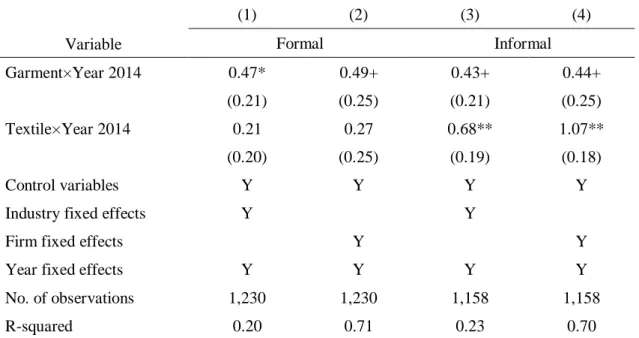
Table 5 presents the results for formal firms in garment and textile industries.18 Column (1) shows the result for equation (1). The coefficient of 𝐺𝐺𝑖𝑖× 𝑃𝑃𝑖𝑖 is significant and positive, suggesting that labor productivity increased by 76.8% for formal garment establishments. This finding supports the hypothesis 1. By contrast, the coefficient of 𝑇𝑇𝑖𝑖× 𝑃𝑃𝑖𝑖 is not significant, implying that labor productivity did not increase significantly
for formal textile establishments. Additionally, column (2) presents the result for equation (2). While the coefficient of 𝐺𝐺𝑖𝑖× 𝑃𝑃𝑖𝑖 remains significant and positive, the coefficient of 𝑇𝑇𝑖𝑖× 𝑃𝑃𝑖𝑖 remains insignificant. Taken together, these results show that labor productivity
increased significantly for formal firms only in the garment industry. ---Table 5---
In column (3), the coefficient of 𝐺𝐺𝑖𝑖× 𝑃𝑃𝑖𝑖 is significant and positive, suggesting that labor productivity increased by 58.4% for informal garment establishments. This finding supports the hypothesis 2. The coefficient of 𝑇𝑇𝑖𝑖× 𝑃𝑃𝑖𝑖 is significant and positive, implying that labor productivity increased by 107.5% for informal textile establishments. Column (4) shows that the coefficient of 𝐺𝐺𝑖𝑖× 𝑃𝑃𝑖𝑖 remains significant and positive. The coefficient of 𝑇𝑇𝑖𝑖× 𝑃𝑃𝑖𝑖 remains significant and positive, implying that labor productivity increased by 203.4% for informal textile establishments. Taken together, these results suggest that labor productivity increases significantly for informal establishments in both garment and textile industries. While the finding is consistent with the hypothesis 2, it raises a question of why informal textile factories increased productivity significantly. I discuss this issue in section 6.4.
18 Appendix Tables 1 and 2 show the summary statistics for formal and informal firms’ samples,
respectively. Appendix Table 3 shows that the results remain similar for the samples including only formal or informal firms in all industries.
18 6.2. Robustness Checks
This section presents robustness checks of the main results. First, I have previously conducted statistical inference based on the standard errors that are clustering within each industry at the 2-digit level, thereby reducing a downward bias in standard errors arising from an error correlation within clusters. However, the benchmark sample includes 14 clusters at the industry-level, which may cause a problem of few clusters (Cameron et al., 2011).
To address this concern, Table 6 presents the results of Table 5 with standard errors that are clustered at the firm-level. In columns (1) and (2), the coefficient of 𝐺𝐺𝑖𝑖× 𝑃𝑃𝑖𝑖 remains significant and positive, suggesting that labor productivity increased significantly for formal garment establishments. The coefficient of 𝑇𝑇𝑖𝑖× 𝑃𝑃𝑖𝑖 remains insignificant. Additionally, column (3) for informal firms shows that the coefficients of 𝐺𝐺𝑖𝑖× 𝑃𝑃𝑖𝑖 and 𝑇𝑇𝑖𝑖× 𝑃𝑃𝑖𝑖 are significant and positive. Column (4) shows that the coefficient of 𝐺𝐺𝑖𝑖× 𝑃𝑃𝑖𝑖 is
positive, but not significant. The standard error increases to 0.32 from 0.24. The coefficient of 𝑇𝑇𝑖𝑖× 𝑃𝑃𝑖𝑖 remains significant and positive, implying a significant increase in labor productivity for informal textile establishments. Overall, the main results are generally robust to alternative clustering in standard errors, whereas evidence for informal garment establishments may be sensitive to the type of clustering.
---Table 6---
Second, I have previously focused on labor productivity as a measure of economic performance. An alternative measure is entrepreneurial profitability. To measure profitability, I compute net profits per worker: 𝑁𝑁𝑃𝑃𝑖𝑖𝑖𝑖 = ln((𝑆𝑆𝑆𝑆𝑆𝑆𝑆𝑆𝑖𝑖𝑖𝑖− 𝐸𝐸𝐸𝐸𝐸𝐸𝑆𝑆𝐸𝐸𝐸𝐸𝑆𝑆𝑖𝑖𝑖𝑖) 𝐿𝐿⁄ ). I 𝑖𝑖𝑖𝑖 deflate net profits with the industry-level price deflators. Table 7 presents the results for the profitability measure. Columns (1) and (2) for formal firms indicate that the coefficient of 𝐺𝐺𝑖𝑖× 𝑃𝑃𝑖𝑖 is significant and positive, suggesting that profitability increased significantly for formal garment establishments. By contrast, the coefficient of 𝑇𝑇𝑖𝑖× 𝑃𝑃𝑖𝑖 is not significant. Consistent with the main results, there is no significant impact on profitability for formal textile establishments. Additionally, columns (3) and (4) for informal firms show that the coefficients of 𝐺𝐺𝑖𝑖× 𝑃𝑃𝑖𝑖 and 𝑇𝑇𝑖𝑖× 𝑃𝑃𝑖𝑖 are significant and positive. Thus, informal establishments in garment and textile industries increased their profitability significantly. Taken together, the main results are robust to the analysis based on a measure of profitability.
---Table 7--- 6.3. Discussions on Unobserved Factors
19
The analysis up to this point has indicated productivity improvements in formal and informal establishments in the garment industry during the post-reform period, but little impact on productivity in formal textile establishments. These findings are generally consistent with the predicted trade impacts of the EU’s reform in ROO. However, the interaction variables 𝐺𝐺𝐸𝐸× 𝑃𝑃𝑖𝑖 and 𝑇𝑇𝐸𝐸× 𝑃𝑃𝑖𝑖 might pick up unobservable factors in garment and textile production. The estimated productivity effects may include not only the trade impact, but other unobserved factors in Cambodia. Thus, I discuss relevant factors that are not explicitly considered in my model.
First, these factors include an increase in the minimum wage and a growing occurrence of labor strikes in Cambodia. The minimum wage increased from 61 USD in October 2010 to 100 USD in February 2014. The statutory minimum wage applies only to textile, garment, and footwear industries. Labor strikes occurred frequently in garment factories during the sample period. These factors should contribute to an increase in production costs for formal garment and textile factories, which would translate into a decline in productivity improvements. Since my model does not explicitly account for these negative impacts, the estimated productivity effects due to the trade shocks may be underestimated.19
Second, unobserved demand shocks in the non-EU markets may explain productivity improvements in formal garment factories. According to the UN COMTRADE data, the value of garment exports from Cambodia to EU increased from 1.16 billion USD in 2011 to 2.16 billion USD in 2014, whereas the value of garment exports to the non-EU markets increased from 2.81 billion USD to 3.15 billion USD over the same period. Although the export expansion in the EU markets is substantially larger, the export growth in the non-EU markets might also help to improve productivity in the formal garment factories in 2014. Thus, the estimated productivity effects may capture a smaller trade effect from the non-EU markets.
6.4. Informal Textile Producers
I conclude this section by discussing the results on informal textile producers. While I predict that trade shocks due to the EU’s reform should have little influence on these producers, the results show a significant productivity increase for them. This suggests that other unobserved factors, rather than trade shocks, may explain the results. After examining the sample used in analysis, I find that a majority of informal textile producers
19 These factors are difficult to account for in my model. A dummy variable for minimum wages
specific to these sectors has a high correlation with treatment variables for garment and textile industries, thereby leading to a serious multicollinearity issue. Moreover, systematic data on labor strikes are not readily available.
20
in the sample are located in Prey Kabbas district of Takeo province. This province is famous for silk production in Cambodia, suggesting that the sample establishments are likely to be rural weavers who produce silk textiles on a small scale. Thus, the results suggest that these silk weavers in rural villages experienced a significant productivity improvement during the period.
Silk weaving trade in Cambodia developed along the Mekong River since a long time ago. While this cottage industrial activity collapsed during the Khmer Rouge period in late 1970s, it gradually restored after the end of civil conflicts. Nevertheless, silk production in a cottage industry was largely underdeveloped in early 2000s. It is reported that silk weavers in Takeo province were generally poor uneducated villagers, and lacked technical skills in silk production such as designing, spinning, and dying. Silk weavers produce with poor materials such as old wooden handlooms and silk yarn of low quality.20 Subsequently, development programs for silk weaving in Takeo supported silk weavers with technical assistance and marketing. For instance, International Trade Centre (2011) reports that rural weavers received training on quality management and weaving techniques such as plain, basket, Jacquard, and ikat weaving.21 Thus, a productivity improvement in informal textile producers should be in part due to these assistance programs for silk weavers.
7. Conclusion
A linkage between trade and productivity has received a considerable attention in the literature, while a vast number of prior empirical studies focus only on the formal sector for analysis. This paper sheds new light on this issue by exploiting newly constructed panel data on formally registered and unregistered establishments in Cambodia for 2011 and 2014. To address an identification problem in trade and productivity, I exploit a natural experiment from the EU’s reform in rules of origin (ROO) under the EU generalized-system-of-preferences (GSP) scheme: a policy shock involving Cambodia’s garment exports to EU after 2011. Specifically, I seek to identify the productivity effects of trade by exploiting a positive export shock to the garment industry and a negative import shock to the textile industry.
The results show that labor productivity increased significantly by 75% for the
20 The report is “The Export-led Poverty Reduction Programme in Cambodia – A Case Study” by
Gabriela Byrde and Marie-Claude Frauenrath in the ITC Export-led Poverty Reduction Program. Retrieved from http://www.intracen.org/WorkArea/DownloadAsset.aspx?id=51778.
21 Another example is found in Tabitha Foundation Cambodia, which supported silk weaving industry
in Takeo through marketing and community development programs: https://tabitha-cambodia.org/programmes/cottage_industry.
21
garment industry during the post-reform period, but did not change significantly for the textile industry. Separating these overall net impacts between formal and informal firms, I find productivity improvements for both formal and informal establishments in the garment industry. Formal establishments in the textile industry do not exhibit any productivity improvements. These findings are consistent with the predicted impacts of trade shocks due to the EU’s reform in ROO. These results are robust to alternative clustering in standard errors and an alternative measure of economic performance such as entrepreneurial profitability. Additionally, a transition matrix of establishments between formality and informality during 2011 and 2014 shows that the majority of establishments remained either formal or informal during the period. This suggests that transition effects between formality and informality should not play a large role in accounting for a linkage between trade and productivity.
I conclude by discussing some implications and unexplored questions. First, my findings on informal garment firms point to a plausible linkage between trade and productivity in the informal sector through various channels such as horizontal export spillovers. An empirical work based on the formal sector may overlook these potentially important impacts of trade in developing economies. Although it is generally hard to construct panel data on both formal and informal firms, it merits attention on possible consequences of indirect export effects on the informal sector. Second, I demonstrate that a change in preferential trade programs by high-income countries provides a promising natural experiment to identify a causal effect of trade on productivity. Since preferential trade programs can have a large exogenous impact on export industries in developing economies, my approach is a useful method to address identification for future research. Finally, an important issue left for future research is to identify specific mechanisms through which firms benefit from trade. It remains an important question of how trade affects productivity in the formal and informal sectors. Another unexplored question is an employment effect of trade for formal and informal firms (Tanaka and Greaney, 2019). Given the large informal employment, it is a crucial policy question for development.
22
References
Ackerberg, D. A., Caves, K. Frazer, G. 2015. Identification properties of recent production function estimators. Econometrica, 83 (6), 2411-2451.
Alcalá, F., Ciccone, A. 2004. Trade and productivity. The Quarterly Journal of Economics, 119 (2), 613-646.
Aleman-Castilla, B. 2006. The effect of trade liberalization on informality and wages: evidence from Mexico. CEP Discussion Paper No. 763, Centre for Economic Performance, London School of Economics, London.
Alvarez, R., López, R. A. 2008. Is exporting a source of productivity spillovers? Review of World Economics, 144 (4), 723-749.
Amiti, M., Konings, J. 2007. Trade liberalization, intermediate inputs, and productivity: evidence from Indonesia. American Economic Review, 97 (5), 1611-1638.
Arkolakis, C., Costinot, A., Donaldson, D., Rodríguez-Clare, A. 2019. The elusive pro-competitive effects of trade. Review of Economic Studies, 86 (1), 46-80.
Asuyama, Y., Chhun, D., Fukunishi, T., Neou, S. Yamagata, T. 2013. Firm dynamics in the Cambodian garment industry: firm turnover, productivity growth and wage profile under trade liberalization. Journal of the Asia Pacific Economy, 18 (1), 51-70.
Aw. B.-Y., Hwang, A. R. 1995. Productivity and the export market: a firm-level analysis. Journal of Development Economics, 47 (2), 313-332.
Badinger, H. 2008. Trade policy and productivity. European Economic Review, 52 (5), 867-891. Bargawi, O. 2005. Cambodia’s garment industry: origins and future prospects. ESAU Working Paper
13, Overseas Development Institute, London.
Becker, D. 2018. Heterogeneous firms and informality: the effects of trade liberalization on labour markets. Oxford Economic Papers, 70 (1), 47-72.
Bernard, A. B., Jensen, J. B. 1999. Exceptional exporter performance: cause, effect, or both? Journal of International Economics, 47 (1), 1-25.
Cameron, A. C., Gelbach, J. B., and Miller, D. L. 2011. Robust inference with multiway clustering. Journal of Business and Economic Statistics, 29 (2), 238-249.
Clerides, S., Lach, S., Tybout, J. 1998. Is learning-by-exporting important? micro-dynamic evidence from Colombia, Mexico, and Morocco. The Quarterly Journal of Economics, 113 (3), 903-947.
Demenet, A., Razafindrakoto, M., Roubaud, F. 2016. Do informal businesses gain from registration and how? Panel data evidence from Vietnam. World Development, 84, 326-341.
Doan, T., Nguyen, S., Vu, H., Tran, T., Lim, S. 2015. Does rising import competition harm local firm productivity in less advanced economies? evidence from the Vietnam’s manufacturing sector.
The Journal of International Trade & Economic Development, 25 (1), 23-46.
Frankel, J. A., Romer, D. H. 1999. Does trade cause growth? American Economic Review, 89 (3), 379-399.
Halpern, L., Koren, M., Szeidl, A. 2015. Imported inputs and productivity. American Economic Review, 105 (12), 3660-3703.
Harrison, A., Rodríguez-Clare, A. 2010. Trade, foreign investment, and industrial policy for developing countries. In: Rodrik, D., Rosenzweig, M. (Eds.) Handbook of Development Economics, vol. 5 (p. 4039-4214). Amsterdam: Elsevier.
Heid. B. 2016. Regional trade agreements, unemployment, and the informal sector. University of Bayreuth, mimeograph.
Heid, B., Larch, M., Riaño, A. 2013. The rise of the maquiladoras: a mixed blessing. Review of Development Economics, 17 (2), 252-267.
Inama, S. 2011. The reform of the EC GSP rules of origin: per aspera ad astra? Journal of World Trade, 45 (3), 577-603.
International Trade Centre. 2013. Mid-term external evaluation: Cambodia sector-wide silk project (phase Ⅱ). Retrieved from http://www.intracen.org/Evaluation-Report-Cambodia-Sector-Wide-Silk-Project/.
Jongwanich, J., Kohpaiboon, A. 2017. Trade protection and firm productivity: evidence from Thai manufacturing. The Developing Economies, 55 (2), 130-157.
23
evidence. Journal of International Economics, 89 (2), 297-316.
Krishna, K. 2006. Understanding rules of origin. In: Cadot, O., Estevadeordal, A., Suwa-Eisenmann, A., Verdier, T. (Eds.), The Origin of Goods: Rules of Origin in Regional Trade Agreements (p. 19.-34). Oxford: Oxford University Press.
La Porta, R., Shleifer, A. 2008. The unofficial economy and economic development. Brookings Papers on Economic Activity, 39 (2), 275-363.
La Porta, R., Shleifer, A. 2014. Informality and development. Journal of Economic Perspectives, 28 (3), 109-126.
Levinsohn, J., Petrin, A. 2003. Estimating production functions using inputs to control for unobservables, The Review of Economic Studies, 70 (2), 317-341.
McCaig, B., Pavcnik, N. 2018. Export markets and labor allocation in a low-income country. American Economic Review, 108 (7), 1899-1941.
Moreno-Monroy, A. I., Pieters, J., Erumban, A. A. 2014. Formal sector subcontracting and informal sector employment in Indian manufacturing. IZA Journal of Labor & Development, 3, 22. Nataraj, S. 2011. The impact of trade liberalization on productivity: evidence from India’s formal and
informal manufacturing sectors. Journal of International Economics, 85 (2), 292-301.
Natsuda, K., Goto, K., Thoburn, J. 2010. Challenges to the Cambodian garment industry in the global garment value chain. European Journal of Development Research, 22 (4), 469-493.
Pavcnik, N. 2002. Trade liberalization, exit, and productivity improvements: evidence from Chilean plants. Review of Economic Studies, 69 (1), 245-276.
Paz, L. S. 2014. The impacts of trade liberalization on informal labor markets: a theoretical and empirical evaluation of the Brazilian case. Journal of International Economics, 92 (2), 330-348. Rand, J., Torm, N. 2012. The benefits of formalization: evidence from Vietnamese manufacturing
SMEs. World Development, 40 (5), 983-998.
Rodriguez, F., Rodrik, D. 2001. Trade policy and economic growth: a skeptic’s guide to the cross-national evidence. In: Bernanke, B. S., Rogoff. K. (Eds.), NBER Macroeconomics Annual 2000 (p. 261-338). Cambridge: MIT Press.
Royal Government of Cambodia. 2014. Cambodia Trade Integration Strategy 2014-2018. Phnom Penh.
Staritz, C. 2011. Making the cut? low-income countries and the global clothing value chain in a post-quota and post-crisis world. World Bank Study, the World Bank, Washington, DC.
Schneider, F., Enste, D. H. 2013. The Shadow Economy: An International Survey. Cambridge: Cambridge University Press.
Tanaka, K. 2019. The EU’s reform in rules of origin and international trade: evidence from Cambodia. Institute of Developing Economies, Japan External Trade Organization, mimeograph.
Tanaka, K., Greaney, T. 2019. Trade and employment in the formal and informal sectors: a natural experiment from Cambodia. Institute of Developing Economies, Japan External Trade Organization, mimeograph.
Topalova, P., Khandelwal, A. 2011. Trade liberalization and firm productivity: the case of India. Review of Economics and Statistics, 93 (3), 995-1009.
Wagner, J. 2012. International trade and firm performance: a survey of empirical studies since 2006. Review of World Economics, 148 (2), 235-267.
Yamagata, T. 2006. The garment industry in Cambodia: its role in poverty reduction through export-oriented development. Cambodian Economic Review, 2, 81-136.
24
Figure 1. Garment Imports in EU from Cambodia
Notes: The value of garment imports in HS Chapters 61 and 62 from Cambodia eligible for
duty-free access in the EU markets is shown; diamond and circle markers indicate the imports that entered under duty-free and MFN rates, respectively; EC2011 and ES2014 indicate the survey dates for Economic Census in 2011 and Inter-censal Economic Survey in 2014, respectively. Source: EUROSTAT
25
Figure 2. Top 10 Export Goods in Cambodia
Notes: The top 10 largest export goods are shown according to the total value of exports in 2011
and 2014; the goods category is based on 2-digit Standard International Trade Classification, Revision 4.
26
Figure 3. Top 10 Import Goods in Cambodia
Notes: The top 10 largest import goods are shown according to the total value of imports in 2011
and 2014; the goods category is based on 2-digit Standard International Trade Classification, Revision 4.
27
Table 1. Number of Manufacturing Establishments
Data
Panel
ISIC Industry EC2011 ES2014
10 Food products 27,639 653 328
11 Beverages 4,436 166 25
12 Tobacco products 33 7 0
13 Textiles 8,919 115 67
14 Wearing apparel 15,958 502 149
15 Leather and related products 278 37 1
16 Wood and cork products 1,955 80 23
17 Paper and paper products 35 8 2
18 Printing/reproduction of recorded media 284 16 2
19 Coke and refined petroleum products 2 0 0
20 Chemicals and chemical products 144 2 3
21 Pharmaceutical products 10 2 0
22 Rubber and plastics products 46 26 1
23 Other non-metallic mineral products 2,826 97 52
24 Basic metals 38 2 1
25 Fabricated metal products 4,728 97 29
26 Computer, electronic, optical products 4 0 0
27 Electrical equipment 8 2 0
28 Machinery 20 0 0
29 Motor vehicles, trailers and semi-trailers 3 2 0
30 Other transport equipment 81 5 1
31 Furniture 1,196 41 24
32 Other manufacturing 1,835 13 2
33 Repair of machinery and equipment 938 26 8
Manufacturing 71,416 1,899 713
Notes: Panel indicates the number of establishments that are linked between 2011 and 2014
and have information on the log of real value added per worker in both years; Manufacturing shows the aggregate manufacturing sector; ISIC is the International Standard Industry Classification, Revision 4.
28
Table 2. Formal and Informal Firms in Panel Data Panel A: Garment Industry
Year 2014
Year 2011 Formal Informal Total
Formal 93 1 94
Informal 4 51 55
Total 97 52 149
Panel B: Textile Industry
Year 2014
Year 2011 Formal Informal Total
Formal 32 0 32
Informal 1 34 35
Total 33 34 67
Note: Formal is defined as the establishments that register with the Ministry of Commerce or
obtain official license/approval from other ministries and agencies. Source: Economic Census 2011 and Inter-censal Economic Survey 2014