Political conditions for fair elections
著者
Kawanaka Takeshi
権利
Copyrights 日本貿易振興機構(ジェトロ)アジア
経済研究所 / Institute of Developing
Economies, Japan External Trade Organization
(IDE-JETRO) http://www.ide.go.jp
journal or
publication title
IDE Discussion Paper
volume
181
year
2008-11-01
INSTITUTE OF DEVELOPING ECONOMIES
IDE Discussion Papers are preliminary materials circulated to stimulate discussions and critical comments
Keywords: democracy, election, governance, democratic consolidation, institution
* Senior Research Fellow, Area Studies Center, IDE ([email protected])
IDE DISCUSSION PAPER No. 181
Political Conditions for Fair
Elections
Takeshi KAWANAKA*
November 2008
Abstract
Democracy is not necessarily consolidated simply by the introduction of formal democratic institutions. It is often observed in new democracies that democratic institutions are neglected and eroded in actual practice. Particularly, electoral fraud committed by a ruler is one of the main problems in this regard. This paper deals with two questions, (1) under what conditions does a ruler have an incentive to hold fair elections (or to rig elections), and (2) what makes a ruler prefer to establish an independent election governing institution? Assuming that a ruler prefers to maintain her power, basically she has an incentive to rig elections in order to be victorious in the political competition. A ruler, however, faces the risk of losing power if the opposition stages successful protests on a sufficiently large scale. If opponents are able to pose a credible threat to a ruler, she will have an incentive to hold fair elections. The problem is that information on electoral fraud is not shared by every player in the game. For the opposition, imperfect information deepens their coordination problems. Imperfect information, on the other hand, in some cases causes a problem for a ruler. If the opposition is sufficiently cohesive and have little tolerance of cheating, even unverified suspicions of fraud may trigger menacing protests. In such a case, a ruler has an incentive to establish an independent election commission to avoid unnecessary collisions by revealing the nature of the elections.
The Institute of Developing Economies (IDE) is a semigovernmental, nonpartisan, nonprofit research institute, founded in 1958. The Institute merged with the Japan External Trade Organization (JETRO) on July 1, 1998.
The Institute conducts basic and comprehensive studies on economic and related affairs in all developing countries and regions, including Asia, the Middle East, Africa, Latin America, Oceania, and Eastern Europe.
The views expressed in this publication are those of the author(s). Publication does not imply endorsement by the Institute of Developing Economies of any of the views expressed within.
INSTITUTE OF DEVELOPING ECONOMIES (IDE), JETRO 3-2-2, WAKABA,MIHAMA-KU,CHIBA-SHI
CHIBA 261-8545, JAPAN
©2008 by Institute of Developing Economies, JETRO
No part of this publication may be reproduced without the prior permission of the IDE-JETRO.
1
1 Introduction*
The introduction of formal democratic institutions does not necessary consolidate democracy. If players in political competition neglect such institutions in actual practice, democracy may be eroded. In fact, this type of failure in democratic consolidation takes place more frequently than regime changes to non-democracy. Fraudulent elections are a common type of consolidation failure. Holding regular elections does not ensure that society manages the governance democratically.
I will deal with two questions in this paper;
(1) Under what conditions does a ruler have an incentive to hold fair elections (or to rig elections)? (2) What makes a ruler prefer to establish an independent election governing institution?
Certainly, a ruling party has an incentive to commit electoral fraud. It prefers to ensure its electoral victory, assuming its preference is to stay in power as long as possible. In addition, a ruling party is usually in an advantageous position to rig elections, since it controls the state organizations which implement elections. A ruling party also has resources and means with which to manipulate the electoral process.
A ruling party, however, is not always free to cheat. The opposition is always wary of fraud, and they contest the ruler’s victory if they find that elections have been rigged. If the opposition successfully organizes a protest movement on a sufficiently large scale, a ruling party faces the risk of losing power, or worse, being deposed for good.
I argue that the credible threat of the opposition is a primary factor in determining the nature of elections. If the opposition is able to pose a credible threat to a ruler, she will have an incentive to hold fair elections. The problem is that the information on electoral fraud is not shared by every player in the game. For the opposition, imperfect information deepens their coordination problem.
*
This work was supported by the Grant-in-Aid for Scientific Research (B) (No. 20330027, organized by Yutaka Onishi of Kobe University). The author thanks Kengo Soga and Kazuki Minato for their useful comments.
2
Imperfect information, on the other hand, causes a problem for a ruler, in some cases. If the opposition is cohesive enough and has little tolerance for cheating, even an unverified suspicion of fraud may spark menacing protests. In such a case, a ruler has an incentive to establish an independent election commission to avoid unnecessary collisions by revealing the nature of elections.
This argument owes much to the recent literature on self-enforcing democracy. I argue that an independent election commission is established if it brings the cooperation strategies of the players into equilibrium. If an independent election commission supports optimal payoffs for the players, then such a commission will emerge as self-enforcing institution. Przeworski (1991) is a seminal work which provides arguments concerning the logic of democracy as equilibrium. Przeworski argues that democracy tends towards stability when major players have no incentive to deviate from democratic institutions. In other words, if observing democratic institutions optimizes each player’s payoff, democracy is consolidated. In this equilibrium, a loser of an election should have an incentive to accept the results. Przeworski points out that the level of the political stakes involved is the key factor, claiming that the higher the political stakes, the more unstable democracy becomes. Weingast (1997), another important work on this issue, discusses the notion that the solution of the coordination problem among the citizenry is the foundation of democracy and the rule of law.1 In his argument, citizens often suffer from prisoners’ dilemma within themselves for revolting against the ruler’s transgression. He calls this a coordination problem. If citizens solve their coordination problem, their threats to revolt become credible and provide the ruler with an incentive to respect their rights. In his argument, a focal point for citizen cooperation is the key to solving a coordination problem. If the constitution successfully provides such a point, the political regime under the constitution is self-enforcing. Acemoglu and Robinson (2006) also give attention to citizens’ threats to a ruler. A citizens’ threat to depose the elite forces the elite to adopt policies preferred by the citizens, but citizens always face a commitment problem in that the elite may change the policy ex post facto once citizens’ threats become weak and empty as circumstances change. In their argument, democratic institutions are introduced to solve the commitment problem.
1
3
The citizens can set the directionality of policy to their preference under democracy, since they control the majority of the population. Fearon (2006) emphasizes the role of elections in self-enforcing democracy. He focuses on the problem of information in a democratic regime. If the citizens have no means to measure a ruler’s performance, they will have a hard time solving a coordination problem. Elections, in his view, provide such information. He considers that shares of votes in elections indicate the distribution of welfare among citizens. Further, if elections are not held, this then works as a focal point for citizens to revolt.
From these arguments on self-enforcing democracy, a citizens’ threat and a solution to coordination problems to support the threat are important. Whether a citizens’ threat is credible or not primarily depends on the payoff structure. The payoffs are determined by institutional settings, both formal and informal. The institutions of government determine the size of rents derived from power. The more rents a ruler gains, the larger becomes the payoff of winning elections. Whether political institutions provide winner-take-all type political competition is also important in determining the payoff structure. Winner-take-all type competition widens the payoff gap between winners and losers. Losers, therefore, have less incentive to respect the results of elections.
The existence of a focal point to solve coordination problems is another important factor, as Weingast argues. A focal point can be provided by several different means, such as a constitution, a pact or an economic crisis. Fearon (2006) argues that holding elections is a focal point. If elections are suspended, opponents find it relatively easily to coordinate a revolt. The problem, as Fearon notes, is that it is hard to find a focal point in partially rigged elections. The opposition has a hard time sharing common criteria regarding the degree to which elections are rigged before they will revolt. An infinite iteration of rigged elections makes coordination among the opposition groups relatively easier, but there may be more than one equilibrium point. Furthermore, information on electoral fraud is usually provided in part only, or the information is mixed with noise. The opposition may not even share information concerning whether elections are rigged or not.
An independent election commission provides a focal point. Such a commission nullifies the elections in the case of massive cheating. If the ruler does not respect the decision of the
4
commission, with the opposition will find this to be a focal point and revolt. Such a commission also reveals the degree of electoral fraud, or may even prevent such fraud. An independent election commission plays a crucial role for the opposition in solving the coordination problem.
The problem is that the opposition does not have the power to design an election commission. A ruler, instead, is in the position to introduce such a government institution. Does a ruler have any incentive to guarantee the institutional independence of an election commission? Will a ruler agree to tie her hands and not rig elections? In some cases, she will do so. If a ruler finds the opposition’s threat credible, and the payoffs under fair elections are not low, a ruler will prefer to establish an independent election commission. This will happen if the opposition’s power of protest is sufficiently large, even if an imperfect information situation diminishes the cohesiveness of opponents. In such a case, a ruler needs to make the opposition believe that she is committing herself to fair elections. Revealing the nature of elections to all players in some cases serves to benefit the ruler.
In this paper, I first present a basic model of electoral fraud. Following this, the model will then be slightly modified through the introduction of imperfect information. Finally, the arguments will be summed up in the conclusion.
2 Elections with Perfect Information
Suppose that the controlling power in a state produces utility v , and that there are two parties, the i
ruler and the opposition. A party in power obtains v , while an opposition party obtains 0 as long i
5
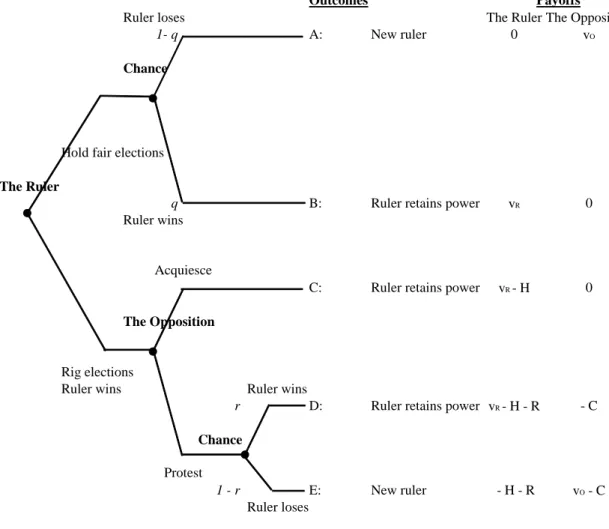
The ruler has a strategy set SR{hold fair elections, rig elections,}.2 The opposition has a strategy set SO{acquiesce if the ruler rigs elections, protest if the ruler rigs elections}. The
payoffs for each player for possible outcomes are as provided in the figure. The game starts from the ruler’s decision node. At the first stage, the ruler decides whether her action will be to hold fair elections or to rig elections. If the ruler holds fair elections, the second stage is a chance node. The ruler wins with the probability q[0,1] and loses with the probability(1q)[0,1]. If the ruler wins, the ruler remains in power and obtains v . Otherwise a new ruler takes power and the ruler R
will receive 0. If the ruler rigs the elections at the first stage, which incurs the cost of electoral manipulation, H, the opposition must decide whether or not to acquiesce or to protest at the second
2
In fact, the ruler may employ the strategy of not holding elections. This will be discussed in the breakdown of democracy.
Figure 1 Elections with Perfect Information (Game 1)
Ruler loses The Ruler The Opposition
1- q A: New ruler 0 vO
Chance
Hold fair elections The Ruler
q B: Ruler retains power vR 0
Ruler wins
C: Ruler retains power vR - H 0
The Opposition
Rig elections
Ruler wins Ruler wins
r D: Ruler retains power vR - H - R - C
Chance 1 - r E: New ruler - H - R vO - C Ruler loses Outcomes Payoffs Acquiesce Protest
6
stage. If the opposition acquiesces, the game terminates, the ruler obtains vRH , and the opposition gets nothing, 0. If the opposition protests, with the probability r[0,1], the ruler successfully represses the opposition’s protest with the cost of repression, R, and remains in power. The ruler obtains vR HR. The opposition pays only the cost of protest C without gaining power, but with the probability (1r)[0,1] that the opposition will succeed in stripping the ruler of her power. In this case, a new ruler takes power and the former ruler will be removed. The former ruler’s payoff will be – H – R, while the opposition obtains vO C. The probability r is
determined by three factors, the repressive power of the ruler, the opposition’s resources for supporting the protest, and importantly, the seriousness of the coordination problem within the opposition. As the repressive power of the ruler increases, the opposition’s resources decrease, or coordination problems become more serious, probability r becomes larger.
In this game, there are two strategy profiles which induce the outcomes A or B, which are the outcomes of fair elections. These are;
(1) R hold fair elections.
O acquiesce if the ruler rigs elections (2) R hold fair elections
O protest if the ruler rigs elections
--- the “fair election” equilibrium
If these two strategy profiles constitute a subgame perfect Nash equilibrium (SPNE), fair elections are achieved. Under what conditions is the fair election equilibrium sustained?
We use backward induction to identify the conditions for this SPNE. For the strategy profile (1) to be an SPNE, first, the payoff for the opposition in its strategy to acquiesce should be larger than that in its strategy to protest, because the opposition prefers acquiescence. This can be written as;
) ( ) 1 ( ) ( 0r C r vO C
7 O O v C v r (2.1) Second, the expected payoff for the ruler in holding fair elections should be larger than her payoff in outcome C, because the ruler prefers fair elections when the opposition is certain to acquiesce. This is expressed as;
H v q v q R(1 )0 R which is; R R v H v q (2.2) The conditions (2.1) and (2.2) are necessary for the strategy profile (1) to constitute an SPNE. Holding both r and q constant, these two conditions hold as the costs of the opposition’s protest and the ruler’s electoral manipulation increase. On the other hand, if the utility which could be obtained through the power, v and O v are large and the costs, C and H are small, the right-hand sides of R
the two conditions approach 1. The conditions will fail to hold in such cases.
Now, we consider the conditions for the strategy profile (2) to be an SPNE. First, we again compare the payoffs for the opposition. The opposition’s expected payoff in its strategy to protest should be larger than its payoff in acquiescence, because the opposition prefers to protest. This is expressed as; ) ( ) 1 ( ) ( 0r C r vO C
which can be rewritten as;
O O v C v r (2.3)
Second, the ruler’s expected payoff in fair elections should be larger than her expected payoff when the opposition protests rigged elections. This is written as;
) ( ) 1 ( ) ( 0 ) 1 ( q r v H R r H R v q R R
which can be rewritten as;
R v R H r q (2.4)
8
The condition (2.3) indicates that the probability of the ruler suppressing the protest successfully, r, needs to be sufficiently small. The threshold of r which satisfies the condition (2.3) is determined by the payoffs. If the cost of the opposition’s protest, C, increases, the threshold becomes smaller. In such a case, the opposition does not protest even if the probability of the ruler succeeding in repressing the opposition is relatively lower. In other words, if the cost of protest is sufficiently low, the opposition protests even with a relatively higher probability of the ruler being able to repress the opposition, as long as condition (2.3) holds. Furthermore, condition (2.3) shows that if the stakes of politics, v , are extremely large, the right-hand side of the inequality will approach 1. In such a O
situation, it is more likely for the opposition to protest.
On the other hand, condition (2.4) indicates that the ruler prefers fair elections if the probability for her to win an election, q, is sufficiently high. Holding the probability q constant, condition (2.4) depends on the payoff structure and the probability of successful repression, r. First, the costs of electoral fraud, H, and repression, R, matter. If they increase, condition (2.4) holds rather easily. Second, the size of the ruler’s payoff in winning, v , affects the condition. If the utility obtained R
through the power is small, the condition holds with lower q. In fact, if (HR)vR, condition (2.4) always holds, because the right-hand side of the inequality will be always negative:
R v R H r q0
Third, the probability of successful repression, r, also affects condition (2.4). Especially, if v is R
quite large, the threshold of q for the ruler to hold fair elections depends on r. If the ruler has a lower probability of repressing opposition protest successfully, she will prefer fair elections, as the right-hand side of the inequality of condition (2.4) decreases. In addition, if
r q , and 0 R v R H ,
which means that if the probability of repressing the opposition successfully is larger than that of the ruler winning a fair election, and the utility which derives from the power is enormously large or the costs of manipulation and repression are trivial, the ruler has no incentive to hold fair elections.
9
The domain of the “fair election” equilibrium in terms of r and q in the model in Figure 1 is indicated in the following figure, which is based on conditions (2.1), (2.2), (2.3) and (2.4).
The conditions which support the two strategy profiles of the “fair election” equilibrium provide important implications. First, the stakes of politics matter. This supports the argument of Przeworski (1991) that higher political stakes cause instability in democracy. If the political institutions create
r q O O v C v R v R H R R v H v R O O V R H v C v
Hold fair elections
Rig elections 0 R v R H r q Protest Acquiesce Opposition’s strategy 1 1
Figure 2 The Domain of the “Fair Election” Equilibrium
10
large scale rents and provide winner-take-all type competition, which produces a large gap in payoffs between those in power and those out of power, the ruler has an incentive to maintain power through electoral fraud, as condition (2.4) implies. The opposition, too, has less incentive to acquiesce in the case of large political stakes, as condition (2.3) indicates. It thus becomes more likely that fraudulent elections and protests from the opposition will take place, and this is a chaotic situation. Second, the costs of fraud, repression and protest affect the players’ strategies. The cost of electoral fraud varies depending on what method the ruler takes. The least costly method is to manipulate the results at the final stage of counting. If the ruler successfully bribes the members of the electoral commission, it is less costly than buying votes at each precinct.3 As long as the ruler has options that lower the cost of maneuvering elections, the ruler tends to rig elections. Third, the probability of successful repression is also important. The probability, r, is a function of the repressive power of the ruler, the resources of the opposition (most importantly the wealth and the population size), and the coordination problem within the opposition. Especially, this point concerning the coordination problem supports Weingast (1997), who claims that a solution of the coordination problem is the key to credible threats.
3 Elections with Imperfect Information
If the ruler suspends elections, the opposition groups share common information on the ruler’s actions. In this situation, it is easier to solve a coordination problem. In contrast, a major problem in fraudulent elections is that the opposition does not have accurate information on the ruler’s actions. Sometimes the opposition does not even know whether the ruler has actually rigged the elections or not. Furthermore, it is more troublesome if the opposition does not know to what extent the ruler has rigged the elections. Imperfect information makes it difficult for the opposition to form a coalition, as the opposition finds it hard to share a common belief concerning the ruler’s manipulation, which is supposed to be the foundation of coordination problem solution. For the ruler, therefore, it is quite convenient if the information on electoral fraud is concealed.
3
Bueno de Mesquita et. al. (2003) and Riker (1962) discuss this issue in the framework of the “winning coalition.” If the support of the election commission is the most crucial factor for the ruler, the commission is the “wining coalition” of the ruler.
11
The ruler, however, sometimes finds imperfect information not preferable. If the coordination problem within the opposition is not so serious from the outset, or the opposition has large resources with which to protest, the threat from the opposition becomes credible. If the opposition’s threat is credible, the ruler has an incentive to hold fair elections, as the model in Figure 1 shows. However, the opposition may protest even if the ruler wins in fair elections, if the information is noisy and the opposition believes that there is a high probability that the elections were rigged. The ruler always faces the risk of losing power in this case, or at least needs to carry the cost of repression, R. To avoid this unfavorable situation, the ruler needs to make the elections transparent and to show her prior commitment to fair elections. An independent election management institution serves this purpose.
We now consider a perfect Bayesian equilibrium (PBE). There is a certain threshold of the opposition’s belief concerning fair elections, below which the opposition prefers to protest. Such a threshold is primarily determined by the payoff structure. If the threshold is high, the ruler establishes an independent election commission to raise the opposition’s belief in the probability of fair elections being high. To illustrate the logic, we will employ the game shown in Figure 3, which is a modified version of the model in Figure 1.
12
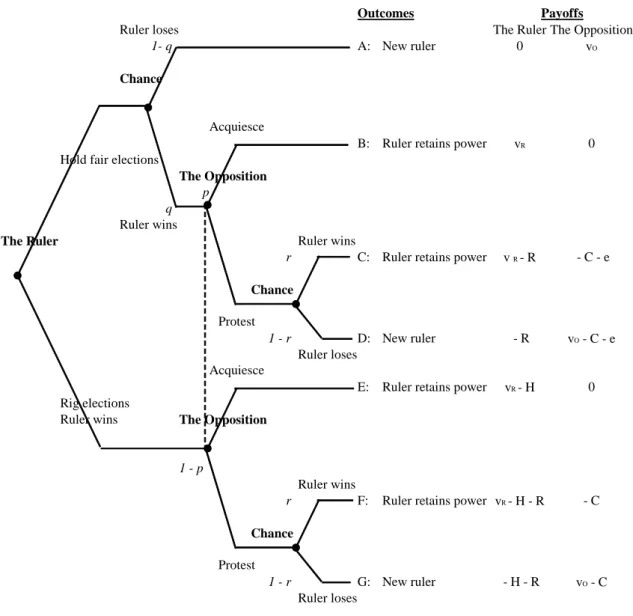
The players are the same as in the model in Figure 1, the ruler and the opposition. The strategy sets of the players are; SR{hold fair elections, rig elections,} SO{acquiesce if the ruler wins, protest if the ruler wins}. The game starts from the ruler’s decision node. The ruler decides whether to hold fair elections, or to rig elections. The ruler wins in fair elections with the probability
] 1 , 0 [
q and loses with the probability (1q)[0,1]. If the ruler holds fair elections and loses, the opposition knows that fair elections were held. The game ends without any action from the opposition. A new ruler takes power, and the ruler obtains 0, while the opposition obtains v . If O
the ruler wins either in fair elections or in rigged elections, the opposition has no accurate information concerning whether the elections were held in a fair way or not. The opposition
Figure 3 Elections with Imperfect Information (Game 2)
Ruler loses The Ruler The Opposition
1- q A: New ruler 0 vO
Chance
B: Ruler retains power vR 0
Hold fair elections
The Opposition
p q
Ruler wins
The Ruler Ruler wins
r C: Ruler retains power v R - R - C - e
Chance
1 - r D: New ruler - R vO - C - e
Ruler loses
E: Ruler retains power vR - H 0
Rig elections
Ruler wins The Opposition
1 - p
Ruler wins
r F: Ruler retains power vR - H - R - C
Chance 1 - r G: New ruler - H - R vO - C Ruler loses Acquiesce Protest Outcomes Payoffs Acquiesce Protest
13
believes that the ruler held fair elections with the probability p
0,1 and that the ruler rigged elections with the probability (1 p)[0,1]. If the opposition protests, the ruler represses the protest successfully with the probability r[0,1], or fails to repress with the probability] 1 , 0 [ ) 1
( r . If the ruler successfully represses the protest, she remains in power. Otherwise, a new ruler takes power. Each player’s payoffs at possible outcomes are as shown in the figure. I introduce an additional cost for the opposition, e, which the opposition incurs if it protests despite fair elections. This expresses future punishment imposed by the voters, and other kinds of costs caused by the opposition’s misjudgment.
If the opposition always acquiesces, the ruler faces no problem. She rigs elections, wins and obtains a higher payoff, as long as the cost of electoral fraud, H, is sufficiently low. A problem arises if the opposition takes protest action. The opposition protests if the expected payoff for protest is larger than that for acquiescence. The condition for the opposition to protest, therefore, is written as;
)} ( ) 1 ( ) ( { ) 1 ( )} ( ) 1 ( ) ( { 0 ) 1 ( 0 p p r C e r v C e p r C r v C p O O
This can be rewritten as;
* ) 1 ( p e C v r p O (3.1)
This condition can also be rewritten as;
O O v C e p v r (3.1)’
If the threshold p* is high, it will be easier to obtain the condition for protest, p p*. The opposition protests even with a relatively higher probability for fair elections. The threshold p* becomes higher as the probability of the ruler’s success in repression, r, decreases. If the opposition solves its coordination problem, if the opposition has relatively large resources, or if the ruler is inferior in terms of power to repress, it becomes more likely that the opposition will protest. Second, the payoff structure also affects s the threshold p*. The sizes of v , C and e determine the level of O
14
the protest threshold p*.4 If the stakes of politics are high, for example, the threshold p* will be pushed up, such that the opposition protests even though there is a higher probability of fair elections.
If condition (3.1) holds, the ruler always faces opposition protest, even if she holds fair elections. In this case, the ruler loses the incentive to hold fair elections unless the cost H is quite high. As the ruler’s expected payoff in fair elections is always lower than that of rigged elections when the opposition protests, the condition for the ruler to rig elections is,
) ( ) 1 ( ) ( 0 ) 1 ( )} ( ) 1 ( ) ( {r v R r R q r v H R r H R q R R
which is rewritten as;
R v r H q R 1 (3.2) Hence, as long as conditions (3.1) and (3.2) hold, the equilibrium in this game is;
R
rig elections
O
protest if the ruler wins elections
--- the “failure of democracy” equilibrium
This is apparently a failure of democracy. Democratic institutions, especially the electoral process, are not observed in this situation.
Now, we consider whether there is a way to avoid this “failure of democracy” equilibrium. Is it possible to achieve a “fair election” equilibrium instead of the “failure of democracy” equilibrium?
To begin with, if the ruler’s expected payoff in the “fair elections” equilibrium in the model in Figure 1 (Game 1) is larger than the ruler’s expected payoff in the “failure of democracy” equilibrium in the model in Figure 3 (Game 2), the ruler prefers the game structure of Game 1. The
4
If the cost e is equal to 0, p does not affect the opposition’s strategy choice. Regardless of the value of p, the opposition’s strategy is determined by the probability of successful repression r and the payoff structure.
15 condition is, ) ( ) 1 ( ) ( 0 ) 1 ( q r v H R r H R v q R R
which can be rewritten as;
R v R H r q (3.3)5
Under these conditions, the key to realizing Game 1 is to arrange for a situation where the opposition can infer a high probability of fair elections p, or at least higher than the threshold p* . Because the threshold p* is determined by the payoffs, as provided by (3.1), which are mostly exogenous parameters, the ruler faces difficulties in changing the threshold p*. The probability of successful repression, r, is exogenous to some extent, though there is room for the ruler to control this, as we will see later. Basically, there is only limited room for the ruler to change the parameters. If the threshold is low, the ruler does not need to make so great an effort to persuade the opposition to believe the elections were fair. She, however, needs to work hard to have the opposition believe that the elections were held in fair way if the threshold p* is high.
One of the ruler’s solutions for increasing the opposition’s belief p is to establish an independent election commission. An independent election commission provides information concerning the nature of elections, for example, whether they have been rigged or not. Game 1 will then be realized with perfect information.6
5
This is actually the same as condition (2.4).
6
In addition, it also makes the cost of election manipulation, H, high, as it restricts the scope of electoral fraud, if not eliminating fraud altogether. By establishing an independent commission, the ruler binds her hands and shows her prior commitment to fair elections.
16
The ruler prefers Game 1 to Game 2, and therefore, has an incentive to establish an independent election commission, if (1) the “fair election” equilibrium is achieved in Game 1, (2) the “failure of democracy” equilibrium is achieved in Game 2, and (3) the ruler’s expected payoff in the “fair election” equilibrium is larger than her expected payoff in the “failure of democracy” equilibrium.
As for the “fair election” equilibrium in Game 1, however, the conditions to bring the strategy profile (1) {R hold fair elections, O acquiesce if the ruler rigs elections} to equilibrium {(2.1), (2.2)} do not affect the ruler’s choice concerning the establishment of an independent commission, because the conditions also bring about the “fair election” equilibrium even in Game 2. The conditions to support the “failure of democracy” equilibrium and the condition to sustain the ruler in a better state in Game 1 than in Game 2 impose stricter conditions than those to bring the strategy profile (2) {R hold fair elections, O protest if the ruler rigs elections} to
equilibrium {(2.3), (2.4)}. In short, the conditions (3.1)’, (3.2) and (3.3) should hold to induce the ruler to take the action of establishing the commission.
Figure 5 shows the domain where the ruler has an incentive to establish an independent election commission from conditions (3.1)’, (3.2) and (3.3).
Figure 4 The Ruler's Choice on an Independent Election Commission Outcomes
Game 1 The "Fair Election" Equilibrium
Establish an independent commission
The Ruler
Do not establish an independent commission
17
Magaloni (2006) discusses the case of the Mexican electoral transition to democracy (collapse of the PRI regime) through similar logic. The PRI received credible threats of war, originating from the Chiapas rebellion, and set up an independent election commission in 1994. The PRI believed it would be victorious in the 1994 presidential election due to President Carlos Salinas’s economic reforms. The elections, however, resulted in the defeat of the PRI and triggered the democratic
r q O O v C v R v R H R R v H v R O O V R H v C v
Hold fair elections
Rig elections 0 R v R H r q Protest Acquiesce
Opposition’s strategy in Game 2
R v r H q R 1
Establish an independent election commission
1 1
Figure 5 The Domain of Establishing an Independent Election Commission
Assumptions: C R C R H e p C R v vR O ( ) ( ), vR vO HRC pe. R v v C e p v H R O O 1 O O v C e p v
18 transition.
Nevertheless, the conditions which induce the ruler to establish an independent commission are not easily brought about. The opposition’s internal division is always problematic. The opposition usually has a moderate faction and a radical one, as Magaloni points out. These factions hardly ever share a common threshold p* in which they take action together. The ruler takes advantage of such factionalism to obtain a higher probability of a successful repression, r. As mentioned above, the ruler has the means to change this r. The ruler can tighten control over the media, instead of establishing an independent commission, which serves to worsen the coordination problem within the opposition and increases the probability r. The ruler may also enhance the cooptation of a moderate faction of the opposition through patronage provision.
On the other hand, establishing an independent election commission, which is to raise the opposition’s belief in fair elections, p, also affects the probability r. An independent commission provides information on elections which is crucial for the solution of the opposition’s coordination problem. If the opposition receives accurate information on the sate of elections, it becomes easier to solve the coordination problem. Establishing an independent commission strengthens the opposition’s power. For the ruler, it means that her relatively superior position will be damaged, and probability r is reduced. Since the ruler can utilize division in the opposition, and establishing an independent election commission strengthens the opposition’s power, the ruler’s initial strategy choice will be to divide the opposition and raise the probability r, unless the threat from the opposition is sufficiently menacing, as in the case of Mexico.
4 Conclusion
Electoral manipulation by a ruler is a crucial problem for democratic consolidation. Whether or not the ruler rigs elections primarily depends on the payoff structure, which is determined by the political institutions (the political stakes) and the costs of manipulation, repression and protest. Likewise, the probability of successful repression of the opposition is an important factor. The probability depends on three factors, e.g. the ruler’s repressive power (control over the state
19
apparatus), the opposition’s power (wealth, numbers and urban concentration), and the seriousness of the coordination problem within the opposition. Considering these conditions, if the opposition can create credible threats, thereby decreasing the ruler’s payoff, holding fair elections emerges as a part of an equilibrium.
The problem of rigged elections, however, is the opposition’s access to accurate information. Without perfect information on electoral fraud, the opposition faces a coordination problem and has difficulty organizing protests of sufficient scale. If the opposition can create a menacing threat despite imperfect information, however, the ruler now faces risks and costs even if she holds fair elections. In such a situation, the ruler has an incentive to establish an independent election commission to avoid unnecessary collisions.
The ruler, however, still has other means to avoid opposition protests, which may be preferred by her. Instead of establishing an independent election commission, the ruler has the option of imposing stricter control on the media. This promotes a deepening of the opposition’s coordination problem. The ruler may also provide patronage to a moderate faction of the opposition in an attempt at cooptation. If the opposition can solve its coordination problem through, for example, external shock, economic crisis or other means, the possibility for the establishment of an independent election commission increases, and there is an enhanced possibility that fair elections will be held.
20
References:
Acemoglu, Daron and James A. Robinson. 2006. Economic Origins of Dictatorship and
Democracy. New York: Cambridge University Press.
Bueno de Mesquita, Bruce, Alastair Smith, Randolph M. Siverson, and James D. Morrow. 2003.
The Logic of Political Survival. Cambridge: MIT Press.
Fearon, James D. 2006. Self-Enforcing Democracy. Paper. Stanford University.
Magaloni, Beatriz. 2006. Voting for Autocracy: Hegemonic Party Survival and Its Demise in
Mexico. New York: Cambridge University Press.
Przeworski, Adam. 1991. Democracy and the Market: Political and Economic Reforms in Eastern
Europe and Latin America. New York: Cambridge University Press.
Riker, William H. 1962. The Theory of Political Coalition. New Haven: Yale University Press. Weingast, Barry R. 1997. “The Political Foundations of Democracy and Rule of Law.” American
Political Science Review. Vol. 91, No. 2: 245-263.
---. 2002. “Rational-Choice Institutionalism.” In Ira Katznelson and Helen V. Milner eds., Political Science: State of the Discipline. W.W. Norton & Company, Inc. ---. 2004. “Constructing Self-Enforcing Democracy.” In Irwin L. Morris, Joe A.
Oppenheimer and Karol Edward Soltan eds., “Politics from Anarchy to Democracy.” Stanford’ Stanford University Press.