Chapter 3 Industrial Location in Cambodia:
Industrial Policies and Economic Statistics
権利
Copyrights 日本貿易振興機構(ジェトロ)アジア
経済研究所 / Institute of Developing
Economies, Japan External Trade Organization
(IDE-JETRO) http://www.ide.go.jp
journal or
publication title
Spatial Statistics and Industrial Location in
CLMV
page range
1-20
year
2010-03
Kuroiwa ed., Spatial Statistics and Industrial Location in CLMV: An Interim Report, Chosakenkyu Hokokusho, IDE-JETRO, 2010.
Chapter 3
Industrial Location in Cambodia
—Industrial Policies and Economic Statistics—
Naomi Hatsukano
INTRODUCTION
Cambodia has experienced high economic growth in the last decade. Because most of its industries were destroyed during the Pol Pot regime and civil war, in the last 20 years the country has been working hard to liberalize its economy to attract foreign investors With its efforts to join the regional and international community and with changes in the international trade environment, Cambodia started to grow its economy in the late 1990s. Now, in the early 21st century, the Cambodian economy seems to be prepared to take off. We can observe a kind of industrial agglomeration occurring, even though still at a small scale.
In this paper, first, I will review the history of Cambodia’s economic development since the late 1980s. Second, I will examine the economic policies, laws, rules, and other environmental factors which have influenced industrial development and industrial location in Cambodia. Third, I will introduce industrial location in the late 2000s. Lastly, I will introduce some statistical data for the future analysis of industrial location in Cambodia.
1. Industrial Policies in Cambodia
Cambodia was ruled by a harsh and bloody regime in the 1970s. Throughout the 1980s, the government tried to reconstruct the economy through socialist policy. However, in 1989, it decided on reform, replacing central planning and starting to liberalize the economy gradually.
2
After the signing of the Paris Peace Agreement in 1991, when Cambodia returned to the international community, the country hurried to catch up with the regional and global economies, in efforts to compensate for the time lost since 1975. To be integrated into the regional and international community has been Cambodia’s strongest desire.
(1) Structural Change in Industry over the last 20 years
Cambodia has achieved high growth in the last 20 years (Figure 1). Its industrial development can be described in 3 phases (Hang 2010): i) 1989- 1998, the Rehabilitation Phase; ii) 1999-2004, the Reconstruction Phase; and iii) 2004-present, the Economic Take-off Phase.
i) The Rehabilitation Phase
In 1989, Cambodia started to move away from its policy of central planning in efforts to liberalize its economy (Hang 2010, Hirohata 2004). For example, the government started to privatize state-owned enterprises (SOEs). In 1989, there were more than 160 SOEs but most were not so active. Due to its inefficiency, the system cost more to maintain than it could produce. Besides reforming the SOEs, the government removed price controls, ended its close relationship with the Soviet Union, and ceased receiving commodity aid and other humanitarian assistance from Eastern Europe countries and Vietnam.
3
Figure 1 GDP and GDP per capita in Cambodia, 1990-2008
(Source) ADB Key Indicators 2009.
Upon reentering the international community, a bigger wave of liberalization swept the entire country. Since the end of the 1980s, few industries have been protected, because there were no big domestic companies and most SOEs were not powerful enough to resist the open economy at that time. Cambodia did not have to take such measures as an infant industry protection policy. Furthermore, with the considerable support of Western donors, it worked hard to reconstruct the economy.
The new Constitution of 1993 states that Cambodia shall adopt a market economy system (Article 56, Constitution). The government aimed at liberalization, which can be clearly observed in the Law on Investment 1994 (amended in 2003). There is no discrimination between domestic capital and foreign capital except in the case of land ownership (Article 8, Low on Investment) and thus Cambodia aimed at industrialization by utilizing foreign capital in its policy of liberalization, which included the service sector.
0 500 1000 1500 2000 2500 3000 3500 0.0 5000.0 10000.0 15000.0 20000.0 25000.0 30000.0 35000.0 1990 1991 1992 1993 1994 1995 1996 1997 1998 1999 2000 2001 2002 2003 2004 2005 2006 2007 2008 GDP Per capita GDP i) ii) iii) Billion Riel
4
In 1996, Cambodia received Most-favored-nation (MFN) status from the US and EU. Normalization of these trade relationships allowed Cambodia to export goods to those countries with a lower tariff. Cambodia was granted General System of Tariff Preferences (GSP) for some specific goods as it was one of the least developed countries in the world. The EU also allowed Cambodia to apply for the “Everything but Arm (EBA) initiative” which gives duty-free access under the very strict rule of origin. Being granted the GSP and EBA status has allowed Cambodia to export some products on the lists without tariff or with a very low tariff.
ii) The Reconstruction Phase
Cambodia started to achieve high economic growth in the reconstruction phase, between the late 1990s and early 2000s. It was mainly led by the garment industry owned by foreign capital, especially from the Chinese. This growth was not only attributable to the aforementioned tariff incentives, but also the peculiarity of the global garment trade system. Following strong demands made by garment industry groups in the US and EU, large exporters as well as imports from China were severely restricted under the Multi Fiber Agreement (MFA). This Agreement imposed quota restrictions on strong exporters like China who had bilateral agreements, even though those countries are members of World Trade Organization (WTO).
As a consequence, Chinese garment companies looked for locations in big markets to which they could export more garment products, such as the US. In 1996, when Cambodia received MFN status from the US, it meant that it could export garment products there with a tariff rate of 16-17% without any quota restrictions. Therefore, many Chinese companies started to invest in Cambodia, establishing factories to produce garments for the US market. Garment exports to the US jumped during 1996-1999 (Figure 2). The US started to restrict the
5
imports from Cambodia in 1999 but the quota was still bigger than Cambodia’s production capacity and so the exports to the US continued to grow. Cambodia was able to enjoy MFA restrictions until the end of 2004, when the MFA expired worldwide (Hatsukano 2006). In fact, China had to self-regulate its exports in 2005-20081.
Figure 2. Garment Exports to the US and EU markets
Unit: million USD
(Source) U.S. Dept. of Commerce, Bureau of Census and EuroStat
Cambodia joined ASEAN in 1999. But, because the Cambodian economy was led by the garment industry’s exports to the US and EU markets, the regional ASAEN network itself did not hold much significance for Cambodia at this time. However, its entry was important as it signified a historical as well as symbolic return of the country to the regional community. Since then, ASEAN and neighboring countries have shown more interest in filling the gap in the region in order to develop the region’s economy and stability.
1 After 2009, all garment trade is carried out under a WTO scheme, without any quota restrictions. However,
due to the current global economic crisis, exports to the US market decreased dramatically in late 2008 and early 2009.
6
iii) The Economic Take-off Phase
During the period 2004-2008, the economy started to grow more quickly and strongly. It can be said that the Cambodian economy was poised on the brink for take off. The growth rate during this period is shown in Table 1.
Table 1. Growth rate of the Cambodian economy in the 2000s
2000 2001 2002 2003 2004 2005 2006 2007 2008
Rate 8.4% 7.7% 7.0% 8.5% 10.3% 13.3% 10.8% 10.2% 6.7%
(Source) ADB Key Indicators 2009.
In 2004, Prime Minister Hun Sen’s fourth term started. He declared “The Rectangular Strategy” to promote growth, employment, equity and efficiency, as will be explained in detail later in this paper. In this period, Cambodia joined the WTO. This was a symbolic event for post-conflict and least-developed countries like Cambodia. The garment industry continued to grow and the agriculture, construction, and tourism sectors also contributed to the country’s high rate of growth until the current global economic crisis hit in late 2008.
(2) Policies on Domestic Industrial Development
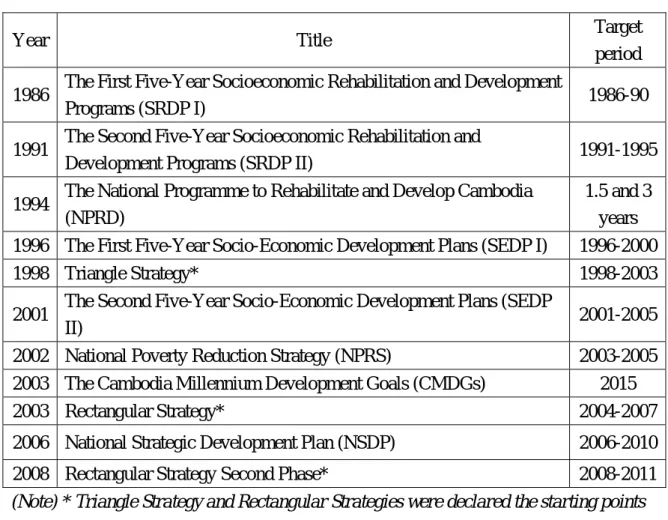
Since the late 1980s, the Cambodian government has consistently tried to take liberal policies toward economic development. Naturally, there remain many seen and unseen barriers to their implementation, but these policies play an important role in the growth of the real economy. Next, we will briefly examine the history and contents of these industrial policies (Table 2).
7
Table 2. Main Industrial Policies, 1986-2008
1) The First and Second Five-Year Socioeconomic Rehabilitation and Development Programs (SRDP I and II) and The National Programme to Rehabilitate and Develop Cambodia (NRDP): Late 1980s to 1990s
The SRDP I and II and NRDP were the first policies in the move toward liberalization. The priority sector in all three policies was agriculture. SRDP I and II stated that agriculture, especially food, rubber, fishing, and timber, was a priority; for example, in SRDP I, which was made in cooperation and coordination with Vietnam and Lao, the plan aimed to expand rubber plantations to 50,000ha, jute production to 15,000t, fish production to 130,000t, etc. The plan was less specific with regards to the industrial sector, with the exception of
Year Title Target
period 1986 The First Five-Year Socioeconomic Rehabilitation and Development
Programs (SRDP I) 1986-90
1991 The Second Five-Year Socioeconomic Rehabilitation and
Development Programs (SRDP II) 1991-1995
1994 The National Programme to Rehabilitate and Develop Cambodia (NPRD)
1.5 and 3 years 1996 The First Five-Year Socio-Economic Development Plans (SEDP I) 1996-2000
1998 Triangle Strategy* 1998-2003
2001 The Second Five-Year Socio-Economic Development Plans (SEDP
II) 2001-2005
2002 National Poverty Reduction Strategy (NPRS) 2003-2005
2003 The Cambodia Millennium Development Goals (CMDGs) 2015
2003 Rectangular Strategy* 2004-2007
2006 National Strategic Development Plan (NSDP) 2006-2010
2008 Rectangular Strategy Second Phase* 2008-2011
(Note) * Triangle Strategy and Rectangular Strategies were declared the starting points for new legislation after the general elections.
8
electricity (Cosslett 1990, 158-159).
2) The First and Second Five-Year Socio-Economic Development Plans (SEDP I and II): Mid 1990s-present
Both SEDP I and II were aimed at poverty reduction of around 6-7% through sustainable economic development. SEDP I aimed at high economic growth (double that of 1994 GDP by 2004) centering on the agriculture, industry, and tourism sectors. The government pointed out the importance of the private sector in economic development and poverty reduction. However, the low growth rate among other results for SEDP I were not satisfactory (Hirohata 2004). The results for SEDP II were much more positive; in combination with other polices and factors including the international environment and national stability, the economy started to show dramatic growth.
3) National Poverty Reduction Strategy (NPRS): 2003-2005
NPRS was basically the policy paper for poverty reduction, whose original initiative was led by the World Bank group (RGC 2002). Here, we shall review only the part concerning industry. NPRS stated the following eight points are important for sustainable economic development in Cambodia.
i) Continue to develop labour-intensive industry, such as garment, toys, and footwear industries
ii) Promote the development of agribusiness by strengthening the legal framework for longer-term land management. (omitted)... provide tax incentives to establish factories to process agricultural products, such as cotton, jute, sugar, palm oil, cashew nuts, rubber, cassava, and fruits
9
processing the existing natural resources in the country such as fish, meat, cement production, brick, and tile
iv) Promote small and medium enterprises (SMEs), micro-enterprises, and handicrafts v) Promote industries that produce appliances and electronics products for domestic and industrial uses and improve product quality….(omitted)
vi) Establish industrial and export processing zones by developing infrastructure, improving service quality and encouraging investments. These zones can be established on the outskirt of Phnom Penh, Sihanoukville, Banteay Meanchey, or Koh Kong… (omitted)
vii) Increase the production of goods for import substitution to some extent by encouraging the development of paper, chemical industries, such as the production of fertilizers, acid, as well as daily consumption goods such as soap, paint, electrical appliance, water pump, and agricultural inputs, etc.
viii) (omitted) …promote “cultural and natural tourism development"
NPRS broadly covered a great number of points. But, what looked new in this strategy was that it mentioned Special Economic Zones (SEZ) and specifically named certain provinces. This strategy also mentioned the importance of developing both export-oriented and import substitution industries.
4) National Strategic Development Plan (NSDP): 2006-2010
In the NSDP, the important points for industrial development are agriculture and agro-industry, transport and telecommunications infrastructure, energy and electricity generation and distribution, labour-intensive industries and export-oriented processing and manufacturing, tourism and related spheres, and human resource development (4.73). Furthermore, it announces the “creation and implementation of SEZ which could attract
10
foreign direct investments and create jobs.” (4.72) (RGC 2006).
5) Triangle Strategy: 1998-2003
The Triangle Strategy was a strategy of PM Hun Sen’s second term in government, and was started in 1998. It worked alongside SEDP I and aimed at strengthening the three pillars: i) Strengthening stability, peace, security and public order; ii) Integrating Cambodia into international and regional community; and iii) Socio-economic development and poverty reduction. All three pillars are related to each other and are based on state reform.
6) Rectangular Strategy (Phases I and II): 2004-2011
The Rectangular Strategy is a strategy for the third and forth government terms of PM Hun Sen (RGC 2004, 2008). It has four pillars to be achieved: i) Peace and political stability and social order; ii) Integration of Cambodia into the region and the world; iii) Partnership in development; and iv) Favorable macroeconomic and financial environment, centered around the notion of “Good governance.” In this strategy, the government is strengthening these four elements along with the four points mentioned above: i) Enhancement of the agriculture sector; ii) Further rehabilitation and construction of physical infrastructure; iii) Private sector development and employment generation; and iv) Capacity building and human resource development. With these goals, the government is trying to achieve “Growth, Employment, Equity and Efficiency”.
As for the industrial sector, The Rectangular Strategy mentioned above seeks to achieve the following: i) Development of agriculture and agro-industry by giving priority to agricultural irrigation; ii) Development of transport and telecommunications infrastructure systems; iii) Development of the energy and electricity sectors; iv) Labor-intensive industries and export-oriented processing and manufacturing; v) Tourism-related industries; and vi)
11
Human resource development.
The Rectangular Strategy II basically took over the concepts of Phase I. It states that partnership, infrastructure development, joining regional integration initiatives, diversifying the economic base (agro-processing, assembling industry (electronic and machinery), and SEZ are important for sustainable economic development. In Phase II, it seems that the government wants to scale up the development stage.
7) Section Summary
In the preliminary stage, when Cambodia had just started the process of reconstructing its economy, policies were aimed just at peace and stability. Later, the government introduced some specific goals for economic development. In the early 1990s, most of the policies mentioned agriculture and labor-intensive sectors only. After the garment sector flourished, policies started to become ambitious and concrete to some extent. After 2000, NPRS mentioned SEZ, and all subsequent policies related to industry refer to SEZ, especially SEZ in border areas.
(3) Laws, Rules and other factors impacting on industrial location i) Law on Investment 1994 (amended in 2003)
The Law on Investment was approved in 1994 (CDC/CIB 2005). This law governs both Cambodian and foreign investors in a non-discriminatory manner (Article 1, 8). The original Article 12 of the Law listed 9 types of investments to be promoted: 1. Pioneer and/or high technology industries; 2. Job creation; 3. Export-oriented; 4. Tourism industry; 5. Agro-industry and processing industry; 6. Physical infrastructure and energy; 7.Provincial and rural development; 8. Environmental protection; and 9. Investments in Special Promotion
12
Zones (SPZ) as shall be created by law2.
The Law was amended in 2003. Article 12 was amended and no longer limits the types of business to be promoted but rather promotes investment broadly. To this end, it states that the government shall make available incentives to Qualified Investment Projects (QIPs). There are three types of QIPs: 1. Export QIP; 2. Supporting Industry QIP; and 3. Domestically oriented QIP. They include various types of investment and QIP can receive incentives including tax exemption for a trigger period + 3 years + priority period. There is also a list of investment activities which can not receive incentives, such as production of poisonous chemicals or forestry exploitation, and processing and production of electricity power by using any waste imported from a foreign country (Annex I of the Sub-Decree No.111 ANH/BK dated September 27, 2005 on the implementation of the law on the amendment to the law on investment of the Kingdom of Cambodia). QIP in SEZ can receive the same incentives as QIP located outside SEZ.
The Law on Investment does not discriminate domestic and foreign investors, location of investment, types of industries, and so on. It welcomes all types of investment from any country. Therefore, the Law itself does not much affect industrial location in the individual provinces/districts.
ii) Sub-Decree on Special Economic Zones and some related Rules (2005)
Government of Cambodia approved Sub-Decree No.148 on the Establishment and Management of the Special Economic Zones on 29 December 2005. SEZ provide a one-stop service via the SEZ administration office, whose members are composed of representatives from the Cambodian SEZ Board (CASEZB), Customs and Excise Department,
13
CAMCONTROL3, the Ministry of Commerce, and the Ministry of Labor and Vocational Training (Article 4.2, Sub-Decree No.148). Since 2009, the government also offers VAT exemption for the investment within SEZ.
Developers can develop SEZ at any location in Cambodia, although there are certain Articles which support their location in border areas: Article 7.6 (Sub-Decree No.146) states that the Zone Developer may obtain a land concession from the State for the establishment of a Special Economic Zone in areas along the borders or in isolated regions, in accordance with the Land Law, and may lease this land to the Zone Investors; Article 3.4.1 (Annex to Prakas No.734, Ministry of Economy and Finance, 11 September 2008) states that SEZ located near the official border gate or located within 20 km of the inland or coastal borders of the Custom zone may apply simpler and quicker formalities4.
iii) Regional development cooperation: Greater Mekong Subregion (GMS) and The Ayeyawady - Chao Phraya - Mekong Economic Cooperation Strategy (ACMECS) as examples
Cambodia is the original member of GMS. In 1998, GMS decided to develop economic corridors in the GMS region—the Southern economic corridor which traverses Cambodia from East to West, connecting Bangkok to Ho Chi Minh City, is one such corridor project. Under the GMS development scheme, Cambodia succeeded in rehabilitating the national road infrastructure. Currently, the pavement ratio is 99.1%for the main national roads (1 digit, Nos.1-7) and 30.2 % for second level national roads (2 digits) (Table 3).
Table 3. Percentage of roads that are paved at national level as of December 2009
3 CAMCONTROL is the organization within the Ministry of Commerce which is in charge of Import Export
Inspection and Fraud Repression.
4 For example, exporters need show only a copy of the export documents to the border gate authorized custom
14 Road Length Pavement ratio (%) Length (Km) Percentage of total
1 1 digit national roads 2,117 5.3 99.1
2 2 digit national roads 3,146 7.9 30.2
3 Provincial roads 6,441 16.2 1.7
4 Rural roads 28,000 70.5 0.3
Total 39,704 100.0
Source: Ministry of Public Works and Transport
Under the GMS scheme, to take greater advantage of these infrastructure developments, the Cross Border Transportation Agreement (CBTA) was signed by GMS countries. The Government of Cambodia signed in 2001 and the agreement became effective in 2004. As for the Cambodian border, Bavet (Moc Bai, Vietnam) and Poi Pet (Aranya Prathet, Thailand) are included among the five gates at which the CBTA is aiming at early implementation (Ishida 2010).
The governments of Cambodia and Vietnam signed a Memorandum of Understanding (MOU) to accept entry of each other’s vehicles. In regards to the tourist buses operating between Ho Chi Minh City and Phnom Penh, a maximum 40 round trips are permitted per day and at present 12 buses are operating. They also agreed for the procedures for a single stop at the border gates, although this has not been implemented yet (Shiraishi 2010).
Regarding the border gate with Thailand, the instability of the Thai government and tensions between Cambodia and Thailand have delayed the negotiations between two countries since 2008. In addition, Thailand’s internal law restricts their public officers from working outside of the nation and therefore additional amendments to Thai law must be made in relation to the single-stop border procedures.
Despite the delay, in September 2009, the two governments signed an MOU to accept 40 of each other’s vehicles per day (Yagura 2010). However, since the traffic rules differ in
15
the two countries, there are further issues to be discussed in order to realize smooth implementation. Thus, vehicles from Thailand are not so commonly seen in Cambodia yet, unlike in the case of Vietnam.
Besides GMS, ACMECS was initiated in 2004 with the strong backing of Thailand. Under this scheme, Thailand supported the construction of National Road No.48, which is a part of Southern Coastal Corridor along the Gulf of Thailand.
2. Trends in Industrial Location in Cambodia
Three trends in industrial location can be identified in Cambodia: 1. Phnom Penh and neighboring provinces; 2. Sihanoukville5 located near the only international sea port in Cambodia, and 3. Border areas, especially that along the Southern Economic Corridor. Table 4 shows the number of establishments and other information at province level.
Most of large factories are located along the growth corridor in Phnom Penh City (the capital), Kandal Province (National Road No.4), and Sihanoukville (international sea port), (Table 5). However, development of the Southern Economic Corridor has resulted in the development of Poi Pet in Banteay Meanchey Province, which is the large border gate with Thailand, and Bavet in Svay Riang Province, which is the large border gate with Vietnam, since the mid 2000s. Even though GDP or GDP per capita in 2006 was still relatively low in these provinces, it is expected that, within several years, it will become higher in the border areas than in surrounding provinces.
Table 4. Province-Level Data
Province No. of establishments Population 2008 Provincial GDP GDP per capita 2006*
5 The government changed the name of province from Sihanoukville City to Preah Sihanouk Province in 2008,
increasing the province’s size. However, most of the statistical data in 2009 were collected under the previous boundary condition. Therefore, in this paper, I use the former name of Sihanoukville.
16 2009 2006* 1 Banteay Meanchey 15,536 677,872 1,021.5 312 2 Battambang 19,539 1,025,174 1,845.5 441 3 Kampong Cham 43,896 1,679,992 3,078.2 397 4 Kampong Chhnang 13,888 472,341 790.0 365 5 Kampong Speu 18,206 716,944 815.9 266 6 Kampong Thom 19,274 631,409 1,001.3 350 7 Kampot 13,305 585,850 1,055.0 420 8 Kandal 38,754 1,265,280 2,253.2 434 9 Koh Kong 4,759 139,170 665.2 810 10 Kratie 7,991 319,217 622.6 442 11 Mondul Kiri 1,615 61,107 177.9 990 12 Phnom Penh 55,593 1,327,615 8,012.7 1,436 13 Preah Vihear 5,129 171,139 338.7 526 14 Prey Veng 26,513 947,372 1,305.2 301 15 Pursat 10,133 397,161 689.2 385 16 Ratanak Kiri 3,847 150,466 269.2 525 17 Siemreap 22,350 896,443 1,995.2 550 18 Sihanoukville 7,621 199,707 1,098.7 1,235 19 Stung Treng 2,591 111,671 249.8 568 20 Svay Rieng 12,216 482,788 711.3 318 21 Takeo 27,606 844,906 1,186.2 316 22 Oddar Meanchey 3,707 185,819 155.3 376 23 Kep 790 35,753 61.5 383 24 Pailin 1,902 70,486 113.1 809
(Note) Provincial GDP and GDP per capita (Constant Price) is based on unofficial estimations by the National Institute of Statistics (NIS).
(Source) NIS.
Table 5. Number of Registered Companies by Province in 2004
Small-size Medium and large-size
Province No Share Province No Share
1 Kampong
Thom 4318 15.3% Phnom Penh 275 74.5%
17
3 Kampong
Cham 3015 10.7% Sihanoukville 11 3.0%
4 Kampot 2397 8.5% Kampong Speu 6 1.6%
5 Kandal 2122 7.5% Kampot 6 1.6%
Others 13159 46.8% Others 12 3.3%
Total 28131 100.0% Total 369 100.0%
(Note) Data is for only registered companies with MIME. (Source) Ministry of Industry, Mines and Energy.
(1) Phnom Penh City and neighboring provinces
Most of the large-scale factories are located in Phnom Penh City and Kandal Province. This trend has remained unchanged since the early 1990s. In this area, basically all aspects such as the labor force and infrastructure are better prepared than in any other areas of Cambodia. Among the large-scale factories in this area, most are garment and textile factories and they have a large proportion of their workers coming from other provinces.
The population of the city is around 1.3 million, but reaches around 2 million when the surrounding areas are included. This region is the political, economic, and cultural center of the country. All of the main national roads start from Phnom Penh and it has river port along the Tonle Sap River. The river flows to southern Vietnam, so exporters use this port to transport their products to the US, EU or Japan via Vietnam. Therefore, Phnom Penh has better connections with outside of the country in three ways: it has National Road No. 1, a part of the main Southern Economic Corridor, National Road No.4 to Sihanoukville sea port about 3-4 hours away, and the river port to Vietnam.
(2) Sihanoukville; the one international sea port in Cambodia
As mentioned earlier, Sihanoukville has the only international sea port in Cambodia and it has, therefore, been a very important place for economic development. Garment product exports to the US and EU via Singapore go from Sihanoukville port. Since 2005, the Japanese
18
government has supported the upgrading of this port with a yen loan. A project to build a new SEZ attached to the port—the Sihanoukville port SEZ—is also being supported by Japan. Besides development in the SEZ, there are shoe factories, garment factories for export, and beverage factories for the domestic market in the Sihanoukville area.
(3) SEZ near borders
There are 21 SEZ located in Cambodia, 13 of which are located in border areas (Table 6). Five are in the border area with Thailand and 8 in the border area with Vietnam. There are also 6 in Sihanoukville (the most important port for logistics) and 2 in Kandal Province which surrounds Phnom Penh City where there is a large population. Phnom Penh City also has the river port with good connections to Vietnam.
In the border areas, investors can use the relatively cheap Cambodian labor force and benefit from GSP for the goods manufactured domestically. At the same time, they can use the well-equipped infrastructure in neighboring countries such as roads, ports, and electricity. The price of electricity especially is high in Cambodia compared to other ASEAN countries.
Table 6. List of SEZ in Cambodia as of the end of 2009
Name of SEZ Province ha Economic Activities in the SEZ
T Kok Koh Kong
SEZ Koh Kong 335.43
Car Assembly and Spare Part Manufacturing
T Suoy Chheng SEZ Koh Kong 100 NA
PS SNC SEZ Preah
Sihanouk 150 NA
PS Stung Hav SEZ Preah
Sihanouk 192 NA
V NLC SEZ Svay Rieng 105 NA
V Manathen SEZ
(Svay Rieng) Svay Rieng 157
Bicycle Manufacturing, Exporting to Europe
19 Footwear Manufacturing Textile Manufacturing Electronic Processing Hospital Garment Factory Packaging Materials Garment Factory
Packaging Materials Factory
T Poi Pet Oneag SEZ Banteay
Menchey 467 Jewelry Packaging
V Duong Chhiev
Phnom Den SEZ Takeo 79 NA
- Phnom Penh SEZ Kandal 350 Footwear Manufacturing
Dry Port Establishing
Pure Drinking Water
Manufacturing
Electricity Pillars Production
Pure Drinking Water Production
Garment Factory
Motorcycle Assembly
Processing of Metal, Construction
Materials
Sugar Cane
Plastics Factory
Paper Boxes and Cases
Electricity Power Factory
Ingredient and Food Processing
V Kampot SEZ Kampot 145 NA
PS Preah Sihanouk 1 SEZ
Preah
Sihanouk 178 NA
V Tai Seng SEZ
Bavet Svay Rieng 99 Bicycle Manufacturing, Export
Footwear Manufacturing
Garment Factory
T Ork Nha Mong SEZ Koh Kong 100 NA
- Gold Fem Park Sun
20
As for the border areas, Bavet City, Svay Riang Province is the most successful area. It is only 1.5-2 hours by road to Ho Chi Minh City in Vietnam. As mentioned earlier, Bavet is one of the CBTA-prioritized gates. Furthermore, due to export restrictions imposed in 2006 on several products, such as bicycles, from Vietnam to the EU because of trade conflicts, some companies have started to think to open additional factories in Cambodia. One such company is a bicycle assembly factory in Manhattan SEZ, Bavet, who successfully produce bicycles even though productivity is as high as in their factories in Vietnam. Manhattan SEZ provides a one-stop service with the cooperation of CSEZB. Therefore, staff from, for example, the Customs office, CAMCONTROL, and the Ministries of Commerce and Labour have bases there. It is 2 hours to the port near Ho Chi Minh City, from where they can deliver products to the EU market in 20 days. Because of the recent upgrade to the port in Vietnam, access to the
V Thary Kampong
Cham SEZ
Kampong
Cham 142.14 Vegetable Processing
PS Preah Sihanouk
SEZ 2
Preah
Sihanouk 1,688 Garment Factory
Garment Factory
Motorcycle and Electronic Bicycle
Assembly
Plastics Factory
V D & M Bavet SEZ Svay Rieng 117.95 NA
T Kiri Sakor Koh
Kong SEZ Koh Kong 1,750 NA
PS Preah Sihanouk Port SEZ Preah Sihanouk 70 NA PS Kampong Saom SEZ Preah Sihanouk 255 NA
V P (SEZ) I C Svay Rieng 107.55 NA
(Note) NA= No Action Yet, T=Near the border with Thailand, V=Near the border with Vietnam, PS=Near Sihanoukville Port
(Source) Cambodia Special Economic Zone Board (CSEZB)/Cambodia Development Council (CDC).
21
US, EU and Japanese markets is expected to improve further in the near future.
Due to the political instability in Thailand since 2008, the border areas with Thailand are not as active as the Vietnam border areas. However, Hyundai (Korean) is now planning to establish a motor assembly factory in Koh Kong SEZ by the end of 2010. Road infrastructure has been improved to connect Thailand to Vietnam via Cambodia. Thus, it is expected the when the political situation is resolved, there will be better growth in the border areas with Thailand.
4. Statistical data for analysis in future work
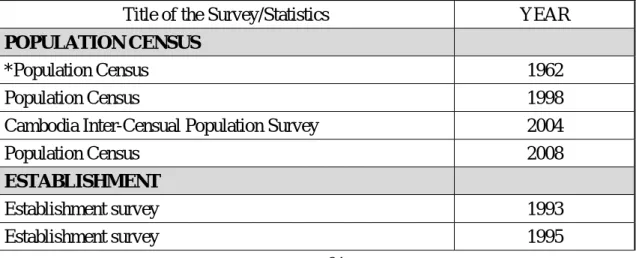
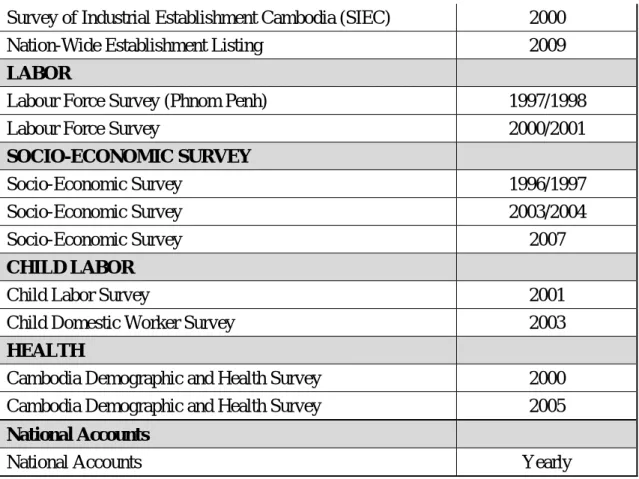
For analysis in the future, the following statistical data is available at, for example, the National Institute of Statistics (NIS), the Ministry of Planning and other relevant ministries such as the Ministry of Commerce, Ministry of Economy and Finance (Tables 7 and 8).
Most of the information is available from the Data User Service Center at NIS and some from websites listed in Table 7. Since 2000, the Statistical Year Book has been published every year. This publication provides the main statistical data for Cambodia including population, education, health, income and expenditure, agriculture, industry, investment, government finance, national accounts, and trade.
Table 7. Surveys and Statistical Data Available from the National Institute of Statistics
Title of the Survey/Statistics YEAR
POPULATION CENSUS
*Population Census 1962
Population Census 1998
Cambodia Inter-Censual Population Survey 2004
Population Census 2008
ESTABLISHMENT
Establishment survey 1993
22
Survey of Industrial Establishment Cambodia (SIEC) 2000
Nation-Wide Establishment Listing 2009
LABOR
Labour Force Survey (Phnom Penh) 1997/1998
Labour Force Survey 2000/2001
SOCIO-ECONOMIC SURVEY
Socio-Economic Survey 1996/1997
Socio-Economic Survey 2003/2004
Socio-Economic Survey 2007
CHILD LABOR
Child Labor Survey 2001
Child Domestic Worker Survey 2003
HEALTH
Cambodia Demographic and Health Survey 2000
Cambodia Demographic and Health Survey 2005
National Accounts
National Accounts Yearly
(Source) NIS.
Besides those data, through daily administration activities, each ministry collects data on agriculture, education, public health, import/export data, and so forth. Every year, NIS collects these data from other ministries for the purpose of publishing the Statistical Year Book (NIS 2008). When NIS conducts a statistical survey that cuts across fields, the relevant ministries get together under NIS.
Table 8. Economic Data from Other Ministries
Title Ministries URL
Trade
MEF http://www.mef.gov.kh/share.php?cid=9&p=1&scid=1 MEF/Customs http://www.customs.gov.kh/
MOC http://www.moc.gov.kh/News/Default.aspx?MenuID=17 Agriculture
23
(Source) Prepared by the author.
Province-level and district-level statistical data are still very limited. The census data can, however, tell us about the population and living standards at district level (NIS 1998, 2009). Some ministries like the Ministry of Education or Ministry of Health know more about schools or health centers at a detailed level. As for economic data specifically, an establishment listing was undertaken in 2009 and the first economic census will be held in 2011. The data gathered by these new surveys will provide us with more detailed and accurate statistical information for use in future research.
Conclusion
The Government of Cambodia chose to implement a market economy at the end of 1980s. The present location of industry in Cambodia is not the result of the government’s strong intentions to invite specific industry into specific locations; however, with the promulgation of certain laws and regulations promoting SEZ and progress in regional cooperation such as GMS as well as policies which open up the economy to foreign investors, we can observe from the data for the late 2000s that industries in Cambodia are located in the Phnom Penh area, the Sihanoukville area, and the border areas with Thailand and Vietnam. Future analysis should refer to more detailed data such as other economic indicators, infrastructure development indicators, and social development indicators at province or district level.
1980-present Education
Statistics MEYS http://www.moeys.gov.kh/education_static_indicator.php Registered
Companies List
MOC, MIME,
24 References
Cosslett, Tuyet L. 1990. “The Economy.” in Cambodia: a Country study, ed. Russel R. Ross. United States Government.
Council for the Development of Cambodia (CDC)/Cambodia Investment Board (CIB). 2005. “Laws & Regulations on Investment in the Kingdom of Cambodia.” Phnom Penh: Council for the Development of Cambodia.
Hang Chuon Naron. 2010. Cambodian Economy: Charting the Course of a Brighter Future. Supreme National Economic Council, Ministry of Economy and Finance.
National Institute of Statistics (NIS). 1998. “1998 Population Census of Cambodia.” Phnom Penh: National Institute of Statistics.
_________. 2008. Statistical Year Book 2008. National Institute of Statistics.
_________.2009. “2008 Population Census of Cambodia.” Phnom Penh: National Institute of Statistics.
Royal Government of Cambodia (RGC). 2002. “National Poverty Reduction Strategy 2003–2005.” Phnom Penh: Royal Government of Cambodia.
_________. 2004. “Address by Samdech Hun Sen Prime Minister of the Royal Government of Cambodia on Rectangular Strategy for Growth, Employment, Equity and Efficiency.” First Cabinet Meeting of the Third Legislature of the National Assembly at the Office of the Council of Ministers, Phnom Penh, 16 July 2004, Royal Government of Cambodia. _________. 2006. “National Strategic Development Plan 2006-2010.” Phnom Penh: Royal
Government of Cambodia.
_________. 2008. “Address by Samdech Hun Sen Prime Minister of the Royal Government of Cambodia on Rectangular Strategy Phase II -- For Growth, Employment, Equity and Efficiency.” First Cabinet Meeting of the Fourth Legislature of the National Assembly at the Office of the Council of Ministers, Phnom Penh, 26 September 2008, Royal Government of Cambodia.
Japanese
Hirohata, Nobuo. 2004. Kanbojia keizai nyumon [Introduction to Cambodian economy]. Tokyo: Nippon-Hyoron-Sha.
Hatsukano, Naomi. 2006. “Industrialization in Cambodia: The Manufacturing Industry and Its Actors” in Kohatsu ASEAN shokoku no kogyoka: CLMV shokokuno keiken to tenbo [Industrialization in CLMV countries: The Experience and Prospects of Late-Comer ASEAN Countries] ed. Naoko Amakawa. Kenkyu Sosho No.553. Institute of Developing Economies, JETRO.
Ishida, Masami. 2010. “Ekkyo-Kotsu-Kyotei to Boeki-Enkatsuka (CBTA and Trade Facilitation)” in Ajiken World Trend, No. 172, January 2010.
25
Shiraishi, Masaya. 2010. “Nanbu-Keizai-Kirou: Mokubai=Babetto-Kokkyo Gaito (Southern Economic Corridor: Mocbai-Bavet border gate)” in Ajiken World Trend, No. 172, January 2010.
Yagura, Kenjiro. 2010. “Tai=Kanbojia kokkyo(Thai=Cambodia border)” in Ajiken World Trend, No. 172, January 2010.