The Transformation of Rural Society under the
Economic Policies after 1992 in Duc Trong
District, Lam Dong Province, Vietnam
著者
HONDA Mamoru, PH?M THANH THOI
journal or
publication title
Annual Journal of the Asian Cultures Research
Institute
number
50
page range
186(161)-165(182)
year
2016-02-29
the Economic Policies after 1992 in Duc Trong District,
Lam Dong Province, Vietnam
HONDA Mamoru
PHẠM THANH THÔI
要 旨 ベトナムは1986年のドイモイ政策という市場メカニズムの導入後現在まで大きく発展し続けてい る。国民の物質的生活向上も著しい。こうした中,筆者の調査地であるラムドン省に住む水耕作民 は,現在,水稲収穫後の裏作開始,あるいは水田から畑作への完全転換をし始めている。 そこで筆者は,調査地の形成から現在に至るまでの経済政策の変遷の結果を,特に合作社解体後 に行われた土地の返還後(1992年以降)の政策と人々の反応を,インタビューから分析した。そし て,現在行われている政策が,調査地の人々に対してどのような結果をもたらしているかを 明らか にした。 I IntroductionVietnam has continued to increase development up to now after the introduction of market mechanisms, the Renovation (Doi Moi) policy of 1986. Internationally, Viet Nam is 1/2007 into the World Trade Organization (WTO) member and will establish common criteria for world trade system, further enhances the cusp of change. Since 1990, the authors studied, the slash-and-burn farming people that called the Ma and the Koho-Cil group. The study is about the transformation of their society in exogenous change from the French colonial period up to the present through the Renovation. In recent years, the authors have been comparative study the transformations in the social structure of the slash-and-burn cultivation people the Koho-Cil group and rice cultivation people the Koho-Sre group. In the meantime, the fi eld of the authors, the improvement of the electric network and the road construction, increasing the income of cash, appears to be growing. As a result of such policies, in some of the high self-evaluation of the administrative side, it has also received criticism from researchers.
Therefore, in this paper, the authors, after introducing the criticism and evaluation of the policy, based on these are already over time from their announcement, clarify the transformation of society in the fi eld, in particular, focus on the use of land. And authors as well as evaluate the results of the policy, suggest the change of the ethnic group own consciousness.
This survey is targeted to rice farming people (the Koho-Sre group). The fi eld was selected one village along the national highway, which would be greatly affected by exogenous changes. Currently, many of the rice cultivation people who live there, began the second crop, or quit the rice, began to fi eld crops.
1 Overview of the survey
This paper is the outcome of the investigation conducted about two weeks in June 2015. This investigation was carried out by Honda Mamoru, Institute of Asian Cultural Studies, Toyo University, and Phạm Thanh Thôi, Department of Anthropology, the Faculty of Social Sciences and Humanities, Vietnam National University Ho Chi Minh City. The authors carried out this investigation in the Vietnamese and Kơho languages.
2 The outline of this paper
The outline of this paper is as follows: Section II is Evaluation and criticism. Here, the authors introduce the papers of Cu Hoa Van was the chairperson of the ethnic council of Parliament [Cư Hòa Vần 2000:9-13], Le Van Toai who was the director of the department Commerce Lam Dong Province [Lê Văn Toại 2000:356] and the papers of two researchers Dang Nghiem Van [Đặng Nghiêm Vạn 2002:182-213] and P. Mcelee [Mcelee, P.2004:182-213]. And to compare the policies in the fi eld, the authors grasp the policies made in other areas through these papers. Section III is a general overview and the history of the fi eld. The authors explain social transformations by describing the signifi cant exogenous change of the fi eld in each of three stages: the fi rst stage, following the French colonial period and Vietnam Wars; the second stage, following the revolution of 1975; and the third stage, following the dissolution of cooperatives. Section IV is the effects of policy as seen from the Social Changes through the interview data. The authors with using the interview data, point out the effects of the policy of the social transformation in the fi eld, mainly related to the change of the economic activities of the land. As a result, the authors consider the various policies, impact of related to the current situation, evaluate the policies, and presents the future study.
II Evaluation and criticism.
As mentioned at the beginning, here the authors introduced the evaluation of the policies briefl y by the administrative side, the criticism by the Vietnamese domestic and foreign researchers.
Cu Hoa Van is described as follows. Below is the abridged translation by authors.
・・・・・since the Renovation is implemented・・・・greater economic development policy has been carried out. And prepare the infrastructure that is the foundation of the industry and life, to be able to feed the livestock to raise the yield of the crop.
Of the 3 million people, which was the subject of DCDC(1)
policy, life has stabilized for hunger units, have a spacious house, owns some of the cultivator, watering machine, threshing machine, tracks such as modern machine.・・・・・・・・・・・In Tan Chau commune, Di Linh district, Lam Dong province, Koho Sandiu Kinh, group 1, 395 units. Units that make coffee cultivation amounted to more than 20 percent, more than the annual income 500,000,000đ. In the whole commune, track 30, cultivators, and small delivery vehicles total 306, phone 120, 717 bikes and the poverty rate is only 5%. The vehicle passable road raced in each village; some are asphalt pavement. Still a few years later, it would paved road to reach the village by donation. As described above, the minority district has the potential for development, become a rich, it canceled the concept of minority has not kept up with the Kinh group. The case of Tan Chau is one of the models of mountain people caught up with plain people[Cư Hòa Vần 2000:9-10]
Next, the authors introduce the paper of Le Van Toại. According to that paper, against poverty policy by the government from1995 to 1998, the salt was added iodine and the oil have been provided to remote areas,
it has been promoting the construction shop for consumer goods supply by the Department Commerce. As a problem of the future of the province, while promoting the development of economic capital, human capital and social infrastructure, the government should condition made reform of the markets of agricultural products and goods[Lê Văn Toại 2000:356].
And in “the promulgation of the economic and social development aid policy mechanism for the provinces in Tay Nguyen(2) until 2010(24/2008/QD-TTg)” was promulgated in February 2008.
GDP growth rate gave the fact that become 12-13% per year, to increase the rate of poverty eradication, the creation of the job for 12-14 million people in the year. Workers ratio that has received the job training aims to be up to 25-30%. Also on the agricultural side, there is the support policy for growing production of food and economic value of marketable crops. In the concrete, until 2010 stop ineffi cient coffee production in the waterless land, the total production area is in 33-35,000 hectares, other cash crops with high economic value, will change as shown in, for example, fl owers and cashew nuts[Bộ Công Thương 2010:141-162].
On the other hand, Vietnamese researcher Dang Nghiem Van has raised the issue of the development process. Dang Nghiem Van is using the data of each province in Tay Nguyen, including Lam Dong province where has the author’s fi eld, pointed out that land development has resulted in the impoverishment of ethnic minorities, Trust relationship between the Kinh group and ethnic minorities has been compromised as a result. The fact that, including the case of Lam Dong province with our fi eld, were revealed as follows.
In 1990, the outback of Loc Lam commune, the old revolutionary base area was fi ve settlement 1800 people who lived there, each unit 0.8 ha of cultivated land and farm land, also, to have 5,000 of planning immigration to the commune, and came a large number of free immigration. 1990, people began to pass the land and forest. People who lived originally in the land, was honest and not calculating nature, began selling the forest and land to new settlers. New settlers traded 0.1 hectares of land for one bale of rice or one jar of alcohol.
Currently, this commune has 200 farms. In the provision of the province regarded as farm more than 5 ha land. Therefore, the phenomenon that the people of this commune to destroy the forest and makes a slash-and-burn agriculture, or will people to go to work has occurred. Previously Protestant but did not, now the entire village is a believer. Transfer or sale of forest land, not only traffi c route along and the city suburbs, spread into the hinterland and the old revolutionary base. As a result, the difference of living level between newly arrived ethnic groups and Agriculture and forestry offi cials and staff, and the people in this area originally is gradually opening up.
According to Dac Lac agricultural fi rm survey (1998), in 29 communes, 81 hamlets of this area, 24% of the commune and 19% of the hamlet have enough land. The rest, i. e., the 3/4 of the commune, 4/5 of the hamlet has been insuffi cient from 1/3 to 3/4 of the cultivated areas.
6,840 units in 15,930 units, i. e., 2/5 unit in poverty hunger region of 29 communes, 81 Hamlet described above is, of which 2,170 units, 31% due to the land shortage.
That is, in the poverty regions of 29 communes, 81 hamlets as above, 2/5 unit, for which 2,170unit, 31 percent is caused by land shortage is poverty. Field surveys of Le Trong Cuc and other researchers showed a poverty rate rising to 60% of the population, of Ron Ngao village, of Gia Rai village, near the town of Kon Tum District-level, of the Koho village Ta It commune Loc Nam district Lam Dong province.
That is why we would not be surprised. Ethnic minorities who lived from ancient times in that area, for the sake of independent freedom, equality, happiness, participated in the revolution after the revolution of a trust relationship is reduced. The main reason for trust relationship is decreased, is the fact cannot
resolve the land issue successfully [Đặng Nghiêm Vạn 2002:340]. Also, P. Mcelee [2004: 204-205], is criticized as follows.
The state continues to create centralized policies for development that mirror ineffective ones from the past. …..Vietnam government….focus less on security issues and more on legitimate equity and social justice concerns……..Rather than turning inward to worry about security, Viet Nam should look outward, beyond its borders, to the world increasingly addressing issues such as the rights of “indigenous peoples.
The authors confi rm whether this condition is still going on.
III A general overview and the history of the fi eld 1 Industry and population in fi eld
The fi eld of this paper is in Phinom administrative hamlet, Hiep Thạnh commune, Duc Trong district, Lam Dong province. The area is located in Da Lat city south spread around the point where the national highway 27 and 20 merge, is 90.90㎢ , at 1200-1400 m above sea level. There is the agriculture as the main industry. Agriculture area of 2,487ha. The breakdown, rice 24ha, fl ower 76ha, sweet potato 31.5ha, corn 49ha, vegetables 1,746ha, perennials 546.75ha consisting mainly of fruit trees, grass 88ha, ponds 25ha[UBND xã Hiệp Thạnh 2015:2]. The fi eld is No16 tổ(3) of the 36 tổ in Phinom hamlet.
No16 tổ is located along the left side of the national highway
20 near the T-junction, the national highway 27, and national highway 20 are merged. On the 15th of June 2015 statistics 33 units 44 family, most of the population of ethnic nationality is the Koho. Currently, No16 tổ mostly engaged in agriculture. However, they are not as specializes in rice or coffee cultivation as the author’s fi eld until now. From their agriculture rice cultivation, vegetable of the second crop has been changed to full-time in the crop rotation. People participated in the technical workshops that pesticide companies and fertilizer companies held with permitting of the commune or hamlet; it has mastered the vegetable cultivation technology. Currently, Phinom is a hamlet as an administrative unit; it is planned to change the Commune-level town within 2015 year. During the development of such Phinom, the No16 tổ there are six absolute Poverty units and 2 Relative Poverty units(4).
2 The formation process of the current fi eld
For this, the informants, (the Koho-Sre YB 1966,YB(5)
1946) is the summary information by the authors.
2-1 Until revolution in 1975
Time the 20 national highway was made in the French colonial period(6)
, already exists my village(boon(7)
)Phi Mnom. This is the exact name, Phinom is the name that the People’s Committee was map 1 fi eldsite map
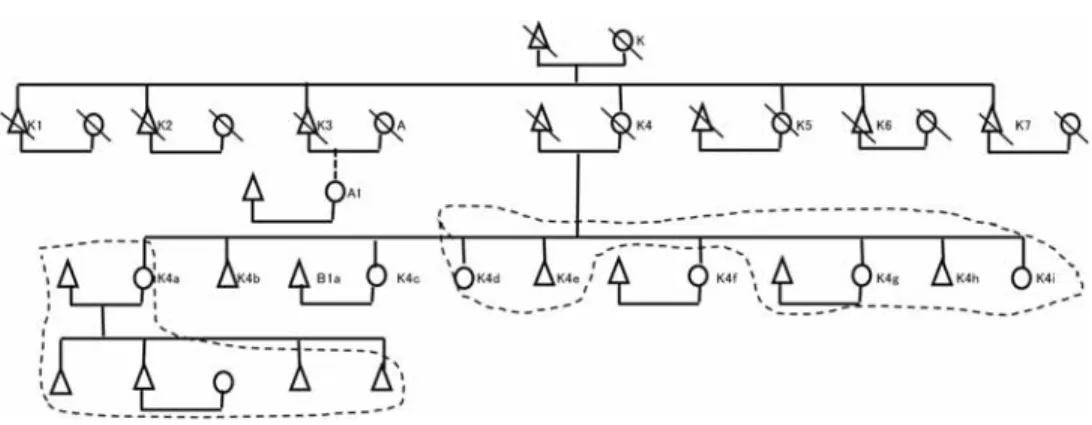
wearing. Drom, Kanreo, Cirong, Kogram, Klong around our village, these villages had a marital relationship with our village. Our village has three large lineage group. The fi rst Kinships group was originally here original Phinom group named (7 units: statistics2015). The second group was had the male spouse from Kanreo village Kanreo group named (13 units: statistics2015).The third group is the ancestors and descendants of K’Blai came from Cirong to Phinom, Cirong group named (13units: statistics2015). During the French colonial period, Before K’Blai comes, the Phinom village had only two houses. People of Phinom wanted a competent leader. K’Blai is born Cirong village, handled land management as an assistant of one regional management leader in Canton Dong Duong. Since K’Blai was competent, people of Phinom, to make the K’Blai their leader, invited the family of K’Blai from Cirong to Phinom. Originally K’Blai’s wife was the adopted daughter of a low-income family without property, was easy to move. First K’Blai is invited, then the husband of K’Blai’s daughter J (fi gure 4)(8)
, and next, husband of K’Blai daughter K (fi gure 4)(9)
came. K’Blai has seven daughters, including J, K all had immigrated.
However, K’Blai is suspected to have an affair with the wife of an important man, had been poisoned by people of Phinom. For this incident, Cirong side asked for compensation for Phinom, Cirong got the 30 buffaloes. Also, K’Blai’s daughters got the fi ve Buffalo and land. At the present descendants of the K’Blai called Cirong group. Since that time it was before still violent war, the villagers were rice cultivation, they had kept 40-50 buffaloes in total. The Era US military came, the road is extended(10). And the Kinh group has
been moved .But gradually war approached, 1965, checkpoints to check the movement of people has been installed on the T-junction to the confl uence of the 20 and 27 national highway[Bch Db HDT 2010:131]. In 1967, in Kanreo village next to live the same Koho-Sre, Strategic Hamlet had been built just at that time, was the Kinh immigrated to the area of Kanreo village.
2-2 From after the revolution to cooperatives dismantling, and up to now
・Cooperatives era (1976-92)
After the revolution, cooperatives are organized which is called cooperatives Hiep Thanh. In the village, purifi cation pantries of salt were made with iodine defi ciency measures (to 1988). From 1988, it was made tobacco company (-2007).
Phinom village land (paddy fi elds) becomes to be attributed to the State. The harvest has been distributed by a number of workers of each unit. The production group manager is two husbands of J2 (fi gure 3), K4 (fi gure 4) who are K’Blai’s granddaughter.
At the beginning of 1980, there were only a few Kinh units. However, when the security has become well, about 17-18 unit has been moved (mid 1980s-).Around this time, the Kinh and the Koho have come to the farm work together in the production group.
In 1988,”the Communist Party Politburo No. 10, a resolution on the Renovation of agricultural management(11)
“ has been promulgated. Cooperatives, change the system from that time, it distributes the land by the labor number of people, Producers of the harvest, after paying a predetermined amount to the cooperatives, the rest becomes a share of producers, it was able to dispose of freely. In addition, since the ownership of the buffalo was also observed, buffalo gone temporarily most during the war, the volume is restored from this time. And the Koho began to sell it pioneered the land for the Kinh that has emigrated.
・After cooperatives of dismantling(1992-)
original landowners. However, the Kinh did not return to the original landowners for the land that they had pioneered. They did not return the land that they had already handed before cooperatives dismantling. The Koho, because life was painful and have pioneered the forest and sell the timber, and sell fi rewood, continued to sell the land. Moreover, by the prohibition of developing in 1996, wood as a building material of traditional houses will be diffi cult to obtain, the house style was forced to shift to modern houses of cement and brick. And, they want to buy the agricultural machinery, as they already knew how easy it is to cultivate using agricultural machinery at cooperatives times, people needed cash. People in 1988 but had lost a large number of buffalo in the disease, in turn, because the grazing land has been reduced by the prohibition of developing, has become diffi cult to keep the Buffalo. They had sold the remaining buffalo almost until 2000 for the cultivator and house construction.
Then people began to sell the paddy that has been pioneered by themselves (2000).
Traditional House dwindling had disappeared completely in a few years, people required fund for building houses of bricks and cement. Currently, the arable land owns 0.2-0.3ha on average per unit. The government has banned the sale of the minority land from 2001 (SỐ 168/2001/QĐ-TTG).
IV The effects of policy as seen from the Social Changes through the interview data.
Here, as well as presenting the interview data from the informant, will continue to point out the relationship between each group, the important points of the data. Moreover, the authors explain the effects of policy as seen from the interviews.
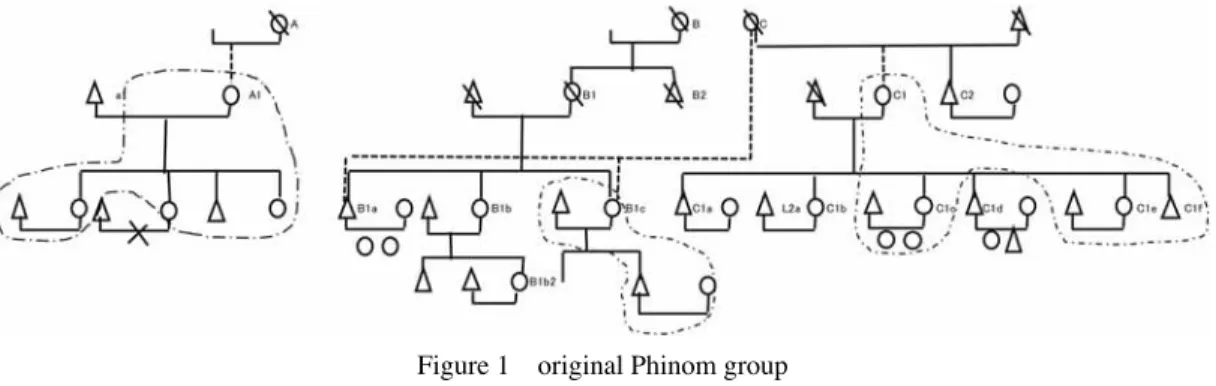
1 Original Phinom group
A, B, C, but is not the same mother is the same lineage. Thus, the descendants because the same ancestor that it cannot get married.1 Original Phinom group
1-1 interview with C (YB 1962)
C1 belong to the Kinh, but in the ID card, she is the Koho. Because C did not have a girl, she adopted C1 as the daughter. The husband of C1 was born in 1952 in Mron village. Married in cooperatives era, C1 couple has six children in total. Eldest son C1a (YB 1980) married a woman of the Churu in 2000, eldest daughter C1b (YB 1983) married L2a, who belong to Cirong group of this village in 2004. Second daughter C1c (YB 1989) married a man of Kanreo village in 2010. C1d (YB 1992) married a woman of Kanreo village, this year, youngest woman C1e (YB 1993) was engaged to a man of Cirong village. The rest is a boy who is unmarried.
After cooperatives dismantling, C1 had received a paddy fi eld of 2ha. But her husband is a drunkard, did not work. Since there is no income, the C1 couple rents the land to the Kinh woman. That woman began grocer. C1 couple’s life is painful, and the C1 couple had put daily necessities, food, and liquor in hand without paying the money at that grocer. Suddenly one day, grocer demanded to the C1 couple to pay the bill until then. The C1 couple cannot repay that debt in money, they had no way other than to repay in the land.
They had also done the second crop of vegetables had failed. Moreover, the expense of the wedding ceremonies of children was big. In the Koho custom, bride side has to bear all expenses, bridegroom side does nothing. For example, reception hall, i. e., chair, table and set up tents, and meals, drinks, gifts for bridegroom side, it’s the burden of all C1 side. So the cost of the engagement and wedding of three daughters, C1 have to borrow money and will pay it. In the past, it was possible to get married if we prepare only pig
and alcohol, necklace and cloth. To marry one woman now, 100,000, 000 đ or more. Continues to the debt, still no repayment is terminated. The rest of the C1b of wedding costs 14,000,000 đ, wedding expense of C1c is, 50,000,000 đ. In addition to these, at present, debt 30,000,000 đ is for restaurants and bridegroom side in the engagement of C1e, it remains. The debt at the time of the C1e’s paid off scheduled for 2017. The C1’s youngest child is but unmarried. When a man married, the bridegroom side has to prepare, only 10,000,000 đ. It is very easier than the case of a woman.
C1 is living with C1c, C1e couple, the youngest son C1d. C1 just goes home only on Sunday because she is working in the live-in the neighboring hotel from 2008. Salary the fi rst year, but was 1,200,000đ / month, this year’s seventh year is a 4,500,000d / month. Since C1’s reputation as a housekeeper was good at private home, she was adopted at the hotel. The land she inherited from foster mother C (0.22ha) dispensed to the children living together. It has given 0.12ha to the second daughter C1c and 0.1ha to the youngest daughter C1e. They made rice until 2010, since 2010 they have made the vegetables. C1e husband has a driver of vegetables transported in market suburbs. It did not dispense to C1b because C1b couple got 0.15ha from bridegroom side. Currently, they are making cucumber and tomato in that fi eld.
[Point]
・Payments on land instead of repaying the debts to the Kinh. In this village have a few same cases. In this village have a few same cases. And these are considered an act of fraudulence against him.
・By that it has changed to the current style from the traditional marriage style increased the cost of related to marry; that is pressure on the livelihood of families that have the women who reached the marriageable age. ・From 2000 or earlier, crop rotation is being carried out.
・Since 2000, it found the move out to the occupation other than farming.
・Sale of inherited land from ancestors that are prohibited, in customary law but has done. ・a marriage case in the same village of Cirong group
・a marriage case with the different ethnic group the Churu.
1-2 interview with B1a (YB 1968)
B1 mother of B1a died in 1976, father born in Kogram village (-2012) has gone back to his hometown according to the Koho custom. After that, B1a and B1a’s two sisters, raised by a maternal grandmother C and C1. Wife K4c whom B1a married in 2005 (YB 1975 fi gure4) belong to Cirong group in Phinom village. There are two children. Now B1a have arable land 1 ha. Of these, 0.4 are the property division of the wife’s parents. The remaining 0.6, maternal uncle B2 of B1a dispenses to B1a and B1a’s two younger sisters the property of the mother. Elder sister B1b (YB 1970, MB 1995) was the 1 ha, following sister B1c (YB 1972,
MB 1994) have received 0.7 ha. Of B1a arable land 1ha, it has rent a 0.6ha in 3,000,000đ / 0.1ha. B1a itself make a vegetable and rice (1 cropping season) in 0.4ha, also owns a fi sh farm 0.37ha. Vegetables cultivated tomato, lettuce, red pepper, green onion, turnip a wide like. It is suffi cient to live in a family of four if 4,000,000đ/month on average.
[Point]
・they form the matrilineal society, and a man is not subjected to the distribution of property. However, in this case, B1a received 0.6ha.
・Case it is leasing the cultivated land to the Kinh (2009~). ・Since 2005, B1a started a second crop.
・B1a’s partner is a woman Cirong group of this village, but not outside of the village.
1-3 interview with B1b (YB 1970)
B1b married a man born Ka Do commune, Don Duong province. B1b inherited the land of 1ha, further, in the property division of C, B1b has got a cultivated land 0.2ha, C1 is 0.22ha, C2 is 0.2ha, B1c 0.2ha.
By selling its arable land 0.2ha and four buffaloes, around 2000 B1b built a new house. The transfer price of land 40,000,000đ, four buffaloes were 3,200,000đ. Initially, 0.8ha had a two cropping rice. However, building the house after beginning the second crop of vegetables. it is renting a 0.2ha to Kinh from 2009 to squeeze such as the fertilizer in 5,000,000đ/year. Since the eldest daughter married in 2005, and impart a 0.15ha, the remaining 0.25ha corn, makes one rice cropping to 0.2ha, in the remaining six months after harvest 0.2ha It has been renting in 30,000,000đ/0.2ha/6 months.
[Point]
・Case it is leasing the cultivated land to the Kinh (2005~). ・Since 2005, B1b started a second crop.
・Marriage partner does not belong to the traditional marriage sphere.
・When the distribution of property, man (C2) has become the recipient of the land. ・The sale of land and buffalo for house rebuilding around 2000
1-4 interview with husband a1 of A1 (YB 1962)
a1 belong to ethnic group Cil. a1 came Phinom with my foster mother j1 (fi gure 3). Because foster mother married a man of Phinom village. a1 married to wife A1 (YB 1964) in 1982.
a1’s wife A1 has had a paddy fi eld 1ha. Around 1992, the a1 couple has sold cultivated land for gold 3.75g per 0.1ha in economic distress. a1 is poor at rice cultivation.
From 2011, a1 pioneered the land of the Kinh on the condition that for two years rent-free.
From 2013, a1 is renting 0.18 ha for 60,000,000đ per year for a1’s vegetable cultivation. The vegetables a1 grow various but make a bean now.
a1 has bred three buffaloes. Female Buffalo in two years gave birth to three buffaloes. a1 breed buffaloes, and sell them for 40,000,000-50,000,000 đ per one buffalo. The a1 couple goes to day labor a total of one month in one year. Wages 150,000-200,000đ case of a man one day, if the woman is a 120,000đ.
a1 have four children and have lived in this House with the eldest daughter A1a couples, the second daughter. The second daughter married to the Kinh, but one childbirth gotten divorced, two people also stay here. It takes 75,000đ / month for their children to go to nursery school.
[Point]
・a marriage case with different ethnic groups, the Cil, the Kinh. ・day labor work and that wage
・renting land (2011 ~) ・Buffalo breeding farm
2 Kanreo group
This Kanreo group is called so for the mother of the D in Figure2 married a man born Kanreo village. By the way, D husband is also a born Kanreo village. On the Genealogy, there are several spouses who were born in Kanreo village. Mother of D in Figure2 is the same lineage in the same generation as the mother of A, mother of B, mother of C in Figure1.
2-1 interview with D
D’s husband Mron village born, died in 2013. D have eight children. D distributed cultivated land (0.25ha) to each independent daughter’s family. Now that D has cultivated land (0.5ha) is of two families living together (D3e, D3g). D3a eldest daughter has married a man of Kogram village and died in 2000. Husband of D3a remarried already, does not live here anymore. So the land of the eldest daughter is managing use by D3d for looking after children of the eldest daughter. D3d’s a high school teacher. Husbands of D3b and D3d belong to the Kinh born in Ben Tre province, they came to Phinom as the worker for the harvest, then fell in love with their wife. The husband of D3e is the Kinh of HCM born. The marriage with the Kinh man, the bride side can win the bridegroom side cash contribution, the bride side can survive economically. And if a husband is the Kinh, they can choose their house into either of a hometown of the bride or the hometown of the bridegroom. It took a cost of 40,000,000đ when the Kinh man and D3b marriage, but the bride side came back more than 40,000,000đ by car or gold or the cash contribution from the bridegroom side. In the marriage between the Koho, the bride side bear all, without bridegroom side helping anything.
Since the opponent’s Koho when the marriage of D3c, it took more than 100,000,000đ.
In 2000, D3 built this house in 100,000,000đ. Currently, D3e and D3d couples, D3f are living with D3. From 2005, after one term harvest in rice cultivation, D3 started to make the vegetables in the second crop. This year D3 has made the green beans and corn. Rice quit from this year.
D4 of the husband is a K6 (fi gure4) born Cirong group in this village. D4a married the husband of Kanreo village, D4c married a woman of Kanreo village. D4b married a man of Cirong village but have divorced this year. And D4d married a woman of Kogram village.
[Point]
・marriage with Mron village = Marriage partner does not belong to the traditional marriage sphere. ・a marriage case with different ethnic group the Kinh.
・the Kinh have the difference in the marriage customs with the Koho. ・second crop start from 2005 and Rice quit from 2015.
2-2 interview with D5(YB 1946)
D5’s father died before the revolution. D5 married a man of Kanreo village in 1972, two daughters (YB 1972, 1978) could be. However in three days after birth, D5 gave the second daughter as an adopted child to D5’s husband relatives without having a daughter in Kogram village. And in a few years D5’s husband died. Then D5 was made a living by getting the rice paddies (0.5ha) from mother D(-2010) in the property division.
Daughter(YB 1972), married the Kinh had been seasonal workers harvesting from Ben Tre province in 1998. D5 and that couple are now living together.
Paddy fi elds until 2007 since it is making lettuce, tomato, green beans, eggplant. [Point]
・Rice quit from 2007.
・a marriage case with different ethnic group the Kinh.
2-3 interview with D6(12)
D6’s husband is from Cirong village, who died last year (2014). Eldest daughter D6b (YB 1968) married a man (YB1970) from Drom village in 1990 and were independent, so D5 distributed 0.8 hectares of land. This husband from Drom is a son of the father (B2 fi gure1). At present, the paddy rice in 6 months, once it is 5 tons of harvest. Lettuce, cucumbers, corn, and turnips are made in the remaining six months. D6b have three daughters; the eldest daughter married a man of Drom village (YM 2012), and youngest daughter married a man of Klong (YM 2015). A few days ago, that wedding reception was held, and more than 40 tables for guests were prepared for the banquet. It costs 1,600,000-1,800,000đ for one cuisine per table, so, it would be calculated took 64,000,000đ at a minimum. In addition to this, D6 has to pay the cost of the drink, and the rental fee of the tent, tables, and chairs.
Live in this couple in which the land is located 565㎡ , it is one that was purchased in 1996 by 6,500,000đ from F1.
D6 dispensed land for two daughters. For Second daughter D6c, who married a man of Cirong group and lived apart already, is a 0.6ha, for the third daughter D6d, who married a man of Kogram village and lived apart, is a 0.5ha. At present, D6 live with the D6d couple, D6e, D6f, have used the arable land of 0.6ha. Of these 0.4-0.5ha, a 4-month rice carried out in two cropping. Harvest is about 4,200kg. In the remaining land are making lettuce, corn, cucumbers, etc.
Also, D6 has reared two cows for sale. House whereD6 live D6 built in 100,000,000đ ten years ago. Expenses 15,000,000đ/Buffalo that made by selling four buffaloes, a 90,000,000đ that made by selling the land 300 m2 along the national highway20.
[Point]
・marriage with Mron village
・conversion in part from rice cultivation to vegetables ・Current marriage expenses
・House building costs and its fi nancial resources
2-4 interview with husband(YB 1968) of D7(YB 1972)
The Husband of D7 is a native of Mron village married in 1989. Arable land to be owned by the wife D7 in the 2ha, of which rice at 0.7-0.8ha, the rest are making lettuce, winter melon, carrot, recently, the green beans, cucumber. In Mron village is the birthplace of the husband of D7, it had been cultivated vegetables earlier than Phinom village. The husband of D7 proud of his beginning to make the vegetables in Phinom village. Also, the husband of D7 raises Buffalo fi ve. However large ones only one. The husband of D7 has broken cultivators bought with gold 37.5 g that the husband of D7 got from my wife’s mother D.
D7 have one son, three daughters. Eldest son (YB 1990) lives in Kogram village married a woman of Kogram village in 2012. At That time, it took 1,400,000đ per one table, the number of tables was 56, the total is 78.4 million đ. D7 received a 90,000,000đ as cash contribution of marriage, which pay 80,000,000đ to the restaurant, leaving only 10,000,000đ. D7 gave a 30 g gold (equivalent to 30,000,000 đ) to D7’s eldest son. These expenditures at the wedding reception of the bridegroom’s house, bride side has to hold the reception bigger than the bridegroom side because many gather. The bride side bears those expenditures at the wedding reception of the bride’s house. Eldest daughter (YB 1992) of D7 is in engagement with a man of Kogram village.
D7’s problem is the shape of this residential land. D7’s family member is in and out through the land of others because D7’s land is not connected to the road. So D7 could not get issue land use certifi cate, as the result, it is not possible to borrow money in the bank. D7 must buy a part that D7’s family are using as a road. [Point]
・marriage with Mron village
・Start growing vegetables before 1990 and Technology acquisition from the home of D7’s husband. ・Buffalo breeding farm= Buffalo is property
・On the burden of wedding expenses
2-5 interview with husband(YB 1942)of E2(YB 1962)
The Husband of E2 is a native of Mron village, visited Phinom to buy a buffalo, met his wife and married in 1982. The birth mother of E2 was D6, but D6 asked the upbringing of E2 to E. So E becomes a foster mother of E2. After marriage, E2 got a 0.2ha from D6, made house and farm at there. Even the roof is intact. And E2 construct the cement fl oor of this House in 2000.In this fi eld of the front of the house, the husband of E2 begins to cultivate tomatoes, cucumber, corn, pepper. The husband of E2 also proud of his beginning to make the vegetables in Phinom E2 got from E a 1ha of rice fi elds, were making rice in double cropping until 2011. From 2011, to make a rice 0.2ha only one cropping season, there is a harvest of 2000kg. It began to grow fl owers after one cropping season. The remaining 0.8ha is rented to the Kinh in 30,000,000đ
/ year. In 2004, by the completion of the bypass roads from Lieng Khuong to Da Lat, E2 lost the pastureland for Buffalo, so E2 sold two buffalo for10,000,000đ and used the money to buy a farm tractor made in China. When they are no longer the rice cultivation, also eliminated collaborate with other people.
[Point]
・marriage with Mron village
・Start growing vegetables before 1990 and Technology acquisition from the home of E2’s husband.(the same case of D7’s husband)
・disappearance of the collaboration ・the start of the second crop from 2011. ・Buffalo breeding farm= Buffalo is property.
3 Cirong group
As mentioned at the beginning, there are no ties of blood between the ancestor of this group and the other two groups. Father of H-N from Cirong village, but mother belongs to a different Ethnic group that live in Buon Ma Thuot.
3-1, Lineage J
3-1-1 interview with j1 (YB 1952)
The husband of J belongs to the Churu born in Preyong village (map 1), died in 2011.
J1 (1951-2010) has been working as a doctor in the Da Dong Hospital, fell in love a woman of the Cil j1 (YB 1952) who work at the hospital, and married j1 in 1970. j1 was a Christian mission believer, so before J1j1 marriage J1converted. We came back Phinom with eldest son (YB 1971) and eldest daughter (YB 1972) in 1972. Under the infl uence of J1j1 couple, parents and uncle, aunt of J1, cousin and siblings of J1, and the children were converted to Christian mission. Here come in one year, the J1j1 couple earns money by managing poultry and pig farms, the following year it was purchased about 0.2ha of land from K1 (fi gure4). J1j1 couple built a wooden house on the land. In 1979, j1 had the youngest son J1c.
1980 second half, the Kinh group of northern come a lot, pioneered around the Phinom. J1j1 couple sells in the fi rewood the wood out with development, then selling vegetables, selling sugar cane juice to make a living. In 1986, J1a married the Kinh from Can Tho province (YB 1966). Around this time, J1j1 had 20 cattle. So j1 suggested that J1j1 will rebuild a house by sell that, but it was not possible to sell for the opposite of her
husband J1. In the meantime, 20cattles had been wiped out by disease in 1988. J1 buys 30 cattle again, also died 10, so sold 20 at last and built our new house in 1989.After cooperatives era, J1j1 got a paddy fi eld of 2ha. And J1j1 will get a 120,000,000đ by selling the land 1ha, it purchased a residential land 0.15ha using 20,000,000đ in Da Me. There J1j1 built a house with the rest of the money, and it is currently rented. The rental income is 800,000đ / month.
After the house becomes cramped for adding four children of J1a to the family member, j1 thought to build a new house for J1a family, then, sold a 0.8ha facing the road, got the 150,000,000đ in 1996, with the money j1 were building a new house for J1a family (2000). J1a family lives in a new house, while the breeding farm of pigs from 1998, at a store facing the road owned by me, Pho restaurant until 2010, then clothes shop up to 2013, from 2014 they have a restaurant. J1a have a 30,000,000đ debt for preparing the restaurant.
J1 has Ethnic minority nationality, so three children also have, but J1a married the Kinh so their children could choose an Ethnic nationality (the Koho or the Kinh) on Birth registration.
The ethnic nationality of J1a’s four children was in fi rst the Kinh. Normally, in this case, the parents decided that Ethnic nationality the Koho for the children being obtained priority on education. Here so close to the urban areas, it was because also not obtained any priority rights for ethnic minority nationality. But in 2012, J1a was changed all to the Koho. Because, in the revision of the education law, it is the law one of the parents have the ethnic nationality, were supposed to be given priority on education.
At present, two of J1a’s four children are married to the Kinh. A pair of husband and wife to engage in the street vendors while living in a cheap hotel in HCM. The other is helping the J1a’s restaurant here. Another son runs a barber next door.
J1c (YB 1979) repeats the marriage, divorce three times so far, its counterpart is the Cil, the Kinh and the Hoa. J1c’s two children and j1 live in this house now. The current arable land owned by Paddy 0.2 ha and leasehold of upland areas 0.2ha, J1 will mainly be working.
In religion, j1 is Christian mission but does not go to church anymore. Although priest who handled this district was the priest of Suoi Thong, that the priest will not come from around the end of the 1990s, many of the followers of Phinom got converted to Catholicism.
[Point]
・a marriage case with different ethnic groups the Churu, the Cil, the Kinh, the Hoa ・about Christian mission
・the ethnic nationality and the education law ・House building costs and its fi nancial resources ・Since 2005, j1 started a second crop.
・store management ・leasehold for vegetables
3-1-2 Interview with J2(YB 1956)
The Husband of J2 is a native of Cirong village (1950-1982). The Husband of J2 worked as Production group manager with the husband of K4(fi gure 4).Children are all married, except for the second daughter of the disease, in 2 Male 2 Female.
Eldest son J2a married D6c(fi gure 2), eldest daughter J2b(YB 1975)married the Kinh(YB 1967), a native of Hue city, in 1991.
The husband of J2b had come to work from 1983 to the Ironworks that his uncle was managing in Phinom. After marriage, J2b couple had been the rice cultivation in the land 0.2ha of the mother J2, but now cannot make a living, had to work as a farm laborer.
In 2000, J2 built a house to put the four stores along the road, J2b couple rent in the rent free and manages a cafe shop at one of four stores. Rent free. J2 has obtained a rent 8,500,000đ / month for the remaining three stores. The j2b couple had one male, three female. The ethnic nationality of the four children is all the Kinh. The eldest daughter (YB 1996) goes to a junior college now in HCM. Youngest son J2d married the Koho of Di Linh district. J2 got a 2.5ha in the property division from H. However 0.4ha of this, People’s Committee has built a market in the cooperatives era, it has not returned.
In 2012, the husband of J2 died, J2 sold 0.4ha with the money 6,000,000đ for carrying out husband’s funeral. Currently, J2 have rented 1.6ha to the Kinh group as upland areas in 3,000,000đ / 0.1ha / year. [Point]
・a marriage case with different ethnic group the Kinh, ・cafe shop management
・rental property management
・in expansion of the marriage sphere of same ethnic group ・rent upland area to the Kinh
3-1-3 The husband (YB 1960) of J4 (YB 1963)
J4 married a man (YB 1960) of Cirong village in 1983. The husband of J4 had been the management of the production group from 1985 to 1992. When the production group dismantled in 1992, the People’s Committee returned the land to the original owner, J4 also received a 1ha at this time. The J4 couple from 1992 until 2004 had been making a living by the omnibus van. Her husband served as a police offi cer of commune from 2004 to 2012. The husband of J4 sold the land for the living, and the rest is 0.25ha.
Children of J4 are 2 Male 2 Female, J4a (YB 1985), J4b (YB 1987), J4c (YB 1989), all graduated from high school, two daughters proceeded to Medical University. Two daughters were studying with living in the same dormitory, made a lover in the same Medical University. Eldest daughter of J4a becomes a doctor, and she married a doctor who is her the Kinh classmate, both are working at a hospital in Cu Chi. Two children of the couple are the Koho nationality. The husband of J4a probably thinks the Koho nationality is the better choice for own children because there is a priority system in education. From 2015, on the law of education, one of the parents has the ethnic nationality, were supposed to be given priority.
Younger Daughter J4b worked as a doctor at the Hospital of the same Cu Chi, married her Khmer classmate. Eldest son J4c (YB 1989) after graduating from high school, take over the police offi cer of the commune from his father. Youngest son J4d (YB 1992) got married to a classmate while attending high school (2011). According to the Koho custom, after marriage J4d have to stay wife’s hometown,However, J4’s daughters, nobody come back to home, so J4 negotiate with the parents of the wife of J4d in the hope that come to the bride. At present, J4d family lives in a two-story house made of brick and cement. This house was built in 700,000,000đ in 2010. Still debt remains 300,000,000đ.
In addition to this, J4 couple has rented 300 square meters in 2,500,000đ / month in the fi ve-year contract from 2013. The rest is making vegetables.
[Point]
・Higher education
・a marriage case with different ethnic group the Kinh ・House construction in 2010 and house construction costs
3-2, Lineage K
3-2-1 interview with the husband (YB 1966)of K4a (YB 1972)
The husband of K4a is a man of Cirong village, the father of him is a man of Kamputte (Tu Tra commune Đon Dương district) .The father of K4a belongs to the Cil ethnic group in Dam Rong province, married K4 in 1970. K4a married the husband in 1992, live apart in 1993.
In 2001, wife K4a’s mother K4 died, in 2011, father died. At present, the K4g couple (husband from Di Linh District) married in 2012, are taking care of siblings unmarried in the house of the K4. The Husband of wife’s grandmother K, in other words, the maternal grandfather belonged to Ma ethnic group of Bao Lam. In the siblings of the wife, the person who had been dispensed paddy fi elds of ancestors are, wife K4a 0.5ha, k4b 0.2ha, K4c 0.4ha, K4f 0.3ha, and K4g 0.5ha. K4g has also obtained residence land 0.3ha in addition to this.
The K4a couple rents a 0.5ha paddy to the Kinh in 1,500,000đ/year from 1993 .In 1995, K4a sold the 0.5ha that wife’s father pioneered by myself, in 50,000,000đ to the Kinh in Da Lat. And asking my aunt who lives in Cirong, the K4a couple has purchased a 0.2ha paddy in a part of that money (30,000,000đ). There, the K4a couple has a harvest of 1000kg in one cropping season. That land is more fertile than Phinom. The K4a couple purchased a large cultivator two years ago. It cost about 500,000,000đ including a cart and accessories. This type of cultivator, this village have only two. About small cultivators, every household has. Mostly people have begun to buy it in around 1990. By selling buffalo, or received loans from rural development bank, people could buy that.
K4a have four sons. Eldest son unmarried in sick, and the second son married the Kinh in Cirong village. According to ID card, his wife belongs to the Kinh, however, her parents that live for a long time in Cirong village, her father is the Kinh but her mother is the Koho in Cirong village.
[Point]
・land dispensation to son
・a marriage case with different ethnic group the Kinh ・lend land to the Kinh group
・purchase fertile land outside the Phinom village
・By selling buffalo or receiving loans from the bank, villagers purchase the small cultivator
3-3 Lineage L
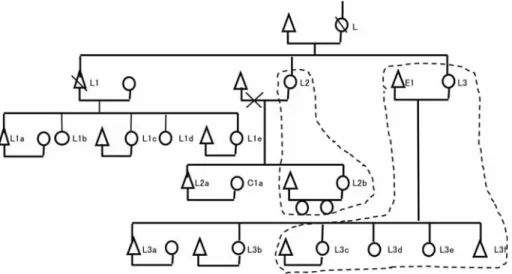
3-3-1 interview with L2 (YB 1962)
L2’s elder brother L1 (YB 1958) married a woman of the Bahnar ethnic group, died in 2015. She lived in the house of the husband, so the ethnic nationality of the fi ve children she has, is the Koho
L2’s eldest son L1a married a woman of the Kinh in 2007. Second daughter L1c married the Kinh from HCM. Youngest L1e married the Koho.
L2’s elder brother L1 has had the arable land 1.2ha, but he continues to sell so remain the only 0.2ha. The children of L2 make vegetables over there.
L1 family and L2 family also were a Christian mission believer, it was because the pastor is no longer come, have converted to Catholicism.
L2 married a man of Cirong village in 1980 but divorced in 1982. L2’s son L2a married C1b(YB 1983 fi gure 1), a woman of Phinom group in 2004. L2’s daughter L2b married the Churu(YB 1985)of Tu Tra commune in 2005. L2’s daughter L2b have two daughters, ethnic nationality is the Koho.
In 1997, L2 got the gold 9cay (3.75g × 9) by selling the land of 200 square meters, was building this house in 20,000,000đ (= gold 5cay). In 2004, bought a bike sell 0.15ha, in 2007 were obtained 200,000,000đ sold its 0.5ha. By that money, L2 purchased a paddy fi eld 0.3ha of L3 in 95,000,000đ and repaid the debt 100,000,000đ that was at the time of the daughter of the wedding. Paddy 0.3ha L2 purchased stopped rice cultivation two years ago because it does not even enter the cultivator, and L2 have rented the paddy to the Kinh in 2,400,000đ / 0.1ha / year. In addition to this, L2 has cultivated the 1.7ha for vegetables yourself. And son-in-law (husband of L2b) are served to the fertilizer company of Linh Nghia from three years ago. He works 20 days a month in one day 200,000đ. Because it is a monthly income system, the life is more stable than daily employment.
[Point]
・a marriage case with the different ethnic group the Kinh.
・the reason sells the land are house (1997), bike (2004), paddy (2007) ・the case of conversion from rice cultivation to land rental (2013) ・the case of fi nding a job in the private companies
3-3-2 interview with L3b (YB 1984)
L3b’s father E1 is a Phinom group in this village, married L3 (YB 1964). L3b’s mother has more than 1ha paddy fi eld. L3b’s elder brother L3a (YB 1981) married the Koho in Di Linh. L3b married the Kinh(YB 1979), seasonal workers being harvesting from Ben Tre Province in 2002. L3b have two sons(YB 2004, 2011) and ethnic nationality is the Koho. L3b is a Communist Party member, and working at the Vietnam Fatherland Front of the commune. Monthly income is three days a week, working time is 7: 30-14: 30 in 1,150,000đ. Then got the arable land of 0.2ha from parents, L3b husband is making vegetables. L3b is going to rent further about 0.1ha in this year for making a living. Younger sister L3c (YB 1986) married to a man of Cirong village, L3c family are living with parents and unmarried siblings at present.
[Point]
・a marriage case with the different ethnic group the Kinh. ・civil servants
・a case of having the plan to borrow the cultivated land
4 the effects of policy as seen from the interviews
Here, the authors clarify the effects of the policy from the social transformation by using the points extracted.
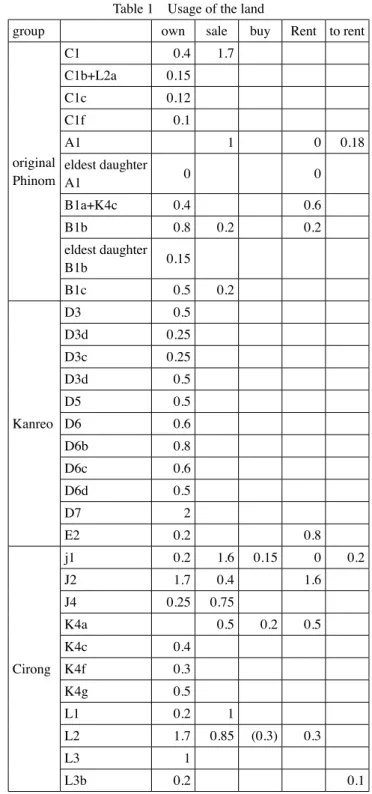
4-1 Land trading[table 1]
According to the customary law of the Koho group, people cannot sell ancestral paddy fi elds. However, in Phinom, ignore the customary law, there are a lot of cases to sell. According to interviews, nine villagers (J, H, L, J1, C1, D, F, D3, and D6) in No16 tổ have the land along national highway 20. At present, it continues to own the land along the national highway, three (J, J1, D3) only. Time loss of ownership that land, the fi rst is the period from the late 1960s until the revolution, was due to barter. Many cases of sale to concentrate on the period after the land return to the old owner at the time of cooperatives dismantling. There are two in the way of the sale of land. One is the case of pay in land instead of money to repay the debt as of C1 in 1-1 section IV, and the other is trading with money.
The case to be taken in the form of debt as described like the C1 is a method such as the fraud, non-C1 is only one case. In particular, C1 complained to the People’s Committee that it was taken in the form of debt, as a result, has been a part return. The rest of the case seems to have taken the form of actual trading. In the cases of cultivated land trading, A1, K1, L1, L2 are true. The appeal that it is unfair trade is not a party. Some people party speaks trades are normal trading. Because was not possible to obtain detailed traded case, the authors want to refrain from judgment as to whether a case should be criticized. There is another special case. The problem, cases such as J2, i. e., despite People’s Committee has made a land expropriation, is a case that the compensation is not (IV3-1-2). As the authors introduced Dang Nghiem Vạn’s criticism in section 2, this is a problem to be solved People’s Committee. Before the revolution, the people of this region had already been issued ownership certifi cates by the former government around 1970. Therefore, the correspondence of the government for them, must be more polite. Moreover, as with Dang Nghiem Vạn of pointed out, even in the fi eld, after the Kinh has pioneered the minority of land, has not been returned the land to ethnic minorities.
The authors are considered to be due to this problem in the mutual non-understanding between two ethnic groups. For the Koho, even if it is undeveloped land, it is if the dominant region of their own, is a land under the control of their own. On the other hand for the Kinh, no one lived, the land that have not yet even
development is a land of ownerless, was a way of thinking and that may be i n d e v e l o p m e n t i n t h e i r l a n d . Differences in values related to ownership of this ethnic minority and the Kinh, which are being eliminated by the penetration of the law, about what happened to the previous penetration of law, ethnic minority discontent remains.
The reasons for the sale of land in the interviews, are living expenses, house construction costs, wedding cost, bike purchase, the purchase of land. Among the reasons for the sale of land, the authors deal with two reasons.
The Koho was forced to prepare the construction cost of houses, policy is the primary factor. First, the revolutionary government has inherited a policy that prohibits the construction of traditional houses from the old government. Then, as mentioned in section III, the government promulgated in 1996 about the development ban, so material that has been put in hand without penalty up until that time is no longer unobtainable, the people Phinom were forced to purchase all of the material.
Case due to wedding expenses is a case to sell the land for paying the debt of the wedding as L2. The luxury of marriage cost is entirely independent of the policy of the government. The government, by the promulgation of HĐCP Số: 56-CP (1975), have noticed that shortening of ritual held period for
wedding or funeral, etc. and prohibition of the waste, to being the equality of the cost burden ratio. Although the ritual period is shortened in the fi eld, the total cost is equal to or greater than the Kinh. Moreover, it is in a state that customary law is being followed for the burden ratio.
Table 1 Usage of the land
group own sale buy Rent to rent
original Phinom C1 0.4 1.7 C1b+L2a 0.15 C1c 0.12 C1f 0.1 A1 1 0 0.18 eldest daughter A1 0 0 B1a+K4c 0.4 0.6 B1b 0.8 0.2 0.2 eldest daughter B1b 0.15 B1c 0.5 0.2 Kanreo D3 0.5 D3d 0.25 D3c 0.25 D3d 0.5 D5 0.5 D6 0.6 D6b 0.8 D6c 0.6 D6d 0.5 D7 2 E2 0.2 0.8 Cirong j1 0.2 1.6 0.15 0 0.2 J2 1.7 0.4 1.6 J4 0.25 0.75 K4a 0.5 0.2 0.5 K4c 0.4 K4f 0.3 K4g 0.5 L1 0.2 1 L2 1.7 0.85 (0.3) 0.3 L3 1 L3b 0.2 0.1
4-2 Usage of the land [table 1, 2]
Based on the interview with the leader of the Youth Union, the land use situation of No16 tổ was tabulated as follows [table 1]. However, the sale area of up to now is not perfect because that based on the memory of Youth Union leader. The authors suspect that there is a lack of data.
According to the Youth Union leader, the second crop increases from 2005. And people in which the rice cultivation in 2014 was in fi ve people (B1b, D5, D6, D7, E2). As of June 2015, people abandoned the rice, was converted to vegetables. Therefore, in the No16 tổ it became a state in which no one has done the rice cultivation.
When the cultivation area is narrower, since it is necessary to increase the high income in a narrow area. As Rice cultivation has been taking for six months, Rice as agricultural products was forced to give up. And, effort than the rice takes, but people want to cultivate vegetables of being the possibility of obtaining high profi t every three months.
In addition, more people to rent the land as shown in table 1. Table 2 is some rental cases were the author can be confi rmed in an interview with the applicant. Each of the rental agreement cannot be an accurate comparison because
there are a mixed contract period, a different terrain and geology. The amount of money of one year contract period, when we translated at 0.1ha, is 3,000,000-5,000,000đ. When we asked Youth Union leader for a comparison rent in Kanreo village and rent in the Phinom village, Phinom is a year 3,000,000đ / 0.1ha on average, fertile Kanreo is 15,000,000đ. For contract amount, therefore, the authors think it would be normal trading. Rent start timing, B1a since 2005, B1b 2000, B1b2 since 2005, E2 is 2012, K4a is 1993, L2 is 2009, J2 is unknown. After the government issued the certifi cate of land use right in 1995, it can be regarded as renting becomes active. The ban on selling land of the ethnic group has been promoting the rent Moreover, the fact that it has to coexist to lend and to sell, which means that it had a certain degree of room for the minority side to select either.
4-3 land shortage and family planning
One informant said, if, before the revolution, a woman married and lived apart, the new family could get a one hectare of paddy from wife’s parents. As already mentioned in IV, from the being denied the ownership of individuals, until the cooperatives are dismantled, The Koho of Phinom had lost already many areas. And the opportunity of that the People’s Committee returns the areas to the old owner at the time, cooperatives dismantling, was the last chance that people could get more than 1ha. After that, the sale of land continued, land ownership area of the individual is reduced. On the other hand, since the number of births if it is more than fi ve people there were many (C1, C3, D2, E2, K4, K6, L1, L3, etc.), therefore if parents distribute the land to the children, owned area per capita was smaller. However, the number of children in the couples married in the 2000s, two people about (such as C1c, C1d, L2b, and L3b) is. C1c, who married in 2010 and had two children, says as follows. “I cannot abortion because I am Catholics. After NCPFP1 has issued a provision that to reduce the third child (Số: 01/2000/TT-UB) in 2000, the People’s Committee has recommended contraceptive surgery. Everyone also began to think the number of children is too much. Now, unless the couple wants a child more, as women are not pregnant, they get tied the fallopian tube to the Table 2 Rent stiuation of cultivated land name Rent(đ) area/period total area B1a 3,000,000 0.1/year 0.60 B1b 5,000,000 0.2/6month 0.20 B1b2 3,000,000 0.2/6month 0.25 E2 30,000,000 0.8/year 0.80 K4a 15,000,000 0.5/year 0.50 L2 2,400,000 0.1/yaer 0.32 J2 4,000,000 0.1/yaer 1.60
doctor.
Just married in 2015, wife of D6b3 (YB 1997) is also referred to as “two children is enough for me.” Decree of birth control is to act effectively to improve the situation of the areas where land has fallen into economic distress insuffi cient.
Conclusion
In this paper, the authors showed much interview data and clarifi ed social transformation and the association with the policy from that. Looking at the actual state of Phinom region from the policy aspects, it is possible to point out the following points can be regarded as the policy has been successfully operated.
1, for the land, by the government bans the sale of the land in 2001 (TTCP 2001 SỐ 168/2001/QĐ-TTG), the trading action of land is progressing changes to the rent from the sale. According to the collected data, rent is started at the same time of the sale, that means the possibility that there was an option (sale or rent) to people in No16 tổ. 2, By rice fi eld that owns decreased, people’s income decreased. People had to compensate for the decreased amount somewhere. Around that time, People’s Committee and fertilizer companies and pesticide companies cooperation, by carrying out the technical training to people as Le Van Toai mentioned in Section II. Thereby, a lot of people became possible second crop, a crop rotation. 3, In the context of the land shortage, fertility is leading to poverty, but there is also changing the consciousness of the people by the spread of family planning. 4, People are beginning to aware of the choice of the profession other than agriculture. For example, husband of L2b of III, not the work of day laborers, who is working as company employees has a consciousness that is more stable. Also, people begin to recognize the agriculture is not in a stable occupation. 5, Penetrate the understanding of preferential policies of education for ethnic minorities, currently, the No16 tổ, is present nearly 20 people high school graduates.
As described above, in the fi eld, after cooperatives era and the subsequent confusion convergence (around 2005), the authors want to consider the effects of a variety of policies gradually. However, because the author’s study was a short period, we are not able to grasp in details. For example, many people are using the loan of Vietnam Bank for Social Policies (33 people under management Youth Union, seven people under management Farmer Union). According to the document of the Commune, Loan purpose on the surface is the overwhelming sewage treatment and waste disposal of their livestock. And few other purposes are purchase of such as seedlings and farm equipment, and life support for Poverty units and Relative Poverty units. It is not possible to confi rm about the actual uses of borrowing, it is a future task for us. Just fi eld the authors chose, there is a shopping street in along the national highway. Also, there are many small businesses in the vicinity, so it is developed prone areas. In the outback and this fi eld, there is a possibility that there are regional differences, the authors want to advance the comparative study in other areas.
Endnotes
⑴ Policy to be settled down in the plains for ethnic groups who live by the slash-and-burn agriculture. Vietnam Government tried to change of the occupations of people, from swidden cultivation to rice cultivation, or to fi eld crops, for aiming at regional development.
⑵ Tay Nguyen is generic name of Kon Tum, Gia Lai, Dac Lac, Dac Nong and Lam Dong provinces located in the Central Highlands. The fi eld lies in Lam Dong prefecture of this.
⑶ “tổ” is minimum administrative unit in the Field.
unit is the cost of living per month of one member is specifi ed in the 500,000-600,000đ ⑸ “YB” means “year of birth”, ”YM” means year of marriage.
⑹ The French colonial government began to build a No. 20 national highway facing the fi eld is the 1909[UBND tỉnh Lâm Đồng2001;335].Completion is 1932. [BCHDBHDC 2010 :22]
⑺ The Koho call their village as ”boon” ⑻ The Churu of Pre Yong village.
⑼ The Ma of Bao Lâm commune, His origin is the Ede.
⑽ The road from 1958 through 1962 has been paved extension [UBND tỉnh Lâm Đồng2001; 337]. ⑾ In Vietnamese, Nghị quyết của Bộ Chính trị số 10-NQ/TW: “Về đổi mới quản lý kinh tế nông nghiệp” ⑿ D6 had owned the ID card of YB 1925, yet younger sister of D5 (YB 1946).
⒀ It stands for “National Committee for Population and Family Planning”
References Cited
Ban Chấp Hành Đảng Bộ Huyện Đức Trọng(BCHDBHDC) 2010 Lịch sử đảng bộ Huyện Đức Trọng(1930-1975) Hà Nội Bộ Chính trị
1988 Nghị quyết của số 10-NQ/TW “Về đổi mới quản lý kinh tế nông nghiệp” Bô Công Thương
2010 Sự phát triển vùng dân tộc thiểu số Việt Nam sau hội nhập, Hà Nội: Nxb. Công Thương Cư Hòa Vần
2000 Những vấn đề cấp bách đối với sự phát triển các dân tộc thiểu số ở nước ta hiện nay. In Các dân tộc thiểu số Việt Nam trong sự nghiệp công nghiệp hóa hiện đại hóa. Hội dân tộc học(ed), 9-13 Hà Nội: nhà báo Quân đội
Đặng Nghiêm Vạn
2002 vấn đề đất đai ở các tỉnh Tây Nguyên: một số vấn đề Kinh tế xã hội phất triển kinh tế-xã hội buôn làng các dân tộc thiểu số Tây nguyên. In Một số vấn đề Kinh tế xã hội phất triển kinh tế -xã hội buôn làng các dân tộc thiểu số Tây nguyên. Ngô Đức Thịnh(ed), 324-352 Hà Nội: Nxb. Khoa học xã hội
Hội đồng chính phủ
1975 Quyết định của hội đồng chính phủ số56-C P (18/3/1975) “về việc ban hành bản thể lệ về tổ chức việc cưới, việc tang, ngày giỗ, ngày hội”
Lê Văn Toại
2000 Thương mại phục vụ đồng bào các dân tộc thiểu số. In Các dân tộc thiểu số Việt Nam trong sự nghiệp công nghiệp hóa hiện đại hóa. Hội dân tộc học(ed), 356-357 Hà Nội: nhà báo Quân đội
Mcelwee, Pamera
2004 Becoming Socialist or becoming Kinh? Government policiesfor ethnic minorities in the Socialist Republic of Viet Nam. In civilizing the margins, Southeast Asian government policies for the development of minorities. Duncan, C. R(ed)182-213 New York: Cornell University
Tổng cục Địa chính
1999 Tập bẩn đồ địa danh-địa giới các tỉnh Đông Nam Bộ.Hà Nội: Nxb Bản Đồ. UBND tỉnh Lâm Đồng
2000 Đia chí Lâm Đồng Hà Nội Nxb. Văn hóa dân tộc. UBND xã Hiệp Thạnh(số153/BC-UBND)
2014 Báo cáo tình hình thực hiện nhiệm vụ kinh tế-xã hội, quốc phòng-an ninh năm 2014 và phương hướng, nhiêm vụ phát triển KT-XH, QPAN năm 2015
Thủ tưởng chính phủ
2001 Quyết định của thủ tưởng chính phủ số 168/2001/QĐ-TTG (30/10/2001) “Về việc định hướng dài hạn, kế hoạch 5 năm 2001-2005 và nhưỡng giải pháp cơ bản phát triển kinh tế-xaxhooji vùng TÂY NGUYÊN 2002 Quyết định của thủ tưởng chính phủ số: 132/2002/QĐ-TTG (8/10/2002) “Về việc giải quyết đất sản xuất
và đất ở cho đồng bào dân tộc thiểu số tại chỗ ở”
Uỷ ban quốc gia dân số và kế hoạch hóa gia đình(The national committee for population and family planning) 2000 Thông tư của ủy ban quốc gia dân số và kế hoạch hóa gia đình số 01/2000/TT-UB (23/2/2000)”hướng dẫn
kế hoạch chương trình dân số và kế hoạch hóa gia đình năm 2000”
HONDA Mamoru A s i a n C u l t u r e s R e s e a r c h Institutes, TOYO University, Japan
PHẠM THANH THÔI Department of Anthropology, Faculty of Social Sciences and Humanities, Viet Nam National University Ho Chi Minh City