Numerical
analysis
of Io’s
atmosphere
based
on
a model
Boltzmann equation: Unsteady behavior
during eclipse
Shingo
Kosuge
Department
of Mechanical Engineering and Science, Kyoto University
1
Introduction
$Io$ is a satellite of Jupiter. The observations made by NASA’s spacecrafts in the $1970s$
(Pioneer and Voyager probes) revealed the existence of volcanic activities and
a
thin atmosphere mainly composed of sulfur dioxide $(SO_{2})$ gas. The surface temperature of Iois considered to vary according to the sunlight between about
90
$K$ and130
$K$ (exceptnear
volcanos). The phase transition of $SO_{2}$occurs
in this temperaturerange:
the $SO_{2}$gas condenses to form $a$ (very thin) layer of frost
on
the ground during the night and,as
a result, the atmosphere may almost vanish; conversely, the frost sublimates and the atmosphere is restored during the daytime. The dynamics of $Io$’s atmosphere undersublimation and condensation of$SO_{2}$ has been studied for a longtime (see, e.g., Refs. [1,
2, 3, 4] and references therein).
The above-mentioned process of atmospheric collapse and reformation is expected to take place also during and after eclipse, during which Io is in the shadow of Jupiter. Moore et. al. [5] tackled such a problem for thefirst time: they carried out a numerical analysisof the Boltzmann equation by the direct simulation Monte Carlo (DSMC) method [6, 7] to investigate the unsteady one-dimensional behavior of the atmosphere in eclipse. In Ref. [5], the atmosphere
was
treatedas
a binary mixture of $SO_{2}$ and another minorcomponent ($SO$
or
$O_{2}$), the latter of which is (partially) noncondensable. The resultsin Ref. [5] reveal the effect of the noncondensable gas:
a
trace of noncondensable gascarried by the condensing flow of $SO_{2}$ accumulates on the surface at the early stage of
eclipse and then acts
as a
barrier to furthercondensation to delay the atmospheric collapse significantly. In the meantime, little informationon
the time evolution and structure of the flow field is available from Ref. [5], mainly because of the stochastic noise inherent in the DSMC results.In this report, we introduce
our
recent results in Refs. [8, 9], where essentially thesame
problemas
in Ref. [5]was
studied througha
different approach after makingsome
simplifications. First we adopted the model Boltzmann equation proposed in Ref. [10], instead of the full Boltzmann equation, forcomputationalconvenience. Secondwe focused on the effect of the noncondensable gas only, because it was expected to be dominant;
we
omitted all other effects taken into account in the previous DSMC analysis [5], suchas
theeffect
of plasma impingementfrom
the outer space, that of molecular internal structure, andso on.
Thenwe
could perform an accurate deterministic computation bymeans
ofa finite-difference method at a reasonablecomputational cost. In spite of those simplifications, however, the overall behavior (the column density of $SO_{2}$) during eclipseobtainedin
our
study is quite similar to the previous result [5]. Moreover,as
will be seen later in Sec. 5, our solutions with higher temporal and spatial resolution revealsome new
phenomena (waves in the profiles of macroscopic quantities andan
oscillatory motion), whichwere
not explored in Ref. [5].2
Problem and assumptions
Consider an atmospheric column
over
a fixed pointon
Io’s surfacenear
the equator belonging to thesub-Jovianhemisphere.1
The groundis located at $X_{1}=0$ and is coveredby the frost of$SO_{2}$, where $X[=(X_{1}, X_{2}, X_{3})]$ be the spacerectangular
coordinates.2
Theatmosphere extends
over
the half-space$X_{1}>0$and iscomposed of$SO_{2}$ vaporand anothernoncondensable gas, $SO$ or $O_{2}^{3}$ The eclipse starts at time $t=0$ and lasts until $t=120$
$\min$. The initial atmosphere is assumed to be in a saturated equilibrium state at rest
with uniform temperature $T_{0}$. The surface temperature $T_{w}$, which coincides with $T_{0}$ at
$t=0$, varies with timeaccording to the change of insolation [see Eq. (11) below] and then condensation or sublimation of$SO_{2}$ may
occur.
We investigate unsteady behavior of theatmospheric column during eclipse under the following assumptions: (i) the behavior of the atmosphere is
described
by the model Boltzmann equation for mixtures proposed in Ref. [10]; (ii) the vapor ($SO_{2}$ gas) obeys the complete-condensation boundary conditionon
the surface [see Eq. (7) below]; (iii) the noncondensable gas ($SO$or
$O_{2}$) obeys thediffuse-reflection boundary condition on the surface; (iv) the surface and the atmosphere
are horizontally uniform [in thelength scale ofthe pressure scaleheight $H$ $(\sim 7-9 km)$ of
the atmosphere], sothat the problem
can
be treated as aspatially 1-$D$problem dependingon $X_{1}$ only.
$\overline{1As}$
aresult of tidal locking, Io always shows thesameside(thesub-Jovianhemisphere) to Jupiter,sothat the eclipsedoes not much effect the anti-Jovian hemisphere.
2Thecurvature of thesurface isignorableinthepresentproblem.
3
Formulation
Inthe following, the vapor ($SO_{2}$ gas) and noncondensablegas ($SO$or$O_{2}$) willbe referred
to
as
species $A$ and $B$, respectively. The Greek letters $\alpha$ and $\beta$ will be used to representthe species, i.e., $\alpha,$$\beta=\{A, B\}.$
Let
us
denote the velocity distribution function (VDF)of molecules
of species $\alpha$as
$F^{\alpha}=F^{\alpha}(t, X_{1}, \xi)$, where $\xi[=(\xi_{1}, \xi_{2}, \xi_{3})]$ is the molecular velocity. The macroscopic
quantities, such
as
the number density $n^{\alpha}$, flow velocity $v^{\alpha}[=(v_{1}^{\alpha}, v_{2}^{\alpha}, v_{3}^{\alpha})]$, pressure $p^{\alpha},$and temperature $T^{\alpha}$ of species $\alpha$,
are
definedas
the moments of $F^{\alpha}$as
follows:$n^{\alpha}= \int F^{\alpha}d\xi, v^{\alpha}=\frac{1}{n^{\alpha}}\int\xi F^{\alpha}d\xi,$
(1)
$p^{\alpha}=kn^{\alpha}T^{\alpha}= \frac{1}{3}\int m^{\alpha}|\xi-v^{\alpha}|^{2}F^{\alpha}d\xi,$
where $m^{\alpha}$ is the molecular
mass
of species$\alpha,$ $k$ is the Boltzmann constant, and $d\xi=$
$d\xi_{1}d\xi_{2}d\xi_{3}$. The domain of integration is the whole space of$\xi$. The corresponding
quanti-ties of the totalmixture, i.e., the number density$n$, flow velocity$v[=(v_{1}, v_{2}, v_{3})]$,
pressure
$p$, and temperature $T$ of the mixture,are
given by$n= \sum_{\alpha=A,B}n^{\alpha}, v=\sum_{\alpha=A,B}m^{\alpha}n^{\alpha}v^{\alpha}/\sum_{\alpha=A,B}m^{\alpha}n^{\alpha},$
(2)
$p=knT= \sum_{\alpha=A,B}(p^{\alpha}+\frac{1}{3}m^{\alpha}n^{\alpha}|v^{\alpha}-v|^{2})$ .
Note that the horizontal components of the flow velocity will be ignored (i.e., $v_{2}^{\alpha}=v_{3}^{\alpha}=$ $v_{2}=v_{3}=0)$ in the actual analysis, whereas they are left in the formulation.
3.1 Model Boltzmann equation
The model Boltzmann equation in Ref. [10] for the present problem may be written
as
follows:$\frac{\partial F^{\alpha}}{\partial t}+\xi_{1}\frac{\partial F^{\alpha}}{\partial X_{1}}-g\frac{\partial F^{\alpha}}{\partial\xi_{1}}=K^{\alpha}(M^{\alpha}-F^{\alpha}) , (\alpha=A, B)$. (3)
Here, $g(=1.8m/s^{2})$ is the gravitational acceleration
on
Io, which is treatedas a
constantsince the scale height $H$ is much smaller than Io’s radius $R$ $(=1820 km)$. For the
same
reason, the effect of planetaryrotation (theCoriolis and centrifugal force) is omitted. The
$K^{\alpha}$ and $M^{\alpha}$
are
defined by$K^{\alpha}= \sum_{\beta=A,B}K^{\beta\alpha}n^{\beta},$
(4)
The $K^{\beta\alpha}(=K^{\alpha\beta})$ is
a
positive constant, that determines the collision frequency ofan
$\alpha$-species molecule with $\beta$-species molecules via$K^{\beta\alpha}n^{\beta}$. Thus, the above $K^{\alpha}$ corresponds
to the total collision frequency of
an
$\alpha$ molecule. The velocity $v^{(\alpha)}$ and temperature $T^{(\alpha)}$ofthe Maxwellian $M^{\alpha}$
are
defined by$v^{(\alpha)}=v^{\alpha}+ \frac{2}{m^{\alpha}K^{\alpha}}\sum_{\beta=A,B}\mu^{\beta\alpha}\Omega^{\beta\alpha}n^{\beta}(v^{\beta}-v^{\alpha})$, (5a)
$T^{(\alpha)}=T^{\alpha}- \frac{m^{\alpha}}{3k}|v^{(\alpha)}-v^{\alpha}|^{2}$
$+ \frac{4}{K^{\alpha}}\sum_{\beta=A,B}\frac{\mu^{\beta\alpha}\Omega^{\beta\alpha}n^{\beta}}{m^{\beta}+m^{\alpha}}(T^{\beta}-T^{\alpha}+\frac{m^{\beta}}{3k}|v^{\beta}-v^{\alpha}|^{2})$ , (5b)
where $\mu^{\beta\alpha}[=m^{\beta}m^{\alpha}/(m^{\beta}+m^{\alpha})]$ is the reduced
mass
and $\Omega^{\beta\alpha}(=\Omega^{\alpha\beta})$ isan
additionalpositive constant; the positivity of $T^{(\alpha)}$ follows if $\Omega^{\beta\alpha}\leq K^{\beta\alpha}$. Note that Eq. (1) is
necessary to complete the model equation because$n^{\alpha},$ $v^{\alpha}$, and $T^{\alpha}$ appearin Eqs. (4) and
(5).
This model
was
designed in such a way that, by adjusting $\Omega^{\beta\alpha}$, the momentum and energyexchanges betweendifferent speciescanbe the same as thosefor (pseudo-)Maxwell molecules with an arbitrary value of the angular cutoff parameter (see, e.g., Ref. [11]). In the present study, however, this property is not used for specifying thevalue of $\Omega^{\beta\alpha}$. We
first specify $K^{AA}$ by the relation
$K^{AA}=4d^{2}(\pi kT_{0}/m^{A})^{1/2}$, (6)
where $d(=7.16\cross 10^{-10}m)$ is the nominal diameter of an $SO_{2}$ molecule. This
rela-tion means that the molecular
mean
free path with respect to $SO_{2}-SO_{2}$ collisions in anequilibrium state with temperature $T_{0}$ for the model equation is equal to that for the
hard-sphere gas with molecular diameter $d$. Then, for simplicity, $K^{BB},$ $K^{BA}$, and $\Omega^{BA}$
are
all assumed to be identical with $K^{AA}$ [note that $\Omega^{AA}$ and $\Omega^{BB}$ are unnecessary; seeEq. (5)$]$. Therefore, pseudo-Maxwell behavior of the molecules is not enforced in the present study.
3.2 Initial and boundary conditions
The boundary condition on the surface is written as follows. For $X_{1}=0$ and $\xi_{1}>0,$
$F^{\alpha}=n_{w}^{\alpha}( \frac{m^{\alpha}}{2\pi kT_{w}})^{3/2}\exp(-\frac{m^{\alpha}|\xi|^{2}}{2kT_{w}})$ , (7a)
Here
$p_{w}^{A}$ is thesaturated vapor pressure of
$SO_{2}$ at temperature $T_{w}$ and isgiven
by theClausius-Clapeyron relation:
$p_{w}^{A}=\Pi\exp(-\Gamma/T_{w})$,
(8)
$(\Pi=1.516\cross 10^{13}$ Pa and $\Gamma=4510K)$.
In the present problem, thevariation of$T_{w}$ and corresponding$p_{w}^{A}$ withtimewould induce
the unsteady motion ofthe atmosphere through the boundary condition (7). The initial condition is written
as
follows. At $t=0,$$F^{\alpha}=n_{0}^{\alpha}( \frac{m^{\alpha}}{2\pi kT_{0}})^{3/2}\exp(-\frac{m^{\alpha}(|\xi|^{2}+2gX_{1})}{2kT_{0}})$. (9)
Here $n_{0}^{\alpha}$ is the initial number density ofspecies $\alpha$ on the surface $(X_{1}=0);n_{0}^{A}=p_{0}^{A}/kT_{0}$
with $p_{0}^{A}$ being the saturated vapor pressure at temperature $T_{0}$ [i.e., $p_{0}^{A}$ is givenby Eq. (8)
with $T_{w}$ being replaced by $T_{0}$]. The initial temperature $T_{0}$ will be chosen in the next
section. Theconcentration $\chi^{B}$of the noncondensable gas in the initial atmospheric column
is written
as
$\chi^{B}=\int_{0}^{\infty}n^{B}(t=0)dX_{1}/\int_{0}^{\infty}n(t=0)dX_{1}$
(10)
$= \frac{(n_{0}^{B}/m^{B})}{(n_{0}^{A}/m^{A})+(n_{0}^{B}/m^{B})}.$
In the following, the amount of the noncondensable gas will be specified by $\chi^{B}$, instead
of$n_{0}^{B}.$
3.3 Surface temperature
The surface temperature $T_{w}$ is determined by the
same
differential equationas
that inRef. [5]:
$\frac{dT_{w}}{dt}=\{\begin{array}{ll}A\sigma(T_{{\rm Min}}^{4}-T_{w}^{4}) , for 0\leq t\leq 120\min,A\sigma(T_{E}^{4}-T_{w}^{4}) , for t>120\min,\end{array}$ (11)
where $\sigma$ is the Stefan-Boltzmann constant and $A=\epsilon/C$ with $\epsilon$ being the bolometric emissivity and $C$ the heat capacity per unit
area
ofthe surface. The $T_{E}$ isan
equilibriumtemperature defined as
$T_{E}=\{\begin{array}{ll}(T_{{\rm Max}}-T_{{\rm Min}})\cos^{1/4}\theta+T_{{\rm Min}}, for \theta\leq 90^{o},T_{{\rm Min}}, for \theta>90^{o},\end{array}$ (12)
where $\theta$ is the solar zenith angle (SZA), whichvaries with time according to the diurnal motion of the sun. The maximum and minimum of $T_{E}$ are fixed
as
$T_{{\rm Max}}=120K$ and$\frac{}{}\frac{TABLE1:Simulationcases}{CaseT_{0}(K)Longitude(^{\circ})GasB(\chi^{B})A^{-1}(J/m^{2}K),111069-(0)350}$ 2 110 69 $SO$ (0.35) 350 3 110 69 $SO$ (0.35) 700 4 110 69 $SO$ (0.35) 175
$5 110 69 O_{2}(0.35) 350$
$6 110 69 O_{2}(0.07) 350$
$7 115 52 -(0) 350$
8 115 52 $SO$ (0.22) 350$9 120 351 -(0) 350$
10 120 351 $SO$ (0.03) 350The initial temperature $T_{0}$ appearing in Eq. (9) is chosen as $T_{0}=T_{E}(t=0)$ using
Eq. (12), after we specify the location of the atmospheric column (i.e., the longitude and latitude) and calculate the SZA $\theta$ as a function of time $t$ (note that $t=0$ is defined to
be the time when eclipse starts). It should be noted that the above $T_{w}$ is influenced only
by the insolation and not by the atmospheric behavior (i.e., not by the latent heat and sensible heat from the gas), since the former is dominant. We solve Eq. (11) with the
initial condition $T_{w}(t=0)=T_{0}$ to obtain $T_{w}(t)$ beforehand.
4
Numerical analysis
We first eliminate the molecular-velocity variables $\xi_{2}$ and $\xi_{3}$ from the initial-boundary
value problem (3), (7), and (9) by introducing appropriate marginal VDF’s. Then, the reduced problem with three independent variables $t,$ $X_{1}$, and $\xi_{1}$ is solved by a
finite-difference method. We used (i) animplicit scheme in Ref. [12] where the derivatives with respect to $X_{1}$ and $\xi_{1}$
are
expressed by a $2nd$-order up-wind finite-difference (see, e.g.,Ref. [13]$)$ and (ii) $2nd$-order Runge-Kutta (Heun’s) scheme along the characteristics of
Eq. (3) in combination with the interpolation method devised in Ref. [14]. In the latter scheme, because of the properties of the method in Ref. [14], the transient waves tend to be more accurately captured without overshoots in the profiles of the macroscopic quan-tities (and in those of the VDF’s). However,
as
in the cubic interpolated pseudo-particle (CIP) method [15], equations for the derivatives of $F^{\alpha}$ must be solved simultaneously.Thus the latter requires larger amount of computations (and involves
some
difficulty in the treatment of boundary conditions for the derivatives). To compensate the increased amount of computations, we performed a parallel computing (the latter is an explicit$\vee\wedge$ $f_{\neg}^{*}$
$t$(lllin) $t( \min)$
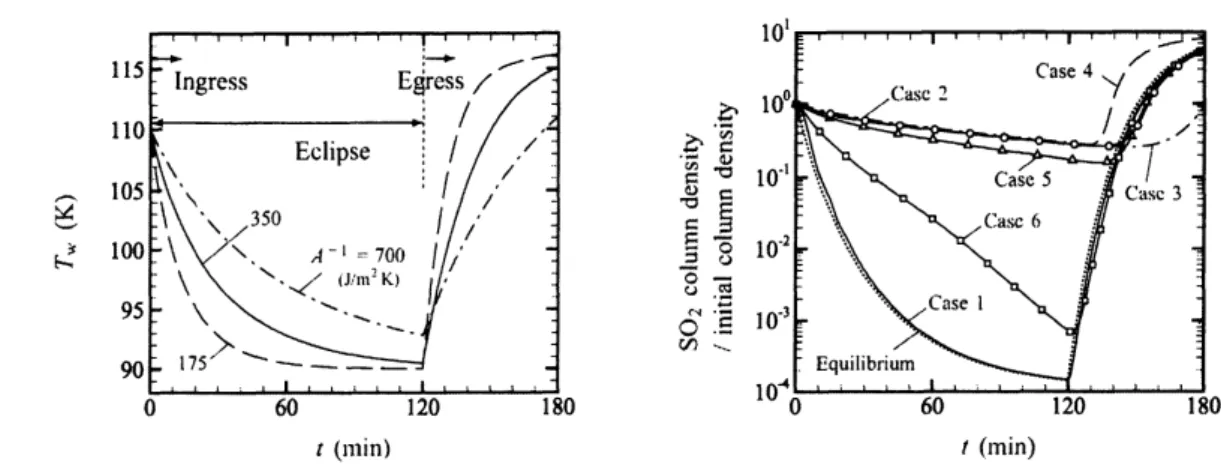
FIGURE 1: Surface Temperature $T_{w}$ and $SO_{2}$ column density vs. time in the case of $T_{0}=110$ $K.$
The initial $SO_{2}$ columndensity is $1.2386\cross 10^{20}\neq/m^{2}$. The dotted line in the right panelindicates the
theoretical value for pure $SO_{2}$ atmosphere in an isothermal saturated equilibrium state at rest when
$A^{-1}=350J/m^{2}K.$
scheme).
The results shown in the next section
were
obtained by scheme (ii), while the details of the methodare
omitted here [some testruns
with scheme (i)were
also performed andgave
roughly thesame
results]. In the computation,we
limit the range of$X_{1}$ up to $X_{1}\sim$$282-313$ km and impose the specular-reflection condition at the upper $boundary^{4}$; the
minimum grid intervalsfor $T_{0}=110,115$, and 120 $K$ are, respectively, 15.9 $m,$ $8.3m$, and
4.3 $m$ at $X_{1}=0$; the maximum intervals
are
about 0.3–1.1 km at the upper boundary.The range
of
$\xi_{1}$ is limitedas
$|\xi_{1}|\leq 8c_{0}$, where $c_{0}[=(2kT_{0}/m^{A})^{1/2}]$ is about173
$m/s$ for$T_{0}=115K$; the minimum and maximum grid intervals
are 0.005
$c_{0}$ at $\xi_{1}=0$ and $0.045c_{0}$at $\xi_{1}=\pm 8c_{0}$, respectively. The time steps
are
about 4.7 ms for $T_{0}=110$ and 115 $K$ and2.3
ms
for 120 $K.$5
Results
We consider Cases $1-10$ listed in Table 1; for simplicity, the column located in the
equator (orlatitude $0^{o}$) is considered in all the cases. The values of parameters in Table 1
were cited from Ref. [5].
Figure 1 shows the variations ofthe surface temperature and of the column density of
$SO_{2}$ in the
case
of $T_{0}=110$ K. The column density of pure $SO_{2}$ atmosphere (Case 1)decreases significantly at the end ofeclipse, whereas in the
case
of mixtures the decrease4Thiscondition wasusedto fixthetotal amountof thenoncondensable gasinthe column. $A$vacuumconditionforthe
(a)
$X_{1}$ (km) $X_{1}$ (km) $X_{1}$ (km)
(b)
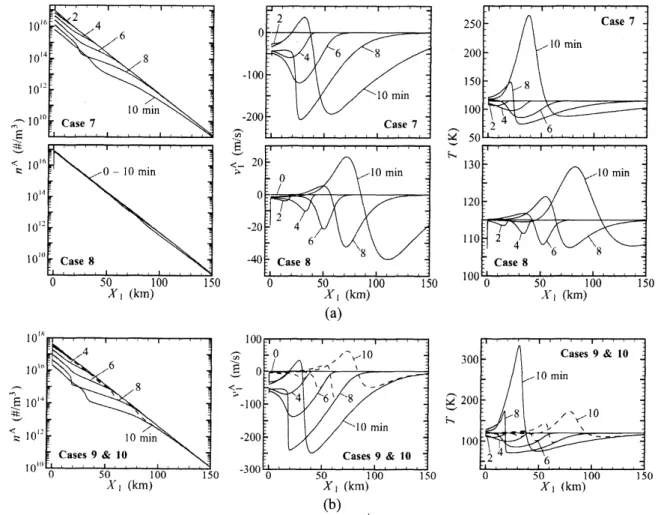
FIGURE 2: Profiles of the macroscopic quantities at every 2 minutes during the first 10 minutes after ingress. (a) Cases 7and 8, and (b) Cases 9 (solidhne) and 10 (dashed line). In (b), eachof thedashed lines approaches the corresponding solidline for thesame$t$ as $X_{1}arrow\infty.$
is hindered by the noncondensablegas [see Fig. 3(b) below]. The effects of the gasspecies
$(i.e., the$molecular$mass$ratio$m^{B}/m^{A})$, concentration$\chi^{B}$, and heat capacity of thesurface
$(\sim A^{-1})$
are
also examined. Except forsome
minor differences, the overall behavior ofthe column shown in Fig. 1
seems
to be close to the corresponding result of the previous DSMC analysis (i.e., Fig. 8 in Ref. [5]).5.1 During eclipse
Figure2showstheprofiles of macroscopic quantities at the beginning of eclipse. InCases 7 and 9 (pure$SO_{2}$), afast condensing flow is induced, and, as aresult, anexpansion
wave
(a)Case7 (b)Cabe8
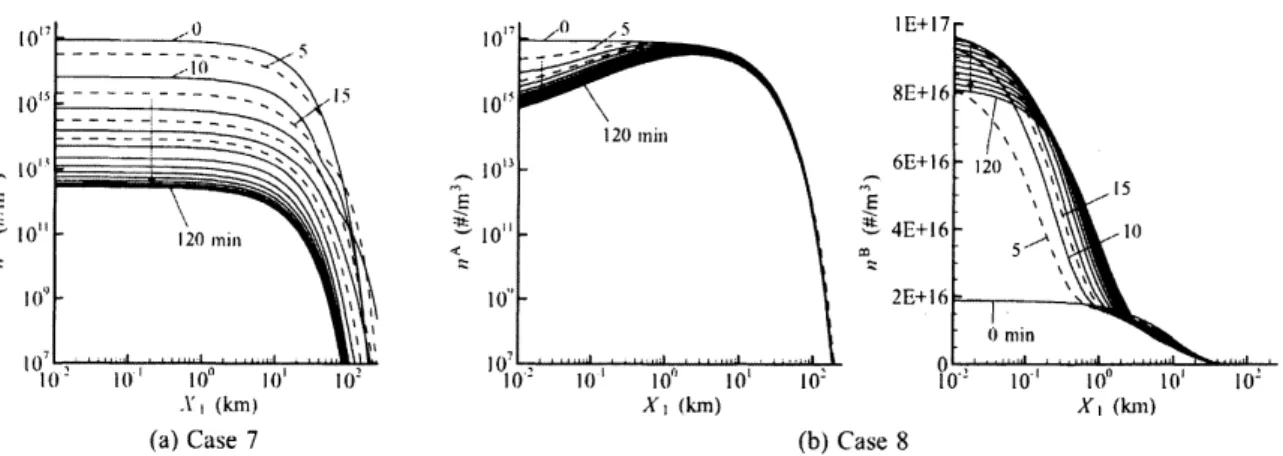
FIGURE 3: Number density profiles during eclipse. (a) Case 7and (b) Case 8. The solidline indicates
profiles at every 10 minutes $(t=0,10, \ldots, 120\min)$, and the dashed line those at $t=5,15,25$, and 35
$\min$ in (a) and those at $t=5$ and 15 $\min$in (b).
the surface. While propagating upward, the shock
wave
stretches rapidly because the background pressure decays exponentially with altitude (thus the localmean
free path grows exponentially). In Cases 8 and 10 (mixture), the condensing flow is relatively slow because of thehindrance by the noncondensable gas [see Fig. 3(b) below]. The expansionwave
is sentas
in the pure $SO_{2}$ case, but is immediately followed by a relatively weakcompression
wave.
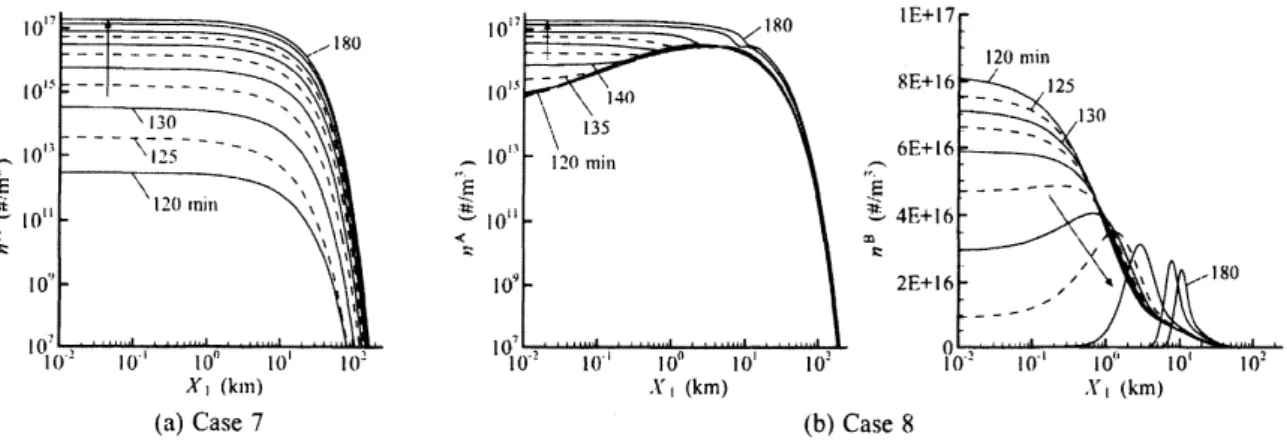
Figure 3 shows the profiles of the number density in Cases 7 and 8 during eclipse. In
Case
7
(pure $SO_{2}$), the number density decreases at all altitudes until the end of eclipseexcept at$t \sim 10-30\min$. During that timeperiod, the number density at high altitudes
$(X_{1}>\sim 100 km)$ is increased temporarily by the passage ofthe shock
wave
seen
inFig. 2.In Case 8 (mixture), the number density of $SO_{2}$ decreases only in the neighborhood of
thesurface and hardly changes at high altitudes. This is because the noncondensablegas, which is carried by the condensing flow of$SO_{2}$to thesurfaceand accumulates there, forms
thepartialbarriertotheatmospheric collapse. Thenumberdensityof thenoncondensable gas
near
the surface increasesrapidly until$t \sim 20\min$and thenstartsto decrease becauseof the upward selfdiffusion.
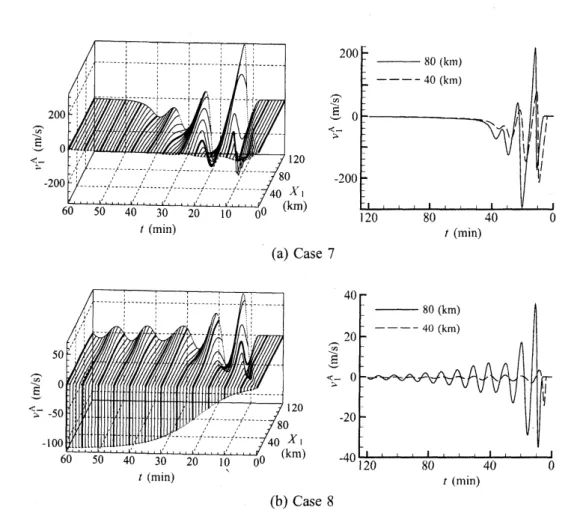
Figures 4 and 5 show, respectively, the profiles of the flow velocity and temperature in
Cases 7 and 8 during eclipse. The oscillatory behavior
seen
in the figures is produced bywaves
which,as
those in Fig. 2, appear in the lower atmosphere and propagate upward successively. In Case 7, the amplitude of oscillation is large and thusa
very fast flow and high temperature may appear instantaneously, especially at high altitudes. The oscillation decays rapidly with time and almostceases
until $t \sim 40\min$. In Case 8, while$t( \min)$ 120 (a)Case 7 80 40 $0$ $t( \min)$ $t(r\iota\tau i\mathfrak{n})$ (b) Case8
FIGURE 4: Profiles of the flow velocity$v_{1}^{A}$ at every minute(left panel) and thecrosssectionsat$X_{1}\simeq 40$
and80 km (right panel). (a) Case 7 and (b) Case 8. The thick line in the left panelindicates profiles at every 5 minutes.
continuesuntil the end ofeclipseexcept nearthe surface. The oscillation period measured from the right panels of Figs. 4(b) and 5(b) is about 10 $\min$, whereas the Brunt-V\"ais\"al\"a
period for the initial isothermal atmosphere computed by a textbook formula is about
11.5 $\min$. In Case 8, a fast condensing flow in the close vicinity of the surface remains
until the end of eclipse. This is because the $SO_{2}$ density
on
the surface is kept muchhigher than the saturation density by theeffect of the noncondensable gas [see Fig. $3(b)$].
The temperature in Case 8oscillates around the initial temperature $(T_{0}=115K)$ in most
parts ofthe atmosphere. The atmosphere is cooled only
near
the surface via conduction. 5.2 After egressFigure 6 shows the profiles of the number density in Cases 7 and 8 afteregress. In Case 7, the number density starts to increase immediately after egress and the initial density
$\hat{i4\vee}$ $k$
$120 80 40 0$
$t( \min)$ $t( \min)$ (a)Case 7$120 80 40 0$
$t( \min)$ $\prime(\min)$ (b) Case8FIGURE 5: Profiles of the temperature$T$ateveryminute (left panel) andthecrosssections at $X_{1}\simeq 40$
and 80 km (right panel). (a) Case 7 and (b) Case 8. The thick linein theleft panel indicates profiles at
every 5 minutes.
(a) Case 7 (b) Case8
FIGURE 6: Number density profiles after egress. (a) Case 7 and (b) Case 8. The solid line indicates
profiles at every 10 minutes $(t=120,130, \ldots, 180\min)$, and thedashed line those at $t=125,135,145,$
on the surface is restored at $t \sim 160\min$. In Case 8, the number density of $SO_{2}$ remains
almost unchanged during the first 10 minutes after egress until the surface temperature and the corresponding saturation density increase sufficiently and thesublimation starts. The noncondensable gas is swept upward by the sublimating flow of $SO_{2}$ and forms a
layer centered around $X_{1}=10$ km at $t=180 \min$. Correspondingly, a hollow is
seen
in the profile of $SO_{2}$ density.6
Concluding
remarks
The unsteady one-dimensional behavior of Io’s atmosphere during and after eclipse caused by sublimation and condensation of $SO_{2}$ is studied via a numerical analysis of the
model Boltzmann equation by
means
of a finite-difference method. To concentrateon
the key physics in this problem,we
took into account the effect of the noncondensable gas ($SO$ or $O_{2}$) only and ignored other effects included in the previous DSMC analysis[5] (e.g., the plasma impingement, molecular internal structure, and
so
on). In spite of the simplifications, the column density of $SO_{2}$ in eclipse is quite similar to the previousDSMC result. Thus, we may say that the atmospheric collapse and the interruption by a noncondensable gas are,
as
a whole, correctly reproduced in the present simulation.The solutions obtained in the present approach may have
some
restrictions because ofthe simplifications. However, they were able to clarify some detailed structures, such as
thewaves in the macroscopicquantitiestraveling in the column and anoscillatory motion in the atmosphere during eclipse, that had not been noticed in Ref. [5]. Indeed, it is a formidabletask tofindsuch detailedstructures of the atmospheric behavior by theDSMC simulation, especially in the case of unsteady problems. Therefore, we may emphasize
that thepresent resultsprovideadeeper understandingof thephenomenafoundinRef. [5] and thus complement this reference.
References
[1] A. P. Ingersoll, M. E. Summers, and S. G. Schlipf, Icarus 64, 375-390 (1985). [2] J. V. Austin and D. B. Goldstein, Icarus 148,
370-383
(2000).[3] W. H. Smyth and M. C. Wong, Icarus 171,
171-182
(2004).[4] A.
C.
Walker,S.
L. Gratiy, D. B. Goldstein, C. H. Moore, P. L. Varghese, L. M. Trafton, D. A. Levin, and B. Stewart, Icarus 207, 409-432 (2010).[5] C. H. Moore, D. B. Goldstein, P. L. Varghese, L. M. Trafton, and B. Stewart, Icarus 201, 585-597 (2009).
[6] G. A. Bird, Phys. Fluids 6,
1518-1519
(1963).[7]
G.
A. Bird, MolecularGas
Dynamics andthe Direct Simulationof
Gas
Flows,Oxford
University Press,Oxford
(1994).[8] S. Kosuge, K. Aoki, T. Inoue, D. B. Goldstein, and P. L. Varghese, Icarus 221,
658-669
(2012).[9] S. Kosuge and K. Aoki,
Rarefied
Gas Dynamics, AIPConf.
Proc., 1501,1541-1548
(2012).[10] P. Andries, K. Aoki, and B. Perthame, J. Stat. Phys. 106,
993-1018
(2002).[11] Y. Sone, Molecular Gas Dynamics: Theory, Techniques, and Applications,
Birkh\"auser,
Boston (2007).[12] K. Aoki, Y. Sone, and T. Yamada, Phys. Fluids A 2,
1867-1878
(1990). [13] T. Ohwada, Y. Sone, and K. Aoki, Phys. Fluids A 1,1588-1599
(1989).[14] F. Xiao, T. Yabe, G. Nizam, and T. Ito, Comput. Phys. Commun. 94,
103-118
(1996).[15] H. Takewaki, A. Nishiguchi, and T. Yabe, J. Comput. Phys. 61, 261-268 (1985). Department of Mechanical Engineering and Science
Kyoto University Kyoto
615-8540
JAPAN$E$-mail address: kosuge. [email protected]