
Structure of positive solutions for semilinear elliptic equations with supercritical growth (Shapes and other properties of solutions of PDEs)
10
0
0
全文
(2) 21. Define the exponent p_{JL}. :=\left\{ begin{ar ay}{l} 1+\frac{4}{N-42\sqrt{N-1} ,&N\geq1 ,\ \infty,&2\leqN\leq10, \end{ar ay}\right.. PJL. which is called the. by. Joseph‐Lundgren exponent introduced. that there exists $\lambda$^{*}>0 and the. infinitely. $\lambda$( $\alpha$). is. change. many times around $\lambda$^{*} and converges to $\lambda$^{*}. and converges to $\lambda$^{*}. strictly increasing of. following. variables,. problem (3). the. [11].. in. as. as. $\alpha$\rightarrow\infty ,. $\alpha$\rightarrow\infty. an. shown. was. $\lambda$( $\alpha$). by [11]. oscillates. and when p\geq p_{JL},. Note. .. be transformed into. can. It. holds: When p_{S}<p<p_{JL},. that, by. a. special. autonomous first order. system. The. study. of the. problem. \left{\begin{ar y}{l \triangleu+$\lambda$u+^{p}=0&\mathrm{i}\ athrm{n}B,\ u>0&\mathrm{i}\ athrm{n}B,\ u=0&\mathrm{o}\mathrm{n}\partilB \end{ar y}\right. was. initiated. case. p>p_{S}. Flores. [8],. by Brezis‐Nirenberg [1]. was. and Guo‐Wei. by changing u\displaystyle \mapsto $\lambda$\frac{1}{p-1}u. in the critical. by Budd‐Norbury [3],. studied. [10]. The. .. (4). Note that. singular. case. Budd. (4). p=p_{S}. [4],. Later, the supercritical. .. Merle‐Peletier. (1). is transformed into. solution of. (4). was. [13], Dolbeault‐ f(u)=u+u^{p} [13]. According. with. constructed in. [3, 8, 10], the bifurcation curve has infinitely many turning points if p_{S}<p<p_{JL}. In [10] the nonexistence of a turning point for large solutions was proved for a certain range on p(>p_{JL}) In general we cannot expect a change of variables that transforms the equation into an autonomous first order system. In [10] they used the intersection number between the regular and singular solution and their Morse indices. In [5, 6, 7] to. .. Dancer studied. infinitely. using the analyticity.. many. turning points for. For other bifurcation. analytic. various. diagrams. of. nonlinear terms,. supercritical problems. see. [12, 15, 16]. We. mainly study the bifurcation. number. Let. us. introduce. a. (\mathrm{f}.1)f\in C^{1}([0, \infty)). and. f(u)>0. (f.2) f. (2),. where. has the form. (f.3) f(u). some. is. constants. convex. in the. case. hypotheses. of. ,. f(u). in. (1).. satisfies. |g'(u)|\leq C_{0}u^{p- $\delta$-1}. and. u_{0}\geq 0, $\delta$>0 and C_{0}>0.. for u\geq 0.. p\geq p_{JL} using the intersection. for u\geq 0.. g(u). |g(u)|\leq C_{0}u^{p- $\delta$} with. curve. collection of. ,. for u\geq u_{0}.
(3) 22. Let C denote the set of all the. by [14]. Then it is known. regular. (1).. solution of. that C becomes. and is described. a curve. C=\{( $\lambda$( $\alpha$), u(r, $\alpha$)):0< $\alpha$<\infty\}. (f.1). Assume that. with. and. (f.2). hold.. as. u(0, $\alpha$)= $\alpha$.. (0,0) (1), we mean that u(r) is a classical solution of (1) for and satisfies 0<r\leq 1 u(r)\rightarrow\infty as r\rightarrow 0 Define H_{0,\mathrm{r}\mathrm{a}\mathrm{d}}^{1}=\{u(x)\in H_{0}^{1}(B);u(x)= u(|x|)\} Let p>p_{S} and assume that (f.1) and (f.2) hold. It was shown by [14] that there exists a singular solution ($\lambda$^{*}, u^{*}) of (1) such that u^{*}\in H_{0,\mathrm{r}\mathrm{a}\mathrm{d} ^{1} and satisfies Since. f(0)>0,. By. C emanates from. singular. a. solution. .. of. u. .. .. ,. u^{*}(r)=A(\sqrt{$\lambda$^{*}}r)^{- $\theta$}(1+O(r^{ $\delta \theta$})). u(r, $\alpha$). as. solution u^{*}. Let. a. Suppose. .. is the. Remark. The. be. f\in C(I). .. solution in. =. a. f changes sign. by [14],. we. turning points. in. .. Then,. as. $\alpha$\rightarrow\infty,. C_{loc}^{2}((0,1. shown. was. by. (7). Merle‐Peletier. define three types of bifurcation. $\lambda$( $\alpha$). \displaystyle \sup\{n\in \mathrm{N}. in I , and. of C.. a. with $\lambda$=$\lambda$^{*}.. [13]. for the. slight simpler proof.. :. diagrams according. and $\lambda$^{*} for $\alpha$> O. Let I\subset \mathrm{R} be. there. are. such that if. of (1). solution. (i).. We define the zero‐number of. \mathcal{Z}_{I}(f). hold.. unique singular. u(r, $\alpha$)\rightarrow u^{*}(r). and. to the intersection number of. let. a. asymptotic properties (7). the idea. (f.2). satisfies (5) with (6). a solution of (1) with u(0, $\alpha$)= $\alpha$>0. singular. problem (4). We will give. Following. and. and. ( $\lambda$( $\alpha$), u(r, $\alpha$)). ($\lambda$^{*}, u^{*}). (f.1). unique $\lambda$^{*}>0 such that the problem (1) with $\lambda$=$\lambda$^{*} has. $\lambda$( $\alpha$)\rightar ow$\lambda$^{*} where. that. The solution u^{*} is. .. u^{*}\in H_{0,\mathrm{r}\mathrm{a}\mathrm{d} ^{1}. Furthermore,. (ii). (6). $\alpha$\rightarrow\infty.. There exists. singular. A:=\displaystyle \{\frac{2}{p-1}(N-2-\frac{2}{p-1})\}^{\frac{1}{p-1}. and. Theorem 1. Let p>p_{S}. (i). (5). ,. uniqueness of the singular solution ($\lambda$^{*}, u^{*}) and the asymptotic behavior. We show the of. r\downarrow 0. (f.2),. where $\delta$>0 is the constant in. $\theta$=\displaystyle \frac{2}{p-1}. as. \mathcal{Z}_{I}(f)=0. f. in I. $\alpha$_{1} ,. .. .. .. interval,. and. by ,. $\alpha$_{n+1}\in I, $\alpha$_{1}<\cdots<$\alpha$_{n+1}. f($\alpha$_{i})f($\alpha$_{i+1})<0. otherwise.. an. By \mathcal{I}[C]. we. for 1\leq i\leq n }. denote the number of the.
(4) 23. m=\mathcal{Z}_{(0,\infty)}( $\lambda$(\cdot)-$\lambda$^{*}). Definition. Put. (i). We say that C is of. (1) (ii) (iii). has. infinitely. I if. Type. m=\infty. regular. many. Type. II if m=0.. We say that C is of. Type. III if 1\leq m<\infty. and. finitely. regular. many. .. a. consequence, if. $\alpha$\rightarrow 0. Then the. .. obtain the. (1). type II if and only if. regular $\lambda$\in(0, $\lambda$^{*}) problem (3), the diagram C is of Type and. solution for $\lambda$\geq$\lambda$^{*}. no. (1). has at least III.. Type. diagram C. is of. type II if. following.. (\mathrm{f}.1)-(\mathrm{f}.3) hold. Then $\lambda$( $\alpha$)\upar ow$\lambda$^{*} as $\alpha$\rightarrow\infty.. and. consequence, C is of. each. a. Assume that. 1.. strictly increasing. is. As. .. then. Type I,. \mathcal{I}[C]=\infty.. ,. ,. Proposition. consequence, if C is of. a. solutions for $\lambda$=$\lambda$^{*} then C is of. f(0)>0 we have $\lambda$( $\alpha$)\rightar ow 0 as $\lambda$( $\alpha$)\leq$\lambda$^{*} for all $\alpha$>0 Furthermore, we Since. As. As. .. solutions for $\lambda$=$\lambda$^{*} and. We say that C is of. one. $\lambda$( $\alpha$). .. has In. .. C is. of type. II. if. and. only if. unique regular solution for. a. particular, \mathcal{I}[C]=0. I if p_{S}<p<p_{JL} , and. II if. Type. .. For the. p\geq p_{JL} and ,. III does not appear.. Type. Brezis‐Vázques [2]. nondecreasing,. problem (1). studied the. convex. functions defined. f(0)>0 It is well known that there exists. a. on. and finite. in. [0, \infty ). a. general. domain when. f. is. C^{1},. with. \displaystyle \lim_{u\rightar ow\infty}\frac{f(u)}{u}=\infty. positive number \overline{$\lambda$} called the extremal value, ,. such that. (i). for. 0< $\lambda$<\overline{ $\lambda$} there. (ii). for. $\lambda$=\overline{ $\lambda$} there. (iii). for. $\lambda$>\overline{ $\lambda$}. ,. exists. ,. exists. ,. there exists. a. a. minimal classical solution. weak solution \overline{u} of. no. weak solution of. The solution \overline{u} , called the extremal as. $\lambda$\upar ow\overline{$\lambda$}. ,. and it may be either classical. solution is be the. solution,. singular,. singular. stable in the. then. (1).. It. was. shown. the. then. ($\lambda$^{*}, u^{*}). as. curve. the. increasing limit of. problem (1),. In the. if. u^{*}\in H_{0}^{1}(B). ,. where. is the extremal. solution,. for all. and hence the. $\phi$\in C_{0}^{1}(B). curve. u_{ $\lambda$}. if the extremal. C is of Type II. Let. by [2] that,. \displaystyle \int_{B}(|\nabla $\phi$|^{2}-$\lambda$^{*}f'(u^{*})$\phi$^{2})dx\geq 0. (1),. (1).. singular.. ,. of. (1),. is obtained. \overline{ $\lambda$}=$\lambda$^{*} and by (iii),. solution of. sense. or. u_{ $\lambda$}\in C^{2}(\overline{B}). ,. C is of Type II.. ($\lambda$^{*}, u^{*}). and if u^{*} is.
(5) 24. A in. result about the classification of the bifurcation. partial. [14]. in terms of Morse index.. By m(u^{*}). we. diagrams. obtained. was. define. m(u^{*})=\displaystyle \sup{ \dim X:X\subset H_{0,\mathrm{r}\mathrm{a}\mathrm{d} ^{1}(B) H[ $\phi$]<0. for all. ,. $\phi$\in X\backslash \{0\} },. where. H[ $\phi$]=\displaystyle \int_{B}(|\nabla $\phi$|^{2}-$\lambda$^{*}f'(u^{*})$\phi$^{2})dx. We call. m(u^{*}). the Morse index of u^{*}.. Theorem A.. [14,. (i) If p_{S}<p<p_{JL} (ii) If p>p_{JL} In this. note,. of solution. ,. then. we. curve. ,. Theorems A and \mathrm{B} ]. then the. C is. of Type. that N\geq 3 and. (\mathrm{f}.1)-(\mathrm{f}.2). hold.. m(u^{*})=\infty.. I and. 0\leq m(u^{*})<\infty.. consider the. of. curve. Suppose. (1) by. case. p\geq PJL and N\geq 11 and investigate the. of the. means. structure. ,. zero. number of the solutions to. $\phi$' +\displaystyle \frac{N-1}{r}$\phi$'+$\lambda$^{*}f'(u^{*}) $\phi$=0. (8). for 0<r<1 ,. ($\lambda$^{*}, u^{*}(r)) be the singular solution of (1). We denote by z( $\phi$) the the number of the zeros of $\phi$(r) for 0<r<1 We see that, for any solution $\phi$ of (8), z( $\phi$)=\infty if p_{S}<p<p_{JL} and 0\leq z( $\phi$)<\infty if p\geq p_{JL} We show the following. where. .. .. ,. Theorem 2.. Suppose. that. (\mathrm{f}.1)-(\mathrm{f}.3). hold.. Then the. following (\mathrm{i})-(\mathrm{i}\mathrm{i}\mathrm{i}). are. equiva‐. lent each other.. (i). (ii). The. diagram C. For any. is. of type. $\phi$\in C_{0,\mathrm{r}\mathrm{a}\mathrm{d} ^{1}(B). II.. ,. \displaystyle \int_{B}|\nabla $\phi$|^{2}dx\geq$\lambda$^{*}\int_{B}f'(u^{*})$\phi$^{2}dx. (iii). There exists. a. We consider the see. solution. case. $\phi$ of (8) satisfying z( $\phi$)=0.. where. (8). has. that if p\geq p_{JL} , then there exists. a. a. solution. $\phi$ satisfying 1\leq z( $\phi$)<\infty We will. unique solution. .. $\phi$^{*}(r)\in C^{2}(0,1 ]. \left\{ begin{ar y}{l ($\phi$^{*})'+\frac{N-1}{r($\phi$^{*})'+$\lambda$^{*}f'(u^{*})$\phi$^{*}=0,&0<r 1,\ r^{$\nu$} \phi$^{*}(r)\ightarow1\mathrm{a}\mathrm{s}r\downarow0,& \end{ar y}\right.. of. (9).
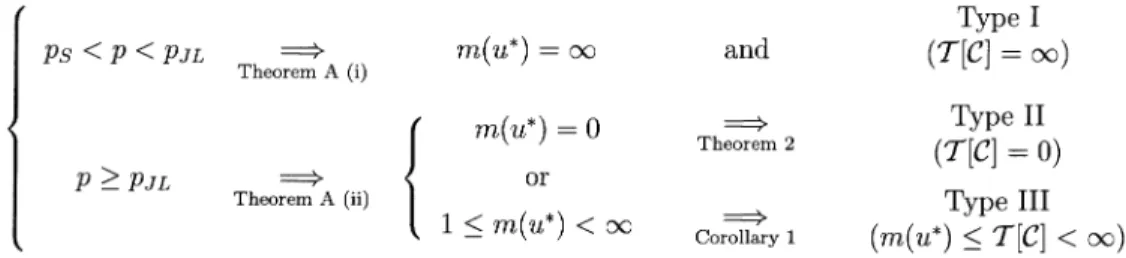
(6) 25. where. $\nu$=\displaystyle \frac{(1-$\epsilon$_{p})(N-2)}{2}. $\epsilon$_{p}=\displaystyle \frac{2}{N-2}\sqrt{\frac{(N-2)^{2} {4}-\frac{2p}{p-1}(N-2-\frac{2}{p-1})}.. and. $\epsilon$_{p}\in(0,1) if p>p_{JL} and $\epsilon$_{p}=0 if p=p_{JL} By the Strum comparison have |z($\phi$_{1})-z($\phi$_{2})|\leq 1 for any solutions $\phi$_{1} and $\phi$_{2} of (8). We see that, theorem, for any nontrivial solution $\phi$ of (8), z($\phi$^{*})\leq z( $\phi$) Then, Theorem 2 implies that the curve \mathrm{C} is of Type II if and only if z($\phi$^{*})=0. Note that. .. we. .. We. impose the condition. (f.3) f(u). is. f:. for u\geq u_{0} for. convex. Theorem 3. Let. on. (f.1)) (f.2) and (f.3) hold. problem (9). of z($\phi$^{*})\geq 1 Then least z($\phi$^{*}) regular solution(s) for $\lambda$=$\lambda$^{*} Assume, in. Let N\geq 11 and. be the unique solution. $\phi$^{*}. T[C]\geq z($\phi$^{*}). (1). and. has at. addition, that $\phi$^{*}(1)\neq 0. .. p\geq p_{JL}. Suppose. .. that. Assume that. the. .. .. Then. M\geq\tilde{M}>0. exist constants. u_{0}\geq 0.. some. u. is. nondegenerate if \Vert u\Vert_{L^{\infty}. such that the. is. \{( $\lambda$( $\alpha$), u(r,. curve. large,. and. hence, there. $\alpha$>\overline{M} }. $\alpha$. has. no. turning point and $\lambda$( $\alpha$)\neq$\lambda$^{*}for $\alpha$>M. Remark. Note that. Corollary. z($\phi$^{*})<\infty. 1. In addition to the. in the. hypotheses. (- $\eta$, \infty) for some problem (9). If z($\phi$^{*})\geq 1 and $\phi$^{*}(1)\neq 0 that. f. is. analytic. see. N\geq 11 and p\geq p_{JL}. on. then the. that, if (f.1), (f.2) and (f.3) hold,. N,. Let. $\eta$> O.. on. ,. We. case. p and. then. be the. $\phi$^{*}. curve. f. C is. in Theorem. 3,. assume. unique solution of the. of Type. m(u^{*})=z($\phi$^{*}). .. III.. We. are. led to the. following conjecture. Conjecture.. [14, Conjecture 1.4]. turning point(s) for. Combining as. The bifurcation. certain class of nonlinear. Theorem A and Theorems 2 and. terms, i.e.,. 3,. we can. curve. C has. exactly m(u^{*}). \mathcal{I}[C]=m(u^{*}). classify. .. bifurcation. diagrams. Table 1 shows.. Table 1 tells. singular a. a. Type. us. solution.. III bifurcation. bifurcation. (1). is encoded in the. of the Morse index of the. singular solution,. that the structure of the From the. diagrams.. viewpoint. diagram. is. an. regular. intermediate. solutions of. case. between. Type. I and. Type. II.
(7) 26. \left{bginary}{l \mathr{T}\mathr{y}\mathr{p}\mathr{e}\mathr{I}\ p_S< {JL}\mathr{T}\mathr{}\mathr{e}\mathr{o}\vecfra{}\mthr{}\mathr{e}\mathr{}\pime athrm{A}(\athrm{i})(u^*=\inftymahr{}\mathr{n}\mathr{d}(\mathcl{I}[C]=\infty) p\geqP_{JL}\mathr{T}\mathr{}\mathr{e}\mathr{o}\mathr{}\mathr{e}\mathr{}\mathr{A}(\mathr{i} m)\Rightarow[Cse] \nd{ary}\ight. Type. II. Type. III. \Rightarrow. m(u^{*})=0. Theorem 2. (m(u^{*})\leq \mathcal{I}[C]<\infty). Table 1: Classification of bifurcation. Sufficient conditions for. 2. We will show. sufficient conditions for. some. Theorem 4. Let N\geq 11 and p\geq p_{JL} in. (2). for. diagrams. supercritical elliptic equations. with. growth.. power. that. g(u)\geq 0 for u\geq 0. Types. II and III.. Suppose. .. II and III. Types. that. f satisfies (\mathrm{f}.1)-(\mathrm{f}.3). .. Assume. and. g'(u)\leq C_{A}u^{p-1} for u\geq 0. (10). ,. where. Then the. curve. Remark. case. C is. (i). of Type. We. that. see. p=p_{JL} , the condition. (ii) large. [0, u_{0}]. Let p>p_{JL}. u. Since. .. automatically.. with. some. C_{A}>0 if p>PJL and C_{A}=0 if p=p_{JL} Thus, .. (10). leads that. we assume. f_{a}(u)=f(u+a). g^{l}(u)\leq 0. in the. for u\geq 0.. inequality (10). is satisfied for sufficiently that require inequality holds for u\in (10). the. for u\geq 0. .. Let. us. consider the. problem. \left\{ begin{ar y}{l \triangleu+$\lambda$f_{a}(u)=0,&x\inB,\ u>0,&x\inB,\ u=0,&x\in parti lB. \end{ar y}\right.. Let N\geq 11 and p\geq p_{JL}. Then there exists a_{0}\geq 0 such. To show. (f.2),. Thus the condition. following.. Theorem 5.. (f.3). (11) is of Type. C_{A}=\displaystyle \frac{\frac{(N-2)^{2} {4}-pA^{p-1} {A^{p-1} .. u_{0}>0.. For a\geq 0 , define. We obtain the. II.. (11). Assume that. .. that, for. f satisfies (f.1), (f.2) and curve C of the problem. all a\geq a_{0} , the. II.. examples. of. Type. III bifurcation. diagram,. we. impose the condition. on. f:.
(8) 27. (f.1) f\in C^{1}[0, \infty) f(u)>0 ,. Define. f(0)=0.. F(u) by. We obtain the. u>0. g(u). for u\geq 0.. (f.1), (f.2), (f.3). that p\geq p_{JL} and. Suppose. Assume that. .. F(u)=\displaystyle \int_{0}^{u}f(t)dt. following.. Theorem 6.. for. for u>0 , and. hold and. f(u). is. analytic. (2) satisfies. in. g(u)=u^{q}+O(u^{q+$\delta$_{0}}). u\rightarrow 0. as. and. g'(u)=qu^{q-1}+O(u^{q-1+$\delta$_{0}}) with. some. q\in(p_{S},p_{JL}). constants. and. $\delta$_{0}>0 Assume, .. (q+1)F(u)\leq uf(u) Then there exists holds:. following III. a. sequence. typical example. and. of. n\leq \mathcal{I}[C]<\infty. f(u)=u^{p}+u^{q} By changing. the variables. to the. equivalent. where b :=a^{q-p}. Corollary then the. We then. (13). the term. u\mapsto au. .. We obtain the. \{a_{n}\}_{n=1}^{\infty}. 2. Let. has. intuitively. that. for u\geq 0.. n\geq 1. then the. ,. problem (11) has. a. given by. with p_{S}<q<PJL \leq p. and $\lambda$\mapsto a^{1-p} $\lambda$ ,. we. see. (12). .. that. (11). with. (12). is. be. Type. (3). in Theorem 6.. as. III. If a_{n}^{q-p}<b<a_{n+1}^{q-p} for. bifurcation diagram. Corollary. with p\geq p_{JL} , and. b(u+1)^{q} point(s). However, is. if. u. is. nondegenerate. Hence,. \mathcal{I}[C]. can. (13). following:. understand. C has turning. u. Type. hold.. 2 in the. hence, C. be controlled. by. large,. then. this is. an. b=a^{q-p}.. and. is of a. some. n\geq 1,. n\leq T[C]<\infty.. following. with p_{S}<q<PJL is dominant for. lower bound of. addition,. \left\{ begin{ar y}{l \triangleu+$\lambda$\{(u+1)^{p}+b(u+1)^{q}\=0&\mathrm{i}\mathrm{n}B,\ u>0&\mathrm{i}\mathrm{n}B,\ u=0&\mathrm{o}\mathrm{n}\partilB, \end{ar y}\right.. is close to. dominant and. in. problem. problem (13). can. some. in Theorem 6 is. f. u\rightarrow 0. such that a_{1}>a_{2}>\cdots>a_{n}>\cdots>0 and the. If a_{n+1}<a<a_{n} for. bifurcation diagram A. \{a_{n}\}_{n=1}^{\infty}. as. way: If b>0 is. Type. II. When b is. relatively. small solution. (u+1)^{p}. small,. large, u. and. with p\geq p_{JL} becomes. intermediate. case.. Moreover, the.
(9) 28. References [1]. H. Brezis and L.. volving. [2] [3]. H. Brezis and J.. Vázquez, Blow‐up. Rev. Mat. Univ.. Complut.. C.. C.. Equations. E.. E.. [9]. (1983),. of some. nonlinear. elliptic problems,. (1997),. 437‐477.. 443‐469.. and. supercritical growth,. 169‐197. to semilinear. turning points for. many. elliptic equations, SIAM. (2000),. some. supercritical problems, Ann.. 225−233. 213‐233.. 33. (2013),. results. for rapidly growing. elliptic equations. in. a. B.. Ni, and. Gidas,. W.‐M.. principle,. Z. Guo and J.. elliptic. D.. space and solutions. ball, Trans. Amer. Math. Soc. L.. nonlinearities Discrete. 153‐161.. Flores, Geometry of phase. (2011),. Nirenberg, Symmetry. Comm. Math.. Phys.. 68. 359. (2007),. and related. (1979),. equation with. super‐critical. of. semilinear. 4073‐4087. via the. properties. 209‐243.. Wei, Global solution branch and Morse index. estimates. of. a. semi‐. exponent, Trans. Amer. Math. Soc. 363. 4777‐4799.. Joseph. and S.. Lundgren, Quasilinear. sources, Arch. Rational Mech. Anal. 49. [12]. in‐. Appl.. J. Dolbeault and I.. linear. [11]. (2008),. Dyn. Syst.. maximum. [10]. Appl.. 178. elliptic equations. Math. 36. 1069‐1080.. Dancer, Some bifurcation. E.. Contin.. [8]. nonlinear. Dancer, Finite Morse index solutions of supercritical problems, J. Reine Angew.. Math. 620. [7]. (1987),. 68. (1989),. Dancer, Infinitely. Mat. Pura. [6]. solutions. Madrid 10. Budd, Applications of Shilnikovs theory. J. Math. Anal. 20. [5]. of. Budd, C and J. Norbury, Semilinear elliptic equations. J. Differential. [4]. Positive solutions. Nirenberg,. critical Sobolev exponents, Comm. Pure. A. Kosaka and Y.. Miyamoto, The. Dirichlet. (1972/73),. problems. driven. by positive. 241‐269.. Emden‐Fowler equation. on a. spherical. cap. of. \mathrm{S}^{N} preprint. ,. [13]. F. Merle and L.. critical. [14]. Peletier, Positive solutions of elliptic equations involving growth, Proc. Roy. Soc. Edinburgh Sect. A118 (1991), 49‐62.. Y.. Miyamoto, Structure of the positive. in. a. ball,. J. Math. Pures. Appl.. 102. solutions. (2014),. super‐. for supercritical elliptic equations. 672‐701..
(10) 29. [15]. Y.. Miyamoto, Classification of bifurcation diagrams for elliptic equations with. exponential growth. [16]. in. a. ball, Ann.. Mat. Pura. Miyamoto, Structure of the positive radial mann problem $\epsilon$^{2}\triangle u-u+u^{p}=0 in a ball J.. Y.. Appl.. 194. solutions. (2015),. for. the. Math. Sci. Univ.. 931‐952.. supercritical. Tokyo. 22. Neu‐. (2015),. 685‐739.. Yasuhito. Miyamoto. Graduate School of Mathematical The. Sciences,. University of Tokyo. Tokyo 153‐8914, Japan \mathrm{E} ‐mail address:. [email protected]‐tokyo.ac.jp. Yuki Naito. Department of Mathematics, Ehime. University. Matsuyama 790‐8577, Japan \mathrm{E} ‐mail address:. ynaito@ehime‐u.ac.jp. \ovalbox{\t \smal REJECT}\overline{5\mathrm{J}\backslash}\star\mathrm{i}^{\backslash}\not\equivx_{\mp}^{\rightar ow$\beta$_{$\pi$\mathscr{X}$\iota$\ovalbox{\t \smal REJECT}\ovalbox{\t \smal REJECT}4\rightar ow}^{B} \backslash\backslash\backslash\backslash\backslash\mp\Re_{7}^{$\pi$_{$\iota$}\ovalbox{\t \smal REJECT}_{-\} ^{\backslash} \backslash\overline{\mathrm{B} *R *^{j_{\backslash } =\S\#\neq\not\in $\lambda$\mapsto\backslash \mathrm{i}^{\backslash }\mp $\varpi$ \mathrm{f}_{ $\Lambda$}^{ $\pi$\ovalbox{\t \smal REJECT}_{-\} ^{\backslash } \backslash \mathrm{N}\ovalbox{\t \smal REJECT}_{\mathrm{A} $\Phi$\neq\neq.
(11)
図
関連したドキュメント
New nonexistence results are obtained for entire bounded (either from above or from below) weak solutions of wide classes of quasilinear elliptic equations and inequalities.. It
Lair and Shaker [10] proved the existence of large solutions in bounded domains and entire large solutions in R N for g(x,u) = p(x)f (u), allowing p to be zero on large parts of Ω..
To study the existence of a global attractor, we have to find a closed metric space and prove that there exists a global attractor in the closed metric space. Since the total mass
We study the existence of positive solutions for a fourth order semilinear elliptic equation under Navier boundary conditions with positive, increasing and convex source term..
Keywords and Phrases: Calculus of conormal symbols, conormal asymptotic expansions, discrete asymptotic types, weighted Sobolev spaces with discrete asymptotics, semilinear
Sun, Optimal existence criteria for symmetric positive solutions to a singular three-point boundary value problem, Nonlinear Anal.. Webb, Positive solutions of some higher
Wu, “Positive solutions of two-point boundary value problems for systems of nonlinear second-order singular and impulsive differential equations,” Nonlinear Analysis: Theory,
Li, “Multiple solutions and sign-changing solutions of a class of nonlinear elliptic equations with Neumann boundary condition,” Journal of Mathematical Analysis and Applications,
