Domain Decomposition Method and Infinite-Precision
Numerical Simulation
Toshiki TAKEUCHI (竹内敏己) and Hitoshi IMAI (今井仁司)
Faculty ofEngineering, University ofTokushima, Tokushima 770-8506, Japan.
(徳島大学工学部)
1
Introduction
(Domain Decomposition Method) has been popularin numerical simulation It
saves
CPU time and memory space. Moreover, balanced accuracy realized by suitable resolution
in each subdomains makes numerical simulation stable.
On the other hand, (Infinite-Precision Numerical Simulation) has been developed
recently[5]. It attains ultimatelyhigh accuracy. From this property IPNS hasreclaimed new
fields of numerical simulation, e.g. direct simulation of inverse problems[3, 4, 6, 7].
In the paper application of DDM and IPNS is considered. Atest problem is solved.
Numerical results
are
investigated from the view point ofaccuracy.2Application of DDM and IPNS
2.1
Infinite-Precision
Numerical
Simulation
Numerical
errors
originate from the truncationerror
in the discretization and the roundingerror.
Realization of highly accurate numerical simulation needs arbitrary reduction ofbotherrors.
For such numerical simulationwe
proposed asimple method calledIPNS(Infinite-Precision Numerical Simulation). IPNS consists of the arbitrary order approximation and
the multiple-precision arithmetic. The former is used for the arbitrary reduction of the
truncation
error.
The last is used for the arbitrary reduction of the roundingerror.
Asfor the arbitrary order approximation spectral methods
are
very useful[l]. Especially, thespectral collocation method is most useful. Its application is same in FDM, so it is easily
applicable to nonlinear problems,
even
to free boundary problems[10]. In the spectralcoll0-cation method, the order ofapproximation
can
be controlled by the number of collocationpoints. The multiple-precision arithmetic[8] is
now
easily available. Alot of subroutinesabout it
are
already prepared. Some librariesare
free and distributedon
the net, e.g数理解析研究所講究録 1288 巻 2002 年 102-107
http:$//\mathrm{w}\mathrm{w}\mathrm{w}$.lmu.$\mathrm{e}\mathrm{d}\mathrm{u}/\mathrm{a}\mathrm{c}\mathrm{a}\mathrm{d}/\mathrm{p}\mathrm{e}\mathrm{r}\mathrm{s}\mathrm{o}\mathrm{n}\mathrm{a}\mathrm{l}/\mathrm{f}\mathrm{a}\mathrm{c}\mathrm{u}\mathrm{l}\mathrm{t}\mathrm{y}/\mathrm{d}\mathrm{m}\mathrm{s}\mathrm{m}\mathrm{i}\mathrm{t}\mathrm{h}2/\mathrm{F}\mathrm{M}\mathrm{L}\mathrm{I}\mathrm{B}$.html [9]. IPNS has bee
applied to many problems and ultimately high accuracy has been
seen
in numerical results.2.2
Test
problem
We consider the following simple boundary value peoblem.
Problem 1. For agiven $a$ find $u(x)\mathrm{s}.\mathrm{t}$.
$\{$
$\frac{d^{2}u}{dx^{2}}=\frac{-8a^{2}(e^{ax}-e^{-ax})}{(e^{ax}+e^{-ax})^{3}}$,
$-1<x<1$
,$u(-1)= \frac{e^{-a}-e^{a}}{e^{-a}+e^{a}}$, $u(1)= \frac{e^{a}-e^{-a}}{e^{a}+e^{-a}}$.
(1)
Remark 1. The exact solution to Problem 1is $u(x)= \tanh(ax)=\frac{e^{ax}-e^{-ax}}{e^{ax}+e^{-ax}}$.
If
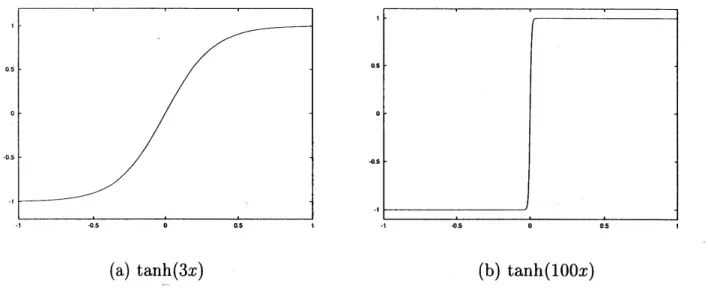
$a$ islarge this problem becomes
difficult
to be solved numerically. This is becausefor
a large $a$ thesolution becomes the step
function
approximately. This situation can be seen in Fig. 1.(a) $\tanh(3x)$ (b) $\tanh$(100x)
Fig. 1. Exact solutions for various values of $a$.
2.3
Application
of DDM and IPNS
The exact solution to Problem 1is analytic, so IPNS can catch it in arbitrary accuracy.
However, if $a$ is large, IPNS cost very much. Thus efficiency of DDM to such acase is our
interest. Our interest is rather mathematical,
so
parallel computing or automatic domaindecomposition are not considered. DDM is applied to Problem 1as follows. The domain
103
is decomposed into three subdomains [-1, -c], [-c, c] and [c, 1] where
$0<c<1$
. ThenProblem 1is decomposed into the following three problems.
$\{$ $\frac{d^{2}u}{dx^{2}}=\frac{-8a^{2}(e^{ax}-e^{-ax})}{(e^{ax}+e^{-ax})^{3}}$, $c<x<1$, $u(1)= \frac{e^{a}-e^{-a}}{e^{a}-e^{-a}}$, (2) $\frac{d^{2}u}{dx^{2}}=\frac{-8a^{2}(e^{ax}-e^{-ax})}{(e^{ax}+e^{-ax})^{3}}$,
$-c<x<c$
, (3) $\{$ $\frac{d^{2}u}{dx^{2}}=\frac{-8a^{2}(e^{ax}-e^{-ax})}{(e^{ax}+e^{-ax})^{3}}$,$-1<x<-c$
, $u(-1)= \frac{e^{-a}-e^{a}}{e^{-a}+e^{a}}$. (4)For the application of IPNS with the Chebyshev polynomial in each subdomains, the
fol-lowing mapping functions
are
indroduced for mapping each subdomains into [-1, 1]. For$-1\leqq t\leqq 1$
$\{\begin{array}{l}x_{1}(t)=\frac{\mathrm{l}-c}{2}(t+1)+cx_{2}(t)=ctx_{3}(t)=\frac{1-c}{2}(t+1)-1\end{array}$ (5)
By using these mapping functions equations in subdomains
are
transformedas
follows,re-spectively. $\{\begin{array}{l}\frac{d^{2_{4}}\tilde{u}_{1}}{dt^{2}}=\frac{-2a^{2}(\mathrm{l}-c)^{2}(e^{ax_{1}(t)}-e^{-ax_{1}(t)})}{(e^{ax_{1}(t)}+e^{-ax_{1}(t)})^{3}}\tilde{u}_{1}(1)=\frac{e^{a}-e^{-a}}{e^{a}+e^{-a}}\end{array}$
$-1<t<1$
, (6) $\frac{d^{2}\tilde{u}_{2}}{dt^{2}}=\frac{-8a^{2}c^{2}(e^{act}-e^{-act})}{(e^{act}+e^{-act})^{3}}$,$-1<t<1$
, (7)104
$\{$
$\frac{d^{2}\tilde{u}_{3}}{dt^{2}}=\frac{-2a^{2}(1-c)^{2}(e^{ax_{3}(\mathrm{t})}-e^{-ax_{3}(\mathrm{t})})}{(e^{ax_{3}(t)}+e^{-ax_{3}(t)})^{3}}$,
$-1<t<1$
,$\tilde{u}_{3}(-1)=\frac{e^{-a}-e^{a}}{e^{-a}+e^{a}}$.
(8)
Here $\tilde{u}_{i}(t)=u(x_{i}(t))$, $i=1,2,3$. As for patching conditions the followings
are
introduced :$\{$ $\tilde{u}_{1}(-1)$ $=\overline{u}_{2}(1)$, $\frac{d\tilde{u}_{1}}{dt}(-1)$ $= \frac{1-c}{2c}\frac{d\tilde{u}_{2}}{dt}(1)$, (9) $\{$ $\tilde{u}_{2}(-1)=\tilde{u}_{3}(1)$, $\frac{1-c}{2c}\frac{d\tilde{u}_{2}}{dt}(-1)=\frac{d\tilde{u}_{3}}{dt}(1)$. (10)
As mentioned before, our interest is efficiency of DDM in accuracy. So, iteration for parallel
computing is not used. Eqs. (6), (7), (8), (9) and (10) are discretized by SCM(Spectral
Collocation Method) with the Chebyshev polynomial and C-G-L(Chebyshev-Gauss-Lobatto)
collocation points and they are solved simultaneously in high precision. Multiple precision
arithmetic is not necessary in numerical computation seen later.
3Numerical Results
In this section numerical results are shown. Oursimpleinvestigation did not require multiple
precision and consequently strict IPNS
was
not carried out. However, results obtained heresuggest the role of DDM in IPNS. Of course, IPNS is necessary for detailed investigation.
For the case where DDM is not applied, i.e. Problem 1is solved by IPNS without DDM,
$(N+1)$ C-G-L points in [-1, 1] are used. Then,
error $= \max 0\leqq j\leqq N|u^{c}(x_{j})-u(x_{j})|$, $x_{j}= \cos\frac{j\pi}{N}$, $\dot{\gamma}=0,1$,$\cdots$ , $N$, (11)
where $u^{c}$ and $u$ denote the numerical solution and the exact solution, respectively. For
the case where DDM is applied, $(N_{1}+1)$, $(N_{2}+1)$ and $(N_{3}+1)$ C-G-L points are used
in $[c, 1]$, $[-c, c]$, and $[-1, -c]$, respectively. Then, $N=N_{1}+N_{2}+N_{3}$. Moreover, $N_{1}=N_{3}=10$ for our purpose. Then,
error $= \max\{\max 1\leqq i\leqq 30\leqq j\leqq N_{i}|\overline{u}_{i}^{c}(t_{j}^{i})-u(x_{i}(t_{j}^{i}))|\}$, $t_{j}^{i}= \cos\frac{j\pi}{N_{i}}$,
$\dot{J}$
$\prime ic$ denotes the numerical solution by DDM.
Table 1. Maximum
error
for Problem 1with $a=1\mathrm{O}\mathrm{O}$.(Quadruple precision, DDM : $c=0.1$, $N_{1}=N_{3}=10$)
$\overline{\mathrm{Q}\mathrm{g}}$
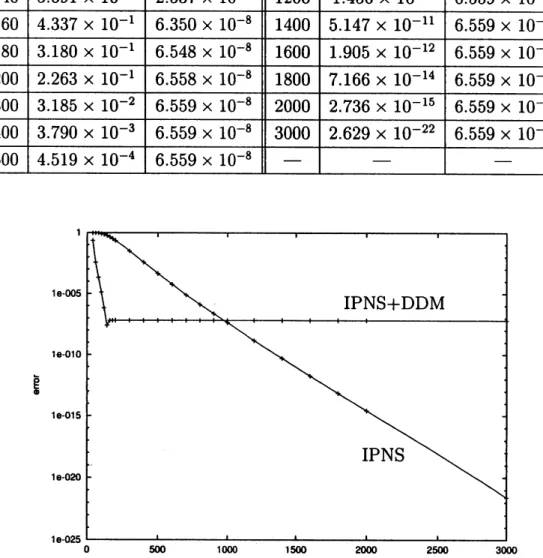
Fig. 2. Behavior of maximum
error
for Problem 1with $a=1\mathrm{O}\mathrm{O}$.(Quadruple precision, DDM : $c=0.1$, $N_{1}=N_{3}=10$)
1these numerical results it is
seen
DDM is efficient in IPNS. Thismeans
DDspace (and CPU time) for adegree of accuracy comparing with the case 1
not used. At the
same
time, it should be remarked improper DDM spoils merit of DDM. This means high resolution in theregion where solutions change alot does not always attainhigh accuracy.
4Conclusion
In the paper DDM is applied in IPNS. Numerical results show efficiency of DDM
on
savingmemory space (and CPU time). At the
same
time they also show high accuracy is notattained by improper resolution in each subdomains. Our future work is parallelization and
solving more difficult problems in high accuracy.
Acknowledgements
This work is partially supported byGrants-in-AidsforScientific Research (No. 13640119),
from the Japan Society of Promotion of Science.
References
[1] C. Canutoet al., Spectral Methods in Fluid Dynamics, Springer, 1998.
[2] N. Debit et al., Domain Decomposition Methods in Science and Engineering, ddm.org, 2001.
[3] H. Imai and T. Takeuchi, Application of the Infinite-Precision Numerical Simulation to
an.
InverseProblem, NIFS-PROC-40(1999), 38-47.
[4] H. Imai and T. Takeuchi, Some Advanced Applications of the Spectral Collocation Method, GAKUTO
Int. Ser. Math. Sci. Appl., 17(2001), 323-335.
[5] H. Imai, T. Takeuchi and M. Kushida, On Numerical Simulation ofPartial Differential Equations in Infinite Precision, Advancesin Mathematical Sciencesand Applications, $9(2)(1999)$, 1007-1016.
[6] H. Imai, T. Takeuchi, M. Nakamura and N. Ishimura, ADIRECT APPROACH TO AN INVERSE
PROBLEM, GAKUTO Int. Ser. Math. Sci. Appl., 12(1999), 223-232.
[7] H. Imai, T. Takeuchi andH. Sakaguchi, Infinite Precision Numerical Simulation for PDE Systems and Its Applications, RIMS Kokyuroku, Kyoto University, 1147(2000), 42-50.
[8] D. E. Knuth, TheArt of Computer Programming,Addison-Wesley, 1981.
[9] D. M. Smith, AFORTRAN Package For Floating-Point Multiple-Precision Arithmetic, Transactions
on Mathematical Software, 17(1991), 273-283.
[10] Tarmizi, T. Takeuchi,H. Imai and M. Kushida, Numerical simulation of one-dimensional free boundary
$\mathrm{p}\mathrm{r}.\mathrm{o}\mathrm{b}\mathrm{l}\mathrm{e}\mathrm{m}\mathrm{s}\cap\cap$ in infiniteprecision,Advancesin Mathematical Sciences andApplications, 10(2)(2000), 661