A mathematical model for
a
hysteresis
appearing
in
adsorption phenomena
日本女子大学 理学部 愛木豊彦(Toyohiko Aiki)
Department of Mathematical and Physical Sciences, Faculty of Science
Japan Women’s University
名城大学 理工学部 村瀬勇介 (Yusuke Murase)
Department of Mathematics, Faculty of Science and Technology
Meijo University
長岡工業高等専門学校 一般教育科 佐藤直紀 (Naoki Sato)
Division of General Education
Nagaoka National College ofTechnology
千葉大学 教育学部 白川健 (Ken Shirakawa)
Department of Mathematics, Faculty of Education
Chiba University
1
Introduction
In the present paper we propose an original mathematical model for a hysteresis
ap-pearing in adsorption phenomena. The mathematical model (FBP) will be given in
Section 3
as
a free boundary problem, in which the free boundary stands between theregions of moisture liquid and moisture vapor in one hole of a porous medium. The
aim of this paper is to contribute researches for complex systems including hystereses
through a discussion about a modeling process for the new mathematicaldcscription of
the hysteresis.
Our study is motivated to
overcome
difficulties thatarose
in the works for threedimensional concrete carbonation process in [2, 3, 4]. In these papers a mathematical
model for the process
was
proposed and studied taking into account of a hysteresiseffect. The model consists of quasilinear diffusion equations with a hysteresis operator
approximately described by
a
type ofa
play operator which is given by an ordinarydifferential equation including the subdifferential of the indicator function for a closcd
interval. Here, we note that the uniqueness question remains open in either of [2, 3, 4].
The difficulty of the uniqueness is caused by the fact that the continuous dependence
between a solution and given data of quasilinear parabolic equations is not sufficient
to conform to the continuous property of the play operator summarized as follows (see
[12, 22] for details):
$(*)$ For a play operator $\mathcal{P}$ : $C([O, T])arrow C([O, T])$ with $0<T<\infty,$
$|\mathcal{P}(v_{1})-\mathcal{P}(v_{2})|_{C([0,T])}\leq C|v_{1}-v_{2}|_{C([0,T])}$ for $v_{1},$ $v_{2}\in C([0, T])$,
When we consider the model for concrete carbonation, the input function$v$ of the
opera-tor is a solution of the quasilinear parabolic equation andthe output function $w=\mathcal{P}(v)$
appears in the coefficient of the equation. In most of quasilinear parabolic equations, it
is not easy to obtain an estimate for difference of solutions with respect to atopologyof
the space of continuous functions. Thus it is not easy to prove the uniqueness.
Inordertoovercome these difficulties wecan choose thefollowingtwo ways. Thefirst
way is toimprovecontinuous properties of solutions to thequasilinearparabolicequation.
The second
one
is to develop a new mathematical description of a hysteresis operator.For the past years the mathematical treatment with the ordinary differential equations
was applied for thc study to various mathematical models for nonlinear phenomena.
Also, the following advantages of such a treatment were pointed out in [1]. One of
advantages is to approximate them easily and the other is to enable to describe change
of the hysteresis by perturbation of given data. However,
as
mentioned above thistreatment has aweakness
on
the continuous property. Moreover, for the treatment it ishard to express a behavior inside of the hysteresis $10$op, because the treatment is just
a phenomenologically approach. Then, based on these arguments we choose the second
way
as
a strategy in this paper, and hence our main aim is to propose a new model for ahysteresis appearing in adsorption process by consideration for a mechanism, in detail.
The discussion of this paper will be proceeded
as
follows. In the next Section 2,we briefly
see
the hysteresis operators appearing in adsorption phenomena. Due to thisobservation
our
original model (FBP) is statedin Section 3. InSection
4we
consider analgorithm to obtain approximatesolution, and show some data of numerical experiments
associated with (FBP). Finally, in Section5, we comment about the adequacy of (FBP)
by taking into account the numerical data, and discuss about the future prospects.
2
Adsorption phenomenon
In this section we focus the relationship between the humidity and the saturation
de-scribing an adsorption phenomenon (see [16]). The hysteresis is a type ofinput-output
relationship between the humidity and the saturation in one hole of a porous medium.
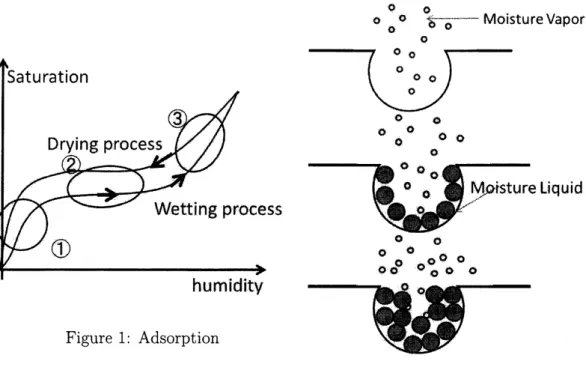
From the experimental data (Figure 1)
we
have the following three featureson
the be-havior of the graph:$\bullet$ Around $1$ and $3$ the slopes
are
steep..
Around $2$ the slope is gradual.$\bullet$ The loop depends
on
the historical data.The scenario for the behavior the relationship is described as follows (see Figure 2
to get general schcmes of the ideas): We consider one hole of the porous medium and
suppose that the degree of saturation
can
be regardedas
the $vo$lume ratio of the liquidin the hole. When the humidity is low, moisture vapor touches the wall directly and
becomes moisture liquid. After the surface ofthe wall is covered with moisture liquid, moisture vapor touches the liquid and becomes liquid.
Since
attractive force between$\Diamond oc_{O}$
$oo\mapsto 0$ Moisture Vapor
Figure 1: Adsorption
Figure 2: Scenario of adsorption
slope will be gradual
as
the humidity becomes high. When the humidity rises further,the slope becomes steeper, since the probability that the vapor touches the liquid in the
hole is also high,
Therefore, the aims of this research are to propose a mathematical model
represent-ing the above scenario and to confirm that the above graph obtained from numerical
simulations for the model.
3
Mathematical modeling for
adsorption
In this section we shall propose our mathematical model for adsorption phenomena.
First, we simplify a hole in the porous medium as one dimensional compact interval
$[0, L]$, where $L$ indicates the depth of the hole. Moreover, we assume that at $x=0$ the
wall exists, from the point $x=L$ the atmosphere flows into the hole, and the domain
$[0, L]$ is separated by the liquid region $(0, s)$ and the vapor region $(s, L)$ (see Figure 3),
Under these assumptions
we
define the degree of saturation $w$ by$w= \frac{s}{L}.$
Inthis paperthe humidity$u=u(t, x)$ indicates the ratio of volume of moisture vapor
per unit volume for any time $t$ and the spatial position $x$. Then the
mass
conservationleads to
$\rho_{v}u_{t}+j_{x}=0$ in $(s, L)$,
Figure 3: One-dimensional model Figure 4: Near the free boundary
implies that $j=-\kappa u_{x}$ and
$\rho_{v}u_{t}-\kappa u_{xx}=0$ in $(s, L)$,
where $\kappa$ is a diffusivity constant.
Next, we consider the
mass
conservation of moisture near the free boundary $x=$$s(t)$ for $t>0$ . If $s’(t)>0$ , then for small $\triangle t>0$ the
mass
of vapor of the interval$(s(t), s(t+\triangle t))$ is given by
$\int_{s(t)}^{s(t+\Delta t)}\rho_{v}u(t, x)dx.$
Also, the
mass
of liquidon
$(s(t), s(t+\triangle t))$ at time $t+\triangle t$ is given by$\rho_{\tau v}(s(t+\triangle t)-s(t))$,
where $\rho_{w}$ is the density of moistureliquid (see Figure 4). Then. it holds that
$\rho_{w}(s(t+\triangle t)-s(t))=\int_{s(t)}^{s(t+\triangle t)}\rho_{v}u(t, x)dx-\Delta t\cross j(t, s(t+\triangle t))$,
and by letting $\triangle tarrow 0$
we
have$\rho_{w}s’(t)=\rho$
。$s’(t)u(t, s(t))+\kappa u_{x}(t, s(t))$.
We note that the above equation also holds in
case
$s’(t)\leq 0.$According to the scenario shown in the previous section the dynamics of the free
boundary depends on the distance between the wall and the front of the liquid region,
and the humidity at the front. Then we
assume
$s’(t)(= \frac{d}{dt}s(t))=\alpha(s(t), u(t, s(t)))$ for $t>0$, (3.1)
Here, from simple observations
we
can give some assumptions for $\alpha$. First, as thehumidity at the front is high, the vapor can easily become moisture liquid. This implies
$\frac{\partial}{\partial u}\alpha(s, u)>0$ for $(s, u)\in R^{2}$. (3.2)
Next, if the humidity is extremely high, then the front must grow. Also, if the humidity
vanishes, then thefront can not grow. Namely, for any $s\in R$ it should be that
$\alpha(s, u)\geq 0$ for $u\geq 1$ and $\alpha(s, u)\leq 0$ for $u\leq 0$. (3.3)
Moreover, since the front of liquid region can not grow beyond the gate of the hole and
the wall, we can suppose that for any $u\in R$
$\alpha(s, u)\leq 0$ for $s\geq L$ and $\alpha(s, u)\geq 0$ for $s\leq 0$. (3.4)
Thus we have obtained the following free boundary problem (FBP) to find a pair
$\{s, u\}$ of a
curve
$x=s(t)$on
$[0, T],$ $0<T<\infty$, and afunction $u=u(t, x)$ on $Q_{s}(T)$ $:=$$\{(t, x)|s(t)<x<L, 0<t<T\}$ satisfying
$\rho_{v}u_{t}-\kappa u_{xx}=0$ in $Q_{s}(T)$, (3.5)
$u(t, L)=g(t)$ for
$0<t<T$
, (3.6)$u(O, x)=u_{0}(x)$ for $s_{0}<x<L,$
$s’(t)=\alpha(s(t),$$u(t, s(t))$ for $0<t<T,$
$\kappa u_{x}(t, s(t))=(\rho_{w}-\rho_{v}u(t, s(t)))\alpha(s(t), u(t, s(t)))$ for $<t<T$, (3.7)
$s(0)=s_{0},$
where $s_{0}$ is a initial position of the free boundary, and $g$ and $u_{0}$ are given boundary and
initial functions on $[0, T]$ and $[s_{0}, L]$, respectively. In [20] we establish the well-posedness
for the above problem under the assumptions (3.2) $\sim(3.4)$.
4
Numerical simulation
In this section we consider the problem (FBP) and present its numerical simulation.
First, we show the values ofconstants in (FBP)
as
the following Table 1:$\frac{L\kappa\rho_{w}\rho_{v}s_{0}}{1111.73\cross 10^{-5}0.01}$
Table 1: Values ofconstants
Also, we set $u_{0}(x)=0$ for $x\in(s_{0}, L)$
.
Here,wegivetwo remarks concerned with anumerical simulationto (FBP)
as
follows:1. (FBP) is a free boundary problemso that the domain $(s(t), L)$ isunknown for each
time $t$, where $\{s, u\}$ is asolution of (FBP). Moreover, since the value of$u(t, s(t))$
is also unknown, it is not easy to extend $u$
on
the fixed interval, for example $[0, L],$2. There is
a
big difference between orders of $\rho_{v}$ and $\rho_{w}$. By this it takesa
lot timeto calculate the solution, numerically. We
see
this property if the original domainmaps into cylindrical domain by change of variable, especially.
Hence, in order to solve these problems
we
develop the following algorithm for ournumerical simulations. For $\triangle t>0$
we
find approximations of$s(n\triangle t)$ and $u(n\triangle t, x)$ for$n=1,2,$$\cdots$ , and $x\in(s(n\triangle t), L)$. As you
see
the algorithm, the number of latticcpoints and the mesh size on space depend on $n$ so that we denote them by $N_{n}$ and
$(\triangle x)_{n}$ for each $n$. Thus
we
calculate $s_{n}$ and$u_{n}^{(i)}$
as
approximations of $s(n\triangle t)$ and
$u(n\triangle t, s(n\triangle t)+i(\triangle x)_{n})$, respectively, for $n$ and $i=0,1,$$\cdots,$$N_{n}.$
Step 1. Set $n=0,$ $s_{n}=s_{0},$ $N_{n}=40$, and $u_{n}^{(i)}=u_{n}(s_{n}+i( \frac{L-s_{n}}{N_{n}}))$ for $i=0,1,$$\cdots,$$N_{n}.$
Step 2. Set $( \triangle x)_{n}=\frac{L-s_{n}}{N_{n}}.$
Step 3. Set $u_{n}^{(-1)}=u_{n}^{(1)}- \frac{2(\triangle x)_{n}}{\kappa}(\rho_{w}-\rho_{v}u_{n}^{(0)})\cross\alpha(s_{n)}u_{n}^{(0)})$.
Step 4. Put $s_{n+1}=s_{n}+\triangle t\cross\alpha(s_{n}, u_{n}^{(0)})$.
Step 5. Let $N_{n+1}’= \max\{j\in N|j\leq\frac{L-.s_{n+1}}{0025}\},$ $N_{n+1}= \max\{\min\{40, N_{n+1}’\}, 10\}$ and
$( \triangle x)_{n+1}=\frac{L-s_{n+1}}{N_{n+1}}.$
Step 6. Compute $\overline{u}^{(i)}$
from $u_{n}^{(i)}$ for $i=-1,0,1,$
$\cdots,$ $N_{n+1}$ by using the Lagrange
inter-polation with degree $1+N_{n+1}$, where $\overline{u}^{(i)}$
is corresponding to an approximation of
$u(n\triangle t, L-i(\triangle x)_{n+1})$
.
Step 7. Compute $u_{n+1}^{(i)}$ for $i=0,1,$
$\cdots,$$N_{n+1}$
as
an approximate solution satisfying(3.5), (3.6) and (3.7) from $\overline{u}_{n}^{(i)}$
by using the Gauss-Seidel method.
Step 8. Set $n:=n+1$ and $GOTO$ Step 2.
In order to verify the correctness of
our
algorithmwe
put$s(t)= \frac{3}{4}(1-e^{-t})+\frac{1}{4}, u(t, x)=(1+\sin\pi x)e^{t},$
$\alpha(s, u)=(1+u^{2})(u-\frac{\arctan(l0s-6)-\arctan(-6)}{arc\tan(4)-\arctan(-6)})$ .
Then, $u$ and $s$ satisfy
$\rho_{v}u_{t}-\kappa u_{xx}=f$ in $Q_{s}(T)$,
$u(t, L)=g(t)$ for $0<t<T,$
$u(O, x)=u_{0}(x)$ $:=1+\sin\pi x$ for $s_{0}<x<L,$
$s’(t)=\alpha(s(t), u(t, s(t)))+k(t)$ for $0<t<T,$
$\kappa u_{x}(t, s(t))=(\rho_{w}-\rho_{v}u(t, s(t)))(\alpha(s(t), u(t, s(t)))+k(t))+h(t)$ for $<t<T,$
where $f(t, x)=(\rho_{v}+(\rho_{v}+\kappa\pi^{2})\sin\pi x)e^{t},$ $g(t)=e^{t},$ $k(t)= \frac{3}{4}e^{-t}-\alpha(s(t),$$u(t, s(t))$ and
$h(t)= \kappa\pi e^{t}\cos(\pi s(t))-\frac{3}{4}(\rho_{w}-\rho_{v}u(t, s(t)))e^{-t}$for $(t, x)\in Q_{s}(T)$ for $T>0.$
Since we know the exact solution of the above problem, we can calculate errors of
approximate solutions obtained by our algorithm and summarize these errors as the
following Table 2:
Table 2: Errors
From these results we infer that our method is somehow effective to (FBP). Then by
using this algorithm we obtain the following solutions.
$0\{$ $0$フ 03
$04\kappa’\backslash /)0^{r_{)}}$
, 0.$6$ 0.$7$ 0.$8$ 09 $0$ 01 $0.$? 03
$04t’\backslash t^{\backslash }0_{\backslash }\Gamma)$ 06
01 08 09
Figure 5: Simulation 1 Figure 6: Simulation 2
In Simulation 1 (Figures 5) we set
$\alpha(s, u)=(1+u^{2})(u-\frac{\arctan(l0s-6)-\arctan(-6)}{\arctan(4)-\arctan(-6)})$ , and $g(t)=\{$ $\frac{t}{25}-\frac{t}{5}$ $(5<t\leq 10)$, $(0<t\leq 5)$, $\frac{t}{5}-2$ $(10<t\leq 15)$, $4- \frac{t}{5}$ $(15<t\leq 19)$, $\frac{t}{5}-3.6$ $(19<t\leq 22)$, $5.2- \frac{t}{5}$ $(22<t\leq 24)$, $\frac{t}{5}-4.4$ $(24<t\leq 25)$, $5.6- \frac{t}{5}$ $(25<t\leq 26)$. (4.1)
Also, in Simulation 2 (Figures 6)
we
setwhere
$\beta(u)=\{$ $\frac{o_{1-\cos(\pi u)}}{12}$ $ifu\in ifu<ifu>[0’, 1]01,$
’ $\gamma(s)=\{\begin{array}{ll}0 if s<0,\frac{1-\cos(\pi s)}{2} if u\in[0,1],1 if s>1,\end{array}$
$g$ is given by (4.1).
From observations these graphs in Figures 5 and 6 we can conclude that:
$\bullet$ Sincemost of the ascending branchesarelocated under descending ones, ourgraphs
are
quite similar to graphs obtainedbyexperiments. In thissense we can
representthe hysteresis in the absorption phenomena by (FBP).
.
Our graphs do not have the features mentioned in Section 2. More precisely, theslopes for the low and high humidities are gradual in Figure 5 and the slope for
the low humidity is too, in Figure 6. Hence,
we
need to finda
better form of$\alpha$ toreproduce the scenario
as
in Figure 1.5
Conclusion and
discussion
In this section we discuss about (FBP) in terms of numerical simulation, mathematical
analysis and application to concrete carbonation process.
5.1
Numerical simulation
As mentioned inSection 4, by using (FBP)
we can
obtain appropriate graphs todescribethehysteresis inadsorptionphenomena, andmore accurate approximationto experiment
data still remains as a significant challenge.
Additionally,wedonotprove yet,whether
our
algorithm outputscertainapproximatesolutions of (FBP), or not. This is also
our
future problem.5.2
Mathematical analysis
Here,
we
show the challenge in the mathematical analysis of (FBP), referring to similarfree boundary problem. The reference problem
was
proposedas
a mathematical modelfor concrete carbonation and discussed by B\"ohm and Muntean in [17, 19]. Recently, the
simplificd modelof the problemwasstudied. The problem (CC) is to find acurve$x=\ell(t)$
satisfying
$w_{t}-(\kappa_{1}w_{x})_{x}=f(w, v)$ in $Q_{\ell}(T)$,
$v_{t}-(\kappa_{2}v_{x})_{x}=-f(w, v)$ in $Q_{\ell}(T)$,
$w(t, 0)=h_{1}(t),$ $v(t, 0)=h_{2}(t)$ for $0<t<T,$ $w(O, x)=w_{0}(x),$ $v(O, x)=v_{0}(x)$ for $0<x<\ell_{0},$
$\ell’(t)(=\frac{d}{dt}\ell(t))=\psi(w(t, \ell(t)))$ for $0<t<T,$
$\kappa_{1}w_{x}(t, \ell(t))=-\psi(w(t, \ell(t)))-\ell’(t)w(t, \ell(t))$ for $0<t<T,$ $\kappa_{2}v_{x}(t, s(t))=-\ell’(t)v(t, \ell(t))$ for $0<t<T,$
$\ell(0)=\ell_{0},$
where $\kappa_{1}$ and$\kappa_{2}$ are positive constants, $f$ is agiven continuous function on $IR^{2},$ $h_{1}$ and $h_{2}$
are
boundary data, $w_{0},$ $v_{0}$ and $\ell_{0}$are
initial data and $\psi(r)=\kappa_{0}|[r]^{+}|^{p}$ where $\kappa_{0}>0$ and$p\geq 1$ are given constants. In this problem $w$ and $v$ represent the mass concentration of
carbon dioxide dissolved in water and inair, respectively, while $\ell(t)$ denotes the position
of the penetration reaction front in concrete at time $t>0$. Theinterface $P$ separates the
carbonated from the non-carbonated regions.
For this problem the existence, the uniqueness ofaweak solution and the large time
behavior of the free boundary were investigated in [5, 6, 7, 8, 9, 10, 11]. As compared
to the concrete carbonation model (CC), our problem (FBP) has the following features,
The first one is that the time derivative of the free boundary depends on the position
of the free boundary (see (3.1)).Secondly, in (FBP) we cannot know the $sign$ of the
derivative of the free boundary a priori, while in (CC) we can show that it is always
nonnegative. On the other hand, we can not know the $sign$ of the derivative of the
free boundary a priori for (FBP). Due to these facts, it becomes not easy to obtain the
global estimate for the derivative of the free boundary. This leads to the difficulty to
show the convergence of the free boundary $s(t)$ of (FBP) as $tarrow\infty$, although it looks a
natural event in physics. Therefore, up to aresearch to alarge time behavior ofthe free
boundary we possibly need to improve
our
model.5.3
Application
to
concrete
carbonation
Finally, weshow much further challengeofthis study. Indeed, we have a futureprospect
to consider
a
coupled system which consists of the quasilinear parabolic equation as-sociated with the concrete carbonation, and the free boundary problem (FBP) in the adsorption,In previous works relationship between the the humidity and the degree of
satura-tion is described by an operator so that we can make a mathematical model only to
combine thedifferential equation and the operator. However, whenwe propose asystem
containing (FBP) which is a model for concrete carbonation, it is necessary to show a
certain physical interpretation. To this end,
we
will adopta
two-scale modelingas
thisinterpretation.
The two-scale problem
was
already studied in [15]. Recently, this ideawas
used intwo-scale modeling $W^{1^{\circ}}$
.
can
deal withmacro
and micro domains, andmacro
and microparameters at the
same
system. Accordingly, afterwe clarify the continuous dependencebetween the humidit) $g$ and the degree ofsaturation $s$
on
(FBP), and the large timebehavior of the free boundary, we will propose and study the couple combined by the
two-scale modeling.
References
[1] T. Aiki, Mathenlatical models including a hysteresis operator, Dissipative phase
transitions, 1-20, Ser. Adv. Math. Appl. Sci., 71, World Sci. Publ., Hackensack, $NJ,$
2006.
[2] T. Aiki, K. Kumazaki, Well-posedness ofamathematical model for moisture
trans-port appearing in concrete carbonation process, Adv. Math. Sci. Appl., 21(2011),
361-381.
[3] T. Aiki, K. Kumazaki, Mathematical model for hysteresis phenomenon in moisture
transport ofconcrete carbonation process, Physica$B$, 407(2012), 1424-1426.
[4] T. Aiki, K. Kumazaki, Mathematicalmodeling ofconcrete carbonation processwith
hysyteresis effect. Surikaisekikenkyusho Kokyuroku, No. 1792(2012), 98-107.
[5] T. Aiki, A. Muntean,Existence and uniqueness of solutions toamathematical model
predicting service life ofconcrete structures, Adv. Math. Sci. Appl., 19(2009), 109-129.
[6] T. Aiki, A. Muntean, Large time behavior of solutions to concrete carbonation
problem,
Communications on
Pure and Applied Analysis, Vol. 9, $(2010)1117-1129.$[7] T. Aiki, A. Muntean, Mathematical treatment of concrete carbonation process,
Current Advances in Nonlinear Analysis and Related Topics, Gakuto Intemational
Series, Mathematical Sciences and Applications, Vol. 32, 2010, 231-238.
[8] T. Aiki, A. Muntean, Onuniqueness ofaweak solution ofone-dimensional concrete
carbonation problem, DiscreteContin. Dynam. Systems Ser. $A$, Vol.29,
(2010)1345-1365.
[9] T. Aiki, A. Muntean,
Mathematical
treatment of concrete carbonation process,Current Advances in Nonlinear Analysis and Related Topics, Gakuto International
Series, Mathematical Sciences and Applications, Vol. 32, 2010, 231-238.
[10] T. Aiki, A. Muntean, Large time behavior of solutions to concrete carbonation
problem, Communications on Pure and Applied Analysis, Vol. 9, $(2010)1117-1129.$
[11] T. Aiki, A. Muntean, $A$ free-boundary problem for concrete carbonation: Rigorous
[12] M. Brokate andJ. Sprekels, Hysteresis and Phase Transitions, Springer, Appl. Math.
Sci., 121, 1996.
$[13]$ V. Chalupeck\’y, T. Fatima, and A. Muntean. Numerical study of a fast
micro-macro mass transfer limit: The caseof sulfate attack in sewerpipes. $J$.
of
Math-for-Industry, $2B:171-181$, 2010.
[14] T. Fatima, A. Muntean and T. Aiki. Distributed space scales in a semilinear
reaction-diffusion system including
a
parabolic variational inequality: $A$well-posedness study, Adv. Math. Sci. Appl. 22(2012), 295-318.
[15] A. Friedman, A. Tzavaras, $A$ quasilinear parabolic system arising in modelling of
catalytic reactors. J. Differential Equations, 70(1987), 167-196.
[16] K. Maekawa, R. Chaube, T. Kishi, Modeling
of
concrete performance, Taylor andFrancis, 1999.
[17] A. Muntean, $A$ moving-boundary problem: Modeling, analysis and simulation of
concrete carbonation, Cuvillier Verlag, G\"otingen, 2006. $PhD$ thesis, Faculty of
Mathematics, University of Bremen, Germany.
[18] A. Muntean and M. Neuss-Radu, $A$ multiscale Galerkin approach for a class of
non-linear coupled reaction-diffusion systems in complex media, J. Math. Anal. Appl.,
371(2010), 705-718.
[19] A. Muntean, M. B\"ohm, $A$ moving-boundary problem for concrete carbonation:
global existence and uniqueness of solutions, Journal of Mathematical Analysis and
Applications, 350(1)(2009), 234-251.
[20] N. Sato, T. Aiki, Y. Murase, K. Shirawaka, One dimensional free boundary problem
for adsorptionphenomena, in preparation.
[21] T. Fatima and N. Arab and E. P. Zemskov and A. Muntean, Homogenization of a
reaction-diffusion system modeling sulfate corrosion in locally-periodic perforated
domains, J. Eng. Math., 69(2011), 261-276.
[22] A. Visintin,