Bifurcation analysis
to
Rayleigh-B\’enard
convection at degenerate
critical
points
大阪大学・大学院基礎工学研究科 小川知之 (Toshiyuki Ogawa)
GraduateSchool of Engineering Science
Osaka University
1
Introduction
In this paper
we
consider pattern formation problem to the classical Rayleigh-Benardcon-vection by the standard bifurcation analysis method. Let
us
consider the problem by theBussinesq approximation (Oberbeck-Boussinesq model) with
uP-down
symmetric boundarycondition. It is already a classical fact that the hexagonal pattern appear right after the
critical Rayleigh number and it is unstable. See forexample [6]. In [2] theyobtained general
bifurcational structure under the
uP-down
symmetryincludingtheBoussinesq approximation.However, both of them have not obtained the eigenvalues about the mixed mode solutions
such
as
the hexagonal pattern. On the other hand, recent $3\mathrm{D}$ numerical simulation showsthat it is rather easy to obtain the hexagonal pattern under the
same
uP-down
symmetricsituation $(\mathrm{e}\mathrm{g}$
.
[3]$)$.
Thereforewe
have calculated the cubic normal form about the criticalpoint where both the roll and hexagonal patterns appearand study the dynamics ofthem in
our
previous study([5]). By the cubic normal form wecan
study the invariant torus whichincludes the fixed point corresponding to the hexagonal pattern inside. To determine the
motion on the torus
we
need to calculate the normalform up to higher order. But we onlydiscuss the stabilityof the invariant torus and calculatetheeigenvalues for the transversal
di-rection tothetorus. Oneof
our
previous results shows that it istrue thatthe invariant torusofthehexagonal patternhas positiveeigenvalues but they
are
smallcompared totheabsolutevalue of thenegative
ones.
The invarianttorus isa
saddle for its transversal directions andit will take quite
a
long time to observe unstable dynamics. It is consistent to the classicaltheoretical results and also the numerical simulations. Notice that a hexagonal pattern
can
be stable in the
case
when the two boundary conditionare
different so that it breaks theuP-down
symmetry. In fact the normal form has quadratic terms which correspond to thehexagonal
resonance.
In these previous works the fluid tank with particular size is mainly considered. There
exist 3 roll solutions which have the
same
criticalwave
length andcross
each other by theangleof120 degrees. Here; inthis study,
we
shall considermore
generalsituationsby changingthe size of the tank. It is still difficult to study the reduce dynamics for all the variations of
the system size. However,
we
found astable mixed mode solution (patchwork quilt tyPe) bytaking the size and the Prandtl number appropriately.
2
Formulation
We consider the Boussinesq approximation for the Rayleigh-Benard convection. Variation
equations about the conductive state
can
be written in the following non-dimensional form.$\{$
$u_{t}+$ (tt
.
$\nabla$)$u$ $=$$\theta_{t}+(u\cdot\nabla)\theta$ $=$
$\nabla\cdot u$ $=$
$-\nabla p+R\theta \mathrm{e}_{z}+$ Au
$(w+\Delta\theta)/P$ (2.1)
Here, $u=(u,v,w)$ is
a
velocity vector and $\mathrm{e}_{z}=(0, 0,1)$. Two constants $R$ and $P$are
theRayleigh and the Prandtl numbers, $1^{\backslash }\mathrm{e}\mathrm{s}\mathrm{p}\mathrm{e}\mathrm{c}\mathrm{t}\mathrm{i}\mathrm{v}\mathrm{e}1\mathrm{y}$.
Let the boundary conditions be free-slipfor both the top and the bottom:
$u_{z}=v_{z}=w=\theta=0$ $(z =0, 1)$. (2.2)
Therefore solutions to this problem have
uP-down
symmetry whichmeans
that theyare
invariant under the mapping:
$(u_{;}v, w, \theta,p)(t_{;}x,y, z)\mapsto(u, v, -w, -\theta,p)(t,x, y, 1-z)$.
Moreover let
us
assumethe periodlcity for both$x$and$y$directions with the$\mathrm{p}\mathrm{e}\mathrm{l}\cdot \mathrm{i}\mathrm{o}\mathrm{d}\mathrm{s}$ $(2\pi/\alpha,2\pi/\beta)$.
We represent each unknownvariables by the Fourier expansion.
$u= \sum_{\langle m,n,l)\in \mathrm{Z}^{3}}u_{m,’ x},\iota e^{i(m\alpha x+n\beta y+l\pi z)}$
We
use
an abrebiated
notation $\mathrm{m}=(n\iota,n, l)$ for the mode vector and $u_{\mathrm{m}}=u_{m,n,l}$. Since all theunknown variablesare
real valued and their Fouriercoefficientshave theHer-mitian symmetry: $u_{\mathrm{r}\mathrm{n}}=u_{-f\mathrm{n}}$
.
They also satisfy the following properties which correspondto the up-down symmetry.
$u_{m,n,l}$ $=$ $u_{m,n,-l}$, $v_{m,n,l}$ $=$ $v_{m,n,-l;}$ (2.3) $w_{m,n},\iota$ $=$ $-w_{7n,n,-l;}$ $\theta_{m,n,l}$ $=$ $-\theta_{m,n,-l}$
,
$Pm,n,l$ $=$ $p_{m,n,-}\iota$Now
we
rewrite the equations $(2,1)$ by using the Fouriercoefficients $\mathrm{a}_{1}\mathrm{s}$ follows.$(\begin{array}{l}u_{\dot{\mathrm{I}}\mathrm{n}}v_{\dot{\mathrm{m}}}u^{j_{\mathrm{m}}}\theta_{\dot{\mathrm{m}}}0\end{array})=($
$-\omega^{2}000$ $-\omega^{2}000$ $-\omega^{2}1/P00$
$-\omega_{0}^{2}/PR00$ $-\mathrm{i}n\iota\alpha-\mathrm{i}n\beta-\dot{\uparrow,}l\pi 00)$
$(\begin{array}{l}u_{\mathrm{m}}v_{\mathrm{m}}w_{\mathrm{m}}\theta_{\mathrm{m}}p_{\mathrm{m}}\end{array})-(\begin{array}{l}\{(u\cdot\nabla)u\}_{\mathrm{m}}\{(u\cdot\nabla)v\}_{\mathrm{m}}\{(u\cdot\nabla)w\}_{\mathrm{m}}\{(u\cdot\nabla)\theta\}_{\mathrm{m}}0\end{array})$ (2.4)
$im\alpha$ $in\beta$ $il\pi$
Here, $\omega^{2}=m^{2}\alpha^{2}+n^{2}\beta^{2}+l^{2}\pi^{2}$.
(2.4) with the symmetry (2.3) is equivalent to (2.1) with (2.2). Moreover the Fourier
coefficients for the
pressure
$p$ and $w$can
be eliminated by the fifth equation of (2.4) andfinally
we
obtain the following system ofordinarydifferential
equations for $\mathrm{m}\neq 0$.
$(\begin{array}{l}u_{\dot{\mathrm{m}}}v_{\dot{\mathrm{m}}}\theta_{\dot{\mathrm{m}}}\end{array})=M_{\mathrm{m}}$
$(\begin{array}{l}\prime U\prime \mathrm{m}v_{\mathrm{m}}\theta_{\mathrm{m}}\end{array})-(\begin{array}{l}\{(u \cdot \nabla)u\}_{\mathrm{m}}\{(u\cdot\nabla)v\}_{\mathrm{m}}\{(u\cdot\nabla)\theta\}_{\mathrm{m}}\end{array})$ $+k_{\mathrm{m}}$
$(\begin{array}{l}?\uparrow]\alpha n\beta 0\end{array})$
$(l \neq 0)$ (2.5)
$(\begin{array}{l}u_{\dot{\mathrm{m}}}v_{\dot{\mathrm{m}}}\end{array})=M_{(m,n\}0)}$
$(\begin{array}{l}u_{\mathrm{m}}v_{\mathrm{m}}\end{array})-(\begin{array}{l}\{(u\cdot\nabla)u\}_{\mathrm{m}}\{(u\cdot\nabla)v\}_{\mathrm{m}}\end{array})$ $+k_{(m,n,0)}$
$(\begin{array}{l}m\alpha n\beta\end{array})$ ($l=0$ and $\mathrm{m}\neq 0$)
(2.6) Here,
$M_{r\mathrm{n}}=(\begin{array}{lll}-\omega^{2} 0 -77\mathrm{k}l\pi\alpha R/\omega^{2}0 -\omega^{2} -nl\pi\beta R/\omega^{2}-m\alpha/l\pi P -n\beta/l\pi P -\omega^{2}/P\end{array})$ , $(l\neq 0)$,
$M_{\mathrm{m}}=(\begin{array}{ll}-\omega^{2} 0\mathrm{O} -\omega^{2}\end{array})$ , ($f=0$ and $\mathrm{m}\neq 0$)
Notice that the
mean
flow should be zero, that is $u_{0}=v0$ $=Po=0$ and it holds that$w_{0}=\theta_{0}=0$ by the symm etry (2.3). It is easy to
see
that the linearized matrix $M_{\mathrm{m}}$ has0-eigenvalue ifand only if$l\neq 0$ and $R=R(k)=(k^{2}+l^{2}\pi^{2})^{3}/k^{2}$where$k$ isthe wave number
with $k^{2}=\uparrow 7\iota^{2}\alpha^{2}+n^{2}\beta^{2}$. $R(k)$ takesits minimumvalue$R_{c}=27\pi^{4}/4$at thecritical wavelength
$k_{c}=\sqrt{2}\pi/2$. $R_{\mathrm{c}}$ is called the critical Rayleigh number. We
axe
interested in thecase
whenthe first instability takes place
as
weincrease the Rayleigh number. Therefore, we have onlyto consider the
case
$l=1$ and $R=R(k)$ $=(k^{2}+\pi^{2})^{3}/k^{2}$.Let
us
similarly consider the2dimensionalcase
wherethe solution depends onlyon$(x, z)-$direction. Now the unknown variables
are
$u$,$w$,$\theta,p$and theirtimeevolutioncan
bedescribedas
follows. Notice that the modevector is $\mathrm{m}=(m, l)\in \mathrm{z}^{2}$ and $\omega^{2}=m^{2}\alpha^{2}+l^{2}\pi^{2}$.$(\begin{array}{l}u_{\mathrm{m}}\backslash \theta_{\dot{\mathrm{m}}}\end{array})=M_{\mathrm{m}}$ $(\begin{array}{ll}u_{\mathrm{m}} \theta_{\mathrm{m}} \prime\end{array})-(\begin{array}{l}\{(u\cdot\nabla)u\}_{\mathrm{m}}\{(u\cdot\nabla)\theta\}_{\mathrm{m}}\end{array})\backslash$
,
$+k_{\mathrm{m}}($ $m_{0}\alpha,)$ $(l\neq 0)$ (2.7)
$u_{\dot{\mathrm{m}}}=-\omega^{2}u_{\mathrm{m}}$ (l $=0$ and m$\neq 0$) (2.8)
Here, $M_{\mathrm{m}}$ and $k_{\mathrm{m}}$
are
definedas
follows although weuse
thesame
notationas
the3-Dcase.
$k_{\mathrm{m}}= \frac{1}{\omega^{2}}(m\alpha\{(u. \nabla)u\}_{\mathrm{n}1}+l\pi\{(u\cdot\nabla)u)\}_{\mathrm{m}})$,
$l\mathrm{t}’I_{\mathrm{m}}=(\begin{array}{ll}-\omega^{2} -ml\pi\alpha R/\omega^{2}-m\alpha/l\pi P -\omega^{2}/P\end{array})$, $(l\neq 0)$
Now let
us
calculate the convolution terms.$\{(u. \nabla)u\}_{\mathrm{m}}$
$=$
$\mathrm{m}_{1}+\mathrm{m}_{2}=\mathrm{m}\sum_{l_{1}\neq 0}\frac{\mathrm{i}\alpha(m_{2}l_{1}-m_{1}l_{2})}{l_{1}}u_{\mathrm{m}_{1}}u_{[] \mathrm{n}_{2}}$ (2.9)
$\{(u.\nabla)\theta\}_{\mathrm{m}}$
$=$
$\mathrm{m}_{1}+\mathrm{m}_{2}=\mathrm{m}\sum_{l_{1}\neq 0}\frac{i\alpha(m_{2}f_{1}-m_{1}l_{2})}{l_{1}}u_{\mathrm{m}_{1}}\theta_{\mathrm{m}_{2}}$ (2.10)
$\{(u\cdot\nabla)w\}_{\mathrm{m}}$ $=$
$\mathrm{m}_{1}+\mathrm{m}_{2}=\mathrm{m}\sum_{l_{1}l_{2}\neq 0}-\frac{\mathrm{i}m_{2}\alpha^{2}(n\tau_{2}l_{1}-l7?_{1}l_{2})}{l_{1}l_{2}\pi},u_{\mathrm{m}1}u_{\mathrm{m}_{2}}$ (2.11)
Here, we denote $\mathrm{m}_{i}=(m_{i}, l_{i})$.
These coupled systems $( (2,5)$ (2.6) and (2.7) (2.8) $)$ of countably many ordinary
differ-ential equations have
a
trivialzero
solution. We study the local bifurcation about the trivialsolution. It is necessary to calculate the normal form
on
the center manifold which is locallyspanned by thecritical eigenvectors of$M_{\mathrm{m}}$ foreach set ofparameter values of$(R, \alpha, \beta)$.
There
are
two possibilities of critical points in the 2-Dcase.
In fact ifa
critical pointis degenerate then two adjacent modes , $n$ and $n+1$ modes, are critical. In the 3-D case,
if
we
choose the domain with $(\alpha,\beta)$ $=k_{c}(1/2, \sqrt{3}/2)$ where $k_{c}$ is the criticalwave
length, 3critical modes appear and they correspond to the roll patterns which differ by 120 degrees
3
2-D
problem
and
stability
of
mixed
mode solutions
We review
our
previousresultsforthe stability of mixed mode solutionsfor a2-D fluid tank.It might be easier to explain
our
analysis in the 2-D problem andwe
basically take similarstrategy for the 3-D problem.
When $R=R(\alpha;m):=(n\iota^{2}\alpha^{2}+\pi^{2})^{3}/m^{2}\alpha^{2}$ holds, $(m1)\}$ mode becom
es
critical in thelinearized problem about
zero
to (2.7)(2.8). Therefore at most two critical modes becomecritical at the
same
time. Moreprecisely, fora
given athere existsa
number $R^{*}$ such that allthe eigenvalues about
zero
is negative for $R<R^{*}$) andmoreover one
of the following holds.(See also Figure 1.)
:
.
simple criticalcase:
There existsa
natural number $n$ such that $R^{*}=R(\alpha;\pm n, 1)$and if $|?71|\neq n$ then $R^{*}<R(\alpha;m, 1)$. We call the pair of parameter values $(\alpha, R^{*})\mathrm{a}$
simple critical point.
.
multiple critical case: Thereexistsa natural number$n$such that $R^{*}=R(\alpha;\pm n, 1)=$$R(\alpha;\pm(n+1), 1)$ and if $|m|\neq n$,$n+1$ then $R^{*}<R(\alpha,\cdot m, 1)$. We call the pair of
parameter values $(\alpha, R^{*})$
a
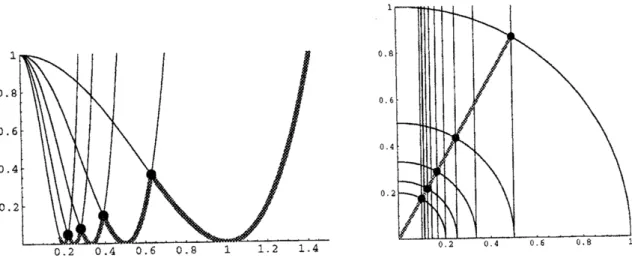
multiple critical point.Figure 1: [Left $\mathrm{f}\mathrm{i}\mathrm{g}\mathrm{u}\mathrm{r}\mathrm{e}|:\mathrm{N}\mathrm{e}\mathrm{u}\mathrm{t}\mathrm{r}\mathrm{a}\mathrm{l}$stability
curves
drawn in$(\alpha, \#)$-plane. They correspond
the critical
curves
for $R$ $=$ $R(\alpha;1)$, $\cdots$ ,$R(\alpha, 4)$ respectively from the right. Thickcurve means
the first instability and the black dotsare
mutiple critical points. [Right$\mathrm{f}\mathrm{i}\mathrm{g}\mathrm{u}\mathrm{r}\mathrm{e}]:C_{m,\mathrm{n}}$ drawn in $(\alpha,\beta)$-plane for the 3-D problem (See section 4 in detail)
for
$(m, n)$ $=(1_{7}1)$,$(2, 2)$,$(3, 3)$, $(4, 4)$,$(5, 5)$,$(2, 0)$, $(3, 0)$,$(4, 0)$,$(5, 0)$,$(6, 0)$,$(7, 0)$,$(8, 0)$,$(9, 0)$ and $(10, 0)$. Black dots correspond to the hexagonal critical points.
It is easy to
see
that a roll solution bifurcates ata
simplecritical
pointas
asuper-critical pitchfork bifurcation. In fact, $M_{\mathrm{m}}$ has simple $0$-eigenvalue ifand only if
$\mathrm{m}\in S.=$
$\{(\pm n, \pm 1), (\pm n, \mp 1)\}$. Thecritical eigenvectors
are
not $v_{\mathrm{m}}$ but time.$\mathrm{m}\in S$
as
follows. Thelinear transformation:
$(\begin{array}{l}\tilde{u}\mathrm{m}\tilde{\theta}_{\mathrm{m}}\end{array})=T$ $(\begin{array}{l}u_{\mathrm{m}}\theta_{\mathrm{m}}\end{array})$ , $T= \frac{1}{(1+P)_{l71}\alpha l\pi\omega^{2}}$
make the linear part of the equation for $\mathrm{m}\in S$ diagonal
as
$(\begin{array}{l}\tilde{u}_{\dot{\mathrm{m}}}\overline{\theta}_{\dot{\mathrm{m}}}\end{array})=(\begin{array}{ll}0 00 -\frac{1+P}{P}\omega^{2}\end{array})(\begin{array}{l}\tilde{u}_{\mathrm{m}}\tilde{\theta}_{\mathrm{m}}\end{array})$ $-T$ $(\begin{array}{l}\{(u\cdot\nabla)u\}_{\mathrm{m}}\{(u\cdot\nabla)\theta\}_{\mathrm{I}\mathrm{n}}\end{array})$$+Tk_{\mathrm{m}}$ $(\begin{array}{l}n\uparrow\alpha 0\end{array})$ (3.1)
Now the center manifold about the simple critical point
can
be described by $\tilde{u}_{\mathrm{m}}(\mathrm{m}\in S)$.
The other modes: $\overline{\theta}_{\mathrm{m}}(\mathrm{m}\in S)$ and $u_{\mathrm{m}\}}\theta_{\mathrm{m}}(\mathrm{m}. \not\in S)$
are
the slave modes. Moreover, itholds that $\tilde{u}(n_{l}1)=\tilde{u}(n,-1)$ by the up-down symmetry. Therefore $\overline{u}\langle n,1$),$\overline{\tilde{u}(n,1)}$ gives the local
coordinate
on
the center manifold. Weare
interested in the small solutions $|\tilde{u}(n,1)|<\delta$near
the critical point. Then all the slave modes are $O(\delta^{2})$ by the center manifold theorem. To
obtain the effective normal formon thecenter manifold
we
pick up the nonlinearterms fromthe equations ofthe critical modesin (3.1) uPto$O(\delta^{3})$. The nonlinearterms for theequation
of $\tilde{u}(n,1)$ in (3.1) consist of $u_{\mathrm{m}_{1}}u_{\mathrm{m}_{2}}$ and $u_{\mathrm{m}_{1}}\theta_{\mathrm{m}_{2}}$ with $\mathrm{m}_{1}+\mathrm{m}_{2}=(n, 1)$
.
The combinationsof $(\mathrm{m}_{1}, \mathrm{m}_{2})$ which give nonlinear terms
uP to $O(\delta^{3})$
are
$((n, 1),$$(0,0))$, $((-n, 1),$$(2n,0))$, $((n, -1)$,$(0, 2))$ and $((-n-\}1), (2n2)\})$. Since $\mathrm{O}(\mathrm{m},0)=0$ holds by the up-down symmetryand$u(m,0)=0$holdsin the 2-Dsetting, thenonlinear terms
come
from thefirst twocombinationsof above
are zero.
It isalsozero
for $(\mathrm{m}_{1)}\mathrm{m}_{2})=((-n, -1),$ $(2n, 2))$ by (2.9), (210) and (2.11).Therefore the slave modes uP to 0 $(\delta^{3})$ which relate to the equation for $A:=\tilde{u}(n,1)$
are
only$B:=v(0,2)\mathrm{a}\mathrm{I}\underline{1}\mathrm{f}_{-}1C:=(0,2)|$ Wecan writethe corresponding $\mathrm{e}t-\mathrm{t}\mathrm{L}1\mathrm{a}\mathrm{t}\underline{\mathrm{i}}0_{-}\mathfrak{n}_{-}\mathrm{s}L$as foilows
$A\dot{4}$
$=$ $\lambda A+\frac{n^{2}\alpha^{2}-\pi^{2}}{n^{2}\alpha^{2}+\pi^{2}}n\alpha \mathrm{i}AB+\pi\omega^{2}iAC+O(\delta^{4})$ (3.2)
$\dot{B}$
$=$ $-4\pi^{2}B\dashv- O(\delta^{4})$ (33)
$\dot{C}$
$=$ $-4\pi^{2}C+4\pi\omega^{2}n^{2}\alpha^{2}\mathrm{i}|A|^{2}+O(\delta^{4})$ (3.1)
Here, we
assume
A $=R-R’=O(\delta^{2})$.
To obtain the normal formon
the center manifoldwe
need to calculate the approximation of the center manifold by the coordinate $A$ orwe
take
an
appropriate near-identity transformation before the center manifold reductionas
follows. More precisely we determine unknown constants $P$ and $q$
so
that wecan
eliminatethe quadratic terms in the equation after taking the near-identity transformation $\tilde{A}=A+$
$pAB+qAC$. Finally
we
obtain$\tilde{A}.=\lambda\tilde{A}-\omega^{4}n^{2}\alpha^{2}|\tilde{A}|^{2}\tilde{A}+O(\delta^{4})$. (3.3)
It shows that
a
supercritical pitchfork bifurcation to a roll solutionoccurs
at the criticalpoint.
Next,
we
shall consider the multiple criticalcase.
$M_{\mathrm{m}}$ has simple0-eigenvalue ifand onlyif$\mathrm{m}\in S:=\{(\pm n, \pm 1), (\pm?7, \mp 1), (\pm n’, \pm 1), (\pm n’, \mp 1)\}$ , where $n^{\mathit{1}}=n+1$
.
After takingthe similar linear transformation which diagonalize the matrix$M_{\mathrm{m}}$ the 4 critical modes
are
represented by A $:=\tilde{u}(n,1)$, $\overline{A}=\tilde{u}\langle-?\mathrm{z},-1$
), $B:=\tilde{u}\{n^{l},1$) and $\overline{B}=\tilde{u}(-n’,-1)$
.
Moreover the slave modes coming intotheequation for $A=\tilde{u}_{(n,1)}$
are
$C:=u(0,2)’ D:=$$\theta(0,2)’ E:=y,(n-n’,2)$, $F:=\theta(n-n’,2)’ G:=u(n+n’,2)$ and$H$ $:=\theta(n+n’,2)$ up to$O(\delta^{3})$
.
We obtainthe following normal form when$n\geq 2$ by taking the similar near-identity transformation
as
above. Notice that it has quadratic
resonance
terms when $n=1$ andwe
needa
differentapproach
as one can see
in [1].$\{$ $\tilde{A}$ . $=$ $\tilde{A}(\lambda-a|\tilde{A}|^{2}-b|\tilde{B}|^{2})+O(\delta^{4})$ $\tilde{B}$
.
$=$ $\tilde{B}(\lambda^{/}-c|\overline{A}|^{2}-d|\overline{B}|^{2})+O(\delta^{4})$ (3.1)It
can
be separated into the equation for the modulus(amplitude) and the argument(angle)by the polar coordinate And the equationsfor the amplitud
es are
$\{$
$\dot{r}$ $=$ $r(\lambda-ar^{2}-bs^{2})+O(\delta^{4})$, $\dot{s}$ $=$ $s(\lambda’-cr^{2}-ds^{2})+O(\delta^{4})$.
(3.7)
Here,
we
denote $r=|\tilde{A}|$,$s=|\tilde{B}|$. The equations (3.7) have at most 4 equilibriums $(0, 0)$,$(r_{1},0)$, $(0, s_{1})$ and $(r^{*}, s^{*})$ when $r\geq 0$
,
$s\geq 0$. We callone
of these equitibrium $\mathrm{s}(r^{*}, s^{*})$a
mixed mode solution if $r^{*}s^{*}\neq 0$. Since the linearized matrix for (3.7) about the mixedmode solution is given by $N=-$ $(\begin{array}{ll}o_{\prime} bc d\end{array})$ ,
a
mixed mode solution is stable in thesense
of (3.7) if $\det N>0$ . It
means
that (3.6) has stable invariant torus which include a mixedmode stationary solution. Here,
we
don’t consider the motion on the invariant torus butthe stability ofthe invariant torus, since
we
need higher order normal form todeterminethewhole dynamics
on
the center manifold. We showed that there exista
stable mixed modebytaking the Prandtl number appropriately. In fact Figure 2 shows the relation between$\det N$
and the Prandtl number.
Figure 2: The stability of $n-(n+1)$ mixed mode. Values of$\det N$with respect todifferent
values of $P$
are
drawn. Two of the figures correspond to $n=2$ and $n=3$ from the left,respectively.
4
Neutral
stability
surfaces for 3-D problem
The 3 critical roll modes become unstable exactly at the critical Rayleigh number $R_{c}$ when
$(\alpha, \beta)=k_{c}(1/2, \sqrt{3}/2)$. While,
on
the other hand, the first instabilityoccurs
at $R>R_{c}$ ingeneral It is convenient to define the neutral stability surface for each mode $(m\rangle n, 1)(\mathrm{o}\mathrm{r}$
simpty
we
denote $(m, n))$as
follows.$G_{m,n}=\{$$(\alpha, \beta, R)$ ; $R=R_{m,n}(\alpha, \beta)$ ,
$\alpha,\beta\in(\mathrm{O}, +\infty)\}$
The $(m, n)$-mode instability
occurs
on
the surface $G_{m,n}$. Remember thatwe
$\mathrm{h}\mathrm{a}\downarrow \mathrm{v}\mathrm{e}$ set $l=1$
since
we are
interested 1n the first instability. Therefore, for a given $(\alpha,\beta)$, the firstin-stability
occurs
as
$(m*’ n*)$-mode where $R_{m_{*},n_{*}}(\alpha_{1}\beta)\leq R_{m,n}(\alpha,\beta)$ for any $(n\iota, n)\in \mathrm{Z}^{2}$.there
can
be multiple critical modes. In fact when $(\alpha,\beta)=k_{c}(1/2, \sqrt{3}/2)$ , both $(2, 0)$$\{(\pm 2,0), (\pm 1, \pm 1), (\pm 1, \mp 1)\}$ in this
case.
By using the Hermitian symmetry we havees
sentially 3critical modes: $\tilde{u}_{(2,0,1)},$$v\sim,(-1,1,1)$ and $\tilde{\mathrm{t}t}_{(-1,-1,1)}\cdot R_{m,n}(\alpha,\beta)$attains its minimu$\mathrm{m}R_{c}$
on
$C_{m,n}=\{(\alpha, \beta)$ ; $m^{2}\alpha^{2}+n^{2}\beta^{2}=k_{c}^{2}$,$\alpha$,$\beta\in(0, +\infty)\}$ .
Figure 3: Neutral stability surfaces for $(2, 0)$ and $(1_{\mathrm{t}}1)(\mathrm{l}\mathrm{e}\mathrm{f}\mathrm{t})$ and $C_{m}$,$n$ (right).
Figure 4: Neutral stability surfaces (left) and $C_{m}$,
$n$ (right) for $(m, n)$ $=$
$(1,1)_{7}(2_{\dagger}0)$,$(0, 2)$,$(3, 0)$,$(2, 1)$,$(1, 2)$,$(0, 3)$
,
$(3, 1)$,$(2, 2)$ and $(1, 3)$.Next, if
we
proportionally increaseor
decrease the size$(\alpha, \beta)$ tosome
extentthenwe
havethe
same
set ofcritical modes but the critical value of $R$ is larger than $R_{c}$. If we furtherdecrease $(\alpha, \beta)$ then another set of modes replace this set of critical modes. There
are
so
many
possibilities of multiple critical points. In this articlewe are
interested in the criticalpoints where the set of critical modes
are
$\{(\pm n, 0), (\pm m, \pm l), (\pm m, \mp l)\}$, where $n>m$ and$l\neq 0$. We call the point $(\alpha, \beta, R)$ which satisfies this property the pseudo hexagonal critical
pointsinceit has essentially 3 critical roll modes. In fact the center manifold
can
bedescribed
by 3 critical modes $\tilde{u}_{(n,0,1)},\tilde{u}_{(-m_{l}l,1)}$ and $\overline{u}_{(-m,-l,1)}$
.
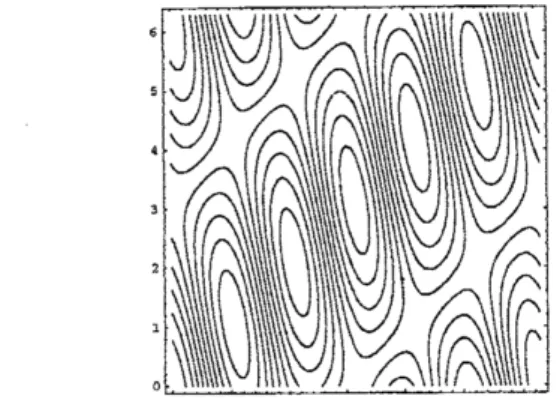
Figure 5: Pseudo hexagonal points of $(n, 1)$ and $(n+1,0)$ (left) and the vertical section
of neutral critical sul.faces
on
the line $\{(\alpha,\beta)=sk_{c}(1/2, \sqrt{3}/2);s\in(1/2,1)\}$ (right). Eachcurves
in the right figure corresponds tothe section of $S_{1,1}$,$S_{2,1}$,$S_{3,0}$,$S_{3,1},$ $S_{1,2}$ and $S_{2,2}$ fromthe right, respectively. Notice that the pair of surfaces $\{S_{1,1}, S_{2_{\backslash }0}\}$
as
well as $\{S_{0.2}, S_{3,1}\}$coincide each other
on
this line. Black dot is the point where the patchwork-quilt is stable.the center manifold
as
follows. Herewe
denote$A_{1}=\tilde{u}(n,0,1)$,$A_{2}=\tilde{U}l.(-m,l,1)$,
$A_{3}=\tilde{u}_{(-m,-l,1)}$’$\{$
$A_{1}=A_{1}(\mu-a|A_{1}|^{2}-b|A_{2}|^{2}-b|A_{3}|^{2})$ $\dot{A}_{2}=A_{2}(\mu-c|A_{1}|^{2}-d|A_{2}|^{2}-e|A_{3}|^{2})$ $A_{3}=A_{3}(\mu-c|A_{1}|^{2}-e|A_{2}|^{2}-d,|A_{3}|^{2})$
(4.1)
In the
case
of hexagonal critical point it holds that $a$ $=d$,$b=c=e$. Also it has generallyquadratic terms
as
the hexagonal resonance, however, in thiscase
quadratic terms shouldvanish by the
uP-down
symmetry.We extract the equations for the amplitudes from (4.1) by taking the polar coordinates
$A_{\mathrm{t}}=r_{\tau}e^{i\phi_{i}}$:
$\{$
$7^{\cdot}.1$ $=$ $r_{1}(\mu-ar_{1^{2}}-br_{2^{2}}-br_{3^{2}})$ $\dot{r}_{2}$ $=$ $r_{2}(\mu-cr_{1^{2}}-d r_{2^{2}}-e r_{3^{2}})$ $\dot{r}_{3}$ $=$ $r_{3}(\mu-cr_{1^{2}}-er_{2^{2}}-dr_{3^{2}})$
(4.2)
These equations
can
have the follow$\mathrm{i}\mathrm{n}\mathrm{g}$ equilibriums:.
(0):
(0,0,0).
(R):
$(r_{1}^{\dagger},0,0)$,$(0, r_{2}^{\dagger}, 0)$,$(0, 0, r_{3}^{\uparrow})$.
(PQ):
$(r_{1}^{\}, r_{12}^{\ddagger}, 0)$,$(0, r_{21\}}^{\ddagger}r_{22}^{\ddagger})$,$(r_{31}^{1},0,r_{32}^{\ddagger})$’ (H)
:
$(r_{1}^{*}, r_{2}^{*}, r_{3}^{*})$Here, each of $rr^{\mathrm{t}}\dagger$, and $r^{*}$ is non-zero, We call them $(\mathrm{O}):\mathrm{z}\mathrm{e}\mathrm{r}\mathrm{o}$, $(\mathrm{R}):\mathrm{r}\mathrm{o}11$, $(\mathrm{P}\mathrm{Q}):\mathrm{p}\mathrm{a}\mathrm{t}\mathrm{c}\mathrm{h}\mathrm{w}\mathrm{o}\mathrm{r}\mathrm{k}$
quilt and $(\mathrm{H}):\mathrm{p}\mathrm{s}\mathrm{e}\mathrm{u}\mathrm{d}\mathrm{o}$ hexagonal solution, respectively. As
we showed
in the$\mathrm{p}\iota\cdot \mathrm{e}\mathrm{v}\mathrm{i}\mathrm{o}\mathrm{u}\mathrm{s}$study
in the
case
of the hexagonal critical point, $\mathrm{i}.e.$, when $(n, m, l)=(2,1_{\}}1)$,
the number ofpositive eigenvalues about each solution in the
sense
of (4.2) is $(\mathrm{O}):3$, $(\mathrm{R}):0$, $(\mathrm{P}\mathrm{Q}):1$, $(\mathrm{H}):^{\eta}\sim$’
can
show the ratio $(b-0)/(a+2b)$ between the absolute values of the positive and negativeeigenvalues is small. This
means
that the invariant torus corresponding to the hexagon isa
saddle for the transversal direction to the torus and it will takea
long time to observeunstable dynamics in general.
Now let
us
go back tothe analysison
thepseudo-hexagonal critical point. We calculatedthe normal form about
some
ofthese critical points in $\{(\alpha, \beta, R_{\mathrm{c}});(\alpha,\beta)\in C_{n,1}\cap C_{n+1,0}\}$ asin Figure 5 (left). Asa result it turnsout that all the pseudo hexagonal and patchwork quilt
solutions
are
unstable. We conjecture this holds for every pseudo hexagonal critical pointsat the critical Rayleigh number $R_{\mathrm{c}}$
.
On the other hand, a patchwork quilt pattern can be stable by taking $(\alpha,\beta)$ suitably
so
that the critical value for $R$ islarger than Rc. Infactthisis true, for example, atthe multiple
critical point of$(3, 0)$ and $(2, 1)$ with $(\alpha,\beta)$ $=s(1, \sqrt{3})$ for
some
$s>0$ (See also Figure 5) and$P$ is less than certain critical value which is approximately 0.8. At that point
our
results onthe normal form show that $a$,$b$
,
$d$,$e>0$,$d<e$ while $\mathrm{c}<0$. We also conjecturethat thereare
other parameter regions where the patchwork quilt pattern becomes stable.
Figure 6: Schematic picture of
a
patchworkquiltpattern$\mathrm{n}$ whichisstable at amultiple criticalpoints of $(3, 0)$ and $(2, 1)$
.
5
Discussion
We
are
developingacodetoexactly calculate normal form. The results shownintheprevioussection
are
basedon
these calculations. (These are joint work with my student TakashiOkuda.) We
can
exactlycalculate normal form coefficients ata
given critical point, however,it is still not easy to analyze the dynamics
on
the center manifold by the followingreasons.
One difficulty
comes
from the fact that someofthe critical points havemore
than 4 criticalmodes. In these
cases
cubicresonance
terms might appear andwe can
not separate thedynam ics on the center manifold into the equations for amplitude and argument. Another
trouble is that the normal form coefficients obtained by the code
are
generally describedby tremendously long and complex formula. Therefore
we
can
utilize the formula for onlyobtaining the numerical values of them. However,
we
believe further analysis to the normalform will give
us an
ideaon
why and how the mixed mode solutions be stabilized undera
References
[1] D.ARMBRUSTER, J.GUCKENHEIMER AND P.Holmes, Kuramoto-Sivashinsky dynamics
on
thecenter-unstable
manifold, SIAM J. Appl. Math., 49(1989), pp.676-691.[2] M.GOLUBITSI{Y, J.W.SWIFT AND E.KXOSLOCH, Symmetries and pattern selection in
Rayleigh-B\’enard convection, Physica10D, 1984,249-276.
[3] $\backslash \grave{;}\mathrm{L}^{\mathrm{t}}$
田勉長$\iota \mathrm{L}\mathrm{f}\not\in$晴, 木村忠$\mathrm{t}_{-}^{\equiv}arrow$, X平衡系の内部
$\ovalbox{\tt\small REJECT} \mathrm{g}\grave{\mathrm{l}}\underline{\mathrm{D}\ }$一正六角形対流パターン・らせん
波一, 数学セミナー, 38(6), 1999, 30-33.
[4] T.NISHIDA, T.IKEDA AND H.YOSHIHARA, Pattern
fo
rmationof
heat convectionprob-lern, in
Mathematical
Modelingand NumericalSimulation inContinuum Mechanics(eds.LBabuska, P.G.Ciarlet and T.Miyoshi), Lecture Notes in Computational Sciences and
Engineering Vo1.19, Springer, 2002, 209-218.
[5] $;\mathrm{J}\backslash ]\mathrm{I}|$ 知之, ベナール対流におけるヘキサゴンパターンと
$l\xi_{\mathfrak{Q}}^{\mathrm{A}}$ロー)$\triangleright 0$)$\not\cong \mathrm{E}^{l}|\not\simeq$
諏理解
究所講究録, vo1.1368, 2004, 144-151.
[6] A.SCHL\"UTER, D.LORTTZ AND F.H.Busse, On the stability
of
steadyfinite
amplitudeconvection, J.Fluid Mech., $\bigcap_{\sim},3(1)$, 1965,129-144.
[7] $\mu\rfloor$ffl
祥子藤村薫密度が温度の弱い
2次$6\ovalbox{\tt\small REJECT}\Re^{\mathrm{e}}$である場合の Rayle\sim gh-B\’enard $\mathrm{X}1\backslash$
流パターン