Asymptotic
behavior of
solutions of
anisotropic
curvature motions
Hirokazu Ninomiya (Ryukoku University)
(二宮広和・龍谷人学 理工学部)
Remi Weidenfeld (Ecole Centrale de Lyon)
1Introduction
If the two chemical or physical states coexists, the interfaces are often observed as the
boundaries of two states. The dynamics of interfaces is one of the interesting problems
in applied mathematics. Ifthe interfaces between the twostates are moved by the local
forces, they are often controlled by the surface free energy and the energy difference
between two phases. The surface free energy usually depends on the orientations which
represents $\Psi(\theta)$ is afunction of 0with period $\pi$ where 0is the angle between the $x$ axis
and the normal vector. Let $\Gamma_{t}$ be the interface, $V_{n}$ anormal velocity of the interface
and $\kappa$ acurvature. In this note we consider the following moving $\grave{\mathrm{D}}\mathrm{o}\mathrm{u}\mathrm{n}\mathrm{d}\mathrm{a}\mathrm{r}_{\mathrm{d}}\mathrm{v}$problem in
the tw0-dimensional space $(\mathrm{A}^{\overline{/}}=2)$:
$\{$
$\ddagger_{r\iota}^{\gamma}/=-\Psi(\theta)(\Psi(\theta)+\Psi’(\theta))\kappa$$+a\Psi(\theta)$
$\Gamma_{l}|_{t=0}=\Gamma_{0\backslash }$
$(\mathrm{i}.\mathrm{i})$
where $a$ is aconstant which corresponds to the energy difference between the two
states. This equation was introduced independently by Angenent and Gurtin [$1_{A}^{\urcorner}|$ (also
see [2, 3, 9] for instance).
We always assume
(HI) $\Psi$ $\in C^{2}(\mathbb{R})$ and $\Psi’$ is aglobally Lipschitz function,
(H2) there exists positive constants $\lambda_{i}(i=1,2_{\backslash }3, 4)$ such that for all $\theta\in \mathbb{R}$
$\lambda_{1}\leq\Psi(\theta)\leq\lambda_{2}$, $\lambda_{3}\leq\Psi(\theta)+\Psi’(\theta)\leq\lambda_{4}$.
If tlle interface $\Gamma_{t}$ is represented by the level set of $U$, that is,
$\Gamma_{t}=\{(x, y)|U(x, y, t)=0\}$,
then $U$ satisfies the following degenerate parabolic equation:
If $\Gamma_{t}$ is a graph, then we may set $U(x, y, t)=y-u(x, t)$
. Define
$\theta(p):=\mathrm{A}\mathrm{r}\mathrm{c}\cos(\frac{-p}{\sqrt{1+p^{2}}})$ ,
and then $\theta’(p)=-1/(1+p^{2})$. Denoting the angle between the normal vector $(-u_{x}, 1)$
and the $x$ axis by $\theta(u_{x})$ and setting
$G_{1}(u_{x}):=\Psi(\theta(u_{x}))(\Psi(\theta(u_{x}))+\Psi’(\theta(u_{x})))$, $G_{2}(u_{x}):=a\Psi(\theta(u_{x}))\sqrt{1+ll_{x}^{2}}$,
we see that $u$ satisfies the following parabolic equation:
$\{$
$u_{t}= \frac{C_{1}X(u_{x})}{1+u_{x}^{2}}u_{xx}+G_{2}(u_{x})$ in $\mathbb{R}\cross(0, \infty)$
$u(x, 0)=u_{0}(x)$ in $\mathbb{R}$.
(1.3)
The existence of solutions to (1.3) isguaranteedby Barles, Biton and Ley [8, Chapter
4] when the initial function $u_{0}$ has a polynomial growth at infinity arld
$\llcorner$
$\mathrm{s}^{7}.\mathrm{a}$tisfies:
(H3) There exist $\nu\in[0,$ $(1+\sqrt{5})/2)$ and a modulus of continuity $rn$ such that
$|u_{0}(x)-u_{0}(y)|\leq m((1+|x|+|y|)^{\nu}|x-y|)$ for all $x$,$y\in \mathbb{R}$.
The comparison principle also holds for (1.3). For the detail, see [10].
2
The
traveling curved fronts
Consider the solution of
$u_{t}= \frac{G_{1}(u_{x})}{1+u_{x}^{2}}u_{xx}+G_{2}(u_{x})$. (2.1)
Definition. We say that a solution $u$
of
(2.1) is a traveling curved$f_{7}\cdot ont$if
it holds that$u(x, t)=\varphi(x-c_{1}t)+c_{2}t$
for
all $(x, t)\in \mathbb{R}\cross[0, +\infty)$ where there exist $0<\theta_{-}<\theta_{\mathrm{T}}<\tau_{1}$such that the
function
$\varphi$ has two asymptotic lines $y=\tan(\theta_{\pm}-\pi/2)x$ as $xarrow\pm\propto$.The function $\varphi$ is called the profile of the front and tlle vector $c:={}^{t}(c_{1}, c_{2}\cdot)$ $\mathrm{i}.\backslash$ the
velocity of the front.
If $u$ is a traveling curved front, then its profile
$\varphi$ satisfies
Let $\theta(J^{\cdot})$ be the angle between the $x$-axis and the normal vector to the graph of $\varphi$
at the point $x$. Then we have
$\varphi’(x)=\tan(\theta-\frac{\pi}{2})$ , (2.3) and (2.2) reduces to $\theta’(x)$ $=$ $f(\theta)$, (2.4) $\theta(-\infty)$ $=$ $\theta_{-}$, (2.5) $\theta(\infty)$ $=$ $\theta_{[perp]}$, (2.6) where $f(\theta)$ $:=$ ’ $\frac{c_{1}\cos\theta+c_{2}\sin\theta-a\Psi(\theta)}{\Psi(\theta)(\Psi(\theta)+\Psi’(\theta))\sin\theta},\cdot$
By (2.5) and (2.6), $c_{1}$ and $c_{2}$ are uniquely determined as follows:
$(\begin{array}{l}c_{1}c_{/2}\end{array})$ $=$ $a$ $(\begin{array}{ll}\mathrm{c}()\mathrm{s}\theta_{+} \mathrm{s}\mathrm{i}\mathrm{n}\theta_{+}\mathrm{c}\mathrm{o}\mathrm{s}\theta_{-} \mathrm{s}\mathrm{i}\mathrm{n}\theta_{-}\end{array})$ $(\begin{array}{l}\Psi(\theta_{+})\Psi(\theta_{-})\end{array})$
$=$ $- \frac{a}{\sin(\theta_{+}-\theta_{-})}$ $(\begin{array}{ll}\mathrm{s}\mathrm{i}\mathrm{n}\theta_{-} -\mathrm{s}\mathrm{i}\mathrm{n}\theta_{+}-\mathrm{c}\mathrm{o}\mathrm{s}\theta_{-} \mathrm{c}\mathrm{o}\mathrm{s}\theta_{\mathrm{T}}\end{array})(\begin{array}{l}\Psi(\theta_{+})\Psi(\theta_{-})\end{array})$ (2.7)
First we state the following lemma.
Lemma 2.1. For. $a\mathit{7}\iota y$ $\theta_{\pm}(0<\theta_{-}<\theta_{+}<\pi)$, there exist a unique pair of constants
$(c_{1}, \mathrm{r}_{2})$ such that
$f(\theta_{\pm})=0$.
Moreove$r,$ $\mathrm{z}\dot{f}\mathit{0}$ $\neq 0$, then
$\{$
a$f(\theta)>0$
for
$\theta_{-}<\theta<\theta_{+}$,a$f(\theta)<0$
for
$0\leq\theta<\theta_{-}$, $\theta_{+}<\theta\leq\pi$,a$f\cdot,(\theta_{-})>0$, a$f’(\theta_{\tau})<0$.
(2.8) See $\lfloor\lceil 10$] for the detail. As a consequence of this Lemma, we
can
easilysee that thereis a connecting orbit from $\theta_{-}$ to $\theta_{+}$ satisfying (2.4) and then a unique traveling curved
front. Note that Angenent and Gurtin in Section 6.3 of [1] already proved the lemma
in the context of the Finsler metric and the existence of the traveling curved fronts was
already shown in [1, Theorem $()\mathrm{n}$ steady motions, p. 349] or [9, Section 9.2, p. 65]. The
advantage $()\mathrm{f}$
our
proof is that it also gives the global stability of the traveling curvedTheorem 2.2. Let $u(x, t)$ be a solution
of
(2.1) with $u(x, 0)=u_{0}(x)satit\mathit{9}f\uparrow/ing$$\lim_{xarrow\pm\infty}|u_{0}(x)-x\tan(\theta_{\pm}-\pi/2)|=0$. (2.9)
Then,
$\lim_{tarrow\infty}\sup_{x\in \mathbb{R}}|u(x, t)-\varphi(x-\mathrm{C}1\mathrm{t})$ $-c_{2}t|=0$.
This theorem can be proved using similar arguments as in [12]. To construct the
supersolutions and the subsolutions, we also need an other kinds of traveling curve$\mathrm{d}$
fronts (see [10]).
Next, we consider any interfaces which may not be represented by the graph. Let
$\Gamma_{0}$ be a curve in $\mathbb{R}^{2}$ possessing
asymptotic lines $y=x\tan(\theta_{\pm}-\pi/2)$ as $xarrow\pm\infty$. More
$\mathrm{p}\mathrm{r}\mathrm{e}\mathrm{c}\mathrm{i}\mathrm{s}\mathrm{e}1_{v}\mathrm{v}$, there are two interfaces $\Gamma_{0}^{\pm}=\{(x, y)|y=u_{0}^{\pm}(x)\}\mathrm{w}1_{1}\mathrm{e}\mathrm{r}\mathrm{e}$
$u_{0}^{-}(x) \leq\inf_{(x,y)\in\Gamma_{0}}y\leq(x,y)\in\Gamma_{0}\sup y\leq u_{0}^{+}(x)$ ,
$\lim_{xarrow\pm\infty}|u_{0}^{\pm}(x)-x\tan(\theta_{\pm}-\pi/2)|=0$.
Let $U_{0}$ be a continuous function such that
$\{(x, y)\in \mathbb{R}^{2}|U_{0}(x, y)=0\}=\Gamma_{0}$,
$\lim_{yarrow}\inf_{\infty}U_{0}(x, y)>0$, $\lim_{yarrow-}\sup_{\infty}U_{0}(x, y)<0$ for all $x\in \mathbb{R}$.
Then, we obtain the following result.
Theorem 2.3. Let$\Gamma_{0}$ be as above and$U$ be the unique solution $of\cdot(1.2)$ with $\mathrm{u}(\mathrm{x}, y, 0)=$
$U_{0}(x, y)$. Set
$\Gamma_{t}:=\{(x, y)\in \mathbb{R}^{2}|U(x, y, t)=0\}$.
Then,
for
$ar\iota y\epsilon$ $>0$, there exists $T>0$ such thatfor
all $t\geq T$$\Gamma_{t}\subset\{(x, y)\in \mathbb{R}^{2}||y-\varphi(x-c_{1}t)-c_{2}t|\leq\epsilon\}$.
3
Singular limit of traveling curved fronts
and
crys-talline
motions
In this section
we
consider the profile ofthe traveling waves when $\Psi$ includes the smallparameter $\epsilon$ $>0$.
We
assume
that $\Psi=\Psi(\theta, \epsilon)$ belongs to $C^{2}(\mathbb{R}, \mathbb{R})$ and satisfies (H2) where $\lambda_{1}$ an(l $\lambda_{2}$ are independent of’.; $\lambda_{3}$ and $\lambda_{4}$ depend on $\epsilon$. We use $f(\theta, \epsilon \mathrm{i})$ instead of $f(\theta)$ to
(H4) There exist $0\leq\theta_{1}<\theta_{2}<$ , . . $<\theta_{m}<2\pi$ and positive constants $m_{j}$ such that
$\Psi(\theta, \in \mathrm{i})$ $+ \Psi_{\theta\theta}(\theta, \epsilon)arrow\sum_{j=1}^{m}m_{j}\delta(\theta-\theta_{j})$ in the distribution sense as
$\epsilon$ $\downarrow 0$.
(H5) There are positive integers $j_{1}$ and $j_{2}$ such that $1\leq j_{1}<j_{9}\sim\leq m$ and $\theta_{-}<\theta_{j_{1}}<$
$\theta_{j_{2}}<\theta_{+}$ and $\theta_{j_{1}-1}<\theta_{-}$, if$g_{1}\geq 2$, and $\theta_{+}<\theta_{j_{2}arrow 1}$, if$j_{2}\leq m-1$.
Using (2.4) and the definition of$f$, we have
$\int_{\theta_{0}}^{\theta}\frac{ds}{f(\theta,\epsilon)}=\int_{x_{0}}^{x}dx$.
$\mathrm{P}_{11}\mathrm{t}\mathrm{t}\mathrm{i}\mathrm{n}\mathrm{g}$
$d_{j}:=, \frac{m_{j}\Psi(\theta_{j})\sin\theta_{j}}{c_{1}\mathrm{c}o\mathrm{s}(\theta_{j})+c_{2}\sin(\theta_{j})-a\Psi(\theta_{j})}$, (3.1)
we $\sec$ that $\theta$ converges to the step function and that the traveling wave
$\varphi$ converges
to the segment with the slope $\tan(\theta_{j}-\pi/2)$ in the interval $[x_{j}, x_{j}+d_{j}](j=j_{1}, \cdots j_{2})$
where $x_{j+1}=x_{j}+d_{j}$ and $x_{j_{1}}$ is chosen appropriately. The traveling front converges
to a faceting which moves the constant velocity. The length of the each facet and its
normal vector are
$L_{j}:= \frac{d_{j}}{\sin\theta_{j}}$, $n_{j}$ $:=(\cos\theta_{j}\sin\theta_{j})$
respectively. We note that the length of the facet does not depend on $t$ because it is a
traveling front. The normal velocity is
$V_{j}:=n_{j}$ By (3.1), we have $(\begin{array}{l}c_{1}c_{2}\end{array})$ (3.2) $V_{j}$ $=$ $c_{1}\cos\theta_{j}+c_{2}\sin\theta_{j}$ $=$ $( \frac{m_{j}\sin\theta_{j}}{d_{j}}+a)\Psi(\theta_{j})$ $=$ $( \frac{m_{J}}{L_{j}}+a)\Psi(\theta_{j})$. (3.3)
This shows that the traveling front of (1.1) converges to the travelingfaceting governed
We consider the following example (see Fig. 1). Set
$\Psi(\theta, \epsilon):=$
Then,
$\Psi(\theta, \epsilon)+\Psi_{\theta\theta}(\theta, \epsilon)=\frac{\epsilon(1+\in)}{(/\cos(\theta-\pi/4)+\epsilon)^{3/2}}+\frac{\epsilon(1+\epsilon)}{(\sin(\theta-\pi/4)+\epsilon)^{3/2}}$.
Setting
$\theta_{j}:=\frac{\pi+2(j-1)\pi}{4}$, $(j=1,2,3,4)$,
we get
$\Psi(\theta_{j}.\epsilon)+\Psi_{\theta\theta}(\theta_{j}, \epsilon)=\frac{\epsilon(1+\in \mathrm{i})}{(1+\epsilon)^{3/2}}+\frac{\epsilon(1+\in)}{\epsilon^{3/2}}arrow\infty$ as $\epsilon$ $arrow \mathrm{O}$.
Using the change of variables $\sin s=\sqrt{\epsilon}\tan\eta$, we can check that
$J_{-\delta}^{\delta} \frac{\overline{\mathrm{c}}(1+\epsilon \mathrm{i})}{(\sin s+\epsilon)^{3/2}}ds=\int_{-\arctan(\sin\delta/\sqrt{\Xi})}^{\mathrm{a}\mathrm{r}\mathrm{c}\mathrm{t}\mathrm{a}\mathrm{I}1(\sin\overline{\delta}/\sqrt{\epsilon})}$ 2
as $\xi j$ $arrow 0$.
Wc see that (H4) and (H5) hold and that $m_{j}=2$.
Figure 1: The profiles of the frank diagram and tlle traveling curved front
4
Expanding solutions
of the
anisotropic mean
cur-vature
flow
Hereafter, we
assume
$a<0$, whichmeans
$G_{2}<0$. In an isotropiccase
$(\mathrm{i}.\mathrm{e}., \Psi\equiv 1)$,Deckelnicketal $\lfloor\lceil 7$] proved that the solution
$u(x, t)$ of (1.3) with$u_{0}(x)=|x|\tan(\theta_{0}-\pi/2)$
behaves
where
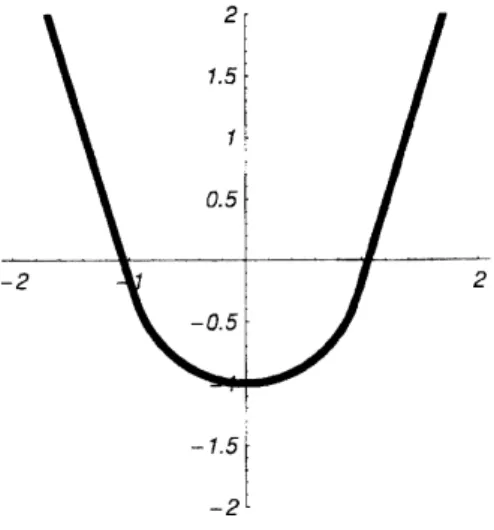
$Q(s)=\{$
$-\sqrt{a^{2}-s^{2}}$ $(|s|\leq|a|\cos\theta_{0})$,
$-|s| \tan(\theta_{0}-\pi/2)-\frac{|a|}{\sin\theta_{0}}$ $(|s|>|a|\cos\theta_{0})$
(see Fig. 2). Since $s^{2}+Q(s)^{2}=a^{2}$ on $[-|a|\cos\theta_{0}, |a|\cos\theta_{0}]$, the solution looks like an
arc after an appropriate rescaling.
Figure 2: The graph of$Q$ with the case where $a=1$ and $\theta_{0}=\pi/10$
Next consider the anisotropic case. Set
$\hat{C_{\tau_{3}}}(\theta):=a\{\Psi’(\theta)\cos(\theta-\pi/2)+\Psi(\theta)\sin(\theta-\pi/2)\}$.
By (H2), we see that $\hat{G}_{3}’(\theta)=a(\Psi^{\prime/}+\Psi)<0$. Thus we can define
$\Theta(s):=\hat{G}_{3}^{-1}(-s)$.
For the anisotropic case we can show that the limiting profile after the rescaling is
$\overline{Q}(s)$ $:=$ $\{$ $\mathrm{s}$$\tan(\theta_{-}-\pi/2)\neq\frac{a\Psi(\theta_{-})}{\cos(\theta_{-}-\pi/2)}$ for $s\leq-\hat{G}_{3}(\theta_{-})$, $-a\Psi’(\ominus(s))\sin(\ominus(s)-\pi/2)+a\Psi(\mathrm{O}-(s))\cos(\mathrm{O}-(s)-\pi/2)$ for $-\hat{G}_{3}(\theta_{-})<s<-\hat{G}_{3}(\theta_{+})$, $s$tarl$( \theta_{+}-\pi/2)+\frac{a\Psi(\theta_{\ovalbox{\tt\small REJECT}})}{\cos(\theta_{+}-\pi/2)}$
for $s\geq-\hat{G}_{3}(\theta_{[perp]})$.
(4.1)
We can check that $(s,\overline{Q}(s))$ is aportion ofa circle on the Finsler metric. This result is
References
[1] S. Angenent and M. E. Gurtin. Multiphase thermomechanics with intcrfacial
structure. II. Evolution of an isothermal interface. Arch. Rational Mech. Anal,,
108$(4):323$ 391, 1989.
[2] G. Bellettini and M. Paolini. Anisotropic motion by mean curvature irl the context
of Finsler geometry. Hokkaido Math. J., 25, 537-566, 1996.
[3] M. Benes, D. Hilhorst, and R. Weidenfeld. Anisotropic... to appear, 2004.
[4] X. Chen, Generation and propagation of interfaces for reaction-diffusion equations,
J.
Differential
Equations, 96, (1992) 116-141.[5] X. Chen, $\mathrm{E}\mathrm{x}\mathrm{i}\mathrm{s}\mathrm{t}\mathrm{e}\mathrm{n}\mathrm{c}\mathrm{e}_{j}$ uniqueness, and asymptotic stability of
traveling waves in
nonlocal evolution equations, Advances in
Differential
Equations. 2, (1997)125-160.
[6] M. G. Crandall, H. Ishii, and P.-L. Lions. User’s guide to viscosity solutions of
second order partial differential equations. Bull. Amer. Math. Soc. (N.S.), 27,
(1992) 1-67.
[7] K. Deckelnick, C. M. Elliott, and G. Richardson, Long time asymptotics for forced
curvature flow with applications to the motion ofa superconducting vortex,
Non-linearity 10 (1997),
655-678.
[8\rceil O. $\mathrm{L}\mathrm{e}\}^{r}$. Th\‘ese de doctorat. U\gamma \iota iversit\’e de Tours, 2001.
[9] M. E. Gurtin, Thermomechanics
of
evolvingphase boundaries in the plane, $()\mathrm{x}\mathrm{f}\mathrm{t}\supset \mathrm{r}\mathrm{d}$Science PubL, (1993).
[10] T. $\mathrm{A}4\mathrm{a}\mathrm{r}\mathrm{u}\mathrm{t}\mathrm{a}\mathrm{n}\mathrm{i}$, H. Ninomiya and $\mathrm{R}$
, Weidenfeld, Traveling curved fronts of
anisotropic mean curvature flows, in $pre,parati$on.
[11] H. Ninomiya and M. Taniguchi, Traveling curved fronts of a mean curvature flow
with constant driving force, in ”Free boundary problems: theory and $appl\dot{\iota}cation.s.$,
$I$’ GAKUTO Internal Ser. Math. Sci Appl 13 (2000), 206-221.
[12] H. Ninomiya and M. Taniguchi, Stability oftraveling curved fronts in a curvature
flow with driving force, Methods and Application
of
Analysis, 8 (2001), 429 450.[13] H. Ninomiya and M. Taniguchi, Existence and global stability $()\mathrm{f}$traveling (.urved
fronts in the Allen-Cahn equations, to appear in Journal
of
Differential
Equations.[14] H. Ninomiya and R. Weidenfeld, in preparation.
[15] J. E. Taylor and J. W. Cahn, Diffuseinterfaceswithsharp cornersand facets: Phase