108
CONSTRUCTION
OFDOUBLY-CONNECTED WANDERING
DOMAINS
MASASHI KISAKA (木坂 正史) AND MITSUHIRO SHISHIKURA(宍倉 光広)
ABSTRACT. We investigate the connectivity conn(D) of a wandering domain $D$ of a
transcendentalentirefunction$f$. Firstweshowthat conn$(f^{n}(D))$is constantfor large$n$
and itis either1,2oroo (Theorem$\mathrm{A}$). Nextweconstructanexample ofan$f$withdoubly
connected wandering domain (Theorem$\mathrm{B}$), which is the main resultofthis paper. For
this purposeweestablish a slightlydifferentversion of quasiconformalsurgery(Theorem
3.1).
.
Alsowe construct followingexamples bythe similar method:An entire function $f$ having a wandering domain $D$ withconn(D) $=p$for a given
$p\in \mathrm{N}$ (Theorem$\mathrm{C}$).
.
Anentire function $f$ having adoubly connectedwandering domain and all its sin-gular values are contained in preperiodic Fatou components (Theorem $\mathrm{D}$)..
An entirefunction $f$ such that the set $\overline{f(\mathrm{s}\mathrm{i}\mathrm{n}\mathrm{g}(f^{-1}))}$ is equal to the whole plane $\mathbb{C}$but$f$has a wandering domain, hence $J_{f}\neq \mathbb{C}$(Theorem $\mathrm{E}$).
.
Anentire function $f$ withinfinitely manygrand orbitsofwanderingdomains.Fur-thermore, this $f$ can be constructed sothat the Lebesguemeasure of the Julia set
$J_{f}$ is positive (Theorem $\mathrm{F}$).
1, INTRODUCTION
Let $f$ be
a
transcendental entire function and $f^{n}$ denote the n-th iterate of$f$. Recallthat the Fatou set$F_{f}$ and the Julia set $J_{f}$ of$f$
are
definedas
follows:$F_{f}$ $=$
{
$z\in \mathbb{C}|\{f^{n}\}_{n=1}^{\infty}$ is a normal family in a neighborhood of $z$},
$J_{f}$ $=$ $\mathbb{C}\backslash F_{f}$.
A connected component $D$ of$F_{f}$ is called
a
Fatou componentof
$f$. A Fatou component$D$ is called
a
wandering domain if $fm(D)\cap fm(D)=\emptyset$ for every $m$, $n\in \mathrm{N}(m\neq n)$. Ifthere exists
a
$p\in \mathrm{N}$ with $f^{p}(D)\underline{\subset}D$, then $D$ is called a periodic componentof
period$p$and it is either an attracting basin, a parabolic basin,
a
Siegel disk or a Baker domain. Inparticular, if$p=1$, $U$ is called an invariant component
Here we briefly explain the history of wandering domains. For more details,
see
[R],It
was
I. N. Baker who proved the existence ofwandering domains for the first time. In1963
heproved the following:Theorem 1.1 (Baker, 1963 [Bal, p.206 Statement (A), p.210 Theorem 1]). There is
an
entire
function
$g(z)$ given by the canonicalproduct$g(z)=Cz^{2} \prod_{n=1}^{\infty}(1+\frac{z}{r_{n}})$
such that $g(z)$ has at least one multiply connected Fatou component, where $C>0$ is $a$
constant and $r_{n}$ is
defined
bysome
recursiveformula
andsatisfies
$1<r_{1}<r_{2}<\cdots$.
1991 Mathematics Subject Classification, Primary $58\mathrm{F}23$; Secondary$30\mathrm{D}05$.
MASASHI KISAKA ($*\Re$ it) AND MITSUHIRO SHISHIKURA $( \frac{arrow}{\nearrow\backslash }\ovalbox{\tt\small REJECT}\grave{7}\mathrm{b}\Gamma \mathrm{A})$
Moreprecisely, let $A_{n}$ be the annulus
$A_{n}$ : $r_{n}^{2}<|z|<r_{n+1}^{\frac{1}{2}}$,
then there is
an
integer $N>0$ such thatfor
all $n>N$ the mapping $zarrow g(z)$ maps $A_{n}$into $A_{n+1}$ and $g^{n}(z)arrow$ oo uniformly in $A_{n}$. For each $n>N$, $A_{n}$ belongs to a multiply
connected component $G_{n}$
of
$F_{g}$.At this moment, he did not assert that the above Fatou component
was
a wanderingdomain, because there
was
a
possibility that $G_{n}$were
equal for any $n>N$ and hence itwas an invariant component. Thatis, it might be
a
Bakerdomain, onwhich, by definition,every point goes to oo under the iterate of$g$. But about ten years later, he proved the
following result.
Theorem 1.2 (Baker,
1976
(Received 1 November 1974) [Ba2, p.174, Theorem]). For$n>N$
the components $G_{n}$of
$F_{g}$ described above are alldifferent
and each is awan-dering domain
of
$g$.More generally he proved
Theorem 1.3 (Baker,
1975
(Received26
May 1975) [Ba3, p.278, Theorem 1]).if
$f$ istranscendentaland entire, then$F_{f}$ has
no
unboundedmultiply connected component. Thatis, any unbounded Fatou component is simply connected
Thus the first example of a wandering domain
was
multiply connected, On the otherhand, the example of simply connected wandering domains are known by M. Herman
(see [Ba4, p.567, Example 5.1]). In this paper
we
consider the connectivity ofa
Fatoucomponent, which is defined
as
follows:Definition. For adomain D of$\mathbb{C}$, the connectivity conn(D) is defined to be thenumber
ofconnectedcomponents of$\hat{\mathbb{C}}\backslash D$, which may be $\infty$.
Note that conn(D) $=1$ if and only if$D$ issimply connected, andconn(D) $=2$ ifand only
if$D$ is doublyconnected and conformally equivalent to
a
round annulus$\{z|0 \leq r_{1}<|z|<r_{2}\leq\infty\}$.
By density of periodic points in the Juliaset and Theorem 1.3, it is easily shown that if
a Fatou component $D$ is multiply connected, then it must be
a
wandering domain and$f^{n}|_{D}arrow\infty$ $(narrow\infty)$. In 1985, Baker constructed an example of a
transcendental
entirefunction $g$ with a wandering domain $D$ of infinite connectivity.
Theorem 1.4 (Baker,
1985
[Ba5, p.164, Theorem 2]). There is an entirefunction
$g(z)$given by the canonicalproduct
$g(z)=C^{2} \prod_{j=1}^{\infty}(1+\frac{z}{r_{j}})^{2}$, $1<r_{1}<r_{2}<\cdots$ , $C>0$
such that $g(z)$ has
a
wandering domain withinfinite
connectivity.So thefollowing is a natural question to ask;
Question: Is there
a
wandering domain D with finite connectivity,or
more
precisely,CONSTRUCTION OF DOUBLY-CONNECTED WANDERING DOMAINS
This question
was
raised byBaker in [Ba5] and is also explicitlystatedas
“Question 7” in[Ber, p.167]. Main purpose of thispaperisto constructsuchanexample. Incidentally, the
connectivity of the wandering domaindiscussed in Theorem 1.1 and 1.2 isstill unknown.
In this paper
we
first show the following:Theorem $\mathrm{A}$, For a wandering domain $D$
of
a transcendental entirefunction
$f$, thecon-nectivity $\mathrm{c}\mathrm{o}\mathrm{n}\mathrm{n}(f^{n}(D))$ is constant
for
large $n$ and it is either 1, 2or
$\infty$.If
it is 1, thenconn(D ) $=1$.
if
it is 2, then $f$:
$f^{n}(D)arrow f^{n+1}(D)$ is a coveringof
annulifor
everysufficiently large$n$.
According to this theorem,
we
make the following:Definition. We define the eventual connectivity of
a
wandering domain $D$ to beca $\mathrm{n}(f^{n}(D))$ for sufficiently large $n$.
Main result ofthis paper is
as
follows:Theorem B. There exists a transcendental entire
function
$f$ with a wandering domain$D$ such that $f^{n}(D)$
are
doubly connectedfor
all$n\geq 0$, $\mathrm{i}.e$. the eventual connectivityof
$D$is 2. Moreover $f$ has no asymptotic values and all critical values are mapped to 0 which
is a repelling
fixed
pointTheorem$\mathrm{B}$givesanegative
answer
tothefollowing open problem raisedbyW. Bergweiler.Problem (Bergweiler, 1994 [YWLC,p.354]): Let $f$be
an
entiretranscendentalfunction.Suppose that $f^{n}|_{U}arrow$ oo
as
$narrow$ oo forsome
connected component $U$ ofthe Fatou set of$f$. Does there exist ( $\in$ sing$(f^{-1})$ such that $f^{n}(\zeta)arrow\infty$? If not, does there exist at least
$\zeta\in \mathrm{s}\mathrm{i}\mathrm{n}\mathrm{g}(f^{-1})$ such that $f^{n}(\zeta)$ is unbounded7
Main techniqueto construct this kindof examplesis the quasiconformalsurgery. By using
the
same
technique and some additional arguments,we can
also show the following:Theorem C. For every p$\in \mathrm{N}$ withp $\geq 3$ there exists a transcendental entire
function
$f$with a wandering domain D with conn(D) $=p$ and ca $\mathrm{n}(f^{n}(D))=2$
for
every n $\geq 1$.Theorem D. There exists a transcendental entire
function
$f$ with a wandering domain$D$ such that the eventual connectivity
of
$D$ is 2. Moreover $f$ has no asymptotic valuesand all critical values are mapped to
0
which is an attractingfixed
pointTheorem E. There exists
a
transcendentalentirefunction f
such thattheset$f(\mathrm{s}\mathrm{i}\mathrm{n}\mathrm{g}(f^{-1}))$is equal to the whole plane $\mathbb{C}$ but
f
has a wandering domain, hence $J_{f}\neq \mathbb{C}$.Theorem F. There exists
a
transcendental entirefunction
$f$ with infinitely many grandorbits
of
doubly connected wandering domains. That is, there exist doubly connectedwart-dering domains$D_{i}(\mathrm{i}\in \mathrm{N})$ suchthat
if
$\mathrm{i}\neq j$, then$f^{m}(D_{i})\cap f^{n}(D_{j})$ $=\emptyset$for
any$m$, $n\in$ N.Furthermore, this$f$ can be constructedso that the Lebesgue
measure
of
the Julia set $J_{f}$ ispositive.
Theorem $\mathrm{D}$
answers
the followingquestion also by W. Bergweiler:
Question (”Question 10” in [Ber, p.170]):
Can a
meromorphicfunction$f$havewanderingdomains if all (or all but finitely many) points ofsing$(f^{-1})$
are
contained in preperiodicMASASHI KISAKA ($i[\Re$ JEft) AND MITSUHIRO SHISHIKUEA $( \frac{\wedge}{f\backslash }\ovalbox{\tt\small REJECT}\#^{\backslash }\Gamma \mathrm{A})$
Incidentally, Baker constructed
an
example of anentire function with infinitelymanygrand orbits of simply connected wandering domains in [Ba4, p.567, Theorem 5.2]. Also
Baker, KotusandLiiconsideredthe similar problem of existence of multiplyconnected
Fa-toucomponentsfor transcendentalmeromorphicfunctions withat least
one
pole ([BKLI],[BKL2] ).
Jn
\S 2,
we
prove TheoremA and\S 3
is devotedto the explanation of the quasiconformalsurgery, which is
a
main tool for the proofof the main Theorem B. We give a proof ofTheorem $\mathrm{B}$ in
\S 4.
2. Proof OF THEOREM $\mathrm{A}$
We need
some
lemmas.Lemma 2.1 (Baker,
1984
[Ba4, p.565, Theorem 3.1]). Let $D$ be a multiply connectedwandering domain
of
an entirefunction
$f$ ancl $\gamma\subset D$ is a nontrivial curve in D. Then$f^{n}arrow$ op $(narrow\infty)$ in $D$ and
for
every sufficiently large $n$ the winding numberof
$f^{n}(\gamma)$with respect to the origin is positive.
Lemma 2.2 (cf. Baker, 1984 [Ba4, p.565, Corollary]).
If f
has an asymptotic value,then every Fatou component
of
$F_{f}$ is simply connected.Proof of
Theorem A. By Lemma 2.1 and Lemma 2.2, we mayassume
that $f$ has noas-ymptotic values and $D$ is bounded. Then $f$ : $Darrow f(D)$ is
a
branched covering. Ifconn(D) $=\infty$, then
conn
$(f^{n}(D))=\infty$for every$n\in$ N. Sowe assume
that conn(D ) $<\infty$.
By Riemann-Hurwitz Theorem,
we
have2- conn(D) $=(\deg f|_{D})$($2$ -conn(D) (D))$)$ $-\#$
{critical
points in $D$}.
(2.1)Then it easily follows that conn(D) $\geq$
conn
$(f(D))$ and henceconn
$(f^{n}(D))$ is constant forlarge $n$. Let
us
denote it by$p$.
Suppose that $3\leq p<\infty$, then by replacing $D$ with $f^{n}(D)$in (2.1) it follows that $\deg f|_{f^{n}(D)}=1$ and hence $f$ : $f^{n}(D)arrow f^{n+1}(D)$ is conformal
By the Argument Principle, $f$ is also 1 to 1 on the bounded components of $\mathbb{C}\backslash f^{n}(D)$
.
Then from Lemma 2.1, $f$ must be 1 to 1 on whole $\mathbb{C}$, which is a contradiction, since$f$ is
transcendental. Therefore if$p$ is finite, then$p=1$
or
2. If$p=1$, then it is easy tosee
that conn(D) $=1$
.
If$p=2$, then from (2.1)we
have $\#${critical
points in $f^{n}(D)$}
$=0$ andhence the result follows. $\square$
3.
SURGERY AND CONFORMAL STRUCTUREIn this section,
we
recall the definition of quasiconformal map and explain thequasi-conformal surgery (Theorem 3.1).
Definition 3.1.
An
orientation preserving homeomorphism $\varphi$ : $Darrow D’$ between two domains $D$ and $D’$ is called aquasiconformal
map if it is absolutely continuous on lineson any rectangle $R=\{z=x+iy|a\leq x\leq b, c\leq y\leq d\}\subset D$, that is,
(i) $\varphi(x+\mathrm{i}y)$ is absolutely continuousas afunction of$x\subset-[a, b]$ for almost every$y$, and
$\varphi(x+\mathrm{i}y)$ is absolutely continuous
as a
function of$y\in[c, d]$ for almost every $x$CONSTRUCTION OFDOUBLY-CONNECTED WANDERING DOMAINS
(ii) $|\mu_{\varphi}(z)|\leq k$ $<1$ $\mathrm{a}.\mathrm{e}$. $z\in D$,
where $\mu_{\varphi}=\varphi_{\overline{z}}/\varphi_{z}$ and $k$ is
some
constant with $0\leq k<1$. If$k=0$, then$\varphi$ is conformal.If$k\neq 0$,
we
set $K=(1+k)/(1-k)$ and call$\varphi$ a$K$-quasiconformal(K-qcforshort) map.The constant
$K_{\varphi}= \inf$
{
$K|\varphi$ isK-qc}
is called the maximal dilatation
of
$\varphi$. A map 9 : $Darrow D’$ is calleda
$K$-quasiregular mapif$g$
can
be written as $g=f\circ\varphi$with a$K$-quasiconformal map $\varphi$ andan
analyticmap $f$.For properties ofquasiconformal maps,
see
[A1].In order toconstruct anentire function with doubly-connected wanderingdomains,
we
first construct a quasiregular map $g$ with the similar properties
as
whatwe
really wantto construct by gluing suitable polynomials together by using interpolation. Then
we
choose a suitable quasiconformal map $\varphi$
so
that $\varphi\circ g\circ\varphi^{-1}$ isa
desired entire function.We call this procedure the quasiconformal surgery. More precisely,
we can
formulate thisprocedure
as
follows, which is slightly different from theone
discussed in [Sh]:Theorem 3.1 (quasiconformal surgery). Let$g$ be a quasiregular mapping
from
$\mathbb{C}$ to C.
Suppose that there are (disjoint) measurable sets$E{}_{j}\mathrm{C}\mathbb{C}(j=1, 2, \ldots)$ satisfying:
(i) For almost every $z\in \mathbb{C}$, the
$g$-orbit
of
$z$ passes $E_{j}$ at mostonce
for
every$j$;(ii) $g$ is $K_{j^{-}}$quasiregular on$E_{j}$;
(iii) $K_{\infty}= \prod_{j=1}^{\infty}K_{j}<\infty$;
(iv) $g$ is holomorphic $a.e$. outside $\bigcup_{\mathrm{j}=1}^{\infty}E_{j}$ ($\mathrm{i}.e$. $\frac{\partial g}{\partial\overline{z}}=0a$.$e$. on $\mathbb{C}\backslash \bigcup_{j=1}^{\infty}Ej$).
Then there exists a $K_{\infty}$-quasiconformal mop
$\varphi$ such that $f=\varphi\circ g\circ\varphi^{-1}$ is
an
entirefunction.
Proof.
A measurableconform
$al$structureis the measurable conformalequivalence of mea-surable Riemannian metrics, andcan
be represented by the metric of the form$ds=|dz+\mu(z)d\overline{z}|$,
where $\mu(z)$ is a $\mathbb{C}$-valued measurable functionwith
$|| \mu||_{\infty}=\mathrm{e}\mathrm{s}\mathrm{s}.\sup|\mu(z)|<1$.
The distance between two measurable conformal structures a$=[|dz+\mu(z)d\overline{z}|]$ and $\sigma’=$
$[|dz+\mu’(z)d\overline{z}|]$ is definedby
$d( \sigma, \sigma’)=\mathrm{e}\mathrm{s}\mathrm{s}.\sup d_{\mathrm{D}}(\mu(z), \mu’(z))$,
where $d_{\mathrm{D}}$ denotes the Poincare distance
on
the unit disk D. A quasiregular map definesthepull-back $g^{*}(\sigma)$ of the measurable conformalstructure $\sigma$, and the pull-backpreserves
the above distance. Let $\sigma_{0}=[|dz|]$ denote the standard conformal structure. If $g$ is
$K$-quasiregular, then we have $d(g^{*}(\sigma_{0}), \sigma_{0})\leq\log K$.
Now define the conformal structures
$\sigma_{n}(z)=(g^{n})^{*}(\sigma_{0}(g^{n}(z)))$,
which
are
defined almost everywhere. The pointwise distance (when defined) satisfies113
MASASHI KISAKA ($*\ovalbox{\tt\small REJECT}$ it) AND MITSUHIRO SHISHIKURA ($\frac{\mathrm{r}}{/\backslash }\Leftrightarrow\Leftrightarrow$ At)
if$g^{n}(z)$ is in
some
$E_{m}$ and it is0
otherwise.By the hypotheses (i) and (iii), $\{\sigma_{n}(z)\}_{n=0}^{\infty}$ isdefined and
a
Cauchysequenceforalmostall $z$
.
Therefore the pointwise limit $\sigma(z)=\lim_{narrow\infty}\sigma_{n}(z)$ exists $\mathrm{a}.\mathrm{e}$. and satisfies$d( \sigma, \sigma_{0})\leq\sum_{j=1}^{\infty}\log K_{j}=\log K_{\varpi}$.
Then a
can
be writtenas
$\sigma(z)=[|dz+\mu(z)d\overline{z}|]$ with
$| \mu(z)|\leq\frac{K_{\infty}-1}{K_{\infty}+1}$ $\mathrm{a}.\mathrm{e}$.
ByMeasurable Riemann Mapping Theorem ([Al, p.98, Theorem 3]), there exists a $K_{\infty}-$
quasiconformal mapping $\varphi$ :
$\mathbb{C}arrow \mathbb{C}$such that $\frac{\partial\varphi}{\partial\overline{z}}/\frac{\partial\varphi}{\partial z}=\mu(z)\mathrm{a}.\mathrm{e}.$, inother words $\varphi^{*}(\sigma_{0})=$ $\sigma$. Then $f=\varphi\circ g\circ\varphi^{-1}$ is quasiregular andsatisfies $f^{*}(\sigma_{0})=\sigma_{0}$
.
This implies that $f$ islocally conformal except at critical points, hence it is analytic. $\square$
Remark. Theorem
3.1
also follows from the idea by Sullivan ([Su, p.750, Theorem 9]).4. CONSTRUCTION ($\mathrm{p}_{\mathrm{R}\mathrm{O}\mathrm{O}\mathrm{F}}$ OF THEOREM B)
Part I : Construction of
a
model map $f_{0}$.
Definition 4.1. For
a
closed concentric annulus $A$with center 0, weuse
a notation$A=A(r_{1}, r_{2})=\{z|r_{1}\leq|z|\leq r_{2}\}$, $(0<r_{1}<r_{2})$
and
$\partial_{\mathrm{i}\mathrm{n}\mathrm{n}\mathrm{e}\mathrm{r}}A=\{z||z|=r_{1}\}$, $\partial_{\mathrm{o}\mathrm{u}\mathrm{t}\mathrm{e}\mathrm{r}}A=\{z||z|=r_{2}\}$,
which denote the inner boundary and the otiier boundary of $A$, respectively. We define
the modulus of$A$ by
mod (A) $= \frac{1}{2\pi}\log\frac{r_{2}}{r_{1}}$.
The core
curve
Core(A) is the unique closed geodesic of$A$ and given byCore(A) $=\{z||z|=\sqrt{r_{1}r_{2}}\}$.
Wefirst
construct
a model map $f_{0}$ which roughly describes the dynamics ofwhatwe
reallywant to
construct.
Let $k_{n}\in \mathrm{N}$be given integers with $k_{0}\leq k_{1}\leq\cdots\leq k_{n}\leq\cdots$.
Inwhat follows
we
choose suitable $R_{n}\in \mathbb{R}$ with $0=R_{0}<R_{1}<R_{2}<\cdots$ and set$A_{n}=A(R_{n}, R_{n+1})$ $(n\geq 0)$.
(Note that here
we
abuse the notation$-A_{0}$ isa
disk, notan
annulus). Thenwe
wanttoconstruct a
map $f_{0}$ : $\mathbb{C}arrow \mathbb{C}$ with the following dynamical properties:Zo(z) $=a_{0}z^{k_{0}}$, $z\in A_{0}\backslash \partial_{\mathrm{o}\mathrm{u}\mathrm{t}\mathrm{e}\mathrm{r}}A_{0}$
such that $f_{0}(A_{0})=A_{0}\cup A_{1}$ and
CONSTRUCTION OF DOUBLY-CONNECTED WANDERING DOMAINS
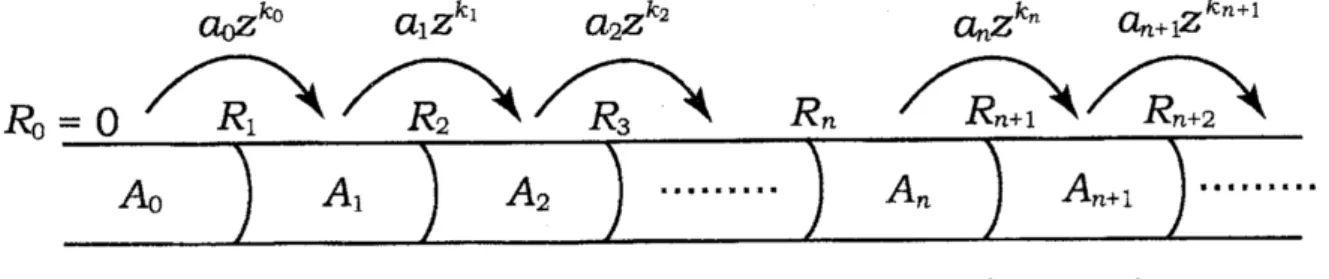
$a_{0}z^{k_{0}}$ $a_{1}z^{k_{1}}$ $a_{2}\mathrm{z}^{k_{2}}$ $a_{n}z^{k_{n}}$ $a_{n+1}z^{kn+1}$
$R_{0}$
FIGURE 1. The model map $f_{0}$. Note that this is only a schematic picture
and in reality, mod$(A_{n})$ rapidly increases
as
$n$ tends to00.
Thesame
isalso true for the following figures,
suchthat$f_{0}$ : $A_{n}arrow A_{n+1}$ is acoveringmap ofdegree $k_{n}$. (SeeFigure 1, where
we
describethe annuli $A_{n}$ as subsets of an infinite cylinder, instead of round annuli in the complex
plane.)
For this purpose, we have to choose appropriate $a_{n}\in \mathbb{C}^{*}$ and $R_{n}>0$. So first
we
take$a_{0}$ and $R_{1}$
so
that $R_{2}=|a_{0}|R_{1}^{k_{0}}>R_{1}$ holds and $M_{1}=\exp$($2\pi$mod$(A_{1})$) is large enough
to be able to apply Proposition 4.1 inthe next part. (Actually
we
have to choose so thatmod$(A_{1})>m_{0}$, where $m_{0}$ is theconstant in Proposition 4.1.) Once the constants $a_{0}$, $R_{1}$
and $k_{n}$ $(n \in \mathrm{N})$ are chosen, thenthe constants $a_{n}\in$ C’ $(n\geq 1)$ and $R_{n}>0(n\geq 2)$ are
determined inductively as follows: Define $M_{n}>0$ by
$M_{1}=\exp(2\pi \mathrm{m}\mathrm{o}\mathrm{d} (A_{1}))$, $M_{n+1}=M_{n^{n}}^{k}/(n\geq 1)$
and set
$R_{n+1}=M_{n}R_{n}(n\geq 1)$.
Also take $a_{n}\in \mathbb{C}^{*}$ with the condition
$R_{n+1}=|a_{n}|R_{n}^{k_{n}}$.
Notethat only $|a_{n}|$ is determined bythe condition above and
we can
choose $\arg a_{n}$ freely.Then it is easy to
see
that$\lim_{|z\nearrow R_{n}}|f_{0}(z)|=\lim_{|z|[searrow] R_{n}}|f_{0}(z)|$,
because
$|f_{0}(z)|=|a_{n-1}z^{k_{n-1}}|arrow|a_{n-1}|R_{n}^{k_{n-1}}$ $(|z|\nearrow R_{n})$
and
$|a_{n-1}|R_{n^{n-1}}^{k}=|a_{n-1}|R_{n-1}^{k_{n-1}}M_{n-1}^{k_{n-1}}=R_{n}M_{n}=R_{n+1}$,
on
the other handwe
have$|f_{0}(z)|=|a_{n}z^{k_{n}}|arrow|a_{n}|R_{n^{n}}^{k}=R_{n\cdot\vdash 1}$ $(|z|[searrow] R_{n})$.
Hence $f_{0}$ itself is discontinuous
on
$|z|=R_{n}$ but the map $|f_{0}|$ : $\mathbb{C}arrow \mathbb{R}$ is continuous.According to Lemma 2.1, in general, $f^{n}$ goes to oo
on
a
multiply connected wanderingdomain $D$ and $f^{n}(D)$ is mapped to
an
“outer” region by$f$. Soour
$f_{0}$ indeed satisfiesthissituation.
Part II : Construction of
a
quasiregular map $f_{1}$ from the model map $f_{0}$.
Now
we
modifythe map $f_{0}$ to constructa
new
quasiregular map $f_{1}$ and then performMASASHI KISAKA $(*\Re \mathrm{i}\mathrm{E}\mathfrak{B})$ AND MITSUHIRO SHISHIKURA $(_{\backslash }^{\wedge},’\ovalbox{\tt\small REJECT}\Leftrightarrow;^{\backslash }*\ulcorner \mathrm{A})$
each $n$
we
replace $f_{0}$ withsome
different polynomialaroundsome
annulus containing thecircle $|z|=R_{n}$ and gluethis polynomial and the original map$f_{0}$together by interpolation.
More precisely
we
prepare the following proposition.Proposition 4.1. (1) $Lei$$A$, $A’$ and$\hat{A},\hat{A}’$ be two pairs
of
concentric round annuli withcenter
0
which satisfy$\partial_{\mathrm{o}\mathrm{u}\mathrm{t}\mathrm{e}\mathrm{r}}A=\partial_{\mathrm{i}\mathrm{n}\mathrm{n}\mathrm{e}\mathrm{r}}A’=\{z||z|=R\}$,
$\partial_{\mathrm{o}\mathrm{u}\mathrm{t}\mathrm{e}\mathrm{r}}\hat{A}=\partial_{\mathrm{i}\mathrm{n}\mathrm{n}\mathrm{e}\mathrm{r}}\hat{A}’=\{z||z|=\hat{R}\}$,
and
$\mathrm{m}\mathrm{o}\mathrm{d} (\hat{A})=k\cdot$ $\mathrm{m}\mathrm{o}\mathrm{d} (A)$, $\mathrm{m}\mathrm{o}\mathrm{d} (\hat{A}’)=(k+1)\cdot$ $\mathrm{m}\mathrm{o}\mathrm{d} (A’)$.
Let$F_{A}$ : $Aarrow\hat{A}$, $F_{A}(z)=c_{A}z^{k},$ $(k\geq 2)$ be a covering map
of
degree$k$ which maps$A$ ontoA. Similarly let $F_{A’}$ : $A’arrow\hat{A}’$, $F_{A’}(z)=c_{A’}z^{k+1}$, $(k\geq 2)$ be a covering map
of
degree$k+1$ which maps $A’$ onto $\hat{A}’$
.
For the annulus $A$, take annuli $B^{\mathfrak{g}}(A)$, $E\#(A)$, $E^{\mathrm{b}}(A)$ and $B^{\mathrm{b}}(A)$ as in Figure 2 such thatmod$(B^{8}(A))=$ mod$(E^{\mathfrak{g}}(A))=$ mod$(E^{\mathrm{b}}(A))=$ mod$(B^{\mathrm{b}}(A))=\sqrt{\mathrm{m}\mathrm{o}\mathrm{d} (A)}$ (4.1)
and
define
$A^{-}=A\backslash (B^{\beta}(A)\cup E^{\mathfrak{p}}(A)\cup E^{\mathrm{b}}(A)\cup B^{\mathrm{b}}(A))$.
Take similar annuli
for
each $A’,\hat{A}$ and $\hat{A}^{J}$.Then there exists a constant $m_{0}>0$ such
that
if
mod$(A)>m_{0}$ and mod$(A’)>m_{0}$, then there exists a quasiregular map$g$ : $A^{-}\cup E^{\mathrm{b}}(A)\cup B^{\mathrm{b}}(A)\cup B^{\mathfrak{g}}(A’)\cup E\#(A’)\cup A^{\prime-}arrow \mathbb{C}$
which
satisfies
the following conditions (I) $\sim(\mathrm{I}\mathrm{I}\mathrm{I})$:(I-a) $g=F_{A}$ on $A^{-}$ and$g=F_{A’}$
on
$A^{\prime-}$(1-a) $g$ is holomorphic
on
int $B=$ int(B $\mathrm{b}(A)$ $\cup B\#(A’)$) with a unique critical point$\zeta\in B^{\mathrm{b}}(A)$. Also $g$
satisfies
$g(()=\hat{R}$ and$g(R)=0$.(I-c) $g$ is $K$ quasiregular oniut $E=\mathrm{i}\mathrm{n}\mathrm{t}(E^{\mathrm{b}}(A)\cup E\#(A’))$ and the maximal dilatation
$K_{g}$
satisfies
$K=K_{g}$ $\leq$ $\max$
(
$1+ \frac{2}{\sqrt{k\cdot \mathrm{m}\mathrm{o}\mathrm{d} (A)}}$, $1+ \frac{2}{\sqrt{(k+1)\cdot \mathrm{m}\mathrm{o}\mathrm{d} (A’)}}$)
(4.2)$=$ $\max$
(
$1+ \frac{2}{\sqrt{\mathrm{m}\mathrm{o}\mathrm{d} (\hat{A})}}$, $1+ \frac{2}{\sqrt{\mathrm{m}\mathrm{o}\mathrm{d} (\hat{A}’)}}$
).
(I-a) $g$
Core
$(A^{-}))$ $=$ Core$(\hat{A}^{-})$. Similarly, $g$ Core$(A^{\prime-}))$ $=$ Core$(\hat{A}^{\prime-})$.
(Il-b) $g(A^{-})$ $\subset\hat{A}^{-}$ and this inclusion is
essential
That is, $g(A^{-})$ is an annulusin $\hat{A}^{-}$ anci
its
core curve
is not 0-homotopic in $\hat{A}^{-}$ Similarly, $g(A^{\prime-})\subset\hat{A}^{\prime-}$essentially.
(III-a) $g(E\#(A’))\subset E\#(\hat{A}’)\cup\hat{A}^{\prime-}$ essentially.
(III-b) $g(E^{\mathrm{b}}(A))$ $\subset A^{-}\cup E^{\mathrm{b}}(\hat{A})$ essentially.
(2) In the
case
of
$k=1$, thesame
conclusion holdsif
we replace the condition (4.1)for
the annulus $A$ with
mod$(E^{\mathrm{b}}(A))=\mathrm{m}\mathrm{o}\mathrm{d} (B^{\mathrm{b}}(A))=\mathrm{m}\mathrm{o}\mathrm{d}$$(B^{\#}(A))=\mathrm{m}\mathrm{o}\mathrm{d} (E^{\#}(A))=2\sqrt{\mathrm{m}\mathrm{o}\mathrm{d} (A)}$. (4.3)
(Note that we need not change the conditions (4.1)
for
the annuli$A’$)
CONSTRUCTION OF DOUBLY-CONNECTED WANDERING DOMAINS
FIGURE 2. Interpolation between the two maps $F_{A}$ and $F_{A’}$
.
We glue thesetwo maps together in
a
neighborhood ofthe circle $\{z||z|=R\}$.Remark. Note that $g(B)$
covers
not onlya
neighborhood of $\{|z|=\hat{R}\}$ but also both$\hat{A}$and the bounded component of$\mathbb{C}\backslash \hat{A}$.
Now
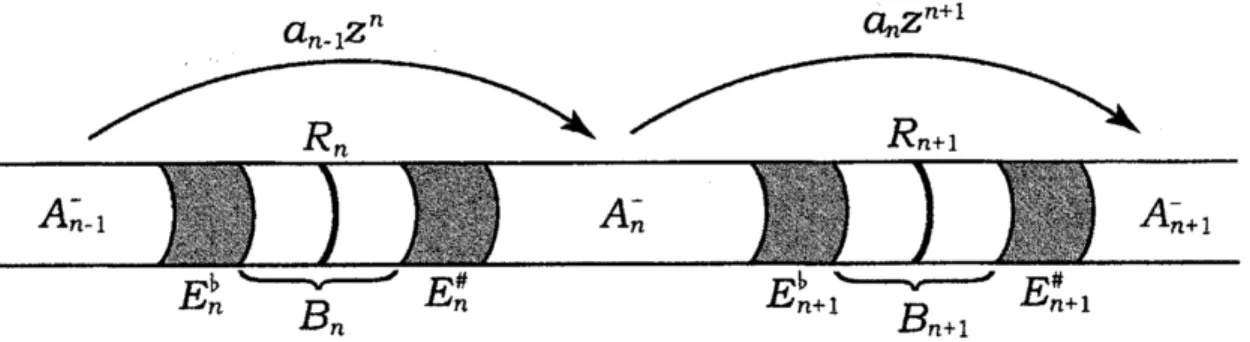
we
apply Proposition 4.1 (1) to eachpair of annuli $(A, A’)=(A_{n-1}, A_{n})$and maps$F_{A}(z)=a_{n-1}z^{n}$, $\mathrm{F}\mathrm{A}(\mathrm{z})=a_{n}z^{n+1}(n=2,3, \cdots)$ to obtain a
new
map $g(z)=g_{n}(z)$. Inthis case, of course, $\hat{A}=A_{n}$ and $\hat{A}’=A_{n+1}$. We
use
the following notations:$B_{n}^{8}=B^{\mathfrak{g}}(A_{n})$, $E^{\oint_{n}}=E^{\beta}(A_{n})$, $E_{n+1}^{\mathrm{b}}=E^{\mathrm{b}}(A_{n})$, $B_{n+1}^{\mathrm{b}}=B^{\mathrm{b}}(A_{n})$.
Also
we
define$B_{n}=B_{n}^{\mathfrak{d}}\cup B_{n}\#=B^{\mathrm{b}}(A_{n-1})\cup B^{\#}(A_{n})$.
SeeFigure
3.
Note thatthese notationsare
somehowdifferent fromwhat we havedefinedin Proposition 4.1. Here
we use
“$\#$” and $” \mathrm{b}$” with respect to the circle
$\{z||z|=R_{n}\}$ so,
for example, the annuli $E_{n}^{\mathrm{b}}$, $B_{n}$ and $E_{n}\#$
are
located in this order as in Figure3.
For $n=1$,
we
consider the pair $(A_{0}^{0}, A_{1})$ rather than $(A_{0}, A_{1})$. More precisely,we
take$A_{0}^{0}$ to be a preimage of$A_{1}$ by the map $a_{0}z$. Then
we
have mod$(A_{0}^{\phi})=$ mod$(A_{1})$. Definesubannuli $B\#$, $E^{\oint_{0}}$,
$A_{0}^{-}$, $E_{1}^{\mathrm{b}}$ and $B_{1}^{\mathrm{b}}$ such that
$A_{0}^{\theta}=B_{0}^{\#}\cup E_{0}^{\#}\cup A_{0}^{-}\cup E_{1}^{\mathrm{b}}\cup B_{1}^{\mathrm{b}}$,
mod$(E_{1}^{\mathrm{b}})=$ mod$(B_{1}^{\mathrm{b}})=$ mod$(B^{\oint_{0}})=$mod$(E_{0}^{\#})=2\sqrt{\mathrm{m}\mathrm{o}\mathrm{d} (A_{0}^{0})}(=2\sqrt{\mathrm{m}\mathrm{o}\mathrm{d} (A_{1}}))$.
Then we apply Proposition 4.1 (2) instead of (1) to the pair $(A_{0}^{0}, A_{1})$ to construct $g_{1}(z)$.
Erom the condition (I-b), itfollowsthatthecritical point $\zeta_{n}$of
$g_{n}$satisfies$g_{n}(\zeta_{n})=R_{n+1}$
and $g_{n+1}(R_{n+1})=0$. Also $g_{n}$ satisfies
an
estimateon
its maximal dilatation which isobtainedfrom (4.2) in Proposition
4.1. Since
we
take $a_{0}$so
that $R_{2}=|a_{0}|R_{1}>R_{1}$, $z=0$MASASHI KISAKA $(*\Re \mathrm{i}\mathrm{E}\mathfrak{B})$ AND MITSUHIRO SHISHIKURA ($\frac{m}{\prime\backslash }\ovalbox{\tt\small REJECT}$aerA)
FIGURE
3.
Construction of$f_{1}$ from $f_{0}$ by interpolation.Then define
a new
map $f_{1}$ by$f_{1}(z)=\{$
$f_{0}(z)$ $z\in A_{0}\backslash (E_{1}^{\mathrm{b}}\cup B_{1}^{\mathrm{b}})$
$f_{0}(z)$ $z\in A_{n}^{-}$ $n=1$,2,$\cdots$
$gn(z)$ $z\in E_{n}^{\mathrm{b}}\cup B_{n}\cup E_{n}\#$ $n=1,2$,$\cdots$
Part III : Application of the quasiconformal surgery to $f_{1}$
.
The
new
map $f_{1}$ is a quasiregular map with the desired dynamical properties. Hencewe
can apply the quasiconformalsurgery (Theorem 3.1) to obtain a transcendental entirefunction $f$ with the desired properties. More precisely, the following holds:
Proposition
4.2.
Thenew
map $f_{1}$satisfies
thefollowing conditions (I) $\sim(\mathrm{I}\mathrm{V})$:(I-a) $f_{1}(z)=a_{n}z^{n+1}$ on$A_{n}^{-}$.
(I-b) $f_{1}$ is holomorphic on $B_{n}$.
(I-c) $f_{1}$ is $K_{n}$-quasiregular
on
$E_{n}=E_{n}^{\mathrm{b}}\cup E_{n}\#$ with $K_{n} \leq 1+\frac{2}{\sqrt{n!\cdot \mathrm{m}\mathrm{o}\mathrm{d} (A_{1})}}$.(I-d) $f_{1}$ has a critical point $\zeta_{n}\in B_{n}^{\mathrm{b}}$ uthich
satisfies
$f_{1}(\zeta_{n})$ $=R_{n+1}$ and $f_{1}^{2}(\zeta_{n})=0$$(n=1, 2, \cdots)$
.
$\{\zeta_{n}\}_{n=1}^{\infty}$ is the setof
all criticalpointsof
$f_{1}$.(I-a) $f_{1}$(Core$(A_{n}^{-})$) $=\mathrm{C}\mathrm{o}\mathrm{r}\mathrm{e}(A_{n+1}^{-})$.
(II-b) $f_{1}(A_{n}^{-})\subset A_{n+1}^{-}$ and this inclusion is essential
(III-a) $f_{1}(E_{n}\#)\subset E^{\oint_{n}}+1\cup A_{n+1}^{-}$ essentially.
(II-b) $f_{1}(E_{n}^{\mathrm{b}})\subset A_{n}^{-}\cup E_{n+1}^{\mathrm{b}}$ essentially.
(IV) $f_{1}(B_{n}) \subset\bigcup_{j=0}^{n+1}A_{j}$.
Hence there exists
a
quasiconformalmapping $\varphi$ such that$f=\varphi\circ f_{1}\circ\varphi^{-1}$ is holomorphic
and entire.
Proof
All theconditions (I) $\sim$ (III)are
obtainedby applying Proposition 41 to each pairofannuli $(A, A’)=(A_{n-1}, A_{n})$ and maps$F_{A}(z)=a_{n-1}z^{n}$, $F_{A’}(z)=a_{n}z^{n+1}(n=1, 2, \cdots)$.
Notethat
CONSTRUCTION OF DOUBLY-CONNECTED WANDERING DOMAINS
Condition (IV) holds from the construction. Then (Il-b), (Ill-a) and (III-b) show that
for any $z\in \mathbb{C}$ the $f_{1}$-orbit of $z$ passes $E_{n}$ at most
once
for every $n$. Also from (I-c), $f_{1}$ is$K_{n}$-quasiregular on $E_{n}$ with
$K_{\infty}= \prod_{n=1}^{\infty}K_{n}\leq\prod_{n=1}^{\infty}(1+\frac{2}{\sqrt{n!\cdot \mathrm{m}\mathrm{o}\mathrm{d} (A_{1})}})<\infty$ .
Finally $f_{1}$ is holomorphic outside $\bigcup_{n=1}^{\infty}E_{n}$ by (Iv) and (i-b). Therefore
we can
applyTheorem3.1 to the map $f_{1}$ and hence there exists a $K_{\infty}$-quasiconformal map $\varphi$ suchthat
$f=\varphi\circ g\circ\varphi^{-1}$ is a transcendental entire function. $\square$
Part IV : The map
f
has the desired properties.Let $\overline{A}_{n}=\varphi(A_{n}),\tilde{B}_{n}=\varphi(B_{n})$, $\cdots$ etc. Then $f$ satisfies exactly the
same
conditionsfor $\tilde{A}_{n\}}\tilde{B}_{n}$ etc in Proposition 4.2 as $f_{1}$ satisfies for An, $B_{n}$, etc.
Lemma 4.3. The annuli $\tilde{A}_{n}^{-}$ (n $=1,$2,
\cdots )
are contained in the Fatou set$F_{f}$.Proof.
By the construction,we
have $f(\tilde{A}_{n}^{-})\subset\tilde{A}_{n+1}^{-}$ and the iteratestend to $\infty$ uniformlyon
$\overline{A}_{n}^{-}$, hence $\tilde{A}_{n}^{-}$ is contained in $F_{f}$. $\square$Let
us
denote by $D_{n}$ the Fatou component containing$\tilde{A}_{n}^{-}(n\geq 1)$.Lemma 4.4. $D_{n}\neq D_{n+1}$.
MASASHI KISAKA $(*\mathrm{B} \Pi \mathrm{i}!\mathrm{E})$ AND MITSUHIRO SHISHIKURA $(_{\backslash }^{arrow\wedge},\ovalbox{\tt\small REJECT}$ $\ovalbox{\tt\small REJECT}_{\dot{L})}^{\ulcorner}\backslash$
Proof.
Suppose $\tilde{A}_{n}^{-}$ and $\tilde{A}_{n+1}^{-}$ belong to thesame
Fatou component $D=D_{n}=D_{n+1}$.Take $z_{1}\in$ Core$(\tilde{A}_{n}^{-})$ and
$z_{2}\in$ Core$(\overline{A}_{n+1}^{-})$
.
See Figure 4. Then $f^{k}(z_{1})\in$ Core$(\tilde{A}_{n+k}^{-})$ and$f^{k}(z_{2})\in$ Core$(\tilde{A}_{n+k+1}^{-})$ from Proposition 4.2 (Il-a). By the construction 0 ( $D$, since 0 is
a repelling fixed point. Also for $m\geq 1$, the criticalpoint $\zeta_{m}$ of $f$ satisfies $\zeta_{m}\in B_{m}\backslash D$,
since $f^{2}(\zeta_{m})=0$. Let $\psi_{m}(z)=z/\zeta_{m}$ then
$\psi_{n+k+1}\circ f^{k}(D)\subset\Omega\equiv\hat{\mathbb{C}}\backslash \{0,1, \infty\}$.
Therefore
$d_{\Omega}(\psi_{n+k+1}\circ f^{k}(z_{1}), \psi_{n+k+1}\circ f^{k}(z_{2}))\leq d_{D}(z_{1}, z_{2})$,
where$d_{\Omega}$ and $d_{D}$
are
the Poincaredistances of$\Omega$and $D$, respectively. Bytheconstructionwe
have$\psi_{n+k+1}\circ f^{k}(z_{1})arrow 0$ $(karrow\infty)$.
Infact, $\{0, f^{k}(z_{1})\}$ and $\{\zeta_{n+k+1}, \infty\}$
are
separated byan annulus which is the outerhalf of$\overline{A}_{n+k}^{-}\backslash$
Core
$(\overline{A}_{n+k}^{-})$, and its modulustends to oo as$karrow\infty$. Similarly$\psi_{n+k+1}\mathrm{o}f^{k}(z_{2})arrow\infty$holds. Hence it follows that
$d_{\Omega}(\psi_{n+k+1}\mathrm{o}f^{k}(z_{1}), \psi_{n+k+1}\mathrm{o}f^{k}(z_{2}))arrow\infty$.
This contradicts with the previous statement, $\square$
Remark. This Lemma also follows immediately from the general result Theorem
1.3
byBaker, His proof of Theorem 1.3 is based on the construction of the hyperbolic metric
and
so
the main idea ofour
proofof Lemma 4.4 is very similar to his.Proposition 4.5. The Fatou component $D_{n}$ containing $\tilde{A}_{n}^{-}$
can
be written as$D_{n}=\mathrm{U}^{\tilde{A}_{n,k)}^{-}}k=0\infty$ (4.4)
where $\tilde{A}_{n,k}^{-}$ is the component
of
$f^{-k}(\tilde{A}_{n+k}^{-})$ containing$\overline{A}_{n}^{-}$
.
Moreoverif
all $D_{n}$ do notcontain critical points, then they
are
doubly connected, $\mathrm{i}.e$. the eventual connectivityof
$D_{n}$ is 2.
Note that (4.4) is
an
increasing union, since $f(\tilde{A}_{n+k}^{-})\subseteq\overline{A}_{n+k+1}^{-}$.
In order to provePropo-sition 4.5
we
needsome
lemmas.Lemma 4.6. Let$a$,$b>0$ and$A=\{z\in \mathbb{C}|0<{\rm Re} z<a\}/\sim$, where$z\sim z+nb\mathrm{i}(n\in \mathbb{Z})$.
Suppose that $\varphi$ is a quasiconformal mapping
from
$A$ onto another annulus $A’$. Denote
ps $= \frac{\partial\varphi}{\partial\overline{z}}/\frac{\partial\varphi}{\partial z}$. (In other words, $A’$
can
be consideredas
an annulus$A$ with the
conformal
structure $|dz+\mu(z)d\overline{z}|.)$ Then the moduli
of
$A$ and $A’$ satisfy$\frac{\int\int_{A}1dxdy}{\int\int_{A}K_{\mu}(z)dxdy}\leq\frac{\mathrm{m}\mathrm{o}\mathrm{d} (A’)}{\mathrm{m}\mathrm{o}\mathrm{d} (A)}\leq\frac{\int\int_{A}K_{\mu}(z)dxdy}{\int\int_{A}1dxdy}$,
where $K_{\mu}(z)= \frac{1+|\mu(z)|}{1-|\mu(z)|}$.
In particular,
if
$K_{\mu}(z)=1$ outside ameasurabte
set $X\subset A$ and $K_{\mu}(z)\leq K$ on $X$,then
$\frac{\mathrm{m}\mathrm{o}\mathrm{d} (A’)}{\mathrm{m}\mathrm{o}\mathrm{d} (A)}\leq K\frac{|X|}{|A|}+(1-\frac{|X|}{|A|})$ ,
120
CONSTRUCTION OF DOUBLY-CONNECTED WANDERING DOMAINS
The first half is called Grotzsch inequality and the second half is an easy consequence.
See [GL]
\S 1.4,
the proof of Proposition3.
(The proofwas
fora
rectangle but itcan
beeasily adapted for annuli of the above form.)
In the construction in Part III,
we
had$\frac{|A_{n}^{+}|}{|A_{n}^{-}|}arrow 1$ $(.narrow\infty)$,
where
$A_{n}^{+}=B_{n}^{\mathrm{b}}\cup A_{n}\cup B_{n+1}^{\#}$
and $|\cdot|$ denotes the Lebesgue
measure
in the cylindermodel$\mathbb{C}/2\pi \mathrm{i}\mathbb{Z}$. Since$\varphi$is conformalon
$A_{n}^{-}$, it follows from Lemma4.6
that$\frac{\mathrm{m}\mathrm{o}\mathrm{d} (\tilde{A}_{n}^{+})}{\mathrm{m}\mathrm{o}\mathrm{d} (A_{n}^{+})}arrow 1$ $(narrow\infty)$
.
Combining with mod$(\overline{A}_{n}^{-})=$ mod$(A_{n}^{-})$ and mod$(A_{n}^{+})/\mathrm{m}\mathrm{o}\mathrm{d} (A_{n}^{-})$ $arrow 1(narrow\infty)$,
we
have:Corollary 4.7.
$\frac{\mathrm{m}\mathrm{o}\mathrm{d} (\tilde{A}_{n}^{+})}{\mathrm{m}\mathrm{o}\mathrm{d} (\tilde{A}_{n}^{-})}arrow 1$ (n$arrow\infty)$.
Lemma 4.8. For$m>0$ and $L>0$, there exists an$\epsilon=\epsilon(m, L)>0$ such that
if
$A_{1}$ isan
essentialsubannulus
of
anannulusA2
with$m\leq$ mod$(A_{1})\leq\infty$ and mod$(A_{2})/\mathrm{m}\mathrm{o}\mathrm{d} (A_{1})<$$1+\epsilon$, then anypoint $z\in A_{2}$ with $d_{A_{2}}$($z$,Core$(A_{1})$) $\leq L$ belongs to $A_{1}$.
Proof.
Fix constants $m>0$ and $L>0$. Suppose that $A_{1}$ isan
essential subannulus ofan annulus $A_{2}$ with $m\leq$ mod$(A_{1})\leq$ oo and that there exists a point $z_{0}\in A_{2}\backslash A_{1}$ with
$d_{A_{2}}$($z_{0}$, Core$(A_{1})$) $\leq L$. We want to show that mod$(A_{2})/\mathrm{m}\mathrm{o}\mathrm{d} (A_{1})$ cannot be arbitrarily
close to 1.
Choose $z_{1}\in$ Core$(A_{1})$ such that $d_{A_{2}}(z_{0}, z_{1})=d_{A_{2}}$($z_{0}$,Core$(A_{1})$). There exist universal
covering maps $\pi_{j}$ :
$\mathrm{D}$
$arrow A_{j}$ with $\pi_{j}(0)=z_{1}(j=1, 2)$. Since $A_{1}$ is essential in $A_{2}$, there
exists
a
lift $\psi$ : $\mathrm{D}$$arrow \mathrm{D}$ of theinclusion map$\iota$ : $A_{1}\mathrm{c}arrow A_{2}$ such that$\pi_{2}\circ\psi=\iota\circ\pi_{1}=\pi_{1}$ and$\psi(0)=0$. There exists a point $\zeta_{1}\in \mathrm{D}$ such that the segment $[0, \zeta_{1}]$ maps onto Core$(A_{1})$
by $\pi_{1}$, $d_{\mathrm{D}}(0, \zeta_{1})=$ lengthy(Core$(A_{1})$) and $\pi_{1}(\zeta_{1})=z_{1}$. Let $\zeta_{2}=\psi((_{1})$, then $\pi_{2}((_{2})=z_{1}$
and $|\zeta_{2}|\leq|\zeta_{1}|$
.
There is also a point $\zeta_{0}\in \mathrm{D}$ such that $\pi_{2}(\zeta_{0})=z_{0}$, $d_{\mathrm{D}}(0, \zeta_{0})\leq L$ and$\zeta_{0}\not\in$ Image $\pi_{2}\circ\psi$.
It is wellknown [$\mathrm{M}$, p.12] that
$1\mathrm{e}\mathrm{n}\mathrm{g}\mathrm{t}\mathrm{h}_{A_{j}}$(Core$(A_{j})$) $= \frac{\pi}{\mathrm{m}\mathrm{o}\mathrm{d} (A_{j})}$ $(j=1,2)$.
It follows from the Schwarz-Pick Theorem ([A2, p.3 Theorem 1-1]) and the definition of
geodesies that
$\frac{\pi}{\mathrm{m}\mathrm{o}\mathrm{d} (A_{2})}=1\mathrm{e}\mathrm{n}\mathrm{g}\mathrm{t}\mathrm{h}_{A_{2}}$(Core$(A_{2})$) $\leq d_{\mathrm{I})}(\mathrm{O}, \zeta_{2})\leq 1\mathrm{e}\mathrm{n}\mathrm{g}\mathrm{t}\mathrm{h}_{A_{2}}$(Core$(A_{1})$) $\leq 1\mathrm{e}\mathrm{n}\mathrm{g}\mathrm{t}\mathrm{h}_{A_{1}}$(Core$(A_{1})$)
121
MASASHI KISAKA $(*\Re \mathrm{i}\mathrm{E}\mathfrak{B})$ AND MITSUHIRO SHISHIKURA $(_{\overline{J\backslash }}"\ovalbox{\tt\small REJECT}\#\overline{\prime \mathrm{A}})$
Hence
we
have$\frac{\mathrm{m}\mathrm{o}\mathrm{d} (A_{1})}{\mathrm{m}\mathrm{o}\mathrm{d} (A_{2})}\leq\frac{d_{\mathrm{D}}(0,\zeta_{2})}{d_{\mathrm{D}}(0,\zeta_{1})}\leq 1$ and $d_{\mathrm{D}}(0, \zeta_{1})\leq\frac{\pi}{m}$.
Define $\psi_{0}(0)=\psi’(0)$ and $\psi_{0}(z)=\psi(z)/z(0\neq z\in \mathrm{D})$. The Schwarz Lemma applied to $\psi$ implies $|\psi_{0}(z)|<1$ since $\psi$ is not surjective. We have
$| \psi_{0}(\zeta_{1})|=\frac{|\zeta_{2}|}{|\zeta_{1}|}\geq\frac{d_{\mathrm{D}}(0,\zeta_{2})}{d_{\mathrm{D}}(0,\zeta_{1})}\geq\frac{\mathrm{m}\mathrm{o}\mathrm{d} (A_{1})}{\mathrm{m}\mathrm{o}\mathrm{d} (A_{2})}$ ,
where the left inequality follows from the fact that the coefficient $\frac{2}{1-|z|^{2}}$ ofthe Poincare’
metric in $\mathrm{D}$ is increasing in $[0, 1)$
.
Since$d_{\mathrm{D}}( \psi_{0}(0), \psi_{0}(\zeta_{1}))\leq d_{\mathrm{D}}(0, \zeta_{1})\leq\frac{\pi}{m}$,
there exists afunction$\delta(\epsilon, m)>0$ such that ifmod (A2)$/\mathrm{m}\mathrm{o}\mathrm{d} (A_{1})<1+\epsilon$ then $|\psi’(0)|=$
$|\psi_{0}(0)|>1-\delta(\epsilon, m)$ and $\delta(\epsilon, m)arrow \mathrm{O}$ as $\epsilon$$arrow 0$.
Now decompose $\psi$ as $\psi=\psi_{3}\circ\psi_{2}\circ\psi_{1}$, where
$\psi_{3}(z)=\frac{z+\zeta_{0}}{1+\overline{\zeta_{0}}z}$ : I$[)$ $arrow \mathrm{D}$
is
a
Mobius transformation sending $-\zeta_{0\}}0$ to 0, $\zeta_{0}$,$\psi_{2}$ : $\mathrm{D}^{*}\equiv \mathrm{D}$ $-\{0\}\mathrm{L}arrow$ ID
is the inclusion and $\psi_{1}$ : $\mathrm{D}$ $arrow \mathrm{D}$’ is a holomorphic map sending 0 to $-\zeta_{0}$ and its image
avoids 0. By the Schwarz-Pick Theorem,
we
have $|\psi’(0)|$ $=$ $||\psi’(0)||_{\mathrm{D},\mathrm{D}}$$=$ $||\psi_{3}’(-\zeta_{0})||_{\mathrm{D},\mathrm{D}}\cdot||\psi_{2}’(-\zeta_{0})||_{\mathrm{D}^{*},\mathrm{D}}$ . $||\psi_{1}’(0)||_{\mathrm{D},\mathrm{D}^{*}}$ $\leq$ $||\psi_{2}’(-\zeta_{0})||_{\mathrm{D}^{*},\mathrm{D}}$,
where $||\cdot$ $||_{X,Y}$ denotes the
norm
of the derivative with respect to the Poincare’ metric ofthe domain$X$ and that of the range $Y$. Since thePoincare’ metric of$\mathrm{D}^{*}$ is $\frac{|dz|}{|z|\log(1/|z|)}$,
we
can
write downexplicitlyas
$|| \psi_{2}’(-\zeta_{0})||_{\mathrm{D}^{\mathrm{r}},\mathrm{D}}=\frac{2|\zeta_{0}|\log(1/|\zeta_{0}|)}{1-|\zeta_{0}|^{2}}=\frac{t}{\sinh t}$ with $t=\log(1/|\zeta_{0}|)$.
Hence there exists$\lambda(L)<1$suchthatif$d(0, \zeta_{0})\leq L$then $|\psi’(0)|\leq||\psi_{2}’(-\zeta_{0})||_{\mathrm{D}^{*},\mathrm{D}}\leq\lambda(L)$.
Finally, choose $\epsilon>0$
so
that $1-\delta(\epsilon, m)>\lambda(L)$. If $\mathrm{m}\mathrm{o}\mathrm{d} (A_{2})/\mathrm{m}\mathrm{o}\mathrm{d} (A_{1})<1+\epsilon$,we
have a contradiction, therefore
we
have thus proved the lemma. $\square$Proof of
Proposition4.5.
Theconnectedcomponent of$f^{-k}(\tilde{A}_{n+k}^{-})$ containing $\tilde{A}_{n}^{-}$ must becontained
in $D_{n}$. Hence the right hand side is contained in the left hand side.In order to show the converse, take any point $z_{0}\in D_{n}$
.
Join $z_{0}$ withCore
$(\tilde{A}_{n}^{-})$ by $\mathrm{a}$
smooth
curve
$\gamma$ in Dn. See Figure 5. Let$L=1\mathrm{e}\mathrm{n}\mathrm{g}\mathrm{t}\mathrm{h}_{D_{n}}(\gamma)$
.
Note that$f^{k}(\mathrm{C}\mathrm{o}\mathrm{r}\mathrm{e}(\tilde{A}_{n}^{-}))=$
Note$(\tilde{A}_{n+k}^{-})$ by Proposition 4.2 (II)(i) and that $D_{n+k}\subset\tilde{A}_{n+k}^{+}$ by Lem
ma
4,4. Then bythe
Schwarz-Pick
Theorem again, for $z_{0}\in\gamma$,we
have$d_{\tilde{A}_{n+k}^{+}}$($f^{k}(z_{0})$,Core
$(\tilde{A}_{n+k}^{-})$) $\leq d_{D_{n+k}}$($f^{k}(z_{0})$,Core$(\tilde{A}_{n+k}^{-})$) $\leq L$, $(k\geq 0)$.
Since
obviously mod$(\tilde{A}_{n+k}^{-})arrow$oo
$(karrow\infty)$,we
can
apply Lemma $4.\mathrm{S}$ with $A_{1}=\overline{A}_{n+k}^{-}$CONSTRUCTION OF DOUBLY-CONNECTED WANDERING DOMAINS
that $f^{k}(\gamma)\subset\tilde{A}_{n+k}^{-}$ for $k\geq k_{0}$. This implies thatforlarge $k$,
$\gamma$ (and hence$z_{0}$) is contained
in $\tilde{A}_{n,k}^{-}$. Thus $D_{n}$ is contained in $\bigcup_{k=0}^{\infty}\tilde{A}_{n,k}^{-}$.
Moreover, if all $D_{n}$ do not contain critical points, then $\tilde{A}_{n,k}^{-}$ is doubly connected.
Since $\tilde{A}_{n,k}^{-}\subset\tilde{A}_{n,k+1}^{-}$ essentially, $D_{n}$ is also doubly connected
as an
increasing union ofannuli. $\square$
$1^{f^{k}}$
FIGURE 5
By the construction, all the critical points of $f$
are
mapped to 0 by $f^{2}$.Since 0
is arepelling fixed point, which is in $J_{f)}$ all the critical points are in $J_{f}$ and hence all $D_{n}$ do
not containcriticalpoints. Therefore $D_{n}$ isdoublyconnected forevery$n$from Proposition
4.5. This completes the proofofTheorem B. $\square$
REFERENCES
[A1] L. Ahlfors, “LecturesonQuasiconformalMappings”, Van Nostrand (1966).
[A2] L. Ahlfors, “ConformalInvariants”, McGraw-Hill(1973).
[Bal] I. N. Baker, Multiply connected domains ofnormality in iteration theory, Math. Z. 81, (1963), 206-214.
[$\mathrm{B}\mathrm{a}\mathit{2}_{\mathrm{J}}^{\rceil}$ I. N. Baker, The domains ofnormality
of
an entire function, Ann. Acad. Sci. Fenn. Ser. A. I.Math. , 1, (1975), no.2, 277-283.
[Ba3] I. N. Baker, An entirefunction which has a wandering domain, J. Austral. Math. Soc Ser. A 22,
(1976), 173-176.
[Ba4] I. N. Baker, Wandering domains in the iteration
of
entire functions, Proc. London Math. Soc.(3) 49, (1984),563-576.[Ba5] I. N. Baker, Some entirefunctions withmultiply-connected wandering domains, Erg. Th. & Dyn.
Sys. 5 (1985), 163-169.
[BKLI] I. N. Baker, J. Kotus andY. L\"u, Iterates
of
meromorphicfunctions
II.. Examples ofwandering domains, J. London Math. Soc. (2) 42 (1990), 267-278.[BKL2] I. N. Baker, J. Kotusand Y. L\"u, Iterates ofmeromorphic
functions
III.. Preperiodic domains,Erg. Th. & Dyn. Sys. 11 (1991), 603-618.
[Ber] W.Bergweiler, Iteration
of
meromorphic functions, Bull AMS 29 No.2 (1993), 151-188.[GL] Gardiner-Lakic, Quasiconformal Teichmuller Theory”, Mathematical Surveysand Monographs,
123
MASASHI KISAKA (木坂 正史) AND MITSUHIRO SHISHIKURA (宍倉 光広)
[M] C.T.McMullen, “Complex DynamicsandRenormalization”, Annalsof MathematicsStudies, 135,
Princeton University Press, (1994).
[R] P. Rippon, Wandering domains and Baker domains
for
entire functions, in “TranscendentalDy-namics and Complex Analysis”, Cambridge University Press, toappear.
[Sh] M. Shishikura, On the quasiconformal surgery ofrationalfunctions, Ann. Sci. Ec. Norm. Sup. 20
(1987), 1-29.
[Su] D. Sullivan,
Conformal
dynamical systems, inGeometricdynamics (RiodeJaneiro, 1981), LectureNotesinMath., 1007 Springer, Berlin, (1983), 725-752.
[YWLC] C.-C. Young,G.-C. Wen, K.-Y. Li and Y.-M Chiang, “Complex analysis anditsapplications” , Pitman ResearchNotesin Math. Ser, 305, LongmanScientific & Technical, (1994).
GRADUATE SCHOOL 0F HUMAN AND ENVIRONMENTAL STUDIES, Kyoto UNIVERSITY, Kyoto
606-8501, JAPAN
$E$-mail address: $\mathrm{k}\mathrm{i}\mathrm{s}\mathrm{a}\mathrm{k}\mathrm{a}(\mathrm{h}\mathrm{a}\mathrm{t}\mathrm{h}.\mathrm{h}$.kyot$0-\mathrm{u}.\mathrm{a}\mathrm{c}$
.
$\mathrm{j}\mathrm{p}$DEPARTMENT OF MATHEMATICS, FACULTY OF SCIENCE, Kyoto UNIVERSITY, Kyoto 606-8502,
JAPAN