Abstract:
English has been an essential part of Japanese pop-music for the past decades. Despite the music being targeted for primarily the local audience, English is often used in musician names, song titles, and lyrics. This research collected each best-selling song of the years from 1989 to 2016 and quantitatively analyzes how English was used in the songs, specifically the usages as musical fillers, isolated words, full sentences and code-switching mechanisms. It was discovered that 68% of the songs contained English with a majority of those songs used English in more than one form. Based on previous studies by Stanlow (2004) and Moody (2006), this study concluded by summarizing the motivations behind why artists decide to include English in their musical creations.
Keyword:
English, popular culture, J-pop, pop-music, loanword
Jackson Koon Yat LEE
SPECIALLY - APPOINTED LECTURER, GIFU UNIVERSITY
“Manatsu no Sounds Good!”:
Analyzing Usage of English in Japanese Popular
1. Introduction
Music is universal, and many people come in contact with popular music of other languages before the language itself. For linguists, this heavy inclusion of English is an intriguing trend. This research answers the following three questions: how often is English used in Japanese pop-music, how is English used, and what are the artists trying to achieve. By analyzing 28 best-selling songs, this study has found that English is regularly included in Japanese popular music throughout decades. It also provides insights into how the English is used and summarizes various motivations behind it. Section 2 provides background knowledge about English in Japan before section 3 focuses on English’s role in Japanese music. The research method and data are explained in section 4. Lastly, section 5 is devoted to presenting and discussing the results in detail.
2. English in Japan
It is necessary that we understand the role of English in Japan in general before discussing the role of English in the Japanese pop-music culture. In this section, we examine English in Japan in regards to history and the Japanese language.
2.1. English in Japanese history
From 1633 to 1853, Japan went through a period of national isolation that kept the country’s relations with other nations extremely limited to protect the shogunate’s power against foreign colonial and religious influences. When the country was forcibly reopened to the Western world by an American naval squadron after 200 years of isolation, numerous cultures, merchandise and philosophies came flowing into Japan and influenced the country’s national culture. One of the biggest effects was the inclusion of English in the Japanese language in the form of loanwords to manage the huge amount of foreign items suddenly coming in that had no suitable words in Japanese for. We will further explore loanwords in later sections.
2.2. English in the Japanese language as loanwords
English is significantly visible in the Japanese language in the form of loanwords. Foreign loanwords in the Japanese language include words from various foreign languages including English, German, French, Portuguese, Russian, Dutch, and Italian (Chinese is excluded due to its deeper historical connection with the Japanese language) (Stanlaw, 2004). However, Stanlaw (2004) estimated that 5-10% of the Japanese ordinary daily vocabularies are loanwords, and 94% of such loanwords are of English origin.
Linguists have different perspectives on perceiving loanwords, especially with Japan being a relatively monolingual country. Stanlaw (2004) summarized the three broad approaches being: the ‘loanword’ approach, the ‘English-inspired vocabulary item’ approach, and the ‘made-in-Japan English’ approach. The ‘loanword’ approach suggests that the words come with the cultural meaning of its origin attached. For example, the loanwords hazu (husband) and waifu (wife) represent the modern attitude towards marriage and gender equality whereas the Japanese words shujin and kanai strongly reflect the traditional Japanese view of
marriage as the words literally translate to ‘master’ and ‘the one at home’. The ‘English-inspired vocabulary item’ approach criticizes the metaphor of ‘loaning’ when many of the borrowed “English” terms have very different or no meaning for English speakers, such as ‘paper driver’ (people with driver’s license but rarely drive) and ‘consent’ (electric outlet). This approach argues that these “English” words are essentially Japanese lingual items, made to be used by Japanese people. The ‘made-in-Japan English’ approach, or also known as the wasei-eigo approach is similar to the ‘English-inspired vocabulary item’ approach as it recognizes that these “English” words may have little or different meanings in English, such as the made-in-Japan English term paso-kon to represent ‘personal computer’, but they are essentially English words that were created in Japan and assumed a life of their own to take on the Japanese-spin in meaning.
2.2.1. Process of loanword adaptation
Kay (1995) has identified five changes foreign words may go through in the process of being modified and adapted into the Japanese language: orthographical, phonological, morphological, semantic, and syntactical. The orthographical changes and phonological changes are discussed in the next section as we examine how katakana is used to adapt foreign words.
Morphological changes occur in two ways: abbreviation and combination (Kay, 1995). Sometimes English words are abbreviated by backclipping, for example: conbini (conveni{ence store}), pasokon (perso[nal]+com[puter]). New combinations of English words with distinct Japanese meanings are often recognized as wasei-eigo, for example: wanpiisu (one+piece=dress), opunkaa (open+car=convertible). There are also examples of combinations of English and Japanese words, for example: haburashi (ha/ tooth+brush=toothbrush), denshireenji (denshi/electric+range=microwave oven). With the last examples, one may question just how “English” those words are.
Some English words go through drastic semantic changes and resemble little of their original meanings (Kay, 1995). For example, the Japanese word saabisu derived from the English word ‘service’ refers to the free food or drinks you might receive with your order, and the word dorinkubaa derived from ‘drink bar’ refers to a soda machine.
Lastly, while loanwords usually fit into Japanese sentences easily, some words go through syntactical changes (Kay, 1995). The most common case of this is with the use of suru, roughly translated as ‘to do’ something, for example: shoppingu suru (to go shopping), sukii wo suru (to ski).
2.2.2. Displaying loanwords
There are two ways within the Japanese writing systems to display loanwords: katakana and romaji. While the hiragana and kanji (Chinese characters) subsets of Japanese characters are used for Japanese-origin and Chinese-origin words, katakana is used to onomatopoeize foreign vocabulary in the Japanese language by adopting these new words into the Japanese phonemes and syllable patterns. For example, by moulding the segmental and suprasegmental features of the English words ‘volleyball’ and ‘basketball’ to fit the Japanese patterns, the word for these sports in Japanese are bareebooru/バレーボール and basukettobooru/バスケッ トボール, displayed only in katakana. Ironically, many of these everyday words are often incomprehensible to English speakers due to the orthographical changes and phonological changes after they are katakana-ized,
which may further demonstrate how foreign words are adapted mainly for Japanese usage.
The romaji system, on the other hand, simply displays any Japanese words using Western alphabets, regardless of the origin of the word. While hiragana, kanji and katakana are used collaboratively within a sentence, romaji would be used to display the entire sentence. However, romaji is rarely used for communication beyond the occasional advertisements to catch attention, so not many Japanese people consider romaji as a subset of the Japanese written language.
2.2.3. Reasons for using loanwords
The discussion of the reasons behind using loanwords is tremendously intriguing. Historically, loanwords are used to deal with the new foreign items with no Japanese lingual counterparts. However, linguists have identified more reasons why a Japanese speaker might choose to use a loanword, particularly when a Japanese word is also available. We cannot possibly analyze the motivations behind everyone in Japan who choose to use loanwords, but Stanlaw (2004) identified four common reasons, and these relate to this research directly when we discuss the reasons why some song writers choose to incorporate English words rather than Japanese words.
Stanlaw (2004) suggested that English loanwords are a linguistic resource for Japanese speakers to achieve various sociolinguistic ends. First, using these words help the speaker to appear more “modern, Western, chic, or sophisticated” (p. 17). He referenced how popular songs use English in their titles to achieve that effect. Second, the usage of some English loanwords reflect the changing attitude of the Japanese society. For example, while the usage of the Japanese phrase watashi no (meaning ‘my’) appears selfish, using the English ‘my’ is a much easier way to express the value of individualism in the modern Japanese society, so words like ‘my cup’ and ‘my pace’ became commonly used terms. Third, some English words appear less threatening and have less cultural constraints than the Japanese counterparts, and Stanlaw referenced the same example of ‘husband’ and ‘wife’ as discussed above. Lastly, he identified that there is more creative freedom and personal interpretation in how an individual uses the words. He described that in an interview he had with the famous pop-singer Matsutooya Yumi, when asked why she chose the mundane-sounding ‘dandelion’ over
tanpopo, Yumi explained that she liked the ‘English hillside’ impression she felt from this word which added ‘a
little fragrance of Western culture’ to the song.
We will return to these reasons in later sections when we discuss the findings of this research. At this point, I would like to clarify that for the purpose of this research, we focus on English within Japanese pop-songs and not loanwords. Many songwriters choose to use English over Japanese words for various reasons, including the ones Stanlaw suggested. In addition, this discussion of the background information of English within the Japanese language demonstrates that English as loanwords is a crucial part of the Japanese language, suggesting that songwriters spend extra effort when they choose to include non-loanword English in songs.
3. English in Japanese music
English is essential to the modern Japanese language, and as the popular music of a culture often reflects the values of its society, English is also indispensible in Japanese popular music. English can be found in different places in the modern Japanese music industry, including lyrics, song titles, and band names, while other languages are extremely rare. This premise seems to be understood and already accepted by essentially everyone who is knowledgeable about Japanese music.
We turn to public education to examine how deeply English is connected to modern music in Japan by witnessing how early on children interact with Japanese songs that subtly include English. Western-style music has been a part of Japanese music education since the 1880s (Kitagawa, 2009). By inspecting the list of songs included in one of the popular music textbooks used in Japanese elementary schools, we can find English loanwords within song titles such as ‘koime no march’, ‘message’ and ‘dagakki party’, written in katakana: ‘こいめのマーチ’, ‘メッセージ’ and ‘だがっきパーティー’ in songs aimed for as young as first grade (Kyouikugeijutsusha, 2017a). The first appearances of song titles written in English is in the fifth grade textbook with the songs ‘Believe’ and ‘A good day’, both songs by Japanese writers (Kyouikugeijutsusha, 2017b). The sixth grader’s textbook includes the first code-switching song titles of ‘Wish ~ 夢 を 信 じ て ’ and ‘ALWAYS 三 丁 目 の 夕 日 ’ (Kyouikugeijutsusha, 2017c). The trend only increases upon entering junior high school, as the first year textbooks by the same publisher include the songs ‘We'll Find The Way ~はるかな道へ’, ‘Forever’ and ‘Let's Search For Tomorrow’ (Kyouikugeijutsusha, 2017d). These textbooks are all approved by the Ministry of Education. This demonstrates how young generations in Japan are conditioned through education to accept the concept of seeing, hearing and singing English within Japanese music.
4. Research method
To find and discuss the various usages of English in Japanese popular music, this research drew data from 28 different Japanese pop songs by examining and extracting the English lyrics from each song. These lyrics are categorized into four different types of English usages in order to provide a better overview of how English is utilized in English pop songs. In this section, we discuss the research method and the data used for the study.
4.1. Method procedures
Examining best-selling singles of each year from 1989 to 2016, we focus on the English lyrics by extracting the sentences that include English. Songs without English lyrics are identified and removed from consideration. Once we have separated the songs with English in the lyrics and songs without, we classify the lyrics into four categories based on their usage.
repetitions, all instances of a type of English usage will simply count as one to note that “this type of usage has appeared in this song”. In a similar study, Moody and Matsumoto (2003) also categorized the English lyrics in Japanese songs into four categories: musical fillers, single words and phrases, clauses and sentences, and code-ambiguation. While they claimed the code-ambiguation (when English or Japanese words are used with possible meanings in both languages, for example, the sound ai could be the English ‘I’, or ai, Japanese for ‘love’) is the most innovating function of J-pop (Moody and Matsumoto, 2003), I believe that this is an obsolete category as such code-ambiugation was popular in the early 2000s but was rarely seen before then and is even rarer since. Instead, the four categories used in this research are the following:
1. Musical fillers (words like ‘ah’, ‘wow’, ‘yeah’, ‘oh’, etc.) 2. Isolated words and phrases (expressing an incomplete idea) 3. Phrases and sentences (expressing a complete idea)
4. Code-switching (mixing English and Japanese within a phrase to express an idea)
In their research, Moody and Matsumoto (2003) defined that musical fillers appear in romaji and therefore can be counted as English words, despite them being pronounced as Japanese words. I disagree about the fillers being romaji, as the lyrics almost always present these musical fillers in English spellings. If they were presented in romaji, ‘yeah’ would be shown as iiea, ‘wow’ (pronounced as ‘whoa’ /wo/) in songs, would be wuou, and wu is actually not a typical sound in the Japanese phonetics. Therefore, not only are they not shown as romaji, they are often not pronounced as Japanese words either. However, I do identify them as English because they self-identify as English words as they are written and sung as English.
I decided to differentiate between phrases that express a complete idea with those that do not. For instance, there is a difference between the lyric that is simply ‘true heart’ and a full-sentence line such as ‘my love is always true for you’. For the purpose of this research, grammatical correctness is not as important as the visible effort on the artist’s attempt to deliver a complete idea in English.
The significance of the addition of the code-switching category which Moody and Matsumoto did not include in their research is that Japan is very much a monolingual country where code-switching does not normally occur in everyday conversations (Moody, 2006), and if we adopt the loanwords as a part of the Japanese language perspective, especially considering how the phonetic features of these foreign words are changed to fit the Japanese features, the usage of loanwords within Japanese sentences should not be considered code-switching. Therefore, this category of English usage is distinctly for musical purposes rather than conversational purposes, and this gives us insight to see if English in lyrics are used in similar ways loanwords are used in conversational sentences.
4.2. Loanword or English?
How do we distinguish between loanwords and English? We have witnessed how English is already a significant part of the modern Japanese language in the form of loanwords, and some people may consider loanwords to be more ‘Japanese’ than ‘English’. I propose that we examine the lingual items in question based on two factors: 1. Are they written in English or katakana? 2. Are the artists singing these words as
‘English’? The first factor is easy to identify as we can reference the official lyrics released with the songs. As for the second factor, if the artists have endeavoured to pronounce the words to sound more ‘English’, specifically if the words are sung with the English syllable patterns, then they were considered to be sung as ‘English’ instead of ‘Japanese’ or ‘loanwords’. While phonetic segmental features of English words can easily be sung in ‘Japanese’ ways while keeping the rhythm of the song intact (for example, pronouncing /v/ as /b/), suprasegmental features, especially the syllables of the words, would influence the rhythm and melody of the song if sung in ‘Japanese ways’ (for example, ‘beachside’ {2} vs biichisaido {5}). Therefore, the ‘Englishness’ of the word can be determined based on the syllables of the word in the artist’s performance.
4.3. Description of the source
The 28 songs selected are the best-selling singles of each year from 1989 to 2016, based on Oricon Inc.. A list of the songs analyzed is included in Appendix 1. Oricon Inc. is the leading data collecting firm that focuses on the music industry in Japan, famed in tracking CD sales and providing daily statistics and ranking of the sales figures (2018). It is important to note that their data only includes physical sales and not digital sales, and there are yet to be any authoritative sources that gather information from the various digital marketplaces (such as iTunes and Chaku-uta) that have become more popular in recent years.
4.3.1. What is a ‘single’?
In Japan, music is sold mainly in three different forms: singles, albums and digital tracks. When an artist releases a new song, they are usually first released in the form of a single including one ‘A-side’ song that is being heavily promoted and another ‘B-side’ song as the accompanying track that receives little attention. Typically, two to four singles are released before the artist assembles an album to include them.
For the purpose of this research, only one song from each single is used. In the cases of ‘Double-A’ and ‘Triple-A’ singles, the first track is selected as they are often recognized to be the more popular song (except for item 3 ‘Love Story wa totsuzen ni’ due to its overwhelming popularity).
Since singles are heavily promoted alongside their releases, analyzing the best-selling single of each year should yield us a list of the most played and promoted pop songs at the time, reflecting the songs widely accepted and adored by the society.
4.3.2. The featured artists and music genre
With 28 songs included on this list, there are 20 solo or group artists of both genders of various age groups, ranging from teenagers to performers in their forties at the time of release. These singers span various genres of music, including pop, pop-rock, new wave, folk rock, hip-hop, idol, and more. The diversity in the artists will help illustrate that the reach of English in Japanese popular music is a phenomenon shared by almost everyone and not only a subgroup of the society.
4.4. Research questions
1. How often is English of each of the four categories used in Japanese pop-music? 2. What types of words are used?
3. What results were the artists trying to achieve by including English in the lyrics?
5. Results and discussion
In this section, we examine the results as well as to analyze and discuss the implications of the results in regards to these individual questions. Please refer to Appendix 1 for the tracklist and extracted lyrics. 5.1. How English is used in Japanese pop-music
With the extracted English from the 28 songs, the data demonstrates how often English of each category is used in Japanese popular music. In this research, I have found that all the words written in English are also pronounced as English, thus they are all analyzed as English.
5.1.1.English vs. no English
Table 1 displays the results of having English lyrics in songs versus the songs with no English lyrics. Out of the 28 best-sellers, 19 (68%) of the songs included English lyrics to some degree. I believe such a number is sufficient to claim that English’s appearance in Japanese popular music is indeed a regular occurrence.
Table 1. Songs with English lyrics vs. songs without
Of the 28 examined songs (%) Contain English lyrics 19 68% Contain no English lyrics 9 32%
One song (Appendix item 14) actually has an English title ‘Independence’ but zero English within the lyrics. Given that this research is set out to examine how English is used within songs, and titles of songs are not ‘sung’, that track is considered to be in the group without English lyrics.
Out of the 9 songs without English, 3 of them are atypical pop-songs as two of them (2 and 11) are children’s songs and one (19) was a ballad performed by a Japanese classical tenor singer. Despite being atypical pop-songs, we will include them in this research based on their undeniable popularity and fame.
The result correlates with another similar research done by Moody in 2001 (cited in Moody 2006), where he examined 307 Oricon top-50 songs in the year 2000 and found that 62% of the songs contained English and Japanese lyrics. While he focused on one particular calendar year, our finding suggests that this phenomenon is beyond a short-term fad, but is in fact a trend generations in the making.
5.1.2. Four categories of English usage
As aforementioned, this research approached categorizing the different English usages within Japanese pop-songs by identifying four types:
1. Musical fillers (words like ‘ah’, ‘wow’, ‘yeah’, etc.) 2. Isolated words and phrases (expressing an incomplete idea) 3. Phrases and sentences (expressing a complete idea)
4. Code-switching (mixing English and Japanese within a phrase to express an idea)
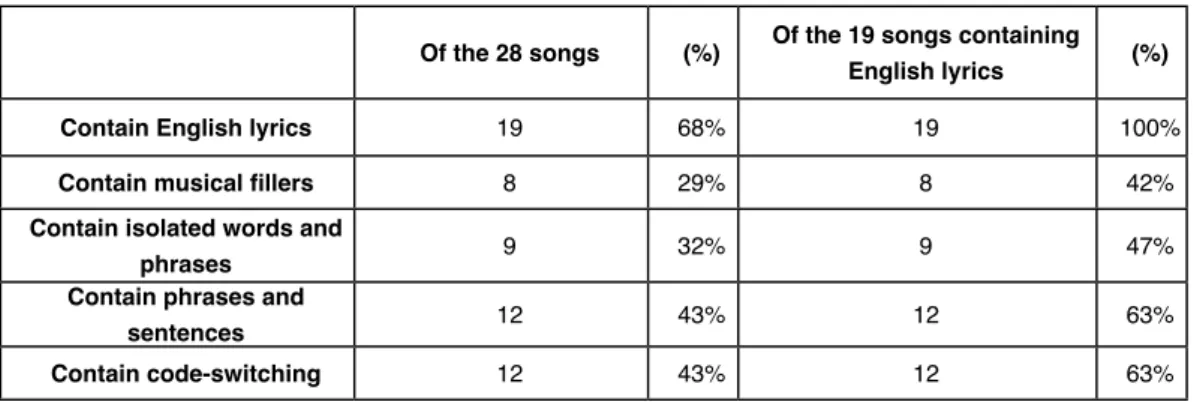
The results of the usage are shown in Table 2 below. To examine how English is used in Japanese songs, we focus our attention more on the results in proportion to songs containing English lyrics, and less on the other 9 songs without English lyrics. Almost every category appeared in around half of the songs analyzed, which is rather significant.
Table 2. Four categories of English usage
Of the 28 songs (%) Of the 19 songs containing English lyrics (%) Contain English lyrics 19 68% 19 100% Contain musical fillers 8 29% 8 42% Contain isolated words and
phrases 9 32% 9 47%
Contain phrases and
sentences 12 43% 12 63%
Contain code-switching 12 43% 12 63% 5.1.2.1 Songs containing musical fillers
As discussed above in section 4, many of the musical fillers in Japanese songs are identified as English, and 42% of the songs include English as musical fillers. We cannot gain a lot of information from the word choices for fillers, but the fact that many artists make the extra effort to include English fillers is astounding. A quick glance at the full lyrics would also reflect that there are more English fillers than Japanese fillers. Perhaps Japanese simply has less musical filler choices.
5.1.2.2. Songs containing isolated words and phrases
Out of the songs, 47% of them include isolated words or phrases. These words do not convey complete ideas, thus they can be less relevant to the rest of the song and simultaneously easier to add into the lyrics. With lower relevancy, these words are there likely to contribute to the mood of the song more than the meaning.
5.1.2.3. Songs containing phrases and sentences
Contrasting with the second category, 63% of the songs employ phrases and sentences that carry complete ideas. They cohere with the rest of the lyrics directly and carry more value in their meaning. Presumably, it also takes more linguistic effort to write English sentences than inserting random words, so the high figure is indeed noteworthy.
5.1.2.4. Songs containing code-switching
Since code-switching does not normally happen in everyday conversations in the monolingual country, the 63% figure of English-Japanese code-switching in songs was unexpected. These English words
do not simply replace loanwords, as loanwords still appeared regularly in the lyrics and are excluded from consideration. We will take a deeper look into the types of words used for code-switching in section 5.2.
5.1.3. One or multiple usage
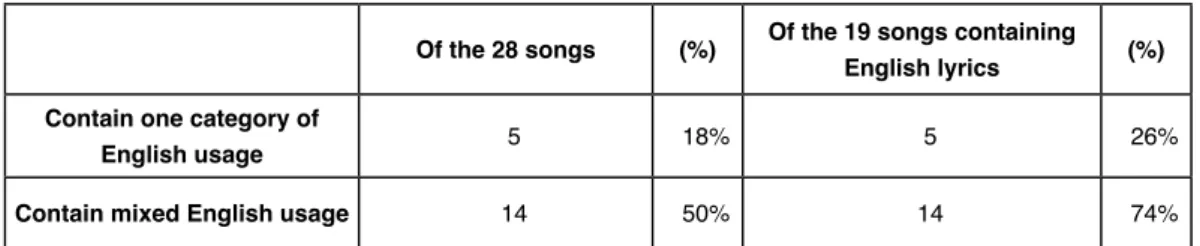
The table below demonstrates that almost three-fourths of the songs use English in more than one way.
Table 3. One usage vs. mixed usage
Of the 28 songs (%) Of the 19 songs containing English lyrics (%) Contain one category of
English usage 5 18% 5 26%
Contain mixed English usage 14 50% 14 74%
This suggests that most of the song writers do not limit themselves to using English in one style, but rather they insert English wherever they determine it is appropriate and suitable to express their creativity.
5.1.4 Summary
The various tables from the collected data have successfully shown that the appearance of English in Japanese popular songs is extremely frequent, with over 68% of the analyzed songs containing English in various ways. This discovery supports the results of Moody and Matsumoto (2003).
5.2. The types of words used
Working with limitations, it is difficult to quantify all the English lyrics collected in this research and apply values to them. However, we can visualize some common themes within the extracted lyrics and make a few inferences. Each of the points below can easily warrant deeper research.
5.2.1. Level of English
Based on my personal teaching experience and textbooks I have used in Japan, other than several words such as ‘celebrate (9.1, repetitions within the same song are unlisted)’, ‘tight (9.5)’, ‘destiny (12.1)’, ‘beginner (22.3)’ which are introduced in high schools, the majority of the words and sentences used in these songs are around the junior high school level. Many of the simpler words and phrases are even recognizable for elementary school students, for instance, ‘hello (9.8)’, ‘good bye (9.7)’, ‘morning (10.4)’, ‘can you…? (9.1, 13.1)’, and ‘stand up (22.4)’.
The crucial point regarding the level of the English is intelligibility. Based on the English analyzed, it seems that the most popular songs avoid containing difficult English. In Japan, virtually everyone who went through high school have studied English, thus a majority of the audience should be able to understand the English lyrics. I imagine the main reasons behind using easy words were consideration for the general public to understand the meaning of the lyrics, the limitations of the song writer’s English ability, or likely both.
5.2.2. Common words
Henard and Rossetti (2014) studied the lyrics of the most successful English songs of the past 50 years where he identified lists of the most important words in lyrics of each decade. Comparing the English
lyrics extracted from our Japanese pop-songs with his lists, there are many words that overlap: ‘baby (13.3, 26.1)’, ‘time (9.3, 18.5)’, ‘heart (4.2, 9.7, 16.4, 26.6)’, ‘good (24.1)’, ‘life (20.1, 21.3)’, and of course, ‘love (7.1, 9.3, 10.1, 16.1, 26.1)’.
The intriguing factor is how these English words were likely chosen for their different connotations than their Japanese counterparts. In particular, the word ‘baby’ does not have an equivalent Japanese word. This topic is briefly discussed in the early section on reasons for using loanwords, and we will further discuss the reasons in regards to music in a later section.
5.2.3. Usage of pronouns and possessive cases
Another notable point about the lyrics is the regular usage of the pronouns ‘you (9.2, 10.1, 13.1, 16.5)’ and ‘I (9.9, 10.1, 16.2, 18.22, 20.1, 21.5)’, as well as the possessive determiners ‘your (16.1, 20.1, 22.2)’ and ‘my (9.7, 16.3, 20.1, 21.4)’. The significance of the usage of ‘my’ is explained earlier, but ‘you’ and ‘I’ are also noteworthy in that pronouns are often dropped in conversations when the main subject of the conversation is mutually understood (Aston, 1888). Lyrics like ‘I wish forever (16.2)’ would become 永 遠 に願う, stating ‘wish forever’ with the ‘I’ implied and dropped. This is to avoid direct references to self and others to show humbleness, yet song writers seem to have no refrain from using them in songs.
5.2.4. Code-switching
Lastly, there are differences between the code-switching as seen in the lyrics and the usage of loanwords in conversational Japanese. Many of the English words are used in two variations: using English words that are not available as common loanwords (ex. ‘secret (13.1)’, ‘beginner (22.3)’, ‘70’s/seventies (26.3)’), or two or more English words used together within the Japanese sentence (ex. ‘my life (20.1, 21.1)’, ‘sounds good (24.1)’, ‘because I love you (10.1)’). For the former, since the loanword option is not available, the writers decided on the English words rather than Japanese. For the latter, they include words that may be common individual loanwords, but are used in ways or with other words that are irregular to conversational usage, such as ‘on the beach (23.2)’, where ‘beach’ is a common loanword in Japanese as beechi/ビーチ, but ‘on the’ are not, and ‘sounds good (24.1)’, where ‘good’ is regularly used in Japanese as guddo/グッド, but ‘sounds’ is not.
It is also important to point out that code-switching in Japanese music may sometimes ignore grammatical rules. For example: ‘真夏のsounds good (24.1)’ (translates: Sounds good of the summer time); ‘俺流start dash で行くんだ (18.16)’ (translates: My style, I go by start dash).
These striking differences show that the English words used in lyrics and loanwords in the Japanese language are not interchangeable. Therefore, I disagree with Moody’s (2006) suggestion that the English lyrics are simply romanized renditions of loanwords.
5.3. The artists’ desired results
There is no single dominating reason for writers to use English in Japanese pop-music. By expanding on the previous research of Stanlaw (2004) and Moody (2006), demonstrating with examples and adding my own suggestions, this discussion serves as a summary to explore the various explanations why many song
writers may be motivated to make such a creative decision. 5.3.1. Image
As aforementioned, Stanlaw (2004) identified four motivations behind the usage of English loanwords in the Japanese language, and I will demonstrate that his suggestions are also applicable towards English lyrics. His first reason was that using loanwords makes the speaker appear more “modern, chic and sophisticated” (p. 17), and considering English is a foreign language in Japan, displaying a strong command of it makes the performer appear well educated, especially if they overcome the issue of pronunciation too.
5.3.2. Changing social attitude
Stanlaw suggested the popular usage of ‘my’ as a loanword reflects the changing attitude of the Japanese society (2004). I have highlighted the usage of ‘my’ in the English lyrics, and the regular usages of ‘you’ and ‘I’ also reflect how the society is shifting towards an endorsement of individualism, to be seen and to recognize other people as individuals. Comparing the statement ‘I love you (10.1)’ and its Japanese counterpart of aishiteru/愛してる which simply says ‘loving’, the English does appear more personal with the participants included.
5.3.3. Avoiding cultural constraints
Related to the point above, some Japanese words may be replaced by loanwords because of their negative connotations (for example, ‘husband’ and ‘wife’), and this has encouraged some people to look for loanword alternatives (Stanlaw, 2004), or in pop-music, English alternatives. What resulted from this are usages of words with much less cultural constraints or limitations. The most interesting examples are the English words of ‘darling (8.1)’ and ‘baby (13.3, 26.1)’, because there are no equivalents in Japanese. There are no such affectionate names in Japanese for lovers to use, except for occasional married couples which may call each other omae/お 前 and anata/あ な た, which are actually both terms for ‘you’ spoken by different genders. Many couples use nicknames derived from their real names, but there are no generic affectionate names as in English. Another word like ‘kiss (9.2, 10.6)’ is used regularly because the traditional Japanese term kuchizuke/くち付け, literally meaning ‘sticking of mouths’, has a very out-dated connotation when affection was rarely discussed in public. In fact, this is simply an obsolete term even in conversational Japanese as they are replaced by the loanword of ‘kiss’ (キス) and the word chuu (ちゅう), which is the onomatopoeia of a kiss. Therefore, using these English words in songs can avoid cultural constraints or limitations.
5.3.4. Creative interpretation
The last point raised by Stanlaw (2004) was that song writers have greater creative freedom to interpret the loanwords and English words. Since the English lyrics do not have decades of built-up connotations, words such as ‘true heart (4.2)’ and ‘beginner (22.3)’ are vague enough for the artists to add their own implications, just as how Matsutooya Yumi preferred ‘dandelion’ to avoid the folksong-like image (Stanlaw, 2004). The audience can insert their own images of ‘morning moon (10.4)’ and ‘doop な rhymeで (with a doop rhyme) (18.4)’. ‘Make bounce (18.21)’, and ‘celebrate’ in ‘can you celebrate? (9.1)’ might make little sense to native speakers, so the interpretation is all up to the artists and listeners. Without the knowledge of the subtext of the English words, artists have much more freedom with how they want to interpret the
English.
5.3.5. Globally reaching identity
Moody (2006) suggested that a strong motivation include English in Japanese pop-music is to fulfill the desire of the monolingual society to create a global and cosmopolitan identity. Considering artists’ aspiration for popularity, I agree with Moody and I would further propose that artists want to create an identity of global reach and/or global potential. For performers, the crucial factor is not to be familiar with other cultures, but rather that the audience from other cultures can become familiarized with them. I believe this is reflected by the many song titles in English, despite the songs being mostly in Japanese. In addition, the many English band names on the list indicate the hope the artists have for their names to be globally recognized. English helps create the desired image of a globally reaching identity, or at least global potential.
5.3.6. Musical framing
Lastly, there is the musical framing, specifically rhythms and word syllables. Song writers are always working within the boundaries set by the melodies. In order to convey more details in the limited syllable counts, many English words do have the advantage of generally taking less syllables than the Japanese words, for example, ‘love (7.1, 9.3, 10.1, 16.1, 26.1)’ {1 syllable} vs. aishiteru {5}, ‘heart (4.2, 9.7, 16.4, 26.6)’ {1 syllable} vs. kokoro {3}, and ‘new world (21.1)’ {2} vs. atarashii sekai {8}. With each line of a song containing an estimated 5 to 15 syllables, using the corresponding English words to replace the Japanese words will provide the writers with more space in the songs for expressing ideas.
6. Conclusion
Through this research, it is clear English has an essential role in Japanese popular music, thus reflecting its acceptance by the society. I have summarized various motivations why song writers may choose to include English in their lyrical works, and this research can be the foundation for future research into specific reasons discussed above. It is fascinating how Japan as a relatively monolingual country has adapted English into its popular culture. Simultaneously, the inclusion has intrigued and facilitated people outside of the community to appreciate the music, myself included. This phenomenon is worth further exploration so that English can embrace a more clarified purpose within Japanese popular music.
Appendix 1: Discography and extracted English lyrics.
A. Discography of the songs used for the research:
Item number Year Artist Song title 1 1989 Princess Princess Daimonds
2 1990 B.B. Queens Odoru Pompokolin
3 1991 Kazumasa Oda Love Story wa totsuzen ni
4 1992 Kome Kome CLUB Kimi ga iru dake de
5 1993 CHAGE & ASKA YAH YAH YAH
6 1994 Mr. Children Innocent World
7 1995 DREAMS COME TRUE LOVE LOVE LOVE
8 1996 Mr. Children Namonaki uta
9 1997 Namie Amuro Can You Celebrate?
10 1998 GLAY Yuuwaku
11 1999 Kentaro Hayami, Ayumi Shigemori, Himawari Kids and Dango Gasshodan Dango 3 Kyodai 12 2000 Southern All Stars TSUNAMI
13 2001 HIkaru Utada Can you keep a secret? 14 2002 Ayumi Hamasaki independence
15 2003 SMAP Sekai ni hitotsu dake no hana
16 2004 Ken Hirai Hitomi wo tojite
17 2005 Shuji to Akira Seishun Amigo
18 2006 KAT-TUN Real Face
19 2007 Masafumi Akikawa Sen no kaze ni natte
20 2008 Arashi truth
21 2009 Arashi Believe
22 2010 AKB48 Beginner
23 2011 AKB48 Flying Get
24 2012 AKB48 ManatsuGood! no Sounds
25 2013 AKB48 Sayonara Crawl
26 2014 AKB48 Labrador Retriever
27 2015 AKB48 Bokutachi wa
tatakawanai
28 2016 AKB48 Tsubasa wa iranai
Italic font in the table indicates that the words are written in Japanese (hiragana, katakana or kanji). Otherwise, they are written in English.
Discography
AKB48 (2010). Beginner. In: Beginner [CD]. KIZM-63/4. King Records AKB48 (2011). Flying Get. In: Flying Get [CD]. KIZM-111/2. King Records
AKB48 (2012). Manatsu no Sounds Good!. In: Manatsu no Sounds Good! [CD]. KIZM-151/2. King Records AKB48 (2013). Sayonara Crawl. In: Sayonara Crawl [CD]. KIZM-213/4. King Records
AKB48 (2014). Labrador Retriever. In: Labrador Retriever [CD]. KIZM-283/4. King Records
AKB48 (2015). Bokutachi wa tatakawanai. In: Bokutachi wa tatakawanai [CD]. KIZM-90337/8. King Records
AKB48 (2016). Tsubasa wa iranai. In: Tsubasa wa iranai [CD]. KIZM-90431/2. King Records Arashi (2008). truth. In: truth/Kaze no mukou e [CD]. JACA-5109/10. J Storm
Arashi (2009). Believe. In: Believe/Kumorinochi, kaisei [CD]. JACA-5109/10. J Storm Ayumi Hamasaki (2002). Independent. In: H [CD]. AVCD-30380. Avex Trax
B. B. Queens (1990). Odoru ponpokorin. In: Odoru ponpokorin [CD]. BVDR-1. BMG Japan CHAGE & ASKA (1993). YAH YAH YAH. In: YAH YAH YAH [CD]. PCDA-00416. Pony Canyon
DREAMS COME TRUE (1995). LOVE LOVE LOVE. In: LOVE LOVE LOVE [CD]. ESDB-3590. Epic Records Japan
GLAY (1998). Yuuwaku. In: Yuuwaku [CD]. PODH-7020. Polydor
Hikaru Utada (2001). Can You Keep A Secret?. In: Can You Keep A Secret? [CD]. TOCT-4301. EMI Music Japan
KAT-TUN (2006). Real Face. In: Real Face [CD]. JACA-5029. J-one Records
Kazumasa Oda (1991). Love Story wa totsuzen ni. In: Oh!Yeah! [CD]. FHDL-1004. Funhouse Ken Hirai (2004). Hitomi wo tojite. In: Hitomi wo tojite [CD]. DFCL-1133. Defstar Records
Kentaro Hayami, Ayumi Shigemori, Himawari Kids and Dango Gasshodan (1999). Dango 3 Kyoudai. In:
Dango 3 Kyoudai [CD]. PCDG-00107. Pony Canyon
Kome Kome CLUB (1992). Kimi ga iru dake de. In: Kimi ga iru dake de [CD]. SRDL-3465. Sony Music Records
Masafumi Akikawa (2006). Sen no kaze ni natte. In: Sen no kaze ni natte [CD]. TECI-103. Takumi Note Mr. Children (1994). Innocent World. In: Innocent World [CD]. TFDC-28025. Toys Factory
Mr. Children (1996). Namonaki uta. In: Namonaki uta [CD]. TFDC-28039. Toys Factory
Namie Amuro (1997). Can you celebrate?. In: Can you celebrate? [CD]. AVDD-20167. Avex Trax Princess Princcess (1989). Diamonds. In: Diamonds [CD]. 07SH-3272. Sony Records
Shuji to Akira (2005). Seishun Amigo. In: Seishun Amigo [CD]. JECN-0076. Johnny’s Entertainment
SMAP (2003). Sekai ni hitotsu dake no hana. In: Sekai ni hitotsu dake no hana [CD]. VICL-35477. Victor Entertainment
Bibliography
Aston, W. (1888) Grammar of the Japanese spoken language. Google Books [Online]. Available at: https://
play.google.com/store/books/details?id=s7ZBAAAAYAAJ (Accessed: 5th August 2017).
Henard, D. and Rossetti, C. (2014) 'All You Need is Love? Communication Insights From Pop Music’s #1 Hits', Journal of Advertising Research, 54(2), pp. 53-66 [Online]. Available at: http://davidhenard.com/
Landing_Page/About.html (Accessed: 3rd August, 2017).
Kay G. (1995) 'English loanwords in Japan', World Englishes, 14(1), pp. 67-76.
Kitagawa, J. (2009) 'Music Culture', in Sugimoto, Y. (ed.) The Cambridge companion to modern Japanese
culture. Cambridge: Cambridge University Press, pp. 261-280.
Kyouikugeijutsusha (2017a) Tracklist of "Music for Elementary School Students 1" (in Japanese), Available at: https://www.kyogei.co.jp/textbook/es/es-h27_1.html (Accessed: 13th August 2017).
Kyouikugeijutsusha (2017b) Tracklist of "Music for Elementary School Students 5" (in Japanese), Available at: https://www.kyogei.co.jp/textbook/es/es-h27_5.html (Accessed: 13th August 2017).
Kyouikugeijutsusha (2017c) Tracklist of "Music for Elementary School Students 6" (in Japanese), Available at: https://www.kyogei.co.jp/textbook/es/es-h27_6.html (Accessed: 13th August 2017).
Kyouikugeijutsusha (2017d) Tracklist of "Music for Junior High School Students 1" (in Japanese), Available at: https://www.kyogei.co.jp/textbook/jh/jh-h28_1.html (Accessed: 13th August 2017).
Moody, A. (2006) 'English in Japanese popular culture and J-Pop music', World Englishes, 25(2), pp. 209-222.
Moody, A. and Matsumoto, Y. (2003) '‘‘Don’t touch my moustache’’: language blending and code ambiguation by two J-pop artists', Asian Englishes, 6(1), pp. 4-33.
Oricon News (2017) About Ranking Collection, Available at: http://www.oricon.co.jp/rank/about/ (Accessed: 26th July 2017).
Stanlaw, J. (2004) Japanese English: Language And The Culture Contact (Asian Englishes Today), Hong Kong: Hong Kong University Press.