
an automated end-to-end penetration testing for the internet of thing
2
0
0
全文
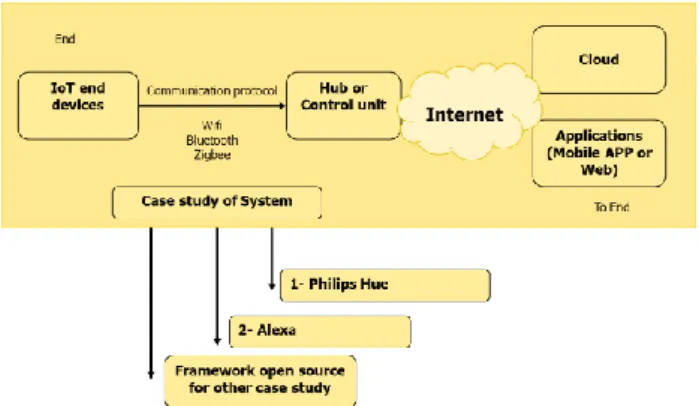
(2) 情報処理学会第 81 回全国大会 B. Discovery The penetration testing start with this step. The main task of this step is to finds the vulnerabilities on the target system by port and network scanning. Also, there are some other activity in this step such as packet capturing, banner grabbing. Then, the system apply the vulnerability analysis to be used as input data to the next step of the penetration testing.. Figure 1: Overview of End-to-End III.. DESIGN. Since the organization need to perform the pentation testing regular in following situations: new infrastructure is added, software is installed, system updates are applied, security patches are applied and user policies are modified. These items have to be tested in each time the organization perform any change to the system. It can be tested manually by expert tester or automatically by automated system. We showed in introduction that automated system have many advantages comparing with manual test. However, the existing automated system provide a separate testing for each level of the system individually [4]. The existing automated system didn’t consider that these separated items are connected on one system and testing each level (items) of the system separately can cause some gabs (vulnerabilities) that cannot discover by such automated pentation testing. For that our method will cover End-to-End Penetration testing for IoT system. We will show later on our full paper a mathematical model that prove that testing each level (item) of the system separately can cause some vulnerabilities that cannot detected by existing automated system. Figure 2 summarize the main steps of any pentation testing that also will be similar to our proposed pen-test, but the framework that we going to proposed it can test the End to End IoT system one time. The following sub-section show the steps of the proposed framework. A. Planning This is the first stage in penetration testing. This stage usually involves the standard planning steps of setting goals. It work by gathering all information about the target system and mapping the network.. C. Attack In this step of testing the system performing the attacks on the IoT network. The attacks are performed on the vulnerabilities that have been discovered through the previous step (discovery phase). On this step of testing the proposed system will test every discovered vulnerability and a loop of attack will be continued until all the objectives of the attack phase are completed. D. Reporting Finally, all result of the previous two step of this test will be compiled and presented as a report to users, this report include the details of the vulnerabilities and the attacks performed on the target system. IV.. CONCLUSION. We will proposed the End-to-End Penetrating testing that provides the user with the ability to have a test from inside or outside the system automatically. Once the user connect to the system the proposed framework will scan the system for any vulnerabilities and then attack script is triggered and maliciously crafted packets are sent to the specified system. Once the attack is completed a report is generated. This Endto-End pen-test enables the user to identify and analyze the security threats. ACKNOWLEDGMENT This research was supported by Strategic International Research Cooperative Program, Japan Science and Technology Agency (JST) , SICORP and JSPS KAKENHI Grant Number JP16K00480. REFERENCES [1]. [2]. [3]. [4]. Eduard Kovacs. “Brian Kreb’s Blog Hit by 665 Gbps DDoS Attack”. 21 September 2016 [Online]. Available: http://www.securityweek.com/brian-krebs-blog-hit-665-gbpsddosattack. M. Denis, C. Zena and T. Hayajneh, "Penetration testing: Concepts, attack methods, and defense strategies," 2016 IEEE Long Island Systems, Applications and Technology Conference (LISAT), Farmingdale, NY, 2016. pp. 1-6. doi: 10.1109/LISAT.2016.7494156. L. Epling, B. Hinkel, and Y. Hu, "Penetration Testing in a Box", 2015 Information Security Curriculum Development Conference (InfoSec '15), ACM, New York, USA, Article 6. V. Visoottiviseth, P. Akarasiriwong, and S. Chaiyasart, Siravit Chotivatunyu, “PENTOS: Penetration Testing Tool for Internet of Thing Devices”. Proc. of the 2017 IEEE Region 10 Conference (TENCON), Malaysia, November 5-8, 2017.. Figure 2: Steps of penetration testing. 3-388. Copyright 2019 Information Processing Society of Japan. All Rights Reserved..
(3)
図
関連したドキュメント
We obtained the condition for ergodicity of the system, steady state system size probabilities, expected length of the busy period of the system, expected inventory level,
The theorem also implies that all p-adic L-functions for elliptic curves at odd primes p of semi-stable ordinary reductions are integral elements in the Iwasawa algebra.. See
In order to achieve the minimum of the lowest eigenvalue under a total mass constraint, the Stieltjes extension of the problem is necessary.. Section 3 gives two discrete examples
For further analysis of the effects of seasonality, three chaotic attractors as well as a Poincar´e section the Poincar´e section is a classical technique for analyzing dynamic
In order to be able to apply the Cartan–K¨ ahler theorem to prove existence of solutions in the real-analytic category, one needs a stronger result than Proposition 2.3; one needs
In this paper, we established the conditions of the occurrence of local bifurcation (such as saddle-node, transcritical and pitchfork) with particular emphasis on the Hopf
This paper presents an investigation into the mechanics of this specific problem and develops an analytical approach that accounts for the effects of geometrical and material data on
Based on sequential numerical results [28], Klawonn and Pavarino showed that the number of GMRES [39] iterations for the two-level additive Schwarz methods for symmetric
