Dominance of a dipole magnetic field under the
condition of the past Earth's interior based
on numerical simulations of the geodynamo
著者
Nishida Yuki
学位授与機関
Tohoku University
博士論文
Dominance of a dipole magnetic field under
the condition of the past Earth’s interior based
on numerical simulations of the geodynamo
(数値ダイナモシミュレーションに基づく
過去の地球内部条件下における
双極子磁場卓越性に関する研究)
博士論文
Dominance of a dipole magnetic field under
the condition of the past Earth’s interior based
on numerical simulations of the geodynamo
(数値ダイナモシミュレーションに基づく
過去の地球内部条件下における
双極子磁場卓越性に関する研究)
東北大学大学院理学研究科
地球物理学専攻
西田 有輝
論文審査委員 加藤 雄人 教授(指導教員・主査) 小原 隆博 教授 笠羽 康正 教授 寺田 直樹 教授 熊本 篤志 准教授 松島 政貴 助教(東京工業大学) 松井 宏晃 准上級研究員(カリフォルニア大学デービス校)令和
2
年
Acknowledgement
Foremost, I would like to express the deepest appreciation to my supervisor,
Pro-fessor Yuto Katoh for his continuous support. His advice, comments, and
encour-agement have been a great help in my study. I would also like to express the
great appreciation to Dr. Hiroaki Matsui for his kind advice. His comments and
suggestions in weakly meeting are very helpful in my study. I would also like to
express the large appreciation to Assistant Professor Masaki Matsushima for his
suggestions. His comments at scientific conferences have advanced my study and
submitted paper. I am deeply grateful to Associate Professor Atsushi Kumamoto
and Emeritus Professor Hiroshi Oya for their fruitful advice, suggestions, and
en-couragement. I extend my deep thanks to Professors Takahiro Obara, Yasumasa
Kasaba, and Naoki Terada. Their comments in their lectures or our group’s
sem-inars gave me chances to take deep thought of my study. I would like to express
the deep gratitude to members of the group of Deep Earth Physics in Kyushu
search theme in weakly study meeting. I wish to express my special thanks to the
past and present members of the Space and Terrestrial Plasma Physics Labortory.
Assistant Professors Tomoki Kimura and Yohei Kawazura gave me new
perspec-tives in my study field. Mr. Takumi Kera helped me advancing my study in daily
discussion. Finally, I would like to express heartfelt thanks to my parents, Tetsuya
Abstract
The solid inner core of the Earth has been growing for approximately one
bil-lion years due to cooling of the Earth. The changing spherical shell geometry
of the Earth’s core is likely to influence on the geodynamo driven by convective
motions in the fluid outer core. To understand the geometry effect on the dynamo
regime through evolution of the core, we perform numerical simulations of
geody-namo with three spherical shell radius ratios: ri/ro = 0.15, 0.25, and 0.35, where
ri and ro are the inner and outer core radii, respectively. To evaluate the
mor-phology of the magnetic field, we examine two indices about dipole component
dominance: (i) fdip, dipolarity used to assess the relative strength of the dipole
field at the core surface in numerical dynamo models, and (ii) fmag fit, the ratio
of magnetic energy density for the dipole component to that extrapolated from
the magnetic power spectrum for the high degree components. We investigate the
field morphology estimated from fdipand fmag fit, and find that fmag fitis valid to
number for sustained dynamos based on both fdip and fmag fit, and find that the
range of the Rayleigh number for the dynamo characterized by the strong dipole
field becomes narrower for the smaller inner core. The fdip-dependences on the
Rayleigh number obtained for ri/ro = 0.25 and 0.35 are similar to each other,
whereas the fmag fit-dependence for ri/ro = 0.35 is found to be relatively larger
than that for ri/ro = 0.25. On the other hand, small values of fdip and fmag fit
for ri/ro = 0.15 suggest that the dynamo regime is characterized not only by
the dipolar dominance but by non-dipolar dominance. These results indicate that
changes in the spherical shell radius ratio largely influence on the dynamo regime
in numerical dynamos with the fixed temperature boundary condition.
We also perform numerical dynamo simulations with five different heat flow
rates: Qi/Qo = 0, 0.25, 0.5, 0.75, and 1, where Qiand Qo are the heat flow at the
inner core boundary (ICB) and the core-mantle boundary (CMB), respectively, to
understand dynamos in which the outer core lets heat escape from the CMB to the
mantle. The kinetic energy basically becomes large with increasing Ra/Racrit,
which is the Rayleigh number normalized by the critical Rayleigh number Racrit.
The simulation results also reveal that the magnetic energy dissipated for the
smaller Ra/Racrit range, and increased significantly with increasing Ra/Racrit,
followed by the decrease of the magnetic energy in the larger Ra/Racrit range.
The simulation results reveal the similar behavior of the dynamo action to the
cannot be determined only based on fdip, which decreases gradually with
increas-ing Ra, the use of fmag fit enables us to determine the dynamo regime clearly
and quantitatively. These tendencies are the same as we find in the FT cases at
ri/ro = 0.25 and 0.35. Based on the simulation results and related discussion, in
the range of Qi/Qo ≥ 0.5, we conclude that the dynamo regime is determined by
Contents
1 Introduction 1
1.1 Development of dynamo studies . . . 1
1.2 Observations of a magnetic field . . . 5
1.3 Properties of the outer core . . . 8
1.4 Focusing on the inner core size . . . 11
1.5 Purpose of this study . . . 13
2 Method 20 2.1 Governing equations . . . 20
2.2 Initial and boundary conditions . . . 25
3 Fixed temperature 27 3.1 Result of thermal convection . . . 27
3.2 Result of MHD simulation . . . 28
3.3 Assessment of dipolar dominance . . . 33
3.4 Discussion . . . 37
4 Fixed heat flux 58 4.1 Result of thermal convection . . . 58
4.2 Result of MHD simulation . . . 61
4.3 Assessment of dipolar dominance . . . 63
4.4 Difference of FT and FF cases . . . 65
5 Fixed heat flux in cooling from CMB 77 5.1 Thermal convection . . . 77
5.2 MHD simulations . . . 79
6 Conclusion 92 6.1 Concluding remarks . . . 92
Chapter 1
Introduction
1.1
Development of dynamo studies
The Earth has an intrinsic magnetic field, which is dipolar-dominated. Since the
Middle Ages, human beings have taken advantage of the property of the
dipolar-dominated geomagnetic field as a magnetic compass to know the north-south
di-rection in the journey, especially during the voyage. The first answer to the
rea-son why a compass points the direction was presented by Gilbert. In 1600, he
published ”De Magnete”, in which he concluded that the Earth itself is a huge
magnet to affect the compass to point the direction by its magnetic force. Many
great achievements not only in mathematics but also in geomagnetism were made
by Gauss. He devised a method of measuring the total intensity of the Earth in
A question of why the Earth itself is a magnet had been given to a number of
hypotheses, which were that the Earth is a permanent magnet, that geomagnetic
field has been maintained by a freely decaying current in the Earth’s interior, or
that a giant rotating body is accompanied by a magnetic field. The first hypothesis
was denied because the Earth’s constituents lose magnetism under a depth deeper
than some tens of kilometers where its temperature is higher than the Curie point.
The second hypothesis was denied because time constant of current in the outer
core is of the order of 104 years, which is by far shorter than the duration for
which the geomagnetic field has been sustained. The third hypothesis was denied
because it was proved through an experiment that a metal block rotating with the
Earth’s angular velocity is not accompanied by a magnetic field (Blackett, 1952).
With the progress of understanding the structure of Earth’s interior based on
seismological studies, a new theory of generating geomagnetic field was proposed
(Elsasser, 1946; Bullard, 1948). Using seismic data, Bullen (1936) calculated the
distribution of density within the Earth to classify some layers. Fig. 1.1 shows
a widely accepted model of the interior structure of the Earth. The geomagnetic
field has been generated by current in the liquid iron alloy outer core. The theory is
called dynamo theory, which was originally proposed by Larmor (1919) to explain
a generating mechanism of the solar magnetic field.
The dynamo theory is essentially a three dimensional problem since an
motion of fluids (Cowling, 1933). Because of this Cowling’s anti-dynamo
the-orem, many kinematic dynamo models were proposed. In kinematic dynamos, a
magnetic field is solved in a given velocity field. A rotating disk dynamo model
described change of the intensity of a magnetic field (Bullard, 1955). A rotating
coupled-disk dynamo model is famous for the first model to explain reversal of
the magnetic field polarity (Rikitake, 1958). Although this Rikitake model seems
to describe convection columns in the outer core, in today’s understanding, it is
pointed out that the disks are not imitation of the columns in the outer core
be-cause the tendency of reversal is not similar to that of paleomagnetic data (Kono,
1987). Parker (1955) presented a production model of a poloidal magnetic field
from a toroidal magnetic field by the helical velocity field, and a production model
of a toroidal magnetic field from a poloidal magnetic field by a toroidal velocity
field. The former is called the α effect and the latter is called the ω effect.
Thermal instability in a rotating spherical shell or sphere has been studied
from linear stability analysis. The onset of thermal convection is represented as
the critical Rayleigh number, Racrit. Racrit of an axisymmetric mode (m = 0)
was derived by Chandrasekhar (1961), where m represents the wavenumber in the
azimuthal direction. Then, Racritof non-axisymmetric modes (m = 1, 2, ...) was
uniform in a rapidly rotating system. This theorem is proved by taking the
rota-tion of the Navier-Stokes equarota-tion of incompressible inviscid fluids in a rapidly
rotating system under a steady state.
The Earth’s outer core consists of magnetofluids in a rotating spherical shell.
In this system, the fluids basically follow magnetogeostrophic flow, in which the
Coriolis force, pressure gradient, and magnetic pressure are balanced. Since fluids
flow clockwise at anticyclone columns, the Coriolis force faces in the direction
of the center of the column. The Coriolis force carries magnetofluids inside the
columns, therefore magnetic field is concentrated. For cyclone columns, at which
fluids flow counterclockwise, the Coriolis force faces outward, so magnetic field
is not concentrated. Direction of forces in magnetogeostrophic flow is sketched
by Fig. 1.3.
Since Glatzmaier and Roberts (1995) reported a reversing dynamo model and
Kageyama et al. (1995) reported a compressible dynamo model as the first three
dimensional magnetohydrodynamic (MHD) self-consistent dynamo simulation,
many numerical dynamo simulations have been performed actively.
Understand-ing of generation mechanism of a dipole magnetic field has been progressed.
Kageyama and Sato (1997) explained a model of generating a dipole magnetic
field from a toroidal magnetic field under a columnar flow structure. In setting of
the present geometry of the outer core, dominance of a dipolar magnetic field
Christensen and Aubert, 2006; Olson et al., 2011; Soderlund et al., 2012).
How-ever, in spite of some numerical simulations, the dipolar dominance with different
geometry of the outer core from the present one is not fully understood (see
sec-tion 1.4 in detail).
1.2
Observations of a magnetic field
In an electrically insulating space, a magnetic field B can be defined by a magnetic
scalar potential V as B = −∇V . By combining this equation with the Gauss’s law for magnetic field, ∇ · B = 0, we acquire Laplace’s equation ∇2V = 0. In
spherical coordinates (r, θ, ϕ), where r is the radial distance from the center of the
Earth, θ is the geocentric colatitude, and ϕ is the longitude, this Laplace’s
equa-tion can be solved through separaequa-tion of variables. The soluequa-tion is approximately
expressed in terms of finite series as follow;
V (r, θ, ϕ, t) = RE lmax ∑ l=1 l ∑ m=0 ( RE r )l+1 × [gm l (t) cos(mϕ) + h m l (t) sin(mϕ)]P m l (cos θ), (1.1)
where RE is the Earth’s mean spherical radius, 6371 km, Plm are the Schmidt
the global distribution of geomagnetic field, the Gauss coefficients glm and hml up to degree l = 13, and the secular variation ˙glm and ˙hml up to degree l = 8, which are rates of annual change of the Gauss coefficients, are proposed every five
years as International Geomagnetic Reference Field (IGRF) model by a working
group in the International Association of Geomagnetism and Aeronomy (IAGA)
since IGRF 1965 (IAGA Commission 2 Working Group No. 4, 1969). The latest
published version is the 13th generation IGRF (Alken et al., 2021).
The geomagnetic field is observed as dipolar-dominated in the magnetic power
spectrum at the Earth’s surface (Lowes, 1974) and at the core-mantle boundary
(CMB) (Langel and Estes, 1982). Fig. 1.3 shows the geomagnetic power spectrum
at the Earth’s surface and the CMB based on Magsat satellite data from November
1979 to March 1980. A surface integral of a magnetic field over a spherical surface
with radius r leads to the geomagnetic spectrum given by
Rl(r) = ( RE r )2(l+2) (l + 1) l ∑ m=0 [(glm)2+ (hml )2]. (1.2) Note that spherical harmonic degree is defined as n in Fig. 1.4. The dipole
com-ponent is significantly larger than the higher degrees’ trend in this spectra both at
the Earth’s surface and the CMB.
Strength of a dipolar component of a magnetic field represents a magnetic
moment of the Earth is calculated by M = 4πRE 3 µ0 √ (g0 1)2+ (g11)2 + (h11)2, (1.3)
where µ0 is the magnetic permeability in vacuum. The present Earth’s magnetic
moment can be calculated from the 12th IGRF as M = 7.71 × 10²² Am2(=
77.1 ZAm2). The magnetic moment has been decreasing by approximately 6 %
for the recent 100 years. This decrease does not mean that the geomagnetic field
will be vanishing. It is revealed that the change of this percentage can occur
naturally based on paleomagnetic studies (Shcherbakova et al., 2017; Kulakov
et al., 2019). The virtual dipole moment (VDM) is often used to represent the
intensity of the past geomagnetic field. VDM is calculated under the assumption
that a geomagnetic field can be expressed in terms of an axial dipole (Merrill
et al., 1996). The paleointensity maintained its present intensity for more than
3.5 billion years based on paleomagnetic observations (Biggin et al., 2015); the
geodynamo has been sustained during this period. However, the higher degrees’
structure of the paleomagnetic field cannot be determined because of limitation of
1.3
Properties of the outer core
Properties of magneto-fluid in a rotating spherical shell are described by
nondi-mensional numbers listed in Table 1.1. The Rayleigh number (Ra), Ekman
num-ber (E), Prandtl numnum-ber (P r), and magnetic Prandtl numnum-ber (P m) are defined
by Ra = αTg0(∆T )L 3 νκT ; E = ν ΩL2; P r = ν κT ; P m = ν η, (1.4)
where g0, ∆T , L, αT, Ω, ν, κT, and η are the acceleration of gravity at the CMB,
average temperature difference between the inner core boundary (ICB) and CMB,
outer core thickness, thermal expansion coefficient, rotation angular velocity of
the mantle, kinematic viscosity, thermal diffusion coefficient, and magnetic
diffu-sion coefficient, respectively.
Ra is the ratio of buoyancy versus viscous forces. When the buoyancy is large
or viscosity is small, Ra becomes large and therefore the thermal convection is
expected to be intense in large Ra. Ra is of the order of 1026in the Earth’s outer
core.
E is the ratio of viscous versus Coriolis forces. When the rotation is rapid, E
becomes small. This means that convection structure is strongly aligned with the
P r is the ratio of viscous versus thermal diffusivities. When the thermal
dif-fusivity is large, P r becomes small. This means that temperature diffuses easily
in small P r. P r is of the order of 0.1 so that the kinematic viscosity and thermal
diffusivity are comparable in the Earth’s outer core.
P m is the ratio of viscous versus magnetic diffusivities. When the magnetic
diffusivity is large, P m becomes small. This means that a magnetic field diffuses
easily in small P m. P m is of the order of 10−6in the Earth’s outer core.
For numerical dynamo simulations, the real value of Ra is much large, and the
real values of E and P m are much small because of limitation of computational
resources. In a number of numerical simulations, E is set as order 10−3to 10−6or
P m is set as order 0.1 to 10 (Shaeffer et al., 2017). Since the use of real values of
nondimensional numbers is impossible due to the limitation of the computational
resource, understanding physics of small Ra, large E, or large P m is important
in numerical dynamos.
Previous studies have performed a number of numerical dynamo simulations
under the assumption of the present geometry of the Earth’s core; the aspect ratio
of the inner core radius, ri, to the outer core radius, ro, is ri/ro = 0.35. For
ex-ample, Christensen and Aubert (2006) revealed, in detail, sustained dynamo
conditions (Kutzner and Christensen, 2002) or to calculate the virtual
geomag-netic pole (Olson et al., 2011).
For connecting findings in numerical dynamo simulations to understanding
the real planetary dynamos, a scaling law is important. In observation, one of
famous scaling laws is the magnetic Bode’s law (e.g., Russell, 1978). The law is
that magnetic moments of the planets in the solar systems are ridden in a straight
line which is proportional to the angular momentum. In numerical dynamo
simu-lations, there are a number of proposed scaling laws. Recently, the magnetic field
strength is scaled by the energy flux including all control parameters (Christensen
and Aubert, 2006; Stelzer and Jackson, 2013). On the current status in which
values of parameters in numerical dynamos are far away from the real values, a
scaling law is essential to interpret properties of numerical dynamos.
To investigate the condition of sustained dynamos, the magnetic Reynolds
number (Rm) is used. Rm is the ratio of generation versus diffusion terms in the
induction equation (2.4). When generation process of a magnetic field is strong
or diffusion process of a magnetic field is weak, Rm becomes large. This means
that somewhat large Rm is needed to sustain the magnetic field by dynamo
ac-tion. Rm is of the order of 103 in the Earth’s outer core. In numerical dynamos
assuming the present radius ratio of the inner to outer core radii, it is required to
be sustained dynamo that Ra is larger than 40 (Olson and Christensen, 2006). The
of the Lorentz versus Coriolis forces, Λ = 1 means that the Lorentz and Coriolis
forces are balanced. When Λ is significantly larger than1, the Lorentz force is
well working in the outer core. Λ is of the order of 102 in the Earth’s outer core.
1.4
Focusing on the inner core size
The history of the Earth can be said as the cooling history. Since the birth of
the Earth, it lets the heat of its interior escape to the space. The fluid of liquid
iron alloy in the outer core gains buoyancy due to the cooling of the Earth. Upon
cooling, the inner core nucleated as liquid iron solidified from the center of the
fluid core at high pressure. Compositional convection, which is associated with
the growth of the inner core, is also a source of outer core convection. Recent
thermochemical calculations suggest that the inner core formed approximately
one billion years ago and that the inner core has been continually growing to its
present size (Labrosse et al., 2001). Although the geometry of the core has been
changing across the geological time scale, the geodynamo has been sustaind for
more than 3.5 billion years. The changing spherical shell geometry of the Earth’s
core is likely to influence on the geodynamo driven by convective motions in the
fluid outer core. Understanding the geometry effect on the dynamo regime is
0.35) are cleared by a number of numerical dynamo simulations (Kutzner and
Christensen, 2002; Christensen and Aubert, 2006; Olson et al., 2011; Soderlund
et al., 2012), there have been a few attempts to explore dynamos with an inner core
smaller than the present. Some studies on numerical dynamos have shown that the
geometry effect on the dynamo regime is small. Hori et al. (2010) investigated the
morphology of a magnetic field imposing fixed temperature (FT) and fixed heat
flux (FF) boundary conditions for two spherical shell radius ratios: ri/ro = 0.10
and 0.35. Regardless of the difference in radius ratios, they found that sustained
dynamos were dipolar under the FF boundary condition and non-dipolar under
the FT boundary condition. Driscoll (2016) carried out numerical simulations of
geodynamo for eleven patterns of radius ratios in the range of 0.10 < ri/ro < 0.35
and core power derived from a thermal evolution model. Driscoll (2016) found
that the total magnetic energy in a spherical shell increased with increase of ri/ro
ratios and that sustained dynamos were characterized by a strong dipole magnetic
field.
Other studies on numerical dynamos have shown that the inner core size
in-fluences dipolar dominance. Heimpel et al. (2005) investigated dynamo onset
conditions for six spherical shell radius ratios: 0.15 < ri/ro < 0.65. They
found that the dipolar and total magnetic energy at the CMB decreases with
de-crease of ri/ro values for ri/ro < 0.45. Lhuillier et al. (2019) also reported
driven geodynamo simulations by changing ten patterns of radius ratios in the
range of 0.10 < ri/ro < 0.44. They found that sustained magnetic fields were
dipolar for ri/ro < 0.18 and ri/ro > 0.26, whereas they were less dipolar for
0.20 < ri/ro < 0.22. Although some studies have attempted to reveal the
depen-dence of the dynamo regime on the spherical shell radius ratio, we do not yet fully
understand how the morphology of the magnetic field is determined.
1.5
Purpose of this study
In recent numerical dynamos, dipolarity, fdip, which is defined as the ratio of
the dipole field strength to the total field strength at the CMB (Christensen and
Aubert, 2006), has been widely used as an index for assessing the morphology of
geomagnetic field. The dipolarity at the CMB is defined by
fdip= ( Emag(l=1,m=0)(r = ro) ∑lmax l=1 ∑l m=0E (l,m) mag (r = ro) )1/2 . (1.5)
where Emag(l,m)(r = ro) is the magnetic energy of (l, m) component at the CMB.
After summation of m and l, the denominater is the totel magnetic energy at the
CMB, Emag(r = ro), is calculated by
where So(= 4πro2) is the area of the CMB. Christensen and Aubert (2006)
men-tioned that the magnetic field is dipolar-dominated when fdip exceeds 0.35. This
criterion for the dynamo regime is valid when dynamos are categorized into large
and small fdip groups (Soderlund et al., 2012). However, this criterion is not
al-ways valid when dynamos are not categorized only by the dipolarity (Aubert et
al., 2009).
The geomagnetic field can be expressed in terms of the magnetic power
spec-trum at the Earth’s surface (Lowes, 1974) and at the CMB (Langel and Estes,
1982). While Kono and Roberts (2002) compared a power spectrum of the
ob-served geomagnetic field with that of numerical dynamos, there was a lack of
quantitative evaluation of the dipolar dominance. As the dipolarity has no
infor-mation of the magnetic power spectrum distribution in higher degrees, we require
not only the dipolarity but also another index that represents dipolar dominance
assessed from the spectrum distribution.
Although numerical dynamo simulations are useful tools to investigate
mag-netic field intensity and structure in the past Earth environment, previous studies
have not yet established the criterion to evaluate the dipolar dominance. The
pur-pose of this study is to investigate the dynamo conditions of a sustained dipolar or
non dipolar dynamo for different spherical shell radius ratios based on an
evalu-ation of the dipolar dominance. We carried out numerical simulevalu-ations of
focus on how convection occurs, the Rayleigh number (Ra) was only treated as a
variable. Ra is a parameter related to buoyancy, which is the driving force of
con-vection. By performing numerical simulations adopting a wider range of Ra than
those used in previous studies, we compare cases of a small inner core size
set-ting with those of the present size. A combination of the dipolarity at the CMB,
as well as the magnetic energy spectrum at the CMB in the spherical harmonic
degree expansion, reveals the range of Ra in the sustained dipolar or non-dipolar
dynamo for each radius ratio.
In this thesis, the method of numerical geodynamo simulations including
gov-erning equations, the initial/boundary conditions and parameter setting is described
in Chapter 2. Properties of sustained dynamos in FT cases with different radius
ratios are described in Chapter 3. The dynamo regime depending on the Rayleigh
number is determined by combination of the dipolarity at the CMB and the
in-dex proposed in this study. For a more realistic model, properties of sustained
dynamos in heat flow balanced FF cases with different radius ratios are described
in Chapter 4. The differences between FT and FF cases are also explained. For
the investigation of the effect of cooling from the CMB, properties of sustained
dynamos in the heat flow unbalanced FF cases with different radius ratios are
T able 1.1: Nondimensional numbers of magneto-fluid.
Name
Definition
Ratio
Estimation
Rayleigh
number
R
a
=
α
Tg
0(∆
T
)L
3/ν
κ
Tb
uo
yanc
y
vs
viscous
forces
10
28Ekman
number
E
=
ν
/
Ω
L
2viscous
vs
Coriolis
forces
10
− 15Prandtl
number
P
r
=
ν
/κ
Tviscous
vs
thermal
dif
fusi
vities
0
.1
Magnetic
Prandtl
number
P
m
=
ν
/η
viscous
vs
magnetic
dif
fusi
vities
10
− 6Magnetic
Re
ynolds
number
R
m
=
U
L/η
generation
vs
dif
fusion
terms
10
3Elsasser
number
Λ
=
B
2/ρ
0µ
0η
Ω
Lorentz
vs
Coriolis
forces
10
2Fig. 1.1:The interior structure of the Earth. Bullen (1936) classified layers as the crust, upper mantle, lower mantle, core-mantle boundary (CMB), outer core, inner core boundary (ICB), and inner core. The number represents the depth from the surface. riand roare the inner and outer core radii, respectively.
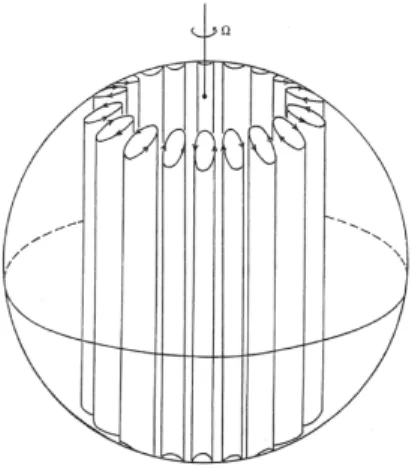
Fig. 1.2:A columnar structure alined with the rotation axis in a rotating sphere (Busse, 1970).
Fig. 1.3:The sketch of magnetogeostrophic flow viewed from the Northern hemisphere. Red and blue circles indicate clockwise anticyclone and counterclockwise cy-clone columns, respectively. Green, yellow, and white arrows show the Coriolis force, pressure gradient, and magnetic pressure, respectively. Magnetic field is concentrated inside anticyclone column because the Coriolis force faces in the direction of the center of the column.
Fig. 1.4:The geomagnetic field spectrum at the surface and the CMB in expansion of spherical harmonic degrees n. The curves represent the trend of observations at the Earth’s surface and extrapolations to the CMB (Langel and Estes, 1982).
Chapter 2
Method
2.1
Governing equations
In the present study, we use a numerical geodynamo model given by an electrically
conducting Boussinesq fluid in a rotating spherical shell. The governing equations
of the geodynamo in the outer core are described by the momentum equation, heat
equation, continuity equation, magnetic induction equation, and Gauss’s law for
the magnetic field, which are respectively given as
ρ0 ( ∂u ∂t + (u· ∇)u ) =−∇P + ρ0ν∇2u + ρg− 2ρ0Ω× u + J × B, (2.1) ∂T ∂t + (u· ∇)T = κT∇ 2T, (2.2) ∇ · u = 0, (2.3)
∂B
∂t =∇ × (u × B) + η∇
2B, (2.4)
and
∇ · B = 0, (2.5)
where u, B, J , g, T, P, ρ, αT, Ω, ν, κT, and η are velocity, magnetic field, current
density, acceleration of gravity, temperarure, pressure, mass density, thermal
ex-pansion rate, rotation angular velocity, kinematic viscosity, thermal diffusivity,
and magnetic diffusivity, respectively, and ρ0 is the stationary component of the
density. Since the Boussinesq approximation is applied in (2.1), the density
varia-tion due to temperature is only related to the buoyancy term. The mass density ρ is
written as a function of T as ρ = ρ0[1− αT(T− T0)], where T0is the temperature
of a reference state.
We normalize the length, time, temperature, pressure, and magnetic field by
the outer core thickness, L(= ro − ri), kinematic viscous diffusion time, L2/ν,
average temperature difference between the ICB and the CMB, ∆T , the pressure
by ν2/L2, and the magnetic field by√ρ
governing equations is given as ∂u ∂t + (∇ × u) × u = −∇ ( P + 1 2u 2 ) − ∇ × (∇ × u) +Ra P rT r ro − 2 Eez× u + 1 P m· E(∇ × B) × B, (2.6) ∂T ∂t =−(u · ∇)T + 1 P r∇ 2T, (2.7) ∇ · u = 0, (2.8) ∂B ∂t =∇ × (u × B) − 1 P m∇ × (∇ × B), (2.9) and ∇ · B = 0. (2.10)
The Rayleigh number, Ra, Ekman number, E, Prandtl number, P r, and magnetic
Prandtl number, P m are respectively defined as follows:
Ra = αTg0(∆T )L 3 νκT , E = ν ΩL2, P r = ν κT , P m = ν η. (2.11)
We use a numerical dynamo code Calypso (Matsui et al., 2014) for the
com-putation of the governing equations. The outer core is modeled in the
three-dimensional spherical coordinate (r, θ, ϕ). The spherical harmonic expansion is
used for the horizontal discretization. A scalar field, for example, temperature
T (r, θ, ϕ) is expanded as T (r, θ, ϕ) = lmax ∑ l=0 l ∑ m=−l Tlm(r)Ylm(θ, ϕ). (2.12) The spherical harmonics Ym
l are defined as real functions. Plmcos(mθ) is
as-signed for positive m, Plmsin(mθ) is assigned for negative m, where Plmare the Schmidt quasi-normalized associated Legendre functions. Because of (2.8) and
(2.10), velocity and magnetic field are solenoidal fields, which can be decomposed
into poloidal and toroidal components. For example, magnetic field is expressed
by B(r, θ, ϕ) = lmax ∑ l=1 l ∑ m=−l (BSlm+ BT lm), (2.13) where BSlm(r, θ, ϕ) =∇ × ∇ × (BSlm(r)Ylm(θ, ϕ)er), (2.14)
and
BT lm(r, θ, ϕ) =∇ × (BT lm(r)Ylm(θ, ϕ)er). (2.15)
Now er is a unit vector in the radial direction. The orthogonality relations for the
spherical harmonics Ym
l , the poloidal field (e.g., BSlm), and the toroidal field (e.g.,
BT lm) are ∫ ∫ YlmYlm′ ′sin θdθdϕ = 4π 1 2l + 1δll′δmm′, (2.16) ∫ ∫ BSlm· BSlm′′sin θdθdϕ = Nl 1 r2 [ l(l + 1) r2 |B m Sl| 2+ ∂BSlm ∂r 2]δll′δmm′, (2.17) ∫ ∫ BT lm· BT lm′′sin θdθdϕ = Nl 1 r2|B m T l| 2δ ll′δmm′, (2.18) and ∫ ∫ BSlm· BT lm′′sin θdθdϕ = 0, (2.19)
where δll′ is Kronecker delta and Nl = 4πl(l + 1)/(2l + 1). The second-order
For the time integration, the Crank-Nicolson method is used in the linear diffusive
terms and the second order Adams-Bashforth method is used in the other terms.
2.2
Initial and boundary conditions
For the initial condition, temperature perturbation was applied to all sectorial
modes given by l = |m|. The initial magnetic field was set as an axial dipole plus a zonal toroidal field based on Christensen et al. (2001). For the boundary
condition, simulations were performed with fixed temperature (FT) boundary and
fixed heat flux (FF) boundary. In FT cases, the temperatures at the CMB were
fixed as T00(ro) = 1 and Tlm(ro) = 0 for l≥ 1. The temperatures at the ICB were
also fixed as Tlm(ri) = 0 for l ≥ 0. In FF cases, the radial temperature gradient
was set as ∂T0
0/∂r = A, and ∂Tlm/∂r = 0 for l ≥ 1, where A is a constant heat
flux. The mantle and inner core were assumed to be co-rotating, and a non-slip
boundary (u = 0) was applied to the CMB and ICB, i.e., the poloidal and toroidal
coefficients of velocity, Um
Sl(r) and USTm(r) were set as USlm(r) = ∂USlm/∂r = 0
and UT lm(r) = 0 at the CMB and ICB. The mantle and inner core were assumed to be electrically insulated, and the magnetic field at the boundaries was connected
to the potential field, i.e., the poloidal and toroidal coefficients of magnetic field,
Bm
parameter setting, Ra was changed among the cases; the Ekman, Prandtl, and
magnetic Prandtl numbers were fixed at E = 1× 10⁻³, P r = 1, and P m = 5 in all simulation cases. The truncation of the spherical harmonics and the radial grid
points were set to lmax = 47 and Nr = 63, respectively. To avoid aliasing in the
spherical harmonic expansion, horizontal grids were set to (Nθ, Nϕ) = (72, 144).
To investigate the effects of different inner core sizes, the spherical shell radius
ratios of the inner core radius to the outer core radius were set as ri/ro = 0.15,
0.25, and 0.35. The inner and outer core radii, riand ro, were defined by
ri= ri/ro 1− ri/ro , ro = 1 1− ri/ro . (2.20)
In each radius ratio case, ri and ro were set as Table 2.1. First, we performed
numerical simulations of non-magnetic thermal convection in rotating spherical
shells to estimate the critical Rayleigh number, Racrit, for the onset of thermal
convection. We then carried out numerical simuations of magnetohydrodynamic
(MHD) dynamos driven by the thermal convection.
Table 2.1:Spherical shell dimensions for various values of ri/ro.
ri/ro ri ro L
0.15 3/17(= 0.1764705882352941) 20/17(= 1.1764705882352941) 1 0.25 1/3(= 0.3333333333333333) 4/3(= 1.3333333333333333) 1 0.35 7/13(= 0.5384615384615384) 20/13(= 1.5384615384615384) 1
Chapter 3
Fixed temperature
3.1
Result of thermal convection
First, we performed numerical simulations of non-magnetic thermal convection
in order to estimate the critical Rayleigh number (Racrit), the Rayleigh number
required for the onset of the thermal convection. We solved the set of equations of
(2.6) without the Lorentz force term, (2.7), and (2.8). The kinetic energy density
was calculated by Ekin = 1 2VS ∫ VS u2dV, (3.1)
where VS is the volume of the spherical shell, for the average in the time interval
from t/τν = 4.5 to 6, where τν is the viscous diffusion time.
numbers are estimated to be Racrit = 1.09× 10⁵, 0.72× 10⁵, and 0.56× 10⁵ in
ri/ro = 0.15, 0.25, and 0.35, respectively, by the method used in Al-Shamali et al.
(2004). The obtained values of Racritare almost identical to those reported in
Al-Shamali et al. (2004) for the same parameters and conditions used in this study.
We obtain larger Racrit for the smaller aspect ratio, indicating that the convection
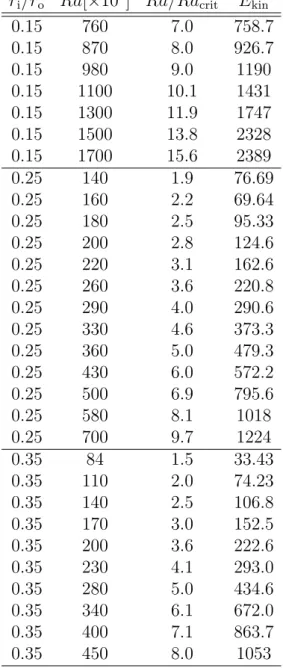
in a rotating, thick spherical shell requires large buoyancy. Ekinlisted in Table3.2
are results of larger Ra cases than those in Table3.1.
3.2
Result of MHD simulation
We performed MHD dynamo simulations for various Rayleigh numbers and the
radius ratios using Eqs. (2.6)-(2.10). The magnetic energy density was calculated
by Emag = 1 2VSEP m ∫ VS B2dV. (3.2)
Tables 3.3, 3.4, and 3.5 list results of MHD simulations. First, we changed the
amplitude of the initial magnetic field, Binit = 0.3, 0.5, 0.7, and 1, at Racrit = 2.5
for ri/ro = 0.25. The time evolution of the kinetic and magnetic energy densities
in each Binit is shown in Fig. 3.2. When large Binit were set, Ekin and Emag
we adopted Binit = 1. We performed numerical simulations for the time interval
at least two magnetic diffusion times (t = 2τη = 2P mτν) to assess whether the
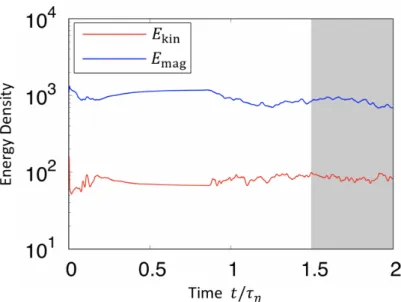
magnetic field was sustained or dissipated. Fig.3.3 shows the time evolution of
the kinetic and magnetic energy densities at Racrit = 2.8 for ri/ro = 0.25, as an
example of the case where the magnetic field was sustained. We calculated the
time average of the kinetic and magnetic energy densities as well as the dipolarity
over the 0.5 magnetic diffusion time at the end of simulations, the time interval
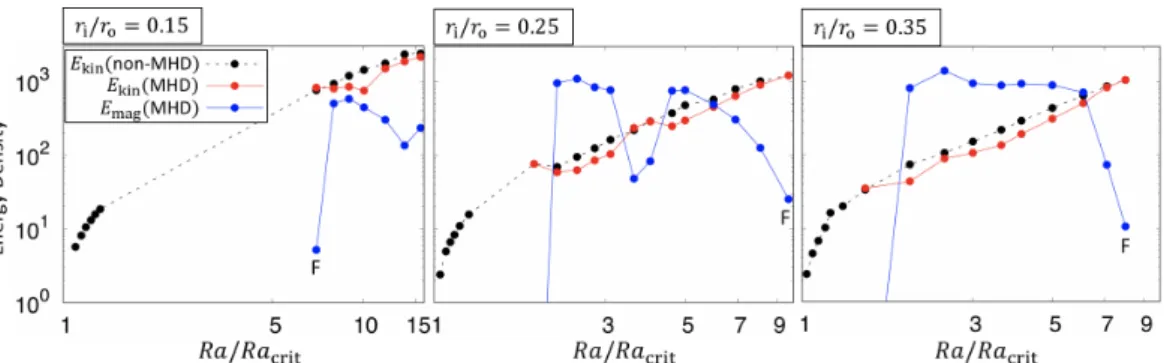
indicated by the shaded area in Fig.3.3. The kinetic and magnetic energy densities
as a function of the Rayleigh number are shown in Fig. 3.4, where the black,
red, and blue points are the Ekin in the non-MHD cases, Ekin in the MHD cases,
and Emag in the MHD cases, respectively. The ”F” denotes the failed dynamo
cases. In each radius ratio case with a sustained magnetic field, the Ekinvalues in
the MHD cases are smaller than the Ekin values in the corresponding non-MHD
cases. These results show that the Lorentz force caused by the intense magnetic
field disturbs convection. We also find the different tendency of the kinetic and
magnetic energy densities among the three radius ratio cases. At ri/ro = 0.15,
the Emag values in the MHD cases are smaller than the Ekin values in the MHD
cases for all cases. This trend is consistent with the results of Heimpel et al.
significantly smaller than those for the cases of other Rayleigh numbers. Although
the trend in the magnetic energy spectrum does not change, there is a decrease in
the amplitude. At ri/ro = 0.35, the values of Emag in the MHD cases are larger
than the values of Ekin in the MHD cases for almost all cases. The results of the
different ri/ro indicate that it is not likely to sustain a strong magnetic field with
a smaller inner core.
To examine dynamics of the outer core, we calculated the Elsasser number Λ,
which is the ratio of the Lorentz force to the Coriolis force. The Elsasser number
is acquired by
Λ = B
2
ρ0µ0ηΩ
= 2P mEEmag. (3.3)
Fig. 3.5 shows Λ as a function of the Rayleigh number for different spherical
shell geometries. The red, blue, and green points indicate the cases of ri/ro =
0.15, 0.25, and 0.35, respectively. The range of Λ is approximately from 5 to 10
in sustained strong dipole dynamo cases in all ratios, indicating that the Lorentz
force is sufficiently working for core dynamics. At ri/ro = 0.15, even though the
magnetic energy is smaller than kinetic energy, Λ is larger than one and therefore
the Lorentz force is significantly working as well.
To examine the dynamo occurring condition, we calculated the magnetic Reynolds
induction equation. The magnetic Reynolds number is acquired by
Rm = U L
η =
√
2EkinP m. (3.4)
Fig. 3.6 shows Rm as a function of the Rayleigh number for different spherical
shell geometries. The red, blue, and green circles indicate Rm values in the cases
of ri/ro = 0.15, 0.25, and 0.35, respectively. We found that Rm increases with
increasing the Rayleigh number in all radius ratio cases. The range of Rm for
sustained dynamos was Rm > 193.4 at ri/ro = 0.15, Rm > 54.3 at ri/ro =
0.25, and Rm > 46.7 at ri/ro = 0.35. This is consistent with the numerical
simulation results of Olson et al. (2006) that the minimum Rm is approximately
39 at ri/ro = 0.35. The minimum Rm for sustained dynamos becomes larger
with the smaller inner core, indicating that larger generation term in the induction
equation is needed to defeat magnetic diffusion with the smaller inner core.
Magnetic moment M is calculated from Eq. (1.3). From the Preliminary
Ref-erence Earth Model (Dziewonski and Anderson, 1981), the density in the outer
core is 10 − 12 g/cm3(≈ 104 kg/m3), so we use ρ
0 = 104 kg/m3. The
mag-netic permeability in vacuum is a constant; µ0 = 4π× 10−7 H/m. The
rota-tion angular velocity Ω = 2π/1 day = 7.27 × 10⁻⁵/s. The magnetic
5 are acquired from this magnetic field scaling.
To verify whether the truncation of lmax = 47 is sufficient resolution, we
performed simulations for Ra/Racrit = 2.0 at ri/ro = 0.35 with lmax = 47 and
95. Spectra of kinetic and magnetic energy densities are shown in Figs.3.7 and
3.8. The spectrum with lmax = 47 is almost the same as that with lmax = 95 for
l ≤ 47. This truncation is found to be enough to solve dynamo simulations in this
control parameter setting.
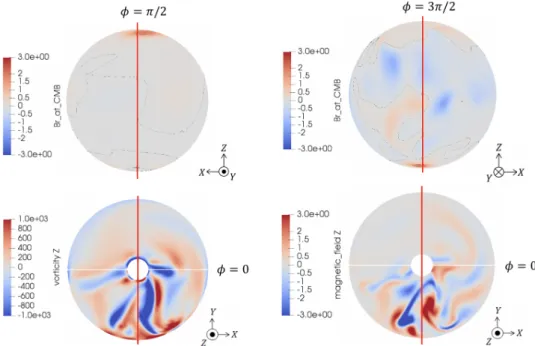
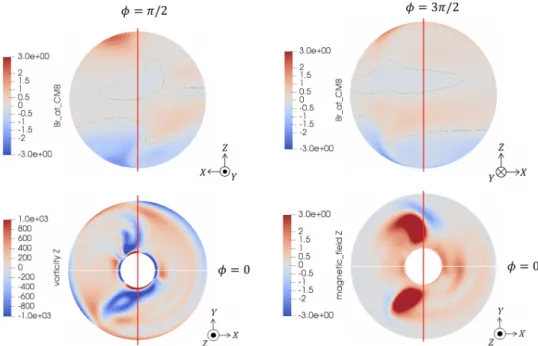
Fig.3.9shows the radial component of the magnetic field at the CMB and the
equatorial cross-sections of the z-component of the vorticity and magnetic field
are plotted at Ra/Racrit = 11.9 for ri/ro = 0.15. The same plots at Ra/Racrit=
3.1 for ri/ro = 0.25 and at Ra/Racrit = 3.0 for ri/ro = 0.35 are shown in
Figs 3.10and3.11, respectively. Spectra of kinetic and magnetic energy density
are shown in Figs 3.12, 3.13, and 3.14. At the equatorial plane, the magnetic
field is concentrated in the anti-cyclone columns to generate a dipolar field at
ri/ro = 0.25 and 0.35; intense magnetic patches are located near the tangent
cylinder, which is an imaginary cylinder tangent to the inner-core equator and
coaxial with the rotation axis. In the case of ri/ro = 0.15, strong convection is
generated locally, where strong BZ convection is generated between the cyclonic
and anti-cyclonic columns in the equatorial plane. As these intense magnetic fields
are not concentrated in the convection columns, the radial magnetic field at the
equator) and is smaller than that of the cases with different aspect ratios.
3.3
Assessment of dipolar dominance
In numerical dynamos, dipolarity is used for quantification of the magnetic field
morphology at the CMB. Although the dipolarity has been evaluated in some
nu-merical dynamos (Christensen and Aubert, 2006; Soderlund et al., 2012), it is
not sufficiently valid in dynamos whose dipolarities are gradually changing (e.g.,
Aubert et al., 2009). In an observational study of the geomagnetic field, the dipole
is assessed by how far the dipolar component is from the trend of higher degree
components (Lowes 1974; Langel and Estes, 1982). We quantitatively evaluated
the dipolar component dominance in combination with the dipolarity, comparison
of the dipolar magnetic energy, and an extrapolation of l = 1 based on the fitting
curve for higher degrees. To quantitatively evaluate the axial dipole component
dominancy, we calculated the dipolarity at the CMB, defined by
fdip= ( Emag(l=1,m=0)(r = ro) ∑lmax l=1 ∑l m=0E (l,m) mag (r = ro) )1/2 , (3.5)
where Emag(l,m)(r = ro) is the magnetic energy of (l, m) component at the CMB.
CMB, Emag(r = ro), is calculated by Emag(r = ro) = 1 2SoEP m ∫ S B2dS, (3.6)
where So(= 4πro2) is the area of the CMB. Fig.3.15 shows the dipolarity as a
function of the Rayleigh number for ri/ro = 0.15, 0.25, and 0.35. The dipolarity
gradually decreases with increasing Rayleigh number for ri/ro = 0.25 and 0.35.
The axial dipolar component becomes weak during intense convection. The
de-pendency of the dipolarity on the Rayleigh number is similar for the radius ratio
cases of ri/ro = 0.25 and 0.35. Here, fdipis always larger than 0.35 in the cases of
ri/ro = 0.25 and 0.35. In contrast, we find the different tendency in ri/ro = 0.15;
fdipis larger than 0.45 at Ra/Racrit = 8.0 and 9.0 while fdipis smaller than 0.35
at Ra/Racrit > 10.1.
Previous numerical dynamo simulations used the threshold of the dipolar
dom-inance for fdip = 0.35. To obtain a clearer threshold for the dipole dominancy,
we focused on the magnetic energy spectrum at the CMB as a function of the
spherical harmonic degree, l. For example, Fig.3.16 shows the magnetic energy
density as a function of the spherical harmonic degree at Ra/Racrit = 2.8 for
ri/ro = 0.25. Using odd-degree components in the magnetic energy from l = 3
to 19, we evaluated a fitting curve as 46.21 × 1.481−l. We compared the Emag
of the simulation result at l = 1 (El=1
function (Emag fittingl=1 ). Then, we acquired the ratio of Emag for the simulation
re-sult to that from the extrapolated value, Emag datal=1 /Emag fittingl=1 (hereafter referred to as fmag fit). We can assess the dipolar component dominance from a higher
de-gree trend based on how much the ratio of the extrapolation from fitting fmag fitis
larger than 1. Here, fmag fitwas calculated in all cases and plotted as a function of
the Rayleigh number at ri/ro = 0.15, 0.25, and 0.35 (Fig.3.17). At ri/ro = 0.15,
fmag fit was smaller than 1 at Ra/Racrit > 10.1. At ri/ro = 0.25, fmag fit was
approximately 2.1 at Ra/Racrit = 2.2 and gradually decreased to 1.6 with
in-crease of Ra/Racrit of up to approximately 8.0. At ri/ro = 0.35, fmag fit was
approximately 4.7 at Ra/Racrit = 2.0, gradually decreasing to 2.1 with increase
of Ra/Racritup to approximately 7.0.
Comparing the result between fdipand fmag fit, we find that the dipolar
domi-nane decreases with increasing Rayleigh number. At ri/ro = 0.15, weak dipolar
dominancy can be represented by Ra/Racrit > 10.1 for both indices. We note
the different behavior of fdip and fmag fit in the smaller Ra/Racrit range in the
different ri/rocases; the fdipvalues obtained in ri/ro = 0.25 are larger than those
in ri/ro = 0.35, while the fmag fit values obtained in ri/ro = 0.25 are smaller
than those in ri/ro = 0.35. The different behavior of fdipand fmag fitcan be
ri/ro = 0.25 and 0.35, Emag datal=1 is significantly large at ri/ro = 0.35, and
there-fore fmag fitis large at ri/ro = 0.35 than at ri/ro = 0.25. The difference between
fdipand fmag fit is whether a higher-degree spectrum is taken into account or not.
The dependence of the dipolar dominance on the radius ratio can be revealed by
fmag fitas it contains information obtained from a higher degree spectrum.
We show an example in which we could not categorize the dipole or
non-dipole based only on the dipolarity, i.e., the cases for fdip = 0.376 at Ra/Racrit=
7.1 with ri/ro = 0.35 and fdip = 0.349 at Ra/Racrit = 10.1 for ri/ro = 0.15.
Fig. 3.18shows the CMB spectra for these two cases. The dipolar component is
dominant against the high degree trend in the former case while it is not dominant
in the latter case. The ratio of extrapolation from the fitting is fmag fit = 2.071
in the former case and fmag fit = 0.860 in the latter case; we observed that the
former case is dipolar-dominated while the latter case is non-dipolar dominated.
The results of fmag fitalso indicate the dependence of the dipolar dominance on the
inner core size. The dipolar dominance becomes weaker with a smaller inner core
by calculating the dipolar magnetic energy at the CMB (Heimpel et al., 2005). On
the other hand, this tendency is not obvious in the results of fdip.
Consideration using both fdipand fmag fitenables us to categorize the dynamo
regime of the simulation results quantitatively. The results of the categorization
of the dynamo regime are shown in Fig. 3.19, where the red circles, blue
non-dipolar, and failed dynamo cases, respectively. We categorized strong
dipo-lar when the magnetic energy is dipo-larger than the kinetic energy in each simulation
result, and vice versa. Sustaining the dynamo with a smaller inner core size
re-quires a larger Rayleigh number. This is consistent with the findings of Heimpel
et al. (2005). At ri/ro = 0.35, almost all the sustained dynamo cases were strong
dipoles. At ri/ro = 0.25, there were strong dipolar dynamo cases and weak
dipo-lar dynamo cases. At ri/ro = 0.15, there were weak dipolar and non-dipolar
dynamo cases.
3.4
Discussion
The dipolarity at the CMB of the present Earth is fdip= 0.64, which is calculated
from the 13th IGRF model (Alken et al., 2021). The present radius ratio, ri/ro, is
0.35. The range of the dipolarity calculated from results of our numerical
simu-lations of geodynamo for ri/ro = 0.25 and 0.35 covers the present Earth’s
dipo-larity. The morphology of the sustained magnetic field in both ratios is Earth-like.
The ratio of the extrapolation from fitting in the present Earth is fmag fit = 4.925.
Here, fmag fit is larger than approximately half of the present Earth’s value for
almost all the cases at ri/ro = 0.35 while fmag fit is smaller than that of almost
ri/ro = 0.25 than the present Earth. In contrast, the dipolarity at ri/ro = 0.15 is
smaller than the present Earth’s dipolarity in all cases. The dipole component is
not dominant.
In numerical dynamos at ri/ro = 0.35, we verified that the transition between
the dipole and non-dipole is fdip ≈ 0.35 (Christensen and Aubert, 2006; Olson et
al., 2011). Our results are consistent with this transition. While dipolarity is an
ef-fective index if dynamos can be categorized into large and small dipolarity groups,
the combination of dipolarity and the ratio of extrapolation from fitting assesses
the dipolar dominance if the dipolarity changes gradually, as in our results.
At ri/ro = 0.15, an axial dipole field formed by a single column (Heimpel
et al., 2005). In this study, a dipole field is also formed by some azimuthally
localized narrow columns around the dynamo-onset cases. Emag is found to be
always smaller than Ekinin all Ra cases. The magnitude relationship is the same
as that of Heimpel et al. (2005). A strong dipole is sustained with a smaller inner
core in the fixed flux calculation (Hori et al., 2010), changing the core power based
on the thermal history (Driscoll, 2016), or the buoyancy gained by light elements
(Lhuillier et al., 2019). Clarifying how heat flow at boundaries sustains the dipole
requires further numerical simulations.
Our proposed method of evaluating the dipolar dominance, fmag fit, enables
quantitative investigations of the magnetic field structure in the past environment.
ge-omagnetic pole), is acquired based on the assumption that the gege-omagnetic field
was dipolar-dominated in the past (Merrill et al., 1996). In contrast, the VGP paths
and actual behavior of the geomagnetic field are not dipolar-dominant.
Investiga-tion of the numerical dynamo with our proposed method is capable of improving
the understanding of the actual behavior of the geomagnetic field and
Table 3.1:Results of Ekin for thermal convection at t = 6τν in ri/ro= 0.15, 0.25, and
0.35 under the FT boundary condition. ri/ro Ra[×105] Ekin 0.15 1.0 8.31× 10⁻⁶ 0.15 1.2 5.72 0.15 1.25 8.15 0.15 1.3 10.62 0.15 1.35 13.16 0.15 1.4 15.80 0.15 1.45 18.54 0.25 0.70 8.55× 10⁻⁴ 0.25 0.75 2.41 0.25 0.78 4.94 0.25 0.80 6.62 0.25 0.82 8.35 0.25 0.85 11.02 0.25 0.90 15.70 0.35 0.55 1.76× 10⁻⁴ 0.35 0.58 2.38 0.35 0.60 4.54 0.35 0.62 6.76 0.35 0.65 10.22 0.35 0.67 12.60 0.35 0.70 16.28
Table 3.2:Results of Ekinin ri/ro= 0.15, 0.25, and 0.35.
ri/ro Ra[×105] Ra/Racrit Ekin
0.15 760 7.0 758.7 0.15 870 8.0 926.7 0.15 980 9.0 1190 0.15 1100 10.1 1431 0.15 1300 11.9 1747 0.15 1500 13.8 2328 0.15 1700 15.6 2389 0.25 140 1.9 76.69 0.25 160 2.2 69.64 0.25 180 2.5 95.33 0.25 200 2.8 124.6 0.25 220 3.1 162.6 0.25 260 3.6 220.8 0.25 290 4.0 290.6 0.25 330 4.6 373.3 0.25 360 5.0 479.3 0.25 430 6.0 572.2 0.25 500 6.9 795.6 0.25 580 8.1 1018 0.25 700 9.7 1224 0.35 84 1.5 33.43 0.35 110 2.0 74.23 0.35 140 2.5 106.8 0.35 170 3.0 152.5 0.35 200 3.6 222.6 0.35 230 4.1 293.0 0.35 280 5.0 434.6 0.35 340 6.1 672.0 0.35 400 7.1 863.7 0.35 450 8.0 1053
T able 3.3: Results of Ekin ,E mag , and fdip for MHD dynamos at ri /r o = 0 .15 under the FT boundary condition. ri /r o R a [× 10 3 ] R a/R acrit Ekin Emag Λ R m fdip fmag fit M [ZAm 2 ] 0 .15 440 4 .0 297 .1 3 .244 0 .0324 121 .9 − − − 0 .15 760 7 .0 823 .7 5 .193 0 .0519 202 .9 − − − 0 .15 870 8 .0 801 .4 501 .6 5 .02 200 .2 0 .494 1 .435 70 .06 0 .15 980 9 .0 846 .4 579 .0 5 .79 205 .7 0 .516 1 .866 75 .20 0 .15 1100 10 .1 748 .4 444 .7 4 .45 193 .4 0 .349 0 .860 27 .69 0 .15 1300 11 .9 1493 300 .5 3 .01 273 .2 0 .117 0 .322 13 .04 0 .15 1500 13 .8 1867 135 .6 1 .36 305 .5 0 .155 0 .391 9 .155 0 .15 1700 15 .6 2141 234 .3 2 .34 327 .2 0 .172 0 .420 14 .67
T able 3.4: Results of Ekin ,E mag , and fdip for MHD dynamos at ri /r o = 0 .25 under the FT boundary condition. ri /r o R a [× 10 3 ] R a/R acrit Ekin Emag Λ R m fdip fmag fit M [ZAm 2 ] 0 .25 140 1 .9 76 .69 1 .491 × 10 − 4 1 .491 × 10 − 6 61 .68 − − − 0 .25 160 2 .2 59 .05 958 .6 9 .59 54 .33 0 .860 2 .116 270 .4 0 .25 180 2 .5 62 .89 1097 10 .97 56 .08 0 .867 2 .397 286 .4 0 .25 200 2 .8 85 .49 844 .4 8 .44 65 .38 0 .784 1 .828 221 .9 0 .25 220 3 .1 103 .9 769 .2 7 .69 72 .08 0 .757 2 .441 200 .0 0 .25 260 3 .6 236 .4 48 .4 0 .484 108 .7 0 .644 2 .477 34 .87 0 .25 290 4 .0 289 .3 83 .0 0 .830 120 .3 0 .620 2 .610 41 .30 0 .25 330 4 .6 248 .6 753 .8 7 .54 111 .5 0 .602 2 .287 103 .3 0 .25 360 5 .0 297 .7 769 .0 7 .69 122 .0 0 .562 1 .935 146 .6 0 .25 430 6 .0 455 .6 491 .0 4 .91 150 .9 0 .522 1 .887 83 .72 0 .25 500 6 .9 642 .2 305 .2 3 .05 179 .2 0 .456 1 .551 62 .10 0 .25 580 8 .1 906 .8 126 .0 1 .26 212 .9 0 .412 1 .556 50 .84 0 .25 700 9 .7 1221 25 .4 0 .254 247 .1 − − −
T able 3.5: Results of Ekin ,E mag , and fdip for MHD dynamos at ri /r o = 0 .35 under the FT boundary condition. ri /r o R a [× 10 3 ] R a/R acrit Ekin Emag Λ R m fdip fmag fit M [ZAm 2 ] 0 .35 84 1 .5 35 .09 2 .376 × 10 − 3 2 .376 × 10 − 5 41 .89 − − − 0 .35 110 2 .0 43 .61 819 .6 8 .20 46 .70 0 .816 4 .713 297 .6 0 .35 140 2 .5 89 .35 1408 14 .1 66 .83 0 .724 3 .174 356 .0 0 .35 170 3 .0 106 .8 950 .2 9 .50 73 .08 0 .739 4 .239 236 .8 0 .35 200 3 .6 136 .3 890 .2 8 .90 82 .55 0 .692 3 .900 200 .3 0 .35 230 4 .1 193 .1 938 .4 9 .38 98 .26 0 .632 2 .946 203 .4 0 .35 280 5 .0 311 .9 895 .6 8 .96 124 .9 0 .556 2 .848 162 .3 0 .35 340 6 .1 508 .7 713 .6 7 .14 159 .5 0 .480 2 .006 132 .7 0 .35 400 7 .1 837 .6 73 .46 0 .735 204 .7 0 .376 2 .071 24 .92 0 .35 450 8 .0 1060 10 .61 0 .106 230 .2 − − −
Fig. 3.1:The kinetic energy density, as a function of the Rayleigh number, calculated in spherical shells with different geometries. Red, green, and blue lines indicate the linear fitting for ri/ro = 0.15, 0.25, and 0.35, respectively.
Fig. 3.2:Time evolution of energy density in various amplitudes of the initial magnetic field at Ra/Racrit= 2.5 at ri/ro = 0.25.
Fig. 3.3:Time evolution of energy density in the case of sustained dynamo at Ra/Racrit = 2.8 at ri/ro = 0.25. The red and blue lines denote the kinetic
Fig. 3.4:The kinetic and magnetic energy density as a function of the Rayleigh number in spherical shells with different geometries. The black, red, and blue points are the Ekin values in the non-MHD cases, Ekin values in the MHD cases, and
Emagvalues in the MHD cases, respectively. The ”F” denotes the failed dynamo
cases.
Fig. 3.5:The Elsasser number Λ as a function of the Rayleigh number for different spher-ical shell geometries. The red, blue, and green circles indicate Lambda values for the cases of ri/ro= 0.15, 0.25, and 0.35, respectively.
Fig. 3.6:The magnetic Reynolds number Rm as a function of the Rayleigh number for different spherical shell geometries. The red, blue, and green circles indicate Rm values for the cases of ri/ro = 0.15, 0.25, and 0.35, respectively.
Fig. 3.7:Spectrum of the kinetic and magnetic energy density for the case with Ra/Racrit = 2.0 at ri/ro = 0.35 and lmax = 47. The red and blue lines
denote the kinetic and magnetic energy density, respectively.
Fig. 3.8:Spectrum of the kinetic and magnetic energy density for the case with Ra/Racrit = 2.0 at ri/ro = 0.35 and lmax = 95. The red and blue lines
Fig. 3.9:Spatial pattern of the flow and magnetic fields for the case with Ra/Racrit =
11.9 at ri/ro = 0.15. The radial magnetic field, Br, at the CMB, viewed from
ϕ = π/2 and 3π/2, are plotted in the upper left and right, respectively. The z component of the vorticity, ωZ, and magnetic field, BZ, at the equatorial plane
Fig. 3.10:Spatial pattern of the flow and magnetic fields for the case with Ra/Racrit =
3.1 at ri/ro = 0.25. The radial magnetic field, Br, at the CMB, viewed from
ϕ = π/2 and 3π/2, are plotted in the upper left and right, respectively. The z component of the vorticity, ωZ, and magnetic field, BZ, at the equatorial plane
Fig. 3.11:Spatial pattern of the flow and magnetic fields for the case with Ra/Racrit =
3.0 at ri/ro = 0.35. The radial magnetic field, Br, at the CMB, viewed from
ϕ = π/2 and 3π/2, are plotted in the upper left and right, respectively. The z component of the vorticity, ωZ, and magnetic field, BZ, at the equatorial plane
Fig. 3.12:Spectrum of the kinetic and magnetic energy density at t/τη = 2.0 for the case
with Ra/Racrit = 11.9 at ri/ro = 0.15. The red and blue lines denote the
kinetic and magnetic energy density, respectively.
Fig. 3.13:Spectrum of the kinetic and magnetic energy density at t/τη = 2.0 for the case
with Ra/Racrit = 3.1 at ri/ro = 0.25. The red and blue lines denote the
Fig. 3.14:Spectrum of the kinetic and magnetic energy density at t/τη = 2.0 for the case
with Ra/Racrit = 3.0 at ri/ro = 0.35. The red and blue lines denote the