THE MODULI SPACE OF ONCE PUNCTURED ELLIPTIC CURVES
WITH LAGRANGIAN SUBLATTICES
YOSHITAKE HASHIMOTO (橋本義武) AND KIYOSHI OHBA (大場清)
1. INTRODUCTION
We introduced a new method ofconstructing once punctured Riemann surfaces in
[H-Ol] (see also [H-O2]). In our construction we use line segments in the complex plane
$\mathbb{C}$ and parallel transformations: For a pair of disjoint parallel line segments with the
same length in $\mathbb{C}$, we first cut $\mathbb{C}$ along the segments and paste each side ofone segment
and the opposite side of the other segment by a parallel transformation obtaining a once
punctured elliptic curve. The puncture is at infinity. We shall call such a pair an Igeta.
(Igetais aJapanesewordcomingfrom atechnical term “Igeta-kuzushi” used in aJapanese
martial art.) Putting$g$disjoint pieces ofIgeta on $\mathbb{C}$, we obtainaonce punctured Riemann
surface of
genus
$g$ in the salne way. (See Figure 1. The numbers (1),$\ldots,(6)$ in Figure 1indicate where to paste.) We denote a set of$g$ disjoint Igeta by $\Gamma$ and the resulting once
punctured Riemann surface by $(R(\Gamma),p_{\infty})$. Moreover when we
move
the position of $g$Igeta, there appears a family of once punctured Riemann surfaces of
genus
$g$. All thepossible configurations of $g$ disjoint Igeta up to the affine automorphisms of $\mathbb{C}$ form a
$3g-2$-dimensional complex $\iota\nearrow$-manifold and this dimension is the same as the dimension
of the moduli space $\mathcal{M}_{g,1}$ ofoncepunctured Rielnann surfaces ofgenus $g$
.
We thusexpectto have avisual image ofthe lnoduli space by using this construction.
Let $I_{g}\eta_{0}$ be the collection of those $\Gamma$ having $[0,1]$ as one of its $2g$ line segments.
$I_{g}\eta_{0}$ turns out to be a $3g-2$-dimensional complex manifold. We showed in [H-O1] that the
Kodaira-Spencer map
$\rho_{\Gamma,0}$
:
$T(I_{g}\mathit{7}|_{0})_{\mathrm{r}}arrow H^{1}(R(\Gamma);(-p\infty))$is an isomorphism for any $\Gamma\in I_{g}\eta_{0}$, where $T(I_{g}\eta_{0})_{\Gamma}$ is the holomorphic tangent space of
$I_{g}\eta_{0}$ at $\Gamma$ and $(-p_{\infty})$ is the sheaf ofgerms ofholomorphic vector fields on $R(\Gamma)$ having
zero
at $p_{\infty}$. This implies that the family ofonce
punctured Riemann surfaces ofgenus
$g$by Igeta-construction is $\mathrm{c}\mathrm{o}\mathrm{n}\mathrm{u}\mathrm{l}$)
$\mathrm{l}\mathrm{e}\mathrm{t}\mathrm{e}$ and effectively
parametrized at any point for each $g$.
We also showed that any once punctured Riemann surface $(R,p)$ can be obtained from
$\mathbb{C}$ by cutting along line segments and pasting by parallel transformations. (Note that
Igeta-construction is a special way of cutting and pasting.) This result is obtained by
considering a Lagrangian sublattice A of $R$, a subgroup of $H_{1}(R;\mathbb{Z})$ which coincides its
orthogonal $\mathrm{C}\mathrm{O}\ln_{\mathrm{P}^{1\mathrm{e}\mathrm{n}}}\mathrm{e}\mathrm{m}\mathrm{t}$with $1^{\cdot}\mathrm{e}\mathrm{s}_{\mathrm{P}^{\mathrm{e}\mathrm{c}\mathrm{t}}}$ to the intersection form
on
$H_{1}(R;\mathbb{Z})$.When we construct a once punctured Riemann surface $(R(\Gamma),p_{\infty})$ from $\Gamma,$ $R(\Gamma)$ has
a natural Lagrangian sublattice $\Lambda_{\Gamma}$. Igeta-construction leads us to consider the moduli
space of once punctured Riemann surfaces with Lagrangian sublattices.
In this paper we consider the case of genus 1, and describe the moduli space using a
natural extension ofIgeta-construction, that is, we make a complete list of
once
puctured$/$
$/$
$arrow$ cut $\nearrow\nearrow$ $\approx$ $(4)\backslash (3)$ (5) (6) $(3)\backslash ^{(4)}$ (6) (5) FIGURE 1. Igeta-constructionTheorem 1. Foranyoncepunctured ellipticcurve with a Lagrangian sublattice$(E,p, \Lambda)$,
there exists one and $onl\tau/one(E(a, b, x),p_{\infty’ 0}\Lambda)$ isomorphic to $(E,p, \Lambda)$.
For any once $\mathrm{p}\mathrm{u}\mathrm{n}\mathrm{c}\mathrm{t}_{\mathrm{U}\mathrm{l}\mathrm{e}}\mathrm{d}$ Riemann surface $(R,p)$, a Lagrangian sublattice A and the
puncture $p$ deternline a certain Abelian differential $\omega_{\Lambda}$ of the second kind up to scalars.
To prove Theorem 1 westudy the geolnetry ofgeodesics on once punctured elliptic curves
having metrics with conical singularities induced by the Abelian differentials $\omega_{\Lambda}$. For
each $(.E(a, b, x),p_{\infty}, \Lambda 0)$, all the closed geodesics can be described visually by using our
construction.
In
\S 3
we consider the conuplex structure ofthe moduli space ofonce
punctured ellipticcurves
with Lagrangian sublattices by using the description given in\S 2.
The authors would lilie to thank the many people who have contributed ideas and
suggestionsfor this $\mathrm{m}\mathrm{a}\mathrm{n}\mathrm{u}\mathrm{s}\mathrm{C}\Gamma \mathrm{i}1^{)}\mathrm{t},$ anlongthem C. F. B\"odigheimer, V. Chueshev, K. Fukaya,
M. Furuta, A. Hattori, S.
Morita
and K. Ono. The authors would like to express theirgratitude to H. Helling for useful suggestions on how to improve the early drafts.
2. ELLIPTIC CURVES WITH LAGRANGIAN SUBLATTICES
In this section, we give a description of all the once punctured elliptic
curves
withLagrangian sublattices $.\mathrm{b}\mathrm{y}$ using a natural extension ofIgeta-construction.
We prepare some notations and ternls about the metrics induced by Abelian
$\gamma$ : [$0,11arrow R$ -line-segment ifits image contains
no
poles of and the integral $\int_{\gamma(0}^{\gamma(1)})\omega$$\mathrm{d}\mathrm{e}\mathrm{p}\mathrm{e}\mathrm{n}\mathrm{d}_{\mathrm{S}}$
on
$t\in[0,1]\mathrm{l}\mathrm{i}\overline{\mathrm{n}}$early. We also call its image $\omega$-line-segment. Let us denoteby $g_{\omega}$ the flat metric on $R-\omega^{-1}(\infty)$ induced by the 2-form
$\frac{i}{2}\omega\wedge\overline{\omega}$, which has conical
singularities at $\omega^{-1}(0)$
.
Then $\omega$-line-segments are geodesics for $g_{\omega}$. Let us call a $\omega$-line-segment $\gamma$ : $[0,1]arrow R-\omega^{-1}(\infty)\omega$-edgeif$\gamma([0,1])\cap\omega^{-1}(0)=\{\gamma(0), \gamma(1)\}$
.
Then closedgeodesics with respect to $g_{\omega}$ which contain some zeros of
$\omega$ consist of $\omega$-edges because
the integral of $\omega$ gives rise to a local isometry between $R-(\omega^{-1}(\infty)\cup\omega^{-1}(0))$ and
$\mathbb{C}$
.
An Abelian differential $\omega$ of the second kind
on
a closed Riemann surface $R$ inducesan element of $H^{1}(R;\mathbb{C})$, and further an elenuent denoted by $\mathrm{P}\mathrm{D}[\omega]$ of $H_{1}(R;\mathbb{C})$ via the
Poincar\’e duality. It holds that
$\int_{\alpha}\omega=\alpha\cdot \mathrm{P}\mathrm{D}[\omega]$ for any $\alpha\in H_{1}(R;\mathbb{Z})$
.
We look for a singular 1-cycle $\sigma$ representing $\mathrm{P}\mathrm{D}[\omega]$ such that
$\sigma=\sum_{k=1}^{N}ck.\gamma_{k}.$, $c_{k}\in \mathbb{C}$
where $\gamma_{1},$ $\ldots,\gamma_{N}$ are $\omega$-edges. (We can find it if$\omega^{-1}(0)$ is nonempty.)
Let $(R,p)$ be
a once
punctured Rielnann surface ofgenus
$g$ and Aa
Lagrangiansub-lattice of $H_{1}(R;\mathbb{Z})$. The kernel $Z_{\Lambda}$ ofthe $\mathrm{h}_{01}\mathrm{n}\mathrm{o}\mathrm{m}\mathrm{o}\mathrm{r}\mathrm{p}\mathrm{h}\mathrm{i}_{\mathrm{S}}\mathrm{m}$given by Abelian integrals $H0(R;\Omega 1(2\mathrm{P}))arrow \mathrm{H}\mathrm{o}\mathrm{m}(\Lambda,\mathbb{C})(\cong \mathbb{C}^{g})$
is always
one-dimensional
because it holds that$\dim H^{0}(R;\Omega 1(2p))=g+1$
from the Riemann-Roch $\mathrm{f}_{\mathrm{o}\mathrm{r}\mathrm{n}1}\mathrm{U}\mathrm{l}\mathrm{a}$ and the surjectivity is implied by the bilinear relations
of Riemann. Accordingly, a Lagrangian sublattice and a point on the surface determine
an
Abelian differential up to scalars. (Note that $\Lambda\cong \mathbb{Z}^{g}.$)From
now on we
consider thecase
ofgenusone.
Figure
2
is a list of some once punctured elIipticcurves
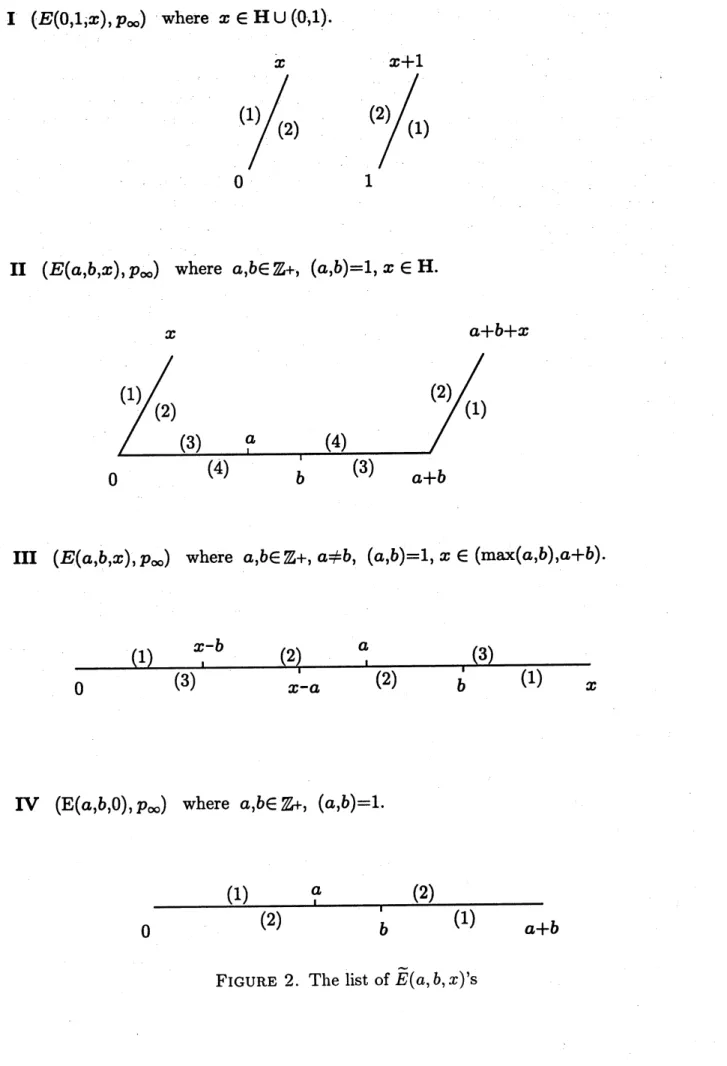
with Lagrangian sublattices denoted by $\tilde{E}(a, b, x)$ (or $(E(a,$$b,$$x),p\infty’\Lambda 0)$) constructed from $\mathbb{C}$ by cutting along theline segments and pasting by parallel transformations. (The numbers (1), (2),
..
. in each figure indicate pasting dataor
where to paste.) They split into the following four types,and each
once
punctured ellipticcurve
$(E(a, b, X),p_{\infty})$ is constructed as follows:I: (The
case
where $a=0,$ $b=1$, and $x$ is a complex number in the upper half plane$\mathrm{H}$
or
a real number in the interval $(0,1).)$ Cut the complex plane along$x([0,1])\cup(X([0,1])+1)$,
and paste each side $\mathrm{o}\mathrm{f}.\tau([\mathrm{o}, 1])$ and the opposite side of $(x([0,1])+1)$ by a parallel
transformation. (Igeta-construction)
II: (The
case
where $\mathit{0}$. and $b$ are relatively prime positive integers, and $x$ isa
complexnumber in the upper halfplane H.) Cut the complex plane along
I $(E(\mathrm{o},1_{X},), p\infty)$ where $x\in \mathrm{H}\cup(0,1)$
.
II $(E(a,b,X), p_{\infty})$ where $a,b\in \mathbb{Z}+,$ $(a,b)=1,$$x\in$ H.
$x$ $a+b+x$
III $(E(a,b,x), p\infty)$ where $a,b\in \mathbb{Z}+,$ $a\neq b,$ $(a,b)=1,$ $x \in(\max(a,b),a+b)$
.
rv
$(\mathrm{E}(a,b,0), p_{\infty})$ where $a,b\in \mathbb{Z}+,$ $(a,b)=1$.
transformation and paste the upper side of (resp. ) and the lower side
of$[b, a+b]$ (resp. $[\mathrm{o},$$b]$) by a parallel transformation.
III: (The
case
where $a$ and $b$are
distinct relatively prime positive integers, and $x$ is areal number such that $x \in(\max(a, b),$$a+b).)$ Cut the complex plane along $[0, x]$,
and paste the lower side of $[0, x-a]$ (resp. $[x-a,$$b],$ $1^{b,x}]$) and the upper side of
$[a, x]$ (resp. $[x-b,$$a],$ $[0,$$x-b1$) by a parallel transformation.
IV: (The case where $a$ and $b$ are relatively prime positive integers, and $x=0.$) Cut
the complex $\mathrm{p}\mathrm{l}\mathrm{a}\mathrm{n}\mathrm{e}$
, along $[0, a+b]$ and paste the upper side of $[0, a]$ (resp.
$[a,$$a+b]$)
and the lower side of $[b, a+b]$ (resp. $[0,$$b]$) by a parallel transformation.
Note that eachelliptic
curve
constructedin thisway hasa natural Abelian differential$\omega_{0}$induced by the differential $d\zeta$ of the standardcoordinate $\zeta$ of$\mathbb{C}$ and that the Lagrangian
sublattice $\Lambda_{0}$ of $\tilde{E}(a, b, x)$ is characterized as the kernel of the period map of $\omega_{0}$ from
$H_{1}(E(a, b, X);\mathbb{Z})$ to $\mathbb{C}$. Further, the primitive period of
$\omega_{0}$ is equal to 1 because $a$ and $b$
are
relatively prime. When $\overline{E}(a, b, x)$ is oftype I, II, or III, the set $\omega_{0}^{-1}(0)$ consists ofthetwo points$p_{0}$ and $p_{1}$ coning from the origin and the point $x$ of$\mathbb{C}$, and when $\tilde{E}(a, b, x)$ is
oftype IV, the set $\omega_{0}^{-1}(0)$ consists of the one point
$p_{0}$ coming from the origin in
$\mathbb{C}$
.
(See Figure 2.)Our
goal in this section is to proveTheorem 1. Foranyoncepuncturedelliptic curvewith aLagrangian sublattice $(E,p, \Lambda)$,
there exists one and only one $\tilde{E}(a, b, x)$ isomorphic to $(E,p, \Lambda)$.
We call twooncepunctured Riemann surfaces withLagrangian sublattices$(R,p, \Lambda)$ and
$(R’,p’, \Lambda/)$ isomorphic, if there exists a biholomorphic map from $R$ to $R’$ transforming $p$
to $p’$ and A into $\Lambda’$
.
In orderto prove Theorem 1 we investigate the geometry of geodesicsononcepunctured
elliptic curves having nuetlics with conical singularities induced by Abelian differentials.
Fora once punctured elliptic curve with a Lagrangian sublattice $(E,p, \Lambda)$, there exists
an
Abelian differential $\omega_{\Lambda}$, unique up to sign, in the kernel $Z_{\Lambda}$ (see [H-O1]or
[H-O2])such that the $\mathrm{p}_{\Gamma \mathrm{i}_{\ln}\mathrm{i}\mathrm{t}}\mathrm{i}\mathrm{v}\mathrm{e}$ period of
$\omega_{\Lambda}$ is equal to 1, because $Z_{\Lambda}$ is one-dimensional and any
non-trivial element in $Z_{\Lambda}$ has non-trivial periods. Then $\mathrm{P}\mathrm{D}[\omega_{\Lambda}]$ is an integral homology
class. Since the nletric $g_{\omega_{\Lambda}}$ on $E-p$ depends only on A in this case, we shall shortly
denote this metric by $g_{\Lambda}$. For the sanue reason we shall also use the term $\Lambda$-edge instead
of$\omega_{\Lambda}$-edge.
We first showthat $\tilde{E}(a, b, x)’ \mathrm{s}$ are not isomorphic to one another by studying $\Lambda_{0}$-edges.
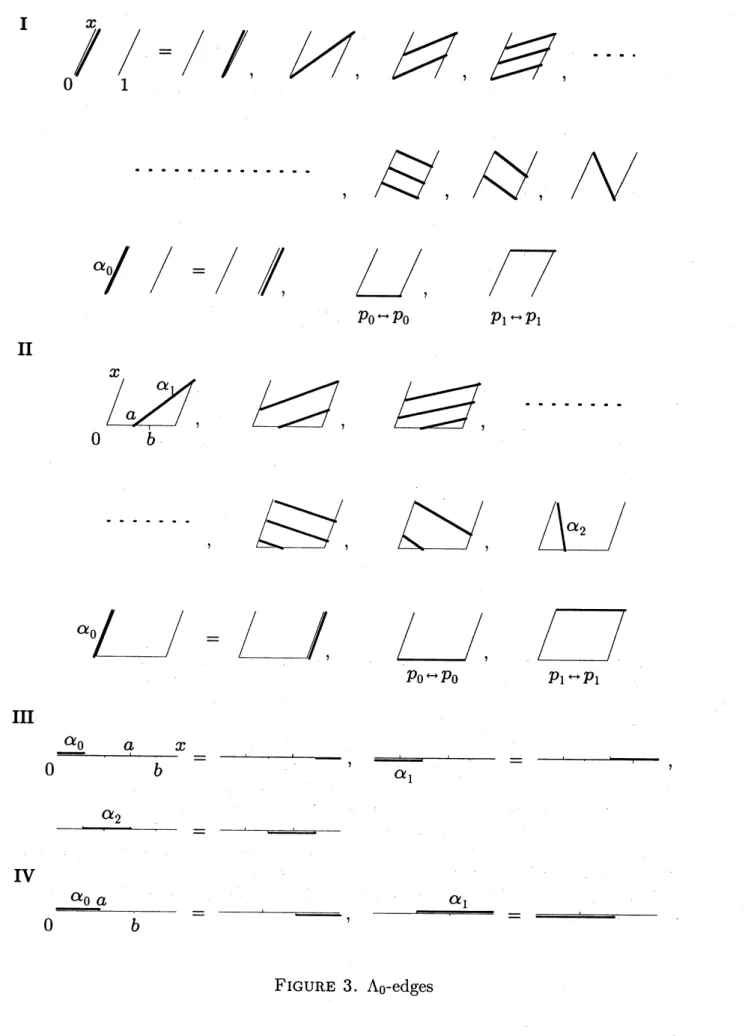
Foreach$\overline{E}(a, b, x)$, the Abelian$\mathrm{d}\mathrm{i}\mathrm{f}\mathrm{f}\mathrm{e}\mathrm{r}\mathrm{e}\mathrm{n}\mathrm{t}\mathrm{i}\mathrm{a}1\omega_{\Lambda_{0}}$coincides with
$\omega_{0}$ uptosign. So$\Lambda_{0}$-edges
areline segments in $\mathbb{C}$ between the points of$\omega_{0}^{-1}(0)$ in each case ofFigure 2. Accordingly
we can easily obtain the following proposition.
Proposition 1. All the $\Lambda_{0}$-eclges can be described as in Figure 3
for
each $\overline{E}(a, b, x)$.Proposition 1 implies that all the closed geodesics containing some
zeros
of$\omega_{0}$, whichconsist of $\Lambda_{0}$-edges,
can
be described visually for each $\tilde{E}(a, b, x)$.
This proposition yieldsthe following corollary.
Corollary 1.
If
$(a, b, x)\neq(a’, b’, x’)$, then $\tilde{E}(a, b, x)$ is not isomorphic to $\tilde{E}(a’, b’, x’)$.Proof.
Suppose $(E,p_{\infty}, \Lambda_{0})$ is isolnorphic to $\tilde{E}(a,.b, x)$. We shallrecover
the data$(a, b, x)$I $0^{//^{X}}$ $\int_{1}$ $=/$ $\parallel$ , $\alpha/0$ $/$
$=[$
$//$ , $p_{0}rightarrow p_{0}$ $p_{1}rightarrow p_{1}$ II $P0^{rightarrow}P^{J}0$ $p_{1}rightarrow\nu_{1}$ III $0\underline{\underline{\alpha_{0}}}$a
$bx=$$\overline{\alpha_{1}}=-$
$\alpha_{2}$$=-$
IV $\alpha_{0a}$$=-\cdot$
, $\alpha_{1}$$=-$
$0$ $b$I
II$q_{1}$ $\tau_{f\iota}$
$\mathrm{n}\mathrm{I}$
IV
FIGURE 4
We distinguish the type IV fronu others by the degeneracy of
zeros
of$\omega_{\Lambda_{0}}$, anddistin-guish the types I, II and III from each other by the properties of $\Lambda_{0}$-edges on $E$
.
Let$\{q0, q_{1}\}$ be the set ofsingular points $\mathrm{o}\mathrm{f}/c_{\Lambda_{0}}$. (When $(E,p_{\infty}, \Lambda_{0})$ is oftype IV, let $q_{0}$ bethe unique singular point of$g_{\Lambda_{0}}.$)
When we describe all the directions of $\Lambda_{0}$-edges around
$q_{0}$,
we
obtain Figure 4 from Proposition 1. We can specify the $\Lambda_{0}$-edges $\alpha_{0},$ $\alpha_{1}$ and $\alpha_{2}$ on $E$ in Figure 4.Note that these figures do not depend on the choice of $q_{0}$, and that there exists a $\Lambda_{0^{-}}$
edge which has the opposite direction of $\alpha_{0}$ in the case where $(E,p_{\infty’ 0}\Lambda)$ is of type I,
however in the
case
where $(E,p_{\infty}, \Lambda_{0})$ is of type II there exists noA-edge ofthis kind. Wethus specify the type of $(E,p_{\infty}, \Lambda)$. We shall orient the $\Lambda_{0}$-edges $\alpha_{0},$ $\alpha_{1}$ and $\alpha_{2}$ in Figure
4, which are also in Figure 3, $\mathrm{f}_{\Gamma \mathrm{o}\mathrm{n}1}q_{0}$ to $q_{1}$ in the case of type I, II or III.
When $(E,p_{\infty’ 0}\Lambda)$ is oftype I
or
II,we
choose the sign of$\omega_{\Lambda_{0}}$ such that ${\rm Im} \int_{\alpha_{0}}\omega_{\Lambda_{0}}>0$.
Then we obtain
In
case
$(E,p_{\infty}, \Lambda_{0})$ is of type II, we also obtain the following: (See Figure 3)$a= \int_{\alpha_{0}}-\alpha_{2}\omega\Lambda 0$ ’
$b= \int_{\alpha_{1}-\alpha 0}\omega\Lambda_{0}$
.
When $(E,p_{\infty}, \Lambda_{0})$ is of type III,
we
choose the sign of$\omega_{\Lambda_{0}}$ such that $\int_{\alpha_{0}}\omega_{\Lambda_{0}}>0$.
Thenwe
obtain the following: (See Figure 3)$a= \int_{\alpha_{0}-\alpha}2\omega_{\Lambda_{0}}$, $b= \int_{\alpha_{1}-\alpha_{2}}\omega_{\Lambda 0}$,
$x= \int_{\alpha_{0}+\alpha_{1}-\alpha_{\sim}},\omega_{\Lambda_{0}}$
.
When $(E,p_{\infty}, \Lambda_{0})$ is of type IV, we obtain the following: (See Figure 3)
$a=| \int_{\alpha_{0}}\omega_{\Lambda_{0}}|$, $b=| \int_{\alpha_{1}}\omega_{\Lambda_{0}}|$.
Wethereby
recover
the data $(a, b, x)$ from $(E,p_{\infty}, \Lambda_{0})$ in anycase.
Hencethis corollaryfollows. $\square$
Corollary 1 inuplies the uniqueness in Theorem 1. In order to finish
our
proofof The-oreml,we
next show the completeness; for a $\mathrm{g}\underline{\mathrm{i}\mathrm{v}}\mathrm{e}\mathrm{n}$ once punctured ellipticcurve
witha
Lagrangian sublattice $(E,p, \Lambda)$, there exists an$E(a, b, x)$ which is isomorphic to $(E,p, \Lambda)$
.
Let $\gamma$ be an oriented loop or map from
$S^{1}$ to $E$ representing a generator of A. The
Abelian differential $\omega_{\Lambda}$ is exact on $E-\gamma(S^{1})$ because the integral of $\omega_{\Lambda}$ along a loop $\alpha$
equals zero if and only if $\alpha \mathrm{r}\mathrm{e}_{1^{)\mathrm{r}\mathrm{e}\mathrm{S}}}\mathrm{e}\mathrm{n}\mathrm{t}\mathrm{S}$ a homology class whose intersection number with
the homology class $[\gamma]$ equals zero. When we denote by $||\gamma||$ the length of
$\gamma$ with respect
to the metric $g_{\Lambda}$, it is verified fronl the followingtwo facts (1), (2) that there exists
a
looprepresenting a generator ofA which has the smallest length
among
such loops, and that the loop consists ofA-edges. We shall calla
loop consisting of A-edgesa
$\Lambda$-edge-loop.(1): For any loop $\alpha$ on $E$, thereexists a$\Lambda$-edge-loop $\alpha’$ consisting ofA-edges such that
$\alpha’$ is homotopic to
$\alpha$ and $||\alpha’||\leq||\alpha||$.
(2): For any positive nunuber $r$, there exist at most finitely many $\Lambda$-edge-loops with
length smaller than $r$.
We
can
show that fact (1) follows thisway: we first approximate$\alpha$ bya
polygonal loop,and then
we
reduce the nunlber ofvertices which donot lieon
$\omega_{\Lambda}(0)$.
On
the other hand, for a positive number $r$, it is obvious that there exist at most finitely many A-edges withlength smaller than $r$, and then the fact (2) follows.
Lemma 1. The image
of
an oriented$\Lambda$-edge-loop$\gamma$ representing agenerator
of
A contains$\infty$ $\infty$
$|_{\sqrt}\Phi(q_{1})$
$\backslash _{\Phi(\partial\overline{E})}$
FIGURE 5
Proof.
The Abelian differential $\omega_{\Lambda}$ hasone
point as zero of order 2, or has twopointsas
zeros
oforder 1. We show the lemma in the secondcase.
(In the othercase
the statementis trivial.) We set $\omega_{\Lambda}^{-1}(0)=\{q_{0}, q_{1}\}$.
Suppose the image of $\gamma$ contains $q_{0}$ and does not contain $q_{1}$
.
(The image of$\gamma$ consistsof only A-edges from $q_{0}$ to $q_{0}$ itself.)
We cut along $\gamma$ with $E$ and denote by
$\overline{E}$ the resulting Riemann polygon or Riemann
surface with $1\mathrm{i}\mathrm{n}\mathrm{e}- \mathrm{s}\mathrm{e}\mathrm{g}\mathrm{m}\mathrm{e}\mathrm{n}\mathrm{t}-\mathrm{b}_{0}\mathrm{u}\mathrm{n}\mathrm{d}\mathrm{a}\mathrm{r}\mathrm{y}$ . (See [H-O1] or [H-O2].) Let $\tilde{q}_{0}$ be a point in
$\overline{E}$
corresponding to $q_{0}$. The holomorphic nuap
$\Phi(q)=\int_{q_{0}}^{q}\omega_{\Lambda}$
from$E-(\gamma(s^{1})\cup\{p\})$ to$\mathbb{C}$ extends toonefrom $\overline{E}$to
$\mathbb{C}P_{1}(=\mathbb{C}\cup\{p_{\infty}\})$, and $\Phi$maps alocal
neighborhood of any point which is not in $\omega_{\Lambda}^{-1}(0)$ to a subset of $\mathbb{C}P_{1}$ biholomorphically.
Moreover, $\Phi$ maps the boundary $\partial\overline{E}$ of $\overline{E}$ into the real axis in $\mathbb{C}P_{1}$, because
$\omega_{\Lambda}$ only has
real periods. .
Then we shall find two paths from $q_{1}$ to $p$
$\alpha_{1},$ $\alpha_{2}$
:
$[0,1]arrow\overline{E}$such that
$\alpha_{1([1]}\mathrm{o},)\mathrm{n}\alpha 2(10,1])=\{q1,p\}$,
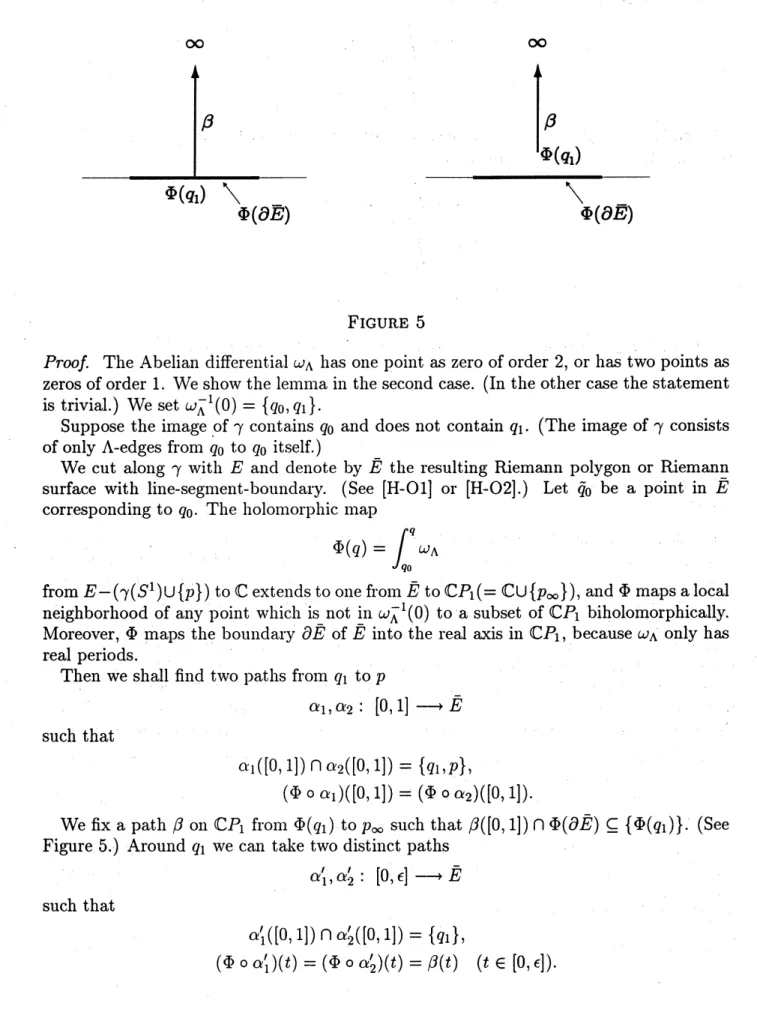
$(\Phi 0\alpha_{1})([0,11)=(\Phi 0\alpha_{2})([0,1])$. We fix apath $\beta$ on $\mathbb{C}P_{1}$ fronl $\Phi(q1)$ to
$p_{\infty}$ such that $\beta([0,1])\cap\Phi(\partial\overline{E})\subseteq\{\Phi(q_{1})\}$. (See Figure 5.) Around $q_{1}$ we can take two distinct paths
$\alpha_{1}’,$$\alpha_{2}’$
:
$[0, \epsilon]arrow\overline{E}$such that
$\alpha_{1}’([\mathrm{o}, 1])\cap\alpha_{2}/(10,1])=\{q1\}$,
Since $\Phi$ is a local biholomorphic map except
$q_{0},$ $q_{1}$,
we
obtain the desired paths $\alpha_{1},$ $\alpha_{2}$as
the pull-back of $\beta$ by $\Phi$ which coincidenear
$q_{1}$ with $\alpha_{1}’,$ $\alpha_{2}’$ respectively. Meanwhile,
the map $\Phi$ is bihololnorphic alound
$p$. This is acontradiction.
We recall three well-known facts about simple loops
on
ellipticcurves.
Fact (1): The holnology class represented by asimple loop is trivial
or
primitive. Fact (2): If $\gamma$ and $\gamma’$ are simple loops such that their homology classes$[\gamma],$ $[\gamma’]$ are
primitive and their intersection number $[\gamma]\cdot[\gamma’]$ is equal to zero, then $[\gamma]=\pm[\gamma]’$
.
Fact (3): If $\gamma$ and $\gamma’$ are simple loops such that their intersection number is equal to
$\pm 1$, then the pair $([\gamma], [\gamma’])$ is a basis of
$H_{1}(E;\mathbb{Z})$
.
Since the integral value of $\omega_{\Lambda}$ along any A-edge does not vanish, the following lemma
follows from Fact (2) and the definition of A-edge immediately, and we omit its proof.
(Note that two distinct parallel A-edges have no
common
points except the points in$\omega_{\Lambda}^{-1}(\mathrm{o}).)$
Lemma 2. Suppose $\omega_{\Lambda}^{-1}(0)$ consists
of
two distinct points$q_{0},$ $q_{1}$
.
If
$\gamma_{1}$ (resp. $\gamma_{2}$) is a$A$-edge
from
$q_{0}$ to $q_{0}$
itself
(resp. $q_{1}$ to $q_{1}$ itself), then $[\gamma_{1}]=\pm[\gamma_{2}]\in H_{1}(E;\mathbb{Z})$.Let $\gamma_{(0)}$ beanoriented$\Lambda$-edge-looprepresenting agenerator ofAand havingthe smallest
length. When we consider $\gamma_{(0)}$ as an ordered set of oriented A-edges, we may obtain
another loop $\gamma_{(0)}’$ representing the same homology class by reordering the oriented $\Lambda-$
edges suitably. (We assunle that each A-edge inherits its orientation from $\gamma_{(0)}.$) We
obtain the following lennma about $\gamma_{(0)}$.
Lemma
3. The $im$ageof
$\gamma_{(0)}$ consistsof
$\Lambda$-edges which have no intersection withone
another except$\omega^{-1}(0)$.
Proof.
When $\omega_{\Lambda}$ has a zero of order 2, the$\mathrm{l}\mathrm{e}\mathrm{n}\mathrm{l}\mathrm{n}\mathrm{l}\mathrm{a}$is immediate
because all the A-edges
are parallel. We thus consider the case where $\omega_{\Lambda}$ has two points $q_{0},$ $q_{1}$ as
zeros.
We consider $\gamma_{(0)}$ as an ordered set $(\gamma_{1}, \gamma_{2}, \ldots , \gamma_{l})$ of oriented A-edges. Suppose A-edges
$\gamma_{i}$ and $\gamma_{j}(1\leq i\leq j\leq l)$ have an intersection at a point $q\not\in\omega_{\Lambda}^{-1}(0)$. Then both
$\gamma_{i}$ and
$\gamma_{j}$ are A-edges between $q_{0}$ and $q_{1}$, and they intersect each other transversely. We prepare paths $\gamma_{i}’$ and
$\gamma_{j}’$ modifying $\gamma_{i}$ and $\gamma_{j}$ around $q$ as in Figure
6.
We replace $\gamma_{i},$ $\gamma_{j}$ with $\gamma_{i}’,$ $\gamma_{j}’\mathrm{r}\mathrm{e}\mathrm{s}_{\mathrm{P}^{\mathrm{e}\mathrm{c}\mathrm{t}\mathrm{i}}}\mathrm{V}\mathrm{e}\mathrm{l}\mathrm{y}$, and set
$\gamma_{(0)}’=(\gamma 1, \ldots, \gamma i, \ldots, \gamma j, \ldots, \gamma l)$
.
Then the cycle $\gamma_{(0)}’$ represents the homology class $[\gamma_{(0)}]$.
In the
case
(1)or
(2),we can
consider $\gamma_{(0)}’$as
a
loop, and the length $||\gamma_{(0)}’||$ is smallerthan $||\gamma_{(0)}||$
.
This contradicts the definition of$\gamma_{(0)}$
.
In the case (3) or (4), it is necessary to reorder the elements of $\gamma_{(0)}’$. Ifthere still exist
A-edges between $q_{0}$ and $q_{1}$ in $\gamma_{(0)}’$, then it is easy to obtain a loop by reordering the
paths and loops $\{\gamma_{1}, \ldots , \gamma_{i’\ldots,\gamma_{j}}’’, \ldots, \gamma_{k}\}$ whose length is smaller than $||\gamma_{(0)}||$. This also
contradicts the definition of$\gamma_{(0)}$. Ifthereexist no more A-edges between $q_{0}$ and $q_{1}$ in $\gamma_{(0)}’$,
we
further replace the loop $\gamma_{i}’$ by A-edges from$q_{0}$ to $q_{0}$ itself, the loop $\gamma_{j}’$ by A-edges from
$q_{1}$ to $q_{1}$ itselfpreserving the homology class. Moreover, byusing Lemma 2,
we can
replace all the A-edges from $q_{1}$ to $q_{1}$ itself by A-edges from $q_{0}$ to $q_{0}$ preserving the homology class.(1) (2)
$a_{\tau}$ $a$, $O\tau$ $q_{1}$
(3) (4)
FIGURE 6
Then we obtain a cycle $\mathrm{r}\mathrm{e}\mathrm{p}\mathrm{r}\mathrm{e}\mathrm{S}\mathrm{e}\mathrm{n}\mathrm{t}\mathrm{i}_{1\mathrm{l}}\mathrm{g}$ the cohomology class $1^{\gamma(0)}$], and consisting of only A-edges from $q_{0}$ to $q_{0}$ itself. This cycle
can
be consideredas
a loop, and this contradictsLemma 1.
Proof of
Theorem 3. Let $\gamma_{(0)}$ be an oriented$\Lambda$-edge-loop representing a generator ofA
and having the smallest length
as
before. We describe $\gamma(0)$as an
ordered set of orientedA-edges;
$\gamma_{(0)}=(\gamma_{1}, \ldots, \gamma l)$
.
We first consider thecase where $\omega_{\Lambda}^{-1}(0)$ consistsof only
one
point $q_{0}$. Inthis case, each element $\gamma_{k}$ of $\gamma_{(0)}$ isan
oriented sinuple loopon
$E$, and the integral of$\omega_{\Lambda}$ along $\gamma_{k}$ isa
non-zero
integer. Hence it follows from Fact (2) that $\gamma_{k}$ represents a primitive class in$H_{1}(E;\mathbb{Z})$
.
We shall choose the sign of$\omega_{\Lambda}$ such that$\int_{\gamma_{1}}\omega_{\Lambda}>0$
.
Since
the integral of$\omega_{\Lambda}$ along $\gamma(0)$ is equal to zero, we may furtherassume
by reordering$\int_{\gamma_{\sim}},\omega_{\Lambda}<0$
.
The loops$\gamma_{1}\mathrm{a}\mathrm{n}\mathrm{d}-\gamma 2$ represent different homologyclasses, because
$\gamma_{(0)}$ has the smallest length.
On
the other hand, they intersect each other only at $q_{0}$. Hence from Facts (1) and (2) it follows that their intersection nunuber at $q_{0}$ is equal to 1 or-l and that the pair $([\gamma_{1}], [\gamma_{2}])$ is a basis of$H_{1}(E;\mathbb{Z})$.(i) (ii)
FIGURE 7
Cut $E$ along $\gamma_{1}$ and $\gamma_{-}$” and denote by
$\overline{E}$ the resulting Riemann polygon. In each case
in Figure 7, by choosing apoint $\tilde{q}_{0}$ in $\partial\overline{E}$
suitably (see Figure 7),
we
obtain aholomorphicmap $\Phi$ from $\overline{E}$ to $\mathbb{C}P_{1}$:
$\Phi(q)=\int_{q)}^{q}\omega_{\Lambda}$.
In
case
(i), set$a= \int_{\gamma_{1}}\omega_{\Lambda}$,
$b=- \int_{\gamma_{2}}\omega_{\Lambda}$.
In case (ii), set
$o=- \int_{\gamma}\underline,\omega_{\Lambda}$,
$b= \int_{\gamma_{1}}\omega_{\Lambda}$
.
Then the integers $a$ and $b$
are
relatively $\mathrm{p}_{\Gamma \mathrm{i}\mathrm{n}}\mathrm{u}\mathrm{e}$ because the pair $([\gamma_{1}], [\gamma_{2}])$ isa
$\mathrm{b}\mathrm{a}s$is of
$H_{1}(E;\mathbb{Z})$, and then $\Phi$ gives rise to an isomorphism between $(E,p, \Lambda)$ and $\tilde{E}(a, b, \mathrm{o})$
.
We next consider the othercase:
$\omega_{\Lambda}^{-1}(0)$ consists of two distinct points $q_{0}$ and $q_{1}$.
Inthis case, from Lenlma 1 there exists at least one A-edge from $q_{0}$ to $q_{1}$ and at least
one
A-edge from $q_{1}$ to $q_{0}$ in $\gamma_{(0)}$
.
We mayassume
that $\gamma_{1}$ is a A-edge from $q_{0}$ to $q_{1}$.
We mayfurther assume from Lemnua 2 that $\gamma_{(0)}$ does not contain A-edges from $q_{1}$ to $q_{1}$ itself.
$\int_{\gamma}.\cdot\omega_{\Lambda}=-\int_{\gamma_{1}}\omega_{\Lambda}$. Because $\gamma(0)$ has the smallest length, the simple loop
$(\gamma_{1}, \gamma_{i})$ is non-trivial, and hence primitive (Fact (1)). Therefore we obtain $\gamma_{(0)}=(\gamma_{1}, \gamma_{i})$
.
(Note that aloop $\gamma$ representinga
generator of A ischaracterized
by two properties;one
is that $\gamma$ representsa
primitivehomology class, and the other is that the integral of$\omega_{\Lambda}$ along$\gamma$ vanishes.)
Cut $E$ along $\gamma_{1}$ and $\gamma_{i}$, denote by
$\overline{E}$
the resulting Riemann polygon, and set the
signature of$\omega_{\Lambda}$ such that
${\rm Im}( \int_{\gamma 1}\omega\Lambda)>0$ or $\int_{\gamma_{1}}\omega_{\Lambda}>0$
.
By choosing
a
point $\tilde{q}_{0}$ in$\partial\overline{E}$suitably, weobtain a holomorphic map $\Phi$ from $\overline{E}$ to $\mathbb{C}P_{1}$:
$\Phi(q)=\int_{r}^{q}\omega_{\Lambda}$
.
If
we
set$x= \int_{\gamma_{1}}\omega_{\Lambda}$,
then $\Phi$ gives rise to an $\mathrm{i}_{\mathrm{S}\mathrm{o}\mathrm{m}}\mathrm{o}\Gamma \mathrm{p}\mathrm{h}\mathrm{i}\mathrm{s}\mathrm{n}1$ between$(E,p, \Lambda)$ and $\overline{E}(0,1, x)$. (Igeta-construction) (ii) Suppose
$\int_{\gamma}.\cdot\omega_{\Lambda}\neq-\int_{\gamma_{1}}\omega_{\Lambda}$
for any $\gamma_{i}$, A-edge fronu $q_{1}$ to $q_{0}$ in $\gamma(0)$.
(ii-a) When the integral of$\omega_{\Lambda}$ along $\gamma_{1}$ is not areal number, we choose the sign of$\omega_{\Lambda}$
such that
$\mathrm{I}\mathrm{n}1(\int_{\gamma}1\omega\Lambda)>0$.
We may
assume
without loss of generality that there exists a A-edge $\gamma_{i}$ from $q_{1}$ to $q_{0}$ in $\gamma_{(0)}$ such that the integral of$\omega_{\Lambda}$ along$\gamma_{1}+\gamma_{i}$ is apositive integer. We mayfurther assumeby reordering that the integral of$\omega_{\Lambda}$ along $\gamma_{1}+\gamma_{2}$ is minimal among such
$\gamma_{i}’ \mathrm{s}$.
$\int_{\gamma_{1}+\gamma:}\omega_{\Lambda}\geq\int_{\gamma_{1}+\gamma 2}\omega_{\Lambda}\geq 0$
Since
the integralof$\omega_{\Lambda}$ along $\gamma_{(0)}$ vanishes,we see
from the inequality above that thereoccur the following two cases:
1: There exists in $\gamma_{(0)}$ a A-edge $\gamma_{j}$ from $q_{0}$ to $q_{0}$ such that
$\int_{\gamma \mathrm{j}}\omega_{\Lambda}<0$
.
2: Thereexist in $\gamma_{(0)}$ A-edges $\gamma_{\mu}$ and $\gamma_{\nu}$ ($\gamma_{\mu}$ is from $q_{0}$ to $q_{1},$ $\gamma_{\nu}$ from $q_{1}$ to $q_{0}$) such that
(1)
(2)
$\Phi(\overline{E})=$
FIGURE 8
Suppose the following two inequalities hold for any$\gamma_{\mu}$ from $q_{0}$ to $q_{1}$ and for any $\gamma_{\nu}$ from
$q_{1}$ to $q_{0}$.
$\int_{\gamma+\gamma_{\mu}}\underline,\omega_{\Lambda}\geq 0$, $\int_{\gamma_{1}+\gamma_{\nu}}\omega_{\Lambda}\geq 0$
Then we obtain the following inequality $\mathrm{f}\mathrm{r}\mathrm{o}\ln$ the second inequality above and the choice of$\gamma_{2}$.
$\int_{\gamma_{1}+\gamma_{\nu}}\omega_{\Lambda}\geq\int_{\gamma_{1}+\gamma_{2}}\omega_{\Lambda}$
Furthermore
we
obtain the following inequality, and this is a contradiction.$\int_{\gamma_{\mu}+\gamma_{\nu}}\omega_{\Lambda}=\int_{\gamma_{\mu}+\gamma}\underline,\omega_{\Lambda}-\int_{\gamma_{\vee}+\gamma 1},\omega_{\Lambda}+\int_{\gamma_{1}+\gamma_{\nu}}\gamma\Lambda$
$\geq\int_{\gamma_{l^{l}}\gamma_{-}}+\cdot\omega_{\Lambda}$
$\geq 0$.
Therefore the following three cases occur:
(1) there is $\gamma_{j}$ from $q_{0}$ to $q_{1}$ such that
$\int_{\gamma_{1}+\gamma j}\omega_{\Lambda}<0$
.
(3) there is $\gamma_{j}$ from $q_{0}$ to $q_{0}$ such that
$\int_{\gamma_{j}}\omega_{\Lambda}<0$
.
The figures on the left-hand side of Figure 8 indicate the images of $\gamma_{1},$ $\gamma_{2}$, and $\gamma_{j}$ by
the integral of$\omega_{\Lambda}$ in each case above.
In the case (1), we shall show that the homology classes represented by the simple
loops $(\gamma_{1},\gamma_{2})$ and $(\gamma_{j}, \gamma_{2})$ form
a
$\mathrm{b}\mathrm{a}s$is of $H_{1}(E;\mathbb{Z})$; If the homology classes $[(\gamma_{1},\gamma_{2})]$ and$-[(\gamma_{j}, \gamma_{2})]$ represent the
same
homology class, then we get a loop $\gamma_{(0)}’$ representing agenerator of A by removing $\gamma_{1},$ $\gamma_{2}$, and $\gamma_{j}$ from $\gamma_{(0)}$ and placing $-\gamma_{2}$ instead, and $\gamma_{(0)}’$ is shorter than $\gamma_{(0)}$
.
This is a contradiction. Hence fronu Facts (1) and (2) it follows that the intersection $\mathrm{n}\mathrm{u}\mathrm{n}\mathrm{l}\mathrm{l}\supset \mathrm{e}\mathrm{r}[(\gamma_{1}, \gamma_{2})]\cdot[(\gamma_{j}, \gamma 2)]$ is not equal tozero.
On the other hand,$(\gamma_{1},\gamma_{2})$ intersects $(\gamma_{j}, \gamma_{2})$ only at $\gamma_{2}$
.
Therefore the pair $([(\gamma 1, \gamma 2)], [(\gamma_{j}, \gamma_{2})])$ is a basis of$H_{1}(E;\mathbb{Z})$
.
In thesame
way, weobtain the fact that the pair $([(\gamma_{1}, \gamma_{2})], [(\gamma_{1}, \gamma j)])$ isa
basisof$H_{1}(E;\mathbb{Z})$ in the
case
(2), and that the pair $([(\gamma 1, \gamma_{2})], [\gamma_{j}])$ is a basis of$H_{1}(E;\mathbb{Z})$ in thecase
(3).Cut $E$ along $\gamma_{1},$ $\gamma_{2}$, and $\gamma_{j}$ in each case, and then denote by
$\overline{E}$ the resulting Riemann
polygon. We obtain aholomorphic nuap $\Phi$ from $\overline{E}$ to $\mathbb{C}P_{1}$
$\Phi(q)=\int_{\mathfrak{g})}^{q}\omega_{\Lambda}$
when we choose abase point $\tilde{q}_{0}$ in $\overline{E}$
, because we obtain a basis of$H_{1}(E;\mathbb{Z})$ from $\gamma_{1},$ $\gamma_{2}$,
and $\gamma_{j}$
.
In the
case
(1), let $\tilde{q}_{0}$ be the point in the boundary$\partial\overline{E}$
which is the initial point of$\gamma_{1}$
and is also the end point of$\gamma_{2}$. Then we get the image
$\Phi(\overline{E})$
as
in the middle figure inFigure 8. It is now easy to nlodify $\overline{E}$ by cutting and pasting from $\Phi(\overline{E})$ such that we can
obtain a Riemann polygon of type II. (See Figure 8.) Note that $a’$ and $b’$ are relatively
prime integers where $b’$ is the integral of$\omega_{\Lambda}$ along $(\gamma_{j}, \gamma_{2})$
.
In the similar way, we obtain a Rielnann polygon of type II in the cases (2) and (3),
and omit the explanation.
(ii-b) When the integral of $\omega_{\Lambda}$ along $\gamma_{1}$ is a real number, there also exists
an
element $\gamma_{j}$ in $\gamma(0)$ different from $\gamma_{1}$ and $\gamma_{2}$.
We obtain the fact that $\gamma_{j}$ joins $q_{0}$ with $q_{1}$ as follows: Suppose $\gamma_{j}$ isa
A-edge from $q_{0}$ to $q_{0}$ itself. We mayassume
$( \int_{\gamma 1+\gamma_{\sim}},\omega_{\Lambda})\cdot(\int_{\gamma j}\omega\Lambda)<0$
.
The simple loop $\gamma_{j}$ intersects the simple loop
$(\gamma_{1}, \gamma_{2})$ at $q_{0}$ with
intersection
numberzero
because the directions of$\gamma_{1},$ $\gamma_{2}$, and $\gamma_{j}$ can be described
as
in the following figure. Henceit follows from Fact (2) that the $\mathrm{h}_{\mathrm{o}\mathrm{n}\mathrm{l}\mathrm{O}}\mathrm{l}\mathrm{o}\mathrm{g}\mathrm{y}$ class $[\gamma_{1}+\gamma_{2}+\gamma_{j}]$ vanishes. This contradicts
the definition of$\gamma_{(0)}$
.
Now
we
mayassume
that $\gamma_{j}$ is an edge from $q_{0}$ to $q_{1}$.
Then the two homology classes[$(\gamma_{1},\gamma 2)1$ and $[(\gamma j, \gamma_{2})]$ fornu a basis of $H_{1}(E;\mathbb{Z})$. We can also describe the directions of
(1) (2)
$||1^{\cdot}\mathrm{t}\mathrm{I}\iota_{---}\prime^{\frac{j_{\mathrm{z}}\overline{\int}^{2}\prime--\backslash }{\backslash q_{0}\gamma\sim\prime}---}\gamma--- 1^{--\backslash }--\backslash ---|11l|’\sim---.---\cdot!\mathrm{T}_{l}^{l}---\wedge|1$
around
$q_{0}$around
$q_{1}$(3) (4)
$l\iota^{\prime^{\frac{\mathrm{j}\backslash \overline{\mathrm{r}}^{2^{--}}\prime\backslash }{q_{0}\gamma\sim\prime}-}}1|1_{--}\gamma--,---..-\vee-\backslash -- 1---\backslash ||\mathrm{l}1\iota’----\cdot---\mathrm{T}^{1},-|1|1$
.
$|\gamma^{\frac{\backslash \backslash q_{0}\gamma\sim}{2\mathrm{b}_{\mathrm{j}}’\backslash _{---}}-}l\iota_{-}\mathrm{I}’---,---.- 1---’--\cdot\perp’|1^{\backslash }..|||1|---\sim{}^{\mathrm{t}}\iota|.|$
.
(5) (6)
$\gamma,1\mathrm{I}\mathrm{l}\mathrm{I}11_{--}\prime^{\frac{j_{r\backslash }\overline{q}0\gamma}{\backslash \mathrm{b}_{2}\backslash _{---}}}---_{J}-’.\cdot.\cdot.1---\iota----\perp_{\mathrm{I}}\vee l||\mathrm{t}|’\backslash --- 1$
.
FIGURE
9
Cut $E$ along $\gamma_{1},$ $\gamma_{2}$, and $\gamma_{j}$, and denote by
$\overline{E}$ the resulting Riemann polygon. We
choose the point $\tilde{q}_{0}$ at the vertex
on
$\partial\overline{E}$ where the boundary is smooth. (See Figure 9.)
We ’
$\mathrm{c}$hoose the sign of$\omega_{\Lambda}$ such that $\Phi \mathrm{n}\mathrm{u}\mathrm{a}_{\mathrm{P}^{\mathrm{S}}}$ each point to a positive number
around
$\tilde{q}_{0}$
.
Then the map $\Phi$ gives rise to an isomorphism between $(E,p, \Lambda)$ and $\tilde{E}(a, b, x)$ oftype III for
some
$(a, b, x)$. We have completed the proof of Theorem 1.We denote by $\mathcal{M}\mathcal{L}_{1,1}$ the set ofonce punctured elliptic
curves
with Lagrangiansublat-tices;
$\mathcal{M}\mathcal{L}_{1,1}=\{\tilde{E}(a, b, x)\}$
.
We will consider the complex structure of$\mathcal{M}\mathcal{L}_{1,1}$ in the next section. 3. COMPLEX STRUCTURE OF $\mathcal{M}\mathcal{L}_{1,1}$
When we consider the forgetful nuap from the set $\mathcal{M}L_{1,1}$ of
once
punctured ellipticcurves
with Lagrangian sublattices to themoduli
space $\mathcal{M}_{1,1}$ ofonce punctured
ellipticcurves, it should be a $\mathrm{h}\mathrm{o}\mathrm{l}\mathrm{o}\mathrm{n}\mathrm{l}\mathrm{o}\mathrm{r}\mathrm{p}\mathrm{h}\mathrm{i}_{\mathrm{C}\mathrm{n}\mathrm{u}}\mathrm{a}\mathrm{P};\mathcal{M}\mathcal{L}_{1,1}$ should be a complex $V$-manifold whose
complex structure is
induced
from $\mathcal{M}_{1,1}$ by the forgetful map.We consider the conuplex structure of $\mathcal{M}\mathcal{L}_{1,1}$ by using the description in Theorem 1: We give
a
local coordinate of $\mathcal{M}\mathcal{L}_{1,1}$around
eachonce punctured
ellipticcurve
with$arrow J\iota$ $j_{-t}arrow$
$\mathbb{C}-s_{t}$ $U_{|t|}$ $\mathbb{C}-s_{-t}$
FIGURE
10
a Lagrangian sublattice $\tilde{E}(a, b, x)$. For this purpose we first prepare two methods of
deforming complex structures of Riemann surfaces.
$\mathrm{S}\mathrm{e}\mathrm{t}\mathrm{L}\mathrm{e}\mathrm{t}t$ be
$\mathrm{a}$ complex number
$\mathrm{a}\mathrm{n}\mathrm{d}\mathrm{l}\mathrm{e}\mathrm{t}-,s_{t}$ be the line segment between
$\sqrt{t}$ and $-\sqrt{t}$in $\mathbb{C}$.
$U_{|t|}:=\{z\in \mathbb{C};|z|>|\sqrt{t}|\}$. Then the following nuap $J_{t}$ is biholomorphic:
$J_{t}$
:
$U_{|t}| \ni Z-\frac{1}{2}(z+\frac{t}{z})\in \mathbb{C}-s_{\iota}$.Hence we obtain a biholomorphic map $J_{t}\mathrm{o}J_{-}^{-1}t$ from $\mathbb{C}-s_{-t}$ to $\mathbb{C}-s_{t}$
.
Note that themap $J_{tt}\mathrm{o}J_{-}^{-1}$ is parametrized by $t\mathrm{h}\mathrm{o}1_{\mathrm{o}\mathrm{n}\mathrm{l}\mathrm{O}\Gamma}\mathrm{p}\mathrm{h}\mathrm{i}\mathrm{c}\mathrm{a}\mathrm{l}\mathrm{l}\mathrm{y}$. (See Figure 10.)
On the other hand, let $s_{1}’$ be the union oftwo line segments; the line segment from $0$
to 1 and the line segnuent from $0$ to $e^{\tilde{\frac{}{3}}\pi i}’$
.
We denote by $IC$ the biholomorphic map from$U_{1}=\{z\in \mathbb{C};|z|>1\}$ to $\mathbb{C}-s_{1}’$ such that $K(1)=0$
.
(There exists uniquely such abiholomorphic map due to Riemann’s mapping theorem.) Let $t$ be a complex number as above. We also denote by $t$ the automorphism of$\mathbb{C}$ defined by multiplication by $t$. Set
$s_{t}’=t(s_{1}’)$.
Then $I\zeta_{t}:=t\mathrm{o}K\mathrm{o}t^{-}1$ is a $\mathrm{b}\mathrm{i}\mathrm{h}\mathrm{o}1_{0}\mathrm{n}\mathrm{u}\mathrm{o}\mathrm{r}\mathrm{p}\mathrm{h}\mathrm{i}_{\mathrm{C}}$ map from $U_{|t|}$ to $\mathbb{C}-s_{t}’$. The map $I\{_{t}$ is
parametrized by $t$ holonlorphically even at $t=0$. We consider the biholomorphic map
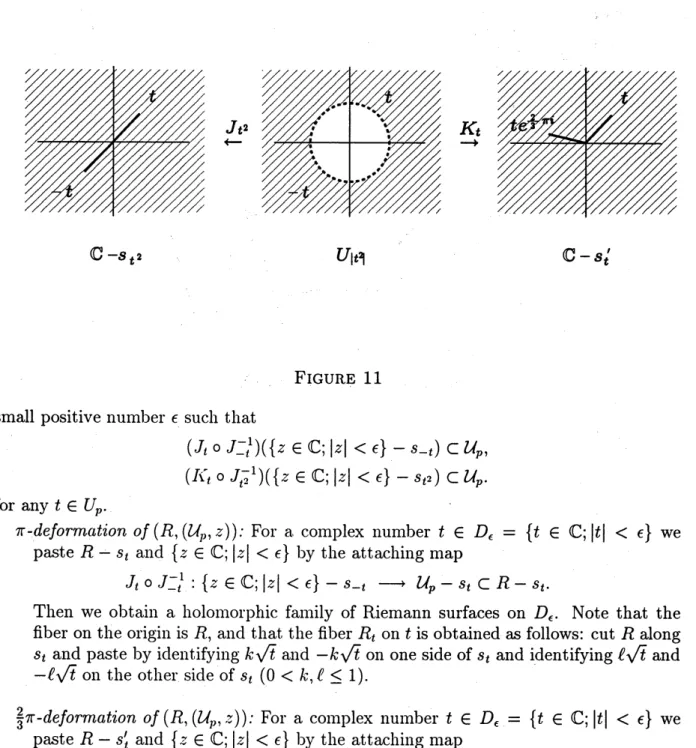
$I\zeta_{t^{\mathrm{O}}}J_{l^{2}}^{-}1$ from $\mathbb{C}-s_{t^{2}}$ to $\mathbb{C}-s_{t}’$, which is also parametrized by $t$ holomorphically. (See Figure 11.)
Let $p$ be a point on a Rienlann surface $R$, and fix a local coordinate $z$ : $\mathcal{U}_{p}arrow \mathbb{C}$
$(z(p)=0)$ around $p$
.
The subset $\mathcal{U}_{p}$ of $R$ is also regarded as a subset of$\mathbb{C}$, and then both$arrow J_{t^{2}}$ $K_{t}arrow$
$\mathbb{C}-s_{t^{2}}$ $U_{|t1}$ $\mathbb{C}-s_{t}’$
FIGURE 11
small positive number $\epsilon$ such that
$(J_{t}\mathrm{o}J_{-}^{-}1)t(\{Z\in \mathbb{C};|z|<\epsilon\}-s_{-1})\subset \mathcal{U}_{p}$, $(I\mathrm{i}_{t}’\mathrm{O}J^{-}2)t(1\{Z\in \mathbb{C};|z|<\epsilon\}-s_{t}2)\subset \mathcal{U}_{p}$.
for any $t\in U_{p}$.
$\pi$
-deformation of
$(R, (u_{p}, z))$: For a complex number $t\in D_{\epsilon}=\{t\in \mathbb{C};|t|<\epsilon\}$ wepaste $R-s_{t}$ and $\{z\in \mathbb{C};|z|<\epsilon\}$ by the attaching map
$J_{t}\mathrm{o}J_{-t}^{-1}$ : $\{_{Z\in}\mathbb{C};|z|<\epsilon\}-S-tarrow \mathcal{U}_{p}-s_{t}\subset R-s_{t}$
.
Then we obtain a $\mathrm{h}\mathrm{o}\mathrm{l}\mathrm{o}\mathrm{m}\mathrm{o}\mathrm{l}\mathrm{P}^{\mathrm{h}\mathrm{i}_{\mathrm{C}}}$ family of Riemann surfaces on $D_{\epsilon}$. Note that the
fiberon the origin is $R$, and that the fiber $R_{t}$ on $t$ is obtained as follows: cut $R$ along
$s_{t}$ and paste by identifying $k\sqrt{t}\mathrm{a}\mathrm{n}\mathrm{d}-k\sqrt{t}$on one side of$s_{t}$ and identifying$\ell\sqrt{t}$ and
$-l\sqrt{t}$ on the other side of $s_{t}(0<k, \ell\leq 1)$.
$\frac{2}{3}\pi$
-deformation of
$(R, (\mathcal{U}_{p}, z))$: For a complex number $t\in D_{\epsilon}=\{t\in \mathbb{C};|t|<\epsilon\}$ wepaste $R-s_{t}’$ and $\{\approx\in \mathbb{C};|z|<\epsilon\}$ by the attaching map
$I\zeta_{t}\mathrm{o}J_{t\underline’}^{-1}$
:
$\{_{\mathcal{Z}\in \mathbb{C};}|z|<\epsilon\}-s_{t}2arrow \mathcal{U}_{P^{-S’\subset}}R-tS’t$.Then we obtain a $\mathrm{h}\mathrm{o}1_{01\mathrm{n}\mathrm{o}}\mathrm{r}\mathrm{p}\mathrm{h}\mathrm{i}\mathrm{c}$ fanlily of Riemann surfaces on $D_{\epsilon}$. Note that the
fiber on the origin is $R$, and that the fiber $R_{t}$ on$t$is obtained asfollows: cut $R$along
$s_{t}’$ and paste by identifying $kt$ and $kte^{\tilde{\frac{}{3}}\pi i}$
’
on one side of $s_{t}’$ and identifying $\ell t$ and
$-\ell te^{\frac{2}{3}}\pi i$
on the other side of$s_{t}’(0<k, \ell\leq 1)$
.
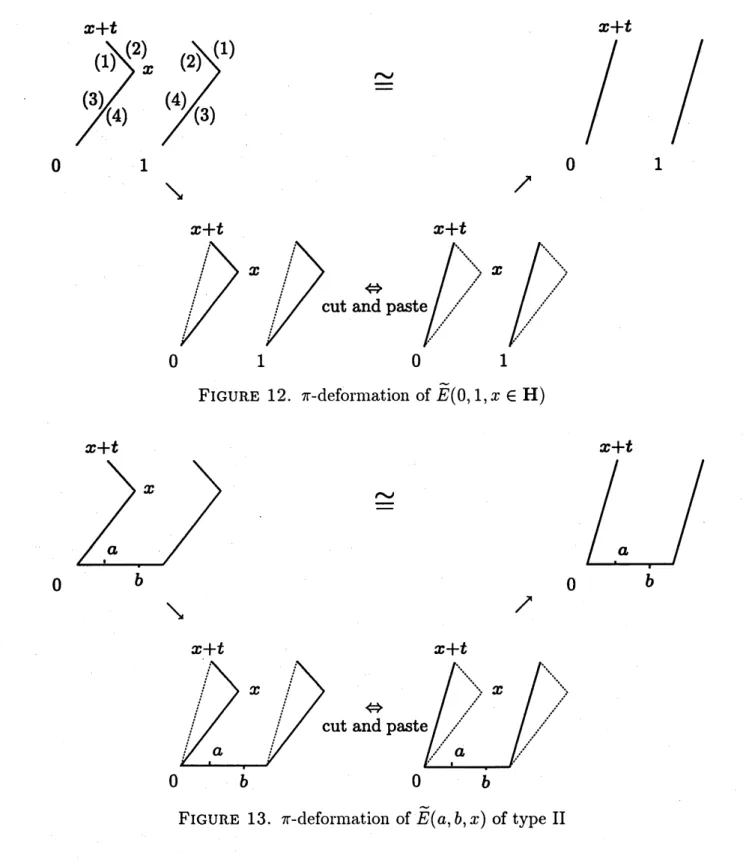
We apply a $\pi- \mathrm{d}\mathrm{e}\mathrm{f}\mathrm{o}\mathrm{r}\mathrm{n}\mathrm{l}\mathrm{a}\mathrm{t}\mathrm{i}_{0}\mathrm{n}$ to each $\overline{E}(a, b, x)$ of type I, II
or
III.Let $p_{1}$ be the point on $\overline{E}(0,1, x)(x\in \mathrm{H})$ coming from $x$ and $x+1$, and fix
a
localcoordinate $z$
:
$\mathcal{U}_{p_{1}}arrow \mathbb{C}$ around $p_{1}$ such that $\zeta=z^{2}+x$ or $\zeta=z^{2}+x+1$, where $\zeta$is the global coordinate of $\mathbb{C}$ as before. When we consider the coordinate
$(\mathcal{U}_{p_{1}}, Z)$, the
$\underline{\simeq}$
$0$ 1 $0$
1
$\backslash$
$\nearrow$
FIGURE 12. $\pi$-defornlation of$\tilde{E}(0,1, x\in \mathrm{H})$
$=\sim$
$0$
$\backslash$
$\nearrow$
FIGURE
13.
$\pi$-deformation of$\tilde{E}(a, b, x)$ of type II$\zeta$-plane:
one
is from $x$ to $x+t$ and the other is from $x+1$ to $x+1+t$. The fiber $F_{t}$on
$t\in D_{\epsilon}$ is obtained from $\tilde{E}(0,1,x)$ by cutting and pasting along the two line segments; $F_{t}$is equivalent to $\tilde{E}(0,1, x+t)$. (See Figure 12. The numbers (1),
...
,(4) indicate whereto paste.) Accordingly we can regard $x\in \mathrm{H}$ as a local coordinate when $a=0$ and $b=1$.
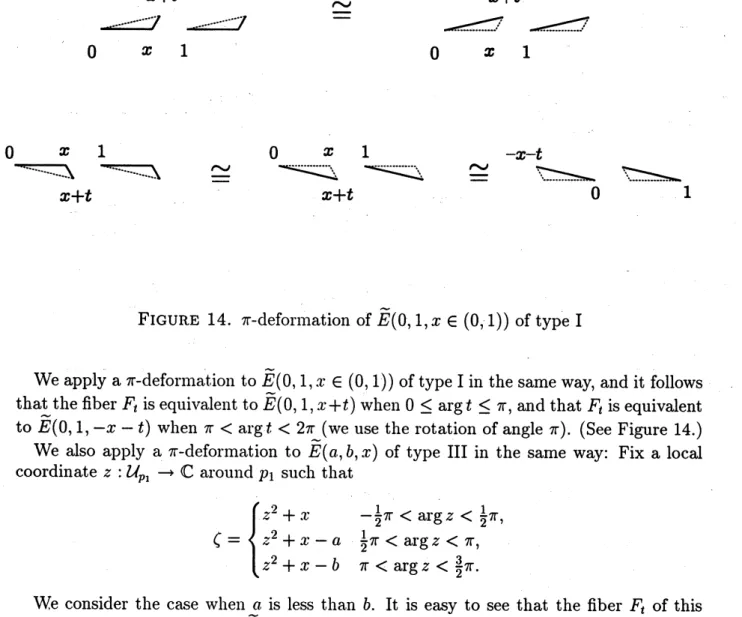
Applying a$\pi$-deformation to $\tilde{E}(\mathit{0},, b, x)$ of type II in the same way, we see that $x$ is also
$x+t.$. $\sim=$ $\sqrt$ $\sqrt$ $x+t$ $\sim_{=}$: $\sim_{=}$: $0$ $x$
1
$0$ $x$1
$0$ $x$1
$0$ $x$ 1 $-x-t$$\neg$ $\neg$ $\underline{\underline{\sim}}$ $\sim$ $\sim$ $=\sim$ $\sim \mathrm{C}$ $\sim \mathrm{C}$
$x+t$ $x+t$ $0$ 1
FIGURE 14. $\pi$-deformation of$\tilde{E}(0,1, x\in(\mathrm{O}, 1))$ of type I
We$\mathrm{a}\mathrm{p}\mathrm{p}\mathrm{l}\acute{\mathrm{y}}$ a$\pi-\dot{\mathrm{d}}$eformat,ion
to$\tilde{E}(0,1, x\in(\mathrm{O}, 1))$ oftype Iin the
same
way, and it followsthat the fiber $F_{t}$ isequivalent to $\tilde{E}(0,1, x+t)$ when $0\leq\arg t\leq\pi$, and that $F_{t}$ is equivalent
to $\tilde{E}(0,1, -x-t)$ when $\pi<\arg t<2\pi$ (we use the rotation of angle $\pi$). (See Figure 14.)
We also apply a $\pi$-deformation to $\tilde{E}(\mathit{0}, b, x)$ of type III in the same way: Fix a local
coordinate $z:\mathcal{U}_{p_{1}}arrow \mathbb{C}$ around$p_{1}$ such that
$\zeta=$
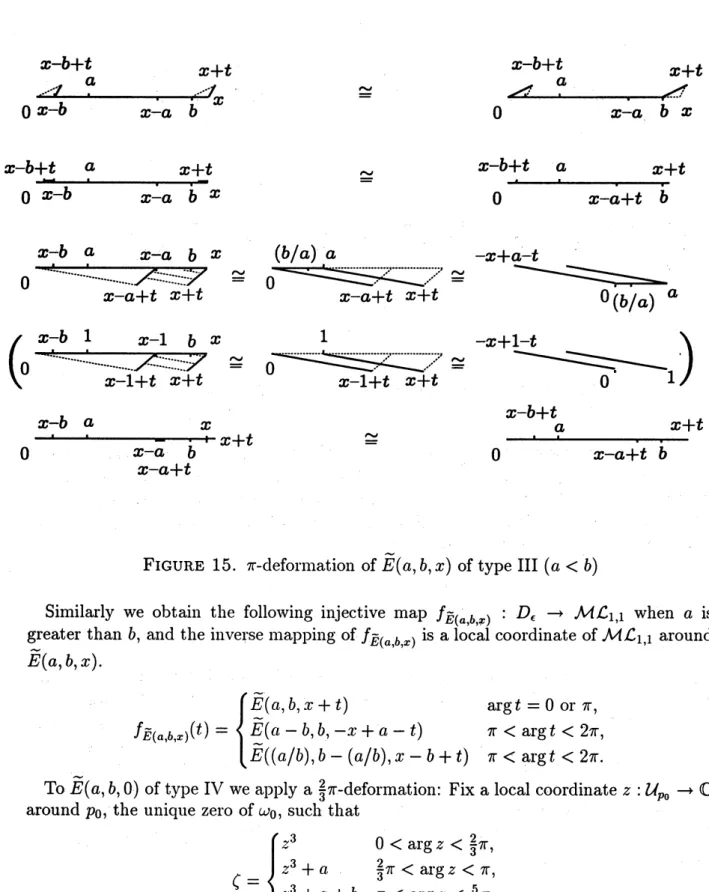
We consider the case when $a$ is less than $b$
.
It is easy to see that the fiber $F_{t}$ of this deformation is equivalent to $\tilde{E}(a, b, x+t)$ when $\arg t=0$or
$\pi$.
When $0<\arg t<\pi$,we
see
bycutting
andpasting
that $F_{t}$ is equivalent to $\tilde{E}(a, b-a, x-b+t)$.
When$\pi<\arg t<2\pi$ and $a\neq 1$, we see that $F_{t}$ is equivalent to $\tilde{E}(a-(b/a), (b/a),$$-X+a-t)$
where $(b/a)$ is a non-negative integer such that $0\leq(b/a)<a$ and $(b/a)\equiv b$ mod $a$
.
Note that $(b/a)$ is equal to $0$ if and only if $a$ is equal to 1, and then $F_{t}$ is equivalent to
$\overline{E}(0,1, -x+1-t)$ of type I. (See Figure 15.) Accordingly
we
obtain the followinginjectivemap $f_{\tilde{E}(a,b,x)}$
:
$D_{\epsilon}arrow \mathcal{M}\mathcal{L}_{1,1}$ when $a$ is less than $b$, and the inverse mapping of$f_{\tilde{E}(a,b,x)}$ is
a local coordinate of$\mathcal{M}\mathcal{L}_{1,1}$ around $\tilde{E}(a, b, x)$.
$\cong$ $x-b+t$
a
$x+t$ $x-b+t$a
$x+t$ $\cong$ $0\overline{x-bx}$$X$ $0\overline{x-a+tb}$ $x-b+t$ $\mathrm{o}^{\ovalbox{\tt\small REJECT}}x-b$a
$x-a$ $bxx+t$ $\cong$ $0^{\frac{ax}{x-a+tb}}+t$ $x-a+t$FIGURE
15.
$\pi- \mathrm{d}\mathrm{e}\mathrm{f}_{0}\mathrm{r}\mathrm{n}\mathrm{u}\mathrm{a}\mathrm{t}\mathrm{i}_{\mathrm{o}\mathrm{n}}$ of$\tilde{E}(a, b, x)$ of type III $(a<b)$Similarly
we
obtain the following injective map $f_{\tilde{E}(b,)}a,x$:
$D_{\epsilon}arrow \mathcal{M}\mathcal{L}_{1,1}$ when $a$ isgreater than $b$, and the inverse$\mathrm{n}\mathrm{l}\mathrm{a}\mathrm{p}\mathrm{P}^{\mathrm{i}}\mathrm{n}\mathrm{g}$ of$f_{\tilde{E}(a,b,x)}$ is alocal coordinate of$\mathcal{M}\mathcal{L}_{1,1}$ around
$\tilde{E}(a, b, x)$
.
$f_{\tilde{E}(a,b,x)}(t)=$
$\pi<\arg\arg t\pi<\arg t<2\pi=0\mathrm{o}\mathrm{r}t<2\pi\pi,.$’
To $\tilde{E}(a, b, \mathrm{o})$ oftype IV
we
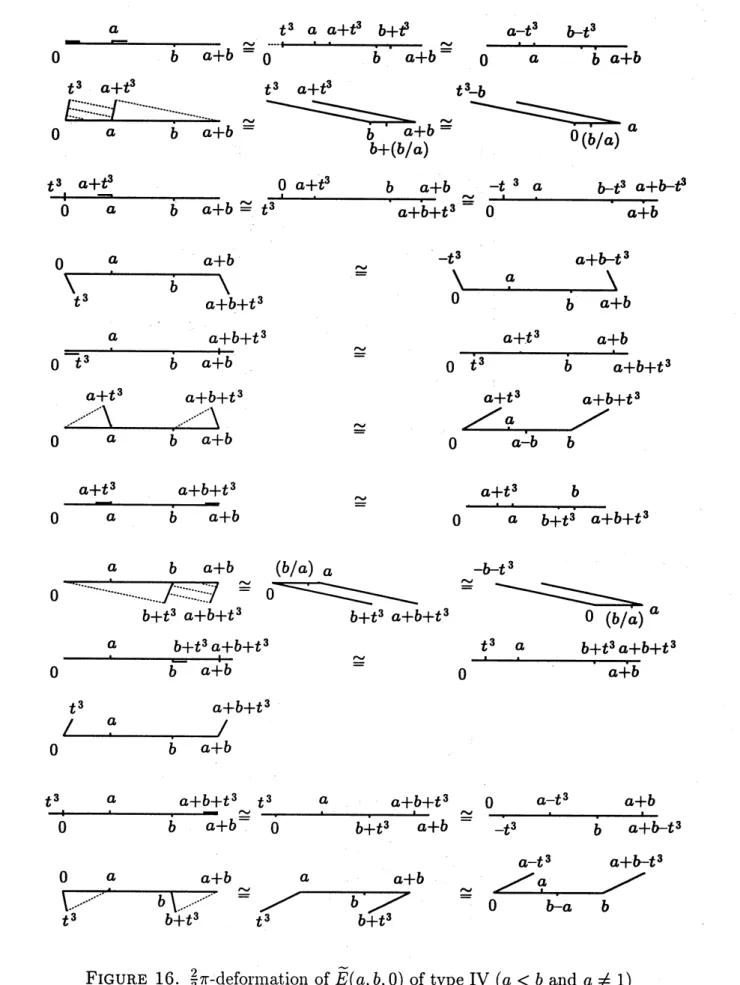
apply $\mathrm{a}\frac{2}{3}\pi$-deformation: Fix a local coordinate $z$ :$\mathcal{U}_{p_{0}}arrow \mathbb{C}$ around $p_{0}$, the unique zero of$\omega_{0}$, such that$\zeta=$
Then the segment $s_{t}’$ is $\mathrm{t}\mathrm{l}\cdot \mathrm{a}\mathrm{n}\mathrm{S}\mathrm{f}\mathrm{e}\mathrm{r}\mathrm{r}\mathrm{e}\mathrm{d}$ to two parallel line segments with the same length $t^{3}$
in $\zeta$-plane.
$\mathrm{o}^{\frac{a}{ba+}}b\cong 0\ldots.\overline{ba+}b^{\cong}$
$a-t^{3}$ $b-t^{3}$
$t^{3}$ a $a+t^{3}$ $b+\theta$
$0\overline{aba+}b$
$\frac{t^{3}.a\underline{+t^{3}}}{\dot{0}a\dot{b}a+}b\cong t^{3}0a+t^{3}$$\ovalbox{\tt\small REJECT}$$baa+b+t+b3$ $-t3$ a $b-t^{3}a+ba+b-t^{3}$ $\cong \mathrm{o}^{\ovalbox{\tt\small REJECT}}$
$\cong$
$0\overline{\overline{t}^{3}}$
a
$b$
$a+ba+b+t^{3}$ $\cong$ $0^{\frac{a+t^{3}a+b}{t^{3}ba}}+b+t^{3}$
$\cong$
$\mathrm{o}^{\frac{a+t^{3}a+b+}{aba}}+bt^{3}$ $\cong$
$0\underline{a+t^{3}b}$
a $b+t^{3}$ $a+b+t^{3}$
$\mathrm{o}^{\frac{a}{ba+b}}$ $\cong$ $0\underline{t^{\theta}}$
a $a+b$ $b+t3a+b+t\theta$ $b+t^{s_{a+bt}3}+$ $t_{\frac{3}{0}}$a $ba+b^{\cong}a+b+t^{3}t_{\frac{3a}{0}}$ . $- a+b+t^{3} \cong\frac{0a-t^{3}a+b}{-t^{3}ba+b}-t^{3}$ $b+t^{3}$ $a+b$ $\cong$
$f_{\tilde{E}(a,b,0)}(t)=|^{\tilde{E}(}\tilde{E}(a+b^{-},b,a+b+t^{3})E(a,b,a_{b/)}+bt^{3})\tilde{E}(a,b-O,a+t^{3})\tilde{\tilde{E}\frac{E}{E}}(a,b,t^{3})(a,a+b,a+b(_{\mathit{0},,b},\mathit{0}+b^{-}+t3)a-(a,(b/a-t^{3})),t3-b)$ $\mathrm{a}\mathrm{r}\arg 0<\arg t<,\frac{1}{3}\mathrm{a}\mathrm{r}\arg t=\frac{1}{3}\pi\frac{2}{3}\pi<\arg t\mathrm{g}\mathrm{g}t=\pi<\mathrm{a}t=\frac{2}{3}\pi t=\frac{1}{3}\pi \mathrm{r}\mathrm{g}t’<\frac{2}{3}\pi \mathrm{o},,<\pi\pi’,$,
$\overline{E}(a-\sim(b/a), (b/a),$ $-t^{3}-b)$ $\pi<\mathrm{a}\mathrm{r}\mathrm{g}.t<\frac{4}{3}\pi$,
$\overline{E}(a, a+b, a+b+t^{3})$ $\arg t=\frac{4}{3}\pi$,
$\tilde{E}(a, b, t^{3})$ $\frac{4}{3}\pi<\arg t<\frac{5}{3}\pi$,
$\tilde{E}(a+b, b, a+b-t^{3})$ $\arg t=\frac{5}{3}\pi$,
$\tilde{E}(a, b-a, a-t3)$ $\frac{5}{3}\pi<\arg t<2\pi$
.
When $a=1$ and $a<b$,
$f_{\tilde{E}(1,b,0)}(t)=1^{E}\tilde{E}(1,b-1’,1)\tilde{E}(1+b,b^{-}1+b+t3)\tilde{E}(1,1+b,1+bt^{3})\tilde{E}(1,b,1+b+t3)\tilde{E}(0,1,t3^{+}b^{-t}\tilde{E}(1,b,-t^{3}(1,b,1b3))+t^{3^{-}})$ $0< \mathrm{a}\mathrm{r}\mathrm{g}\mathrm{a}\mathrm{r}\mathrm{g}\mathrm{a}\mathrm{r}\mathrm{a}\mathrm{r}\mathrm{g}\mathrm{a}\mathrm{r}\frac{1}{3}\pi<\arg t\frac{2}{3}\pi<\mathrm{a}\mathrm{r}t<\frac{1}{3}\pi \mathrm{g}t=0\mathrm{g}t=\frac{1}{3}\pi \mathrm{g}t’<\pi t=\frac{2}{3}t=\pi’,\frac{2}{3}<’,\pi\pi,$
’
$E(\mathrm{O}, 1, -t^{3}-b)$ $\pi<\arg t<\frac{4}{3}\pi$,
$E(1,1+b, 1+b+t^{3})$ $\arg t=\frac{4}{3}\pi$, $\tilde{E}(1, b, t^{3})$ $\frac{4}{3}\pi<\arg t<\frac{5}{3}\pi$,
$\tilde{E}(1+b, b, 1+b-t^{3})$ $\arg t=\frac{5}{3}\pi$,
When $a=b=1$,
$f_{\tilde{E}(1,1,0)}(t)=$ $0.< \mathrm{a}\mathrm{a}\mathrm{r}\mathrm{g}\mathrm{a}\mathrm{r}\arg\pi_{1}\arg t=\pi \mathrm{a}\frac{1}{3}\mathrm{a}\frac{2}{3}\pi\frac{4}{3}\frac{5}{3}\mathrm{r}\mathrm{g}t=\frac{5}{3}\pi\pi<\arg t,<\frac{2}{3},\pi\pi\pi<\mathrm{a}\mathrm{r}\mathrm{g}’ t’<\mathrm{r}\mathrm{g}t=\mathrm{g}t=\frac{4}{3}\pi<\arg t<\mathrm{a}\mathrm{r}t<t==0,\frac{5}{3},\pi\arg t’<2\pi \mathrm{g}t<\frac{1}{3}\pi\pi\frac{\mathrm{l}}{3}\pi\frac{2}{3}\mathrm{g}t’<\pi<\frac{4}{3}\pi,.’$
,
When $b=1$ and $a>b$,
$f_{\tilde{E}(a,b,0)}(t)=$
For each$\overline{E}(a, b, 0)$oftype IV, the
lnap $f\tilde{E}(a,b,0)$ gives risetoa two-fold branched covering;
$f_{\tilde{E}()}a,b,0(t)=f\tilde{E}(a,b,0)(-t)$.
Then $(f_{\tilde{E}(a,b,0)}, D\mathbb{Z}/\epsilon’)2\mathbb{Z}$ gives rise to a local manifold cover of$\mathcal{M}L_{1,1}$ around $\overline{E}(a, b, \mathrm{o})$.
In this way, the set $\mathcal{M}\mathcal{L}_{1,1}$ is regarded as a complex V-manifold.
REFERENCES
[H-O1] Hashimoto, Y. and Ohba, IC.: Cutting and pastingofRiemannsurfaceswithAbelian differentials,
I, preprint.
[H-O2] Hashimoto, Y. and Ohba, $\mathrm{I}\zeta.$: Construction
ofRiemann surfaces by parallel transformations, to
appear in 数理解析研究所講究録
[K] Kodaira, $\mathrm{I}\backslash ^{r}.$: Complex
Manifolcls and Deformation of Complex Structures, Grund. Math. Wiss.
283, Springer-Verlag, New$\mathrm{Y}^{r}\mathrm{o}\mathrm{r}\mathrm{k}-\mathrm{B}\mathrm{e}\mathrm{r}\mathrm{l}\mathrm{i}\mathrm{n}$-Heidelberg-Tokyo, (1986).
[Mo] Morelli, R.: A theory ofpolyhedra, Adv. in Math. 97 (1993), 1-73.
[Mu] Mumford, D.: Tata Lectures on Theta I, Progress in Mathematics vol. 28, Birkh\"auser,
Boston-Basel-Stuttgart, (1983).
[S] Sah, C-H:Hilbert’s th.irdproblem: scissors congruence, Research Notes in Mathematics 33, Pitman
Advanced Publishing Program, San $\mathrm{F}_{\Gamma \mathrm{a}\mathrm{n}\mathrm{C}}\mathrm{i}\mathrm{s}\mathrm{c}0^{-}\mathrm{L}\mathrm{o}\mathrm{n}\mathrm{d}_{0\mathrm{n}\mathrm{M}\mathrm{e}\mathrm{l}\mathrm{b}\mathrm{o}\mathrm{u}\mathrm{r}}-\mathrm{n}\mathrm{e}$ , (1979).
(Yoshitake HASHIMOTO) DEPARTMENT OF MATHEMATICS, FACULTY OF SCIENCE, OSAKA CITY
UNIVERSITY, SUGIMOTO, $\mathrm{S}\mathrm{U}\mathrm{M}\mathrm{I}\mathrm{Y}\mathrm{o}\mathrm{s}\mathrm{H}1- 1\backslash \prime \mathrm{U}$, OSAKA 558, JAPAN
$E$-mail address: $\mathrm{h}\mathrm{a}\mathrm{s}\mathrm{h}\mathrm{i}\mathrm{m}\mathrm{o}\mathrm{t}\emptyset \mathrm{s}\mathrm{C}\mathrm{i}$.osaka-cu.ac.jp
(Kiyoshi OHBA) DEPARTMENT OF MATHEMATICS, FACULTY OF SCIENCE, OCHANOMIZU
UNIVER-SITY, OTSUKA 2-1-1, $\mathrm{B}\mathrm{U}\mathrm{N}\mathrm{I}\{\mathrm{Y}\mathrm{O}- \mathrm{I}\backslash \mathrm{U}r,$ $\mathrm{T}\mathrm{o}\mathrm{I}\backslash \mathrm{Y}\mathrm{o}112$, JAPAN