Japan Advanced Institute of Science and Technology
https://dspace.jaist.ac.jp/
Title
Adaptive Secure-Channel Free Public-Key
Encryption with Keyword Search Implies Timed
Release Encryption
Author(s)
Emura, Keita; Miyaji, Atsuko; Omote, Kazumasa
Citation
Lecture Notes in Computer Science, 7001/2011:
102-118
Issue Date
2011-10-12
Type
Journal Article
Text version
author
URL
http://hdl.handle.net/10119/10294
Rights
This is the author-created version of Springer,
Keita Emura, Atsuko Miyaji, and Kazumasa Omote,
Lecture Notes in Computer Science, 7001/2011,
2011, 102-118. The original publication is
available at www.springerlink.com,
http://dx.doi.org/10.1007/978-3-642-24861-0_8
Description
Encryption with Keyword Search Implies Timed
Release Encryption
Keita Emura1, Atsuko Miyaji2, and Kazumasa Omote2 1 Center for Highly Dependable Embedded Systems Technology
2
School of Information Science
Japan Advanced Institute of Science and Technology, 1-1, Asahidai, Nomi, Ishikawa, 923-1292, Japan
{k-emura,miyaji,omote}@jaist.ac.jp
Abstract. As well-known results, timed-release encryption (TRE) and
public key encryption scheme with keyword search (PEKS) are very close to identity-based encryption (IBE), respectively. It seems natural that there is a close relationship between TRE and PEKS. However, no ex-plicit bridge has been shown between TRE and PEKS so far. In this paper, we show that TRE can be generically constructed by PEKS with extended functionalities, called secure-channel free PEKS (SCF-PEKS) with adaptive security, and discuss the reason why PEKS and (non-adaptive) SCF-PEKS are not suitable for constructing TRE. In addition to this result, we also show that adaptive SCF-PEKS can be generically constructed by anonymous IBE only. That is, for constructing adaptive SCF-PEKS we do not have to require any additional cryptographic prim-itive compared to the Abdalla et al. PEKS construction (J. Cryptology 2008), even though adaptive SCF-PEKS requires additional functionali-ties. This result seems also independently interesting.
1
Introduction
Timed-Release Encryption (TRE): Timed-release encryption (TRE) was
proposed by May [22], where even a legitimate recipient cannot decrypt a cipher-text before a semi-trusted time server (TS) sends (or broadcasts) a time-release key sT assigned with a release time T of the encryptor’s choice. As a well-known
result, (public key based) TRE is very close to identity-based encryption (IBE). More precisely, generic constructions of TRE based on IBE, public key encryp-tion (PKE), and one-time signature (OTS) have been proposed [8, 21, 24]. Since PKE can be constructed by IBE (and OTS) [6], and digital signature can be constructed by the extraction algorithm of IBE [9], we can say that TRE can be generically constructed by IBE. As an intuition, TRE might be close to other cryptographic primitives which are also close to IBE. So, next we introduce public key encryption scheme with keyword search (PEKS) as such a primitive.
Public key Encryption scheme with Keyword Search (PEKS): PEKS
from encrypted data. Briefly, the flow of PEKS is as follows: A receiver makes a trapdoor tω for a keyword ω, and uploads it on an e-mail server. A sender
makes an encrypted keyword (which is encrypted by using a keyword ω′ and the receiver’s public key), and sends it to the server. The server outputs 1 if ω = ω′, by using tω, and 0 otherwise. As a way to construct PEKS, Abdalla et
al. [1] showed that a generic construction of PEKS based on anonymous IBE is sufficient. Next, we discuss the relationships among IBE, TRE, and PEKS.
The Relationships among IBE, TRE, and PEKS: One may think that
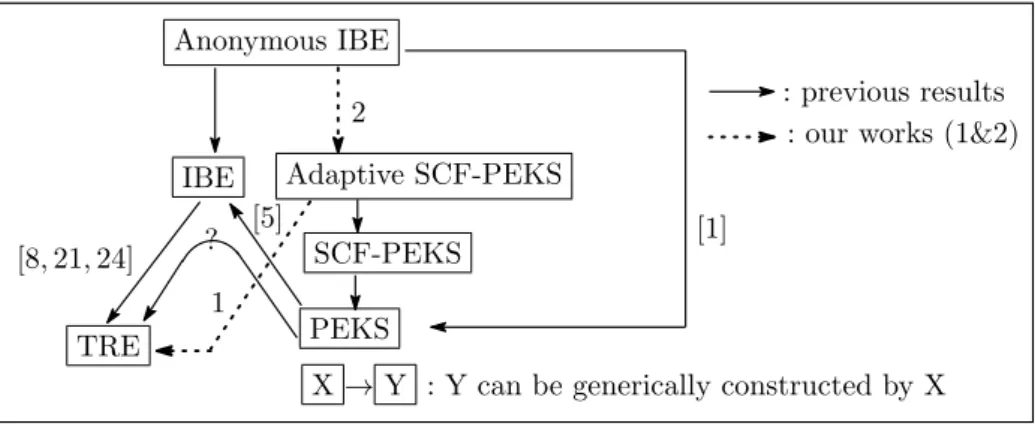
TRE can be generically constructed by PEKS, since IBE (with 1-bit plaintext space) can be constructed by PEKS [5], and TRE can be generically constructed by IBE [8, 24]. However, since generic constructions of TRE based on IBE [8, 24] implicitly3 require multi-bit plaintext space, we cannot conclude that TRE can
be generically constructed by PEKS (so we denote it with “?” in Fig 1 later). There are two easy-to-find ways for showing a relationship between TRE and PEKS: (1) for IBE, show that 1-bit plaintext space is enough to make multi-bit plaintext space (as in the PKE case shown by Myers and Shelat [23]), or (2) propose a generic construction of TRE based on IBE with just 1-bit plaintext space. We do not conclude that these are possible or impossible, but try to establish a bridge between TRE and PEKS from another perspective in this paper. To do so, we revisit PEKS with extended functionalities, called secure-channel free PEKS (SCF-PEKS).
Security Conditions of Previous Secure Channel Free PEKS (SCF-PEKS) Schemes and its Theoretic Extension: PEKS schemes ensure that
the server (or an outsider) does not learn anything about keywords chosen by the sender without trapdoor information. If trapdoors are revealed, then anyone can execute the test procedure. Therefore, trapdoors cannot be sent via public (i.e., insecure) channels. So, in PEKS schemes, a secure channel (such as secure socket layer (SSL) and transport layer security (TLS)) between a receiver and a server is required, and establishing secure channel requires additional setup costs. To solve this problem, secure channel-free PEKS (SCF-PEKS) have been proposed [2, 15, 16, 19], where the server has a public/secret key pair, and the sender makes an encrypted keyword (which is encrypted by using a keyword ω′ and both the server’s public key and the receiver’s public key), and sends it to the server. The server outputs 1 if ω = ω′ by using the trapdoor tω and its own
secret key, and 0 otherwise. Even if tω is sent via an insecure channel, no entity
(except the server) can run the test procedure.
Next, we discuss the security conditions of the previous SCF-PEKS. The security model considered in [2, 15, 16, 19] does not capture the test queries (i.e., “CPA-like” security). As an exception, Rhee et al. have considered test queries [26]. However, this definition is still weak (i.e., “Unquoted CCA-like” security [23]), where an adversary is not allowed to issue the test queries adap-tively. By considering the CCA2 security, SCF-PEKS must be secure even if a
3
That is, a plaintext of IBE has the form Kv||(M ⊕ r), where Kvis a verification key
“malicious-but-legitimate” receiver can be admitted to issue test queries adap-tively. We insist that this adaptive (i.e., “CCA2-like”) security is the natural extension of the SCF-PEKS security theoretically4 , which is called adaptive
SCF-PEKS.
Our Contribution: In this paper, we show the relationships of IBE, TRE, and
adaptive SCF-PEKS (dashed arrows in Fig 1). Anonymous IBE
IBE Adaptive SCF-PEKS SCF-PEKS PEKS TRE
?
X→ Y : Y can be generically constructed by X : previous results
: our works (1&2) [5]
[8, 21, 24]
[1] 2
1
Fig. 1: Relationships of IBE, TRE, and adaptive SCF-PEKS
1. We show that TRE (with 1-bit plaintext space) can be constructed generi-cally from adaptive SCF-PEKS.
– We discuss the detailed reason why PEKS and (non-adaptive) SCF-PEKS are not suitable for constructing TRE in Section 4.3.
2. We propose a generic construction of adaptive SCF-PEKS based on anony-mous IBE, selective-tag chosen-ciphertext (IND-stag-CCA) secure tag-based encryption (TBE), and strongly existentially unforgeable (sUF) OTS. This is the first generic construction of SCF-PEKS.
– IND-stag-CCA-secure TBE can be constructed by selective-ID chosen plaintext (sID-CPA) secure IBE [20], and digital signature can be con-structed by IBE [9]. So, our result shows that adaptive SCF-PEKS can be constructed by anonymous IBE only.
– No additional cryptographic primitive is required from a generic con-struction of PEKS [1], even though adaptive SCF-PEKS requires addi-tional funcaddi-tionalities.
2
Preliminaries
In this section, we define the building tools for our generic TRE and adaptive SCF-PEKS construction. x ← S means that x is chosen uniformly from a set$
4
The word “theoretically” means that here we do not discuss the necessity and prac-ticality of adaptive SCF-PEKS. However, since malicious receivers can use the server as the test oracle in the SCF-PEKS usage, our adaptive security notion might be useful in practice.
S. y←A(x) means that y is an output of an algorithm A under an input x. We denote State as the state information transmitted by the adversary to himself across stages of the attack in experiments.
2.1 Definition of TRE
We refer the Dent et al. TRE definition [10] (which is used by Nakai et al. [24] and Matsuda et al. [21]). As an exception, we exclude pre-open capability from the Dent et al. definition. In the following,T and MT RE are a release-time space
and a plaintext space, respectively.
TRE scheme Π consists of four algorithms, TRE.Setup, TRE.UKG, TRE.Ext, TRE.Enc, and TRE.Dec. A global parameter prm and a master secret key msk are given by executing TRE.Setup(1κ). A user’s public key pk
u and a user’s
se-cret key sku are given by executing TRE.UKG(1κ). For a release-time T ∈ T ,
a time-release key sT corresponding to release-time T is given by executing
TRE.Ext(prm, msk, T ). For a message M ∈ MT RE and T ∈ T , where MT RE is
the message space of TRE, an encryptor runs TRE.Enc(prm, pku, T, M ), and
ob-tains a ciphertext CT RE. The message M is computed by executing TRE.Dec(prm,
sku, sT, CT RE). Correctness is defined as follows: For all (prm, msk)← TRE.Setup(1κ),
all (pku, sku)← TRE.UKG(1κ), all M ∈ MT RE, and all T ∈ T , TRE.Dec(prm,
sku, sT, C) = M holds, where C← TRE.Enc(prm, pku, T, M ) and sT ← TRE.Ext(prm,
msk, T ).
Next, we define time-server security, called IND-TR-CCATS. It guarantees
that no TS can decrypt a ciphertext.
Definition 1 (Time-server Security). A TRE scheme Π is said to be IND-TR-CCATS
secure if the advantage is negligible for any PPT adversaryA, where AdvIND-TR-CCATS
Π,A (1
κ) = Pr[(prm, msk)← TRE.Setup(1κ);
(pku, sku)← TRE.UKG(1κ); (M0∗, M1∗, T∗, State)← ADEC(find, prm, msk, pku);
µ← {0, 1}; C$ T RE∗ ← TRE.Enc(prm, pku, T∗, Mµ∗); µ′← ADEC(guess, CT RE∗ , State);
µ = µ′]− 1/2
that DEC is a decryption oracle, where, for input of a ciphertext CT RE and T ,
it returns the corresponding plaintext M . Note that (CT RE∗ , T∗) are not allowed as input toDEC.
Next, we define insider security, called IND-TR-CPAIS. It guarantees that
no receiver can decrypt a ciphertext before the corresponding time-release key is published.
Definition 2 (Insider Security). A TRE scheme Π is said to be IND-TR-CPAIS
AdvIND-TR-CPAIS
Π,A (1
κ) =
Pr[(prm, msk)← TRE.Setup(1κ); (pku, sku)← TRE.UKG(1κ);
(M0∗, M1∗, T∗, State)← AEX T RACT(find, prm, pku, sku); µ $
← {0, 1};
CT RE∗ ← TRE.Enc(prm, pku, T∗, Mµ∗); µ′← AEX T RACT(guess, CT RE∗ , State);
µ = µ′]− 1/2
that EX T RACT is an extract oracle, where, for input of T , it returns the cor-responding time-release key sT. T ≥ T∗ is not allowed as input toEX T RACT .
One may think that the notion “CPA” is weak, and a stronger notion can be defined. Actually, the TRE definition [7, 14] achieves such strong security, where A can access the decryption oracle. However, if no other public key (pk ̸= pku)
is considered, such decryption oracle is redundant, sinceA has sku. Therefore,
as in [10, 21, 24], we adopt the CPA notion in this paper.
2.2 Definitions of sUF OTS
A strongly existentially unforgeable (sUF) OTS against adaptively chosen mes-sage attack (CMA) [4] Π consists of three algorithms, Sig.KeyGen, Sign and Verify. Sig.KeyGen is a probabilistic algorithm which outputs a signing/verification key pair (Ks, Kv) from the security parameter 1κ. Sign is a probabilistic
algo-rithm which outputs a signature σ from Ks, and a message M ∈ MSig, where
MSig is the message space of a signature scheme. Verify is a deterministic
al-gorithm which outputs a bit (1 means that σ is a valid signature, and 0 other-wise) from σ∈ Ssig, Kv and M , whereSsig is the signature space. Correctness
is defined as follows: For all (Ks, Kv) ← Sig.KeyGen(1κ) and all M ∈ MSig,
Verify(Kv, σ, M ) = 1 holds, where σ← Sign(Ks, M ).
Definition 3 (time sUF-CMA). A signature scheme is said to be
one-time sUF-CMA secure if the advantage Advone-time sUF-CMAΠ,A (1κ) is negligible for any probabilistic polynomial-time (PPT) adversaryA in the following exper-iment.
Advone-time sUF-CMAΠ,A (1κ) := Pr[(Ks, Kv)← Sig.KeyGen(1κ);
(M, State)← A(Kv); σ← Sign(Ks, M ); (M∗, σ∗)← A(State, σ);
(M∗, σ∗)̸= (M, σ); Verify(Kv, σ∗, M∗) = 1]
2.3 Definitions of IND-stag-CCA Secure TBE
A TBE scheme [20] Π consists of three algorithms, TBE.KeyGen, TBE.Enc and TBE.Dec. The public key pk and the secret key sk are given by executing TBE.KeyGen(1κ), where κ ∈ N is the security parameter. For a message M ∈
MT BE with a tag t∈ T AG, where MT BE is the message space andT AG is the
tag space of TBE, an encryptor runs TBE.Enc(pk, t, M ), and obtains a cipher-text CT BE. The message M is computed by executing TBE.Dec(sk, t, CT BE).
Correctness is defined as follows: For all (pk, sk) ← TBE.KeyGen(1κ), all M ∈
MT BE, and all t ∈ T AG, TBE.Dec(sk, t, CT BE) = M holds, where CT BE ←
TBE.Enc(pk, t, M ).
The security experiment of TBE under selective-tag CCA (IND-stag-CCA) is defined as follows.
Definition 4 (IND-stag-CCA). A TBE scheme is said to be IND-stag-CCA
secure if the advantage is negligible for any PPT adversary A in the following experiment.
AdvIND-stag-CCAΠ,A (1κ) = Pr[(t∗, State)← A(1κ); (pk, sk)← TBE.KeyGen(1κ); (M0∗, M1∗, State)← ADEC(find, pk, State); µ← {0, 1};$
CT BE∗ ← TBE.Enc(pk, t∗, Mµ∗); µ′ ← ADEC(guess, C∗, State); µ = µ′]− 1/2 thatDEC is a decryption oracle for any tag t ̸= t∗, where for input of a ciphertext (CT BE, t) ̸= (CT BE∗ , t∗), it returns the corresponding plaintext M . Note that
(CT BE∗ , t∗) is not allowed as input toDEC.
2.4 Definitions of Anonymous IBE
IBE scheme Π consists of four algorithms, IBE.Setup, IBE.Extract, IBE.Enc and IBE.Dec. The public key pk and the master key mk are given by executing IBE.Setup(1κ). For an identity ID∈ ID, where ID is the identity space, a secret key corresponding to ID skID is given by executing IBE.Extract(pk, mk, ID).
For a message M ∈ MIBE and ID ∈ ID, where MIBE is the message space
of IBE, an encryptor runs IBE.Enc(pk, ID, M ), and obtains a ciphertext CIBE.
The message M is computed by executing IBE.Dec(skID, CIBE). Correctness is
defined as follows: For all (pk, mk) ← IBE.Setup(1κ), all M ∈ M
IBE, and all
ID∈ ID, IBE.Dec(skID, CIBE) = M holds, where CIBE ← IBE.Enc(pk, ID, M)
and skID← IBE.Extract(pk, mk, ID).
Next, we define the security experiment of IBE under chosen ciphertext at-tack (IBE-IND-CCA) as follows.
Definition 5 (IBE-IND-CCA). An IBE scheme is said to be IBE-IND-CCA
secure if the advantage is negligible for any PPT adversary A in the following experiment.
AdvIBE-IND-CCAΠ,A (1κ) = Pr[(pk, mk)← IBE.Setup(1κ);
(M0∗, M1∗, ID∗, State)← AEX T RACT ,DEC(find, pk); µ← {0, 1};$
CIBE∗ ← IBE.Enc(pk, ID∗, Mµ∗); µ′← AEX T RACT ,DEC(guess, CIBE∗ , State);
that EX T RACT is an extract oracle, where, for input of an identity ID, it re-turns the corresponding secret key skID. ID∗is not allowed as input toEX T RACT .
DEC is a decryption oracle, where, for input of a ciphertext C and an identity ID, it returns the corresponding plaintext M . (ID∗, CIBE∗ ) is not allowed as input to DEC. Chosen plaintext security (IBE-IND-CPA) is simply defined by removingDEC from the IBE-IND-CCA experiment.
Next, we define anonymity experiment of IBE under CPA (IBE-ANO-CPA).
Definition 6 (IBE-ANO-CPA). An IBE scheme is said to be IBE-ANO-CPA
secure if the advantage is negligible for any PPT adversaryA, where AdvIBE-ANO-CPAΠ,A (1κ) = Pr[(pk, mk)← IBE.Setup(1κ);
(ID∗0, ID∗1, M∗, State)← AEX T RACT(find, pk); µ $
← {0, 1};
CIBE∗ ← IBE.Enc(pk, IDµ∗, M∗); µ′← AEX T RACT(guess, CIBE∗ , State); µ = µ′]− 1/2
Note that ID∗0 and ID∗1 are not allowed as input to EX T RACT .
Definition 7 (Anonymous IBE). An IBE scheme is said to be anonymous
IBE if the IBE scheme is both IBE-IND-CPA secure and IBE-ANO-CPA secure.
3
Definitions of Adaptive SCF-PEKS
In this section, we define security requirements of SCF-PEKS. An SCF-PEKS scheme Π consists of five algorithms, SCF-PEKS.KeyGenS, SCF-PEKS.KeyGenR,
SCF-PEKS.Trapdoor, SCF-PEKS.Enc and SCF-PEKS.Test. The server public key pkS and the server secret key skS are given by executing SCF-PEKS.KeyGenS(1κ),
and the receiver public key pkRand the receiver secret key skR are given by
ex-ecuting SCF-PEKS.KeyGenR(1κ), where κ ∈ N is the security parameter. For a
keyword ω, a trapdoor tωis given by executing SCF-PEKS.Trapdoor(skR, ω), and
a ciphertext λ is given by executing SCF-PEKS.Enc(pkS, pkR, ω). The server has
a public/secret key pair (pkS, skS), and a sender makes a ciphertext λ (which
is encrypted by using a keyword ω′, pkS, and pkR), and sends λ to the server.
The server runs SCF-PEKS.Test(λ, skS, tω), whose output is 1 if ω = ω′, and 0
otherwise. Note that obviously SCF-PEKS implies PEKS (i.e., if skS is publicly
opened and (tω, skS) is regarded as a trapdoor of PEKS, then such a
function-downgraded SCF-PEKS is PEKS). Correctness is defined as follows: For all (pkS, skS)← SCF-PEKS.KeyGenS(1κ), all (pkR, skR)← SCF-PEKS.KeyGenR(1κ),
and all ω∈ K, SCF-PEKS.Test(λ, skS, tω) = 1 holds, where λ← SCF-PEKS.Enc(pkR,
pkS, ω), tω← SCF-PEKS.Trapdoor(skR, ω), andK is a keyword space.
Next, we consider two security requirements “consistency” and “keyword privacy”.
Definition 8 (Consistency). The SCF-PEKS scheme is said to be
computa-tionally consistent if the advantage is negligible for any PPT adversaryA in the following experiment.
AdvΠ,SCF-PEKS-CONSISTA (1κ) = Pr[(pkS, skS)← SCF-PEKS.KeyGenS(1κ);
(pkR, skR)← SCF-PEKS.KeyGenR(1κ); (ω, ω′)← A(pkS, pkR); ω̸= ω′;
λ← SCF-PEKS.Enc(pkS, pkR, ω); tω′ ← SCF-PEKS.Trapdoor(skR, ω′);
SCF-PEKS.Test(λ, skS, tω′
) = 1]
Next, we define two security notions for keyword privacy, “indistinguishability against chosen keyword attack with the server’s secret key” (IND-CKA-SSK for short) and “indistinguishability against chosen keyword attack with all trap-doors” (IND-CKA-AT for short). In the IND-CKA-SSK experiment, an adver-sary A is assumed to be a malicious server. Therefore, A is given the server’s secret key skS, whereas A cannot obtain the receiver’s secret key skR. Instead
of obtaining skR, A can issue a query to a trapdoor oracle T RAP, which for
an input keyword ω, returns a trapdoor tω. Note thatA cannot query the
chal-lenge keywords ω∗0 and ω∗1 toT RAP. As in the definition of [26], A computes
(pkS, skS), and gives pkS to the challenger. So, we omit skS in the following
experiment.
Definition 9 (CKA-SSK). An SCF-PEKS scheme is said to be
IND-CKA-SSK-secure if the advantage is negligible for any PPT adversary A in the following experiment.
AdvIND-CKA-SSKΠ,A (1κ) =
Pr[(pkS, State)← A(1κ); (pkR, skR)← SCF-PEKS.KeyGenR(1κ);
(ω0∗, ω1∗, State)← AT RAP(find, pkR, State); µ $
← {0, 1};
λ∗← SCF-PEKS.Enc(pkS, pkR, ω∗µ); µ′← AT RAP(guess, λ∗, State);
µ = µ′]− 1/2
Remark: Note that, for our TRE construction, the adversarial server’s key
generation above is not required. That is, the weaker definition can be used, whereC can run (pkS, skS)← SCF-PEKS.KeyGenS(1κ), and sends (pkS, skS) to
A in our proof of Theorem 2.
Next, we define the adaptive-IND-CKA-AT experiment. In this experiment, an adversaryA is assumed to be a malicious-but-legitimate receiver or outsider. Therefore, A is given the receiver’s secret key skR, whereas A cannot obtain
the server’s secret key skS. This means that A knows all trapdoors. A can
issue a query to a test oracleT EST , which for an input (λ, tω) which satisfies
(λ, tω)̸∈ {(λ∗, tω0∗), (λ∗, tω∗1)}, returns the result of the test algorithm. As in the
definition of [26], A computes (pkR, skR), and gives pkR to the challenger. So,
Definition 10 (Adaptive-IND-CKA-AT). An SCF-PEKS scheme is said
to be adaptive-IND-CKA-AT-secure if the advantage is negligible for any PPT adversaryA in the following experiment.
AdvAdaptive-IND-CKA-ATΠ,A (1κ) =
Pr[(pkS, skS)← SCF-PEKS.KeyGenS(1κ); (pkR, State)← A(1κ);
(ω0∗, ω∗1, State)← AT EST(find, pkS, State); µ $
← {0, 1};
λ∗← SCF-PEKS.Enc(pkS, pkR, ω∗µ); µ′ ← AT EST(guess, λ∗, State);
µ = µ′]− 1/2
Remark: As in the IND-CKA-SSK, for TRE construction, the adversarial
re-ceiver’s key generation above is not required. That is, we use the weaker defini-tion, whereC can run (pkR, skR)← SCF-PEKS.KeyGenR(1κ), and sends (pkR, skR)
toA in our proof of Theorem 1.
4
Adaptive SCF-PEKS Implies TRE
4.1 Proposed TRE construction based on Adaptive SCF-PEKS
In this section, we propose a generic construction of TRE (with 1-bit plaintext space) based on adaptive SCF-PEKS. Our construction adopts the Boneh et al. IBE construction from PEKS [5], namely, for a plaintext 0 (resp. 1) and a release-time T , the time-release key is a trapdoor of the keyword T||0 (resp. T||1). In the following construction, a SCF-PEKS receiver is regarded as a TS, and a SCF-PEKS server is regarded as a TRE receiver. We set T = K and MT RE ={0, 1}.
Protocol 1 (TRE based on adaptive SCF-PEKS).
TRE.Setup(1κ) : Run (pk
R, skR)← SCF-PEKS.KeyGenR(1κ), set prm = pkRand
msk = skR, and return prm and msk.
TRE.UKG(1κ) : Run (pk
S, skS)← SCF-PEKS.KeyGenS(1κ), set pku = pkS and
sku= skS, and return pku and sku.
TRE.Ext(prm, msk, T ) : Run tT 0 ← SCF-PEKS.Trapdoor(msk, T ||0) and tT 1 ←
SCF-PEKS.Trapdoor(msk, T||1), set sT = (tT 0, tT 1), and return sT.
TRE.Enc(prm, pku, T, M ) : For M ∈ {0, 1}, run λ ← SCF-PEKS.Enc(prm, pku,
T||M), set C = λ, and return C.
TRE.Dec(prm, sku, sT, C) : Parse sT = (tT 0, tT 1). If SCF-PEKS.Test(C, sku, tT 0) =
1 holds, then output M = 0. Else if SCF-PEKS.Test(C, sku, tT 1) = 1 holds,
then output M = 1. Otherwise, output⊥.
4.2 Security Analysis of our TRE construction
Theorem 1. Our TRE construction satisfies IND-TR-CCATSif the underlying
SCF-PEKS satisfies adaptive IND-CKA-AT and consistency.
Proof: LetA be an adversary who can break the IND-TR-CCATS security of
our TRE construction, and C be the challenger of the adaptive IND-CKA-AT game. Then we construct an algorithm B which can break the adaptive IND-CKA-AT security (or consistency) of the underlying SCF-PEKS. First, C runs (pkR, skR)← SCF-PEKS.KeyGenR(1κ) and (pkS, skS)← SCF-PEKS.KeyGenS(1κ),
and sends (pkR, skR, pkS) toB. B sets prm = pkR, msk = skR, and pku= pkS,
and sends (prm, msk, pku) toA.
Phase 1: For a decryption query (C, T ),B issues two test queries (C, T ||0) and
(C, T||1) to C. If C answers 0 for both queries, then B answers ⊥. If C answers 1 for both queries,B can break consistency and aborts. Else, C answers 1 for the query (C, T||M) (M ∈ {0, 1}). Then B answers M.
Challenge:A sends (M0∗, M1∗, T∗) toB. W.l.o.g, we set M0∗= 0 and M1∗= 1.B sends (T∗||M0∗, T∗||M1∗) = (T∗||0, T∗||1) to C as the challenge keywords. C sends λ∗ toB. B sets C∗= λ∗, and sends C∗ toA. Note that C∗ is a TRE ciphertext against either M0∗ or M1∗.
Phase 2: For a decryption query (C, T ) ̸= (C∗, T∗), B issues two test queries (C, T||0) and (C, T ||1) to C. If C answers 0 for both queries, then B answers ⊥. If C answers 1 for both queries, B can break consistency and aborts. Else, C answers 1 for the query (C, T||M) (M ∈ {0, 1}). Then B answers M.
Guess: Finally, A outputs the guessing bit µ′ ∈ {0, 1}. B outputs µ′ as the
guessing bit of the adaptive IND-CKA-AT game. ⊓⊔
Theorem 2. Our TRE construction satisfies IND-TR-CPAIS if the underlying
SCF-PEKS satisfies IND-CKA-SSK.
Proof: LetA be an adversary who can break the IND-TR-CPAISsecurity of our
TRE construction, and C be the challenger of the IND-CKA-SSK game. Then we construct an algorithmB which can break the IND-CKA-SSK security of the underlying SCF-PEKS. First,C runs (pkR, skR)← SCF-PEKS.KeyGenR(1κ) and
(pkS, skS) ← SCF-PEKS.KeyGenS(1κ), and sends (pkR, pkS, skS) to B. B sets
prm = pkR, pku= pkS, and sku= skS, and sends (prm, pku, sku) toA.
Phase 1: For an extraction query T , B issues two trapdoor queries T ||0 and
T||1. C sends tT 0and tT 1toB. B sets sT = (tT 0, tT 1), and sends sT toA. Challenge:A sends (M0∗, M1∗, T∗) toB. B sends (T∗||0, T∗||1) to C as the chal-lenge keywords.C sends λ∗ toB. B sets C∗= λ∗, and sends C∗ toA. Note that C∗ is a TRE ciphertext against either M0∗ or M1∗.
Phase 2: For an extraction query T ̸= T∗, B issues two trapdoor queries T ||0 and T||1. C sends tT 0and tT 1toB. B sets sT = (tT 0, tT 1), and sends sT toA. Guess: Finally, A outputs the guessing bit µ′ ∈ {0, 1}. B outputs µ′ as the
4.3 Discussion: The Reason Why PEKS and Non-Adaptive SCF-PEKS are not Suitable for Constructing TRE
First, we make it clear that we do not deny the possibility of TRE construction based on either PEKS or non-adaptive SCF-PEKS in the following discussion. But we observe that TRE requires two entities, called TS and receiver, and these entities have their public/secret key pair, respectively. So, it is hard to directly implement TRE from PEKS since PEKS requires just one entity (i.e., receiver). From the above considerations, SCF-PEKS is suitable for constructing TRE, since SCF-PEKS requires two entities, called server and receiver. Next, we need to implement the oracles defined in TRE security requirements in the SCF-PEKS context. The extraction query (in the IND-TR-CPAIS experiment)
can be implemented by the trapdoor oracle (IND-CKA-SSK) in the non-adaptive SCF-PEKS context. However, the decryption query (in the IND-TR-CCATS
ex-periment) is hard to be implemented in the “non-adaptive” SCF-PEKS context, since no test query is considered in the IND-CKA-AT experiment. On the con-trary, the decryption query can be handled by the test oracle in the adaptive SCF-PEKS context. This is the reason why we apply SCF-PEKS with adaptive security for constructing TRE. Note that although decryptable PEKS [12, 13, 17] might handle the decryption query, it requires just one entity, and therefore it is hard to directly implement TRE from decryptable PEKS. As a remark, IND-TR-CPATSsecure TRE can be constructed from non-adaptive SCF-PEKS
from the above considerations.
5
Anonymous IBE Implies Adaptive SCF-PEKS
5.1 Proposed Adaptive SCF-PEKS Construction
In this section, we give a generic construction of adaptive SCF-PEKS based on anonymous IBE, IND-stag-CCA TBE, and sUF OTS. In our construction, a ci-phertext of an anonymous IBE scheme (say CIBE) is used as a “plaintext” of
a TBE scheme to hide keyword information from an adversary. From the result of the decryption of the TBE scheme, the ciphertext CIBE must be obtained.
In addition, usually, CIBE ̸∈ MT BE. To handle this condition, we apply the
KEM/DEM framework [28] (a.k.a. hybrid encryption), where KEM stands for key encapsulation mechanism, and DEM stands for data encapsulation mech-anism. By using TBE KEM (see Section 6 of [20]), compute (K, CT BE) ←
TBE.Enc(pk, t), and encrypt CIBE as a plaintext of the CCA secure DEM such
that e = EK(CIBE). Note that a CCA-secure DEM can be generically
con-structed from any pseudorandom functions without redundancy. So, even if we assume that a CCA secure DEM exists, we do not need any additional crypto-graphic primitive, except anonymous IBE, for constructing adaptive SCF-PEKS. From now on, we assume that CIBE ∈ MT BE and e = EK(CIBE) is implicitly
included in CT BE (i.e., CIBE is obtained from the decryption of CT BE).
In the following construction, we use a target collision resistant (TCR) hash function [3] Htag:{0, 1}∗→ T AG.
Protocol 2 (Our Construction of Adaptive SCF-PEKS).
SCF-PEKS.KeyGenS(1κ): Run (pkS, skS)← TBE.KeyGen(1κ), and output (pkS,
skS).
SCF-PEKS.KeyGenR(1κ): Run (pkR, skR)← IBE.KeyGen(1κ), and output (pkR,
skR).
SCF-PEKS.Trapdoor(skR, ω): Run tω← IBE.Extract(skR, ω), and output tω.
SCF-PEKS.Enc(pkS, pkR, ω): Generate (Ks, Kv) $
← Sig.KeyGen, compute t = Htag(Kv), choose R
$
← MIBE, run CIBE ← IBE.Enc(pkR, ω, R), CT BE ←
TBE.Enc(pkS, t, CIBE), and σ← Sign(Ks, (CT BE, R)), and output λ = (CT BE,
Kv, σ).
SCF-PEKS.Test(λ, skS, tω): Let λ = (CT BE, Kv, σ). Compute t = Htag(Kv), run
CIBE′ ← TBE.Dec(skS, t, CT BE) and R′ ← IBE.Dec(tω, CIBE′ ). Output 1 if
1=Verify(Kv, σ, (CT BE, R′)), and 0 otherwise.
Obviously, correctness holds if the underlying TBE, IBE, and OTS satisfy cor-rectness.
By observing our construction, non-adaptive SCF-PEKS (i.e., IND-CKA-AT without test queries, which has the same security requirement with Fang et al. [11]) can be constructed by reducing the one-time signature part and replacing the TBE part with CPA-secure PKE (i.e., chosen plaintext security is enough). A ciphertext is (CP KE, R), where CIBE ← IBE.Enc(pkR, ω, R) and
CP KE ← PKE.Enc(pkS, CIBE). As in our adaptive SCF-PEKS construction,
we assume that CIBE ∈ MP KE, where MP KE is the message space of the
underlying PKE scheme. The test procedure is described as follows. Compute CIBE′ ← PKE.Dec(skS, CP KE) and R′ ← IBE.Dec(tω, CIBE′ ). Output 1 if R′ =
R, and 0 otherwise.
5.2 Security Analysis of our Adaptive SCF-PEKS construction Theorem 3. The SCF-PEKS scheme constructed by our method is
computa-tionally consistent if the underlying IBE scheme is IBE-IND-CPA secure.
Proof: Let A be an adversary who breaks the computational consistency of
SCF-PEKS constructed by the protocol 1, andC be the challenger of the IBE-IND-CPA experiment. Then, we can construct an algorithm B that breaks the IBE-IND-CPA security of the IBE scheme. First, C runs IBE.Setup(1κ), and gives pk to B. B sets pk as pkR, runs (pkS, skS)← TBE.KeyGen(1κ), and gives
(pkR, pkS) to A. B obtains keywords ω and ω′ from A. B chooses R0, R1 $
← MIBE as the challenge messages, and sends (ω, R0, R1) toC. C gives CIBE∗ ←
IBE.Enc(pkR, ω, Rµ) toB, where µ ∈ {0, 1}. B gets a trapdoor tω′ by issuing an
EX T RACT query. If IBE.Dec(tω′, CIBE∗ ) = R1, thenB outputs 1, otherwise B
outputs 0. ⊓⊔
Theorem 4. The SCF-PEKS scheme constructed by our method is
Proof: LetA be an adversary who breaks the IND-CKA-SSK security of
SCF-PEKS constructed by the protocol 1, andC be the challenger of the IBE-ANO-CPA experiment. Then we can construct an algorithmB that breaks the IBE-ANO-CPA security of the underlying IBE scheme. First,C runs IBE.Setup(1κ),
and gives pk toB. B sets pk as pkR.A runs (pkS, skS)← TBE.KeyGen(1κ), and
gives pkS to B. For a T RAP query ωi, B forwards ωi to C as an EX T RACT
query of the IBE scheme, gets tωi, and answers tωi toA.
In the Challenge phase,A sends the challenge keywords ω∗0 and ω∗1 to B. B chooses R∗ $← MIBE, and computes the challenge ciphertext as follows:
1. B sends (R∗, ω∗0, ω1∗) toC.
2. C gives CIBE∗ ← IBE.Enc(pkR, ω∗µ, R∗) toB, where µ ∈ {0, 1}.
3. B generates (Ks∗, Kv∗)← Sig.KeyGen, and computes t$ ∗ = Htag(Kv∗), C3∗ ←
TBE.Enc(pkS, t∗, CIBE∗ ), and σ∗← Sign(Ks∗, (CT BE∗ , R∗)).
4. B sends λ∗= (CT BE∗ , Kv∗, σ∗) toA.
Note thatA can compute CIBE∗ ← TBE.Dec(skS, Htag(Kv∗), CT BE∗ ). In addition,
R∗may be revealed from σ∗without contradicting unforgeability property. How-ever, this situation is the same as in the IBE-ANO-CPA experiment, where A inputs ID∗0:= ω∗0, ID1∗:= ω∗1, and M∗:= R∗, and gets the challenge ciphertext CIBE∗ . Finally,B outputs µ′, where µ′∈ {0, 1} is the output of A. ⊓⊔
Theorem 5. The SCF-PEKS scheme constructed by our method is
adaptive-IND-CKA-AT secure if the underlying TBE scheme is IND-stag-CCA secure, the underlying signature is one-time sUF-CMA secure, and Htagis a TCR hash
function.
Proof: LetA be an adversary who breaks the adaptive-IND-CKA-AT security
of SCF-PEKS constructed by the protocol 1, andC be the challenger of the IND-stag-CCA experiment. Then, we can construct an algorithmB that breaks the IND-stag-CCA security of the underlying TBE scheme. First,B runs (Ks∗, Kv∗)← Sig.KeyGen(1κ), and sends t∗ := Htag(Kv∗) to C as the challenge tag. C runs
TBE.KeyGen(1κ), and gives pk to B. B sets pk as pkS. A runs (pkR, skR) ←
IBE.Setup(1κ), and gives pkRtoB. Let (SCF-PEKS.Enc(pkS, pkR, ωj) := (CT BE,
Kv, σ), tωj) be a T EST query, where ωj ∈ ID. B computes t = Htag(Kv), and
answers as follows:
t̸= t∗ :B can use the DEC oracle of the underlying TBE scheme as follows. 1. B forwards (CT BE, t) toC as a DEC query of the TBE scheme.
2. C answers CIBE′ ← TBE.Dec(sk, t, CT BE).
– Note that if t is not the legitimate tag of CT BE, then C answers ⊥.
In this case,B answers 0.
3. B computes R′ ← IBE.Dec(tωj, CIBE′ ).
4. If Verify(Kv, σ, (CT BE, R′)) = 1, thenB returns 1, and 0 otherwise.
t = t∗ : If Kv ̸= Kv∗, thenB breaks the TCR property of Htag. If Kv= Kv∗(we
In the Challenge phase,A sends the challenge keywords ω∗0 and ω∗1 to B. B chooses R∗ $← MIBE, and computes the challenge ciphertext as follows:
1. B computes CIBE,0 ← IBE.Enc(pkR, ω∗0, R∗) and CIBE,1 ← IBE.Enc(pkR,
ω∗1, R∗).
2. B sends (M0∗, M1∗) := (CIBE,0, CIBE,1) toC as the challenge messages of the
IND-stag-CCA experiment of the TBE scheme. 3. C gives CT BE∗ ← TBE.Enc(pkS, t∗, Mµ∗) toB.
4. B computes σ∗← Sign(Ks∗, (CT BE∗ , R∗)), and sends λ∗= (CT BE∗ , Kv∗, σ∗) to A.
Again, let (SCF-PEKS.Enc(pkS, pkR, ωj) := (CT BE, Kv, σ), tωj) be aT EST query,
where ωj∈ ID. B computes t = Htag(Kv), and answers as follows: In the case tωj ∈ {tω∗0, tω∗1} :
t = t∗ : If Kv̸= Kv∗, thenB breaks the TCR property of Htag. If Kv= Kv∗
(we call this a forge2 event), then B gives a random answer in C, and aborts.
t̸= t∗ : Then B can use the DEC oracle of the underlying TBE scheme as follows. .
1. B forwards (CT BE, t) toC as a DEC query of the TBE scheme.
2. C answers CIBE′ ← TBE.Dec(sk, t, CT BE).
– Note that if t is not the legitimate tag of CT BE, thenC answers
⊥. In this case, B answers 0. 3. B computes R′← IBE.Dec(tωj, CIBE′ ).
4. If Verify(Kv, σ, (CT BE, R′)) = 1, thenB returns 1, and 0 otherwise. In the case tωj ̸∈ {tω∗0, tω∗1} :
(CT BE, Kv, σ) = (CT BE∗ , Kv∗, σ∗) :B returns 0, since (CT BE∗ , Kv∗, σ∗) is
an SCF-PEKS ciphertext of either ω∗0 or ω∗1.
(CT BE, Kv, σ)̸= (CT BE∗ , Kv∗, σ∗) :B runs the same simulation as in the
find stage.
IfB does not abort, then our simulation is perfect. Finally, B outputs µ′, where µ′∈ {0, 1} is the output of A.
Next, we prove that Pr[forge] := Pr[forge1∨forge2] is negligible. We construct
an algorithmB′ which can win the sUF game with probability at least Pr[forge]. B′ obtains K∗
v from the sUF challenger, instead of executing Sig.KeyGen(1κ).B′
runs (pkS, skS)← TBE.KeyGen(1κ), and gives pkS to A. A runs (pkR, skR)←
IBE.Setup(1κ), and gives pk
R toB. Since B′ has skS,B′ can answer any T EST
queries. In the challenge phase of the adaptive-IND-CKA-AT experiment, B′ computes t∗= Htag(Kv∗), chooses R∗ $← MIBE, runs CIBE∗ ← IBE.Enc(pkR, ωµ,
R), and CT BE∗ ← TBE.Enc(pkS, t∗, CIBE∗ ), sets M∗ := (CT BE∗ , R∗), sends M∗
to the sUF challenger, and obtains σ∗ from the sUF challenger. Therefore, B′ makes at most one signature query. Note that we do not have to care about the value µ∈ {0, 1}, since we only have to guarantee that λ∗= (CT BE∗ , Kv∗, σ∗) is a valid SCF-PEKS ciphertext. In the forge events, A sends a T EST query ((CT BE, Kv, σ), tωj) with Kv= Kv∗.
forge1 : In this case, B′ can obtain a signature without issuing the signature query. B′ computes CIBE ← TBE.Dec(skS, Htag(Kv), CT BE) and R′ ←
IBE.Dec(tωj, CIBE). If ((CT BE, R′), σ) is not a valid signature pair, thenB′
returns 0 as the answer of thisT EST query. Otherwise, if ((CT BE, R′), σ) is
a valid signature pair, thenB′ submits a forged pair ((CT BE, R′), σ) to the
sUF challenger and wins.
forge2 : Now tωj ∈ {tω0∗, tω1∗}. Then (CT BE, σ) ̸= (C
∗
T BE, σ∗). B′ computes
CIBE ← TBE.Dec(skS, Htag(Kv), CT BE) and R′ ← IBE.Dec(tωj, CIBE). If
((CT BE, R′), σ) is not a valid signature pair, thenB′ returns 0 as the answer
of thisT EST query. Otherwise, if ((CT BE, R′), σ) is a valid signature pair,
then B′ submits a forged pair ((CT BE, R′), σ) to the sUF challenger and
wins.
Therefore, Pr[forge] := Pr[forge1∨ forge2] is negligible, since the underlying
sig-nature is sUF. ⊓⊔
6
Conclusion
In this paper, to show the relationships of IBE, TRE, and adaptive SCF-PEKS, we propose a generic construction of TRE with 1-bit plaintext space (resp. adap-tive SCF-PEKS) from adapadap-tive SCF-PEKS (resp. anonymous IBE). Our first result seems interesting since no bridge between TRE and PEKS primitive has been known before. In addition, no generic construction of SCF-PEKS has been proposed so far. That is, our second construction also seems independently in-teresting.
As future works, it is interesting to consider the keyword guessing attacks [18, 29], namely, if adaptive SCF-PEKS can handle keyword guessing attack, then what happens in the TRE context. In addition, we expect that the wildcard searching capability [27] might lead to a construction of time-specific encryp-tion [25], where the time “interval” can be specified. Finally, a construcencryp-tion of TRE with multi-bit plaintext space from adaptive SCF-PEKS needs to be revisited.
References
1. Abdalla, M., Bellare, M., Catalano, D., Kiltz, E., Kohno, T., Lange, T., Malone-Lee, J., Neven, G., Paillier, P., Shi, H.: Searchable encryption revisited: Consistency properties, relation to anonymous IBE, and extensions. J. Cryptology 21(3), 350– 391 (2008)
2. Baek, J., Safavi-Naini, R., Susilo, W.: Public key encryption with keyword search revisited. In: ICCSA (1). pp. 1249–1259 (2008)
3. Bellare, M., Rogaway, P.: Collision-resistant hashing: Towards making UOWHFs practical. In: CRYPTO. pp. 470–484 (1997)
4. Bellare, M., Shoup, S.: Two-tier signatures, strongly unforgeable signatures, and Fiat-Shamir without random oracles. In: Public Key Cryptography. pp. 201–216 (2007)
5. Boneh, D., Crescenzo, G.D., Ostrovsky, R., Persiano, G.: Public key encryption with keyword search. In: EUROCRYPT. pp. 506–522 (2004)
6. Canetti, R., Halevi, S., Katz, J.: Chosen-ciphertext security from identity-based encryption. In: EUROCRYPT. pp. 207–222 (2004)
7. Cathalo, J., Libert, B., Quisquater, J.J.: Efficient and non-interactive timed-release encryption. In: ICICS. pp. 291–303 (2005)
8. Cheon, J.H., Hopper, N., Kim, Y., Osipkov, I.: Provably secure timed-release public key encryption. ACM Trans. Inf. Syst. Secur. 11(2) (2008)
9. Cui, Y., Fujisaki, E., Hanaoka, G., Imai, H., Zhang, R.: Formal security treat-ments for IBE-to-signature transformation: Relations among security notions. IE-ICE Transactions 92-A(1), 53–66 (2009)
10. Dent, A.W., Tang, Q.: Revisiting the security model for timed-release encryption with pre-open capability. In: ISC. pp. 158–174 (2007)
11. Fang, L., Susilo, W., Ge, C., Wang, J.: A secure channel free public key encryption with keyword search scheme without random oracles. In: CANS. pp. 248–258 (2009) 12. Fang, L., Wang, J., Ge, C., Ren, Y.: Decryptable public key encryption with
key-word search schemes. JDCTA 4(9), 141–150 (2010)
13. Fuhr, T., Paillier, P.: Decryptable searchable encryption. In: ProvSec. pp. 228–236 (2007)
14. Fujioka, A., Okamoto, Y., Saito, T.: Generic construction of strongly secure timed-release public-key encryption. In: ACISP. pp. 319–336 (2011)
15. Gu, C., Zhu, Y.: New efficient searchable encryption schemes from bilinear pairings. International Journal of Network Security 10(1), 25–31 (2010)
16. Gu, C., Zhu, Y., Pan, H.: Efficient public key encryption with keyword search schemes from pairings. In: Inscrypt. pp. 372–383 (2007)
17. Hofheinz, D., Weinreb, E.: Searchable encryption with decryption in the standard model. Cryptology ePrint Archive, Report 2008/423 (2008), http://eprint.iacr.org/ 18. Jeong, I.R., Kwon, J.O., Hong, D., Lee, D.H.: Constructing PEKS schemes secure against keyword guessing attacks is possible? Computer Communications 32(2), 394–396 (2009)
19. Khader, D.: Public key encryption with keyword search based on k-resilient IBE. In: ICCSA (3). pp. 1086–1095 (2007)
20. Kiltz, E.: Chosen-ciphertext security from tag-based encryption. In: TCC. pp. 581– 600 (2006)
21. Matsuda, T., Nakai, Y., Matsuura, K.: Efficient generic constructions of timed-release encryption with pre-open capability. In: Pairing. pp. 225–245 (2010) 22. May, T.C.: Time-release crypto. Unpublished manuscript (1993)
23. Myers, S., Shelat, A.: Bit encryption is complete. In: FOCS. pp. 607–616 (2009) 24. Nakai, Y., Matsuda, T., Kitada, W., Matsuura, K.: A generic construction of
timed-release encryption with pre-open capability. In: IWSEC. pp. 53–70 (2009) 25. Paterson, K.G., Quaglia, E.A.: Time-specific encryption. In: SCN. pp. 1–16 (2010) 26. Rhee, H.S., Park, J.H., Susilo, W., Lee, D.H.: Improved searchable public key
encryption with designated tester. In: ASIACCS. pp. 376–379 (2009)
27. Sedghi, S., van Liesdonk, P., Nikova, S., Hartel, P.H., Jonker, W.: Searching key-words with wildcards on encrypted data. In: SCN. pp. 138–153 (2010)
28. Shoup, V.: Using hash functions as a hedge against chosen ciphertext attack. In: EUROCRYPT. pp. 275–288 (2000)
29. Yau, W.C., Heng, S.H., Goi, B.M.: Off-line keyword guessing attacks on recent public key encryption with keyword search schemes. In: ATC. pp. 100–105 (2008)