RELATIVE
PROJECTIVITY
OFCARLSON
MODULES
佐々木洋城 (HIROKI SASAKI)
Department
of
Mathematical SciencesFaculty
of
Science, Ehime UniversityMatsuyama, 790-8577, JAPAN
1. INTRODUCTION
The simple
groups
of 2-rank twowere
classified about 1970 by Alperin, Brauer,Gorenstein, Walter, and Lyons. See for example $\mathrm{A}\mathrm{l}\mathrm{p}\mathrm{e}\mathrm{r}\mathrm{i}\mathrm{n}- \mathrm{B}\mathrm{r}\mathrm{a}\mathrm{u}\mathrm{e}\mathrm{r}- \mathrm{G}_{\mathrm{o}\mathrm{r}\mathrm{e}\mathrm{n}}\mathrm{s}\mathrm{t}\mathrm{e}\mathrm{i}\mathrm{n}[3]$
.
The2-groups ofrank two which can be Sylow 2-subgroups offinite simple
groups are
(1) dihedral 2-groups (including four-groups);(2) semidihedral
2-groups;.
$\cdot$(3) wreathed 2-groups;
(4) special 2-group which is
a
Sylow 2-subgroup of $SU(3,4)$.
All finite
groups
with these Sylow 2-subgroups abovewere
determined in those works.The cohomology algebras of finite simple
groups
of 2-rank two have been known,dependingonthe classification theorems and
on
thefact that the cohomology algebrasof some classical
groups
were calculated. A nice oyerview of these results is in thework by Adem-Milgram [1].
TABLE 1. Finite simple
groups
of 2-rank 2 and cohomology algebrasRemark 1.1. In Table 1 the subscript ofacohomology class indicates the degree. For
example $\rho_{4}$ is ofdegree 4, $\sigma_{6}$ is of degree 6, and so on.
From the late $1980’ \mathrm{s}$ the mod 2 cohomology algebras of those finite
groups
with(1) dihedral and quaternion
case
by Martino-Priddy [21], 1991; byAsai-Sasaki
[5],1993; .
(2) semidihedral
case
by Martino [20], 1988; by Sasaki [24], 1994.The works by Martino and Priddy dealt with the classifying
spaces,
and,as
a
consequence, obtained the cohomology algebras. On the other hand, the works byAsai and Sasaki depend
on
the theory of cohomology varieties of modules andon
the modular representation theory of finite groups. Especially the theory of relativeprojectivity of modules played a crucial role. The theory of projectivity of modules
relative to subgroups is fundamental in the theory of modular representations of fi-nite groups. In [17] R. Kn\"orr introduced the notion of projective
covers
of modulesrelative to subgroups. In the works [4] and [5]
an
injective hull ofthe trivial modulerelative to subgroups
gave
almost all information ofthe cohomology algebras. In [23]T. Okuyama introduced the notion ofprojectivity of nodules relative to “modules”.
In the work [24]
an
injective hull of the trivial module relative to moduleswas
es-sentially important. (Carlson pointed out in his lecture note [11] that the definition
of projectivity relative to modules is just
a
specialcase
of the relativehomolog..ical
algebra thatcan
bedefined,for
a
projective class ofepimorphism.)The purpose of this report is to show that
our
methodcan
be applied to finite groups whose Sylow subgroups are(1) extraspecial$p$
-groups
of order $p^{3}$ and of exponent $p$;(2) wreathed 2-groups.
This work
was
done with Professor Tetsuro Okuyama.For $H$
a
subgroup ofa
finitegroup
$G$ andan
element $\zeta$ in $H^{*}(G, k)$we
shall oftenwrite $\zeta_{H}$
or
$\zeta_{|H}$,for the restriction
$\mathrm{r}\mathrm{e}\mathrm{s}_{H}\zeta$
.
2. RELATIVE PROJECTIVITY OF MODULES
2.1. Projectivity relative to subgroups. First
we
statesome
results concerningprojectivity of Carlson modules relative to subgroups. The following lemma is easy
to prove and well known. This can be used to show divisibility by a homogeneous
element.
Lemma 2.1. Let
$E_{\rho}$ : $0arrow karrow\Omega^{-1}(L_{\rho})arrow^{f}\Omega^{r-1}(k)arrow 0$
$be$ th$e$extension corresponding to
an
$el$ement$\rho$ in $H^{r}(G, k)$.
Supposethat th$e$ Carlsonmodule$L_{\rho}$ is$rel$
a
tively$\mathcal{H}$-projective, where$H$ isa
set ofsubgroupsofG. Ifan
$el$ement $\xi$ in $H^{n+r}(G, k)$sa
tisfies$\mathrm{r}\mathrm{e}\mathrm{s}_{H}f^{*}(\xi)=0$ for every $H$ in $7i$,
where $f^{*}:$ $\mathrm{E}\mathrm{x}\mathrm{t}^{n+}(kc^{r})k,$$karrow \mathrm{E}\mathrm{x}\mathrm{t}_{kG}^{n}(L_{\rho}, k)$, th
en
there exis$ts$an
element $\eta$ in $H^{n}(G, k)$such that
$\xi=\rho\eta$.
The Green correspondence is
one
ofthe important tools for analyzingindecompos-able modules. The theorem below is of fundamental importance in investigation of
Theorem 2.2. Let $\rho$ in $H^{n}(G, k)$ be ahomogen
eous
elemen$\mathrm{t}$
.
Let $U$ bean
indecom-posable direct summand ofthe Carlson module $L_{\rho}$ of$\rho$ with vertex D. Let $H$ be
a
$s\mathrm{u}$bgroup of$G$ containing the normalizer $N_{G}(D)$ and le$\mathrm{t}V$ be
a
Green correspondentof$U$ with respect to $(G, D, H)$
.
Then the Green correspondent$V$ isa
direct summandofthe Carlson module$L_{(\rho_{H})}$ ofthe restriction $\rho_{H}=\mathrm{r}\mathrm{e}\mathrm{s}_{H}\rho$ to thesubgroup $H$;
more-over
the multiplici$\mathrm{t}y$ ofthe direct summand $U$ in $L_{\rho}$ is thesame
as
the $\mathrm{m}\mathrm{u}lt\mathrm{i}plicit_{\mathrm{J}’}$of$V$ in $L_{(\rho_{H})}$
.
2.2. Projectivity relative to modules. In the rest of this section we deal with
the theory of projectivity relative to modules. See Okuyama [23]
or
Carlson [11] fordetails.
Definition 2.1. For $V$
a
$kG$-module let$P(V)=$
{
$X|X$ isa
direct summand of $V\otimes A$ forsome
$kG$-module $A$}.
A module in $\mathcal{P}(V)$ is said to be $P(V)$-projective
or
projective relative to $\mathcal{P}(V)$. It isalso said to be $V$-projective
or
projective relative to $V$ for short. A module is said tobe $P(V)$-injective, $in.j$
.ective relative to
$P(V),$ $V$-injective
or
injective relative to $V$ ifit is $P(V)$-projective.
Definition 2.2. An exact sequence $E:0arrow A-^{f}B-^{\mathit{9}}Carrow \mathrm{O}$ of $kG$-modules
is said to be $P(V)$-split (or $V$-split for short) if $V \otimes E:0arrow V\otimes Aarrow^{f}V1\otimes\otimes B\frac{1\otimes q}{}$,
$V\otimes Carrow \mathrm{O}$ splits.
Definition 2.3. Let $M$ be
a
$kG$-module. A short exact sequence $E$ : $\mathrm{O}arrow Xarrow$$Rarrow Marrow \mathrm{O}$ is called
a
$\mathcal{P}(V)$-projectivecover
of$M$ if(1) $R$ is $P(V)$-projective;
(2) $E$ is $\prime \mathrm{p}(V)$-split;
(3) the kernel $X$ has no $\mathcal{P}(V)$-projective direct summand.
If the exact sequence $E$ above is
a
$P(V)$-projectivecover
of$M$, then the kernel $X$ isdenoted by $\Omega_{P(V)}(M)$. A $P(V)$-projective
cover
is also calleda
$V$-projectivecover
and the kernel is also denoted by $\Omega_{V}(M)$. Similarly the notion of a $P(V)$-injective
hullis defined. If$F:\mathrm{O}arrow Marrow Sarrow \mathrm{Y}arrow \mathrm{O}$ is
a
$\prime \mathrm{p}(V)$-injective hull of$M$, thenthe cokernel $Y$ is denoted by $\Omega_{P(V}^{-1}()M)$.
Theorem 2.3. Every $kG$-module $h$as
a
$P(V)$-projective cover, which is uniq$\mathrm{u}el\mathrm{y}$determined up to isomorph$\mathrm{i}sm$ ofsequen
ces.
The following lemma is of fundamental importance in investigation of the
projec-tivity relative to modules by Green correspondence.
Lemma 2.4. Let $X$ be
a
$kG$-module. Let$0arrow\Omega_{P(X)}(M)arrow Rarrow Marrow 0$
$be$
a
$P(X)$-projectivecover
ofa
$kG$-module$M$ and let $U$ bean
indecomposabledirectsummand of$Rw\mathrm{i}$th vertex D. Let $H$ be a subgroup of$G$ containing the normalizer $N_{G}(D)$ and let $V$ be
a
Green correspondent of$U$ with respect to $(G, D, H)$. We letmoreover
$be$ a $P(x_{H})$-projective
cover
ofthe $res$triction $M_{H}$.
Then the Green correspondent $V$ isa
dire$c\mathrm{t}$ summand of$S;\mathrm{m}$oreover
the $mul$tiplici$ty$ of$V$ in $S$ is the
sam
$e$as
themultiplici$\mathrm{t}y$ of$U$ in $R$
.
Definition 2.4 (Carlson [11]). An element $\zeta$ in $H^{n}(G, k)-\{0\}$ is said to be
pro-ductive ifthe exact sequence
$E_{\zeta}$ : $0arrow karrow\Omega^{-1}(L_{\zeta})arrow\Omega^{n-1}(k)arrow 0$
is
a
$P(L_{\zeta})$-injective hull of the trivial module $k$,or
equivalently the extension $E_{\zeta}$ isa
$P(L_{\zeta})$-projectivecover
of thesyzygy
$\Omega^{n-1}(k)$.
This condition is equivalent to thecondition that $\zeta \mathrm{E}\mathrm{X}\mathrm{t}^{*}kc(L_{\zeta,\zeta}L)=0$.
It is known that ’
$\mathrm{a}\mathrm{n}\mathrm{y}$ homogeneous element of odd degree is productive when the
prime$p$ is odd (See for example Benson [6] Proposition 5.9.6 $(\mathrm{i}\mathrm{i})$). However, for$p=2$
no
such general factsare
$\mathrm{k}\mathrm{n}\mathrm{o}\mathrm{w}\dot{\mathrm{n}}$.For
a
homogeneous element $\zeta$ in $H^{*}(G, k)$ anda
subgroup $H$ of $G$we
see
that$L_{\rho|H}=L_{(\rho_{H})}\oplus(\mathrm{P}^{\mathrm{r}\mathrm{o}}\mathrm{j}\mathrm{e}\mathrm{C}\mathrm{t}\mathrm{i}\mathrm{v}\mathrm{e})$. The lemma below is a kind of
converse
of this fact andis useful to show
a
productive element in the cohomology algebra ofa subgroup ofa
finite group $G$ containing $\mathrm{a}’$Sylow normalizer to be stable under G. ,.
Lemma 2.5. Let $S$ be
a
Sylow $p$-subgroup ofa
finitegroup
$G$ and let $H$ bea
subgroup of $G$ containing the $n$ormalizer $N_{G}(S)$. Suppose that an $el$ement $\rho$ in
$H^{r}(H, k)$ is productive, namely, the extension
$0arrow k_{H}arrow\Omega^{-1}(L_{\rho})arrow\Omega^{r-1}(k_{H})arrow 0$
is
a
$P(L_{\rho})$-projectivecover
of thesyzygy
$\Omega^{r-1}(k_{H})$. $As\mathrm{s}ume$ that there exis$\mathrm{t}s$a
$kG$-module $X$ such that
$X_{H}\simeq L_{\rho}\oplus(\mathrm{P}^{\mathrm{r}\mathrm{o}}\mathrm{j}\mathrm{e}\mathrm{C}\mathrm{t}\mathrm{i}\mathrm{v}\mathrm{e})$
.
Then there exis$\mathrm{t}s$
a
producti$veel$ement $\overline{\rho}$in $H^{r}(G, k)$ such that$\mathrm{r}\mathrm{e}\mathrm{s}_{H}\overline{\rho}=\rho$
.
3. SYSTEM OF PARAMETERS OF COHOMOLOGY ALGEBRAS
We first state atheoremofCarlson
on
systemofparameters ofcohomology algebrasand
a
corollary, which is a key fact for investigation of the projectivity relative tosubgroups ofCarlson modules.
Let $G$ be a finite group of$prightarrow \mathrm{r}\mathrm{a}\mathrm{n}\mathrm{k}r$ and let $S$ be a Sylow $p$-subgroup of $G$, where
$p$ is a prime number. For $i=1,$ $\ldots,$$r$ let
$\mathcal{H}_{i}(G)=$
{
$C_{G}(E)|S\geq E$ iseleme.ntary
abelian of rank $i$}.
Let $k$ be
a
field of characteristic$p$.Theorem 3.1 (Carlson [10] Proposition 2.4). The cohomologyalgebra$H^{*}(G, k)$
has
a
$ho\mathrm{m}$ogeneous
system $\{(_{1}, \ldots, \zeta_{r}\}$ofparameters with the property thatfor every$i=1,$ $\ldots,$$r$
$\zeta_{i}\in\sum_{\{_{i}H\in^{\gamma}(G)}\mathrm{t}\mathrm{r}GH*H(H, k)$
.
Corollary 3.2 (Okuyama). $If\mathrm{a}$ homogeneous system $\{\zeta_{1}, \ldots , \zeta_{r}\}$ ofparametersis taken
as
in the theorem
above, then the tensorproduct $L_{\zeta_{1}}\otimes\cdots\otimes L_{\zeta_{r-1}}$ is $\mathcal{H}_{r}(G)-$ projective.In particular, if$r=2$, then $L_{\zeta_{1}}$ is
$\mu_{2}(c)_{\mathrm{P}^{r}}-..ojec\mathrm{t}i_{\mathrm{V}}e$and the $el\mathrm{e}me..nt\zeta_{1}$ is regular in $H^{*}(G, k)$.
The following theorem shows that
a
system of parameterscan
be obtained froma
productive cohomology element when the $p$-rank is two.
Theorem 3.3. Let $G$ be
a
finitegroup
of$p$-rank two. Let $\rho$ in $H^{r}(G, k)$ bea
regularelement in $H^{*}(G, k)$. Assume that the element $\rho$ is productive, that is, the extension
$E_{\rho}$ : $0arrow k_{G}arrow\Omega^{-1}(L_{\rho})arrow^{f}\Omega^{r-1}(k_{G})arrow 0$
$is$
a
$P(L_{\rho})$-injective hull ofthe trivial $kG$-module $k_{G}$ and that fora
number $s$ with$s\geq r-1$
$\Omega^{s}(L_{\rho})\simeq L_{\rho}$
.
Then there exis$\mathrm{t}s$
an
inverse image $\sigma$ in $\mathrm{E}\mathrm{x}\mathrm{t}_{k}^{s}c(k, k)$ of$\Omega^{-r+1}f$ : $\Omega^{s-\Gamma}(L_{\beta})arrow k$ bythe induced homomorphism $f^{*}:$ $\mathrm{E}\mathrm{x}\mathrm{t}s_{G}k(k, k)arrow \mathrm{E}_{\mathrm{X}\mathrm{t}_{k^{-}}^{s}}(c^{r}L_{\beta}, k)$
.
The elements$\sigma$ and $\rho$ forma
system ofparametebrrs
for the cohomology algebra $H^{*}(G, k)$.4. EXTRASPECIAL p-GROUPS
Let $p$ be
an
odd prime. In this sectionwe
consider the cohomology algebra ofan
extraspecialp-group
$P=\langle a, b|a^{p}=b^{\mathrm{p}}=[a, b]^{p}=1, [[a, b], a]=[[a, b], b]=1\rangle$
of order $p^{3}$ of exponent $p$; especially we shall choose a system of parameters whose
members
are
universally stable. The mod $p$ cohomology algebra of $P$was
calculatedby Leary [18]. Tezuka-Yagita [26] investigated the $p$-parts of integral cohomology
algebrasoffinite
groups
$G$ having $P$as
Sylow$p$-subgroups. Tezuka-Yagita [25] studiedthe mod $p$ cohomology algebra of the general linear
group
$\mathrm{G}\mathrm{L}(3, \mathrm{F}_{p})$, whose Sylow$p$-subgroup is our $P$ above. We apply our results on relative projectivity of modules
stated in Sections 2 and 3 to the $p$
-group
$P$ and finitegroups
with $P$ as Sylowp-subgroups.
4.1. System of parameters.
Definition 4.1.
Le.
$\mathrm{t}$$c=[a, b]$.
Then $Z(P)=\langle c\rangle$. For $i,$ $0\leq i\leq p-1$, let
$E_{i}=\langle ab^{i}, C\rangle;a_{i}=ab^{i},$ $b_{i}=b$.
Let
$E_{\infty}=\langle b, c\rangle;a_{\infty}=b,$ $b_{\infty}=a$
.
We put
$\Omega=\{0,1, .. ., p^{-1}, \infty\};\mathcal{E}=\{E_{i}|i\in\Omega\}$.
The set $\mathcal{E}$ is the collection of elementary abelian subgroups of $P$ of rank two. We
Theorem
3.1
and Corollary3.2 say
that there existsa
system$\{\xi_{1}, \xi_{2}\}$ ofparameters such that(1) $\xi_{2}\in\sum_{E\in\epsilon}\mathrm{t}\mathrm{r}^{P}H*(EE, k)$;
(2) $L_{\xi_{1}}$ is $\mathcal{E}$-projective;
(3) $\xi_{1}$ is regular in $H^{*}(P, k)$
.
Of
course
thereare
many choices ofsystem of parametersas
above. Thecohomol-ogy
classes whichwe
define beloware
goodones
becauseofLemma 4.1, Theorens 4.2 and 4.3. We have to mention that they and their properties would beseen or
verifiedby similar arguments to those in the papers [18], [25], or [26].
Definition 4.2. For $i$ with $0\leq i\leq p-1$, regarding $H^{1}(E_{i}, k)$
as
$\mathrm{H}\mathrm{o}\mathrm{m}(E_{i}, k)$, let$\lambda_{i}=a_{i}^{*},$ $\mu_{i}=b_{i}^{*}$
.
We also let
$\lambda_{\infty}=-a_{\infty}^{*},$ $\mu_{i}=b_{\infty}^{*}$.
For $i$ in $\Omega$
we
let$\alpha_{i}=\Delta(\lambda_{i}),$ $\gamma_{i}=\Delta(\mu_{i})$,
where $\Delta$ : $H^{1}(E_{i}, k)arrow H^{2}(E_{i}, k)$ is the Bockstein homomorphism. Then the element
$b_{i}$ acts
on
these elementsas
follows:$\alpha_{i}^{b_{f}}=\alpha_{i},$ $\gamma_{i}^{b_{i}}=-\alpha_{i}+\gamma_{i}$
.
Definition 4.3. Let$l\text{ノ}=\mathrm{n}\mathrm{o}\mathrm{r}\mathrm{m}^{P}E_{\infty}(\gamma_{\infty})\in H^{2p}(P, k)$.
For $i$ in $\Omega$ let
$\zeta_{i}=\mathrm{t}\mathrm{r}_{E_{l}}^{Pp}(\gamma_{i^{-}})1\in H^{2(p-1})(P, k)$ and define $(= \sum_{i\in\Omega}(_{i}$. We define
moreover
$\rho^{=\nu^{p1}}-(^{p}-\in H^{2p}(p-1)(P, k)$, $\sigma=I^{\text{ノ}}p-1\zeta\in H^{2}(p-21)(P, k)$.
Note that . $\sigma\in\sum_{E\in\epsilon}\mathrm{t}\mathrm{r}^{P}E(E, k)H2(p^{2}-1)$.
For $E=E_{i}$ in $\mathcal{E}$
we
shall often omit subscript $i$ of the cohomologies $\gamma_{i}$ and $\alpha_{i}$.Lemma 4.1. For $E$ in $\mathcal{E}$
one
$h$as
$\mathrm{r}\mathrm{e}\mathrm{s}_{E}\rho=\eta\in \mathrm{F}_{p}2\prod_{\mathrm{F}_{p}\backslash }(\gamma-\eta\alpha)$
For $E_{i}$ in $\mathcal{E}$ the factor
group
$P/E_{i}=\langle\overline{b_{i}}\rangle,$ where $\overline{b_{i}}=E_{i}b_{i}$, actson
the set$\{L_{\gamma-\eta\alpha}|\eta\in \mathrm{F}_{p^{2}}\backslash \mathrm{F}_{p}\}$
by conjugation
as
follows$L_{\gamma-\eta\alpha}b$
.
$=L_{\gamma-(\eta+}1)\alpha$.This action induces the action of$P/E_{i}=\langle\overline{b_{i}}\rangle$
on
the set $\mathrm{F}_{p^{2}}\backslash \mathrm{F}_{p}$such that $\eta^{b_{\mathrm{i}}}=1+\eta$for $\eta$ in $\mathrm{F}_{p^{2}}\backslash \mathrm{F}_{p}$. Thus, if
we
write $(\mathrm{F}_{p^{2}}\backslash \mathrm{F}_{p})/P$ for the quotient set of$\mathrm{F}_{p^{2}}\backslash \mathrm{F}_{p}$ underthis action, then
a
complete set of representatives ofthe conjugation on $\{L_{\gamma-\eta\alpha}|\eta\in$$\mathrm{F}_{p^{2}}\backslash \mathrm{F}_{p}\}$
can
be writtenas
$\{L_{\gamma-\eta\alpha}|\eta\in(\mathrm{F}_{p^{2}}\backslash \mathrm{F}_{p})/P\}$
.
Using Lemma 4.1 and Corollary 3.2,
we can
show the following.Theorem 4.2. (1) The set $\{\rho, \sigma\}$ is
a
system ofparameters of the cohomologyalgebra $H^{*}(P, k)$.
(2) The Carlson module $L_{\rho}$ is $\mathcal{E}$-projective. In fact the module
$L_{\rho}$ decomposes
as
follows:
$\prime L_{\rho}--\oplus$
$\in(2\backslash \bigoplus_{E\in\epsilon_{\eta}\mathrm{F}_{\rho}\mathrm{F}_{p})/P}L_{\gamma\eta\alpha}-P$
.
(3) The elem$\mathrm{e}nt\rho$ is $r\mathrm{e}g$ular in $H^{*}(P, k)$.
4.2. Finite group with $P$ as a Sylow $p$-subgroup. In the rest of this section we
let $G$ be afinite group with $P$ as a Sylow$p$-subgroup. We can show that the elements
$\rho$ and $\sigma$
are
the restrictions from any such $G$. NamelyTheorem 4.3. The $co\mathrm{A}$omologies
$\rho$
. and $\sigma$
are
universallystable.Definition 4.4. Since the cohomologies $\rho$ and $\sigma$
are
universally stable, there exitsan
element $\overline{\rho}$in$H^{2_{\mathrm{P}(}}\mathrm{P}-1$) $(c, k)$ such that
$\mathrm{r}\mathrm{e}\mathrm{s}_{P}(\overline{\rho})=\rho$
and an element $\overline{\sigma}$ in $H^{2}(p^{2}-1)(G, k)$ such that
$\mathrm{r}\mathrm{e}\mathrm{s}_{P}(\overline{\sigma})=\sigma$.
Definition 4.5. The Carlson module $L_{\overline{\rho}}$ of the element $\overline{\rho}$ is projective relative to
$H_{2}(G)=\{C_{G}(E)|E\in \mathcal{E}\}$ by Corollary 3.2. The centralizer $C_{G}(E)$ of $E$ in $\mathcal{E}$ has
a normal$p$-complement; hence $L_{\rho}\sim$ is $\mathcal{E}$-projective. Theorem 4.2 implies an
indecom-posable direct summand of$L$-has vertex
some
$E$ in $\mathcal{E}$ andsource some
$L_{\gamma-\eta\alpha},$$\eta$ in
$\mathrm{F}_{p^{2}}\backslash \mathrm{F}_{p}$. For $E$ in $\mathcal{E}/G$
we
write$\{X_{i}^{(E)}|i\in I^{(E)}\}$
for the set ofindecomposable direct summands of$L_{\rho}\sim$whose vertices
are
$E$;we
denoteby $X^{(E)}$ their direct
sum.
Thenwe
haveTheorem 4.4.
.T
he Carlson module $L_{\rho}\sim$ decomposesas
follows:$L_{\overline{\rho}}= \oplus\bigoplus_{iE\in\epsilon/G\in I(E)}X_{i}^{(}\sim E)$,
where if$i\neq j$, then $X_{i}^{(E)}$ and $X_{j}^{(E)}h\mathrm{a}\mathrm{v}e$ different
sources.
Definition 4.6. Let
$Y_{i}^{(E)}$ be
a
Green correspondent of$X_{i}^{(E)}$ with respect to $(G, E, N_{G}(E))$.
By Theorem 2.2 the $kN_{G}(E)$-module $\mathrm{Y}_{i}^{(E)}$ is
an
indecomposable direct summand ofthe Carlson module $L_{\rho’}$ of the restriction $\rho’=\mathrm{r}\mathrm{e}\mathrm{s}_{N(E}$ ) $\overline{\rho}$w
$G$ ith multiplicity
one.
Letus
denote by $\mathrm{Y}^{(E)}$ the directsum
of these modules:$Y^{(E)}= \bigoplus_{)i\in I^{(E}}\mathrm{Y}_{i}^{(E})$
.
Proposition 4.5.One
$h$as
$(.Y^{(E)}.)^{G}=.X^{(E)}\oplus(\mathrm{P}^{\mathrm{r}\mathrm{o}}\mathrm{j}\mathrm{e}\mathrm{C}\mathrm{t}\mathrm{i}\mathrm{v}\mathrm{e})$
.
Corollary 4.6. One $h$
as
$\mathrm{E}_{\mathrm{X}\mathrm{t}_{kG}^{*}}(L\sim k)\rho’\simeq$ $\oplus \mathrm{E}_{\mathrm{X}\mathrm{t}_{kN}^{*}}(c(E))Y^{(E},$$k)$
.
$E\in \mathcal{E}/G$In particular
$\dim H^{n}+2p(p-1)(G, k)=\dim Hn(G, k)+\sum_{E\in\epsilon/G}\dim \mathrm{E}\mathrm{x}\mathrm{t}^{*}(kNc(E))Y(E, k)$
.
Therefore
we
have to investigate the module $\mathrm{Y}^{(E)}$, which is a direct summand ofthe Carlson module $L_{\rho’}$ of $\rho’=\mathrm{r}\mathrm{e}\mathrm{S}_{N(E}G$) $\overline{\rho}$.
Definition 4.7. We write $\{L_{\gamma-\eta_{\mathrm{i}}\alpha}|i\in I^{(E)}\}$ for
a
set of complete set ofrepre-sentatives of the action of the factor group $N_{G}(E)/C_{G}(E)$
on
the set $\{L_{\gamma-\eta\alpha}|\eta\in$$\mathrm{F}_{p^{2}}\backslash \mathrm{F}_{p}\}$.
For $i$ in $I^{(E)}$ the module $Y_{i}^{(E)}$ would be investigated in the following way. We
omit the superscript $(E)$ and subscript
$i$ in what follows, namely, we write $Y$ for
an
indecomposable direct summand of $L_{\rho’}$ with vertex $E$ and
source
$L_{\gamma-\eta\alpha}$.
(1) First investigate
$H_{\eta}=\{g\in N_{G}(E)|L_{\gamma-\eta\alpha^{\mathit{9}}}\simeq L_{\gamma\eta\alpha}-\}$.
(2) Denote by $L_{C}$ the extension of$L_{\gamma-\eta\alpha}$ to $C_{G}(E)$ in
a
natural way. Let$L_{C^{H_{\eta}}}= \bigoplus_{j}M_{j}$
be
an
indecomposable decomposition ofthe induced module $L_{C^{H_{\eta}}}$. The module$Y$ is the induced module $l\vee I_{j}N_{G}(E)$ of
some
indecomposable $M_{j}$.5.
WREATHED $2_{-\mathrm{G}\mathrm{R}}\mathrm{o}\mathrm{u}\mathrm{P}\mathrm{S}$Let
$S=\langle a, b, t|a^{2^{n}}=b^{2^{n}}=t^{2}--1, ab=ba, tat=b\rangle$, $n\geq 2$
be a wreathed 2-group.
Let $k$ be
a
field of characteristic 2 containing a cubic root of unity. We shall consider the cohomology algebras $H^{*}(G, k)$ of finitegroups
$G$ having $S$ aboveas
Sylow 2-subgroups.
5.1.
System ofParameters.Definition 5.1. Let
$c=ab,$ $x=a^{2^{n-1}},$ $y=b^{2^{n-1}},$ $z=xy=c^{2^{n-1}}$
and let
$E=\langle x, y\rangle$, $F=\langle z, t\rangle$
.
Then $\{E, F\}$ is
a
complete set of representatives of the conjugacy classes offour-groups in $S$. Their centralizers
are
$c_{s}(E)=\langle a\rangle\cross\langle b\rangle$, $Cs(F)=\langle c\rangle\cross\langle t\rangle$.
We set
$\langle a\rangle\cross\langle b\rangle=U$, $\langle c\rangle\cross\langle t\rangle=V$.
Then we have
$\mathcal{H}_{2}(S)=\{U, V\}$
.
By Theorem
3.1
and Corollary 3.2, the cohomology algebra $H^{*}(S, k)$ hasa
homo-geneous system $\{\xi_{1}, \xi_{2}\}$ ofparameters such that
(1) $\xi_{2}\in \mathrm{t}\mathrm{r}_{U}^{S}H^{*}(U, k)+\mathrm{t}\mathrm{r}_{V}^{S}H^{*}(V, k)$ ;
(2) $L_{\xi_{1}}$ is $\{U, V\}$-projective;
(3) $\xi_{1}$ is regular in $H^{*}(S, k)$
.
In the rest ofthis report the subscript of
a
cohomology class indicates the degree.For example $\alpha_{2}$ is of degree 2, $\nu_{4}$ is of degree 4, and so on.
Definition 5.2. Let
$\alpha_{2}\in\inf^{U}H^{2}(U/\langle b\rangle, k),$ $\beta_{2}\in\inf^{U}H^{2}(U/\langle a\rangle, k)$ $\chi_{2}\in\inf^{V}H^{2}(V/\langle t\rangle, k),$ $\psi_{2}\in\inf^{V}H^{2}(V/\langle c\rangle, k)$
.
Let $\tau_{1}\in\inf^{S}H^{1}(S/U, k)$ $\zeta_{2}=\mathrm{t}\mathrm{r}_{U}^{S}\alpha_{2}\in H^{2}(S, k)$ \iotaノ4 $=\mathrm{n}\mathrm{o}\mathrm{r}\mathrm{m}_{U}^{S}\alpha_{2}\in H^{4}(S, k)$ and let $\rho_{4}=\tau_{1}^{4}+\zeta_{2}^{2}+\nu_{4}$ $\sigma_{6}=(\tau_{1}^{2}+\zeta_{2})\nu_{4}$
.
Then
we
haveTheorem 5.1. (1) The set $\{\rho_{4}, \sigma_{6}\}$ is
a
homogeneous system ofparameters of$H^{*}(S, k)$.
(2) $\sigma_{6}\in \mathrm{t}\mathrm{r}_{U}Hs6(U, k)+\mathrm{t}\mathrm{r}_{V}Hs6(V, k)$;
(3) The Carlson module $L_{\rho_{4}}$ is $\{U, V\}$-projective. In fact
$L_{\rho_{4}}=Ls_{\oplus}L\alpha_{2}+\omega\beta 2\chi 2+\omega\psi_{2}s$,
where$\omega=\sqrt[3]{1}\in k$.
(4) The element $\rho_{4}$ is regular in $H^{*}(S, k)$
.
The element $\rho_{4}$ is universallystable. To show this,
we
use
the theoryof projectivityof modules relative to “modules”. First
we see
Theorem 5.2. The element $\rho_{4}$ is productive. Namely, the extension
$0arrow karrow\Omega^{-1}L_{\rho}arrow\Omega^{3}karrow 0$
induced by the $\mathrm{e}l$ement
$\rho_{4}$ in $H^{4}(S, , k)$ is a $P(.L_{\rho})$-injective hull of the trivial mod $\mathrm{u}le$
$k$
.
5.2.
Finite group with $S$ with a Sylow 2-subgroup. Let $G$ bea
finitegroup
which has $S$ as
a
Sylow 2-subgroup. Structure of these groups had been deeplyinvestigated in Brauer-Wong [9], Brauer [8], and $\mathrm{A}\mathrm{l}\mathrm{p}\mathrm{e}\mathrm{r}\mathrm{i}\mathrm{n}-\mathrm{B}\mathrm{r}\mathrm{a}\mathrm{u}\mathrm{e}\mathrm{r}-\mathrm{G}_{0}\mathrm{r}\mathrm{e}\mathrm{n}\mathrm{S}\mathrm{t}\mathrm{e}\mathrm{i}\mathrm{n}[2]$ .
The fusion of 2-elements
can
be described by behavior of several involutions andsubgroups. Among them we use four-groups and their normalizers. The
reason
is ofcourse
Theorem
3.1
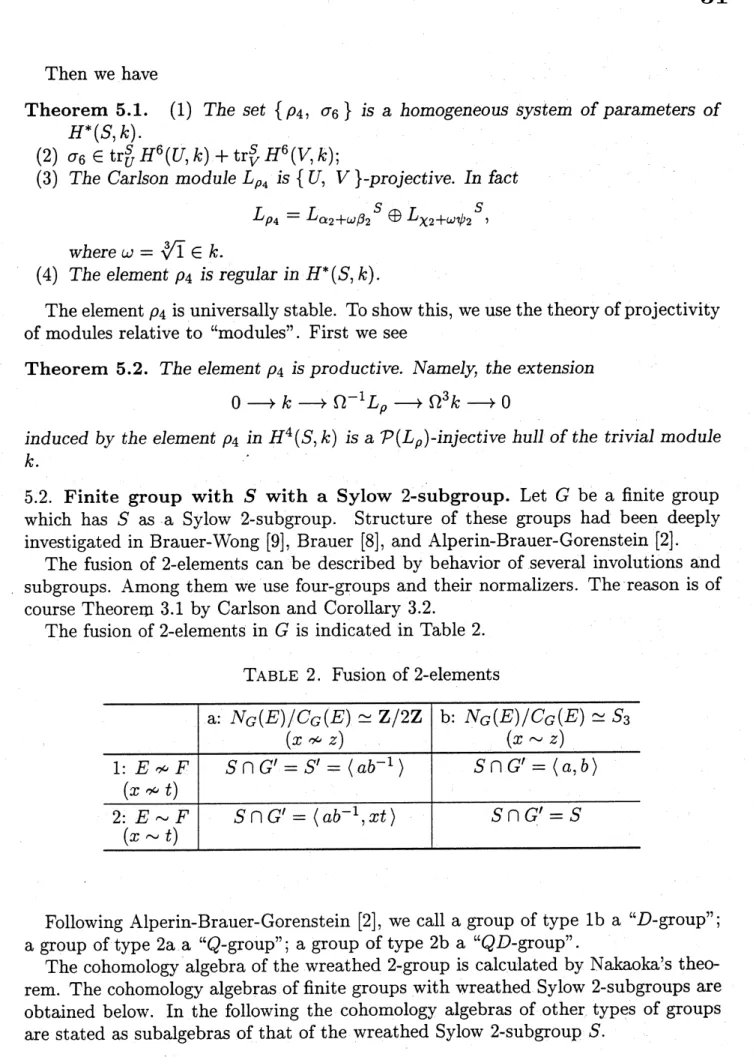
by Carlson and Corollary 3.2.The fusion of 2-elements in $G$ is indicated in Table 2.
TABLE 2. Fusion of 2-elements
Following $\mathrm{A}\mathrm{l}\mathrm{p}\mathrm{e}\mathrm{r}\mathrm{i}\mathrm{n}- \mathrm{B}\mathrm{r}\mathrm{a}\mathrm{u}\mathrm{e}\mathrm{r}-\mathrm{G}_{0}\mathrm{r}\mathrm{e}\mathrm{n}\mathrm{S}\mathrm{t}\mathrm{e}\mathrm{i}\mathrm{n}[2]$ ,
we
calla
group oftype lba
“ $D$-group”;a
group oftype $2\mathrm{a}$a
“$Q$-group”;a group
of type $2\mathrm{b}$a
“QD-group”.The cohomology algebra ofthe wreathed 2-group is calculated by Nakaoka’s
theo-rem.
The cohomology algebras offinitegroups
with wreathed Sylow 2-subgroupsare
obtained below. In the following the cohomology algebras of other types of
groups
are
statedas
subalgebras of that of the wreathed Sylow 2-subgroup $S$.(1) If$G$ is oftype 1$\mathrm{a}$, then
$H^{*}(G, k)\simeq H^{*}(S, k)$
$=k[\zeta_{1}, \tau_{1}, \zeta_{2}, \nu_{2}, \zeta 3, \nu_{4}]/((_{1}^{2}, \nu_{2}, \zeta 232, \tau\zeta 1, \tau\zeta 2, \mathcal{T}\zeta_{3}, \nu 2\zeta_{1}, \nu_{2}\zeta 3, \zeta 1\zeta 3-\zeta 2\nu 2)$
.
(2) If$G$ is
a
$D$-group, then$H^{*}(G, k)=k[_{\mathcal{T}}1, \nu 2, \theta_{3}, \rho 4, \theta_{5,6}\sigma]$,
where
$\theta_{3}=\tau_{1}\nu_{2}+\zeta_{1}\zeta_{2}+\zeta_{3},$ $\rho_{4}=\tau_{1}^{4}+\zeta_{2}^{2}+\nu_{4},$ $\theta_{5}=\tau^{3}\nu_{2}+\zeta_{1}\rho_{4}+\zeta_{2}\zeta_{3},$ $\sigma_{6}=(\tau_{1}^{2}+\zeta_{2})\nu_{4}$
(3) If$G$ is
a
$Q$-group,
then
$H^{*}(G, k)=k[(_{1}, \sigma_{2}, \theta 3, \rho_{4}]$,
where
$\sigma_{2}=\mathcal{T}_{1}^{2}+\zeta_{2}$.
(4) If$G$ is a $QD$-group, then
.
$H^{*}(G, k)=k[\theta_{3}, \rho_{4_{)}5_{)}}\theta\sigma 6]$.Remark 5.1. The elements $\zeta_{1},$ $\nu_{2}$, and $\zeta_{3}$ above will $\mathrm{b}.\mathrm{e}$ stated in subsection 5.5.
To show that the element$\rho_{4}$ in $H^{4}(S, k)$ is universally stable,
we
show the followingTheorem 5.4. There exists
a
$kG$-module $\overline{X}$such that
$\overline{X}_{S}=L_{\rho}\oplus(\mathrm{P}^{\mathrm{r}\mathrm{o}}\mathrm{j}\mathrm{e}\mathrm{C}\mathrm{t}\mathrm{i}\mathrm{v}\mathrm{e})$
.
Using Theorem 5.4, Lemma 2.5, and lemma 2.4,
we can
showTheorem 5.5. There exists
a
productive element $\overline{\rho}$ in $H^{4}(G, k)$ such that$\mathrm{r}\mathrm{e}\mathrm{S}_{S\overline{\rho}=\rho},$ $L_{\overline{\rho}}=\overline{X}$.
5.3. $QD$-groups. Our proof of Theorem 5.4 is slightly complicated. So
we
sketchour argument only for $QD$-groups $G$; namely suppose, in this subsection, that the
four-groups $E$ and $F$ are conjugate in $G$ and the quotient group $N_{G}(E)/C_{G}(E)$ is
isomorphic with $S_{3}$. Let $H$ be the subgroup of $N_{G}(E)$ of index two containing the
centralizer $C_{G}(E)$. We may assume that there exists an element $h$ in $H$ such that
$a^{h}=b_{J}.b^{h}=ab$.
Suppose for the moment that there exits
an
element $\overline{\rho}$in $H^{4}(G, k)$ such that$\mathrm{r}\mathrm{e}\mathrm{S}_{S\overline{\rho}=\rho}$.
Then
an
indecomposable direct summand $\overline{X}$of the Carlson module $L_{\rho}\sim$ would have
vertex $U$ and a
source
$L_{\alpha_{2}+\omega\beta_{2}}$ so that$\overline{X}$
would be the Green correspondent of
an
indecomposable direct summand $X’$ of the Carlson module $L_{\rho’}$ of the restriction$\rho’=\mathrm{r}\mathrm{e}\mathrm{s}_{N_{G}(E})\overline{\rho}$ with vertex $U$ and a
source
$L_{\alpha_{2}+\omega\beta_{2}}$.
We write $N=N_{G}(E)$ and$C=C_{G}(E)$. We know that the centralizer $C_{G}(E)$ has a normal 2-complement:
Let
$\epsilon.=\alpha_{2}+\omega\beta_{2}$
.
Since $C_{G}(E)=U\ltimes O(C_{G}(E))$, the Carlson module$L_{\epsilon}$
can
beextendedto $C=C_{G}(E)$.
We denote by $L_{C}$ the extension of$L_{\epsilon}$ to $C_{G}(E)$:
$L_{C|U}\simeq L_{\epsilon},$ $L_{C))}|O(c_{G}(E=\mathrm{t}\mathrm{r}\mathrm{i}_{\mathrm{V}}\mathrm{i}\mathrm{a}1$ module.
Because the module $X’$ belongs to the principal $kN$-block, the module $X’$ is
a
directsummand of the induced module $L_{C^{N}}$. The induced module $L_{C^{N}}$
can
be analyzedby Clifford theory. First
we
have$H=\{X\in N|Lx\simeq\xi L_{\epsilon}\}$
.
Thus if$L_{C^{H}}= \sum M_{j}$ is
an
indecomposable decomposition, then the induced modules$M_{j}^{N}\mathrm{s}$
are
indecomposable and $L_{C^{N}}= \sum M_{j}^{N}$. Indeed the induced module $L_{C^{H}}$decomposes
as
follows.Lemma 5.6. For $i=0,1,2$ , let $k_{i}$ be the one-dimension$\mathrm{a}lkH$-module
on
which $U$acts trivially and the elem
en
$\mathrm{t}h$ actsas
multiplication by$\omega^{i}$.
Then the indu$c\mathrm{e}d$module$L_{C^{H}}$ has
a
decomposition$Lc^{H}=M0\oplus M_{1}\oplus M2$
ofindecompos
a
$blekH$-modules $M_{0,1}M,$ $M_{2}$ such that(1) $M_{i|U}\simeq L_{\epsilon},$ $i=0,1,2$ ;
(2) $M_{i}s$
are
periodic ofperiod six,(3) $M_{i}\simeq M_{0}\otimes k_{i},$ $i=0,1,2$ ;
(4)
$M_{0}/\mathrm{r}\mathrm{a}\mathrm{d}M_{0}=k_{2}\oplus k_{0}$,
soc
$M_{0}=k_{1}\oplus k_{2;}$ $\Omega(M_{0})/\mathrm{r}\mathrm{a}\mathrm{d}\Omega(M_{0})=k_{0}\oplus k_{1}$,soc
$\Omega(M_{0})=k_{2}\oplus k_{0;}$(5) $\Omega^{2}(M_{0)}=M_{2}, \Omega^{2}(M_{1})=M_{0},$ $\Omega^{2}(M_{2})=M_{1}$.
The indecomposable $kN$-module $X’$ would be one of$M_{i;}^{N_{\mathrm{S}}}$ we put, say,
$X’=Mi^{N}$.
Since the module $\Lambda’I_{i}^{N}$ would be
a
direct summand of $L_{\rho’}$, the module $M_{i}$ would bea direct summand of the Carlson module $L_{\rho’’}$ of the restriction $\rho^{\prime/}=\mathrm{r}\mathrm{e}\mathrm{s}_{H}\rho’$
.
Now let
us
return to construction ofthe $kG$-module $\overline{X}$.
Lemma 5.7. The cohomology$\rho_{4}$ is $N_{G}(E)-S\mathrm{t}\mathrm{a}bl\mathrm{e}$.
Definition 5.3. Let
us
take $\rho’$ in $H^{4}(Nc(E), k)$ such that $\mathrm{r}\mathrm{e}\mathrm{s}_{S\rho’=}\rho$.
Thenwe
have $\rho’=\mathrm{t}\mathrm{r}^{N}s\rho$. We also let $\rho’’=\mathrm{r}\mathrm{e}\mathrm{s}_{H}\rho’$. Thenwe
haveProposition 5.8. The Carlson module $L_{\rho’’}$ has
a
decomposition$L_{\rho’’}=M\oplus M^{t}$
ofindecomposa$blekH$-modules $M$ and $M^{t}$ such that
(1) $M_{U}\simeq L_{\mathrm{g}}$;
(2) $M^{N_{U}s_{;}}\simeq L_{\epsilon}$
(3) $M$ is periodic of period six,
(4)
$M/\mathrm{r}\mathrm{a}\mathrm{d}M=k_{1}\oplus k_{2}$,
soc
$M=k_{0}\oplus k_{1;}$$\Omega(M)/\mathrm{r}\mathrm{a}\mathrm{d}\Omega(M)=k_{2}\oplus k0$,
soc
$\Omega(M)=k_{1}\oplus k2$; $\Omega^{2}(M)/\mathrm{r}\mathrm{a}\mathrm{d}\Omega 2(M)=k_{0}\oplus k_{1}$,soc
$\Omega^{2}(M)=k_{2}\oplus k0$;(5) For$i\geq 0$
$\Omega^{i+3}(M)/\mathrm{r}\mathrm{a}\mathrm{d}\Omega^{i+3}(M)\simeq\Omega^{i}(M)/\mathrm{r}\mathrm{a}\mathrm{d}\Omega i(M)$ ;
soc
$\Omega^{i+3}(M)\simeq \mathrm{s}\mathrm{o}\mathrm{c}\Omega^{i}(M)$.
Definition 5.4. Let$X’=M^{N}$.
The indecomposable $kN$-module $X’$ has vertex $U$ and
source
$L_{\epsilon}$.By
our
definition ofthe indecomposable $kN$-module $X’$we
haveProposition 5.9. (1) The indecomposa$blekN$-module $X’$ isperio$\mathrm{d}ic$ofperiod six.
(2) $X_{S}’=L\epsilon s$.
(3) The indecomposable $kN$-module $X’$ is
a
direct summand of$L_{\rho’}$.Using the proposition above and the assumption that the four-groups $E$ and $F$ are
conjugate,
we
obtainProposition 5.10. It follows that
$X^{\prime G}s\equiv L_{\rho}$ (mod projective).
We can now define the $\dot{k}G$-module $\overline{X}$
.
Definition 5.5. Let
$\overline{X}$
be
a
Green correspondent of$X’$ with respect to $(G, U, N_{G}(E))$.By
means
ofPropositions 5.9,5.10
and the properties ofthe Greencorrespondencewe
see
that the $kG$-module $\overline{X}$is the desired
one.
Theorem 5.11. We have
(1) the $kG$-module $\overline{X}$
isperiodic of period six;
(2)
$X^{;G}=\tilde{X}\oplus(\mathrm{P}^{\mathrm{r}\mathrm{o}}\mathrm{j}\mathrm{e}\mathrm{C}\mathrm{t}\mathrm{i}\mathrm{V}\mathrm{e})$;
(3)
$\tilde{X}$
$\rho’=\rho^{N}$ $X’=M^{N}$
$\rho^{\prime/}=\rho_{H}’$ $L_{\rho’’}=M\oplus M^{t}$
$L_{\rho}$ $\rho$ $L_{C}$
$L_{\epsilon}$ $\epsilon$
Remark
5.2.
When the $\mathrm{f}\mathrm{o}\mathrm{u}\mathrm{r}$’-groups
$E$ and $F$are
not conjugate in $G$, the $kG$-module$\overline{X}$
in Theorem
5.4
is not indecomposable.5.4.
Relative injective hull of the trivial module. Weresume
our
situation that$G$ is a finite
group
with wreathed Sylow 2-subgroup $S$.
The element $\overline{\rho}_{4}$ is productiveby Theorem 5.5. The $L_{\overline{\rho}}$-injective hull
$0arrow k_{G}arrow\Omega^{-1}(L_{\overline{\rho}})arrow\Omega^{3}(k_{G})arrow 0$
gives
us
much information about the cohomology algebra. Firstwe can
deduce thefollowing theorem from Theorem
3.3.
Theorem 5.12. The element $\sigma_{6}$ is universallystable. Namely thereexists
an
element$\overline{\sigma}_{6}\in H^{6}(G, k)$ such that
$\mathrm{r}\mathrm{e}\mathrm{s}_{S}\tilde{\sigma}_{6}=\sigma_{6}$.
Consequently the set
$\{\rho_{4}, \sigma_{6}\}$
is
a
homogeneous
system of$p$aram
eters for $H^{*}(G, k)$ for every $G$.
Second
we can
obtain dimension formulae for the cohomologygroups
$H^{*}(G, k)$.
Applying the cohomology functor $\mathrm{E}\mathrm{x}\mathrm{t}_{kG}(-, k)$ to the extension
$0arrow k_{G}arrow\Omega^{-1}L_{\rho}\simarrow\Omega^{3}k_{G}arrow 0$,
we
obtain the short exact sequences$0arrow \mathrm{H}\mathrm{o}\mathrm{m}_{kG}(\Omega 3k, k)arrow \mathrm{H}\mathrm{o}\mathrm{m}_{kG}(\Omega^{-}1L\sim k\rho_{4}’)arrow 0$,
$0arrow \mathrm{E}_{\mathrm{X}\mathrm{t}_{kG}^{n}}(k, k)arrow \mathrm{E}\mathrm{x}\mathrm{t}_{k^{+}}^{n}(ck1\Omega 3, k)arrow \mathrm{E}\mathrm{x}\mathrm{t}_{k}^{n+1}c(\Omega-1L^{\sim k}\rho_{4}’)arrow 0$, $n\geq 0$
.
In particular
we
ha.ve
a
$\mathrm{f}_{\mathrm{o}\mathrm{r}\mathrm{m}\mathrm{u}}....1\mathrm{a}$and
we can
compute $\dim \mathrm{E}\mathrm{x}\mathrm{t}n(kGL_{\rho_{4}}^{\sim,k})$ byour
construction of the module $\tilde{X}=L_{\rho}^{\sim}$.
For example, if$G$ is
a
$QD$-group, then$\dim \mathrm{E}\mathrm{x}\mathrm{t}_{k}n_{G(L\rho 4}\sim,$
$k)=$
We
can
also calculate $\dim \mathrm{E}_{\mathrm{X}\mathrm{t}^{n}}(kGk, k),$ $n=1,2,3$,so
thatwe
obtain dimensionformulae for $H^{*}(G, k)$
.
We have obtained
a
system of parameters $\{\rho_{4},\sigma_{6}\sim\sim\}$ and established dimensionformulae for the cohomology
groups
$H^{*}(G, k)$.
We have to get generators of thecohomology algebras over the subalgebra $k[\rho_{4},\overline{\sigma}_{6}\sim]$.
5.5. Generators of Cohomology Algebras. First let
us
state generators of thecohomology algebra of the wreathed 2-group $S$. The cohomology algebra $H^{*}(S, k)$
has $\{\sigma_{2}(=\tau_{1}^{2}+(2), \rho_{4}\}$
as a
system of parameters. Hence wecan
take generatorsofdegree up to 4. In fact, $H^{*}(S, k)$ is generated
over
the subalgebra $k[\sigma_{2}, \rho_{4}]$ by $\tau_{1}$,which
was
defined in Section 2, and the elements $\zeta_{1,2}l^{\text{ノ}},$ $\zeta 3\in H^{*}(S, k)$. To state theseelements, let $\alpha_{1}\in\inf^{U}H^{1}(U/\langle b\rangle, k)$; and let
us
define .$\zeta_{1}=\mathrm{t}\mathrm{r}_{U}^{s}\alpha 1\in H^{1}(S, k)$,
$\nu_{2}=\mathrm{n}\mathrm{o}\mathrm{r}\mathrm{m}_{U}^{S}\alpha_{1}\in H^{2}(S, k)$,
$\zeta_{3}=\mathrm{t}\mathrm{r}_{U}^{S}(\alpha_{1}\alpha_{2})\in H^{3}(S, k)$
.
When the four-groups $E$ and $F$
are
not conjugate in $G$, the cohomology algebras$H^{*}(G, k)$ and $H^{*}(N_{G}(E), k)$
are
isomorphic. Thiscan
beseen
by comparing thedi-mensions of the cohomologygroups. On the other hand, when$E$ and $F$
are
conjugate,one can
takean
element $g_{0}\in C_{G}(C)$ such that $E^{\mathit{9}0}=F$ and $U^{\mathit{9}0}\cap S=V$.
Thenwe
can
determine the stable elements by considering the subspaces$\{\xi\in H^{n}(S, k)|\xi^{\mathit{9}0}V=\xi_{V}\}$, $n\leq 4$.
Of
course
the element $g_{0}$ aboveplaysan
important rolethroughout inour
investigationfor those groups in which $E$ and $F$
are
conjugate.REFERENCES
[1] A. Adem and R. Milgram, The mod 2 cohomology rings
of
rank 3 simple groupsare Cohen-Macaulay, Prospects in topology (Princeton) (F. Quinn, ed.), Ann.
Math. Studies, vol. 138, Princeton Univ. Press, 1995, pp. 3-12.
[2] J. L. Alperin, R. Brauer, and D. Gorenstein, Finite groups with quasi-dihedral
and wreathed Sylow 2-subgroups, ’bans. Amer. Math. Soc. 151 (1970), 1-261.
[3] –, Finite simple groups
of
2-rank two, Scripta Math. 29 (1973),191-214.
[4] T. Asai, A dimension
formula for
the cohomology ringsof
finite
groups withdihedral Sylow 2-subgroups, Comm. Algebra 19 (1991), 3173-3190.
[5] T. Asai and H. Sasaki, The mod 2 cohomology algebras
of finite
groups with[6] D. J. Benson, Representations and cohomology II.. Cohomology
of
groups andmodules, Cambridge studies in advanced mathematics, vol. 31, Cambridge
Uni-versity Press, Cambridge, 1991.
[7] D. J. Benson and J. F. Carlson, Diagrammatic methods
for
the modular repre-sentations and cohomology, Comm. Algebra 15 (1987),53-121.
[8] R. Brauer, Character theory
of
finite
groups with wreathed Sylow 2-subgroups, J.Algebra 19 (1971),
547-592.
[9] R. Brauer and W. J. Wong,
Some
propertiesof
finite
groups with wreathed Sylow2-subgroups, J. Algebra 19 (1971), 263-273.
[10] J. F. Carlson, Depth and
transfer
maps in the cohomologyof
groups, Math. Z.218 (1995),
461-468.
[11] –, Modules and group algebras, Lectures in Mathematics, ETH Z\"urich,
Birkh\"auser, $\mathrm{B}\mathrm{a}\mathrm{s}\mathrm{e}\mathrm{l}/\mathrm{B}\mathrm{o}\mathrm{s}\mathrm{t}\mathrm{o}\mathrm{n}/\mathrm{B}\mathrm{e}\mathrm{r}\mathrm{l}\mathrm{i}\mathrm{n}$ ,
1996.
[12] L. Evens, The cohomology
of
groups, Oxford $\grave{\mathrm{M}}$athematics Monograph, Oxford
University Press, New York,
1991.
[13] L. Evens and S. Priddy, The ring
of
universally stableelement.s,
Quart.’J.
Math.Oxford (2) 40 (1989),
399-407.
[14] S. Fiedorowizc and S.
Priddy,
Homologyof
classical groups overfinite fields
andtheir associated
infinite
loop spaces, Springer Lecture Notes in Math., vol. 674, Springer-Verlag, $\mathrm{B}\mathrm{e}\mathrm{r}\mathrm{l}\mathrm{i}\mathrm{n}/\mathrm{N}\mathrm{e}\mathrm{w}\mathrm{Y}_{0}\mathrm{r}\mathrm{k}/\mathrm{H}\mathrm{e}\mathrm{i}\mathrm{d}\mathrm{e}\mathrm{l}\mathrm{b}\mathrm{e}\mathrm{r}\mathrm{g}$ ,1978.
[15] D. Gorenstein, Finite groups, Harper&Row, Publishers, New York, 1968.
[16] D. Gorenstein and J. H. Walter, The characterization
of finite
groups withdihe-dral sylow 2-subgroups, I, II, III, J. Algebra 2 (1965), 85-151, 218-270, 334-393.
[17] R. Kn\"orr, Relative projective covers, Proc. Symp. Modular Representations of
Fi-nite Groups, Various Publication Series, vol. 29, Aarhus University, 1978, pp.
28-32.
[18] I. J. Leary, The mod-p cohomology rings
of
some $p$-groups, Math. Proc.Cam-bridge Philos. Soc. 112 (1992),
no.
1, 63-75.[19] R. Lyons, A characterization
of
$U_{3}(4)$, bans. Amer. Math. Soc. 164 (1972),371-387.
[20] J. Martino, Stable splittings
of
the Sylow 2-subgroup8of
$\mathrm{S}\mathrm{L}_{3}(\mathrm{F}_{q}),$q-odd,
Ph.D.thesis, Northwestern University,
1988.
[21] J. Martino and S. Priddy,
Classification
of
BGfor
groups with dihedral orquater-nion Sylow 2-subgroups, J. Pure Appl. Algebra 73 (1991),
13-21.
[22] H. Nagao and Y. Tsushima, Representations
of
finite
groups, Academic Press,New York, London, 1989.
[23] T. Okuyama, A generalization
of
projectivecovers
of
modules over group algebras,unpublished manuscript.
[24] H. Sasaki, The mod 2 cohomology algebras
of finite
groups withsemid\‘ih’edral
Sylow 2-subgroups, Comm. Algebra 55 (1994),
243-275.
[25] M. Tezuka and N. Yagita, The
mod\ldots
p cohomologyof
$\mathrm{G}\mathrm{L}_{3}(\mathrm{F}_{p})$, J. Algebra 81(1983),
295-303.
[26] M. Tezuka and N. Yagita., On odd prime components
of
cohomologies sporadicsimple groups and the rings