Weak Solutions and
Their
Numerical
Analysis
of Nonlinear Parabolic
Equations
of Fourth Order based
on
FEM
神戸大学自性科学研究科
王全芳
(Quan-Fang Wang)
神戸大学工学部
中桐信一
(Shin-ichi Nakagiri)
1Introduction
In
this
paper
we
investigate
the
weak solutions and
their
numerical
analysis of nonh.near
parabolic equation of fourth order. In recent
years,
there
are
many
mathematical
literature
con-cerning
with
nonnegative
or
positive
solutions to
fourth-order
parabolic
equations
(cf.
[1], [3]).
However,
the study of
numerical
analysis of nonlinear fourth order parabolic equations is few.
In [5],
we
studied abstract nonlinear parabolic equations
having
uniform
Lipschitz
continuous
nonlinearities,
but
the fourth order equations
are
not
treated
in [5]. The
purpose
of this
paper
is to study the weak and
numerical
solutions
of fourth order parabolic equations which include
nonlinear gradient and Laplacian terms.
Let
$\Omega$be
an
open bounded
domain of
$\mathrm{R}^{m}$
and
$\partial\Omega=\Gamma$
be the
piecewise
smooth boundary of
$\Omega$
.
Let
$T>0$
,
$Q=$
$(0, T)\cross\Omega$
and
$\Sigma=(0, T)\cross\Gamma$
.
We
consider
the following nonlinear parabolic
equation of fourth order
$\frac{\partial y}{\partial t}+\Delta(a(t, x)\Delta y)=f(t,$
x, y,
$\nabla y, \Delta y)$
in Q,
(1.1)
where
$a\in C([0,T];L^{\infty}(\Omega))$
satisfifies
$a(t, x)\geq A>0$
for all
$(t, x)\in Q$
and
$f\in L^{\infty}([0,T]\mathrm{x}\Omega \mathrm{x}$
$\mathrm{R}\mathrm{x}\mathrm{R}^{n}\mathrm{x}\mathrm{R})$
is
anonlinear
forcing function. The
initial condition
is
given
by
$y(0, x)=y\mathrm{o}(x)$
in
$\Omega$
.
The
attached
boundary
condition is given
by
the
one
of the
following
four
types
of conditions
(cf. Dautray
and Lions [2]).
Case 1
(Dirichlet
boundary
condition)
$y(t, x)= \frac{\partial}{\partial n}y(t,x)=0$
on
$\Sigma$;
(1.2.1)
Case
2(Neumann
boundary
condition)
$\Delta y(t,x)=\frac{\partial}{\partial n}\Delta y(t, x)=0$
on
$\Sigma$;
(1.2.2)
Case 3
(Mixed
boundary condition, A)
$y(t, x)=$
$y(t,x)=0$
on
$\Sigma$;
(1.2.3)
Case 4
(Mixed
boundary condition,
B)
$\frac{\partial y}{\partial\eta}(t, x)=\frac{\partial}{\partial\eta}(a(t,x)\Delta y(t, x))=0$
on
E. (1.2.4)
We
explain the content
of
this
paper.
In
section
2,
we
prove
the
existence
and uniqueness
theorem of weak solutions for the problem
(1.1)
with
one
of (1.2.1)-(1.2.4).
At
the
same
time
we
give the estimate of weak solutions with respect to initial values and
forcing
terms. After
this,
we
study
the
numerical
analysis
of the problem
based
on
the fifinite element
method
in
section 3.
As
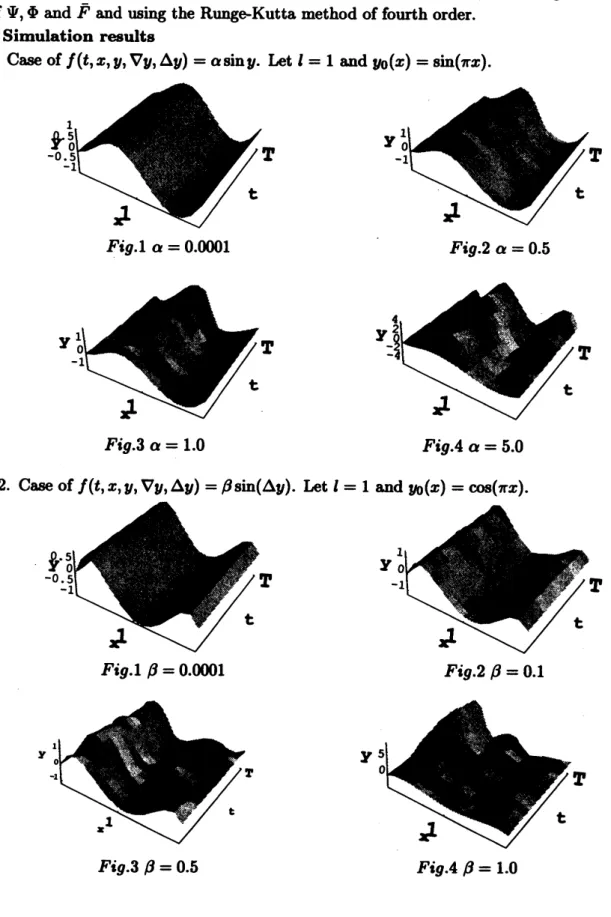
numerical simulations
we
consider
the
special
case
where
$a(t, x)\equiv 1$
and
$f(t,x,y, \nabla y, \Delta y)=$
$\alpha\sin y+\beta\sin\nabla y+\gamma\sin$
by.
数理解析研究所講究録 1254 巻 2002 年 91-99
2
Existence
and
Uniqueness of Weak
Solutions
In this section,
we
study
the
existence
and uniqueness of weak
solutions
for the
initial-boundary
vfiue
problem (1.1)
with
one
of (1.2.1)-(1.2.4). In order to
solve
the problem
in the
ffamework
of vaiational method due to Dautray and Lions [2],
we introduce
two
Hilbert space
$H=L^{2}(\Omega)$
and the
maximum domain
$H(\Delta;\Omega)=\{\phi\in L^{2}(\Omega)|\Delta\phi\in L^{2}(\Omega)\}$
.
$H(\Delta;\Omega)$
is
a
Hilbert space
with the
imer
product
$(\phi,\psi)_{H(\Delta\Omega)}j=(\phi,\psi)+(\Delta\phi, \Delta\psi)$
, where
$(, )$
is
the
imer
product
of
$H=L^{2}(\Omega)$
.
We
now
take the
pivot
Hilbert space
(specified later)
$V$
such
as
$H_{0}^{2}(\Omega)\subset V\subset$
$H(\Delta;\Omega)$
.
Thus
$V$
is aclosed
subspace of
$H(\Delta;\Omega)$
equipped with the
nom
$||\phi||=(|\phi|^{2}+|\Delta\phi|^{2})^{l}2$
,
$| \phi|=(\int_{\Omega}|\phi(x)|^{2}dx)^{\frac{1}{2}}$
(2.1)
We
note
that the
norm
||. ||
is
equivalent
to the
norm
of
$H^{2}(\Omega)$
, i.e. there exists
a
$c_{1}>0$
such
that
$||\phi||_{H^{2}(\Omega)}\leq c_{1}||\phi||$
,
$\forall\phi\in H^{2}(\Omega)$
.
(2.2)
For such
a
V
we
defifine
the
space
$W(0,T)=$
{g|g
$\in L^{2}(0,T;V),g’\in L^{2}(0,T;V’)\}$
.
(2.3)
We introduce
the
bilinear form
$a(t; \phi, \psi)=\int_{\Omega}a(t,x)\Delta\phi(x)\Delta\psi(x)dx$
,
$\forall\phi$,$6 V
$\subset H(\Delta;\Omega)$
.
(2.4)
associated
with the
fourth order differential
operator
$\Delta(a(t,x)\Delta)$
.
It is clear that
$a(t;\phi, \phi)\geq$
$A|\Delta\phi|^{2}$
,
$\forall t\in[0,T]$
.
Further
we
suppose that for my
$\phi\in H(\Delta;\Omega)$
the
ffinction
$f(t;\phi)=$
$f(t,x, \phi, \nabla\phi, \Delta\phi)$
defifines
a
function
in
$H=L^{2}(\Omega)$
for
each
$t\in[0, T]$
.
Here
we
take
$V$
$\mathrm{a}\mathrm{e}$foUows
for
the
case
1-4.
Caae
1: V
$=H_{0}^{2}(\Omega)$
,
Case
2: V
$=H(\Delta;\Omega)$
,
Case 3:
V
$=\{\phi\in H(\Delta;\Omega)$
|
$\phi|\mathrm{r}=0\}$
,
Caae 4:
V
$= \{\phi\in H(\Delta;\Omega)|\frac{\partial\phi}{\partial n}|\mathrm{r}=0\}$
.
(2.5)
Now
we
give the
defifinition
of weak
solutions for
the problem (1.1) with
one
of (1.2.1)-(1.2.4),
md
shortly
we
shaU
cau
the problem
(P).
Deflnition
1
A
function
y is
said
to be
a
weak
solution of
the problem
(P)
if
y
$\in W(0,$
T)
and
y satisfifies
$\{$
$\langle y’(\cdot)$
,
$\phi)_{V’,V}+a(\cdot;y(\cdot), \phi)=(f(\cdot;y(\cdot)), \phi)$
for
$\mathrm{a}\mathbb{I}$
$\phi\in V$
in the
sense
of
$\nu(0,T)$
,
$y(0)=y_{0}$
,
(2.6)
Where
$V$
is given
by
the
one
indicated in
(2.6),
the
symbol
$(\cdot, \cdot)_{V’,V}$
denotes adual pairing
between
$V\mathrm{m}\mathrm{d}$
$V’$
,
and
$y(0,T)$
denotes the
space
of
distributions
on
$(0, T)$
.
Assume
that
$f$
:
$[0, T]$
$\mathrm{x}\Omega \mathrm{x}\mathrm{R}\mathrm{x}\mathrm{R}^{n}\mathrm{x}\mathrm{R}arrow \mathrm{R}$
satisfy
(i)
$f(\cdot,x,y,\xi,\eta)$
is measurable
on
[0, T]
for
each
x
$\in\Omega$
,
y
$\in \mathrm{R}$
,
$\xi\in \mathrm{R}^{n}$
and
$\eta\in \mathrm{R}$
;
(ii) f(.,x,
y,
$\xi,\eta)$
is measurable
on
$\Omega$for each t
$\in[0,\prod,$
y
$\in \mathrm{R}$
,
$\xi\in \mathrm{R}^{n}$
and
$\eta\in \mathrm{R}$
;
(iii)
there is
a
$c\in L^{\infty}(Q)$
such that for
$\forall(t, x)\in Q$
,
$\forall y$
,
$y’$
,
$\xi,\xi’\in \mathrm{R}$
,
$\forall\eta$,
$\eta’\in \mathrm{R}^{n}$
$|f(t, x, y, \xi,\eta)-f(t, x, y, \xi’, \eta’)|\leq c(t, x)(|y-y’|+|\xi-\xi’|+|\eta-\eta’|)$
;
(iv)
there is
a
$\gamma\in L^{2}(Q)$
such that
$|f(t, x,0,0,0)|\leq\gamma(t, x)$
,
$\forall(t, x)\in Q$
.
Theorem
1
Assume
that
f
satisfifies
$(\mathrm{i})-(\mathrm{i}\mathrm{v})$.
Then for
$y0\in L^{2}(\Omega)$
,
there exists
a
unique
weak
solution y
$\in W(0,T)$
of
(P)
such that y
$\in L^{\infty}(0, T;L^{2}(\Omega))\cap L^{2}(0,T;H^{2}(\Omega))$
.
Further the
estimate
$||y||_{L^{\infty}(0,T;H)}^{2}+||y||_{L^{2}(0,T_{j}H^{2}(\Omega))}^{2}\leq C(|y0|^{2}+||\gamma||_{L^{2}(Q)}^{2})exp(C||c||_{L^{\infty}(Q)}^{2})$
(2.7)
holds for
some
C
$>0$
indenpent of
yo.
Proof.
Defifine the function
$\overline{f}:$[0,
$T]\cross Varrow H$
by
$\overline{f}(t, \phi)(x)=f(t, \phi(x),$
$\nabla\phi(x)$
,
$\Delta\phi(x))$
,
a.e. x
$\in$
$\Omega$
.
Then by
(iii)
and
(2.2),
we
have
$|\overline{f}(t, y_{1})-\overline{f}(t, y_{2})|^{2}=|f(t;y_{1})-f(t;y_{2})|_{H}^{2}$
$=$
$\int_{\Omega}|f(t, x, y_{1}, \nabla y_{1}, \Delta y_{1})-f(t, x, y_{2}, \nabla y_{2}, \Delta y_{2})|^{2}dx$
$\leq$
$2||c||_{L\infty(Q)}^{2} \int_{\Omega}(|y_{1}-y_{2}|^{2}+|\nabla y_{1}-\nabla y_{2}|^{2}+|\Delta y_{1}-\Delta y_{2}|^{2})dx$
$\leq$
$2||c||_{L^{\infty}(Q)}^{2}||y_{1}-y_{2}||_{H^{2}(\Omega)}^{2}\leq 2c_{1}^{2}||c||_{L^{\infty}(Q)}^{2}||y_{1}-y_{2}||^{2}$
.
(2.8)
This
proves
that the nonlinear term in
(2.6)
satisfifies
the uniform Lipschitz continuity. Hence
by Wang and Nakagiri [5], there exists
a
unique
weak solution
$y\in W(0, T)$
of the problem (P)
under
the
assumptions
$(\mathrm{i})-(\mathrm{i}\mathrm{v})$.
Next
we
shall
prove the estimate
(2.7).
Taking
$\phi=y$
in the weak form
(2.6)
and
integrating
them
on
$[0, t]$
,
by
(iii), (iv)
and
(2.8)
we
have
$\frac{1}{2}|y(t)|^{2}+A\int_{0}^{t}|\Delta y|dt$
$\leq$
$\frac{1}{2}|y(0)|^{2}+\int_{0}^{t}|f(s;y)-f(s;0)||y(s)|ds+\int_{0}^{t}|f(s;0)||y(s)|ds$
$\leq$
$\frac{1}{2}|y(0)|^{2}+\sqrt{2}c_{1}||c||_{L^{\infty}(Q)}\int_{0}^{t}||y(s)|||y(s)|ds+\int_{0}^{t}|\gamma(s, \cdot)||y(s)|ds$
.
Hence,
for
any
$\epsilon$$>0$
,
we
have
$\frac{1}{2}|y(t)|^{2}+(A-\epsilon)\int_{0}^{t}||y(s)||^{2}ds\leq\frac{1}{2}|y_{0}|^{2}+\frac{1}{2}||\gamma||_{L^{2}(Q)}^{2}+(\frac{2}{\epsilon}c_{1}^{2}||c||_{L^{\infty}(Q)}^{2}+2)\int_{0}^{t}|y(s)|^{2}ds$
.
(2.9)
By setting
$\epsilon$$= \frac{A}{2}$
and aPPlying the
Bellmann-Gronwall
inequality to (2.9),
we
have
$|y(t)|^{2}+||y||_{L^{2}(0,T_{j}V)}^{2}\leq C(|y_{0}|^{2}+||\gamma||_{L^{2}(Q)}^{2})exp(C||c||_{L^{\infty}(Q)}^{2})$
,
$\forall t\in[0,T]$
(2.10)
for
some
C
$>0$
.
Hence (2.7) follows. This completes the proof
3
Numerical
Analysis based
on FEM
In
this
section,
we
study
the numerical
analysis
of
one
dimensional
nonlinear fourth order
parabolic equations (1.1)
based
on
the finite element method. We constmct
a
rather
complete
and
effective
algorithm for approximate
solutions
by
using
the cubic
base functions for
each
type of
boundary
$\infty \mathrm{n}\mathrm{d}\mathrm{i}\mathrm{t}\mathrm{i}\mathrm{o}\mathrm{n}\mathrm{s}$.
The difference
depends
on
the choice of the basis
of
$V$
.
Using
Mathematica,
we
give
several figures of weak
solutions for different
types
of
$\mathrm{i}\mathrm{n}\cdot \mathrm{t}\mathrm{i}\mathrm{a}\mathrm{l}$data,
forcing
functions
$\mathrm{m}\mathrm{d}$physics
parameters.
Let
$0=x_{0}<x_{1}<\cdots<x_{N}<x_{N\dagger 1}=l$
be
a
partition
of
the
interval
$[0, l]$
into subinterval
$I_{e}=[x_{e-1}, x_{e}]$
of length
$h_{e}=x_{e}-x_{e-1}$
,
$e=1,2$
,
$\cdots$
,
$N+1$
.
Let
$V_{h}$
be
the
set of
fimctions
such
that
$\phi$is cubic
on
each
$I_{e}\mathrm{m}\mathrm{d}$
is continuous
on
$[0, l]$
.
Then
it is clear that
$V_{h}\subset H_{0}^{2}(0,l)$
.
Let
us
in-troduce
the baae
functions
$\psi_{\dot{1}}^{e}$defifined
by cubic interpolation
fimctions, which
cm
be
expressed
as
$\{$
$\psi_{1}^{e}(x)=1-\frac{3}{h_{e}^{2}}(x-x_{e})^{2}+\frac{2}{h_{e}^{3}}(x-x_{e})^{3}$
,
$\psi_{2}^{e}(x)=(x-x_{e})-\frac{2}{h_{e}}(x-x_{e})^{2}+\frac{1}{h_{e}^{2}}(x-x_{e})^{3}$
,
$\psi_{3}^{e}(x)=\frac{3}{h_{e}^{2}}(x-x_{e})^{2}-\frac{2}{h_{e}^{3}}(x-x_{e})^{3}1$
’
$\phi_{4}^{e}(x)=-_{\overline{h_{e}}}(x-x_{e})^{2}+\frac{1}{h_{e}^{2}}(x-x_{e})^{3}$
.
The
Hermite
cubic interpolation functions satisfy the following interpolation properties
$\psi_{1}^{e}(x_{e})=1$
,
$\psi_{\dot{1}}^{e}(x_{e})=0$
$(i\neq 1)$
,
$\psi_{3}^{e}(x_{e+1})=1$
,
$\psi_{\dot{1}}^{e}(x_{e+1})=0$
$(i\neq 3)$
,
$( \frac,)|_{x_{e+1}}=1(\frac{-d\psi_{2}^{e}}{-\Psi_{\psi_{4}^{e}},dx})|_{x_{e}}=1,$
,
$(_{dx}^{\mathrm{i}^{e})|_{x_{*+1}}=0}(_{\ovalbox{\tt\small REJECT}}^{d\psi}\mathrm{i}^{e})|_{x_{e}}=0$
$(\dot{\iota}\neq 4)(i\neq 2).$
’
(3.1)
We give the analysis only for the
Case
1:
$V=H_{0}^{2}(0,l)$
.
We omit others
cases
here.
Case
1
corresponds
to the
following
one
dimensional
$\mathrm{i}\mathrm{n}\cdot \mathrm{t}\mathrm{i}\mathrm{a}\mathrm{l}$boundary value
problem
$\{$
$\frac{\partial y}{\partial t}+\Delta(a(t,x)\Delta y)=f(t, x,y, \nabla y, \Delta y)$
,
in
$(0, l)$
$\mathrm{x}(0,T)$
,
$y(t,0)= \frac{\partial y}{\partial n}(t,0)=y(t,l)=\frac{\partial y}{\partial n}(t,l)=0$
,
on
$(0, T)$
,
$y(0,x)=m(x)$
,
$a.e$
.
on
$(0, l)$
.
(3.2)
The
$e$
-th element of
approximate
solution
for
(1.1)
is
defined
by
$yh(t,x)= \sum_{\dot{|}=1}^{4}\xi_{\dot{1}}^{e}(t)\psi_{\dot{1}}^{e}(x)$
,
e
$=$
1, 2,
\cdots ,
N. Then the total
approximate solution
can
be
represented
as
$y_{h}(t,x)= \sum_{e=1}^{N}y_{h}^{e}(t, x)=\sum_{e=1}^{N}\sum_{\dot{|}=1}^{4}\xi_{\dot{1}}^{e}(t)\psi^{e}\dot{.}(x)\in V_{h}\subset V$
,
$\forall t\in[0,T]$
,
where
$y^{e}h$
’
$e=1,2$
,
$\cdots$
,
$N$
satisfy
$\{$
$((y_{h}^{e})’, \psi_{j}^{e})+(a(t, \cdot)\Delta y_{h}^{e}$
,
$\Delta\psi_{j}^{e})=(f(t, \cdot,y_{h}^{e}, \nabla y_{h}^{e}, \Delta y_{h}^{e}), \psi_{\mathrm{j}}^{e})$
,
$(y_{h}^{e}(0),\psi_{j}^{e})=(y_{0}, \psi_{j}^{e})$
.
(3.3)
We
can
rewrite (3.3)
as
follows:
$\{$
$. \sum$
$.–144 \xi^{e\prime}\dot{.}(t)(\psi^{e}\dot{.}, \psi^{e}\dot{.})+\dot{.},\sum_{=1}^{4}\xi_{i}^{e}(t)(a(t, \cdot)\Delta\psi_{i}^{e},$
$\Delta\psi_{j}^{e})-(f(t, \cdot, y_{h}^{e}, \nabla y_{h}^{e}, \Delta y_{h}^{e}),\psi_{j}^{e})=0$
,
$\sum_{i=1}\xi_{i}^{e}(0)(\psi^{e}\dot{.},$
$\psi_{j}^{e}\rangle=(y0,\psi_{j}^{e})$
,
$e=1,2$
,
$\cdots$
,
$N$
.
(3.4)
By the interpolation
properities
(3.1),
we
set
$\psi_{1}^{1}=0$
,
$\psi_{3}^{N}=0$
and
$\nabla\psi_{2}^{1}=0$
,
$\nabla\psi_{4}^{N}=0$
.
For
simplicity
we
denote
$\nabla\psi=\dot{\psi}$
and
$\Delta\psi=\dot{\psi}$
.
Then the fifirst equation of
(3.4)
can
be written
as
$\dot{.}\sum_{=1}^{4}\xi_{i}^{e\prime}\psi_{ij}^{e}+\sum_{i=1}^{4}\xi^{e}\dot{.}\phi_{ij}^{e}-f_{j}^{e}=$
.
0,
(3.5)
where
$\psi_{\dot{\iota}j}^{e}=(\psi^{e}\dot{.},\psi_{j}^{e})$
,
$\phi_{ij}^{e}=(a(t, \cdot)\dot{\psi}_{i}^{e},\dot{\psi}_{j}^{e})$
,
$f_{j}^{e}=(f^{e}(t, \cdot, y_{h}^{e},\dot{y}_{h^{e}},\dot{y}_{h^{e}}.), \psi_{j}^{e})$
.
Now
we
set
$\Psi^{e}=(\psi_{i}^{e},\psi_{j}^{e})_{=1,2,3,4}^{j=1,2,3,4}\dot{.}\in M_{4\cross 4}(\mathrm{R})$
,
$\Phi^{e}(t)=(a(t, \cdot)\dot{\psi}_{\dot{1}}^{e},\dot{\psi}_{j}^{e})_{|=1,2,3,4}^{j=1,2,34}.\in M_{4\cross 4}(\mathrm{R})$
,
$–^{e}-(t)=[\xi_{1}^{e}(t),\xi_{2}^{e}(t), \xi_{3}^{e}(t),\xi_{4}^{e}(t)]^{T}\in M_{4\cross 1}(\mathrm{R})$
,
$\mathrm{Y}_{0}^{e}=[(y_{0}, \psi_{1}^{e}), (y_{0},\psi_{2}^{e}), (y0, \psi_{3}^{e}), (y0,\psi_{4}^{e})]^{T}\in M_{4\mathrm{x}1}(\mathrm{R})$
.
$F^{e}(t,---e(t))=\{ft,\cdot,...\dot{.}\Sigma ft,\cdot,\Sigma ft,\cdot,\Sigma ft,\cdot,\Sigma^{-}---41=144^{1}4^{1}\xi^{e}....(t)\psi_{i}^{e}\xi^{e}(t)\psi^{e}\dot{.}.\dot{.}.,,.\cdot\dot{.},\Sigma^{i_{-}^{-}}\xi_{i}^{e}(t)\psi^{e}’\Sigma\xi_{i}^{e}(t)\psi^{e}’\sum_{=}^{4}\Sigma----,4^{1}4^{1}4^{1}1\xi_{i}^{e}\dot{.}\dot{.}\dot{.}(t)\psi^{e}\dot{.}\dot{.}.,,,.\cdot\dot{.}\sum_{i_{-}^{-1}}\xi_{i}^{e}\dot{.}\dot{.}(t)\psi_{i}^{e}\dot{.}\dot{.}..,\psi_{1}^{e}\xi^{e}(t)\psi_{i}^{e}\xi^{e}(t)\psi_{*}^{e}\xi^{e}(t)\psi^{e}’\Sigma\xi_{i}^{e}(t)\psi^{e},\psi_{2}^{e}\Sigma\xi^{e}(t)\psi^{e},\psi_{3}^{e}\sum_{=1}^{4}\xi^{e}(t)\psi^{e},\psi_{4}^{e}--41--144’$
6
$M_{4\cross 1}(\mathrm{R})$
.
Then (3.5)
can
be
rewriten
as
$\Psi^{e-e\prime}--(t)+\Phi^{e}(t)_{-}^{-e}-(t)-F^{e}(t,---e(t))=0$
.
(3.6)
We get
the
whole assembled
system
equation
$\Psi_{-}^{-\prime}-(t)+\Phi_{-}^{-}-(t)-\overline{F}(t,---(t)=0.$
(3.7)
Here in (3.7), by taking into
account of
boundary
condition
in
$(\acute{3}.2)$
,
we
set
$—=[0, \xi_{2},\xi_{3},\xi_{4}, \xi_{5},\xi_{6}, \cdots,\xi_{2N-3},\xi_{2N-2},\xi_{2N-1},\xi_{2N}, 0, \xi_{2N+2}]^{T}$
,
where
$\xi_{1}=\xi_{1}^{1}=0$
,
$\xi_{2}=\xi_{2}^{1}$
,
$\xi_{3}=\xi_{3}^{1}=\xi_{1}^{2}$
,
$\xi_{4}=\xi_{4}^{1}=\xi_{2}^{2}$
$\xi_{2:-3}=\xi_{\dot{3}}^{-2}.=\xi \mathrm{i}^{-1}$
,
$\xi_{2:-2}=\xi_{\dot{4}}^{-2}.=\xi_{\dot{2}}^{-1}.$
,
$\xi_{2:-1}=\xi_{3}^{i-1}=\xi \mathrm{i}$
,
$\xi_{2}.\cdot=\xi_{\dot{4}}^{-1}=\xi_{\dot{2}}.$
,
$i=3,\ldots,N$
$\xi_{2N-1}=\xi_{3}^{N-1}=\xi_{1}^{N}$
,
$\xi_{2N}=\xi_{4}^{N-1}=\xi_{2}^{N}$
,
$\xi_{2N+1}=\xi_{3}^{N}=0$
,
$\xi_{2N+2}=\xi_{4}^{N}$
.
In
what follows
we
set
$h_{e}=h$
and
$a(t,x)\equiv 1$
.
The components of
$\overline{F}$can
be approximated
by applying the
$6$
-th
order Gauss-Legendre
quadrature at
six points
$p_{1}^{e},p_{2}^{e}$
,
$\cdots,p_{6}^{e}$
with
weights
$w_{1}^{e},w_{2}^{e}$
,
$\cdots$
,
$w_{6}^{e}$
on
each
interval
$I_{e}$
.
Then
$\Psi$
,
$\Phi$
and
$\overline{F}$can
be
calculated
as
foUows:
0
0
0
0
0
0
$...\not\in\infty$
,
$\overline{1}|^{\mathrm{O}}0\triangleleft 1^{\underline{\mathrm{W}}}\tau_{\#}^{n_{1}}\mathrm{o}\mathrm{o}$ $\infty\not\in|^{1}\underline{\mathrm{o}^{\mathrm{O}}}$0
0
0
0
0
$0$
$\mathrm{O}$ $\mathrm{O}$ $\mathrm{O}$ $\mathrm{O}$$\mathrm{O}$
$\infty\not\in \mathrm{C}\mathrm{T}$$|^{*}\underline{\mathrm{o}^{\mathrm{O}}}\mathrm{O}$ $\infty \mathrm{r}_{1}|\underline{\mathrm{o}\triangleleft}$
0
$\mathrm{O}$ $\mathrm{O}$ $\mathrm{O}$ $\mathrm{O}$0
$\mathrm{O}$
0
0
0
0
0
. . .
$\mathrm{C}\mathrm{W}\not\in\Phi|_{\infty}1\circ$0
0
$[mathring]_{\not\in} \frac{\infty}{1}||_{\triangleleft}^{0}\mathrm{N}$00000
$0$
.
.
.
$[mathring]_{\#}\overline{|}_{\triangleleft}^{\mathrm{O}\epsilon \mathrm{Q}}\underline{\epsilon 0|}\infty \mathrm{e}_{1}|\underline{\triangleleft 0}0$
0
. . .
$\not\in\Phi|_{\triangleright}^{\mathrm{o}\frac{\infty}{1}}\propto\not\in|_{\triangleleft}^{0}\mathrm{N}\mathrm{O}$
0
$\mathrm{o}\mathrm{o}$ $\mathrm{o}\mathrm{o}$ $\mathrm{o}\mathrm{o}$ $\mathrm{o}\mathrm{o}$ $\mathrm{o}\mathrm{o}$ $\mathrm{o}\mathrm{o}$
$.\cdot\cdot..\cdot$ $\mathrm{o}\mathrm{o}$ $\infty|\mathrm{O}$$\not\in\circ \mathrm{o}$ $\mathrm{o}\mathrm{o}$ $\mathrm{O}$ $\mathrm{O}$ $\mathrm{O}$ $\mathrm{O}$ $\mathrm{O}$ $\mathrm{O}$
$.\cdot$
.
$.\cdot$.
$.\cdot$.
$.\cdot$.
$.\cdot$.
$.\cdot$.
.
$\cdot$.
$.\cdot$.
$.\cdot$.
$.\cdot$.
$.\cdot$.
$\mathrm{O}$0
0
0
0
0
.
. .
$\mathrm{N}\triangleleft|_{S}^{\mathrm{G}\mathrm{O}}$0
0
0
$\mathrm{O}$0
0
0
$\propto\not\in\frac{\infty}{1}|_{\triangleleft}^{0}\mathrm{o}\mathrm{I}^{\mathrm{S}9}\mathrm{e}_{\mathrm{I}}|\underline{\triangleleft 0}\ldots$0
0
0
0
0
0
0
0
0
0
$\ldots$
$\Phi$
$|_{R\mathrm{N}}"|\not\in \mathrm{O}$
0
.
. .
$’\underline{\mathrm{t}\mathrm{Y}}||_{\mathrm{A}^{\Phi}}^{\infty}|_{\mathrm{S}}^{\mathrm{o}\iota}|\mathrm{O}$0
$\mathrm{O}$0
0
0
$\Leftrightarrow\not\in|_{\triangleright}^{\mathrm{o}}\underline{\infty[mathring]_{4}^{1}}|_{\triangleleft}^{\mathrm{o}}\mathrm{N}$.
.
.
000
$\mathrm{O}$ $\mathrm{O}$ $\mathrm{O}$$\mathrm{O}$
0
0
0
$.\cdot$.
$.\cdot$.
$.\cdot$.
$.\cdot$.
$.\cdot$.
$.\cdot$.
.
$\cdot$.
$.\cdot$.
$.\cdot$.
$.\cdot$.
$.\cdot$.
$\mathrm{o}$0
$\mathrm{N}\not\in\frac{\infty}{1}|^{0}\mathrm{c}\mathrm{w}\mathrm{r}_{1}|\mathrm{u}\infty\underline{\triangleleft 0}$0
$\infty\not\in|\mathrm{N}\underline{\mathrm{o}\mathrm{O}}$...
0
0
0
0
0
0
0
0
$\epsilon \mathrm{e}|_{\epsilon_{\Phi|_{4^{\mathrm{I}}}^{\mathrm{c}}}}^{\mathrm{e}\mathrm{u}}|$...
0
0
0
0
0
0
$\not\in\circ|_{\triangleright}^{\mathrm{o}_{\underline{\Phi}}^{\mathrm{g}}}\circ||_{\mathrm{w}_{\epsilon \mathrm{u}}}^{\mathrm{O}\mathrm{g}}\epsilon \mathrm{u}_{\circ 1^{1}\infty}\mathrm{o}$
0
...
0
0
0
0..
0
0
0
0
$\mathrm{o}$0
0
0
$\underline{\mathrm{N}}|_{\mathrm{e}_{\underline{\mathrm{G}\mathrm{Y}}1_{4}^{n}}}^{\infty}|$$\Phi$
$|_{\mathrm{B}}^{\alpha}$0
$\mathrm{G}9\mathrm{e}_{1}|\underline{\triangleleft 0}$0
$\infty\not\in|0\iota\underline{\mathrm{o}}\underline{n}*0^{\epsilon\tau}\not\in|_{\mathrm{w}_{1}}^{\mathrm{O}\infty}\epsilon \mathrm{u}\mathrm{g}|\underline{\triangleleft\circ}\ldots$0
0
0
0
$\mathrm{o}$ $\mathrm{o}$
I
$\mathrm{e}\tau \mathrm{I}\not\in 0$
$\infty$I
$\not\in$...
$\mathrm{o}$
0
0
0
$\mathrm{o}$0
$\underline{\mathrm{N}}|_{\mathrm{r}_{\Phi|_{4\mathrm{N}}^{\mathrm{O}1\triangleleft}|_{R}^{\infty}}}^{\infty}|0$...
0
$0$
0
$0$
$\mathrm{o}$ $\propto\not\in|_{\triangleleft}^{\mathrm{o}_{1}}\underline{\infty}\mathrm{e}\mathrm{o}\epsilon \mathrm{u}_{\mathrm{N}}^{\mathrm{g}}$ $|_{\infty}1\circ$0
$\not\in\Phi|_{\triangleright}^{\mathrm{o}\frac{\infty}{1}}\infty\not\in|_{\triangleleft}^{0}\epsilon \mathrm{u}$...
0
0
0
0
0
0
0
$\infty|\mathrm{r}^{\mathrm{e}\mathrm{e}|_{4^{1}\mathrm{N}|\mathrm{g}}^{\mathrm{o}}}$...
0
0
0
0
$\mathrm{o}$ $\mathrm{e}\mathrm{o}\mathrm{e}|\underline{|0}\underline{n}0^{R}\circ 1|_{\triangleleft}^{\mathrm{O}\infty}\sim\not\in_{\mathrm{I}}|\underline{\triangleleft 0}$0
0
...
0
$|$...
$\mathrm{o}$$0$
$\circ \mathrm{l}\mathrm{W}|_{\mathrm{S}}^{n}0\underline{\mathrm{C}T}|_{4^{\Phi}}^{\epsilon 0}|$ $|_{4}^{\mathrm{O}1}$ $\mathrm{o}$0
0
0
0
0
0
0
$0$
$0$
0
0
0
$\mathrm{o}$$0$
$0$
$0$
$[|$$|\geq$
$\mathrm{o}\mathrm{o}$
0
0
0
0
...
0
0
$0$
$0$
$\ovalbox{\tt\small REJECT}$
$[|$ $\Theta$96
$\overline{\mathrm{o}_{\grave{\dot{\mathrm{S}}}^{\mathrm{e}_{\neg}}}\backslash }$
$\hat{\mathrm{N}\backslash \ni"}$
$\epsilon\hat{\mathrm{o}_{\dot{\mathrm{S}}}\backslash "}$ $\hat{\infty\dot{3}"}$ $\mathrm{o}\iota \mathrm{r}=\Leftrightarrow-$ $\prod_{\wedge,-\cdot-}\wedge\Leftrightarrow_{-}^{\aleph}$ $\epsilon 0\sim--=\Rightarrow-$ $\infty 01--=\Rightarrow-$
$||$
$\hat{\frac{*}{\mathrm{l}\mathrm{I}}\mathrm{i}}-$ $\frac{\backslash \delta\wedge}{\mathrm{h}}$
We
can
solve the degenerate
first
order
differential
equation
(3.7) by
taking the
re
$)\mathrm{f}\Psi$,
$\Phi$
and
$\overline{F}\mathrm{m}\mathrm{d}$$\mathrm{u}\mathrm{s}\mathrm{i}\cdot \mathrm{g}$