JAIST Repository
https://dspace.jaist.ac.jp/Title
Polynomial-time algorithms for Subgraph Isomorphism in small graph classes of perfect graphs
Author(s) Konagaya, Matsuo; Otachi, Yota; Uehara, Ryuhei Citation Discrete Applied Mathematics, 199: 37-45 Issue Date 2016-02-23
Type Journal Article
Text version author
URL http://hdl.handle.net/10119/15059
Rights
Copyright (C)2016, Elsevier. Licensed under the Creative Commons Attribution-NonCommercial-NoDerivatives 4.0 International license (CC BY-NC-ND 4.0).
[http://creativecommons.org/licenses/by-nc-nd/4.0/] NOTICE: This is the author’s version of a work accepted for publication by Elsevier. Changes resulting from the publishing process, including peer review, editing, corrections, structural formatting and other quality control mechanisms, may not be reflected in this
document. Changes may have been made to this work since it was submitted for publication. A
definitive version was subsequently published in Matsuo Konagaya, Yota Otachi, and Ryuhei Uehara, Discrete Applied Mathematics, 199, 2016, 37-45, http://dx.doi.org/10.1016/j.dam.2015.01.040 Description
Polynomial-time algorithms for Subgraph Isomorphism in small
graph classes of perfect graphs
IMatsuo Konagaya, Yota Otachi, Ryuhei Uehara
School of Information Science, Japan Advanced Institute of Science and Technology, Ishikawa, 923-1292, Japan
Abstract
Given two graphs, Subgraph Isomorphism is the problem of deciding whether the first graph (the base graph) contains a subgraph isomorphic to the second graph (the pattern graph). This problem is NP-complete for very restricted graph classes such as connected proper interval graphs. Only a few cases are known to be polynomial-time solvable even if we restrict the graphs to be perfect. For example, if both graphs are co-chain graphs, then the problem can be solved in linear time.
In this paper, we present a polynomial-time algorithm for the case where the base graphs are chordal graphs and the pattern graphs are co-chain graphs. We also present a linear-time algorithm for the case where the base graphs are trivially perfect graphs and the pattern graphs are threshold graphs. These results answer some of the open questions of Kijima et al. [Discrete Math.312, pp. 3164–3173, 2012]. To present a complexity contrast, we then show that even if the base graphs are somewhat restricted perfect graphs, the problem of finding a pattern graph that is a chain graph, a co-chain graph, or a threshold graph is NP-complete.
Keywords: Subgraph isomorphism, Graph class, Polynomial-time algorithm, NP-completeness.
1. Introduction
The problem Subgraph Isomorphism is a very general and extremely hard problem which asks, given two graphs, whether one graph (the base graph) contains a subgraph isomorphic to the other graph (the pattern graph). The problem generalizes many other problems such as Graph Isomorphism, Hamiltonian Path, Clique, and Bandwidth. Clearly, Subgraph Isomor-phismis NP-complete in general. Furthermore, by slightly modifying known proofs [5, 8], it can be shown that Subgraph Isomorphism is NP-complete when G and H are disjoint unions of paths or of complete graphs. Therefore, it is NP-complete even for small graph classes of perfect graphs such as proper interval graphs, bipartite permutation graphs, and trivially perfect graphs, while Graph Isomorphism can be solved in polynomial time for them [4, 18]. For these graph classes, Kijima et al. [16] showed that even if both input graphs are connected and have
IPartially supported by JSPS KAKENHI Grant Numbers 23500013, 25730003, and by MEXT KAKENHI
Grant Number 24106004. A preliminary version of this paper appeared in the proceedings of the 11th Annual Conference on Theory and Applications of Models of Computation (TAMC 2014), vol. ???? of Lecture Notes in Computer Science pp. ???–???, 2014.
Email addresses: [email protected] (Matsuo Konagaya), [email protected] (Yota Otachi), [email protected] (Ryuhei Uehara)
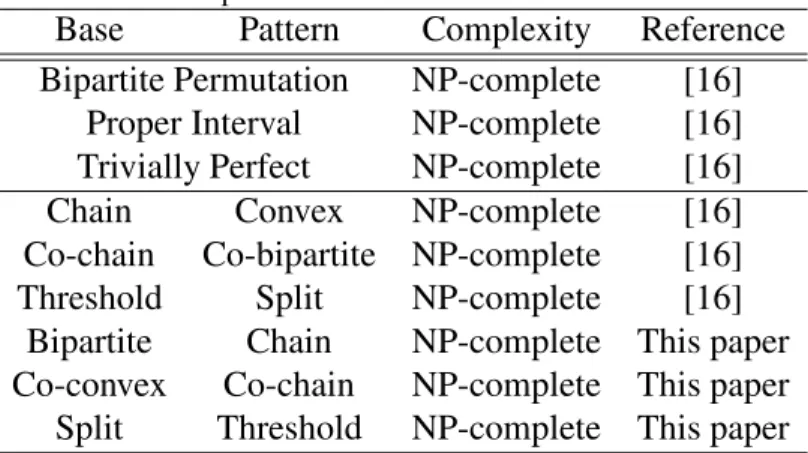
Table 1: NP-complete cases of Spanning Subgraph Isomorphism.
Base Pattern Complexity Reference Bipartite Permutation NP-complete [16]
Proper Interval NP-complete [16] Trivially Perfect NP-complete [16] Chain Convex NP-complete [16] Co-chain Co-bipartite NP-complete [16] Threshold Split NP-complete [16]
Bipartite Chain NP-complete This paper Co-convex Co-chain NP-complete This paper Split Threshold NP-complete This paper
Table 2: Polynomial-time solvable cases of Subgraph Isomorphism.
Base Pattern Complexity Reference Chain O(m + n) [16] Co-chain O(m + n) [16] Threshold O(m + n) [16] Bipartite permutation Chain Open
Chordal Co-chain O(mn2+ n3) This paper Trivially perfect Threshold O(m + n) This paper
the same number of vertices, the problem remains NP-complete. They call the problem with such restrictions Spanning Subgraph Isomorphism.
Kijima et al. [16] also found polynomial-time solvable cases of Subgraph Isomorphism in which both graphs are chain, co-chain, or threshold graphs. Since these classes are proper subclasses of the aforementioned hard classes, those results together give sharp contrasts of computational complexity of Subgraph Isomorphism. However, the complexity of more subtle cases, like the one where the base graphs are proper interval graphs and the pattern graphs are co-chain graphs, remained open.
1.1. Our results
In this paper, we study the open cases of Kijima et al. [16], and present polynomial-time algorithms for the following cases:
• the base graphs are chordal graphs and the pattern graphs are co-chain graphs,
• the base graphs are trivially perfect graphs and the pattern graphs are threshold graphs. We also show that even if the pattern graphs are chain, co-chain, or threshold graphs and the base graphs are somewhat restricted perfect graphs, the problem remains NP-complete. The problem of finding a chain subgraph in a bipartite permutation graph, which is an open case of Kijima et al. [16], remains unsettled. See Tables 1 and 2 for the summary of our results.
1.2. Related results
Subgraph Isomorphism for trees can be solved in polynomial time [22], while it is NP-complete for connected outerplanar graphs [26]. Therefore, the problem is NP-NP-complete even
for connected graphs of bounded treewidth. On the other hand, it can be solved in polyno-mial time for 2-connected outerplanar graphs [17]. More generally, it is known that Subgraph Isomorphism for k-connected partial k-trees can be solved in polynomial time [11, 21]. Epp-stein [7] gave a kO(k)n-time algorithm for Subgraph Isomorphism on planar graphs, where k and nare the numbers of the vertices in the pattern graph and the base graph, respectively. Recently, Dorn [6] has improved the running time to 2O(k)n. For other general frameworks, especially for
the parameterized ones, see the recent paper by Marx and Pilipczuk [19] and the references therein.
Another related problem is Induced Subgraph Isomorphism which asks whether the base graph has an induced subgraph isomorphic to the pattern graph. Damaschke [5] showed that Induced Subgraph Isomorphism on cographs is NP-complete. He also showed that Induced Subgraph Isomorphism is NP-complete for the disjoint unions of paths, and thus for proper in-terval graphs and bipartite permutation graphs. Marx and Schlotter [20] showed that Induced Subgraph Isomorphism on interval graphs is W[1]-hard when parameterized by the number of vertices in the pattern graph, but fixed-parameter tractable when parameterized by the numbers of vertices to be removed from the base graph. Heggernes et al. [14] showed that Induced Subgraph Isomorphism on proper interval graphs is NP-complete even if the base graph is con-nected. Heggernes et al. [15] have recently shown that Induced Subgraph Isomorphism on proper interval graphs and bipartite permutation graphs can be solved in polynomial time if the pattern graph is connected. Belmonte et al. [1] showed that Induced Subgraph Isomorphism on connected trivially perfect graphs is NP-complete. This result strengthens known results since every trivially perfect graph is an interval cograph. They also showed that the problem can be solved in polynomial time if the base graphs are trivially perfect graphs and the pattern graphs are threshold graphs.
2. Preliminaries
All graphs in this paper are finite, undirected, and simple. Let G[U] denote the subgraph of G = (V, E) induced by U ⊆ V. For a vertex v ∈ V, we denote by G − v the graph obtained by removing v from G; that is, G − v = G[V \ {v}]. The neighborhood of a vertex v is the set N(v) = {u ∈ V | {u, v} ∈ E}. A vertex v ∈ V is universal in G if N(v) = V \ {v}. A vertex v ∈ V is isolated in G if N(v) = ∅. A set I ⊆ V in G = (V, E) is an independent set if for all u, v ∈ I, (u, v) < E. A set S ⊆ V in G = (V, E) is a clique if for all u, v ∈ S , (u, v) ∈ E. A pair (X, Y) of sets of vertices of a bipartite graph H = (U, V; E) is a biclique if for all x ∈ X and y ∈ Y, (x, y) ∈ E. A component of a graph G is an inclusion maximal connected subgraph of G. A component is non-trivial if it contains at least two vertices. The complement of a graph G = (V, E) is the graph ¯G = (V, ¯E) such that {u, v} ∈ ¯E if and only if {u, v} < E. The disjoint unionof two graphs G = (VG,EG) and H = (VH,EH) is the graph (VG∪ VH,EG∪ EH), where
VG∩ VH = ∅. For a map η : V → V′ and S ⊆ V, let η(S ) denote the set {η(s) | s ∈ S }.
2.1. Definitions of the problems
A graph H = (VH,EH) is subgraph-isomorphic to a graph G = (VG,EG) if there exists an
injective map η from VH to VG such that {η(u), η(v)} ∈ EG holds for each {u, v} ∈ EH. We
call such a map η a subgraph-isomorphism from H to G. Graphs G and H are called the base graphand the pattern graph, respectively. The problems Subgraph Isomorphism and Spanning Subgraph Isomorphism are defined as follows:
Problem 1. Subgraph Isomorphism
Instance: A pair of graphs G = (VG,EG) and H = (VH,EH).
Question: Is H subgraph-isomorphic to G? Problem 2. Spanning Subgraph Isomorphism
Instance: A pair of connected graphs G = (VG,EG) and H = (VH,EH), where |VG| = |VH|.
Question: Is H subgraph-isomorphic to G?
2.2. Graph classes
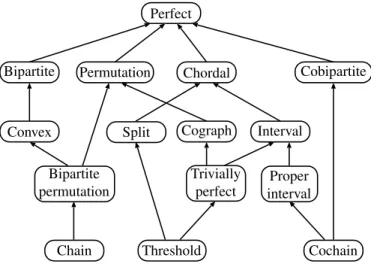
Here we introduce the graph classes we deal with in this paper. For their inclusion relations, see the standard textbooks in this field [3, 9, 25]. See Figure 1 for the class hierarchy.
A bipartite graph B = (X, Y; E) is a chain graph if the vertices of X can be ordered as x1,x2, . . . ,x|X| such that N(x1) ⊆ N(x2) ⊆ · · · ⊆ N(x|X|). A graph G = (V, E) with V =
{1, 2, . . . , n} is a permutation graph if there is a permutation π over V such that {i, j} ∈ E if and only if (i − j)(π(i) − π( j)) < 0. A bipartite permutation graph is a permutation graph that is bipartite. A bipartite graph H = (X, Y; E) is a convex graph if one of X and Y can be ordered such that the neighborhood of each vertex in the other side is consecutive in the ordering. It is known that a chain graph is a bipartite permutation graph, and that a bipartite permutation graph is a convex graph.
A graph is a co-chain graph if it is the complement of a chain graph. An interval graph is the intersection graph of a family of closed intervals of the real line. A proper interval graph is the intersection graph of a family of closed intervals of the real line where no interval is properly contained in another. A graph is co-bipartite if its complement is bipartite. In other words, co-bipartite graphs are exactly the graphs whose vertex sets can be partitioned into two cliques. From the definition, every co-chain graph is co-bipartite. It is known that every co-chain graph is a proper interval graph.
A graph is a threshold graph if there is a positive integer T (the threshold) and for every vertex v there is a positive integer w(v) such that {u, v} is an edge if and only if w(u) + w(v) ≥ T . A graph is trivially perfect if the size of the maximum independent set is equal to the number of maximal cliques for every induced subgraph. It is known that a threshold graph is a trivially perfect graph, and that a trivially perfect graph is an interval graph.
A split graph is a graph whose vertex set can be partitioned into a clique and an independent set. A graph is chordal if every induced cycle is of length 3. Clearly, every threshold graph is a split graph, and every split graph is a chordal graph. It is known that every interval graph is a chordal graph. It is easy to see that any split graph (and thus any threshold graph) has at most one non-trivial component.
A graph is perfect if for any induced subgraph the chromatic number is equal to the size of a maximum clique. Graphs in all classes introduced in this section are known to be perfect.
3. Polynomial-Time Algorithms
In this section, we denote the number of the vertices and the edges in a base graph by n and m, respectively. For the input graphs G and H, we assume that |VG| ≥ |VH| and |EG| ≥ |EH|,
Chain Threshold Cochain Bipartite permutation Trivially perfect Proper interval Cograph Interval Chordal Cobipartite Permutation Convex Perfect Bipartite Split
Figure 1: Graph classes.
3.1. Finding co-chain subgraphs in chordal graphs
It is known that co-chain graphs are precisely {I3,C4,C5}-free graphs [13]; that is, graphs
having no vertex subset that induces I3, C4, or C5, where I3 is the empty graph with three
vertices and Ckis the cycle of k vertices. Using this characterization, we can show the following
simple lemma.
Lemma 3.1. A graph is a co-chain graph if and only if it is a co-bipartite chordal graph. Proof. To prove the if-part, let G be a co-bipartite chordal graph. Since G is co-bipartite, it cannot have I3 as its induced subgraph. Since G is chordal, it does not have C4 or C5 as its
induced subgraph. Therefore, G is {I3,C4,C5}-free.
To prove the only-if-part, let G be a co-chain graph, and thus it is a co-bipartite graph. Suppose that G has an induced cycle C of length k ≥ 4. Then k cannot be 4 or 5 since it does not have C4or C5. If k ≥ 6, then the first, third, and fifth vertices in the cycle form I3.
Now we can solve the problem as follows.
Theorem 3.2. Subgraph Isomorphism is solvable in O(mn2+ n3) time if the base graphs are chordal graphs and the pattern graphs are co-chain graphs.
Proof. Let G = (VG,EG) be the base chordal graph and H = (VH,EH) be the pattern co-chain
graph. We assume that G is not complete, since otherwise the problem is trivial.
Algorithm. We enumerate all the maximal cliques C1, . . . ,Ck of G. For each pair (Ci,Cj),
we check whether H is subgraph-isomorphic to G[Ci ∪ Cj]. If H is subgraph-isomorphic to
G[Ci∪ Cj] for some i and j, then we output “yes.” Otherwise, we output “no.”
Correctness. It suffices to show that H is subgraph-isomorphic to G if and only if there are two maximal cliques Ci and Cj of G such that H is subgraph-isomorphic to G[Ci∪ Cj]. The if-part
is obviously true. To prove the only-if-part, assume that there is a subgraph-isomorphism η from H to G. Observe that for any clique C of H, there is a maximal clique C′ of G such that
η(C) ⊆ C′. Thus, since H is co-bipartite, there are two maximal cliques Ci and Cj such that
Running time. It is known that a chordal graph of n vertices with m edges has at most n maximal cliques, and all the maximal cliques can be found in O(m + n) time [2, 12]. Since G[Ci∪ Cj] is
a co-chain graph by Lemma 3.1, testing whether H is subgraph-isomorphic to G[Ci∪ Cj] can
be done in O(m + n) time [16]. Since the number of pairs of maximal cliques is O(n2), the total running time is O(mn2+ n3).
3.2. Finding threshold subgraphs in trivially perfect graphs
Here we present a linear-time algorithm for finding a threshold subgraph in a trivially per-fect graph. To this end, we need the following lemmas.
Lemma 3.3. If a graph G has a universal vertex uG, and a graph H has a universal vertex uH,
then H is subgraph-isomorphic to G if and only if H − uHis subgraph-isomorphic to G − uG.
Proof. To prove the if-part, let η′be a subgraph-isomorphism from H − uHto G − uG. Now we
define η : VH→ VGas follows: η(w) = uG if w = uH, η′(w) otherwise.
Let {x, y} ∈ EH. If uH < {x, y}, then {η(x), η(y)} = {η′(x), η′(y)} ∈ EG. Otherwise, we may
assume that x = uH without loss of generality. Since uG is universal in G, it follows that
{η(x), η(y)} = {η(uH), η(y)} = {uG, η′(y)} ∈ EG.
To prove the only-if-part, assume that η′ is a subgraph-isomorphism from H to G. If there
is no vertex v ∈ VH such that η′(v) = uG, then we are done. Assume that η′(v) = uG for some
vertex v ∈ VH. Now we define η : VH\ {uH} → VG\ {uG} as follows:
η(w) = η′(u H) if w = v, η′(w) otherwise.
Let {x, y} ∈ EH. If v < {x, y}, then {η(x), η(y)} = {η′(x), η′(y)} ∈ EG. Otherwise, we may assume
without loss of generality that v = x. Since uH is universal in H, it follows that {η(x), η(y)} =
{η′(u
H), η′(y)} ∈ EG.
A component of a graph is maximum if it contains the maximum number of vertices among all the components of the graph. If a split graph has a non-trivial component, then the compo-nent is the unique maximum compocompo-nent of the graph.
Lemma 3.4. A split graph H with a maximum component CH is subgraph-isomorphic to a
graph G if and only if |VH| ≤ |VG| and there is a component CG of G such that CH is
subgraph-isomorphic to CG.
Proof. First we prove the only-if-part. Let η be a subgraph-isomorphism from H to G. We need |VH| ≤ |VG| to have an injective map from VH to VG. Since CHis connected, G[η(V(CH))]
must be connected. Thus there is a component CGsuch that η(V(CH)) ⊆ V(CG). Then η|V(CH),
the map η restricted to V(CH), is a subgraph isomorphism from CHto CG.
To prove the if-part, let η′ be a subgraph-isomorphism from CH to CG. Let RH = VH \
V(CH) = {u1, . . . ,ur}, and let RG = VG \ η′(V(CH)) = {w1, . . . ,ws}. Since |VH| ≤ |VG| and
|V(CH)| = |η′(V(CH))|, it holds that r ≤ s. Now we define η : VH → VGas follows:
η(v) = wi if v = ui ∈ RH, η′(v) otherwise.
Since H is a split graph, any component of H other than CHcannot have two or more vertices.
Thus the vertices in RH are isolated in H. Therefore, the map η is a subgraph-isomorphism
from H to G.
The two lemmas above already allows us to have a polynomial-time algorithm. However, to achieve a linear running time, we need the following characterization of trivially perfect graphs. A rooted tree is a directed tree with a unique in-degree 0 vertex, called the root. Intuitively, every edge is directed from the root to leaves in a directed tree. A rooted forest is the disjoint union of rooted trees. The comparability graph of a rooted forest is the graph that has the same vertex set as the rooted forest, and two vertices are adjacent in the graph if and only if one of the two is a descendant of the other in the forest. Yan et al. [28] showed that a graph is a trivially perfect graph if and only if it is the comparability graph of a rooted forest, and that such a rooted forest can be computed in linear time. We call such a rooted forest a generating forestof the trivially perfect graph. If a generating forest is actually a rooted tree, then we call it a generating tree.
Theorem 3.5. Subgraph Isomorphism is solvable in O(m+n) time if the base graphs are trivially perfect graphs and the pattern graphs are threshold graphs.
Proof. Let G = (VG,EG) be the base trivially perfect graph and H = (VH,EH) be the pattern
threshold graph.
Algorithm. The pseudocode of our algorithm can be found in Algorithm 1. We use the proce-dure SGI which takes a trivially perfect graph as the base graph and a threshold graph as the pattern graph, and conditionally answers whether the pattern graph is subgraph-isomorphic to the base graph. The procedure SGI requires that
• both the graphs are connected, and
• the base graph has at least as many vertices as the pattern graph.
To use this procedure, we first attach a universal vertex to both G and H. This guarantees that both graphs are connected. We call the new graphs G′ and H′, respectively. By Lemma 3.3,
(G′,H′) is a yes-instance if and only if so is (G, H). After checking that |VG′| ≥ |VH′|, we use
the procedure SGI.
In SGI(G, H), let uG and uHbe universal vertices of G and H, respectively. There are such
vertices since G and H are connected trivially perfect graphs [27]. Let CH be a maximum
component of H − uH. For each connected component CGof G − uG, we check whether CH is
subgraph-isomorphic to CG, by recursively calling the procedure SGI itself. If at least one of
the recursive calls returns “yes,” then we return “yes.” Otherwise we return “no.”
Correctness. It suffices to prove the correctness of the procedure SGI. If |VH| = 1, then H is
subgraph-isomorphic to G since |VG| ≥ |VH| in SGI. By Lemmas 3.3 and 3.4, H is
subgraph-isomorphic to G if and only if there is a component CG of G − uG such that CH is
subgraph-isomorphic to CG. (Recall that any threshold graph is a split graph.) The procedure just checks
these conditions. Also, when SGI recursively calls itself, the parameters CG and CHsatisfy its
Algorithm 1 Finding a threshold subgraph H in a trivially perfect graph G.
1: G′ := G with a universal vertex
2: H′ := H with a universal vertex
3: if |VG′| ≥ |VH′|then 4: return SGI(G′,H′)
5: else
6: return no
Require: G and H are connected, and |VG| ≥ |VH|
7: procedure SGI(G, H) 8: if |VH| = 1 then 9: return yes 10: uG := a universal vertex of G 11: uH := a universal vertex of H 12: CH := a maximum component of H − uH
13: for all components CG of G − uGdo
14: if |V(CG)| ≥ |V(H − uH)| then
15: if SGI(CG, CH) = yes then
16: return yes 17: return no
Running time. For each call of SGI(G, H), we need the following: • universal vertices uGand uHof G and H, respectively,
• a maximum component CHof H − uH,
• the components CGof G − uG, and
• the numbers of the vertices of CG and H − uH.
We show that they can be computed efficiently by using generating forests. Basically we apply the algorithm to generating forests instead of graphs.
Before the very first call of SGI(G, H), we compute generating trees of G and H in linear time. Additionally, for each node in the generating trees, we store the number of its descen-dants. This can be done also in linear time in a bottom-up fashion.
At some call of SGI(G, H), assume that we have generating trees of G and H. It is easy to see that the root of the generating trees are universal vertices. Hence we can compute uG
and uH in constant time. By removing these root nodes from the generating trees, we obtain
generating forests of G − uGand H − uH. Each component of the generating forests corresponds
to a component of the corresponding graphs. Thus we can compute the components of G − uG
and a maximum component of H − uH, with their generating trees, in time proportional to the
number of the children of uG and uH. The numbers of the vertices of CG and H − uH can be
computed easily in constant time, because we know the number of the descendants of each node in generating trees.
The recursive calls of SGI take only O(n) time in total since it is proportional to the number of edges in the generating trees. Therefore, the total running time is O(m + n).
4. NP-completeness
It is known that for perfect graphs, Clique can be solved in polynomial time [10]. Since co-chain graphs and threshold graphs are very close to complete graphs, one may ask whether the problem of finding co-chain graphs or threshold graphs can be solved in polynomial time for perfect graphs. In this section, we show that this is not the case. More precisely, we show that even the specialized problem Spanning Subgraph Isomorphism is NP-complete for the case where the base graphs are somewhat restricted perfect graphs and the pattern graphs are co-chain or threshold graphs.
It is known that Maximum Edge Biclique, the problem of finding a biclique with the max-imum number of edges, is NP-complete for bipartite graphs [24]. This implies that Subgraph Isomorphism is NP-complete if the base graphs are connected bipartite graphs and the pattern graphs are connected chain graphs, because complete bipartite graphs are chain graphs. We sharpen this hardness result by showing that the problem is still NP-complete if we further restrict the pattern chain graphs to have the same number of vertices as the base graph. That is, we show that Spanning Subgraph Isomorphism is NP-complete when the base graphs are bipartite graphs and the pattern graphs are chain graphs.
Since the problem Spanning Subgraph Isomorphism is clearly in NP for any graph class, we only show its NP-hardness here. All the results in this section are based on the following theorem and lemma taken from Kijima et al. [16].
Theorem 4.1 (Kijima et al. [16]). Spanning Subgraph Isomorphism is NP-complete if 1. the base graphs are chain graphs and the pattern graphs are convex graphs,
2. the base graphs are co-chain graphs and the pattern graphs are co-bipartite graphs, or 3. the base graphs are threshold graphs and the pattern graphs are split graphs.
Lemma 4.2 (Kijima et al. [16]). If |VH| = |VG|, then H is subgraph-isomorphic to G if and only
if ¯G is subgraph-isomorphic to ¯H.
For a graph class C, let co-C denote the graph class { ¯G | G ∈ C}. The next lemma basically shows that if C satisfies some property, then the hardness of Spanning Subgraph Isomorphism for C implies the hardness for co-C.
Lemma 4.3. Let C and D be graph classes such that co-C and co-D are closed under universal vertex additions. If Spanning Subgraph Isomorphism is NP-complete when the base graphs belong to C and the pattern graphs belong to D, then the problem is NP-complete also when the base graphs belong toco-D and the pattern graphs belong to co-C.
Proof. Given two connected graphs G ∈ C and H ∈ D with |VG| = |VH|, it is NP-complete to
decide whether H is subgraph-isomorphic to G. By Lemma 4.2, H is subgraph-isomorphic to G if and only if ¯G is subgraph-isomorphic to ¯H. By Lemma 3.3, ¯G is subgraph-isomorphic to ¯H if and only if ¯G′ is subgraph-isomorphic to ¯H′, where ¯G′ and ¯H′ are obtained from ¯G
and ¯H, respectively, by adding a universal vertex. Therefore, H is subgraph-isomorphic to G if and only if ¯G′ is subgraph-isomorphic to ¯H′. Clearly, ¯G′ ∈ co-C and ¯H′ ∈ co-D, they are connected, and they have the same number of vertices. Thus the lemma holds.
A graph is a co-convex graph if its complement is a convex graph. Clearly co-convex graphs are closed under additions of universal vertices.
Corollary 4.4. Spanning Subgraph Isomorphism is NP-complete if
1. the base graphs are co-convex graphs and the pattern graphs are co-chain graphs, 2. the base graphs are split graphs and the pattern graphs are threshold graphs.
Proof. The NP-completeness of the case (1) is a corollary to Theorem 4.1 (1) and Lemma 4.3. To prove (2), we need Theorem 4.1 (3), Lemma 4.3, and the well-known facts that threshold graphs and split graphs are self-complementary [9]. That is, the complement of a threshold graph is a threshold graph, and the complement of a split graph is a split graph.
4.1. Finding chain graphs in bipartite graphs
For the case where the base graphs are bipartite graphs and the pattern graphs are chain graphs, we cannot directly apply the combination of Theorem 4.1 (2) and Lemma 4.3 since bipartite graphs and chain graphs are not closed under universal vertex additions. Fortunately, we can modify the proof of Theorem 4.1 (2) in Kijima et al. [16] so that the complements of the base graphs and the pattern graphs are also connected. Then, Lemma 4.2 implies the hardness. We include a full proof to be self contained. We present a reduction from the following standard strong NP-complete problem [8].
Problem 3. 3-Partition
Instance: Positive integers a1, . . . ,a3m and a bound B ∈ Z+ such that Pj∈{1,...,3m}aj = mBand
B/4 < aj < B/2 for each j ∈ {1, . . . , 3m}.
Question: Can {1, . . . , 3m} be partitioned into m disjoint sets A(1),A(2), . . . ,A(m) such that, for
1 ≤ i ≤ m,P
j∈A(i)aj = B?
Lemma 4.5. Spanning Subgraph Isomorphism is NP-complete if the base graphs are co-chain graphs, the pattern graphs are co-bipartite graphs, and the complements of the base graphs and the pattern graphs are connected.
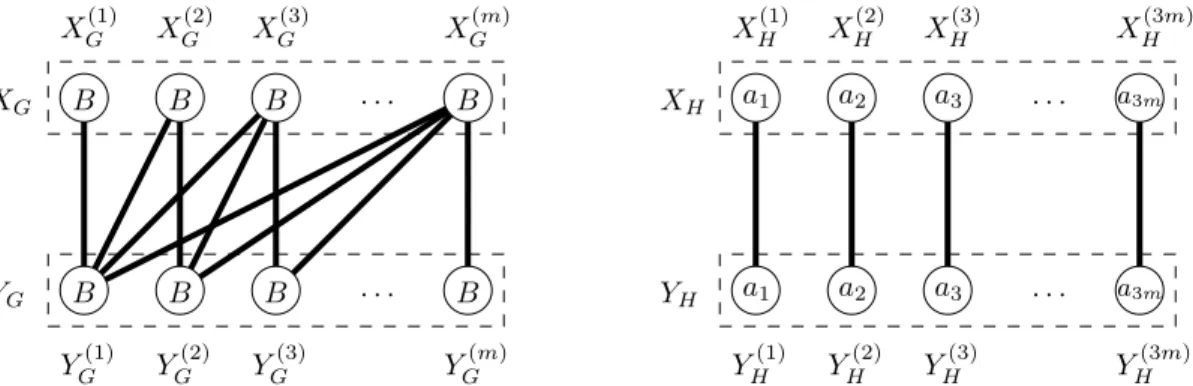
Proof. Let I be an instance of 3-Partition. Bipartite graphs GI = (XG,YG; EG) and HI =
(XH,YH; EH) are defined as follows (see Figure 2). Both sets XG and YG of G consist of m
disjoint independent sets XG(1), . . . ,XG(m) and YG(1), . . . ,YG(m) such that each part is of size B, and two vertices are adjacent if and only if one is in XG(i)and the other is in YG( j)for some i and j with i ≥ j. Similarly, both sets XHand YHof H consist of 3m disjoint independent sets X(1)H , . . . ,XH(3m)
and YH(1), . . . ,YH(3m) such that |XH(i)| = |YH(i)| = ai for each i, and two vertices are adjacent if and
only if one is in XG( j) and the other is in YG( j)for some j.
Now we add disjoint sets XG(0)of 2B vertices and {yG} to GI, and make XG(0)∪ XGand {yG}∪YG
to be cliques. Similarly, we add disjoint sets X(0)H of 2B vertices and {yH} to HI, and make
X(0)H ∪ XH and {yH} ∪ YH to be cliques. We call the resultant graphs G′I and H ′
I, respectively.
From the construction, G′I is a co-chain graph and H′I is a co-bipartite graph. It is easy to see that their complements are connected.
Kijima et al. [16] showed that I is a yes-instance of 3-Partition if and only if there exists a subgraph-isomorphism η from HI to GI such that η(XH) = XG. Thus it suffices to show that
H′I is subgraph-isomorphic to G′
I if and only if there exists a subgraph-isomorphism η from
HI to GI such that η(XH) = XG. The if-part is obvious. To prove the only-if-part, let η′ be a
subgraph-isomorphism from H′I to G′I. Since XG(0)∪ XGand X (0)
H ∪ XHare the unique maximum
cliques of size (m + 2)B in G and H, respectively, it holds that η′maps X(0)
H ∪ XHto X (0) G ∪ XG.
B B B B B B B B · · · · · · X(1) G X (2) G X (3) G X (m) G Y(1) G Y (2) G Y (3) G Y (m) G XG YG · · · · · · X(1) H X (2) H X (3) H X (3m) H Y(1) H Y (2) H Y (3) H Y (3m) H XH YH a1 a2 a3 a3m a1 a2 a3 a3m
Figure 2: Graphs GI (left) and HI (right). Each circle is an independent set of size B in GI and ai in HI. Each
segment between two independent sets implies that these independent sets form a biclique.
Now, by considering the degrees of vertices, it follows that η′ maps X(0)H to XG(0) and yH to yG.
This means that η′ maps X
Gto XHand YG to YH. Therefore, by setting η := η′|XG∪YG, we obtain
a subgraph-isomorphism η from HIto GI such that η(XH) = XG.
Corollary 4.6. Spanning Subgraph Isomorphism is NP-complete if the base graphs are bipartite graphs and the pattern graphs are chain graphs.
5. Conclusion
We have studied (Spanning) Subgraph Isomorphism for classes of perfect graphs, and have shown sharp contrasts of its computational complexity. An interesting problem left unsettled is the complexity of Subgraph Isomorphism where the base graphs are bipartite permutation graphs and the pattern graphs are chain graphs. It is known that although the maximum edge biclique problem is NP-complete for general bipartite graphs [24], it can be solved in polyno-mial time for some super classes of bipartite permutation graphs (see [23]). Therefore, it might be possible to have a polynomial-time algorithm for Subgraph Isomorphism when the pattern graphs are chain graphs and the base graphs belong to an even larger class like convex graphs.
References
[1] R. Belmonte, P. Heggernes, and P. van ’t Hof. Edge contractions in subclasses of chordal graphs. Discrete Appl. Math., 160:999–1010, 2012.
[2] J. R. S. Blair and B. Peyton. An introduction to chordal graphs and clique trees. In A. George, J. R. Gilbert, and J. W. H. Liu, editors, Graph Theory and Sparse Matrix Computation, volume 56 of The IMA Volumes in Mathematics and its Applications, pages 1–29. Springer Verlag, 1993.
[3] A. Brandst¨adt, V. B. Le, and J. P. Spinrad. Graph Classes: A Survey. SIAM, 1999. [4] C. J. Colbourn. On testing isomorphism of permutation graphs. Networks, 11:13–21,
1981.
[5] P. Damaschke. Induced subgraph isomorphism for cographs is NP-complete. In WG ’90, volume 487 of Lecture Notes in Comput. Sci., pages 72–78, 1991.
[6] F. Dorn. Planar subgraph isomorphism revisited. In STACS 2010, volume 5 of LIPIcs, pages 263–274, 2010.
[7] D. Eppstein. Subgraph isomorphism in planar graphs and related problems. J. Graph Algorithms Appl., 3:1–27, 1999.
[8] M. R. Garey and D. S. Johnson. Computers and Intractability: A Guide to the Theory of NP-Completeness. W.H. Freeman and Company, 1979.
[9] M. C. Golumbic. Algorithmic Graph Theory and Perfect Graphs, volume 57 of Annals of Discrete Mathematics. North Holland, second edition, 2004.
[10] M. Gr¨otschel, L. Lov´asz, and A. Schrijver. The ellipsoid method and its consequences in combinatorial optimization. Combinatorica, 1:169–197, 1981.
[11] A. Gupta and N. Nishimura. The complexity of subgraph isomorphism for classes of partial k-trees. Theoret. Comput. Sci., 164:287–298, 1996.
[12] P. Heggernes. Treewidth, partial k-trees, and chordal graphs. Partial curriculum in INF334 - Advanced algorithmical techniques, Department of Informatics, University of Bergen, Norway, 2005.
[13] P. Heggernes and D. Kratsch. Linear-time certifying recognition algorithms and forbidden induced subgraphs. Nordic J. Comput., 14:87–108, 2007.
[14] P. Heggernes, D. Meister, and Y. Villanger. Induced subgraph isomorphism on interval and proper interval graphs. In ISAAC 2010, volume 6507 of Lecture Notes in Comput. Sci., pages 399–409, 2010.
[15] P. Heggernes, P. van ’t Hof, D. Meister, and Y. Villanger. Induced subgraph isomorphism on proper interval and bipartite permutation graphs. Submitted manuscript.
[16] S. Kijima, Y. Otachi, T. Saitoh, and T. Uno. Subgraph isomorphism in graph classes. Discrete Math., 312:3164–3173, 2012.
[17] A. Lingas. Subgraph isomorphism for biconnected outerplanar graphs in cubic time. Theoret. Comput. Sci., 63:295–302, 1989.
[18] G. S. Lueker and K. S. Booth. A linear time algorithm for deciding interval graph iso-morphism. J. ACM, 26:183–195, 1979.
[19] D. Marx and M. Pilipczuk. Everything you always wanted to know about the parameter-ized complexity of subgraph isomorphism (but were afraid to ask). CoRR, abs/1307.2187, 2013.
[20] D. Marx and I. Schlotter. Cleaning interval graphs. Algorithmica, 65:275–316, 2013. [21] J. Matouˇsek and R. Thomas. On the complexity of finding iso- and other morphisms for
[22] D. W. Matula. Subtree isomorphism in O(n5/2). In B. Alspach, P. Hell, and D. Miller, edi-tors, Algorithmic Aspects of Combinatorics, volume 2 of Annals of Discrete Mathematics, pages 91–106. Elsevier, 1978.
[23] D. Nussbaum, S. Pu, J.-R. Sack, T. Uno, and H. Zarrabi-Zadeh. Finding maximum edge bicliques in convex bipartite graphs. Algorithmica, 64(2):311–325, 2012.
[24] R. Peeters. The maximum edge biclique problem is NP-complete. Discrete Appl. Math., 131:651–654, 2003.
[25] J. P. Spinrad. Efficient Graph Representations, volume 19 of Fields Institute monographs. American Mathematical Society, 2003.
[26] M. M. Sysło. The subgraph isomorphism problem for outerplanar graphs. Theoret. Com-put. Sci., 17:91–97, 1982.
[27] E. S. Wolk. A note on “The comparability graph of a tree”. Proc. Amer. Math. Soc., 16:17–20, 1965.
[28] J.-H. Yan, J.-J. Chen, and G. J. Chang. Quasi-threshold graphs. Discrete Appl. Math., 69(3):247–255, 1996.