14
Convergence of
an
Integral
Equation
Method
to Convective
Heat Transfer
大西 和榮
K. Onishi
Applied Mathematics Department
Fukuoka University
Jonan-ku, Fukuoka 814-01 (Japan)
Contents
1. Introduction
2. Integral Equation of the Second Kind
3. Solution of the Integral Equation 4. Galerkin Approximations
5. Conclusions References Abstract.
A boundary-domain (or hybrid) integral equation method is applied to the approximate solution of
transient convection dominated conduction problems in three dimensions. The domain of interest has non-smooth surface of the Wendland type. Given field velocity is assumed to be non-uniform.
Neumann boundary condition is imposed to the problem. Under some conditions which are not much
restrictivein practical applications in engineering, the integral equationisprovedtobe uniquely solvable in the Banachspace ofcontinuous functions onthe enclosure of the domain with the supremumnorm, It is
shown as a direct consequence of the Krasnosel’skii’s result that the computational scheme by the
Galerkinmethod is inversely stable and approximate solutions convergeuniformlyto the exact solution.
数理解析研究所講究録 第 691 巻 1989 年 14-26
15
1. Introduction
Aheat transfer problem to be considered in this paper is loosely stated
as
follows: Giventhe flow velocity $v(x)=(v], v_{2} ,v_{3})$ in
a
domain $\Omega$ in three dimensions with rectangularcoordinates
such that the incompressibility condition:a
$v_{j}$$=$ $0$ in $\Omega$ , $t>0$ (1)
$\partial x_{j}$
is satisfied, find unknown temperature $u(x,t)$ which satisfies the transientheat convection
conduction
equation: $\partial u$ $\partial u$ – $+v_{j}-$ $=$ $h\Delta u$ in $\Omega$ , $t>0$ (2) $\partial t$ $\partial x_{j}$subject to the boundary and initial conditions:
$q$
$:=-\lambda\underline{\partial u}$
$+v_{j}n_{j}u$ $=q$
on
$\Gamma=$a
$\Omega$.
$t>0$ (3)$\partial n$ and
$u(x, 0)$ $=$ $u^{0}(x)$ in $\Omega$ (4)
for given total flux $q^{\wedge}$
on
the boundary and given initial temperature distribution $u0(x)$with given constant heat conductivity $\lambda>0$ and the exterior normal $n=(n_{1}, n_{2}, n_{3})$ to
the boundary F. The proper setting of the problem is presented in the next section. We shall consider the
case
that the boundary $\Gamma$ isa
non-smooth surface ofsome
general kind and correspondinglywe
assume
that the given total flux is not boundedon
theboundary. The solution will be found in the space of continuous functions
on
the closureof the domain.
Transient heat conduction problem with Neumann boundary condition
on
non-smoothsurface
was
considered by Costabel et al. [1987] and Onishi[1987]. They showed the unique existence of the solution of corresponding Volterra-Fredholm integral equation of the second kind and presented the uniform convergence of Galerkin approximatesolu-tions.
The present paper is the extension of those previous twopapers
by including theconvection effectto the heat conduction problem. Owing to the presence of the convection
16
Aboundary-domain integral equation approach for the Neumann problem of steady
con-vection-diffusion problem
was
considered by Onishi[1987], in which the existence of thecontinuous solution is proved at all Peclet numbers.
2. Integral Equation of the Second Kind
We shall derive
an
integral equation corresponding to the initial-boundary value problems(1)$-(4)$
.
To this end,we
start with the specification of the domain in question. Let $\Omega$bea
simply connected and bounded opendomain in $R3$.
The boundary$\Gamma$ is assumed to bea
piecewise Ljapunow surface. Thismeans
that the surface is locally Hoelder continuous with the index $1+\kappa(0<K\leq 1)$.
We denote the set of non-smooth pointson
the surfaceby $\gamma$. It forms edges and
corners.
Let $d\Gamma(y)$ be
an
infinitesimal surfacearea
at the point $y\in\Gamma-\gamma$.
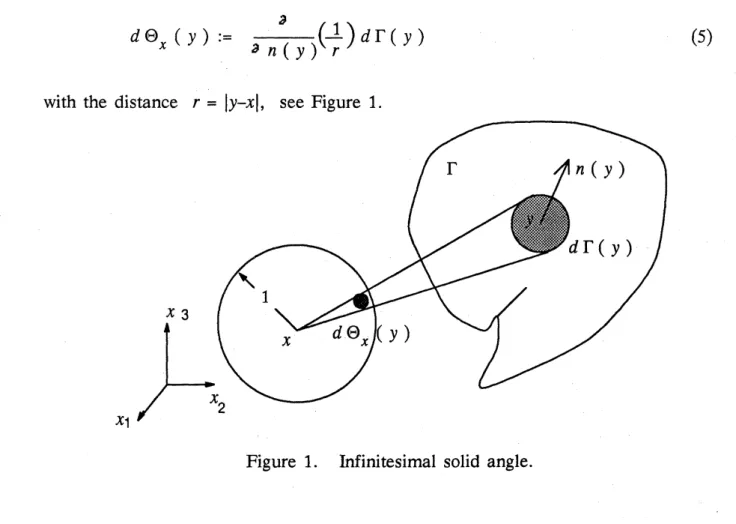
The infinitesimal solidangle at $x(\in R3)$ subtending the
area
$d\Gamma(y)$ is given by the expression:$d\Theta_{x}(y)$ $;=$ $\frac{3}{\partial n(y)}(\frac{1}{r})d\Gamma(y)$ (5)
with the distance $r=$
I
$y-x|$,see
Figure 1.Figure 1. Infinitesimal solid angle.
$X \in sup_{R^{3}}\int_{\Gamma}|d\Theta_{x}(y)$
{
$=$;$A$ $<$ $+\infty$ (6)
with
some
constant$A$.
The solid angle at $x$ subtending to the whole geometry $\Gamma$ is givenby the expression:
$\Theta(x)$ $;= \int d\Theta_{x}(y)=\{\begin{array}{l}4\pi(x\in\Omega^{o})0(x\in\Omega^{ext})\end{array}$ (7)
$y\in\Gamma$
We
assume
moreover
that the boundary $\Gamma$ satisfies the inequality:$\lim$ $su^{p}$
$W_{8}(x)=$; $\omega<$ 1 (8)
$8arrow 0$ $x\in\Gamma$
with
some
constant to, in which$W_{8}(x)$ $;= \frac{1}{4\pi}\{ \int|d\Theta_{X}(y)|+|4\pi-\Theta(x)|\}$ (9)
$0<|y-\chi|\leq 8$
The piecewise Ljapunow surface satisfying the property (8) is called quasi-Wendland
surface.
We notice that the constant $4\pi$ in (9) is replaced by $2\pi$ for the integral equationdefined only
on
the boundaryas
discussed in Wendland[1968]. The assumption (8) im-plies the inequality $4\pi(1-\omega)\leq\Theta(x)$.Let the Neumann data $q^{\wedge}( t)$ be in the space of$pth$
-power
summable functions $Lp(\Gamma)$with$p>2$
.
Weassume
that$\Vert\hat{q}$ (. t) $\Vert_{p}$
$;= \{\int_{\Gamma}|\hat{q}(X, t)|^{p}d\Gamma\}1/p\leq$ $M_{1}$ (10)
uniformly for all $t\in[o,\eta$ with
some
constant $M_{1}$. The boundary condition (3) is under-stood in thesense
of the boundary flow;see
Onishi[1986].As in Costabel et al.[1986],
we can see
that the solution $u(x,t)$ of the initial-boundary18
$u$ $( x, t)=- \lambda\int_{0^{d}}^{t}\tau\int_{\Gamma}u(y, \tau)h^{*}(y, \tau:X, t)d\Theta_{x}(y)$
$+ \int_{0^{d}}^{t}\tau\int_{\Omega}u$ $(y , \tau)v_{j}(y, \tau)\frac{su^{*}}{sx}(yj , \tau : X, t)d\Omega$ (11)
$- \int^{t}d\tau\int\wedge q(y, \tau)u^{*}$
( $y,$ $\tau:X$ , t) $d \Gamma+\int^{t}d\tau\int u^{o}(y)u^{*}$( $y,$ $0$ ; $X$ , t) $d\Omega(y)$
,
$0$ $\Gamma$ $0$ $\Omega$
where $u^{*}$ is the fundamental solution to the heat operator, i.e.,
$\frac{au^{*}}{\partial T}+\lambda\Delta_{y}u^{*}=-8(y-x)8(t-\tau)$
, (12)
$u^{*}= \{(\frac{1}{2\sqrt{}\overline{\pi\lambda(t-\mathcal{T})}}\int\exp 0[-\frac{r2}{4\lambda(t-\mathcal{T})}]$ $(t(t>\tau)<\tau)$ (13)
and
$h^{*}( \mathcal{Y}, \tau:x, t)=\frac{r^{3}}{2h(t-\tau)}u^{*}(\mathcal{Y}, \tau:x, t)$ (14)
We notice that all integrals involved in (11)
are
weakly singular inthesense
thattheyare
absolutely convergent. This nice property is due to the assumption that the surface is piecewise Ljapunow. We shall show here the weaksingularity only forthe first integral
on
the right hand side of (11). In fact,on
each subsurface $\Gamma_{i}$, the integral is written in the
form:
$\int^{t}d\tau\int u(y, \tau)h^{*}(y, \tau:x, t)d\Theta_{x}(y)$
$0$ $r_{i}$
$= \int^{t}d\tau\int u(y, \tau)\underline{su}(y, \tau:X, t)d\Gamma$
$0$ $r_{i}$
a
$n$19
$*$a
$u$ $-(y, \tau:x, t)$a
$n$ $=( \frac{1}{2\sqrt{}\overline{\pi h(t-\tau)}}\int[\frac{-r}{2\lambda(t-\tau)}]\exp[\frac{-r2}{4\lambda(t-\tau)}]\frac{y.-X}{r}n_{j}(y)$Since $\Gamma i$ is
a
Ljapunow surface, it follows that$|\underline{y.-X\cdot}n.(y)|=|\cos v|$ $\leq L(\Gamma)|y-x|^{K}$
$r$ $J$
for the angle $v$ between two vectors $y-x$ and $n(y)$ with the constant$L$. Using the inequality
$\xi^{S}e^{-g}\leq s^{s}e^{-s}(s>0)$ ,
we
can see
that $*$$| \frac{\partial u}{n}\partial$ ( $y,$ $\tau:x$ , t)
$|$ $\leq\frac{c_{1}}{(t-\tau)}\mu\frac{L(\Gamma)}{r^{4-2\mu-K}}$
for all $\mu<1$ with
some
constant $G1$. Choose $\mu$so
that $4-2\mu-\kappa<2$.
This implies that$1-\kappa/2<\mu<1$ and the integral is absolutely convergent.
As regard to the continuity of the second and third integrals in (11),
we
have Lemma 1.(1).
If
$q^{\wedge}is$ in $C(Lp(\Gamma):[o,\eta)$ with $p>2$, then the single-layer heat potential:$\int^{t}d\tau\int\wedge q(y, \tau)u^{*}$
( $y,$ $\tau:x$ , t) $d\Gamma$ $\in C(R3\cross[0, \infty))$
$0$ $\Gamma$
(2).
If
$\mathcal{V}j(\chi)$ is continuous in the closureof
$\Omega$, then the volume heat potential: $*$$\int_{0^{d}}^{t}\tau\int_{\Omega}u(y, \tau)v_{j}(y, \tau)\frac{\partial u}{\partial\chi}$ ( $y1$ ,
$\tau$ : $x$ , t) $d\Omega\in C$
$( R3\cross[0, \infty))$
One of the advantages of the integral equation approach is that
one can
treat thecontinu-ous
functioneven
if the Neumann data $q^{\wedge}$are
discontinuouson
the boundary.Take
a
point $x\in\Gamma-\gamma$.
We know the jump relation for the double-layer heat potential in the form:20
$\lim$ $\int^{t}d\tau\int u(y, \tau)h^{*}(y, \tau:z, t)d\Theta_{Z}(y)$ $Zarrow X$ $0$ $\Gamma$
$z\in\Omega^{O}$
(15)
$=- \frac{1}{2\lambda}u(x, t)+\int_{0^{d}}^{t}\tau\int_{\Gamma}u(y, \tau)h^{*}(y, \tau:x, t)d\Theta_{x}(y)$
The integral appearing
on
the right hand side is definedso
far only at points $x$on
thesmooth boundary. However, it
can
be completed to bea
continuous functionon
the whole boundary F. The value at the point $\xi\in\gamma$ is given from the relation:$\lim$ $\int^{t}d^{r}r\int u(y, \tau)h^{*}$( $y$ , $\tau$ : $x$ , t)
$d\Theta_{X}(y)$
$Xarrow\xi$ $0$ $\Gamma$
$\xi\in\Gamma-\gamma$ (16)
$=- \frac{1}{2\lambda}(1-\frac{\Theta(\xi)}{2\pi})u$ ( $\xi$ , t) $+ \int_{0^{d}}^{t}\tau\int_{\Gamma}u(y, \tau)h^{*}$( $y,$ $\tau$ : $\xi$ , t)
$d\Theta_{\xi}(y)$
By combining (11), (15), and (16),
we see
thatthe unknown$u(x,t)$ at all $x\in\Omega\cup\Gamma$ is given by the solution of the following integral equation:$u(X, t)= \frac{1}{2}(2-\frac{\Theta(x)}{2\pi})u$ ( $X$ , t)
$- \lambda\int_{0^{d}}^{t}\uparrow\int_{\Gamma}u(y, \tau)h^{*}(y, \tau:x, t)d\Theta_{x}(y)$
$+ \int_{0\Omega}d^{t}\tau\int u(y, \tau)v_{j}(y, \tau)\frac{\partial u^{*}}{X}$ (
$y3j$
$\tau:x$ , t) $d\Omega$(17)
$- \int^{t}d\tau\int\wedge q(y, \tau)u^{*}(y, \tau:X, t)d\Gamma+\int^{t}d\tau\int u^{o}(y)u^{*}(y, 0 : x, t)d\Omega(y)$
$0$ $\Gamma$ $0$ $\Omega$
This equation is regarded
as a
Volterra-Fredholm integral equation of the second kind.The equation involves not only integrals
on
the boundary but integrals definedon
the3. Solution of the Integral Equation
We shall consider the existence of the solution of integral equation (17) in the Banach
space
of continuous functions $C$$( \overline{\Omega}\cross[0, T])$ equipped withthe supremumnorm.
Tothis end
we
shall introduce integral operators according to the following definitions:$Qu$ ( $x$ , t) $:= \frac{1}{2}(2-\frac{\Theta(x)}{2\pi})u(x, t)$
(18)
$-h \int^{t}d\tau\int$ $u(y, \tau)h^{*}(y, \tau:x, t)d\Theta_{x}(y)$
$00<|y-x|\leq 8$
$y\in\Gamma$
Vu $(x, t)$ $;=-h \int^{t}d\tau\int u(y, \tau)h^{*}$(
$y,$ $\tau:x$ , t) $d\Theta_{x}(y)$ (19)
$08<|y-x|$
$y\in\Gamma$
$*$
$Wu(x, t):= \int_{0^{d}}^{t}\tau\int_{\Omega}u(y, \tau)v_{j}(y, \tau)\frac{au}{X}$ ( $y\partial j$
$\tau$ : $x$ , t) $d\Omega$ (20)
and
$g$ ( $X$ , t) $;=- \int^{t}d\tau\int\wedge q(y, \tau)u^{*}(y, \tau:x, t)d\Gamma$
$0$ $\Gamma$
(21)
$+ \int^{t}d\tau\int u^{\circ}(y)u^{*}(y, 0 ; x, t)d\Omega(y)$
$0$ $\Omega$
Here, $g(x,t)$ is regarded
as
known continuous function. The integral equation (17) isnow
written in the form:
22
Lemma 2.
If
$\Gamma$ is the quasi-Wendland surface, then it holds that(i). $Q$ is
a
contraction in $C$$( \overline{\Omega}\cross[0, T])$for
some
sufficiently small 8,(ii). $V$ is completely continuous in $C(\overline{\Omega}\cross[0, T])$ with that 8
as
above, and(iii). $W$ is completely continuous in $C$$( \overline{\Omega}x[0, T])$
Proof.
For the proof of (ii) and (iii),see
Onishi[1987]. We shall showan
outline of theproof of (i) here. First for $x\in\Omega$,
we see
that$Q_{\mathcal{U}}( \chi, t)=-\lambda\int^{t}d\tau\int u(\mathcal{Y}, \tau)h^{*}(\mathcal{Y}, \tau:x, t)d\Theta_{x}(\mathcal{Y})$
$00<|y-x|\leq 8$ It follows that
$|Qu(X, t)|$
$\leq\lambda\int|d\Theta_{X}(y)|\int_{0}\frac{{}^{t}r^{3}}{2\lambda(t-\tau)}0<|y-x|\leq 8(\frac{1}{2\sqrt{}\overline{\pi h(t-\tau)}}\int\exp[-\frac{r2}{4h(t-\uparrow)}]d\tau\Vert u\Vert$
with $\Vert u||$ $:=$ $\max|u$ $(x , t)|$ $\overline{\Omega}\cross[0, T]$
To evaluate integrals
we use
the variable transformation:$\taurightarrow 0=\frac{\gamma 2}{2\sqrt h(t-\tau)}$ which implies
$0^{2}= \frac{r2}{4h(t-\uparrow)}$ $t- \tau=\frac{r2}{4\lambda 0^{2}}$ $d \tau=\frac{r2}{2\lambda 0^{3}}do$
Then
we
see
$|Qu(X, t)| \leq h\int|d\Theta_{x_{|\leq 8}^{(y)1\int_{\frac{r\infty 20}{2\sqrt{\lambda t}}}}}0<|y-X2_{\Gamma}(\frac{o}{\sqrt{\pi}r})^{3}e^{-0}\frac{2r2}{2ho^{3}}do$
23
$\leq\frac{1}{4\pi}$ $\int\{\frac{4}{\sqrt{},\pi}\int_{0^{o^{2}e^{-0_{d}^{2}}}}^{\infty}Q\}|d\Theta_{X}(y)|\Vert u||$
$0<|y-\chi|\leq 8$
$= \frac{1}{4\pi}$ $\int|d\Theta_{x}(y)|||u||$ using
$\int_{0^{o^{2}e^{-0}do}}^{\infty 2}$ $=\Gamma_{\pi}/4$
$0<|y-x|\leq 8$
From the relation
$\sup 3\int|d\Theta_{x}(y)|$ $=$ $A$ $<+\infty$
$x\in R$ $\Gamma$
we
can
choose $8(q)$so
small that$\frac{1}{4\pi}$ $\int|d\Theta_{x}(y)|$ $\leq q$
$(0<q<1)$
$0<|y-x|\leq 8$Second for $x\in\Gamma$
we see
that$|Qu$ ( $X$ , t) $|$ $\leq\{\frac{1}{2}|2-\frac{O(x)}{2\pi}|+\frac{1}{4\pi}$ $\int|d\Theta_{X}(y)|\}||u\Vert$
$0<|y-\chi|\leq 8$
$= \frac{1}{4T\Gamma}\{ \int|d\Theta_{x}(y)|+|4T\Gamma-\Theta(x)| \}||u||$
$0<|y-x|\leq 8$
$=W_{8}(x)\Vert u\Vert$
Fromthe assumption in (8),
we
can
take 8 sufficiently small that W\S (x)\leq q with $\omega<q<1$.
$(q.e.d.)$
Hence the operator $I-Q$ has the inverse such that
$\Vert(I-Q\overline{)}1\Vert\leq$
$1/(1-q)$
24
Put $u$ $:=(I-Q)-1w$. Then the equation (22) is equivalent to
$w=(V+W)(I-Q\overline{)}^{1}w+g=;Kw+g$
(24)
Here, the operator $K$ is also completely continuous. We consider following iterated
integrals:
$K^{0}w(x, t)=w$( $x$, t)
$n-1$
$K^{n}w(x, t)=KK$ $w(x, t)$ for $n=$ 1, 2, $\ldots$ (25)
Then
we
haveLemma 3. Operators $K^{n}$ in $C(\Omega\cross[0, T])$
are
bounded
as
$\Vert K^{n}\Vert\leq\frac{[C_{1}t^{6}\Gamma(\Theta)]}{\Gamma(n\Theta+1)}n$ $(n= 0,1,2, \ldots)$
with
some
constant $C1>0$ and $0<6<1/2$.
The lemma
can
be proved in thesame
wayas
the lemma 5 in Onishi[1987]. Nowwe
have the existence theorem:
Theorem 1. Suppose that $\Gamma$ is the quasi-Wendland
surface
and $q^{\wedge}is$ in $C(Lp(\Gamma):[0,T])$ with$p>2$. Then the integral equation is uniquely solvable and the operator $I-H-W$
$ln$ $C(\overline{\Omega}\cross[0, T])$ is inversely stable.
Proof.
The solution $w$ is given by the Neumann series:$w$$( x, t)= \sum_{n=0}^{\infty}K^{n}g$ ( $x$, t)
The series is absolutely uniformly convergent due to the Lemma 3. The solution $u$ is given by
25
$u(X, t)=(I-Q) \sum_{n=0}^{\infty}K^{n}g$ ( $X$, t) $=(I-H-W\overline{)}g1$ ( $X$, t)
with
$\Vert(I-H-W\overline{)}^{1}\Vert\leq(1+q)\sum_{n=0}^{\infty}\frac{[C_{1}T^{\Theta}\Gamma(\Theta)}{\Gamma(n6+1)}$
I
$n$
4. Galerkin Approxinations
We shall consider briefly the Galerkin approximationto the solution of equation (22), and show the optimal rate of uniform convergence in the space of continuous functions. To this end, let $Pn(n=1,2, \ldots)$ be projections mapping $C(\overline{\Omega}\cross[0, T])$ onto closed
subspaces $En$ of $C$$( \overline{\Omega}\cross[0, T])$ We
assume
that $Pn$ satisfies following twocondi-tions:
$\Vert(I-Pn)(H+W)\Vertarrow 0$ (26)
and
$\Vert(I-Pn)gNarrow 0$ (27)
as
$narrow\infty$The Galerkin method is equivalent to finding solutions $un$ of the equation:
$P_{n}$ $(u_{n}-Hu_{n}-Wu_{n}-g )$ $=$ $0$ (28)
in $En$ . As
an
immediate consequence of the theorem 15.3 inKrasnosel’skii et al. [1972],we can
deduceTheorem 2. Assume that $Pn(H+W)$
are
uniformly bounded with respect to $n$.
Then ,for
sufficiently large $n$ it holds that(i) equation (28) is uniquely solvable,
(ii) $\mathcal{U}narrow u$ uniformly in $C(\overline{\Omega}\cross[0, T])$ , and (iii) there exist two constants $c1$ , $c_{2}>0$ such that
$c_{1}\Vert(I-P_{n})u\Vert<\Vert u_{n}-u[<c_{2}\Vert(I-Pn)u\Vert$
26
Conclusions
We presented
an
application of theboundary element method to the Neumann problem ofheat convection conduction problem. Emphasis
was
puton
the advantages of the integralequation method by assuming that
(i) the surface is not smooth in the
sense
that it consists ofa
finite number ofquasi-Wendland subsurfaces,
(ii) the Neumann data may not be bounded in the
sense
that the boundary flux isa
pth power summable function with $p>2$.
$C2$-smoothness
on
the surfacewas
not required. Itwas
shown that the correspondingintegral equationhas
a
unique continuous solution at all Pecletnumbers and thatGalerkin approximation is stable and convergent.Acknowledgements.
The author expresses his sincere appreciation to Professor Dr. W. Wendland of the Uni-versity of Stuttgart for his helpful suggestions. This investigation is supported financially
in part by The Japanese Mnistry of Education, Science and Culture, $Grant-in$-Aid for
Scientific Research
on
Priority Areas and in part by The Central Institute of Fukuoka University.References
Costabel, M. , K. Onishi, and W. Wendland: Aboundary elementcollocation method for
the Neumann problem of the heat equation. pp.369-384 in H. W. Engl and C. W. Groetsch (Eds.): Inverse and Ill-Posed Problems. Academic Press, Boston (1987).
Krasnosel’skii, M. A. , G. M. Vainikko, P. P. Zabreiko, Ya. B. Rutitskii, and V. Ya.
Stetsenko: Approximate Solution
of
Operator Equations. Wolters-Noordhoff Publishing,Groningen (1972).
Onishi, K. : Galerkinmethod for boundary integral equations in transient heat conduction.
pp.232-248 in C. A. Brebbia, W. L. Wendland, and G. Kuhn (Eds.): Boundary Elements
IX, Vol.3, Fluid Flow and Potential Applications. Springer-Verlag, Berlin (1987).
Onishi, K. : An integral equation in Neumann problem of steady convective diffusion.
pp.243-246 in the Proceedings of the First Symposium
on
Numerical Fluid Mechanics,Chuou University, Tokyo (1988).
Wendland, W. : Die Behandlung