Introduction
In the last 30 years we have been overexposed to the idea of an ultimate clash of civilizations between some two unspecified Western and non-Western cultures. It seems that the globalized world is more and more divided into irreconcilable oppositions of religious, economic and ideological factions. Yet, I remember since my early school years a number of stories about different cultures clashing. The confrontation between the complex polytheistic Egyptian and Assyrian reigns in the 6th century BC, the cultural war with concrete consequences between the Roman Republic and Carthage in the half of the 2nd century BC, or the “discovery” of Western Indies by Iberian kingdoms, who found there some quite organized political entities rather than scattered savages in forests, seem to claim that such “encounters” between different civilizations are the tragic engine of history. Nevertheless, in my school memories there are also the wonderful pictures of the Norman Sicily in the 11th century (figure 1), where Christian, Arabic and Jewish cultures flourished together on the legacy of Magna Grecia, in what I would call a crash on civilizations. Byzantine-late-Greek culture encountered the Arabic and Norman rulers to produce an incredible mixture of art, philosophy, music, literature and politics. Years later, I remember reading the autobiographical book of George Gurdjeff (1963), who started his memories by claiming to be born in a place, Armenia, at the crossroad of five different civilizations living and prospering together: Armenian, Turkish, Orthodox, Jewish and Hindu. Thus, civilizations can “clash” or “crash on” each other, producing conflicts, mixtures, new forms of civilizations or all these outcomes at the same time.
「文明」No.20, 2015 41-49
Figure 1 : The clear contamination between Byzantine, Arabic and Norman cultures in the amazing architecture of the Duomo in Monreale, Sicily
Some Ideas on Civilization from the Cultural Psychology’s Viewpoint
Luca Tateo
Aalborg UniversityYet speaking about civilizations evokes an oppositional field of meanings: interpersonal and social situations follow a co-genetic logic (Herbst, 1976), that is a systemic organization in which the alternatives and their opposites are call to existence at the same time as parts of a whole. In fact, if there is a CIVILIZATION then there must exist a non-CIVILIZATION. This is how the notion of “barbarian” was developed by the ancient Greek historian Herodotus. Considering the Greek-speaking civilization (A) as the most advanced form, then it is a created a complementary field of non-Greek-speaking civilizations (non-A), characterized by a strange language that sounds like a dog barking (bar-bar). What is circumscribed is A as a closed system, while its complement non-A remains an open system that can include time by time all the different new encounters. But non-A is an open system also in the temporal sense, to the extent that something that was before included in the category of non-A can become, after a more or less long period of time, included in the category of A (for instance through assimilation, integration, etc.). In both cases, the relationship A<>non-A (CIVILIZED<>non-CIVILIZED), which is at a first glance an oppositional couple (Lebra, 2004), reveals at a closer look to be a complementary one, an inclusive separation (Valsiner, 2014) in which A<>non-A dynamically co-define each other, including a more or less large temporal and symbolic buffer zone that establishes at the same time the rules for separation and the rules for permeable borders between A and non-A (Marsico and Varzi, 2015). Thus, we can say that a first problem in defining civilization(s) is that amidst its discomforts there is not just the fact that soon or later it will clash with or crash on another civilization (what can be considered a positive or negative case depends upon the political ideology of the person or the group issuing the judgement), but also that a civilization is defined through its “discomforts”, in the sense that the notion of civilization must be considered in holistic terms as the relationship between A<>non-A.
Thus, as the 17th century Italian philosopher Giambattista Vico stated in his “New Science” (1744/1948), the problem is often solved in temporal terms, by claiming the developmental primacy of A over non-A (Tateo, 2015a):
“Every nation, according to him, whether Greek or barbarian, has had the same conceit that it before all other nations invented the comforts of human life and that its remembered history goes back to the very beginning of the world […] To this conceit of the nations there may be added that of the scholars, who will have it that whatever they know is as old as the world” (Vico, 1948, p. 55).
Nevertheless, we need to acknowledge the non-CIVILIZED in order to define our CIVILIZATION both in symbolic and temporal terms. The Tour Eiffel was built as the main gate of the 1900 Universal Exhibition in Paris.
On the side, where today the visitor can see an innocent garden, there was originally a “human zoo” or miniature villages with African or Asian people participating in “authentic” activities accompanied by some “ethnographic” and “economic” information meant to educate and entertain the visitors. In contemporary “animal zoos” (figure 2) African cultural and natural landscapes are reconstructed around the animal habitats in order to educate and entertain visitors, without even bothering with the problem of dealing with human activity and physical presence.
While in the case of 18th-19th centuryʼs “human zoos”, CIVILIZATION was appreciated and defined through showing its negative but potentially developing counterpart (non-CIVILIZATION or CIVILIZATION-to-be sometime in the future), contemporary “animal zoos” clear any trace of real human presence turning the cultural landscape into ruins.
In this case, in fact, the construction of the relationship A<>non-A is obtained by opposing our CIVILIZATION to the non-CIVILIZATION (in the sense of extinction), that maybe once was but is now disappearing as the natural habitats in which the zoo animals were supposed to live. Post-modern view is no longer comparing cultures in terms of open superiority of our civilization over the non-civilized cultures, it is rather introducing a dimension of nostalgia for those cultures that are doomed to disappear, as far as they are closer to a state of nature that we are no longer proud to overcome, feeling rather hypocritically guilty for that.
As I stated above, the category (A) is a closed set, while non-A is an open one (figure 3). This depends on the
fact that our relationship with the other is inevitably both egocentric and ethnocentric, in the sense that: “as enculturated human beings we indeed can and commonly do interpret the words and conduct of the others ʻby our own lightsʼ” (Norton, 1996: 44-45). Individually, we are self-centered in exploring the world. Our perspective is embodied in the inner-outer direction, while the complementary perspective of the world is oriented according to the outer-inner opposite direction. Yet, we can experience the world only through the mediation of our cultural traditions. Apparently, egocentrism and ethnocentrism are the base for the binary oppositional logic (Lebra, 2004) A<>non-A, in which our perspective also constitutes the bounded region of the closed set A.
The bounded region (A), though remaining a closed set, can dynamically expand or constrict over time in the relationship with the open set (non-A) in the buffer region corresponding to the marginal instances of that specific civilization. That makes so interesting for cultural psychology all those forms of hybridization and marginality that dwell the buffer zones, and whose symbolic and material status can develop over time. For instance, all the
Figure 2 : the reconstruction of an African hut at Aalborg Zoo, Denmark
Figure 3 : complementary logic of A<>non-A
different categories of immigrants, refugees, nomads, etc. which are dynamically set as A<>non-A in the different conditions over time, probably always dwelling the buffer zone, but changing as soon as the bounded region is expanding or constricting (dotted circles in figure 3).
Recent Japanese history provides nice examples of how the closed set of CIVILIZATION, understood as the ethnocentric perspective that sees itself as the elder form “before all other nations” that we could call Nihon bunka (Japanese culture), defines itself in relationship to the non-CIVILIZATION of the open set of non-Japanese tanin, namely Western, cultures. At the collective level, the modernization of the Meiji era and the reconstruction of the country after the World War II show how the inevitability of the co-definition of A<>non-A is a complex and dynamic negotiation that takes place in the liminal buffer zone. At the individual level, the bounded set of the self is co-defined with the open set of the sekentei, “the awareness of how self appears in the eyes of the community” (Lebra, 2004, p. 37), with a complex negotiation taking place in the buffer zone of the harmonization through relational and presentational practices, that is developing together with the co-definition of Japanese culture in relation to non-Japanese cultures. The person as a whole is co-defined through the dynamic parts relationships between uchi, the closed set of intimacy, and omote, the open and uncertain set of public space, in such a way that
“courtesy and intimacy are also in contingency, complementing and controlling one another” (Lebra, 2004, 67).
Of course, the reverse happened with European civilization, when, for instance, in different moments during the 18th, 19th and 20th centuries various forms of Sinophilia (or its opposite Sinophobia), Orientalism, Japanophilia (or Japanophobia during the WWII) or Japonism (figure 4) deeply affected the self-definition of Western arts, philosophy and linguistics (Yokoyama, 1987).
Figure 4 : Portrait of Père Tanguy by Vincent van Gogh (1887) as example of Japanism in Western art
In this case, the buffer zone is represented by the avant-garde artistic movements that re-elaborated the European identity (the A bounded set) with respect to a non-specified Japanese existential, philosophical and aesthetic profundity (the ill-defined non-A open set).
I have tried so far to show how the opposition between civilizations, which is currently conceptualized in terms of “clash”, is the result of an overlooking of the complex co-generative psycho-social process through which historically situated forms of collective practices and symbols, that we call CIVILIZATION, are co-defined with its open counterpart of non-CIVILIZATION. Traditionally, social psychology, sociology and anthropology have conceptualized this relationship in terms of in-group/out-group dynamics, stressing more the oppositional aspect rather than the inclusive separation (Valsiner, 2014) between the two ideal types. In the case of Japan, Nihon and tannin (the stranger) both form parts of a complex and dynamics whole, that is developing in both continuity and discontinuity starting exactly from the liminal buffer zone between A<>non-A, where both novelty and necessity of re-appreciation emerge1. Yet there is also another form through which the clash of civilizations is emerging smoothly: the distinction through comparison that I will discuss in the next session.
What (A)Cross-Cultural actually means
In his short life, Alexander the Great initiated several campaigns that led him to travel around from Greece to India between 336 BC and 326 BC. This large movement of armies, people and practices generated an enormous process of cultural diffusion during just 10 years, that marked the history of the Far and Near East as well as Mediterranean area. At that time, war campaigns literally were across-cultural travels, in which armies had to physically enter in contact with the local population and moving slowly, during years, and to establish a relationship of cultural contamination. This was a process that strikingly contrasts with the contemporary dynamics of war.
Nowadays, in the same regions we can witness a type of war campaign that is conducted with a minimal contact between cultures, to the extent that American or European soldiers can even fight without physically moving from their military bases. They can just drive some drones or missiles at distance, or more likely the troops will be transported directly to a specific compound in the war zone, avoiding the long way across territories, even ignoring in which part of the world is actually located the country they are fighting in. The globalization of conflicts goes thus hand in hand with the fragmentation of the cultural interactions that always accompanied conflicts as
“collateral constructions” (figure 5).
These two examples are, in my humble opinion, metaphors of the different ways social and human sciences at large approached the issue of the relationship between cultures. During the last two centuries we have witnessed the move from the positivistic idea of comparing cultures in order to assess their step of development, measured on the reference scale of Western societies, to the post-modernist idea of the cross-cultural, that is the idea that culture can be treated as an independent variable, that influences psycho-social processes otherwise universals. In the former case, the voicing of the “other” culture is almost silenced by the dominant one, while in the latter case, the adamantly “politically correct” idea of treating cultures as equivalents, is vitiated by the fact that actually cross-cultural approach is unidirectional. Indeed, I can hardly find cross-cultural studies that do not assume as baseline the perspective of the dominant culture. Thus, cross-cultural studies imply a comparison of some psycho- social dimensions of the Western culture, namely the Anglo-Saxon culture, with the “others”, rather than the other way round. Besides, the idea of cross-cultural is based on two main assumptions: a) the universality of psycho- social processes, that is a kind of “human nature” or “natural brain” which is shared by all the different civilizations, and b) the assumption that a shared culture must produce shared behaviors (Valsiner, 2014). These two assumptions lead to the paradox of assuming at the same time the homogeneity and heterogeneity of cultures (Valsiner, 2014).
One the one hand, cultures must be internally homogeneous because of the bounding force and the capability of culture to shape behavior, like in Durkheimʼs view. Homogeneity must be also present between cultures, to the
extent that they are based on some latent universal features of human nature, independently of the specific contextual conditions, albeit these features can differ in quantity. On the other hand, cultures must be heterogeneous in their diversity, because otherwise no comparison is possible.
Cultural psychology is in a certain sense the main opponent of the idea of culture as a reified entity which is able to guide individual life. First of all, culture does not exist outside, or despite, the person. Secondly, when we treat culture as an explanans, like in cross-cultural studies, we need first to circumscribe the culture we are talking about. What is the level of analysis one should focus on? Culture is clearly not homogeneous. So if one wants to compare something, shall I compare the European culture and the Asian cultures? Shall one instead focus on the Italian culture versus the Japanese culture? Or should one focus on the juvenile South Italian culture compared with the Kyūshū juvenile culture? I call this reification of cultures the “sarcophagus model” (figure 6): if we treat culture as a mere container or naturalize it as a territory, then we have this concentric built-in system of sub- cultures and sub-sub-cultures, of overlapping classifications that are fuzzy and sometimes misleading (e.g. we assume that gender or age are important variables in defining subcultures, rather than PROVING that they actually are). We open one layer of the sarcophagus after another, until we overlook the person, and we just find a kind of unanimated mummy, a fixed entity without temporality and life, instead of the active agent who produces, uses and elaborates culture.
According to cultural psychology, culture is a non-existing object, is not a variable, culture has no agency (Valsiner, 2014) but people have. We cannot use culture to explain and generalize human behavior. Culture can be considered a frame, a system of meanings, practices and artifacts that is ill-defined and fuzzy to the extent that is always constructed, re-constructed and demolished by peopleʼs actions. The system of signs, meanings and practices is collective, internalized by the person during lifetime. Yet persons produce unique versions of personal cultures, their personally idiosyncratic semiotic system of symbols, practices, and personal objects whose creation is oriented and channeled by the collective tradition, its suggestions and demands (Valsiner, 2014).
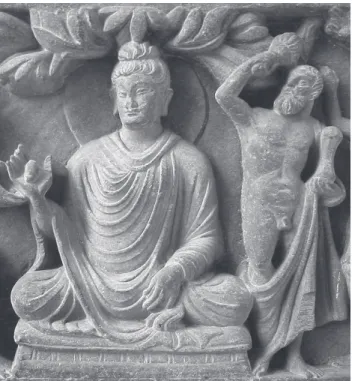
Figure 5 : The divinity Vajrapani (on the right), protector of the Buddha, depicted as the Hellenic Hercules in a 2nd century Greco- Buddhist bas-relief from Gandhara, British Museum.
The humble contribution of cultural psychology
Psychological sciences are usually understood as the study of individuals. Thus, “cultural psychology” can sound an oxymoron. Cross-cultural psychology is about what culture does to individuals, yet persons act through culture.
People invent tools, practices, signs, and meta-signs that organize the work done by other cultural tools and guide the production of novelty. But novelty, as well as continuity, is located in the buffer zone between the persons and the social worlds. Cultural psychology is trying to work exactly at the junction between mind and culture, in order to understand how the uniqueness of human existence and its capability of creating the social world can produce and be produced by the collective forms of action. Thus, concepts such as culture, civilization, society, are not relevant as an explanans, but become an explanandum. I am not acting in a certain way because of my “italianity”. On the contrary, such universal and abstract representation of an Italian “essence” starts from very situated individual actions. Such institutionalized representations of the world become traditions, or life-forms: the frameworks distanced from the individual, immediate experience within which the meaning of the experiences itself acquires sense in return (Tateo, 2015a; 2015b).
If culture was an entity, then we should have been able to define what is non-CULTURE. Culture is a concept that cannot be used alone. It always needs to be accompanied by an adjective. Thus, one can have my culture, Western culture, Japanese culture, collective culture, material culture, etc. ad infinitum. We can think about NATURE as the non-A open set in relation to culture. But immediately the landscape reminds us that such an opposition can be blurred and somehow meaningless (figure 7).
Figure 7 : Mimetolith and rock garden: is nature imitating culture or culture imitating nature?
Figure 6 : the sarcophagus model of cultural comparison
Thus, the non-CULTURE can be the Otherʼs culture, as in the case of civilization. Yet we can deny the Other the right of having a “civilized culture”, not the right to have a culture altogether. So, culture is not a disease, that one can “get” or “have” by means of transmission or acquisition. Culture is rather action, a collective narrative about culture. It is collective not in the sense that is the same for every member of a given group. It is rather the product of a coordinated configuration of repeated individual actions. At the same time, if we consider civilization as a form of collective cultural narrative, we must take into account the role of the non-civilization narrative as integral part. The ethnocentric perspective from which we act produces this illusion of reification and naturalization of culture. If culture is a narrative, then belonging to it is a form of authorship. We cannot recognize ourselves in a story TOLD BY another, but we are able to recognize ourselves in a story ABOUT another.
This narrative ends up in a teleological construction, including a system of categorization of the world which is ethnocentric, or, better, is power-centric, reflecting the historical power relationships in the history of civilizations (Tateo, 2015b).
This quite provoking idea of culture as narrative becomes central in the encounter between civilizations, to the extent that implies a completely different understanding of agency, commitment and responsibility.
“Cultures cannot meet, for ”culture” has no agency. It is just a word, a concept, and concepts do not meet.
So talking as if cultures could do this or that—meet, collide, or clash—begs the question of what drives people. It is people, not culture, who have the power to act. And it is people, not culture, who can change life for better or for worse” (Wikan, 2002, p, 10)
The responsibility of the encounter thus relies upon us as cultural agents, who constantly produce, maintain and demolish the meanings we create in order to cope with the uncertainty of the next moment in the future. The cultural suggestions that we produce and reproduce provide us with a set of possible meanings about ourselves and the others. Culture is not determining our actions, rather is suggesting specific windows of acceptability for what is-to-be (or do) or not-to-be (do), for what is ought-to-be (do) or should-not-be (do), and specific guidance for what is yet-to-be. Experiencing is thus the result of the interaction between a subject, an object and some cultural contextual conditions. In this sense, the development of the experience is a vector whose direction and magnitude cannot be determined a-priori, but only appreciated a-posteriori. Nevertheless, we as human beings constantly anticipate the uncertainty of future events through the production of signs that inhibit or promote specific trajectories within the windows of social acceptability. The power of these signs does not lay in the omnipotent pressure of a constraining form of civilization, rather in the capability of human beings of treating abstract values as they were real things (Tateo, 2015a). It is undoubtable that culture constitutes a value-guided system of constraints and affordance orienting, promoting or inhibiting specific individual and collective actions and meaning-making processes. Yet we cannot take culture, or its historical forms of civilizations, as given or “natural” entities. We have to explain cultural phenomena rather than assuming them as explanations of human action.
People create future-oriented and value-guided courses of action that through repetition and innovation, and through the reifying power of language, rituals and artifacts, become the “entities” that we call cultures. In the course of human history, people create distinctions, segregations, inequalities and then invent the means to overcome them, so that one can kill or die for the fatherland, our zodiac can resist the achievement of our career unless we find a counter-magic, we can modify our environment to make it uglier and then develop a global environmental awareness. But one can also travel to a war country and try to save human lives in an emergency hospital for the sake of altruism. Yet all these antinomies, ambivalences and idiosyncrasies, not surprisingly, coexist in the same civilization and across civilizations as they constitute both the discomforts and the resources of our being humans always striving for transcending our humanity.
Notes
1. Besides, in topological terms, if we consider the whole system of A<>non-A (a closed set + an open set) we obtain an more complex set which is by definition an infinite set, a developmental space in which novelty can emerge and take potentially infinite directions.
Yet this openness is constrained by the bounded nature of the complementary closed set, which guides the collective development of the society toward a more limited range of possible alternatives, maintaining in such a way the balance between production and reproduction of social dynamics.
References
Gurdjeff, G.I. (1963). Meetings with Remarkable Men. New York: Janus.
Herbst, D. P. G. (1976). Alternatives to Hierarchies. Leiden: Martinus Nijhoff.
Lebra, T.S. (2004). The Japanese Self in Cultural Logic. Honolulu: University of Hawai’i Press.
Marsico, G., and Varzi, A.C. (2015). Psychological and Social Borders: Regulating Relationships. In J. Valsiner, G. Marsico, N.
Chaudhary, T. Sato and V. Dazzani (Eds), Psychology as the Science of Human Being, pp. 327-335. New York. Springer.
Norton, D. L. (1996). Imagination, understanding, and the virtue of liberality. Lanham MD: Rowman & Littlefield.
Tateo, L. (2015a). Giambattista Vico and the Principles of Cultural Psychology: A Programmatic Retrospective. History of Human Sciences, 28(1): 44-65.
Tateo, L. (2015b). What Imagination Can Teach Us About Higher Mental Functions. In J. Valsiner, G. Marsico, N. Chaudhary, T. Sato and V. Dazzani (Eds), Psychology as the Science of Human Being, pp. 149-164. New York. Springer.
Valsiner, J. (2014). An invitation to cultural psychology. London: Sage.
Vico, G. (1948). The New Science of Giambattista Vico. Trans. T. Goddard Bergin and M. H. Fisch. Ithaca: Cornell University Press.
Yokoyama, T. (1987). Japan in the Victorian mind: a study of stereotyped images of a nation, 1850-80. Houndmills, Basingstoke, Hampshire: Macmillan
Wikan, U. (2002). Generous Betrayal: Politics of Culture in the New Europe. Chicago, IL: University of Chicago Press.