• 検索結果がありません。

Characterization of Two FSH Inducible Genes, a Nuclear Transcriptional Co - activator p 120 and a Novel Serine Protease - like Protein, in the Rat Ovarian Granulosa Cells

N/A
N/A
Protected

Academic year: 2021

シェア "Characterization of Two FSH Inducible Genes, a Nuclear Transcriptional Co - activator p 120 and a Novel Serine Protease - like Protein, in the Rat Ovarian Granulosa Cells"

Copied!
6
0
0

読み込み中.... (全文を見る)

全文

(1)

Characterization of Two FSH Inducible Genes, a Nuclear Transcriptional Co - activator p 120 and a Novel Serine Protease - like Protein, in the Rat Ovarian Granulosa Cells

Miki YOSHINO

1,2)

, Tetsuya MIZUTANI

1,2)

, Kazuya YAMADA

1,2)

, Takeshi ARIMA

1,2)

, Takashi YAZAWA

1,2)

, Hiroko OGATA-KAWATA , Tetsuya MIZUTANI

1,2)

, Tetsuya MIZUTANI

)

, Toshio SEKIGUCHI , Kazuya YAMADA

1,2)

, Kazuya YAMADA

)

, Takashi KAJITANI

1,2)

and Kaoru MIYAMOTO

1,2)

1 ) Department of Biochemistry, Faculty of Medical Sciences, University of Fukui, Fukui 910-1193, Japan

2 ) CREST, JST (Japan Science and Technology), Japan

Correspondence:Kaoru  MIYAMOTO,  Department  of  Biochemistry, Faculty of Medical Sciences, University of  Fukui, Shimoaizuki, Matsuoka, Fukui  910-1193 , Japan TEL: + 81-776-61-8316

FAX: +81-776-61-8102

E-mail: [email protected] Abstract

 Ovarian follicular development is primarily depen- dent on pituitary gonadotropins. We report here the  identification of two genes, a nuclear transcription co- activator p 120 , and a novel serine protease - like pro- tein, as FSH inducible genes in the rat granulosa cells. 

Characterization of the genes revealed that rat p 120   may work together with PR in the granulosa cells of  large antral follicles to promote the ovulation events,  and that the novel serine protease - like protein may be  involved in the proteolytic process during the follicular  development and ovulation process.

Introduction

 Follicular growth is primarily controlled by pituitary  gonadotropins, LH and FSH. Especially FSH stimulates  proliferation and differentiation of granulosa cells of  small follicles in the ovary, and promotes their develop- ment to pre - ovulatory follicles [ 1 ]. Recently we identi- fied many gonadotropin inducible genes expressed in  the ovary by subtraction cloning and DNA microarray  analyses, and found that a transcriptional co-activator  p 120   and  a  novel  serine  protease - like  protein  were  strongly induced in the rat cultured granulosa cells by 

FSH. In this report, characterization of the co - activa- tor p120 and the novel serine protease-like protein in  the ovary will be described.

Subtraction cloning and DNA microarray

 The subtraction cloning and DNA microarray tech- nology are quite powerful methods for the comprehen- sive analysis of gene expression. In order to identify  FSH-inducible genes in the rat granulosa cells, sub- traction cloning and DNA microarray analyses were  performed. Cultured granulosa cells  (5.0×10

6

 viable  cells )  were treated with or without  30  ng/ml FSH for  15  hours. Messenger RNAs from FSH treated cells as  well as control cells were converted to double strand- ed cDNAs, and subtraction cloning was performed as  previously reported [2]. Resulting cDNAs of size-range  between  0 . 5-2 . 0  kbp long were subcloned to construct  a subtraction plasmid cDNA library. About 400 clones  in the plasmid library were randomly picked up and  their nucleotide sequences were partially determined. 

For DNA microarray analysis, mRNAs from the cells 

treated with or without FSH were labeled with fluo-

rescent dyes, Cye3- or Cye5, respectively. The labeled 

cDNA pools were hybridized to microarray glass slides 

containing  3200  cDNA elements. As listed in Table  1 , 

hundreds of candidate genes were picked-up and 10 

genes were confirmed as FSH inducible genes by the 

semi-quantitative  RT-PCR  analysis.  Among  these 

FSH - inducible genes, we describe here the expression 

and  localization  of  the  transcriptional  co - activator 

p 120 , as well as those of the novel serine protease - like 

(2)

protein in the ovary during the follicular development  and the ovulation processes.

Characterization of rat p 120 , an FSH inducible  transcriptional co - activator

 In this study we identify rat homologue of p 120 , a  nuclear transcription co - activator, as one of the FSH  inducible  genes  in  the  rat  granulosa  cells.  We  then  cloned a full - length cDNA encoding rat p 120  and the  nucleotide sequence was determined. Fig. 1 shows the  deduced  amino  acid  sequence  of  rat  p 120 ,  which  is  compared with that of human p 120 . It contains pro- line - rich, acidic, and bromo - domains, respectively, and  there are two LXXLL - motifs between proline - rich and  acidic domains. The sequences are well conserved be- tween rat and human  (94 % identity at amino acid lev- el), except that rat p120 has  45 amino acid residues  extended at N - terminus. The transcriptional co - activa- tor p 120  was originally isolated as a novel nuclear co - activator  for  thyroid  hormone  receptor  [3].  Further  studies revealed that p 120  also interacts with andro- gen receptor or  9-cis-retinoic acid receptor  (RXR) 

Fig. 1.  Deduced amino acid sequence of rat p120

     The proline-rich domain between 223 and 288 amino acid residues from the N-terminus is underlined, and acidic amino acid-rich domain  between 602 and 731 is shown by bold type. The bromodomain between 809 and 894 is boxed. The putative NR box (LXXLL motif), which  is necessary for the interaction with nuclear hormone receptors, is boxed by colored background. Since there are high homology between rat  and human p120 sequence (94% identity at amino acid level), rat p120 is expected to have similar functions.

Table 1. Induced genes in the rat granulosa cells stimulated with FSH  for 15 hours

Accession

number Definition

AB180485 Human thyroid hormone receptor coactivating protein  like protein (rat p120)

AB180912 Unknown serine protease like protein

NM̲017290 Rat ATPase, Ca

2+

 transporting, cardiac muscle, slow  twitch 2 (Atp2a2)

NM̲022265 Rat programmed cell death 4 (Pdcd4) M64393 Rat 3-α-hydroxysteroid dehydrogenase

(3-α-HSD)
NM̲019683 Mouse globin inducing factor, fetal (Gbif-pending) NM̲011462 Mouse spindlin (Spin)

U

23776

Rat Eker rat

-

associated intracisternal

-

A particle element

NM̲

012600

Rat Malic enzyme 

1

, soluble 

(

Me

1)

AY009092 Rat retrovirus SC1

(3)

functioning as a co-activator of these nuclear recep- tors [ 4 ]. The receptors belong to the nuclear receptor  super-family proteins that activate the transcription of  their target genes when the steroid hormones or li- gands bind to them. The nuclear hormone receptors  generally bind to the respective hormone responsive  elements  ( HREs )  in the upstream regions of the tar- get genes, and activate the transcription. Deficiencies  of estrogen receptors or progesterone receptors  ( PR )   result  in  various  defects  of  reproductive  functions,  such as abnormal follicular development, anovulation,  and infertility [ 5-7 ]. Transcriptional co - activators are  required to form active protein complexes with the  hormone nuclear receptors and the basic transcription  machinery proteins for the target gene transcription. 

Co - activators p 160 /SRC and CBP/p 300  are known to  interact with the nuclear hormone receptors at the  C-terminal  AF-2  region  through  the  LXXLL-motif  ( NR box )  [ 8-10 ]. Knock - out mice of steroid receptor  co-activator 3 (SRC-3), a member of p160 family, ex- hibit infertility [ 11 ], and those of nuclear receptor inter- acting protein  1   ( Nrip 1 /RIP 140)  are also infertile due  to the blockage of the oocytes release from the Graaf- ian follicles by the ovulatory stimuli [ 12 ]. These reports  indicate that co-activators are also important for the  follicular development and ovulation. Therefore we ex- amined expression and localization of p 120  gene in the  ovary during the follicular development using imma- ture rats primed with gonadotropins. As shown in Fig. 

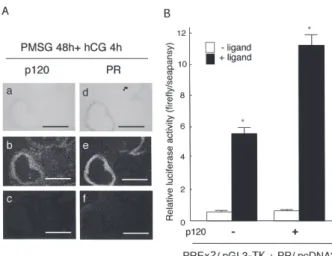
2A, in situ hybridization revealed that the induction  pattern of p 120  was very similar to that of PR in the  granulosa  cells  of  large  pre-ovulatory  follicles.  It  is  well established that PR participates in the ovulation  process occurring in the pre - ovulatory large antral fol- licles. Ovulation is triggered by LH surge from the pi- tuitary. About  4  hours after the LH surge, expression  of PR is rapidly induced in the granulosa cells of pre- ovulatory large antral follicles destined to ovulate [ 13 ,  14 ]. Progesterone binds to the induced receptor to acti- vate gene expression of specific proteases, ADAMTS-1  or Cathepsin L, which are thought to work on follicle  rupture by degrading the ovulating follicle walls [15]. 

In addition, we examined co - activator functions of rat  p 120  by co - transfection experiments to show that p 120   may promote the action of PR during the ovulation. As 

shown in Fig.  2B, p120 enhanced the transcription ac- tivity of PR in the presence of the ligand progesterone. 

These observations suggest that p 120  may work to- gether with PR in the granulosa cells of ovulatory folli- cles to promote the ovulation in the ovary.

A novel serine protease - like protein in the ovary

 We also examined expression and localization of the  novel FSH-inducible serine protease-like protein in  the ovary during the follicular development, in order  to  check  possible  involvement  of  the  gene  in  some  ovarian proteolytic processes. The extracellular matrix  ( ECM )  influences basic cellular processes such as pro- liferation, differentiation, migration and adhesion, and  is fundamental to normal development. A tightly regu- lated proteolytic activity controls the remodeling and  degradation of matrix components in these processes. 

In the ovary, many physiological and pathological pro- cesses including follicular development, ovulation and 

Fig. 2.  Localization  and  transcriptional  co-activator  function  of  rat  p120

     (A) Sections of ovaries from immature rats primed with hCG for  4 hours followed PMSG 48 hours were hybridized with p120  (a, b; antisense probe, c; sense probe) or PR (d, e; antisense  probe,  f;  sense  probe).  Expression  of  these  genes  was  com- pletely co-localized in the granulosa cells of large antral folli- cles, suggesting that p120 works together with PR in the ovary. 

(B) Transcriptional co-activator activity of rat p120 was exam-

ined  by  co-transfection  experiments.  CV-1  cells  were  trans-

fected with a luciferase reporter plasmid and the human PR ex-

pression  vector  with  or  without  10

-7

M  progesterone,  in  the 

presence  or  absence  of  p120.  The  luciferase  activity  of  PR 

was upregulated about two fold in the presence of p120.

(4)

angiogenesis  require  a  regulated  turnover  of  ECM  components. Although a lot of proteolytic enzymes in- cluding members of the plasminogen activator (PA)  or matrix metalloproteinase  ( MMP )  have been recog- nized  to  be  involved  in  several  ovarian  proteolytic  events, a definitive functional role for individual prote- ases has yet to be demonstrated [ 16 ]. Indeed, there ex- ist many deficient mouse strains that lack individual  matrix degrading proteases, but these mice are fertile  and don ' t have major defects of ovulation and female  reproduction, as shown in knockout mice of PA [ 17 ].

 In this context, we cloned a full - length cDNA encod- ing a novel FSH inducible ovarian serine protease-like  protein and the nucleotide sequence was determined. 

Fig. 3 shows the nucleotide sequence of the serine pro- tease - like protein along with deduced amino acid se- quence. The gene encodes a protein of  406  amino acid 

residues with a putative signal sequence, and putative  active site Asp, His, and Ser residues that are con- served in serine protease family such as PA protein. 

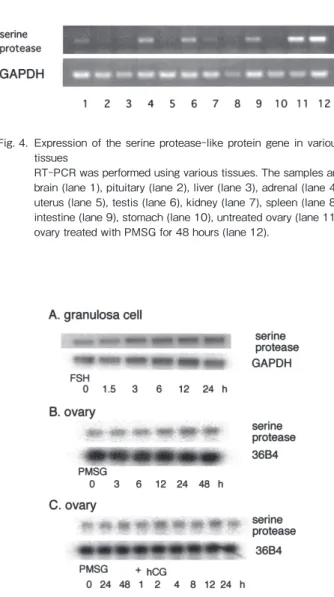
As shown in Fig.  4 , RT - PCR revealed that the serine  protease was expressed in the brain  ( lane  1) , adrenal  (lane 4), intestine  (lane 9), testis  (lane 6), and ovary  ( lane  11) . PMSG treatment increased the gene expres- sion in the ovary after 48 hours (lane 12).

 Northern blot analysis revealed that the serine pro- tease mRNA level was rapidly induced by the FSH  treatment within  3  hours, and the levels were kept  high throughout the treatment  ( Fig.  5 A ) . As shown in  Fig. 5B, the treatment of immature rats with PMSG in 

Fig. 3.  Nucleotide  and  deduced  amino  acid  sequence  of  the  serine  protease-like protein

     The amino acids are numbered starting from the initiation co- don. The deduced signal sequence between 1 and 17 residues  from the N-terminus is underlined, and conserved residues be- tween 162 and 167 involving the putative active site histidine  residue is boxed.

Fig. 5.  Induction of the serine protease-like protein gene expression in  the ovary

     Northern blot analysis of the serine protease-like protein mRNA  in cultured granulosa cells treated with FSH (A), in immature  rat ovaries primed with PMSG (B), and in immature rat ovaries  primed with PMSG followed by hCG (C).

Fig. 4.  Expression of the serine protease-like protein gene in various  tissues

     RT-PCR was performed using various tissues. The samples are 

brain (lane 1), pituitary (lane 2), liver (lane 3), adrenal (lane 4), 

uterus (lane 5), testis (lane 6), kidney (lane 7), spleen (lane 8), 

intestine (lane 9), stomach (lane 10), untreated ovary (lane 11), 

ovary treated with PMSG for 48 hours (lane 12).

(5)

vivo also induced the protease gene expression in the  ovary within  6  hours after the treatment, with a tran- sient peak at  24 hours after the treatment. Further  hCG  treatment  also  increased  the  gene  expression  with a peak at  2  hours as shown in Fig.  5 C.

 Localization of the serine protease in the ovary was  also examined by in situ hybridization using adjacent  frozen sections as shown in Fig. 6. Immature female  rats were treated either with PMSG or PMSG/hCG. 

The expression of the gene was induced in the granu- losa cells of large antral follicles 4 hours after the hCG  treatment  ( Fig.  6 C ) . Since the treatment described  above was typical for ovulation induction, the expres- sion patterns of this serine protease - like protein sug- gest possible involvement of this protein in the ovula- tory  events.  Expression  of  the  serine  protease  was  confirmed  in  transiently  transfected  CHO  cells  by  Western blotting for FLAG epitope that engineered at  the C terminus  ( Fig.  7) . The detected band was con- sistent with the predicted molecular mass of 55 KDa. 

Further studies will be required to show the substrate  specificity of this protein in order to clarify its physio- logical role during the follicle development. It is well  known that ADAMTS -1  is multifunctional MMP and  induced by LH surge in the granulosa cells and cumu- lus cells, and has a critical downstream role in mediat- ing the PR - regulated ovarian activity that culminates  in the rupture of a follicle [15]. The novel serine prote- ase - like protein described here may also be a member  of crucial proteases involved in such processes.

Conclusion

 In this report, we described the isolation and the  characterization of two FSH inducible genes in the rat  ovarian granulosa cells. We showed here that rat p 120 ,  a transcriptional co-activator, interacts with PR to en- hance their activity, and co - localized with PR in the  granulosa cells of large antral follicles. Our observation  suggests that the co-activator p120 may participate in  the ovulation processes co - working with PR. We also  identified a novel serine protease-like protein in the  rat granulosa cells. Although further studies should  clearly be needed for its role in the ovary, the novel  serine  protease-like  protein  may  be  a  new  crucial  member of proteases involved in the proteolytic pro- cesses in the ovary.

Fig.6.  In situ hybridization of the serine protease-like protein      Ovaries from 21-d-old immature rats were used. (A) Control 

ovaries were hybridized with the antisense probe of the serine  protease-like protein (a, b), (B) those treated with PMSG for 24  hours were hybridized with the antisense probe (c, d), or hybrid- ized with sense probes (e, f), (C) those treated with hCG for 4  hours after the PMSG treatment were hybridized with the anti- sense  probe  (g,  h).  Original  magnification  was  x100.  Scale  bars, 0.1 mm.

Fig.7.  Recombinant expression of the serine protease-like protein      CHO cells were transfected with 10 μg of the serine protease-

FLAG/pcDNA3 construct or with control pcDNA3 vector. After  24  hours,  culture  medium  were  collected  and  concentrated. 

Cell lysates were also prepared. Samples were resolved on a 

10  %  SDS-PAGE  gel  and  immunoblotted  with  the  M2  anti-

FLAG epitope antiserum (Sigma). Cell lysate from the serine 

protease-like protein-FLAG/pcDNA3 transfected cells (lane 1), 

from the control vector transfected cells (lane 2), the concen-

trated  culture  medium  from  the  serine  protease-like  protein-

FLAG/pcDNA3 transfected cells (lane 3), and the concentrated 

culture medium from the control vector transfected cells (lane 

4). A specific band corresponding the recombinant protein was 

detected at 55 KDa. This indicates that the novel serine prote-

ase-like protein was actually translated in the cells, and may 

function as an ovarian protease.

(6)

Acknowledgement

 This work was supported in part by a grant from the  Smoking Research Foundation, and by  21 st Century COE  Program  ( Medical Science ) .

References

1 .  Richards JS  (1994)  Hormonal control of gene expression in  the ovary. Endocr Rev  15 ,  725-751 .

2 .   Mizutani T, Sonoda Y, Minegishi T, Wakabayashi K, Miya- moto K  (1997)  Cloning, characterization, and cellular distri- bution of rat scavenger receptor class B type I  ( SRBI )  in  the ovary. Biochem Biophys Res Commun  234 ,  499-505 . 3 .   Monden T, Wondisford FE, Hollenberg AN  (1997)  Isolation 

and characterization of a novel ligand - dependent thyroid  hormone  receptor - coactivating  protein.  J  Biol  Chem  272 ,  29834-29841 .

4 .   Monden T, Kishi M, Hosoya T, Satoh T, Wondisford FE, Hol- lenberg AN, Yamada M, Mori M  (1999)  p 120  acts as a spe- cific coactivator for  9- cis - retinoic acid receptor  ( RXR )  on  peroxisome  proliferator - activated  receptor - gamma/RXR  heterodimers. Mol Endocrinol  13 ,  1695-1703 .

5 .   Lydon  JP,  DeMayo  FJ,  Funk  CR,  Mani  SK,  Hughes  AR,  Montgomery CAJ, Shyamala G, Conneely OM, O ' Malley BW  (1995)  Mice lacking progesterone receptor exhibit pleiotro- pic reproductive abnormalities. Genes Dev  9 ,  2266-2278 . 6 .   Couse JF, Hewitt SC, Bunch DO, Sar M, Walker VR, Davis 

BJ, Korach KS  (1999)  Postnatal sex reversal of the ovaries  in mice lacking estrogen receptors alpha and beta. Science  286 ,  2328-2331 .

7 .   Couse JF, Korach KS  (1999)  Estrogen receptor null mice: 

what have we learned and where will they lead us? Endocr  Rev  20 ,  358-417 .

8 .   Heery DM, Kalkhoven E, Hoare S, Parker MG  (1997)  A sig- nature motif in transcriptional co - activators mediates bind- ing to nuclear receptors. Nature  387 ,  733-736 .

9 .   Torchia J, Rose DW, Inostroza J, Kamei Y, Westin S, Glass  CK, Rosenfeld MG  (1997)  The transcriptional co - activator  p/CIP binds CBP and mediates nuclear - receptor function. 

Nature  387 ,  677-684 .

10 .   McInerney EM, Rose DW, Flynn SE, Westin S, Mullen TM,  Krones A, Inostroza J, Torchia J, Nolte RT, Assa - Munt N,  Milburn MV, Glass CK, Rosenfeld MG  (1998)  Determinants  of coactivator LXXLL motif specificity in nuclear receptor  transcriptional activation. Genes Dev  12 ,  3357-3368 .

11 .   Xu J, Liao L, Ning G, Yoshida - Komiya H, Deng C, O ' Malley  BW  (2000)  The steroid receptor coactivator SRC -3   ( p/CIP/

RAC 3 /AIB 1 /ACTR/TRAM -1)   is  required  for  normal  growth, puberty, female reproductive function, and mamma- ry  gland  development.  Proc  Natl  Acad  Sci  USA  97 ,  6379-6384 .

12 .   White R, Leonardsson G, Rosewell I, Ann JM, Milligan S,  Parker M  (2000)  The nuclear receptor co - repressor nrip 1   ( RIP 140)   is  essential  for  female  fertility.  Nat  Med  6 ,  1368-1374 .

13 .   Park OK, Mayo KE  (1991)  Transient expression of proges- terone receptor messenger RNA in ovarian granulosa cells  after the preovulatory luteinizing hormone surge. Mol Endo- crinol  5 ,  967-978 .

14 .   Natraj U, Richards JS  (1993)  Hormonal regulation, localiza- tion, and functional activity of the progesterone receptor in  granulosa cells of rat preovulatory follicles. Endocrinology  133 ,  761-769 .

15 .   Robker RL, Russell DL, Espey LL, Lydon JP, O ' Malley BW,  Richards  JS  (2000)   Progesterone - regulated  genes  in  the  ovulation process: ADAMTS -1  and cathepsin L proteases. 

Proc Natl Acad Sci USA  97 ,  4689-4694 .

16 .   Tsafriri A  (1995)  Ovulation as a tissue remodelling process. 

Proteolysis and cumulus expansion. Adv Exp Med Biol  377 ,  121-140 .

17 .   Carmeliet P, Schoonjans L, Kieckens L, Ream B, Degen J, 

Bronson R, De Vos R, van den Oord JJ, Collen D, Mulligan 

RC  (1994)  Physiological consequences of loss of plasminogen 

activator gene function in mice. Nature  368 ,  419-424 .

Fig. 2.  Localization  and  transcriptional  co-activator  function  of  rat  p120
Fig. 3.  Nucleotide  and  deduced  amino  acid  sequence  of  the  serine  protease-like protein       The amino acids are numbered starting from the initiation co-don. The deduced signal sequence between 1 and 17 residues   from the N-terminus is underlin

参照

関連したドキュメント

Character- ization and expression analysis of mesenchymal stem cells from human bone marrow and adipose tissue. IGFBP-4 is an inhibitor of canonical Wnt signalling

• Transplantation model systems were established in the zebrafish and clonal ginbuna carp to evaluate the activity of hematopoietic cells. • Hematopoietic stem cells

The present results also provide in situ hybridization evidence that at least chief cells and possibly both chief cells and sustentacular cells of the carotid body express NGF mRNA..

Determination of the Levels of Phosphorylated MAPK and GTP-bound Rac1—J774[SR-BI] cells or HEK293 cells forcedly expressing rat SR-BI and FLAG-tagged human GULP were incubated in

Figure 3 shows the graph of the solution to the optimal- ity system, showing propagation of CD4+ T cells, infected CD4+ T cells, reverse transcriptase inhibitor and a protease

Proc. Studies in Logic and the Foundations of Mathematics, 73. North-Holland Publishing Co., Amsterdam- London; American Elsevier Publishing Co., Inc., New York, 1973..

We show that for a uniform co-Lipschitz mapping of the plane, the cardinality of the preimage of a point may be estimated in terms of the characteristic constants of the mapping,

READY-MAN® Liquid Mn with Boron is a specifically formulated material designed to achieve compatibility with Glyphosate and other herbicides commonly tank mixed