Quantity and Quality Measures of Financial Development:
Implications for Macroeconomic Performance
Hiro ITO
Portland State University
Masahiro KAWAI
Economic Research Institute for Northeast Asia and University of Tokyo April, 2018
Niigata, Japan
ECONOMIC RESEARCH INSTITUTE FOR NORTHEAST ASIA
ERINA Discussion Paper No.1803e
Quantity and Quality Measures of Financial Development:
Implications for Macroeconomic Performance
Hiro ITO*
Portland State University Masahiro KAWAI**
Economic Research Institute for Northeast Asia and University of Tokyo 6 April 2018
Abstract: Financial development is often measured by financial depth such as the stock of private credit and market capitalization as a share of GDP. Such a measure focuses on the quantity aspect of financial development. In this paper, we propose measures that capture both the quantity and quality aspects of financial market development. For quantity measures, we construct a composite index with multiple variables which gauge the size and depth of the banking, equity, bond, and insurance markets.
For quality measures, we create a composite index that reflects the degree of financial market diversity, liquidity and efficiency, and the institutional environment. The last factor captures the development of legal systems and institutions, human capital, and information and telecommunications infrastructure.
We find that the quantity and quality measures are highly correlated with each another for advanced economies and Asian emerging market economies, but not for other economies. The disaggregated components of the quality measures suggest that it is the level of legal and institutional development that differentiates advanced economies from emerging and developing economies in terms of the quality measures. Compared to advanced economies, emerging and developing economies tend to have low levels of market diversity, liquidity, and efficiency. Our simple regression analysis shows that the quality measure of financial development has a positive effect on output growth and negative effects on output volatility and inflation for the sample of emerging and developing economies with relatively high-quality financial development. We also observe that a higher level of financial development, particularly in terms of quality, tends to lead to greater financial openness, and that greater financial openness tends to be associated with low growth, high growth volatility and high inflation for emerging and developing economies with low quality measures of financial development, while such undesirable impacts of financial openness can be mitigated by raising the quality of financial development.
Keywords: financial development; financial liberalization; financial openness JEL Codes: E44; G2; O16
Acknowledgements: Ito thanks Portland State University for their financial support. Kawai thanks the Japan Society for the Promotion of Science (JSPS) for financial support through JSPS KAKENHI Grant Number 16K03733.
* Hiro ITO: Department of Economics, Portland State University, 1721 SW Broadway, Portland, OR 97201, U.S.A.
Tel/Fax: +1–503–725–3930/3945. Email: [email protected]
** Masahiro KAWAI: Economic Research Institute for Northeast Asia, 13th Floor, Bandaijima Building, Bandaijima 5–1, Chuo-ku, Niigata City, 950–0078, Japan. Tel: +81–25–290–5545. Email: [email protected];
Graduate School of Public Policy, University of Tokyo, 7–3–1 Hongo, Bunkyo-ku, Tokyo, 113–0033 Japan. Tel: +81–
3–5841–7641. Email: [email protected]
1. Introduction
Identifying the effect of financial development on macroeconomic performance has long been the subject of research in macroeconomics. The most oft-debated is the effect of financial development on economic growth. Many studies such as King and Levine (1993), Levine (1998), Levine, et al.
(2000), and others, have tried to identify the link between the level of financial development and the rate of economic growth and its stability and have often found a positive link.
1Further financial development tends to enhance output growth and stability by ameliorating information asymmetry, facilitating more efficient and smooth capital allocation and accumulation, and enabling further risk-sharing and portfolio diversification.
Despite likely positive effects of financial development on economic growth, further financial development can also expose economies to high-risk, high-return financial instruments, thereby possibly leading to aggressive risk-taking, boom-bust cycles, and amplified volatility. The impact of financial development on output or financial stability, or just simply economic stability, has also been studied in recent years, especially following the outbreak of the global financial crisis (GFC) of 2007–09. Studies such as Arcand, et al. (2015) and Cecchetti and Kharroubi (2015) show that over-extended financial sector development can cause a drag on real economic growth.
Ambivalence continues to hold for the effect of financial development on macroeconomic performance.
The effect of financial development has also recently received much attention when many international economists debated the effect of a “global savings glut” on global imbalances—a situation where excessive savings in several emerging economies financed the profligacy of several advanced economies such as the United States and European countries. Some researchers believe that global imbalances eventually caused the GFC, although many other factors arguably played a role. Under the “global savings glut” hypothesis, the imbalances were ascribed to underdeveloped financial systems in some emerging economies, such as China, that essentially sent excess savings to the financial centers of the world, i.e., the United States and Europe.
According to this view, financial development should lead to lower domestic savings and smaller current account surpluses.
2This view is in contrast to the “financial deepening” view (Edwards, 1996) where financial development leads to greater depth and sophistication of financial markets and therefore higher savings.
Thus, financial development has received much attention as one of the major determinants of macroeconomic performance, such as economic growth, stability and savings, while empirical evidence of its impact has generated more debate and controversy. At the same time, different measures of financial development may have contributed to the mixed findings on the impact of financial development on the relevant macroeconomic variables.
Financial development is often captured by a quantity measure that gauges the depth of financial markets such as the stock of private credit created as a share of GDP, mainly because this kind of data series is readily available both by country and over time (private credit data go back to as
1
For reviews on the nexus between finance and economic growth, refer to Levine (2005).
2
Refer to Chinn and Ito (2007) and Chinn, et al. (2013).
early as the 1960s for many countries). Beck (2015, 2013) argues that high levels of private credit as a share of GDP do not necessarily mean high levels of financial development. In his argument, what is captured by private credit differs among countries at different income levels because the roles of banks differ. In low- or middle-income countries, bank assets tend more to be composed of low-risk assets such as government bonds and corporate lending, not of lending to small and medium-sized enterprises (SMEs) or consumers. For higher income countries, SME or consumer lending plays a bigger role. In high-income countries, banks’ balance sheets are more diversified toward risky private lending such as mortgages for households. Hence, the meaning of private credit changes depending on the income level of a country.
3Financial development is a multifaceted concept. To capture the subtle complexities of financial development, instead of just focusing on banking sector development, we must look into different types of financial markets such as equity, bond, and insurance markets. Also, instead of merely paying attention to the size and activeness of the financial industry, we must look into the quality aspects of financial development, such as cost performance, the breadth of the industry, and market efficiency (e.g., Hasan, et al. 2009).
In this paper, we revisit the challenge of gauging the level of financial development and construct measures that capture both the quantity and quality aspects of financial development. For quantity measures, we create a composite index with multiple variables that capture the size and depth of different types of financial markets, such as banking, equity, bond, and insurance markets. For quality measures, we create a composite index by looking at the degrees of market diversity, in terms of available financial instruments, market liquidity, market efficiency and the institutional environment. The last factor represents: legal and institutional development; human capital development; and information and telecommunications infrastructure development. We create indexes for each of these categories by using a wide range of variables.
The paper is organized as follows. In Section 2, we carefully explain our method of creating various indexes to construct quantity and quality measures of financial development. In Section 3, we examine the trend of the quantity and quality measures, compare them among countries and different income levels, and examine the correlations between the quantity and quality measures.
In Section 4, we conduct simple analyses on the impacts of the quantity or quality measure of financial development on several key macroeconomic variables. We also extend our analysis to the relationship between financial development, both in terms of quantity and quality, and financial openness, and examine the impact of financial openness on the key macroeconomic variables conditional upon the level of quality in financial development. In Section 5, we conclude the paper.
2. Construction of the Quantity and Quality Measures of Financial Development
One of the goals of this paper is to construct the quantity and quality measures of financial development. The former measure is often used for empirical studies on the impact of financial development on macroeconomic performance. The latter measure of financial development has
3
Beck (2013) also argues that private credit can often reflect business cycles even if it is normalized by the size of
economic activity such as GDP. Hence, rapid increases in private credit can just be a reflection of a financial bubble,
which does not necessarily imply long-term financial development.
not been constructed or utilized in earlier studies, and our contribution lies in the construction of such a measure and its use for macroeconomic analysis.
Hasan, et al. (2009) argue that it is the quality of financial intermediation that matters, not the quantity, and focus on the quality of financial intermediation in terms of profit and cost
efficiency. Here, we take a much broader view, with the multi-dimensional aspects of financial development, to measure its quality.
We take the view that the “quality measure of financial development” has the following dimensions: market diversity or breadth; market liquidity; market efficiency; and the institutional environment, which is a composite index of legal and institutional development, human capital development, and information and telecommunications infrastructure development.
Market diversity or breadth is an important factor determining the quality of a financial market.
The more diverse financial instruments a country’s financial market can offer, the more means for risk-sharing and hedging are available in the economy, enabling greater risk-diversification of portfolios. Capital can be priced more efficiently and competitively, sending more appropriate signals from the financial markets and leading to more efficient and effective allocation and accumulation of capital. More diverse financial markets also make it easier for economic agents to smooth intertemporal consumption.
Market liquidity is a second factor determining the quality of financial market development. High levels of liquidity allow market participants to conduct asset transactions with little delay, at low cost and at a price close to the current market price. Thus high levels of liquidity enable efficient and competitive trading of assets, thereby facilitating the smooth exchange of goods and services.
Market efficiency is a third factor contributing to the quality of financial markets. An active financial market is not necessarily an efficient market, nor is a market with a high level of market capitalization. Generally, the efficient allocation of capital resources requires efficient financial markets. If an economy has a history of implementing active interventionist industrial policies as part of its growth strategy (e.g., East Asian economies), the role of the public sector in the financial sector tends to be significant, limiting market competition and, thus leaving the financial market inefficient. Demirgüç-Kunt and Huizinga (2001) find that underdeveloped financial markets tend to have higher levels of profits and margins. The lack of competition can eventually lead to, or sustain, rent-seeking behavior by the financial industry, hindering the long-term development of both the industry and the economy. Hence, the degree of efficiency of a financial system is an important gauge for the quality of financial market development.
The institutional environment is a fourth factor affecting the quality of financial markets. This has three sub-components. The first sub-component is a country’s legal foundations and institutions, which define the context where financial transactions and economic decisions are made. Levine et al. (2000) find that cross-country differences in legal and regulatory systems influence the development of financial intermediation. 4 The literature identifies a number of channels by which legal and institutional development can affect investment and savings decisions. Whether the legal system clearly establishes law and order, minimizes corruption, or protects property rights
4
See also Beck and Levine (2004), Johnson et al. (2002), and Levine (2005), among others.
efficiently, influences market participants’ financial decision-making. In economies where the legal system does not clearly define property rights or guarantee the enforcement of contracts, incentives for loan activities can be limited. Legal protections for creditors and the level of credibility and transparency of accounting rules also affect financial decisions made by economic agents, including foreign market participants. 5
Human capital is the second sub-component contributing to a country's institutional environment.
The higher levels of education an economy achieves, the more positive externality or network benefits it can enjoy. In financial activities, processing information efficiently is an important consideration. Continuous technological advancement requires high levels of complex information processing, which would also require workers to attain certain levels of education. Hence, an economy that has accumulated high levels of human capital is expected to have a hig-quality financial market.
Information and telecommunications infrastructure development is the third sub-component for a country's institutional environment. In order to process and share information pertaining to financial services and transactions efficiently, developing a strong information and telecommunications infrastructure is essential. Especially following the emergence of the Internet, the role of information and telecommunications infrastructure has become vital.
2.1 Algorithm for constructing indexes
We construct two indexes to measure the degree of a country's financial development. The first measures the quantity aspect of financial development (“Fin_quantity”) and the second measures the quality aspect of financial development (“Fin_quality”). Fin_quantity is a composite index constructed from the eight variables that capture the sizes and depths of different types of financial markets, i.e., banking, stock, bond and insurance markets. Fin_quality is composed of four subindexes: diversity for diversity and breadth of financial markets; liquidity for liquidity of financial markets; efficiency for financial market efficiency; and inst for institutional environment.
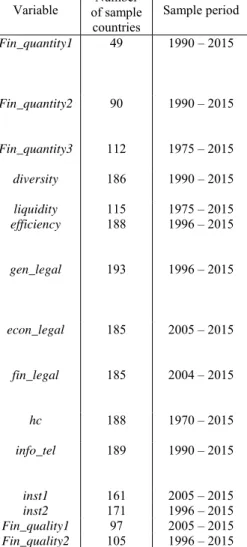
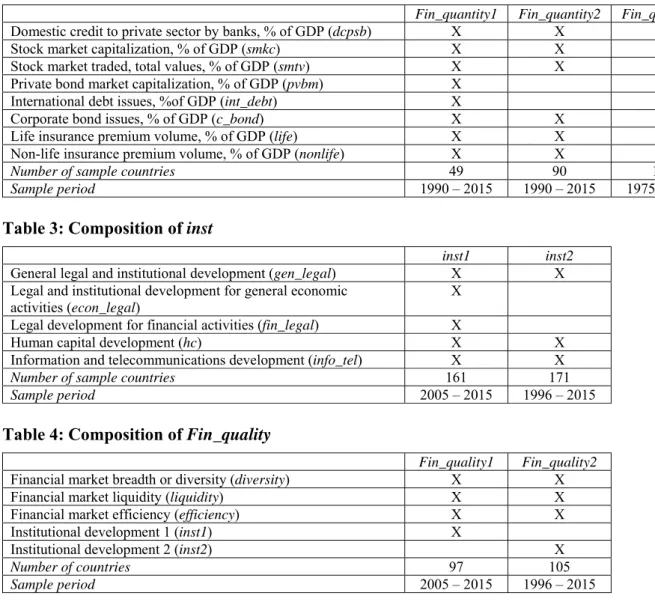
Each of the subindexes is composed of several, more detailed variables (Table 1).
To construct these composite indexes, we take a bottom-up approach. The general rule or algorithm warrants some explanation.
First, all the original variables used to construct Fin_quantity and three of the subindexes used to construct Fin_quality, namely, diversity, liquidity, and efficiency, are winsorized with the 5th and 95th percentiles set as the cutoff levels. That is, extremely small values below the 5th percentile and extremely large values above the 95th percentile are taken out of the sample. This is to remove the outliers while not losing observations. 6
5
Chinn and Ito (2006) find that financial openness leads to financial development, especially when a country is equipped with developed legal systems and institutions. Alfaro, et al. (2008) argue and find evidence that institutional quality is an important determinant of the direction and volume of international capital flows.
6
“Winsorize” means that extremely small values below a certain threshold (e.g., the 5th percentile) and extremely
large values above a threshold (e.g., the 95th percentile) are replaced by the threshold values instead of being replaced by missing variables so that observations will be kept.
Second, these variables are also normalized using the formula:
_
,, ,
(1)
where , and , are the global maximum and minimum of the winsorized variable , respectively.
Then, for the construction of a composite index, if one of the variables used to construct the index is severely limited in terms of the sample length of the time series, the composite index can be spliced using the other variables for the index. For example, if subindex X is composed of variables A, B, C, and D, but if the time series of variable C is available only for 2000–2015 while the others are available for 1995–2015, we create X' using all the four variables for the 2000–2015 period and X" using A, B, and D for the 1995–2015 period. Then, using the growth rates of X", we retroactively extrapolate X' for the earlier years (i.e., for 1995–1999) to obtain subindex X.
All the subindexes, except for diversity and liquidity, are the first principal components of the original variables. Fin_quantity is the first principal component of the eight subindexes.
Fin_quality is the first principal component of the four subindexes. Before the first principal component is computed, however, all four subindexes are winsorized at the 1st and 99th percentiles and normalized again to a range between zero and one. 7
2.2 Subindexes for constructing the quantity measure of financial development
In this subsection we explain the construction of the quantity measure of financial development and its underlying subindexes. Greater detail on data description and sources is given in Appendix 1.
The quantity measure of financial development (Fin_quantity) gauges the degree of financial development with a focus on the size and depth of financial markets. It is composed of the size indexes of the banking, stock, bond, and insurance markets. Namely, it is the first principal component of domestic credit to the private sector by banks, stock market capitalization, the total value of stocks traded, private bond market capitalization, international debt issues, the corporate bond issuance volume, the life insurance premium volume, and the non-life insurance premium volume, all of which are normalized by nominal GDP.
Because of the trade-off between the level of detail and nuance a variable can offer and the degree of its availability, we construct three types of quantity measures for financial development:
Fin_quantity1, Fin_quantity2, and Fin_quantity3. They differ depending on the variables included in the first principal component calculation. Naturally, data availability differs among the three variables (Table 2).
7
The thresholds for winsorizing depend upon the distribution of the original variable. When there are many outliers,
we use the 5
thand 95
thpercentiles (or sometimes the 10
thand 90
thpercentiles) as thresholds. When there are
relatively few outliers, we use the 1
stand 99
thpercentiles as thresholds.
Fin_quantity1 is the quantity measure of financial development and is constructed as the first principal component of eight subindexes, that is, domestic credit to the private sector by banks (dcpsb); stock market capitalization (smkc); the total value of stocks traded (smtv); private bond market capitalization (pvbm); international debt issues (int_debt); corporate bond issues (c_bond);
the life insurance premium volume (life); and the non-life insurance premium volume (nonlife), all as a ratio of GDP. As it involves eight variables in its construction, this measure is available for only 49 countries over the sample period 1990–2015.
“Fin_quantity2” is the first principal component of six subindexes, i.e., domestic credit to the private sector by banks (dcpsb), stock market capitalization (smkc), the total value of stocks traded (smtv), corporate bond issues (c_bond), the life insurance premium volume (life), and the non-life insurance premium volume (nonlife). This measure is available for many more countries than Fin_quantity1; it covers 90 countries for the period 1990–2015. We often use this measure in later data analyses.
“Fin_quantity3” is defined as the first principal component of three subindexes, i.e., domestic credit to the private sector by banks (dcpsb), stock market capitalization (smkc), and the total value of stocks traded (smtv). As it focuses on a smaller number of subindexes, it is available for more countries and for a longer sample period than the other two quantity measures. It covers 112 countries for the period 1975–2015.
2.3 Subindexes for constructing the quality measure of financial development: Diversity, liquidity, efficiency and the institutional environment
The quality of financial development can be measured by four subindexes, i.e., financial market breadth or diversity, market liquidity, market efficiency, and the institutional environment.
Financial breadth/diversity
It is important to look at the extent of financial market development in terms of the breadth or diversity a financial market can provide. In other words, measuring how diversified a financial market is sheds light on the degree of availability of alternative financial instruments to investors, households and non-financial corporations. We measure the level of breadth or diversity of a financial market as:
1
2 2 2 _ 2 _ 2
1 (2)
where dcpsb is domestic credit to the private sector by banks; smkc is stock market capitalization;
pvbm is private bond market capitalization; insurance_assets is insurance company assets; and int_debt is international debt issues. The higher the level of this value defined by (2), the higher the degree of financial market diversity and breadth.
Liquidity
The level of ease with which a financial asset can be converted to another type of asset is an important way of measuring the quality of financial market development. A liquid market allows investors to quickly purchase or sell a financial asset without causing large changes in the asset price. When a large volume of financial assets is traded by a large number of investors, the market tends to be more liquid than otherwise. Here, we use stock market turnover (as a share of GDP) as the measure “liquidity” for financial markets.
Efficiency
Financial market efficiency (efficiency) is the first principal component of the following seven variables: banks’ return on assets (bank_roa); banks’ return on equity (bank_roe); banks' net interest margin (net_int); the lending-borrowing rate spread (spread); banks' non-interest income as a share of total income (non_int_income); banks' overhead costs as a ratio of total assets (overhead); and bank nonperforming loans as a ratio of gross loans (npl_n).
We assume that all variables, except for bank_roa and bank_roe, indicate the market is less efficient when the variable of concern has a higher value. Hence, these variables are transformed in the following way so that a higher value indicates a more efficient market condition.
_ 1 ,
, ,
3
Institutional environment for finance
A country's institutional environment for financial market development is represented by its legal systems and institutions, human capital development, and information and telecommunications infrastructure development.
Legal and institutional development: We have three types of indexes for the development of legal systems and institutions: general legal and institutional development (gen_legal), legal and institutional development for economic activities (econ_legal), and legal development for financial activities (fin_legal), depending on which aspect of legal or institutional development we wish to capture.
General legal and institutional development (gen_legal) is the measure of overall legal and institutional development affecting business activities. It is based on the first principal component of six variables, i.e., anti-corruption measures (anticorrupt); the corporate tax rate (tax);
government effectiveness (govt_eff); the rule of law (ruleoflaw); political stability and absence of violence/terrorism (pol_sta); and the regulatory quality (regulatory), all taken from the World Bank's "Worldwide Governance Indicators" database.
Legal and institutional development for economic activities (econ_legal) is the first principal component of the following six variables: enforcing contract (enfr_cont); starting a business (business); getting electricity (electricity); paying taxes (paytaxes); dealing with construction permits (construction); and trading across borders (trading), all taken from the World Bank's
"Doing Business" database.
Legal development for financial activities (fin_legal) is the measure of legal development particularly relevant to financial market activities and is represented by the first principal component of four variables, i.e., getting credit (get_credit); protecting minority investors (pro_minority); registering property (property); and resolving insolvency (insolvency), which are also taken from the World Bank's "Doing Business" database.
Human capital development: The level of human capital development (hc) captures a country's tertiary and secondary education. It is the first principal component of tertiary school enrollment (% gross, tertiary) and secondary school enrollment (% gross, secondary).
Information and telecommunications infrastructure development: The level of information and telecommunications infrastructure development (info_tel) is represented by the first principal component of four variables, namely, percentage of individuals using the Internet (indiv_internet);
fixed-telephone subscriptions per 100 inhabitants (fixed_tel2); mobile cellular telephone subscriptions per 100 inhabitants (cell); and fixed-broadband subscriptions per 100 inhabitants (broadband).
Two alternative measures of the institutional environment
For a country's institutional environment (inst), we define two measures depending on what is included in the first principal component calculation (Table 3). The first measure, inst1, includes all the variables pertaining to legal and institutional development, namely, development of general legal systems and institutions (gen_legal), legal and institutional development for economic activities (econ_legal), and legal development for financial activities (fin_legal), as well as human capital development (hc) and information and telecommunications infrastructure development (info_tel). The second measure, inst2, includes development of general legal systems and institutions (gen_legal) as well as human capital development (hc) and information and telecommunications infrastructure development (info_tel).
Again we face a trade-off between the level of detail and nuance a variable can offer and the degree of its availability. The first measure, inst1, includes the more detailed and nuanced variables of econ_legal and fin_legal, which makes inst1 available for a shorter time period (2005–2015), whereas inst2, which excludes econ_legal and fin_legal, is available for a longer time period (1996–2015).
2.4 Quality measure of financial development
We construct two measures for the quality of financial development: Fin_quality1 and Fin_quality2. They differ from each other depending on which subindex is used for institutional environment, inst1 or inst2, in the calculation of the first principal component.
Fin_quality1 is the first quality measure of financial development and is constructed as the first principal component of four subindexes, that is, financial market diversity (diversity), liquidity (liquidity) and efficiency (efficiency) as well as the first measure of institutional development (inst1). This quality measure is available for the sample period 2005–2015 and 161 countries.
Fin_quality2 is the second quality measure of financial development and is defined as the first
principal component of four subindexes, namely, diversity, liquidity and efficiency as well as inst2.
This measure is available for the sample period 1996–2015 and 171 countries. We often use Fin_quality2 in later data analyses.
3. Graphical Illustration of Measures of Financial Development
This section presents the quantity and quality measures of financial development by using graphs for selected countries over time. This facilitates cross-country and time-series comparisons for the two measures.
3.1 Quantity measure of financial development
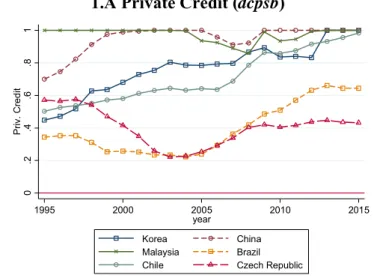
Figure 1 illustrates the development of domestic credit to the private sector (as a share of GDP, dcpsb ) and one each of our quantity and quality measures of financial development, i.e., Fin_quantity2 and Fin_quality2, for Brazil, Chile, China, the Czech Republic, the Republic of Korea (ROK), and Malaysia. 8
A comparison of the first two panels of Figure 1, i.e., for dcpsb and Fin_quantity2, illuminates the difference between the measure purely focused on the banking sector (i.e., dcpsb) and the one accounting for different types of financial markets (Fin_quantity2). For example, if we measure the level of financial development only in terms of private credit creation, for the last decade or so Chile, China, the ROK, and Malaysia appear to have achieved the “highest" level of financial development. However, once the depth of other types of financial markets is taken into account, only the ROK has achieved a high level of financial development in terms of quantity. Other than the banking sector, the other three economies do not have deep financial markets at the level the ROK enjoys. This example makes it clear that high levels of private credit creation do not necessarily reflect a high level of financial development.
Figure 2 illustrates the development of Fin_quantity2 for many more countries, namely the groupings of the Asian economies, the Latin American economies, the advanced economies, and others. 9 We can observe that there is a wide variation across countries in terms of the quantity of financial development. However, the quantity measure of financial development tends to be stable for many countries, while some emerging economies in Asia tend to experience a steady rise in the quantity measure and advanced economies tend to experience cyclical movements. Unlike those in Asia, economies in Latin America and Africa, as well as Russia, tend to have low levels of financial development in terms of quantity.
3.2 Quality measure of financial development
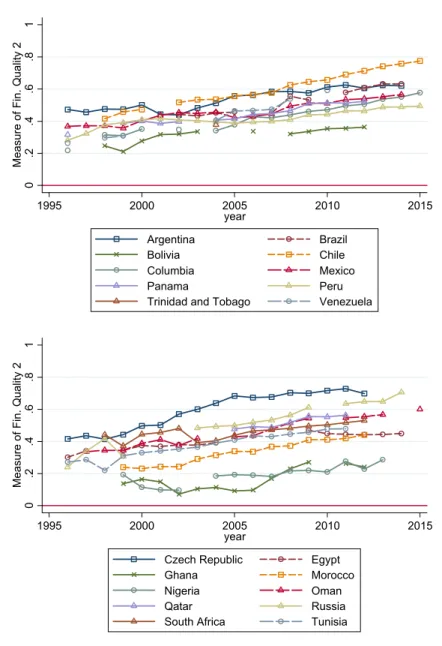
Figure 3 illustrates the quality aspect of financial market development, using Fin_quality2 for the same economy groupings as in Figure 2. We can make several interesting observations. 10
8
The same types of winsorization and normalization (as done to Fin_quantity and Fin_quality) are applied to dcpsb so that parallel comparisons can be made.
9
The whole sample includes economies that are not shown in the figures. See Appendix 2.
10
Even when Fin_quality1 or Fin_quality3 is used, qualitatively similar observations can be made, although they
are not reported here.
First, in the last two decades, most of the economies shown in Figure 3 have experienced financial development in terms of quality with a few exceptions. The trajectory of development is usually steady and not cyclical. Considering that the traditional quantity measures of financial development, such as private credit creation as a share of GDP, could have reflected credit bubbles rather than genuine improvements in the efficiency and quality of financial systems (Beck, 2015), the lack of cyclical movements in Figure 3 likely reflects the long-term development of financial markets.
Second, advanced economies appear to have already reached high levels of quality in financial development in the late 1990s, which is not observed among emerging economies. 11
Third, the ranking of economies for different time periods appears to be relatively stable over time.
This suggests that the quality of financial development improves gradually over time rather than rapidly and abruptly.
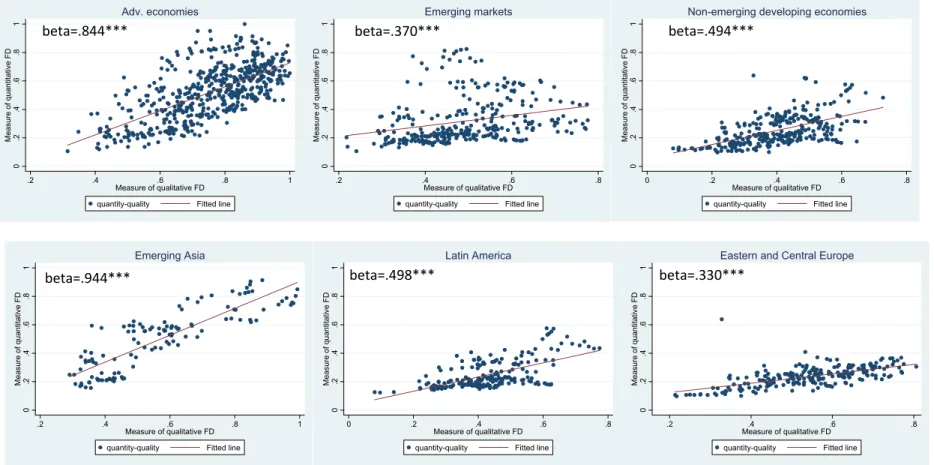
One major question is whether the quality measure of financial market development is correlated with the quantity measure. Figure 4, which uses scatter diagrams to see the relationship between the quality and quantity measures, suggests that the two measures are correlated. 12 However, at the same time, the extent of correlation varies depending on the level of income of the economy or the region to which the economy belongs.
Among advanced economies, the correlation coefficient is high, with a value of 0.84. The correlation coefficient for the group of emerging economies, however, is much lower, with a value of only 0.37, although that of developing economies is a little higher, at 0.49.
Interestingly, for emerging economies in Asia the correlation coefficient is very high, at 0.94. 13 In contrast, the correlation coefficients for Latin America and Eastern and Central Europe are lower, with values of 0.50 and 0.33, respectively. Geographical externality seems to play a role in the link between the quality and quantity measures of financial market development.
In general, advanced economies and Asian emerging economies are different from other economies in that they have achieved high levels of financial market development from both the quantity and quality perspectives. That is, these economies have succeeded in expanding not only the size and depth of financial markets, but also in improving the quality of financial markets with higher levels of diversity (breadth), liquidity and efficiency, and in creating better institutional environments for financial activities.
As we have explained previously, the quality measure of financial development is composed of four subcomponents: financial breadth (diversity), market liquidity (liquidity), market efficiency
11
The definitions of “advanced economies,” “emerging economies,” and “emerging and developing economies” are based on the IMF categorization.
12
For the quality and quantity measures of financial development, we use Fin_quality2 and Fin_quantity2, respectively.
13
“Emerging Asia” includes China, Hong Kong, Indonesia, the Republic of Korea, Malaysia, the Philippines,
Singapore, Thailand, and Vietnam. The result for emerging Asia is unaffected even when Singapore and Hong Kong
are removed from the sample.
(efficiency), and the institutional environment (inst1 or inst2). The subcomponent for the institutional environment is composed of five variables (gen_legal, econ_legal, fin_legal, hc, and info_tel) in the case of inst1 and three variables (gen_legal, hc, and info_tel) in the case of inst2.
Given this construction, we can decompose the quality measure of financial development into several subcomponents and take a closer look at the evolution and cross-country differences of these subcomponents.
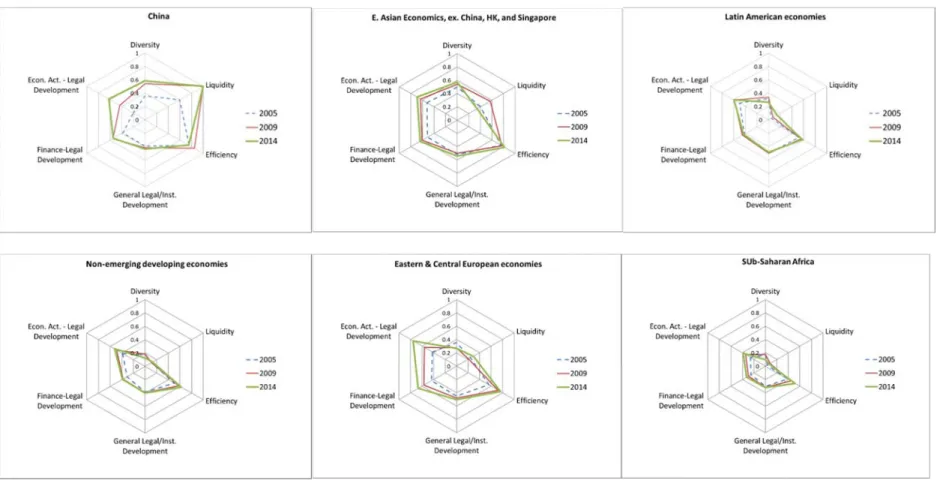
Figure 5 disaggregates Fin_quality2 into six subcomponents, namely, financial market diversity (diversity), liquidity (liquidity), and efficiency (efficiency), as well as general legal and institutional development (gen_legal), legal and institutional development for economic activities (econ_legal), and legal development for financial activities (fin_legal) for 2005, 2009, and 2014. 14 In this construction, all the subcomponents are normalized in a range between zero and one. The value zero is shown as the center of the hexagon.
We can make several observations. First, what makes advanced economies stand out is that their level of legal and institutional development—whether it is general legal and institutional development or one pertaining to economic or financial activities—is consistently high. The hexagonal charts for Germany, Japan, Singapore, and the United States clearly show this tendency.
Conversely, the level of legal and institutional development is lower for other economies.
Emerging economies in East Asia, including China, and in Eastern and Central Europe have higher levels of legal and institutional development, while countries in Latin America and Sub-Saharan Africa have low levels of legal and institutional development.
Second, legal and institutional development appears to evolve only gradually. Looking at the hexagonal charts, the levels of legal and institutional development do not change much from 2005 to 2009, and to 2014. This is consistent with what we have observed for the quality measure of financial development in Figure 3. That is, the gradual evolution of the quality measure of financial development may partly be explained by the slow evolution of legal and institutional development.
Third, for emerging and developing economies, the levels of financial market diversity, liquidity, and efficiency tend to be low. This reflects the fact that these economies tend to have more bank- dominant financial systems and that their financial markets tend to face tight regulatory controls, leading to less efficiency in the markets. Such economies would have less active capital markets and lower turnover ratios as seen in our measure of market liquidity.
Fourth, Japan and the United States stand out as economies with relatively well-balanced achievements in all subcomponents for the quality of financial development. Germany and Singapore also score well in most of the subcomponents except for liquidity levels, which fell significantly in the post-GFC period.
Last, the evolution among the different subcomponents of the quality of financial development in China is interesting. In the period from 2005 to 2014, the level of legal and institutional development was unchanged, while the levels of legal development related to general economic activities or financial activities were rising quite rapidly. The latter improvements reflect the
14
Two other subcomponents, hc and info_tel, are omitted from Figure 5 since these indexes usually show a general
tendency of steady increase over time.
government’s efforts to create an environment friendly toward economic and financial activities.
The levels of financial market diversity and liquidity rose rapidly as well. The level of liquidity is the highest in scale among all the economies, reflecting the active capital market development in China, but the level of diversity remains low in comparison to advanced economies. For the quality of financial development in China to become like that of advanced economies, there is still much room for further improvement, especially in legal and institutional development and financial market diversity.
4. Implications of Financial Development for Macroeconomic Performance
Now that we have constructed both the quantity and quality measures of financial development, we revisit the fundamental question regarding the impact of financial development on key macroeconomic variables. In other words, how does financial development, whether in terms of quality or quantity, affect macroeconomic conditions such as output growth, output volatility, and inflation? What is the impact of financial development on financial market openness and what is the relationship between financial openness and macroeconomic performance?
4.1 Financial development and macroeconomic performance
Financial development may lead to output growth paving the way for greater financial resource mobilization and/or more efficient resource allocation, by mitigating information asymmetry, smoothing exchanges of goods and services through reduced transaction costs, and enhancing and/or supplementing domestic savings. Better functioning financial markets may also allow economic agents to benefit more from the pursuit of sophisticated financial transactions, risk- sharing and portfolio diversification. These growth-enhancing effects will likely lead to output growth through more efficient financial intermediation, smoother capital accumulation and higher total factor productivity growth.
Financial development may also lead to macroeconomic stability. With the efficient allocation of financial resources and the mitigation of information asymmetry, the volatility of output growth tends to decline and inflation tends to become low and stable.
With both quantity and quality measures of financial development, we may be able to add more nuance to the discussions on the nexus between financial development and economic growth and stability.
Financial development and output growth, growth volatility and inflation
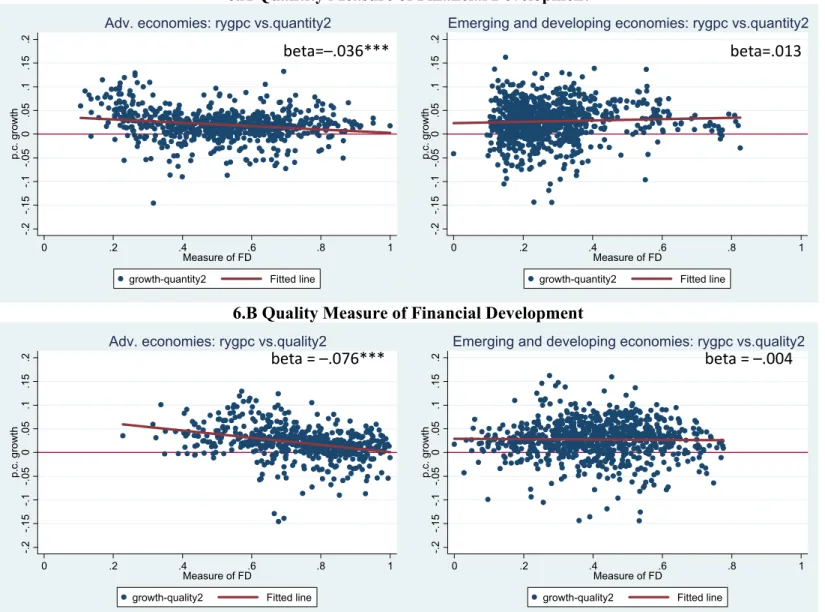
Figure 6 illustrates the impact of financial development on output growth. The upper panels plot the relationship between the quantity measure of financial development and output growth, i.e., the growth rate of real per capita GDP. 15 The left-hand panel is for the subgroup of advanced economies while the right-hand one is for the subgroup of emerging and developing economies.
The lower panels plot the relationship between the quality measure of financial development and
15
To prevent outliers from dominating the results, we removed the outlying observations for output growth rates
which are above the 99th percentile or below the 1st percentile.
output growth. For the quantity measure of financial development, we use “Fin_quantity2,”
whereas for the quality measure we use “Fin_quality2.”
The left-hand panels of Figure 6 show that, for advanced economies, higher levels of financial development tend to be statistically significantly associated with lower levels of per capita output GDP growth, whether financial development is measured by either quantity or quality. In contrast, the right-hand panels show that, for emerging and developing economies, there is no statistically significant association between financial development and per capita GDP growth. The results for advanced economies are somewhat puzzling, but can be explained in three ways. First, the results are consistent with the finding of Arcand, et al. (2015) that economies with highly developed financial markets, in terms of quantity, tend to experience lower growth. Second, the quality measure of financial development, i.e., Fin_quality2, may reflect income levels, that is, the international convergence theory predicts that GDP growth tends to be lower for economies with higher levels of income and thus higher levels of Fin_quality2. Third, the results may be due to missing variables, which we will look into later.
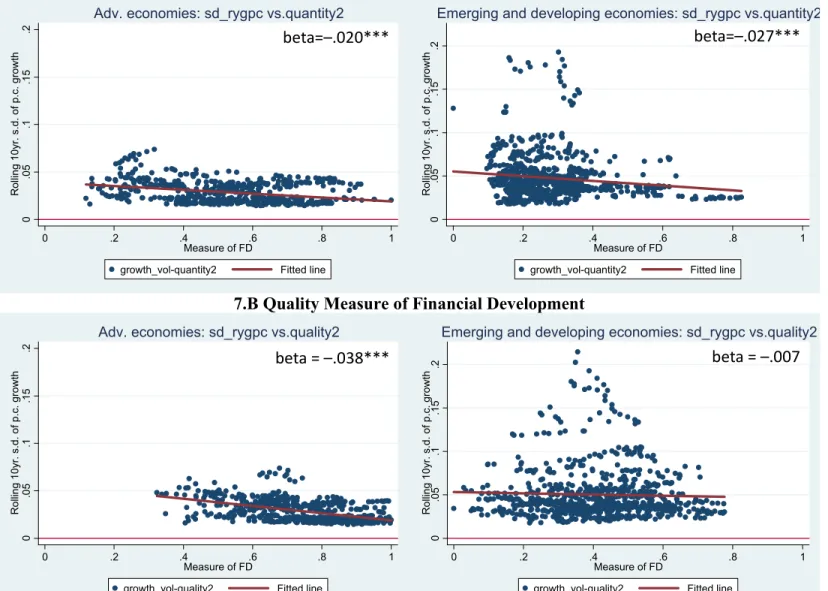
Figure 7 suggests the impact of financial development on the volatility of output growth. Output growth volatility is measured by ten-year rolling standard deviations of per capita GDP growth rates. 16 Interestingly, financial development in terms of quantity is significantly and negatively correlated with output volatility for both advanced and emerging/developing economies. Thus, financial depth has an output-stabilizing effect. However, financial development measured by quality appears to be statistically-significantly and negatively associated with output growth volatility for advanced economies only.
Figure 8 illustrates the impact of financial development on inflation. The panels show that economies with more developed financial markets, whether measured by quantity or quality, tend to have lower inflation rates. 17 Interestingly, the estimated correlation coefficients between financial development and inflation are larger for emerging and developing economies than for advanced economies. Also, the estimates are larger when financial development is measured by quantity.
Quantity–quality interactions and macroeconomic performance
Thus far, we have obtained some evidence that greater financial development, measured by both quantity and quality, tends to be associated with lower GDP growth volatility and lower inflation.
However, we have also obtained the puzzling result that greater financial development tends to be associated with lower GDP growth, particularly for advanced economies (while the association is not statistically significant for emerging and developing economies). Earlier, we have seen that the quantity and quality measures of financial development are correlated with one another, although the degree of correlation varies among countries, regions, and income levels. One natural question that arises is whether or not the quantity and quality measures of financial development have any interactive associations with macroeconomic conditions. For example, economies with higher
16
The outliers above the 99
thpercentile or below the 1
stpercentile were removed.
17
The inflation rate is measured by the annual growth rate of GDP deflators. Outliers, above the 95th percentile or
below the 5th percentile, were removed from the sample.
quantity measures of financial development may face better macroeconomic conditions if they also have higher quality measures of financial development.
In Figure 9, we examine whether or not such an interaction between the quantity and quality measures of financial development (FD) exists. We first divide the sample into two subsamples of
“high FD quality” and “low FD quality,” depending on whether the quality measure of financial development is above or below the full-sample medium. Then, we examine the correlation between the quantity measure of financial development and such variables as GDP growth, GDP growth volatility, and the inflation rate for emerging and developing economies only.
Interestingly, the upper panels of Figure 9 show that the quantity measure of financial development is positively correlated with the per capita GDP growth rate for both high- and low-FD-quality countries, but that the positive correlation is statistically significant only for the subsample of high- FD-quality economies. This suggests that economies with more developed financial markets in terms of quantity (or financial depth) tend to have higher rates of economic growth, but only when their financial markets are developed in terms of quality.
Similarly, the middle and lower panels show that economies with more developed financial markets in terms of quantity tend to have lower GDP growth volatility and inflation rates only when their financial markets are also developed in terms of quality.
When the GDP growth rate is regressed against either the quantity or quality measure of financial development alone, we only identify a negative effect on output growth, which is puzzling.
However, when the GDP growth rate is regressed against the quantity measure of financial development for the subsample of economies with high FD-quality, we identify a positive effect on GDP growth. Similarly when GDP growth volatility and the inflation are regressed against the quantity measure of financial development for the same subsample economies, we observe negative effects on GDP growth volatility and inflation. These results are consistent with Beck, et al. (2014) who find that financial intermediation activities increase growth and reduce volatility in the long run.
4.2 Financial development, financial openness and macroeconomic performance
Thus far we have focused on the effect of financial development on macroeconomic performance.
While most economies have seen financial market development as a trend over recent decades, they have also opened their financial markets to the rest of the world. In short, the world has been experiencing greater financial globalization.
In fact, financial globalization is one of the most contentious and hotly-debated issues in recent
years. The reason for this is that, like financial development, pursing financial openness is a
double-edged sword. That is, while it can foster and stabilize output growth through supplementing
and smoothing consumption and capital accumulation, financial globalization can also be
destabilizing by exposing economies to volatile cross-border capital flows that can involve sudden
stops or reversals of capital flows. Since Quinn (1997) found a positive link between financial
liberalization and output growth, the effect of financial openness on growth has been actively debated in the literature. 18
We examine the relationship between financial openness and macroeconomic performance as we did with financial development in the previous subsection. However, before examining this, we first consider whether and how financial development is correlated with financial openness. In our context, we are not just interested in the correlation between the two, but also interested in investigating whether and how the correlation varies depending on whether we look at the quantity or quality aspect of financial development.
We define the degree of financial openness as the sum of the total external assets and external liabilities divided by GDP. The data on total external assets and liabilities are obtained from the dataset on international investment positions developed by Lane and Milesi-Ferretti (2001, 2007, and 2017). However, the ratio of the sum of total external assets and liabilities to GDP can be very high, especially for economies with global financial centers (e.g., Hong Kong, Ireland, and Singapore). Therefore, we winsorize this ratio at the 10th and 90th percentiles (with both percentiles being calculated from a sample excluding all the financial-center economies), and normalize the ratio using the formula shown in Equation (1). 19
Financial development and financial openness
Figure 10 illustrates the correlation between financial development and financial openness for advanced economies (left-hand panels) and emerging and developing economies (right-hand panels). In the upper panels, we measure financial development in terms of quantity, whereas in the lower panels we measure financial development in terms of quality. As in the previous section, for the measure of financial development we use Fin_quantity2 and Fin_quality2. The measure of financial openness is denoted as Fin_openness.
In Figure 10 we observe that financial development is positively correlated with financial openness for both advanced and emerging and developing economies, whether we use either the quantity or quality measure of financial development. Interestingly, the estimated coefficient is greater when financial development is measured by quality rather than by quantity. 20 This observation suggests that while more developed financial markets in terms of both quantity and quality can lead to further financial openness, the quality measure of financial markets is more important.
Financial openness and macroeconomic performance
We now examine whether and how financial openness is correlated with macroeconomic performance, such as output growth, growth volatility and inflation rates. As in the previous analysis, we are interested in the interactive effect, albeit this time between financial openness and
18
For a review of the empirical literature pertaining to the effects of financial liberalization, refer to Edison et al.
(2004), Prasad et al. (2003), Henry (2006), Kose et al. (2006), and Prasad and Rajan (2008).
19
The definition of financial centers follows that of Lane and Milesi-Ferretti (2017). They are: the Bahamas, Bahrain, Belgium, Cyprus, Hong Kong, Ireland, Luxembourg, the Netherlands, Panama, San Marino, Singapore, Switzerland, and the United Kingdom.
20
Both the estimated coefficients and the fitted lines in the figure are based on the respective samples that exclude
the observations of financial-center countries.
the quality of financial development. Several authors find that the effect of financial openness on macroeconomic performance depends on whether other third factors meet thresholds. For example, Kose et al. (2011) find the effect of financial openness on output growth to be positive only when a financial or institutional variable meets a certain threshold. 21
Here, we investigate whether and how financial openness is correlated with output growth, output growth volatility, and inflation, conditional upon whether the level of quality in financial development is high or low. Our prior expectation is that if an economy has a financial market with higher quality, its financial openness results in better macroeconomic performance, i.e., higher output growth, lower output growth volatility, and lower inflation.
Figure 11 plots the measure of each macroeconomic variable against the degree of financial openness for emerging and developing economies with low and high FD-quality. The upper panels of Figure 11 show that for emerging and developing economies with low FD-quality, financial openness and GDP growth are significantly negatively correlated with one another. 22 The negative correlation, however, is not statistically significant for economies with high FD-quality. The middle panels of the figure show that financial openness is positively and statistically-significantly correlated with GDP growth volatility for emerging and developing economies with low FD- quality, while this correlation is negative, though not statistically significant, for economies with high FD-quality. Finally, the lower panels of Figure 11 show that financial openness is significantly negatively-correlated with inflation whether the economy's financial market has high or low FD-quality. However, the magnitude of the absolute value of the estimated correlation coefficient is larger for the subsample of economies with high FD-quality.
These findings suggest that financial openness may introduce disturbance to emerging and developing economies by exposing them to volatile cross-border capital flows when the quality of financial development is low, although it tends to have dampening effects on inflation. For emerging and developing economies with low-FD quality, both the negative correlation between financial openness and output growth and the positive correlation between financial openness and growth volatility are statistically significant, while for economies with high-FD quality they become statistically insignificant. The correlation between financial openness and inflation is generally negative and the negative correlation is greater in absolute value for economies with high-FD quality than for those with low-FD quality. Thus financial openness tends to encounter low and unstable economic growth if emerging and developing economies have not achieved a high degree of quality in financial development.
5. Concluding Remarks
Researchers usually resort to a quantity measure of financial development such as private credit creation by banks as a share of GDP to assess the extent of financial market development. While the data availability of such a measure is high, it often fails to capture the nuances and subtleties of the development of financial markets. Such a bank-based measure also fails to capture the development of other types of financial markets such as equity, bond, and insurance markets. At
21
Refer to Kose, et al. (2011) for a comprehensive review of the literature on “threshold analyses.”
22