(日英対訳 Japanese-English Translation)
有害物質インベントリー(IHM)の第1部の維持管理手順書の例
AN EXAMPLE OF MANAGEMENT PROCEDURE
TO MAINTAIN PART I OF THE INVENTORY OF HAZARD MATERIALS (IHM)
Hong Kong International Convention for the Safe and Environmentally Sound Recycling of Ships, 2009 に関連する IMO 決議 MEPC.269(68) “2015 Guidelines for the Development of the Inventory of Hazardous Materials”の Paragraph 5.2.2 の規定が IHM の第1部の 維持管理に必要なシステムを構築するように求めている。 従って、陸上にその管理責任者を置く ことを想定した場合のシステムの手順書の例をここに示す。但し、これは一つの例であるので、上 記の条約及び決議に適合する限りこの例に拠らないこともできる。
Paragraph 5.2.2 of IMO Resolution MEPC.269(68) “2015 GUIDELINES FOR THE DEVELOPMENT OF THE INVENTORY OF HAZARDOUS MATERIALS” following “HONG KONG INTERNATIONAL CONVENTION FOR THE SAFE AND ENVIRONMEN -TALLY SOUND RECYCLING OF SHIPS, 2009” requires that a system be established to maintain the part I of IHM. Following this requirement, here is shown an example of procedure of such system, assuming to designate on shore a person responsible for it. This, however, is not more than an example and another style of system procedure may be established as far as it meets the Convention and the Resolution as mentioned above.
< 例 > < EXAMPLE >
有害物質インベントリ(IHM)の第1部の維持管理手順書
MANAGEMENT PROCEDURE
TO MAINTAIN PART I OF THE INVENTORY OF HAZARD MATERIALS (IHM)
(管理責任者を陸上に置く場合)
(Assuming a designated person to maintain the part I of IHM is on shore)
(改訂 0.0)
(Revision 0.0)手順書の改正記録
Revision History of procedure 改正番号 Rev. No. 改正年月日 Date of Revision 項目番号 Section No. 改正の概要 Outline of Revision
定義/略号
Definition/ Abbreviation
HM : 有害物質/ Hazardous Material
IHM : 有害物質インベントリで、その第1,2,3部を含む
Inventory of HM, including the part I, II, III of it. 条約
the Convention
: Hong Kong International Convention for the Safe and Environmentally Sound Recycling of Ships, 2009 ガイドライン
the Guidelines
: IMO Resolution MEPC.269(68), 2015 Guidelines for the Development of the Inventory of Hazardous Materials
インベントリ the Inventory
: 特に断らない限り、IHM の第 1 部を示す。
Referred to the part I of IHM, unless otherwise specified. 管理責任者
DP
: ガイドラインの Par. 5.2.2 に規定するインベントリの維持管理の責 任者
A designated person as responsible for maintaining and updating the Inventory to meet Par. 5.2.2 of the Guidelines
MD/SDoC : 材料宣誓書/供給者適合宣言書
Material declaration/ Supplier’s Declaration of Conformity 表 A/B
Table A/B
: ガイドラインの付録1の表 A 及び表 B
Tables A and B of Appendix 1 of the Guidelines イ ン ベ ン ト リ の
対象品目 objects for the Inventory
: 表 A/B に示す有害物質の含有に関する情報を MD/SDoC を使って
収集する必要のある品目で、IHM の第1部の対象となるもの。
Items requiring to collect information of containing of HM shown in the table A/B by using MD/SDoC, and which are the objects for the part I of IHM.
1 目的/ Purpose
この“IHM の第1部の維持管理手順書”は、条約及びガイドライン 1 に従って作成され
た IHM の第 1 部を船舶の運航期間に亘って適正に維持して、条約の Regulation 5.3
及び ガイドラインの Par. 5.2.2 を満たすことを目的として定められた。
This “management procedure to maintain the part I of IHM” is established for the purpose of meeting Regulation 5.3 of the Convention and Par. 5.2.2 of the Guidelines by means of properly maintaining, during the ship’s operational stage, the part I of IHM developed according to the Convention and the Guidelines2. 2 インベントリ維持管理の方針/ Policy of Management to Maintain the Inventory 2.1 インベン ト リの管 理 責 任 者 の 指 名 / Designation of a Person Responsible for
Maintaining the Inventory
船舶所有者は、【添付 1】に示す者を本船のインベントリの維持の管理責任者として指
名して、陸上においてその任に当たらせる。(G/Par. 5.2.1)3
Ship owner designates a person shown in [Supplement 1] as responsible for maintaining and updating the Inventory for the ship, and entrust the duty to him on shore. (G/Par. 5.2.1)4
2.2 インベントリ維持管理システムの構築/ Establishment of Management System to Maintain the Inventory
管理責任者は、船上にあるインベントリの必要な更新を確実に実施してこれを管理す
るために、項目 3 に示すシステムを構築/監督する。(G/Par. 5.2.2)
The DP establishes and supervises a system shown in the section 3 in order to ensure that the Inventory on board is properly updated and maintained. (G/Par. 5.2.2)
3 インベントリ維持管理システム/ Management System to maintain the Inventory 3.1 有害物質の情報の請求/ Request of Hazardous Material Information
船舶の構造材料及び機器、設備などで本船に搭載する物を発注する者は、項目 4.1 に
示すインベントリの対象品目を発注品の中から選別して、それらに含まれる有害物質
の情報を記した MD/SDoC を修繕ドック及び対象品目の供給者などに請求する。
(G/Par. 4.2.2)
A person who places an order of structure material, machinery and/or equipment 1 インベントリの維持管理に関連する条約及びガイドラインの主な規定を【添付 3】に示す。
2 The regulations/paragraphs relevant to the maintenance of IHM are shown in [Supplement 3]. 3 条約やガイドラインの該当規定を示し、条約を C と、ガイドラインを G と略す。
4 This shows the relevant regulation/paragraph of the Convention or Guidelines, abbreviating “Convention” to “C”
to be installed on board the ship should identify the objects for the Inventory out of the orders following the section 4.1, and request a repair yard or suppliers, etc. of those objects for MD/SDoC showing information of HM which are contained in the objects. (G/Par. 4.2.2)
3.2 収集した有害物質の情報の確認/ Review of Collected Information of HM
船舶への納入品を受ける者は、納入された物について、項目 4 に沿って有害物質の情
報の適正な収集を確保する。
A person who receives the deliveries to be on board the ship should ensure that the information of HM is properly collected following the section 4 for the delivered objects.
3.3 インベントリの改訂版の作成/ Development of Revision of the Inventory
管理責任者またはその指名した者は、調査した品目に有害物質が含まれる場合には、
項目 3.1 及び 3.2 に沿って収集した情報に基づいて、項目 5 に沿ってインベントリの
改訂版の作成を行う。
The DP or a person assigned by the DP should develop a revision of the Inventory following the section 5 based on the information collected following the sections 3.1 and 3.2, where an object reviewed contains HM.
3.4 改正版の確認とインベントリ更新の指示/ Review of Revision and Instruction of Updating Inventory 管理責任者は、作成されたインベントリの改訂版が適正に作成さ
れていることを確認 して、項目 5.8 に示す署名などをこれに記載し、船長にこの改訂
版による船上のイン ベントリの差換えを指示する。
The DP should confirm that the revision of the Inventory is properly developed, should write his signature and others on it following the section 5.8, and should instruct the shipmaster to update the IHM on board with this revision.
3.5 船上のインベントリの更新/ Update of the Inventory on Board
船長は、インベントリが IHM 証書に不可欠な要素であることに鑑みて、項目 6 に沿
って船上のインベントリの更新を確実に実施する。(C/App. 3/Note)
The shipmaster should ensure the update of the Inventory on board following the section 6, recognizing that the Inventory is an essential part of the certificate on IHM. (C/App. 3/Note)
3.6 インベントリの適合性の確保/ Ascertaining the Conformity of the Inventory
管理責任者は、インベントリの適合性を継続させるために項目 7 に示す作業を行う。
The DP should follow the section 7 in order to maintain conformity of the Inventory.
4 有害物質の情報の収集/ Collection of Information of HM
4.1 材料宣誓書と供給者適合宣言を収集する品目/ Items Requiring to Collect MD/SDoC 4.1.1 表 A/B に示す有害物質の含有に関する情報を収集する必要のある品目は、固定(即
ち、溶接、ボルト、リベットあるいはセメントなどで船舶に堅牢に取付けられてその 位置 で使用)される構造材料及び機器、設備(電線、ガスケットを含む)、塗装など となる。 (G/Par. 2.2, 3.1, 3.2.2, 4.2.2, 4.3.2)
The items requiring to collect information of containing of HM shown in the table A/B are structure material, machinery and equipment which are fixed (i.e., securely fitted with the ship, such as by welding or with bolts, riveted or cemented, and used at their position, including electric cables, gaskets), and applied coating.(G/Par. 2.2, 3.1, 3.2.2, 4.2.2, 4,3,2)
4.1.2 項目 4.1.1 の適用にあたり、以下に留意する。
For the application of the section 4.1.1, reference should be made to the followings.
① 持ち運び式消火器、遭難信号灯、救命浮環など、船舶に固定されていない設備は IHM の第 1 部に記載する必要はない。(G/Par. 2.4, 3.2.3)
The items which are not fixed, such as portable fire extinguishers, distress flares, lifebuoys, etc., are not required to be listed in the part I of IHM. (G/Par. 2.4, 3.2.3) ② 酸化鉛またはその他の有害物質を含む蓄電池で船舶に堅牢に取付けられている
物は IHM の第 1 部に記載するが、そうでない物(乾電池、予備の蓄電池を含む)は
記載する必要はない。(G/Par. 3.2.4)
The batteries containing lead acid or other hazardous materials that are fixed in place should be listed in the part I of IHM, but those not fixed, such as consumer batteries and batteries in store are not required to be listed in the part I. (G/Par. 3.2.4)
③ ガイドラインの付録 1 の Table C に示す、シップリサイクル施設で環境や健康
に対して潜在的に有害となる品目は、リサイクル時に IHM の第 2 部または第 3 部に
記載するので、運航中に第 1 部に記載する必要はない。(G/Par. 3.2.1.3, 3.2.2, App. 1/Table C)
The items, potentially hazardous to the environment and human health at ship recycle facilities, which are shown in Table C of Appendix of the Guidelines, are not required to be listed in the part I of IHM during ship operation, while they are going to be listed in the part II or III when recycling. (G/Par. 3.2.1.3, 3.2.2, App. 1/Table C)
④ ガイドラインの付録 1 の Table D に示す、船舶に固定されないで船舶解体施設
ル時に IHM の第 3 部に記載するので、運航中に第 1 部に記載する必要はない。(G/Par. 3.2.1.4, 3.2.2, App. 1/Table D)
Regular consumable goods, potentially containing hazardous materials, which are not integral to a ship and are unlikely to be dismantled or treated at a ship recycling facility, and which are shown in Table D of Appendix of the Guidelines, are not required to be listed in the part I of IHM, while they are going to be listed in the part III when recycling. (G/Par. 3.2.1.4, 3.2.2, App. 1/Table D)
⑤ 船体、船楼、パイプ、機器や装置のハウジングのような一般構造に用いられる固
体金属や合金(鋼、アルミ、黄銅、青銅、メッキ、はんだなど)に含まれる表 B の 物質
はインベントリに記載する必要はない。(G/Par. 3.3.1)
Materials listed in Table B that are inherent in solid metals or metal alloys, such as steels, aluminium, brasses, bronzes, plating and solders, provided they are used in general construction, such as hull, superstructure, pipes or housings for equipment and machinery, are not required to be listed in the Inventory. (G/Par. 3.3.1)
⑥ 電気/電子機器はインベントリに記載するが、それに内在するプリント回路基盤
に含まれる有害物質の量は、報告されなくてよい。(G/Par. 3.3.2)
Although electrical and electronic equipment is required to be listed in the Inventory, the amount of hazardous materials potentially contained in printed wiring boards (printed circuit boards) installed in the equipment does not need to be reported in the Inventory. (G/Par. 3.3.2)
⑦ ガイドラインは、インベントリの対象品目の予備品を第 1 部に記載することを
要求しないが、それが使用されて船舶に堅牢に取付けられる場合を予期して、予め納
入時に MD を集めておく。さらに、船長が項目 6.4 に従って適正な対応を行うため
に、有害物質を含む予備品を船舶に納入する際には、その情報を船長に通知するか MD のコピーをそれに添付する。(G/Par. 4.1.2, 4.1.3)
Even though the Guidelines does not require the spare parts of the objects for the Inventory to be listed in the part I, they should obtain MD/SDoC in advance, expecting that they are going to be fixed when it is in use. Further, when delivering a spare part containing HM on board, the information should be given to the shipmaster, or a copy of MD should be attached to the spare part, in order for the shipmaster to take a proper action following the section 6.4.(G/Par. 4.1.2, 4.1.3)
4.2 収集された MD/SDoC は、ガイドラインの Par.6 及び Par.7 に示されている情報を含
んでいなければならない。また、その標準フォームが同ガイドラインの Appendix6 及
Collected MD/SDoC should contain information required by the Par. 6 and 7 of the Guidelines. Examples of them are referred to in Appendix 6 and 7 of the Guidelines.
4.3 有害物質の所在場所と量をインベントリに記載する必要があるので、一つの製品が据 え付け場所の異なる複数の構成部品からなる場合には、有害物質を含む構成部品の所
在場所に応じて MD を分割するように供給者に依頼する。(C/Reg.5.1.1)
Location on board and approximate quantity of HM needs to be shown in the Inventory, and, therefore, in case where a product consists of plural components located in different places, its MD should be divided correspondingly to the locations of components containing HM.(C/Reg.5.1.1)
4.4 表 A の閾値を超えた有害物質が含まれる納入品は、船舶に搭載してはならない。(C/Reg. 4.1) 5
但し、次の免責事項に従う場合には、その物品を納入でき、インベントリに記載する。 A
delivery which contains HM excessing the threshold value shown in table A should not be installed on board. (C/Reg. 4.1) 6
Where it is subject to the followings, it may be on board and should be listed in the Inventory.
① 条約発効後 5 年以内は Asbestos の閾値を 0.1%に代えて 1.0%を適用できる。その
場合、その閾値をインベントリとできれば MD に記載する。これについて 0.1%を遡 及
適用されることはない。(G /App. 1/Table A)
Threshold value 1.0% for Asbestos may be applied instead of 0.1% not later than 5 years after the entry into force of the Convention, and, in that case, should be recorded in the Inventory and, if available, the MD. 0.1% need not be retroactively applied. (G /App. 1/Table A)
② Hydrochlorofluorocarbons(HCFCs)を含むもので 2020 年 1 月 1 日より前に搭載 されるものは許される。(G /App. 3/Par. 3.2.1)
A delivery which contains Hydrochlorofluorocarbons(HCFCs) and be installed on board before 1st January 2020 may be permitted. (G /App. 3/Par. 3.2.1)
4.5 表 A/B の有害物質の閾値が改正された場合、その改正が採択された後に作成されるイ ンベントリの改訂版にはその改正された閾値を使用するが、遡及適用はされない。
5 アスベストが船上に存在して初版のインベントリに記載されている場合があるが、その取り扱いについては
MSC/Circ.1045 “GUIDELINES FOR MAINTENANCE AND MONITORING OF ON-BOARD MATERIALS CONTAINING ASBESTOS”を参照すること。また、2002 年 7 月 1 日または 2011 年 1 月 1 日以後の搭載が禁止され ているアスベストを含む物品が誤って船舶に 取付けられた場合には、 MSC.1/Circ.1374 “INFORMATION ON PROHIBITION OF THE USE OF ASBESTOS ON BOARD SHIPS”に従ってアスベストを取り除くこと。
6 Where Asbestos is present on board and is listed in the initial version of the Inventory, it is recommended to
follow MSC/Circ.1045 “GUIDELINES FOR MAINTENANCE AND MONITORING OF ON-BOARD MATERIALS CONTAINING ASBESTOS” for the treatment of it. Where, further, Asbestos which is prohibited to install on board after 2002/7/1 or 2011/1/1 is by mistake installed on board, it should be removed out of ship following MSC.1/Circ.1374 “INFORMATION ON PROHIBITION OF THE USE OF ASBESTOS ON BOARD SHIPS”.
(G/Par. 3.5)
Revised threshold values of Tables A/B should be used for a revision of the Inventory to be developed after the adoption of revised values, but need not be retroactively applied. (G/Par. 3.5)
5 インベントリ改訂版の作成7,8/ Development of Revision of the Inventory9,10
5.1 項目4に従って調査されたインベントリの対象品目のうちに、表 A/B の有害物質を含 む ものが有る場合にはインベントリの改訂版を作成する。特に、機器または設備など の
新設、改造、修理、交換、撤去、変更(配置など)及び塗装の更新が行われる場合や 船
籍/船主/管理者の変更が行われる場合には、インベントリの適正な更新が行われるよ うに
注意する。(C/Reg. 5.3, 10.1.3, G/Par. 4.3)
If, among the objects for the Inventory reviewed following the section 4, there is an object containing HM of Tables A/B, a revision of the Inventory should be developed. Especially where new installation, modification, repair, exchange, removal, or alteration of location etc. of structure, machinery and/or equipment, renewal of coating, change of flag, owner or operator is undertaken, attention should be paid so that a proper revision of the Inventory may be made. (C/Reg. 5.3, 10.1.3, G/Par. 4.3)
5.2 機器、設備、塗装などが同一の物で交換/更新される場合には、それらのインベントリ の改訂を行う必要はない。(G/Par. 4.3.2)
Where machinery, equipment, coating, etc. is exchanged/ renewed with an identical part or coating, update of their inventory is not required. (G/Par. 4.3.2) 5.3 撤去品については、別途撤去品のリストを作成してから該当欄を削除するか、インベ
ントリ中の該当欄に抹消線を引くかして、撤去された物を示す。(G/Par. 5.2.3, App. 2)
The item removed out of board should be clearly specified in such manner that a cross line is put on the removed item, or that the item is deleted out of the Inventory providing a separate list of removed items.(G/Par. 5.2.3, App. 2)
5.4 インベントリの改訂版の作成は、初版の作成方法(G/Par. 4.1 または 4.2)の如何にか
かわらず、表 A/B の有害物質の情報を示した MD に基づいて、ガイドラインの付録 2
7 下記の“PrimeShip-GREEN/SRM”の URL を利用して IHM を作成することができる。 https://www.psgreensrm.com/PrimeShip-GREENSRM/InitAction.do?lang=ja このアプリ ケーションの使用方法については,下記 URL の“【船主各位向】インベントリ並びに PrimeShip-GREEN/SRM の紹介”を参照のこと。
http://www.classnk.or.jp/hp/pdf/activities/statutory/shiprecycle/for_owners_ps-greensrm.pdf
8 修繕ドックなどで各種工事を行うときには、【付録2】を参照して HM 情報の入手、記録を行うことが推奨される。
9 IHM can be developed utilizing the application in URL referring to “PrimeShip-GREEN/SRM”. https://www.psgreensrm.com/PrimeShip-GREENSRM/InitAction.do?lang=en
10 It is recommended to obtain HM information and make a record referring to [Supplement 2] when doing kinds of
及び 3 の例を参照して行う。(G/Par. 3.4, 4.1.2~4.1.4, 4.2.2)
A revision of the Inventory should be developed following examples in Appendix 2 and 3 of the Guidelines based on the MD showing the information of HM of Tables A/B regardless of development method (G/Par. 4.1 or 4.2) of the initial version of the Inventory. (G/Par. 3.4, 4.1.2~4.1.4, 4.2.2)
5.5 有害物質の所在場所を示すために、本船の一般配置図などに示された名称を使用し、 IHM 初版作成時のロケーションリストが既にある場合にはこれを利用する。(G/Par. 4.6)
In order to show location of HM, names of location which are indicated in General Arrangement, etc. should be used, and in case there is a list of location when initially developed the IHM, this location list should be utilized. (G/Par. 4.6)
5.6 有害物質の量を表す標準単位は、kg を標準とするが、㎥、㎡などの他の単位が適当と 判断される場合(たとえば、液体や気体には㎥、床や壁の材料には㎡)を除く。有効数 字は少なくとも二桁とする。(G/Par. 4.7)
Standard unit to show the approximate quantity of hazardous materials should be kg, unless other units (e.g. m3 for materials of liquid or gases, m2 for materials used in floors or walls) are considered more appropriate. An approximate quantity should be rounded up to at least two significant figures. (G/Par. 4.7)
5.7 同一の物を多数搭載する場合には、一括して広範囲の場所で所在を表記することがで
きるが、その所在場所は、特定できるようにできるだけ小さな場所にする。(G/Par.
3.2.5/App. 3)
Same items to be installed may be listed together in the Inventory with general location, but, their location should be as small as they can be identified. (G/Par. 3.2.5/App. 3)
5.8 インベントリの改訂版には、改定日、変更/抹消の概要、管理責任者の署名を記載する。 (G/Par. 5.2.3)
Revision of the Inventory should include date of revision, summary of change/ deletion of items, and signature of DP. (G/Par. 5.2.3)
5.9 船上のインベントリの複製を陸上に保管する。 A copy of the Inventory should be kept on shore.
6 船上のインベントリの更新/ Update of the Inventory on Board
6.1 船長は、船舶に納入される物品のすべてについて項目 4.1 に従って調査されて、イン ベントリの改訂版が適正に作成されていることを管理責任者に確認する。
Shipmaster should confirm with DP that, for all the items to be delivered on board, revision of the Inventory is properly developed based on the investigation following
the section 4.1.
6.2 船長は、船上にあるインベントリが条約証書の不可欠な付録であることを認識して、 そ の改訂版を管理責任者から入手した場合、その差換えを速やかに行ってインベント リ
を常に最新の状態に維持する。(C/Reg. 5.3)
Shipmaster should recognize that the Inventory on board is an essential supplement of the Conventional Certificate on IHM, and should replace the Inventory with its revision immediately after receiving the revision from DP, and maintain IHM up-to-date at all times. (C/Reg. 5.3)
6.3 船長は、更新検査を受けて、条約証書の付録を更新し、管理責任者に報告する。(C/Reg. 10.1.2, G/Par. 4.3.2, Par. 5.2.4)
Shipmaster should undergo a renewal survey and update the supplement of the Certificate, and should report it to DP. (C/Reg. 10.1.2, G/Par. 4.3.2, Par. 5.2.4) 6.4 項目 4.1.2.⑦に従って与えられた情報または収集された MD に基づいて、有害物質を
含む予備品を船舶に取付けた場合には、インベントリの改訂を管理責任者に要請し、 必要な対応を行う。
Where, based on the information given or MD collected following the section 4.1.2 ⑦, a spare part containing HM is fixed on board, the shipmaster should request DP to revise the Inventory and take a necessary action.
7 インベントリの適合性の継続/ Continuity of Conformity of the Inventory
7.1 船舶の構造、設備、システム、取付け物、配置、材料の変更、交換、有意な修理を行 っ た場合には、管理責任者は必要に応じて臨時検査を受けるように船長に指示して条 約 証書の付録を更新し、条約への適合性を維持する。(C/Reg10.1.3, G/Par. 4.3.2, 5.2.4) In case where alteration, exchange or significant repair is made on the structure, equipment, system, fitting, location or material of ship, DP should instruct the shipmaster to undergo an additional survey if necessary and renew the supplement of Certificate in order to maintain the compliance with the Convention. (C/Reg10.1.3, G/Par. 4.3.2, 5.2.4)
7.2 船舶の変更がインベントリの複雑な変更につながる場合には、変更すべきインベント リとその他の資料の審査を臨時検査の前に受けることが推奨される。
In case where alteration of ship leads to complicated revision of the Inventory, it is recommended to undergo a review of the revision of the Inventory and its supplementary information prior to the additional survey.
7.3 管理責任者(または管理責任者に委任された者)は、船舶の内部監査の際に、船上の インベントリが適正に更新されて、本船の有害物質の現況と整合することを確認し、 ま た、船上のインベントリと陸上に保管した写しの内容が一致することを確認して、
監査結果を記録する。(G/Par. 5.2)
DP should confirm on the occasion of internal audit of the ship that the Inventory on board is properly updated with revisions and is consistent with the current condition of HM on board, further should confirm that the Inventory on board coincides with its copy kept on shore, and should make a record of the audit. (G/Par. 5.2)
7.4 船籍/船主の変更、売船、廃船などにより管理責任者が変更される場合には、管理責任
者は、インベントリの最新版及びそれに付随する資料(MD/SDoC など)を新たな船主/
管理責任者に移管し、また、旗国や寄港国の検査の際には検査官にこれらを提示でき るように管理する。(G/Par. 4.3.3, 5.2.4)
Where DP is going to be changed in association with a change of flag/shipowner or a sale/recycle of ship, etc., DP should transfer to a new ship owner/ DP the latest version of the Inventory and its supplementary information (MD/SDoC, etc.). And, further, he should maintain them so that they may be shown to an inspector on the occasion of survey of flag or port state. (G/Par. 4.3.3, 5.2.4)
【添付1】インベントリ管理責任者の指名
[Supplement 1] Designation of person responsible for maintaining and updating the Inventory
【添付2】修繕ドックの工事に関わるインベントリの改訂版の作成のために準備する資料13 の
例
[Supplement 2] Example of information list14 to develop a revision of the Inventory relating to the works done at repair yard
2-1 工事に関わる納入品・撤去品のリスト
2-1 List of delivery and dismantlement relating to the works
No. 工事名 発注業者名 発注/撤去品名 個数 発注品の製造社名 1 BWMS 設置 BWMS メーカー フィルタ装置 1 フィルターメーカー 2 殺菌装置 1 BWMS メーカー 11 船舶所有者が管理責任者を指名した文書(所有者の署名か会社印のあるもの)を添付することが推奨される。 12 It is recommended to attach a statement of shipowner with his signature/ company stamp stating that he
designated the DP.
13 “Prime Ship Green SRM”でデータを入力すれば、Purchase List や Collected MD List などが自動的に作表されま
す。
14 Purchase List and Collected MD List are automatically generated when inputting data in the application,
PrimeShip-GREEN/SRM.
下記の船舶の所有者は、そのインベントリの第1部の管理責任者を下記の通り指名する11。
The owner of the ship mentioned below designates a person shown below as DP (person responsible for maintaining and updating the part I of IHM of the ship)12。
管理責任者 DP
会社名及び所属部所名 Name of Company and department DP belongs to 氏名 Name of DP 連絡先 Contact 対象船舶 Ship concerned 船名 Name of ship IMO 番号 IMO Number 船舶所有者 Name of shipowner
3 制御パネル 2 BWMS メーカー 4 修繕ドッ ク 管装置 ガスケットメーカーなど 5 電線(絶縁体) 電線メーカー 6 電線貫通コンパウンド コンパウンドメーカー 7 配 管 ガ ス ケ ット交換 修繕ドッ ク 撤去ガスケット ガスケットメーカー 8 納入ガスケット ガスケットメーカー
No. Work name Contractor of work
Delivery/ Dismantlement
No. Supplier of delivery
1 BWMS
installation
BWMS manufacturer
Filter 1 Filter manufacturer
2 Disinfection
appliance
1 BWMS manufacturer
3 Control panel 2 BWMS manufacturer
4 Repair yard a set of Piping Gasket manufacturer
5 Electric cables E/cable manufacturer
6 Compound for cable
penetration
Compound manufacturer 7 Maintenance
of piping
Repair yard Dismantled gasket Gasket manufacturer
8 Installed gasket Gasket manufacturer
2-2 収集した MD リスト 2-2 Collected MD List
No. 供給者 製品 数量 有害物質(有/無) IHM No. MD No. 備考
【添付3】
[Supplement 3]
Ship Recycle
条約と関連決議にある IHM 維持管理関連の規定
(詳細については、条約/決議の他の関連規定も参照願います)
Requirements relevant to management to maintain IHM
in the Ship Recycle Convention and its relevant Resolution
HONG KONG INTERNATIONAL CONVENTION FOR THE SAFE AND
ENVIRONMENTALLY SOUND RECYCLING OF SHIPS, 2009
REGULATIONS FOR SAFE AND ENVIRONMENTALLY SOUND RECYCLING OF SHIPS CHAPTER 2 – REQUIREMENTS FOR SHIPS
Part A – Design, construction, operation and maintenance of ships Regulation 1 – Definitions
5 “New installation” means the installation of systems, equipment, insulation, or other material on a ship after the date on which this Convention enters into force.
Regulation 4 – Controls of ships’ Hazardous Materials
In accordance with the requirements specified in Appendix 1 to this Convention each
Party:
.1 shall prohibit and/or restrict the installation or use of Hazardous Materials
listed in Appendix 1 on ships entitled to fly its flag or operating under its
authority; and ….
Regulation 5 – Inventory of Hazardous Materials
1 Each new ship shall have on board an Inventory of Hazardous Materials. The
Inventory shall be verified either by the Administration or by any person or organization
authorized by it taking into account guidelines, including any threshold values and
exemptions contained in those guidelines, developed by the Organization. The
Inventory of Hazardous Materials shall be specific to each ship and shall at least:
.1 identify as Part I, Hazardous Materials listed in Appendices 1 and 2 to this
Convention and contained in ship’s structure or equipment, their location and
approximate quantities; and
.2 clarify that the ship complies with regulation 4.
3 Part I of the Inventory of Hazardous Materials shall be properly maintained and updated
throughout the operational life of the ship, reflecting new installations containing Hazardous Materials listed in Appendix 2 and relevant changes in ship structure and equipment, taking into account the guidelines developed by the Organization.
Part C – Surveys and certification Regulation 10 – Surveys
1 Ships to which this Convention applies shall be subject to the surveys specified below: .2 a renewal survey at intervals specified by the Administration, but not exceeding five
required by regulation 5 complies with the requirements of this Convention;
.3 an additional survey, either general or partial, according to the circumstances, may be
made at the request of the shipowner after a change, replacement, or significant repair of the structure, equipment, systems, fittings, arrangements and material. The survey shall be such as to ensure that any such change, replacement, or significant repair has been made in the way that the ship continues to comply with the requirements of this Convention, and that Part I of the Inventory is amended as necessary;
Appendix 1
CONTROLS OF HAZARDOUS MATERIALS
…new installations containing hydrochlorofluorocarbons (HCFCs) are permitted until 1 January 2020.
Appendix 3
FORM OF THE INTERNATIONAL CERTIFICATE ON INVENTORY OF
HAZARDOUS MATERIALS
Note: Part I of the Inventory of Hazardous Materials, as required by regulation 5 of the
Annex to the Convention, is an essential part of the International Certificate on
Inventory of Hazardous Materials and must always accompany the International
Certificate on Inventory of Hazardous Materials. Part I of the Inventory of Hazardous
Materials should be compiled on the basis of the standard format shown in the
guidelines developed by the Organization.
RESOLUTION MEPC.269(68) (adopted on 15 May 2015)
2015 GUIDELINES FOR THE DEVELOPMENT OF THE INVENTORY OF HAZARDOUS MATERIALS
2 DEFINITIONS
2.2 Fixed means the conditions that equipment or materials are securely fitted with
the ship, such as by welding or with bolts, riveted or cemented, and used at their position, including electrical cables and gaskets.
2.4 Loosely fitted equipment means equipment or materials present on board the
ship by the conditions other than "fixed", such as fire extinguishers, distress flares, and lifebuoys.
3 REQUIREMENTS FOR THE INVENTORY
3.1 Scope of the Inventory
The Inventory consists of:
Part I: Materials contained in ship structure or equipment; Part II: Operationally generated wastes; and
Part III: Stores.
3.2 Materials to be listed in the Inventory
3.2.1 Appendix 1 of these guidelines (Items to be listed in the Inventory of Hazardous Materials), provides information on the hazardous materials that may be found on board a ship. Materials set out in appendix 1 should be listed in the Inventory. Each item in appendix 1 of these guidelines is classified under tables A, B, C or D, according to its properties:
.1 table A comprises the materials listed in appendix 1 of the Convention; .2 table B comprises the materials listed in appendix 2 of the Convention;
.3 table C (Potentially hazardous items) comprises items which are potentially
hazardous to the environment and human health at ship recycling facilities; and
.4 table D (Regular consumable goods potentially containing hazardous
materials) comprises goods which are not integral to a ship and are unlikely to be dismantled or treated at a ship recycling facility.
3.2.2 Tables A and B correspond to part I of the Inventory. Table C corresponds to parts II and III and table D corresponds to part III.
3.2.3 For loosely fitted equipment, there is no need to list this in part I of the Inventory. Such equipment which remains on board when the ship is recycled should be listed in part III.
3.2.4 Those batteries containing lead acid or other hazardous materials that are fixed in place should be listed in part I of the Inventory. Batteries that are loosely fitted, which includes consumer batteries and batteries in stores, should be listed in part III of the Inventory.
3.2.5 Similar materials or items that contain hazardous materials that potentially exceed the threshold value can be listed together (not individually) on the IHM with their general location and approximate amount specified there (hereinafter referred to as "bulk listing"). An example of how to list those materials and items is shown in row 3 of table 1 of appendix 3.
3.3 Exemptions – Materials not required to be listed in the Inventory
3.3.1 Materials listed in Table B that are inherent in solid metals or metal alloys, such as steels, aluminium, brasses, bronzes, plating and solders, provided they are used in general construction, such as hull, superstructure, pipes or housings for equipment and machinery, are not required to be listed in the Inventory.
3.3.2 Although electrical and electronic equipment is required to be listed in the Inventory, the amount of hazardous materials potentially contained in printed wiring boards (printed circuit boards) installed in the equipment does not need to be reported in the Inventory.
3.4 Standard format of the Inventory of Hazardous Materials
The Inventory should be developed on the basis of the standard format set out in appendix 2 of these guidelines: Standard format of the Inventory of Hazardous Materials. Examples of how to complete the Inventory are provided for guidance purposes only.
3.5 Revision to threshold values
Revised threshold values in tables A and B of appendix 1 should be used for IHMs developed or updated after the adoption of the revised values and need not be applied to existing IHMs and IHMs under development. However, when materials are added to the IHM, such as during maintenance, the revised threshold values should be applied and recorded in the IHM.
4 REQUIREMENTS FOR DEVELOPMENT OF THE INVENTORY
4.1 Development of part I of the Inventory for new ships1
1 In ascertaining whether a ship is a "new ship" or an "existing ship" according to the Convention, the term "a similar stage of construction" in regulation 1.4.2 of the annex to the Convention means the stage at which:
.1 construction identifiable with a specific ship begins: and
.2 assembly of that ship has commenced comprising at least 50 tonnes or 1% of the estimated mass of all structural material, whichever is less.
4.1.2 Checking of materials listed in table A
During the development of the Inventory (part I), the presence of materials listed in table A of appendix 1 should be checked and confirmed; the quantity and location of table A materials should be listed in part I of the Inventory. If such materials are used in compliance with the Convention, they should be listed in part I of the Inventory. Any spare parts containing materials listed in table A are required to be listed in part III of the Inventory.
4.1.3 Checking of materials listed in table B
If materials listed in table B of appendix 1 are present in products above the threshold values provided in table B, the quantity and location of the products and the contents of the materials present in them should be listed in part I of the Inventory. Any spare parts containing materials listed in table B are required to be listed in part III of the Inventory.
4.1.4 Process for checking of materials
The checking of materials as provided in paragraphs 4.1.2 and 4.1.3 above should be based on the Material Declaration furnished by the suppliers in the shipbuilding supply chain (e.g. equipment suppliers, parts suppliers, material suppliers).
4.2 Development of part I of the Inventory for existing ships
4.2.2 The determination of hazardous materials present on board existing ships should, as far as practicable, be conducted as prescribed for new ships, including the procedures described in sections 6 and 7 of these guidelines. Alternatively, the procedures described in this section may be applied for existing ships, but these procedures should not be used for any new installation resulting from the conversion or repair of existing ships after the initial preparation of the Inventory.
4.3 Maintaining and updating part I of the Inventory during operations
4.3.1 Part I of the Inventory should be appropriately maintained and updated, especially after any repair or conversion or sale of a ship.
4.3.2 Updating of part I of the Inventory in the event of new installation
If any machinery or equipment is added to, removed or replaced or the hull coating is renewed, part I of the Inventory should be updated according to the requirements for new ships as stipulated in paragraphs 4.1.2 to 4.1.4. Updating is not required if identical parts or coatings are installed or applied.
4.3.3 Continuity of part I of the Inventory
Part I of the Inventory should belong to the ship and the continuity and conformity of the information it contains should be confirmed, especially if the flag, owner or operator of the ship changes.
The locations of hazardous materials on board should be described and identified using the name of location (e.g. second floor of engine-room, bridge DK, APT, No.1 cargo tank, frame number) given in the plans (e.g. general arrangement, fire and safety plan, machinery arrangement or tank arrangement).
4.7 Description of approximate quantity of hazardous materials
In order to identify the approximate quantity of hazardous materials, the standard unit used for hazardous materials should be kg, unless other units (e.g. m3 for materials of liquid or gases, m2 for materials used in floors or walls) are considered more appropriate. An approximate quantity should be rounded up to at least two significant figures.
5 REQUIREMENTS FOR ASCERTAINING THE CONFORMITY OF THE
INVENTORY
5.2 Operational stage
Shipowners should implement the following measures in order to ensure the conformity of part I of the Inventory:
.1 to designate a person as responsible for maintaining and updating the
Inventory (the designated person may be employed ashore or on board);
.2 the designated person, in order to implement paragraph 4.3.2, should establish
and supervise a system to ensure the necessary updating of the Inventory in the event of new installation;
.3 to maintain the Inventory including dates of changes or new deleted entries and
the signature of the designated person; and
.4 to provide related documents as required for the survey or sale of the ship.
6 MATERIAL DECLARATION
6.1 General
Suppliers to the shipbuilding industry should identify and declare whether or not the materials listed in table A or table B are present above the threshold value specified in appendix 1 of these guidelines. However, this provision does not apply to chemicals which do not constitute a part of the finished product.
6.2 Information required in the declaration
6.2.1 At a minimum the following information is required in the Material Declaration:
.1 date of declaration;
.2 Material Declaration identification number; .3 supplier's name;
.5 product number (for identification by manufacturer);
.6 declaration of whether or not the materials listed in table A and table B of
appendix 1 of these guidelines are present in the product above the threshold value stipulated in appendix 1 of these guidelines; and
.7 mass of each constituent material listed in table A and/or table B of
appendix 1 of these guidelines if present above threshold value.
6.2.2 An example of the Material Declaration is shown in appendix 6.
7 SUPPLIER'S DECLARATION OF CONFORMITY
7.1 Purpose and scope
7.1.1 The purpose of the Supplier's Declaration of Conformity is to provide assurance that the related Material Declaration conforms to section 6.2, and to identify the
responsible entity.
7.1.2 The Supplier's Declaration of Conformity remains valid as long as the products are present on board.
7.1.3 The supplier compiling the Supplier's Declaration of Conformity should establish a company policy. The company policy on the management of the chemical substances in products which the supplier manufactures or sells should cover:
.1 Compliance with law:
The regulations and requirements governing the management of chemical substances in products should be clearly described in documents which should be kept and maintained; and
.2 Obtaining of information on chemical substance content:
In procuring raw materials for components and products, suppliers should be selected following an evaluation, and the information on the chemical substances they supply should be obtained.
7.2 Contents and format
7.2.1 The Supplier's Declaration of Conformity should contain the following:
.1 unique identification number;
.2 name and contact address of the issuer;
.3 identification of the subject of the Declaration of Conformity (e.g. name,
type, model number, and/or other relevant supplementary information);
.4 statement of conformity; .5 date and place of issue; and
.6 signature (or equivalent sign of validation), name and function of the
7.2.2 An example of the Supplier's Declaration of Conformity is shown in appendix 7.
APPENDIX 1 (of the RESOLUTION)
ITEMS TO BE LISTED IN THE INVENTORY OF HAZARDOUS MATERIALS Table A – Materials listed in appendix 1 of the Annex to the Convention
(See the Table A in the FORM OF MATERIAL DECLARATION of APPENDIX 6.)
Table B – Materials listed in appendix 2 of the Annex to the Convention
(See the Table B in the FORM OF MATERIAL DECLARATION of APPENDIX 6.)
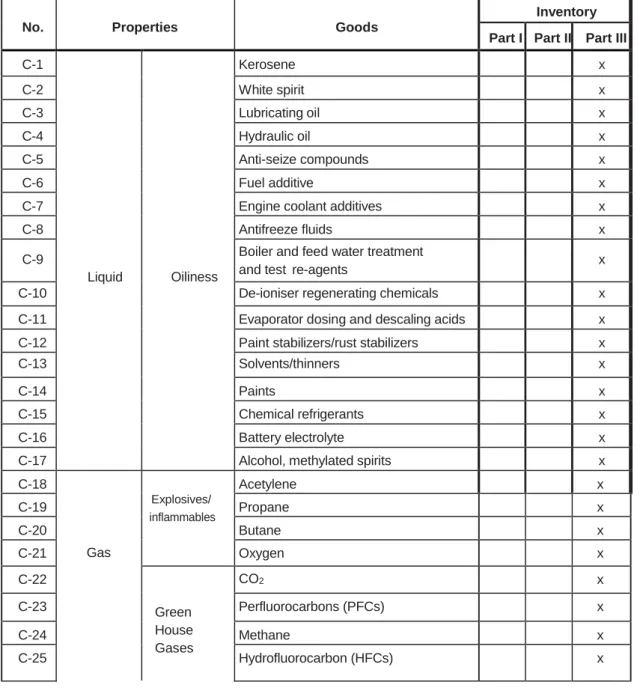
Table C – Potentially hazardous items
No. Properties Goods
Inventory Part I Part II Part III C-1 Liquid Oiliness Kerosene x C-2 White spirit x C-3 Lubricating oil x C-4 Hydraulic oil x C-5 Anti-seize compounds x C-6 Fuel additive x
C-7 Engine coolant additives x
C-8 Antifreeze fluids x
C-9 Boiler and feed water treatment
and test re-agents x
C-10 De-ioniser regenerating chemicals x
C-11 Evaporator dosing and descaling acids x
C-12 Paint stabilizers/rust stabilizers x
C-13 Solvents/thinners x
C-14 Paints x
C-15 Chemical refrigerants x
C-16 Battery electrolyte x
C-17 Alcohol, methylated spirits x
C-18 Gas Explosives/ inflammables Acetylene x C-19 Propane x C-20 Butane x C-21 Oxygen x C-22 Green House Gases CO2 x C-23 Perfluorocarbons (PFCs) x C-24 Methane x C-25 Hydrofluorocarbon (HFCs) x
C-27 Nitrous oxide (N2O) x
C-28 Sulfur hexafluoride (SF6) x
C-29
Liquid
Oiliness
Bunkers: fuel oil x
C-30 Grease x
C-31 Waste oil (sludge) x
C-32 Bilge and/or waste water generated by
the after-treatment systems fitted on machineries
x
C-33 Oily liquid cargo tank residues x
C-34 Ballast water x
C-35 Raw sewage x
C-36 Treated sewage x
C-37 Non-oily liquid cargo residues x
C-38 Gas Explosibility/
inflammability
Fuel gas x
C-39
Solid
Dry cargo residues x
C-40 Medical waste/infectious waste x
C-41 Incinerator ash2 x
C-42 Garbage x
C-43 Fuel tank residues x
C-44 Oily solid cargo tank residues x
C-45 Oily or chemical contaminated rags x
C-46 Batteries (incl. lead acid batteries) x
C-47 Pesticides/insecticide sprays x
C-48 Extinguishers x
C-49 Chemical cleaner (incl. electrical
equipment cleaner, carbon remover) x
C-50 Detergent/bleacher (could be a liquid) x
C-51 Miscellaneous medicines x
C-52 Fire fighting clothing and Personal
protective equipment x
C-53 Dry tank residues x
C-54 Cargo residues x
C-55 Spare parts which contain materials
listed in Table A or Table B x
2 Definition of garbage is identical to that in MARPOL Annex V. However, incinerator ash is classified separately because it may include hazardous substances or heavy metals.
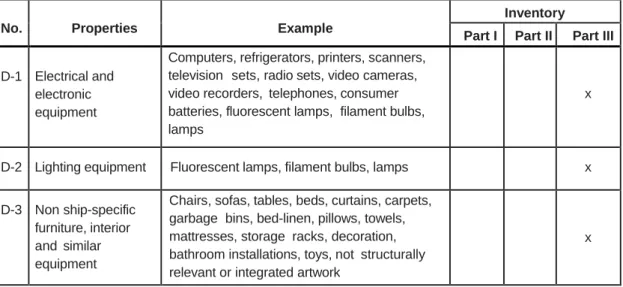
Table D – Regular consumable goods potentially containing hazardous materials3
No. Properties Example
Inventory Part I Part II Part III D-1 Electrical and
electronic equipment
Computers, refrigerators, printers, scanners, television sets, radio sets, video cameras, video recorders, telephones, consumer batteries, fluorescent lamps, filament bulbs, lamps
x
D-2 Lighting equipment Fluorescent lamps, filament bulbs, lamps x
D-3 Non ship-specific
furniture, interior and similar equipment
Chairs, sofas, tables, beds, curtains, carpets, garbage bins, bed-linen, pillows, towels, mattresses, storage racks, decoration, bathroom installations, toys, not structurally relevant or integrated artwork
x
3 This table does not include ship-specific equipment integral to ship operations, which has to be listed in part I of the inventory.
APPENDIX 2
STANDARD FORMAT OF THE INVENTORY OF HAZARDOUS MATERIALS4
Part I
Hazardous materials contained in the ship's structure and equipment
I-1 – Paints and coating systems containing materials listed in table A and table B of appendix 1 of these guidelines
No. Application of paint Name of paint Location (classification Materials
in appendix 1)
Approximate
quantity Remarks
1 Anti-drumming
compound
Primer, xx Co., xx primer #300
Hull part Lead 35.00 kg
2 Anti-fouling xx Co., xx coat #100 Underwat
er parts TBT 120.00 kg
I-2 – Equipment and machinery containing materials listed in table A and table B of appendix 1 of these guidelines
No. Name of equipment and machinery Location
Materials (classification in appendix 1) Parts where used Approximate quantity Remarks
1 Switch board Engine
control room
Cadmium Housing
coating 0.02 kg
Mercury Heat gauge <0.01 kg less than 0.01kg
2 Diesel engine, xx Co., xx #150 Engine room Lead Cadmium Bearing Starter
for blower 0.02 kg
3 Diesel engine, xx Co., xx #200 Engine-room Lead Starter for
blower 0.01 kg
Revised by XXX on Oct. XX, 2008 (revoking No.2)
4 Diesel generator (x 3) Engine-room Lead Ingredient of copper
compounds
0.01 kg
5 Radioactive level gauge No. 1 Cargo tank Radioactive substances Gauge 5
(1.8E+11) Ci
(Bq)
Radionuclides: 60Co
I-3 - Structure and hull containing materials listed in table A and table B of appendix 1 of these guidelines
No. Name of structural element Location (classification Materials
in appendix 1)
Parts where used
Approximate
quantity Remarks
1 Wall panel Accommodation Asbestos Insulation 2,500.00 kg
2 Wall insulation Engine control
room
Lead Perforated
plate 0.01 kg cover for insulation material
Asbestos Insulation 25.00 kg under perforated plates
APPENDIX 3
EXAMPLE OF THE DEVELOPMENT PROCESS FOR PART I OF THE INVENTORY FOR NEW SHIPS
1 OBJECTIVE OF THE TYPICAL EXAMPLE
This example has been developed to give guidance and to facilitate understanding of the development process for part I of the Inventory of Hazardous Materials for new ships.
2 DEVELOPMENT FLOW FOR PART I OF THE INVENTORY
Part I of the Inventory should be developed using the following three steps. However, the order of these steps is flexible and can be changed depending on the schedule of shipbuilding:
.1 collection of hazardous materials information;
.2 utilization of hazardous materials information; and
.3 preparation of the Inventory (by filling out standard format).
3 COLLECTION OF HAZARDOUS MATERIALS INFORMATION
3.1 Data collection process for hazardous materials
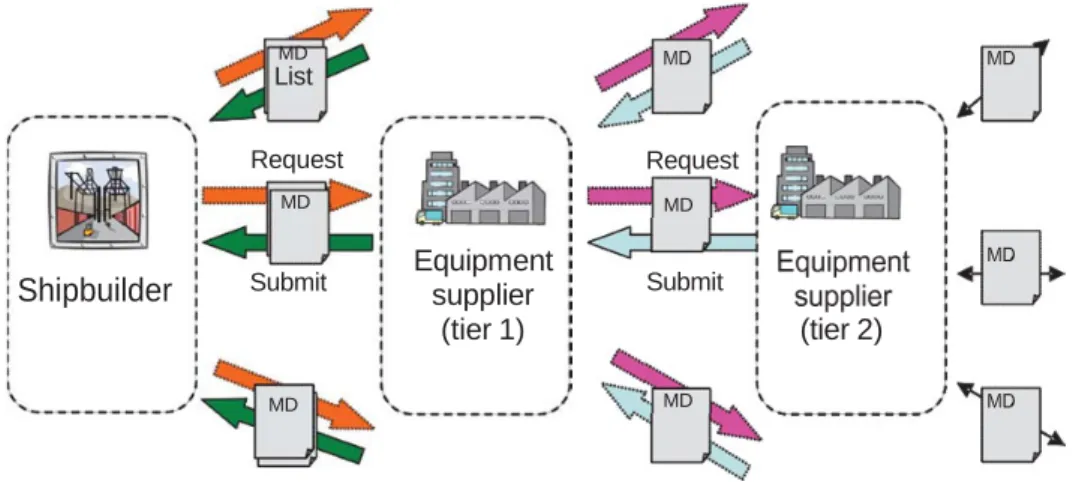
Materials Declaration (MD) and Supplier's Declaration of Conformity (SDoC) for products from suppliers (tier 1 suppliers) should be requested and collected by the shipbuilding yard. Tier 1 suppliers may request from their suppliers (tier 2 suppliers) the relevant information if they cannot develop the MD based on the information available. Thus the collection of data on hazardous materials may involve the entire shipbuilding supply chain (Figure 1).
Figure 1 – Process of MD (and SDoC) collection showing involvement of supply chain
Request MD Submit (tier 2) MD MD List Request MD
Shipbuilder Submit Equipmentsupplier (tier 1)
3.2 Declaration of hazardous materials
Suppliers should declare whether or not the hazardous materials listed in table A and table B in the MD are present in concentrations above the threshold values specified for each homogeneous material in a product.
3.2.1 Materials listed in table A
If one or more materials listed in table A are found to be present in concentrations above the specified threshold value according to the MD, the products which contain these materials shall not be installed on a ship. However, if the materials are used in a product in accordance with an exemption specified by the Convention (e.g. new installations containing hydrochlorofluorocarbons (HCFCs) before 1 January 2020), the product should be listed in the Inventory.
3.2.2 Materials listed in table B
If one or more materials listed in table B are found to be present in concentrations above the specified threshold value according to the MD, the products should be listed in the Inventory.
3.3 Example of homogeneous materials
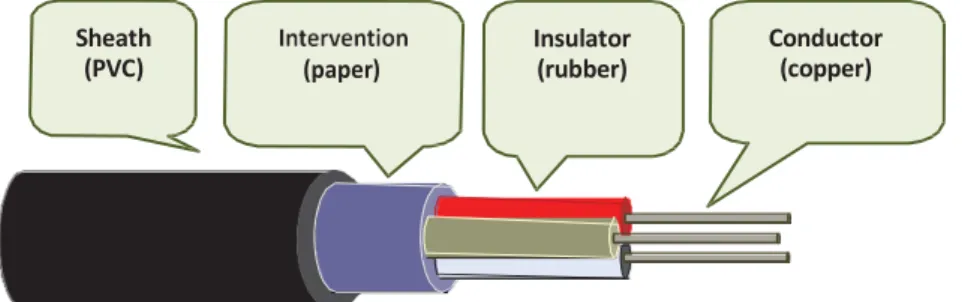
Figure 2 shows an example of four homogeneous materials which constitute a cable. In this case, sheath, intervention, insulator and conductor are all individual homogeneous materials.
Figure 2 – Example of homogeneous materials (cable)
4 UTILIZATION OF HAZARDOUS MATERIALS INFORMATION
Products which contain hazardous materials in concentrations above the specified threshold values should be clearly identified in the MD. The approximate quantity of the hazardous materials should be calculated if the mass data for hazardous materials are declared in the MD using a unit which cannot be directly utilized in the Inventory.
5 PREPARATION OF INVENTORY (BY FILLING OUT STANDARD FORMAT)
The information received for the Inventory, as contained in table A and table B of appendix 1 of these guidelines, ought to be structured and utilized according to the following categorization for part I of the Inventory:
Part I-1 Paints and coating systems; Part I-2 Equipment and machinery; and Part I-3 Structure and hull.
Sheath
5.1 "Name of equipment and machinery" column
5.1.1 Equipment and machinery
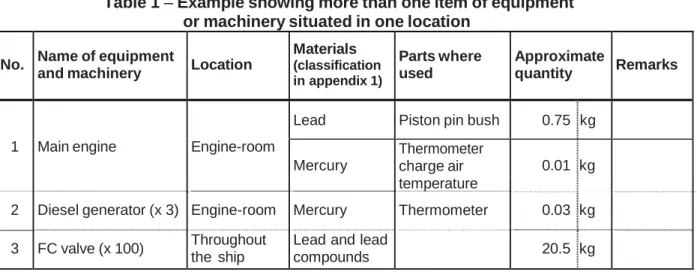
5.1.1.1 The name of each item of equipment or machinery should be entered in this column. If more than one hazardous material is present in the equipment or machinery, the row relating to that equipment or machinery should be appropriately divided such that all of the hazardous materials contained in the piece of equipment or machinery are entered. If more than one item of equipment or machinery is situated in one location, both name and quantity of the equipment or machinery should be entered in the column. Examples are shown in rows 1 and 2 of table 1
5.1.1.2 For identical or common items, such as but not limited to bolts, nuts and valves, there is no need to list each item individually (see Bulk Listing in paragraph 3.2 of the guidelines). An example is shown in row 3 of table 1.
Table 1 – Example showing more than one item of equipment or machinery situated in one location
No. Name of equipment
and machinery Location
Materials (classification in appendix 1) Parts where used Approximate quantity Remarks
1 Main engine Engine-room
Lead Piston pin bush 0.75 kg
Mercury
Thermometer
charge air 0.01 kg
2 Diesel generator (x 3) Engine-room Mercury
temperature
Thermometer 0.03 kg
3 FC valve (x 100) Throughout
the ship
Lead and lead
compounds 20.5 kg
5.1.2 Pipes and cables
The names of pipes and of systems, including electric cables, which are often situated in more than one compartment of a ship, should be described using the name of the system concerned. A reference to the compartments where these systems are located is not necessary as long as the system is clearly identified and properly named.
5.2 "Approximate quantity" column
The standard unit for approximate quantity of solid hazardous materials should be kg. If the hazardous materials are liquids or gases, the standard unit should be either m3
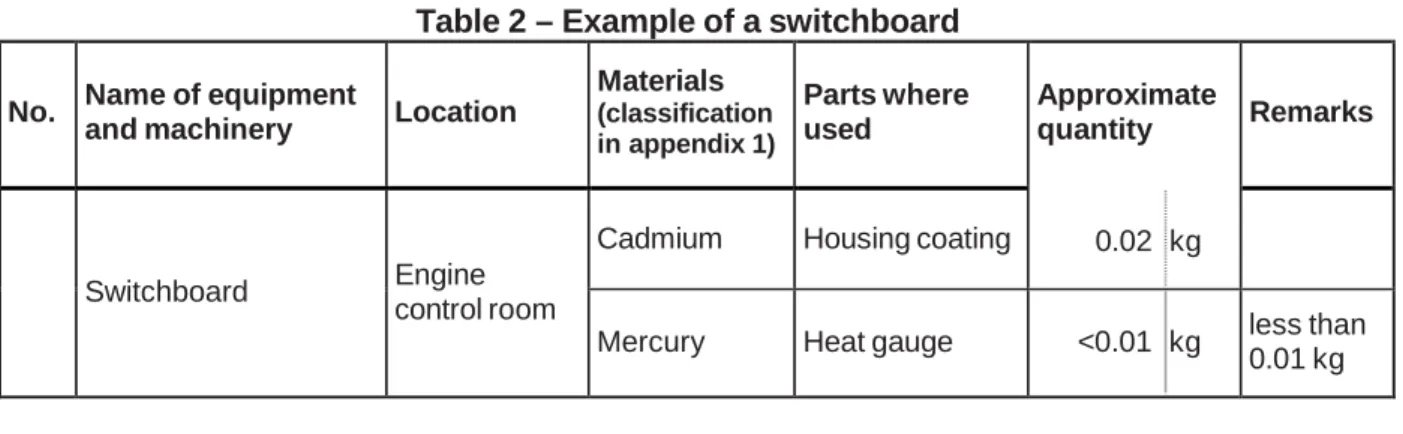
or kg. An approximate quantity should be rounded up to at least two significant figures. If the hazardous material is less than 10 g, the description of the quantity should read "<0.01 kg".
Table 2 – Example of a switchboard
No. Name of equipment
and machinery Location
Materials (classification in appendix 1) Parts where used Approximate quantity Remarks Switchboard Engine control room
Cadmium Housing coating 0.02 kg
Mercury Heat gauge <0.01 kg less than
0.01 kg
5.3 "Location" column
5.3.1 Example of a location list
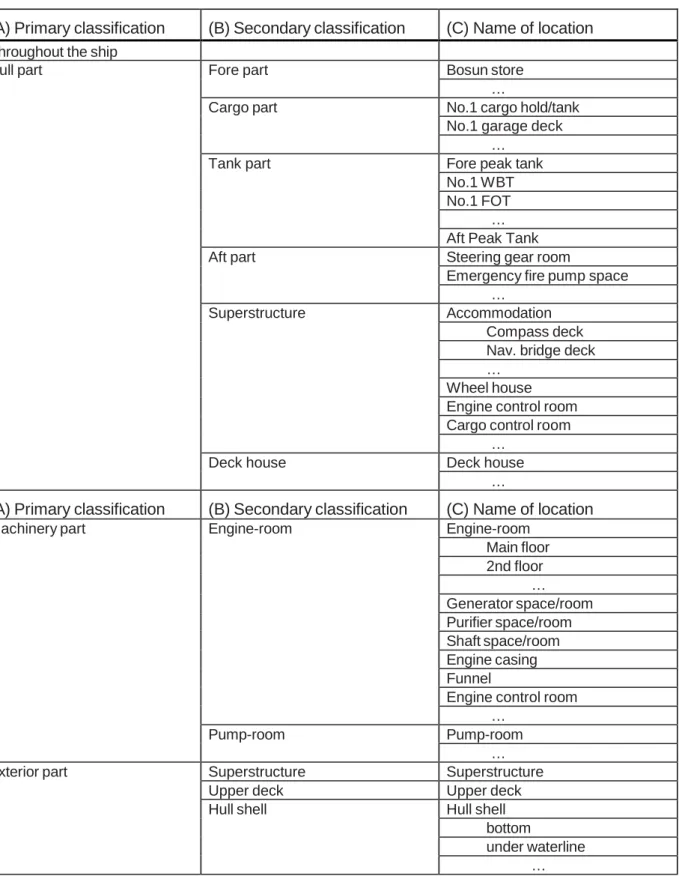
It is recommended to prepare a location list which covers all compartments of a ship based on the ship's plans (e.g. general arrangement, engine-room arrangement, accommodation and tank plan) and on other documentation on board, including certificates or spare parts' lists. The description of the location should be based on a location such as a deck or room to enable easy identification. The name of the location should correspond to the ship's plans so as to ensure consistency between the Inventory and the ship's plans. Examples of names of locations are shown in table 3. For bulk listings, the locations of the items or materials may be generalized. For example, the location may only include the primary classification such as "Throughout the ship" as shown in the table 3 below.
Table 3 – Examples of location names
(A) Primary classification (B) Secondary classification (C) Name of location
Throughout the ship
Hull part Fore part Bosun store
…
Cargo part No.1 cargo hold/tank
No.1 garage deck …
Tank part Fore peak tank
No.1 WBT No.1 FOT
… Aft Peak Tank
Aft part Steering gear room
Emergency fire pump space …
Superstructure Accommodation
Compass deck Nav. bridge deck …
Wheel house Engine control room Cargo control room
…
Deck house Deck house
…
(A) Primary classification (B) Secondary classification (C) Name of location
Machinery part Engine-room Engine-room
Main floor 2nd floor … Generator space/room Purifier space/room Shaft space/room Engine casing Funnel
Engine control room …
Pump-room Pump-room
…
Exterior part Superstructure Superstructure
Upper deck Upper deck
Hull shell Hull shell
bottom
under waterline …
5.3.2 Description of location of pipes and electrical systems
5.3.2.1 Locations of pipes and systems, including electrical systems and cables situated in more than one compartment of a ship, should be described for each system concerned. If they are situated in a number of compartments, the most practical of the following two options should be used:
.1 listing of all components in the column; or
.2 description of the location of the system using an expression such as those shown under "primary classification" and "secondary classification" in Table 3.
5.3.2.2 A typical description of a pipe system is shown in table 4.
Table 4 – Example of description of a pipe system
No. Name of equipment and machinery Location Materials (classification in appendix 1) Parts where used Approximate quantity Remarks Ballast water system Engine-room, Hold parts
APPENDIX 6
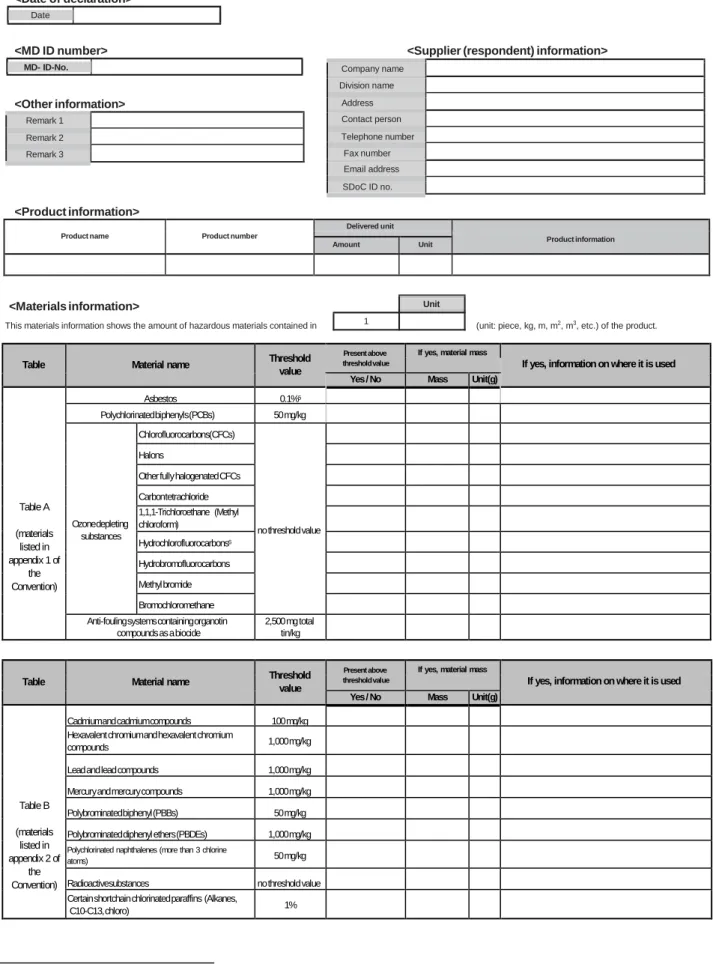
<Date of declaration>
FORM OF MATERIAL DECLARATION
<MD ID number> <Supplier (respondent) information>
<Other information>
Remark 1 Remark 2 Remark 3
<Product information>
Product name Product number
Delivered unit
Product information
Amount Unit
<Materials information>
This materials information shows the amount of hazardous materials contained in (unit: piece, kg, m, m2, m3, etc.) of the product.
Table Material name Threshold value threshold value Present above If yes, material mass If yes, information on where it is used
Yes / No Mass Unit(g)
Table A (materials listed in appendix 1 of the Convention) Asbestos 0.1%5 Polychlorinated biphenyls (PCBs) 50 mg/kg Ozone depleting substances Chlorofluorocarbons(CFCs) no threshold value Halons
Other fully halogenated CFCs Carbon tetrachloride 1,1,1-Trichloroethane (Methyl chloroform) Hydrochlorofluorocarbons6 Hydrobromofluorocarbons Methyl bromide Bromochloromethane Anti-fouling systems containing organotin
compounds as a biocide 2,500 mg total tin/kg
Table Material name Threshold value threshold value Present above If yes, material mass If yes, information on where it is used
Yes / No Mass Unit(g)
Table B (materials listed in appendix 2 of the Convention)
Cadmium and cadmium compounds 100 mg/kg Hexavalent chromium and hexavalent chromium
compounds 1,000 mg/kg Lead and lead compounds 1,000 mg/kg Mercury and mercury compounds 1,000 mg/kg Polybrominated biphenyl (PBBs) 50 mg/kg Polybrominated diphenyl ethers (PBDEs) 1,000 mg/kg
Polychlorinated naphthalenes (more than 3 chlorine
atoms) 50 mg/kg
Radioactive substances no threshold value Certain shortchain chlorinated paraffins (Alkanes,
C10-C13, chloro) 1%
5 If 1% is applied, this threshold value should be recorded in the Inventory and, if available, the Material Declaration and can be applied not later than five years after the entry into force of the Convention. The threshold value of 0.1% need not be retroactively applied to those Inventories and Material Declarations.
MD- ID-No. Date Unit 1 Company name Division name Address Contact person Telephone number Fax number Email address SDoC ID no.
APPENDIX 7
FORM OF SUPPLIER'S DECLARATION OF CONFORMITY
1)
SDoC ID number:2)
Issuer’s name: Issuer’s address:3)
Object(s) of the declaration:4)
The object(s) of the declaration described above is in conformity with the following documents:5)
The company policy on the management of the chemical substances in products:Document no.: Title: Edition: Date of issue:
6)
Additional information:7)
Signed for and on behalf of :(Place of issue) (Date of issue)
(Name, function) (Signature)