Korean Education Struggle (100 Nyeon Gyoyug Tujaeng)
日本におけるポストコロニアル第三空間:ウリハッキョ(私たちの学校)
在日朝鮮人の100年教育闘争
by
Susan Jane Menadue-Chun
A Dissertation Submitted to the Graduate School of Social Design Studies
Rikkyo University
In Partial Fulfilment of the Requirements For Doctor of Philosophy
March 2020
ii
COMMITTEE
主指導 Professor Mark. E Caprio
副指導 萩原なつ子 (Professor Natsuko Hagiwara)
外部審査委員 金敬黙 (Professor Kim Kyungmook )
iii
©Copyright by
Susan Jane Menadue-Chun
iv
ABSTRACT by
Susan Jane Menadue-Chun
Uri Haggyeo (our school) a Postcolonial Third Space in Japan: A Hundred Year Zainichi Korean Education Struggle (100 Nyeon Gyoyug Tujaeng)
(Under the direction of Professor Mark E. Caprio)
The purpose of this dissertation is to present an alternative perspective to existing political and social interpretations of the Joseon schools in Japan. Writing against existing stereotypes and using Homi Bhabha’s hybrid Third Space theory, this study proposes against the common perspective that the Joseon schools are microcosms of the DPRK, but unique postcolonial hybrid spaces that empower articulation of Korean identity and culture. The existing literature generally critiques the curricula and describes oppression during certain periods. However, other studies fail to chronicle the 100-year history of Joseon schools in the context of hybridity, geopolitical displacement, cultural transformation, political negotiation, and transnational bureaucratic oppression.
This research inquires how, contrary to geopolitical postwar and Cold War sanctioned representations, the Joseon schools have created interpreted history, culture, and power to create a Third Space. Through a Postcolonial lens, illustrating the Joseon schools as a Third Space, assists in reinterpreting power dynamics between Japan, the DPRK, the United States, and the ROK and mediates Japan’s social responsibility
v
towards the schools. Permeated by the transnational histories of Korea and Japan, this study analyzes cultural transformation against a milieu of oppression and misrepresentation over four periods. Chapter one looks at the creation of a hybrid Korean community in prewar Naichi Japan against cultural suppression of ethnic education. In chapter two, against a background of SCAP-provoked Cold War discourses and colonial racism, the analysis focuses on the early ethnic schools in response to post-colonial and geopolitical displacement. The third chapter, against a background of ROK- and Japan-provoked DPRK Cold War discourses, focuses on political negotiation in Chongryun’s hybrid education system. The fourth chapter focusses on ongoing cultural translation and a move away from DPRK influences against the background of current anti-DPRK discourses. The results of this research demonstrate that politically constructed labels of the Joseon schools have been fossilized in government policies to deny Zainichi Koreans their right to ethnic education. This study is significant because it builds on the Third Space theory to deconstruct Postcolonial and Cold War discourses. Furthermore, from transnational, cultural transformational, and displacement discourses it offers a pragmatic approach for Japan to interpret the Joseon schools and reinstate Zainichi Koreans’ civil rights to ethnic education.
vi
TABLE OF CONTENTS
INTRODUCTION ··· 1
Theoretical discussion – the Joseon schools in postcolonial discourse ··· 6
Postcolonial Koreans as racial stereotypes ··· 8
Zainichi Koreans and cultural hybridity ··· 11
The Joseon schools – a Third Space ··· 12
Literature Review ··· 15
Historical background ··· 35
Current status of the Joseon schools ··· 45
Chapter 1: Creation of the Zainichi Subaltern: Colonial Cultural Suppression of Korean Education in Japan (1910-1945) ··· 52
Introduction ··· 52
The Creation of the Korean community ··· 55
The beginning of the Chōsen buraku ··· 57
The Chōsen buraku and family settlement ··· 64
The Kyōwakai and the Korean community ··· 66
Korean education in pre-war Japan ··· 71
Child poverty and education ··· 72
Public night schools (Yakkan Gakkō) ··· 75
Sōaikai schools ··· 78
Joseon night schools ··· 79
Japanese elementary schools ··· 83
Education under Kyōwakai ··· 85
Conclusion ··· 90
Chapter 2: Post-colonial and Geopolitical Displacement: Under SCAP the Joseon School Closures 1945-1952 ··· 94
Introduction ··· 95
Background ··· 97
The foundation of a hybrid ethnic education system ···100
The Gugeo Gangseupso schools ···103
School infrastructure ···105
vii
Twofold Oppression ··· 115
Communiqués to the MOE ··· 116
SCAP’s Communist Profile of the Schools ···120
Enforcing Japanese law on the Joseon schools ···126
Chōren’s response ···131
Mass protests over Joseon school closures. ···135
The dissolution of Chōren and the second school closures ···144
Joseon schools following 1950 ···146
Conclusion ···148
Chapter 3: Political Negotiation: the Joseon schools in pro-DPRK Cold War Discourse and the Foreigners' School System Bill (1955-1972) ···151
Introduction ···153
Background ···155
The Chongryun education system and the DPRK ···160
Consolidation of Chongryun education ···164
The creation of a hybrid curriculum under Chongryun ···170
Chongryun textbooks and the DPRK ···175
The Foreigners’ School System Bill ···182
The “Korean concern” ···183
Education for Koreans under the Treaty on Basic Relations between Japan and the Republic of Korea ···189
Preliminary preparations for the Foreigners’ School System Bill ···195
Chongryun’s stance ···201
The accreditation of Korea University ···204
Conclusion ··· 211
Chapter 4: Cultural Translation: the Joseon schools, a Break from the DPRK amid Lingering Cold War images: Exclusion from the High-school Tuition Waiver Program (1972-2019) ···215
Introduction ···215
Background ···217
Cultural translation and the Joseon schools ···222
Second curriculum (1974-1977) ···223
Third curriculum (1993-1997) ···229
Fourth curriculum (2003-2005) ···233
viii
Lobbying for social inclusion ···247
Exclusion of the Joseon schools from the High-school Tuition Waiver Program ·254 Provisions to include the Joseon schools in the High-school Tuition Waiver Program ···255
Processing foreign schools ···256
Joseon schools affected by “North Korean” sanctions ···260
Screening the Joseon schools ···268
The legal justification for including the Joseon schools ···275
The Osaka model for exclusion ···277
A National Tsūtatsu ···279
Joseon schools and litigation against the government ···282
Conclusion ···285
CONCLUSION ···289
TABLES ···312
APPENDICES ···313
GLOSSARY ···325
BIBLIOGRAPHY ···335
INTRODUCTION
On April 25th, 2018, a group of Joseon school (Joseon Haggyeo/조선
학교/
Chōsen Gakkō/朝鮮学校 or Korean schools)1 supporters congregated in front of the
“Liberation Movement Nameless Warrior Tomb” in the Aoyama Cemetery in Tokyo.
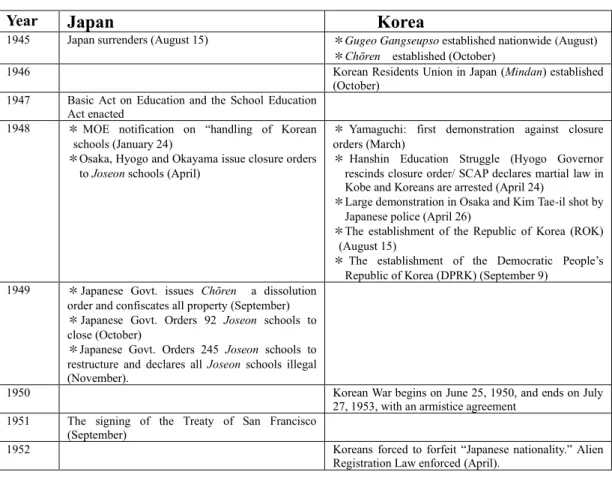
The gathering was organized to commemorate the 70th anniversary of the April 24, 1948, Hanshin Education Struggle when Japanese authorities, acting under the directions of the Supreme Commander for the Allied Powers (SCAP) forcefully closed the Joseon schools. The meeting began with a song: April 24 has come again, the bloody day we resent. Our freedom to learn our ethnic language was stolen. Hear our voices. Next, Japanese teachers, the Republic of Korea (ROK) activists, and researchers offered statements of support for the Joseon schools, and elderly Koreans shared personal testimonies. A moment of silence for the victims was held and the participants reiterated a commitment to the struggle for ethnic education rights. In conclusion, in a speech of unity, the highly respected Chongryun (General Association of Korean Residents in Japan /
在 日 本 朝 鮮 人 總 聯 合 會
/재일본조선인총련합회 or Chōsen Sōren)21 The term Joseon designates the original term for the Korean peninsula (Joseon Bando) and not the DPRK.
2 In Japanese Chongryun Koreans are referred to as Zainichi Chōsenjin.
historian Mr. Oh Hyeong-cheon defined the oppression against Korean ethnic education in Japan as a “One Hundred Year Education Struggle.” Mr. Oh mentioned the 36 years under colonial rule and the 73 years that followed liberation. The four specific periods he referred to were the prewar binary policies of assimilation and exclusion (Ito 1983;
Kim 2006); SCAP and the Japanese government’s forced closures of the Joseon schools between 1948 and 1950 (Wagner 1951; Kim 1997; Inokuchi 2000; Caprio and Yu 2009); the 1968-1972 Foreigners’ Schools System Bill (Pak 1966; Kurusu 1967; Ozawa 1973; Kim 2004) and the 2009 exclusion of Joseon schools from the High-school Tuition Waiver Program (Pak 2011; Ishii 2018; Nakagawa 2018; Ri 2018) (reported by Kiroku suru kai 2018, 258-265).
Photo was taken on April 25th, 2018, at Aoyama Cemetery, Tokyo.
The Chongryun community fondly refers to the Joseon schools as “uri haggyeo”
(our school) because the Joseon schools are an inclusive community venture. However, existing political and social interpretations of the Joseon schools recurrently emphasize the schools’ links with the Democratic People’s Republic of Korea (DPRK). Japan’s Ministry of Education, Culture, Sports, Science and Technology’s (MEXT) English website officially refers to the Joseon schools as “North Korean Schools” (MEXT 2012).
In Japan’s National Diet, the schools are often called Kita Chōsen no Gakkō (North Korean schools) that teach hannichi (anti-Japanese) dogma. The Japanese media generally focusses on the DPRK and Chongryun’s domineering authority over the schools. The western press on occasion refers to the schools as Korean ethnic schools
that generally follows a “socially constructed demonization of North Korea”(Dalton, Bell and Jung 2013: 27), and, to sensationalize, refers to the schools as
“Pro-Pyongyang,” “North Korean,” or uses headlines like “North Korean Schools in Japan Build Loyalty, Even Love, Abroad” (CBS 2018). Furthermore, Japanese
ultra-right groups accuse the Joseon schools of operating as “spy training schools,”
illegally occupying Japanese land and conducting hannichi (anti-Japanese) education (see Nakamura 2014). Due to the overemphasis on the DPRK link, the schools often
receive death threats3 and some have been terrorized. Homi Bhabba (1994, 95) refers to such a condition as a “dependence on the concept of ‘fixity’ in the ideological construction of other[-]ness.” Accordingly, the lack of positive representation has fueled misrepresentations and many people in Japan unconsciously believe the Joseon schools teach an anti-imperialistic hannichi dogma in a pro-DPRK curriculum, thereby educating children to be Japan-haters loyal to the DPRK. Furthermore, in 2002 the Joseon schools became a peculiar focus of international attention as Chongryun Koreans were linked to what is perceived as a dangerous regime. This status quo was a result of the inclusion of the DPRK in George W. Bush's 2002 "axis of evil" speech and Kim Jong-il’s confession to kidnapping Japanese citizens.
This study submits that in order to serve national interests, the ethnic education in Joseon schools has been invalidated and facts regarding the Joseon schools have been reconstructed by a “web of racism, cultural stereotypes, political imperialism, and dehumanizing ideology” (Said 1978, 27). Writing against existing DPRK stereotypes, this dissertation proposes that the Joseon schools are not microcosms of the DPRK, but are unique cultural hybrid spaces of ethnic education that empower articulation of
3 The most recent threat was on August 8, 2019, when a 21-year-old Japanese male threatened to detonate bombs at four Joseon schools in Aichi Prefecture.
Korean identity and culture.4 In Rutherford’s (1990, 211) interview with Homi Bhabha titled “The Third Space,” Bhabha describes cultural hybridity as the “Third Space”
because it “gives rise to something new and unrecognizable, [in] a new era of negotiation of meaning and representation.” In this dissertation, in the context of Bhabha’s cultural hybrid theory, the Joseon schools will be debated in terms of a Third Space. This study over four curricula outlines the ongoing cultural transformation and break from the DPRK. The question central to this research inquires how, contrary to geopolitical postwar- and cold-war-sanctioned representations, have the Joseon schools interpreted history, culture, and power to create a Third Space?
4 The current Joseon schools were established in postwar Japan to accommodate cultural dislocation due to Japan’s colonization of Korea and differ from other ethnic or foreign schools in Japan that were not affected by Japanese colonialism. For example, the first “international” school- the Saint Maur International School, was established in 1872 in Yokohama by the Catholic French order the Sister of Holy Infant Jesus as an English speaking school and currently operates as multi-faith and multinational school for foreigners in the Tokyo and Yokohama areas. The school was closed during World War II but reestablished in 1947. The first ethnic school - the Kobe Chinese School was established in 1899 to accommodate Cantonese Chinese living in the Kobe area; and with local assistance it managed to operate in the pre-war and postwar periods. The Kobe Chinese School now identifies with the People's Republic of China." Moreover, the American School in Japan was established in 1902 in Tokyo to cater for the broader foreign community. The school was closed during the World War II and reopened in 1946 (Kōrai Hakubutsukan, 2014,44).
Theoretical discussion – the Joseon schools in postcolonial discourse
John Lie (2008, x) defines the transient term Zainichi (to reside in Japan) as a postcolonial, ambivalent diasporic identity. Against a background of imperial policies, under colonial rule by 1945, some 2 million Koreans were living in Naichi5 Japan. A legacy of colonialism, according to Bhabha (Rutherford 1990, 218), is the change in the postcolonial individual. In the post-colonial metropolis, the “colonial cultural experience” compels the post-colonial to question the authority of previous narratives creating changes in politics, cultural ideologies, and intellectual discourses. In the same sense, Cumings (2005, 183) who was referring to Koreans on the peninsula writes that colonialism changed the Korean people forever:
They were no longer the same people: they had grievances against those who remained secure at home, they had suffered material and status losses, they had often come into contact with new ideologies, they had all seen a broader world beyond the villages.
For Koreans everywhere, Japan’s defeat and the loss of its colonies meant haebang (liberation) from colonial rule. However, in postwar Japan Zainichi Koreans were challenged with a new form of exclusion. They were no longer considered imperial subjects who shared the same ancestry as Japanese under the colonial slogan isshidōjin;
instead, Japan’s official postwar discourse rejected the “ethnic other” and homogeneity became “the defining quality of Japaneseness” (Lie 2008, 15). Koreans were now
5 Mainland Japan
referred to as non-Japanese and/or criminally bent Sangokujin (third-country nationals) and held responsible for the decay of Japan’s social order (Kim 1997, 276).
Forced to assimilate to new social patterns Ashcroft (1995, 183-184) claims that hybrid communities develop most strongly when members can no longer identify with their own history. Hence, due to colonial cultural suppression, a strengthening of Japanese political and economic hegemony, poverty, and discrimination, Koreans were forced into ghettos termed Chōsen buraku6 where they created a hybrid culture. The growth of a hybrid culture in the Chōsen buraku will be discussed in more in detail in Chapter 1; however, within the context of prewar hybridization, it should be noted here that in the Chōsen buraku homeland regional hometown (gohyang) differences disappeared as dwellers simply became “Korean” (Lie, 2008, 5-8). In the Chōsen buraku, there were spaces where intellectuals and sojourners mingled to study Marxist theories and ethnic nationalism, and in breaking with Confucian tradition many families migrated to Japan for their daughters’ education. In the context of postcolonial hybridity, this discussion aims to construct a logical argument of how the Joseon schools have created a hybrid Third Space for ethnic identification and empowerment. However, before the discussion on the schools, it should be noted that in postcolonial discourse,
6 Korean towns.
the elements of racial stereotyping and cultural hybridity are integral components of Bhabha’s Third Space hypothesis.
Postcolonial Koreans as racial stereotypes
Stereotypes generalize a particular group or minority, are rarely contested and are often accepted as a legitimate discourse. According to Bhabha (Rutherford 1990, 219), postcolonial discourse forces mainstream society to reconsider who is worthy of inclusion and, through the cultural and political construction of the migrant metaphor, leads to a process of “othering.” Hook (2005, 701-702) explains that to be effective the stereotyping discourse must be incessantly repeated to inflate the difference of the
“other” as it recreates the “other” with “usable facts” into a stable plausible object to rationalize the use of dehumanizing terms.
Under colonial rule, Koreans, as imperial subjects, were designated to a lower class “caste” status (Lee 1981, 33). Koreans in Naichi Japan were often considered subversive and frequently called futei Senjin (insolent Koreans); they were also vulnerable, regularly harassed, blamed, penalized, or punished (Ryang 2016). A pertinent example is the genocide of thousands of Koreans following the Great Kanto Earthquake in 1923 over rumors that they had poisoned the drinking water. In postwar Japan xenophobic attitudes towards Koreans endured, but, in contrast to prewar
multiethnic dogma, the postwar “othering” of Zainichi Koreans developed according to new ethnic and cultural homogeneous ideologies. Hence, in the milieu of Japanese homogeneity, poverty-stricken Koreans lived in Chōsen buraku, were rarely seen, and generally forgotten. Moreover, the presence of the Chōsen buraku itself manifested derogatory stereotypes.
In official postwar discourse, Koreans were often labeled as smugglers or public security risks. For example, on August 17, 1946, the Minshutō member Shiikuma Saburo stated in the Diet:
We refuse to stand by in silence watching Formosans and Koreans, who have resided in Japan as Japanese up to the time of surrender, swaggering about as if they were nationals of victorious nations. We admit we are a defeated nation but it is most deplorable that those who lived under our law and order until the last moment of the surrender should suddenly alter their attitude to act like conquerors, pasting on railway carriages ‘Reserved’ without any authorization, insulting and oppressing Japanese passengers and otherwise committing unspeakable violence everywhere.
The actions of these Koreans and Formosans make the blood in our veins, in our misery of defeat, boil (Conde, 1947, 43).
Here, the “useable facts” recognize Japan’s defeat; however, the statement kindles an image of unruly and violent Koreans who were responsible for destroying Japan’s social order for “committing unspeakable violence everywhere.” Or in the 1947 “anti-crime week” campaign, the Ueno Police Crime Prevention Association distributed a poster in downtown Tokyo to warn citizens of the dangers of robbers. The image of the Korean Taegukgi flag (below) undoubtedly created the impression that all Koreans were
criminals (Lee & DeVos 1981, 76).
Image from Lee & DeVos (1981, 76).
Furthermore, in 1965 Ikegami Tsutomu (1965, 96-97), a bureaucrat in Japan’s Ministry of Justice (MOJ) Immigration Bureau writes on the Joseon schools:
The case of the Joseon schools is a delicate and serious issue. With the exception of communist countries, there is no country that would allow the establishment of communist schools that teach intense communist ideologies designed to turn students into revolutionaries. The problem is, Japan has been over-democratized, and with bureaucracies divided the schools fall between reasonable jurisdictions. We would assume that school education falls under the Ministry of Education (MOE); however, the MOE is powerless in controlling these illegitimate schools. The schools are the same as private abacus schools, and legally there is no means to close them. While it may seem trivial, the schools are violent and a security concern.
Here the “usable facts,” recognize the Joseon schools are not legitimate and are linked to the DPRK. However, the statement heightens anxiety by stating that the schools are uncontrollable, violent and a security concern. The discussion in the following chapters on national policies against the Joseon schools will confirm how stereotypes have been inflated and fossilized in national policies.
Zainichi Koreans and cultural hybridity
Tiffin (1995, 95) states that post-colonial cultures are inevitably hybridized due to a dialectical relationship between the colonizer’s ideologies and the colonized who
“create or recreate local identity.” In Homi Bhabha’s words:
Hybridity is the sign of the productivity of colonial power, its shifting forces and fixities; it is the name for the strategic reversal of the process of domination through disavowal. Hybridity is the reevaluation of the assumption of colonial identity through the repetition of discriminatory identity effects (Bhabha 1995, 34-35).
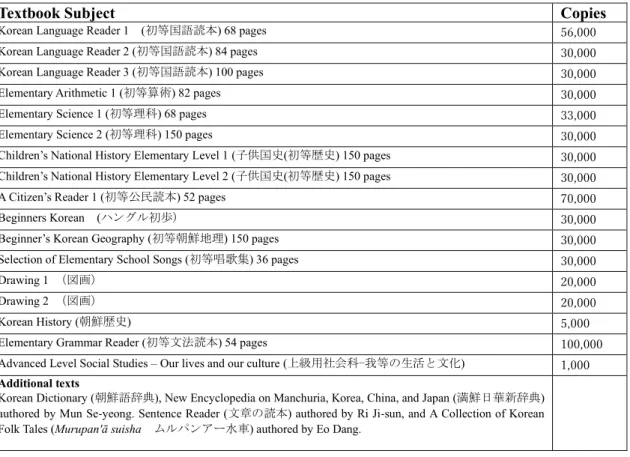
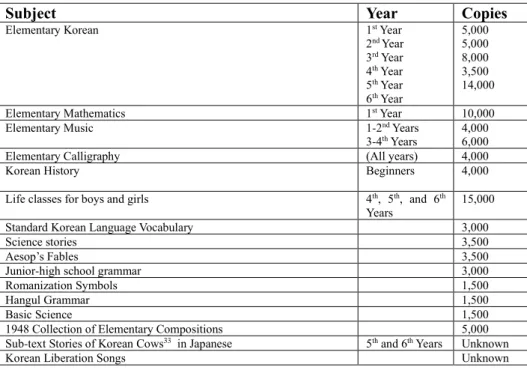
In postwar Japan, against a backdrop of social exclusion and ambiguous legal status, a highly political hybrid culture of empowerment developed. Immediately after Japan’s surrender, to advocate civil rights the diverse community of forced laborers, collaborators, socialists, communists, nationalists, released prisoners, returned soldiers, conscription evaders, students, and Koreans who were expediting liberation created organizations all over Japan (Oh 2009, 3). Moreover, to prepare Koreans for repatriation the community established grass-root nonpartisan language schools called Gugeo Gangseupso. After 35 years of pervasive colonial rule, many adults were illiterate, and most children could not speak Korean. In turn, in the Gugeo Gangseupso, these disenfranchised Koreans were exposed to the printed Korean language and this raised national consciousness (Anderson 1983 44-45). Furthermore, the Gugeo Gangseupso texts, which will be discussed in detail in Chapter 2, were hybrid texts that were often translations from Japanese textbooks.
According to Bhabha, in a hybrid culture, members are obliged to politically negotiate, and when circumstances change, they are required to translate their values and broaden their perspectives (Rutherford 1990, 216). Beyond the sovereign ideologies of the Korean homeland, the postwar Zainichi diaspora residing in the metropole recreated their colonial hybrid culture. In the pursuit of ethnic education, the creation of
the Gugeo Gangseupso (and later Joseon schools) provided a Third Space for ongoing cultural translation and political negotiation.
The Joseon schools – a Third Space
In postcolonial discourse, the “Third Space” is defined as a place where the oppressed can congregate and shelter from discrimination: a place where they share common ground. In terms of people and spaces Lefebvre (1991, 116), explains the “first space” as “spatial practice” which includes members of society, family or working class.
The “second space” is a “representation of space” and may include experts, scientists, architects, technocrats, and social engineers. The “third space” is a representational space where inhabitants and consumers passively encounter space. Pertinent to this study are the Joseon schools as a Third Space. However, in a broader context, the two ethnic organizations, the Chongryun and the ROK affiliated Mindan (Korean Residents
Union in Japan/
재일본대한민국민단
or在日本大韓民國民團),
7 are other examples of Third Spaces for Zainichi Koreans where, in Bhabha’s (1994, 2) words:the intersubjective and collective experiences of nation-ness, community interest or cultural values are negotiated in the emergence of the interstices, the overlap, and displacement of domains of difference.
On a smaller scale, Korean ethnic interest, and religious groups where people can meet and negotiate and reproduce cultural identity are also Third Spaces.
To Bhabha, the concept of hybridization is the Third Space where people are empowered with different perspectives as new structures of authority and political initiatives arise (Rutherford 1990, 211). The Third Space is not based on foreign concepts or multiculturalism but founded on colonial and post-colonial concepts of an
“inter-national culture” created through the “inscription and articulation of the hybridity”
(Bhabha 1995, 209). Furthermore, the Third Space does not represent an identity but establishes a way to identify with and through another. Hall (1990, 223) describes a cultural identity “in terms of one, shared culture, a sort of collective ‘one true self’…
which people with a shared history and ancestry hold in common.”
The Joseon schools as a Third Space were first founded by Zainichi Koreans as a survival strategy. Based on Bhabha’s Third Space hypothesis (1994, 247), this hybrid space was founded from cultural displacement and cultural transformation permeated by
7 In Japanese, Mindan Koreans are referred to as Zainichi Kankokujin.
the transnational histories of Korea and Japan. Furthermore, the cultural identities of people in the Joseon schools identify as “Korean” (Chōsenjin) but they are constantly undergoing a transformation. The Joseon schools explained in Stuart Hall’s terms are:
Far from being eternally fixed in some essentialized past, they are subject to the continuous ‘play’ of history, culture, and power. Far from being grounded in a mere
‘recovery’ of the past, which is waiting to be found, and which when found, will secure our sense of ourselves into eternity, identities are the names we give to the different ways we are positioned by, and position ourselves within, the narratives of the past (Hall 1990, 225).
The transformation mentioned here is a consequence of cultural translation. Cultural translation, according to Pym (2009, 139), happens when colonial and postcolonial processes have “displaced and mixed languages.” Cultural translation is also a consequence of the movement of people rather than the movement of texts. As an example, Michaelsen and Johnson (2001 ix) write:
[that] the language of the Americas is translation, and that therefore questions of translation, dialogue, and border crossings (linguistic, cultural, national, and the like) are necessary for rethinking the foundations and limits of the Americas.
Subsequently, in this study on the Joseon schools, it will become evident how the precolonial movement of Koreans generally from the southern areas on the Korean peninsula and a postcolonial identification with the north pushed the boundaries of translation and interjected hybrid identities in the Joseon school community.
Against a shared history of colonial policies responsible for a loss of Korean identity, cultural dispossession, displacement, and oppression over the last 70 years
(since liberation) the Joseon schools have created a shared cultural identity, by connecting the dots of the forgotten past. For cultural identities are created in “the unstable points of identification, which are made, within the discourses of history and culture” (Hall 1990, 226).
In the chapters that follow, this dissertation will apply the Third Space theory against officially endorsed static stereotypes to emphasize the importance of how concepts such as migration, nationalism, cultural translation, and negotiation have factored into the evolution of the Joseon schools as a unique Third Space.
Literature Review
This study contests the common narrative that Joseon schools are steadfastly hannichi and loyal only to the DPRK and focuses on the Joseon schools as a Third Space hybrid culture. David Chapman’s (2008) study Zainichi Korean Identity and Ethnicity contends that contemporary Zainichi Korean identity is a “third-way” hybrid
identity because of a generational change and politics. This study agrees with Chapman’s hypothesis of Zainichi Korean hybrid identities and expands on his hypothesis in arguing that the Joseon schools are a Third Space hybrid culture created from cultural displacement and cultural transformation.
For general studies in English focusing on other Zainichi fields, Wagner (1951) provides the earliest well-informed accounts on Zainichi Koreans in Japan from 1904-1950 against a postwar background of Korean, Japanese, and SCAP hostilities. To foster a deeper understanding of the Korean minority in Japan Wagner uses SCAP and Japanese documents and gives circumstantial evidence on the postwar geopolitical situation in North-East Asia. For other studies see Richard Mitchel’s (1967) The Korean Minority in Japan-an analysis of how the presence of Koreans in Japan have influenced Japan-Korean relations. Yukiko Koshiro’s (1999) Trans-Pacific Racisms and the U.S.
Occupation of Japan on race and culture including a study on the Korean minority.
Tessa Morris-Suzuki’s (2006) Exodus to North Korea: Shadows from Japan’s Cold War on the 1959 and onward repatriation of some 90,000 Zainichi Koreans from Japan to the DPRK. According to this study the repatriation program was carried out under the auspice of the Red Cross the governments of Japan, the DPRK, the USSR, and the U.S.
to relieve Japan of its “Korean problem.”
Current political and social interpretations of the Joseon schools disregard how and why the Joseon schools were established and a lack of Chongryun literature until the 1980s has further fueled misconceptions in context with links to the DPRK.
Changsoo Lee and George DeVos’s (1981) Koreans in Japan Ethnic Conflict and
Accommodation- a post-WWII chronological analysis of challenges faced by the Korean minority in Japan. In the context of political policies of exclusion, Lee Changsoo (1981) writes an objective analysis on Chōren and Chongryun “ethnic education and national policies” in the post-war era until 1968. Moreover, Yasunori Fukuoka’s (2000 57-58) analysis on the diversity within young Zainichi Koreans, typecasts them as
“Nationalist,”8 “Naturalizing,”9 “Individualist,”10 and “Pluralists.”11 However, Fukuoka’s typology groups all Joseon school students in the “Nationalist” category and reinforces a rigid stereotype as he asserts that the students “feel little sense of attachment in the country of their birth and upbringing.” Or they “live their lives upon the principles of Kim Il Sung to the extent possible in their very different environment”
(Fukuoka 2000, 52-53).
Moreover, English language commentaries on the Joseon schools by Lie (2008), Hicks (1997), Rholen (1981), Ryang (1997), and Okano (2011) emphasize the political connection with the DPRK. An example of political bias against the Joseon schools is Rholen (1981, 206) who writes, “the content of the Ch’ongnyŏn education is patterned closely on North Korean educational practice. The textbooks come from
8 Strong sense of ethnic awareness
9 Korea being a country where ancestors originate.
10 Someone who rejects belonging to any ethnic group for preferring meritocracy.
11 Someone who wants to operate somewhere within ethnicity and nationality constructs.
North Korea,” or Hicks’ (1997, 136) assertion that the standardized curriculum of 1963 until 1993 was “completely dominated by a North Korean perspective [and] focused on quasi-deification of the Great Leader.”
From this point, the literature review will follow a chronological approach corresponding with the chapters in this study. In prewar Japan, the government evaded formulating policies on education for Koreans, and consequently resources are limited as most records at private Joseon schools were destroyed due to intense police surveillance. For Koreans in Naichi Japan, Tanaka (1967), Kawamukai (1973), Ito (1983), Weiner (1994), Park (2000), Tonomura (2004), Kim (2006), and Kashani (2006) assess the fluctuations in colonial immigration and community growth against colonial capitalist policies. First, students and sojourners formed the foundations for a community via social infrastructure in mutual aid and pro-independence ideologically focused organizations (Ozawa 1973; Ko 1977; Pak 1979) and, after 1930, a stronger Korean community was established when women and children began to migrate (Kashani 2006). Against a background of economic migration Naito (1989) points out that in a break away from patriarchal norms some Korean families chose to migrate to educate their daughters because education in Naichi Japan was more accessible than on the peninsula.
In Naichi Japan Koreans attended night schools because Japanese language skills were necessary for employment and Korean literacy for corresponding with family in Korea. The research of Ito Etsuko (1983), Nakajima (2005), and Tanaka (1967) is significant in illuminating how illiterate sojourners and some children in the 1920s attended Japanese day and night schools where Korean instruction was sometimes offered. On the other hand, to expedite assimilation in the 1920s the Sōaikai as a pro-Japanese Korean association offered classes to Koreans (Ringhoffer 1981;
Kawashima 2009). Kawamukai (1973), notes that night schools became the mainstay for Japan’s capitalist ventures, and a substantial number of Korean students were enrolled in Tokyo-based schools and studied alongside impoverished Burakumin12 students. Moreover, in his analysis, Kawamukai (1973) argues that the national government reinforced poverty when it delegated education to the regional governments.
As for Joseon schools established by Koreans, they were considered subversive because many taught pro-independence ideologies, and from the early 1930s were forcefully closed and, barring personal testimonies such as the Ōsaka Jinken Hakubutsukan (1999), documentation is scant.
As Japan mobilized for war, from 1938 Korean parents were obliged to enroll
12 Japan’s outcaste minority.
their children in Japanese schools under the jurisdiction of the Kyōwakai (Ito 1983;
Naito 1989; Higuchi 2002). Again, beyond the assimilation dogma, there was no consistent Kyōwakai national policy on how Koreans should be educated, and similar to Japan’s policy on night schools, Korean education was left to prefectural Kyōwakai branches. Moreover, education under the Kyōwakai did not focus on academics, rather it indoctrinated the powerful Kōminka13 ideology to eradicate Korean identities (Ozawa 1973).
In postwar Japan, SCAP was ill-equipped to supervise Koreans. Wagner (1951), Kim (1997), Inokuchi (2000), and Caprio and Yu (2009) refer to the American intelligence reports Civil Affairs Handbook: Japan (1944) and Aliens in Japan (1945) in substantiating that in preparation for an occupation, the United States did carry out some investigations on the livelihood of Koreans in Japan. However, despite anthropological studies on the Japanese, such as Benedict’s (1947) Chrysanthemum and the Sword, Passin’s The Occupation: Some Reflections (1990, 118) points out that most SCAP personnel were ignorant towards Japanese people, and more so towards the Koreans. Within SCAP, Wagner (1951, 56) points out that there was no special division to supervise Korean affairs and according to Braibanti (1948, 215), the occupation
13 Subjects of the Emperor
relied on an impractical system of dependence on the Japanese bureaucracies for translations and administration. The research for this paper suggests that SCAP and the Japanese Government initially shared similar views on Korean repatriation because a homogenous Japan was preferable for efficient administration (Koshiro 1999; Lie 2008).
SCAP was originally sympathetic towards the plight of Koreans; however, when Koreans, as designated “liberated nationals,” began to demand special treatment and “adopted an unreasonable and highly emotional attitude towards the occupation and or Japanese authority” (Wagner 1951, 41), SCAP’s approach towards the Koreans hardened. Furthermore, the status of Koreans became more precarious when the official expatriation ended in December 1946 and some 600,000 Koreans who stayed were informed that they would hence be considered as “Japanese” until a country of Korea was created. Conde (1948) and Wagner’s (1951) literature on SCAP and Japanese treatment of Koreans and the ensuing “anti-Korean campaigns” is noteworthy. Both writers provide a succinct narrative report on the events that had direct and immediate implications on the lives of Koreans. Moreover, concerning SCAP’s contribution to the
“anti-Korean hysteria” Conde (1948, 42) quotes a SCAP press release that stated that Koreans were a menace to the health of the Occupation and the Japanese nation as a whole. Conde (1948, 41) writes:
The Koreans find themselves being blamed for Japan’s black market and the increase in crime and accused of being the carriers of disease, of paying no taxes, of having secured a financial stranglehold on Japan, and of “being brave” today and having cowered in fright during the war.
Moreover, Wagner (1951, 59) writes of how SCAP promoted the “anti-Korean campaign” as it manipulated the media to influence the Japanese public.
Concerning ethnic education in postwar Japan, in preparation for repatriation, Koreans mobilized and established their autonomous language schools called Gugeo
Gangseupso (Lee 1956, 66). By the end of 1945, 200 schools were teaching approximately 20,000 adults and children (Lee 1956; Eo, 1998, 108). As for SCAP and Japanese suppression of the Joseon schools, Wagner (1951), Fujishima (1966), Ozawa (1966 & 1973), Kurusu (1966), Lee & Devos (1981), Inokuchi (2000), Caprio (2008), Segami (2000), Takamae (2002), Matsushita (2010), and McKee (2014) write on the events linked to the 1948 to 1950 Joseon school closure orders. Conversely, the bulk of the literature is composed by Chongryun historians: Lee (1956), Pak (1980 &1982), Pak (1989), Ko (1996), Kim (1997), Ri (2002), Kim (2004), Gwon (2008), Kim (2011) Ri (2018), and Choi (2018) and focuses on SCAP and Japan’s failure to recognize Korean
ethnic education. Criticism is rare in Chongryun literature as most historians endeavor to create a collective memory of Japanese oppression against ethnic education in connection with ethnic rights. However, Pak (1989, 204) writes that Chōren
(League of Koreans in Japan
재일조선인련맹/재일조선인연맹
or在日本朝鮮人聯 盟) failed to protect the Joseon
schools due to poor political tactics as it became embroiled in SCAP and Japanese provocations.Moving on to Cold War politics and the division of the Zainichi Korean community, Mitchel (1967, 134-164) emphasizes that the ROK and the DPRK involved Zainichi Koreans like pawns in negotiations with the Japanese Government. In Lie’s (2008, 67) words, “the Zainichi population [became] a convenient object of North-South struggles for influence, legitimacy, and primacy.” Similarly, Suzuki (2016, 69) describes the division in the Zainichi community and allegiance to North or South Korea as a reflection of Japanese hegemony.
On the Foreigners’ School System Bill, Chongryun writers and Japanese supporters agree that Chongryun’s affiliation with the DPRK provided the Japanese Government a reason to control the Joseon schools (Fujishima 1966; Fujishima and Ozawa 1966; Kim 1967; Ozawa 1971; Inamoto 1968; Ozawa 1973; Pak 1966; Pak 1982 Kim 2004; Mc Kee 2013). Likewise, Chongryun critics, such as Pak (1966), Han (1967), Kim (1967), Ko (1969), Pak (1982), Kim (2004) and Oh (2015), denounced the Treaty on Basic Relations between Japan and the Republic of Korea as a pretext to regulate and close the Joseon schools. Furthermore, Japanese scholars like Yōnosuke
Inamoto (1968,101-105) questioned how the Joseon schools could be detrimental to Japan’s “national interest,” and Ozawa’s (1971, 38-54) analysis from 1963 to 1965 of Diet and Liberal Democratic Party (LDP) committee proceedings and LDP journals notes that the Joseon schools were the focus of unreasonable criticism well before the June 1965 Treaty on Basic Relations between Japan and the Republic of Korea.
Furthermore, from a human rights perspective, Fujishima Udai (1966) criticized the Japanese Government for failing to protect the rights of Korean children despite ratifying the United Nations Declaration of the Rights of the Child in 1959. In English literature, annotations on the Foreigners’ School System Bill are documented only by Lee Changsoo (1981, 174-181), but despite providing a full analysis on the accreditation of the Tokyo based Korea University in 1968 his inquiry into the Foreigners’ Schools System Bill is somewhat incorrect. While Lee states that the bill was submitted once and shelved in 1966, it was submitted to the Diet seven times between 1966 and 1972 (Ōsaka Minzoku Kyōiku 60-Nen Shi Henshū Iinkai 2005).
In stride with generational and social changes, following the 1980s the Joseon schools began to construct a shared identity around the suppressive events of the 1948 Hanshin school closures and published more literature focusing on ethnic education rights. Chongryun academics Pak (1980; 1982), Ko (1996), Pak (1997; 2003; 2011;
2012), Kim (2004), Han (2006), Oh (2009; 2015), Oh (2019), and Kim (2011) have published subjective studies on various periods that are useful for understanding a Chongryun perspective. For example, Pak Sang-deok’s (1980) Zainichi Chōsenjin no Minzoku Kyōiku pens a chronology on Chongryun’s commitment to ethnic education beginning with pre-war Japanese suppression and DPRK assistance. Chongryun members Byeon Hi-jae and Chon Hyonchol’s (1988) “Ima Chōsen Gakkō de-naze Minzoku Kyōiku ka” focuses on the Joseon school system in the 1980s, asking why Korean parents preferred Joseon schools over Japanese schools and emphasizing ethnic
education as a civil right. The literature gives a detailed analysis of the second curriculum (1974-1977) and highlights the teaching of Korean (Gugeo) and, to demonstrate integration in Japanese society, explains the degree of Japanese literary works in the Japanese language texts. Pak Sam-sok’s (1992) manuscript
“Towareru
Chōsen Gakkō Shogū: Nihon no Kokusai-ka no Mōten” is the first comprehensive and candid account of the Joseon schools under Chongryun. Pak, an academic at Tokyo’s Korea University, writes on different attitudes per generation and the Chongryun community’s commitment to the Joseon schools. He analyzes aspects related to civil rights and integration in Japanese society, the careers of graduates, school management, safeguarding ethnic education, history of oppression, and the Joseon schools from aninternational perspective, Japan-DPRK goodwill, the future of Joseon schools, and the curriculum. Using Chongryun archives Kim Dong-Ryong (2004), a former member of Chongryun’s textbook committee and an academic at the Tokyo based Korea University, chronicles a 1945-1972 school history. Furthermore, from a contemporary and global perspective in Kokusaika Jidai no Minzoku Kyōiku, Ko Chan-yu (1996) gives an account of the historic oppression against the Joseon schools and chronicles the importance of evaluating the schools in a foreign school framework. Han Tong-hyon (2006) highlights the uniqueness of the Chongryun schools in her ethnology on the origins of the Chima Chogori school uniform. Also, Oh, Yong-Ho’s (2019) pioneering literature clarifies how the DPRK and Chongryun collaborated in the 1950s to compile unique texts to accommodate Zainichi Koreans.
The period following the shelving of the Foreigners’ Schools System Bill in 1972 to the present (2019) includes three curricula revisions. The new curricula were launched against a background of turbulent social challenges such as the resumption of the repatriation program between 1971-1985, DPRK education funds, accreditation, civic gains, the fall of the Iron Curtain, Chongryun’s declining profile, DPRK acts of terrorism, the Pyongyang Declaration, Kim Jong-il’s confession to kidnapping Japanese, and the Joseon schools’ exclusion from the Tuition Waiver Program.
While the current curriculum (2003-2005) is mentioned briefly in summaries of Joseon school education (Pak 2003; 2011; 2012), currently there are no comprehensive analyses on the overall curriculum. However, on the current history (yeogsa) syllabus former senior academic at the Korea University Kang Seong-eun (2010) writes that democratic movements in the ROK have influenced the present history textbooks.
Furthermore, with a focus on ethnic education and civil rights, Muraguchi (2004), Pak
(1997, 2011, 2012), the committee Urihakkyo o Tsuzuru Kai (2007), Kim (2014), Fujii (2014) write on changes in the Joseon schools. Chongryun is now more tolerant of outside researchers, an early example being Cary’s (2003, 98-132) general account on the Joseon school history and her analysis of “parental attitudes about language and ethnic identity,” in her fieldwork at the Shikoku Joseon school in the 1990s.
Aside from reports in the media, the literature on the exclusion of the Tuition Waiver Program is still limited. However, Pak (2011), in the context of multiculturalism, writes on the contradiction of excluding the Joseon schools from the Tuition Waiver Program. Moreover, the Chongryun publication Gekkan IO (2015, 2017) has published two books – Kōkō Mushō-ka Saiban. 249 Nin no Chōsen Kōkōsei Tatakai no Kiroku (2015) and Kōkō Mushō-Ka Saiban. Ōsaka de Rekishi-Teki ni Shōso (2017) – to document how the Japanese government has attempted to exclude the
Joseon schools. Furthermore, from an academic and legal standpoint, Chongryun member and lawyer Ri Jun-hui (2018), and Japanese academics Ishii Takuji (2018) and
Nakagawa Ritsu (2018) have correspondingly argued that the Joseon schools’
government exclusion from the Tuition Waiver Program is prejudicial and unconstitutional.
To date, the two main analytical studies on the Joseon schools are Sonia Ryang’s (1997) inquiry – North Koreans in Japan and Song Kichan’s (2012) – Katararenai mono to shite Chōsen gakkō. Zainichi Minzoku Kyōiku to Aidentiti Poritikusu (Things that cannot be articulated in the Joseon schools. Zainichi ethnic education and identity politics). Ryang, a former Chongryun member published her study in 1997 before Chongryun experienced major internal turmoil and subsequent reform in the curriculum following the DPRK’s 2002 confession of kidnapping Japanese citizens (to be discussed in detail in Chapter 4). In context with Chongryun links with the DPRK, Ryang’s title North Koreans in Japan implies that loyal DPRK citizens reside in Japan when Chongryun Koreans are in fact stateless citizens denoted as Chōsen-seki14 because Japan does not formally recognize the DPRK. The main focus of Ryang’s (1997, 18) study is on the Chongryun organization as a “displaced social
14 Chōsen-seki - is a Japanese term that differentiates stateless Zainichi Koreans who are affiliated with the Chongryun organization.
space that pretended, albeit temporarily, to be North Korean although it existed in Japan.” In the discussion on the Joseon schools, Ryang does acknowledge change in the curricula, but emphasizes how it affects social relations within Chongryun; and within the constraint of the organization’s politically constructed DPRK Overseas Citizen
identity. Fundamentally Ryang focuses on Chongryun’s top-down clumsy attempts to reproduce Chongryun identities in the Joseon schools (to be discussed in Chapter 3).
However, in magnifying the reproduction of a North Korean identity through enforcing DPRK education; she disregards that the central focus in Joseon school education is a community commitment to ethnic education. Moreover, this community engagement has been the catalyst for changes in the curricula revisions, social inclusion, and civic activism.
On the other hand, Song (2012), a ROK scholar published his work following the release of the current (2003) curriculum. Song writes against Ryang’s analysis and emphasizes the importance of ethnic education in the Joseon schools and DPRK support as an auxiliary factor. Contrary to Ryang’s focus on reproducing DPRK education, the benchmark for Song’s (2012, 25) research is based on his fieldwork observations of teacher/student interactions in the classroom and community participation as a new interpretation of the schools. Primarily his study focuses on how the students navigate
“identity politics” in context with ethnic education and how the Joseon school
community has recurrently redefined the link with the DPRK. Song describes how students adapt between their Joseon school ethnic identity and personal identities. He argues that rather than focusing exclusively on DPRK political ideologies the schools facilitate “identity management” to help students separate and negotiate their ethnic education experiences in the classroom and their lives in Japan. Song (2012, 22) is critical of Ryang’s inflated image of the Joseon schools’ reproduction of “North Korean
education” and the emphasis on Chongryun politics. He argues her inquiry fails to acknowledge how the schools have translated DPRK concepts to accommodate Korean identities inside and outside school. For example, in her analysis, Ryang (1997, 61) often refers to the Young Pioneers in the Joseon schools in context with teaching DPRK revolutionary concepts to “be loyal to the Fatherland Marshal Kim Il Sung and Dear Leader Kim Jong Il.” However, Song (2012, 170) contends that joining the Young Pioneers in the fourth year of Elementary school is simply an act of initiation into the Chongryun community and celebrated by the local branch, PTA, headmaster, teaching staff and the entire school. Moreover, he notes that the ceremony, where mothers tie the red scarves on their children, is a formality and not a political commitment to the DPRK based Young Pioneers.
The existing literature on the Joseon schools generally critiques changes in the curricula, ethnic identity, Chongryun politics, connection with the Korean homeland, integration in Japan, and civil rights. However, studies review only particular periods and fail to acknowledge that issues related to certain times are only part of a bigger picture of cultural transformation and oppression against the Joseon schools. Historical events are a consequence of combined incidents, the movements of people, and determinations made by people in authority. For this reason, this dissertation spans over 100 years to gain a broader understanding of how colonial cultural suppression, postwar geopolitical displacement, Cold War discourses, and cultural translation have shaped the Joseon schools into a Third Space. Grounded on Bhabha’s Third Space theory, this dissertation fills the gap in the literature and is a unique endeavor to re-define the Joseon schools. This research differs from Song’s focus on “identity management” by within the construct of the Third Space, it examines how Zainichi Koreans “identify”
with the Joseon schools rather than just “identity” per se. Findlay (1984, 58) writes that identification “goes hand in hand with [a] setting [of] others at a distance, an alienation of ourselves from them and their ways.” In context with the Third Space, the “alienation”
discussed here is due to post-colonial marginalization of Zainichi Koreans who strongly identify with the Joseon schools.
Hence, this study contests the socially constructed sociopolitical DPRK stereotypes linked to the schools and focuses on the overall Joseon school education system as a hybrid Third Space for ethnic identification and empowerment. The Joseon school as a Third Space is an effect of colonial subjugation and now functions as a social space “in-between” Japanese and Korean (ROK and DPRK) cultural, political, economic systems and geographical boundaries. Or in other words, it is the space where Japanese and Korean cultures overlap, and hybridity comes into being, and through cultural translation and political negotiation, the Third Space initiates change. For this study, as a Third Space, the Joseon school system encompasses transnational government policies, regulations, funding, administration, facilities, teaching, administrative staff, curricula, teaching resources such as textbooks and community involvement.
In the prewar period, 97% (Morita 1996, 40) of Koreans migrated to Japan
from the southern areas of the Korean peninsula, and in the postwar period displaced Chongryun Koreans identified with the DPRK in the north. The Joseon schools, to some extent, still lean towards the DPRK. For example, in context with how the Korean War started, the curricula briefly teaches a modified DPRK account. Over the twelve-year curricula, the year 8 social studies (sahoe) (Chongryun Jungang Sangim Wiwonhoe
2005, 110) text mentions in a few words that the Korean War was started by the Americans. Furthermore, in the year 10 modern history text (hyeondae Joseon yeogsa)
(Chongryun Jungang Sangim Wiwonhoe 2004, 79), in one paragraph it explains the war began following the ROK’s bombarding of the DPRK Demilitarized Zone (DMZ) on June 23, 1950; and because the Rhee Syngman government failed to heed the DPRK’s appeals to cease hostilities the Korean war commenced on June 25, 1950.
However, it is important to note that in context with shifting identities, identification with the DPRK has fluctuated due to generational change, domestic politics in Japan, and political events on the peninsula. A pertinent example of wavering loyalty to the DPRK is evident in the current curriculum (2003) that bases some lessons on ROK material and the dual acknowledgment of the ROK as an ancestral homeland (gohyang) and the DPRK as the fatherland (jogug). Beyond this ambiguous
identification with the DPRK, the schools have forged a shared cultural identity due to colonial cultural dispossession, postcolonial displacement, and hegemonic Japanese national policies against the schools. In fact, in context with the expression “home is where the heart is,” people in the Joseon school community refer to Uri Haggyeo (our school) as their “home” (gohyang). Furthermore, in testament to the schools as a Third Space, against a background of diversity within the Zainichi Korean community and an
ability to accommodate sociopolitical change in Japan, the original curriculum and school system were established to facilitate moving students between the Japanese and Joseon school system. Moreover, due to a myriad of personal and political reasons Zainichi Korean students have frequently transferred within the Joseon, Japanese, and Mindan school systems. Consequently, the Joseon schools are prepared to accept new students at any stage of their schooling and put no restrictions on their language abilities.
Hence, this study contends that as a hybrid Third Space, rather than identifying
with the DPRK Zainichi Koreans have interpreted DPRK ideologies as a source of empowerment to unify the Chongyrun community. To identify how collective experiences have given rise to the Third Space, this analysis will focus on: colonial independence ideologies, post-colonial and Cold-war displacement, ethnicity and the curricula, community involvement, social inclusion, social activism, and bureaucratic hegemony.
Over 100 years via cultural translation and political negotiation the catalyst for change in the Joseon schools has been an emphasis on regaining a Korean ethnic identity through ethnic education. However, against this backdrop of hybridity, to
discourage Korean ethnic education, the Japanese government, SCAP, and the ROK have negated the value of ethnic education and instead inflated and fossilized discriminatory stereotypes linked to national security. To ascertain this is an ongoing issue, this study will focus on the unique ethnic curriculum against bureaucratic hegemony over four periods of prewar binary policies of assimilation and exclusion;
postwar displacement and SCAP and the Japanese government’s forced closures of the Joseon schools; ROK involvement in Cold-War politics and the Foreigner’ Schools System Bill; and application of DPRK stereotypes and the exclusion of Joseon schools from the High-school Tuition Waiver Program.
Historical background
Before this discussion moves on to chronicling a brief Zainichi Korean background, it should be pointed out that post-colonials residing in the colonial metropolis is not unique. Like the Joseon schools that were created in response to cultural displacement, Algerian youth in France have created a Third Space in Islam due to ongoing social discrimination, and assimilation policies that deny them their Algerian cultural identity. Consequently, despite being educated in French schools many young
Algerians now identify as “Algerian with French nationality”15 (Alsaafin, 2019).
Algeria regained its independence in 1962 and by 1965 some 500,000 Algerians were living in France (House 2006). Initially, the French government saw the Algerian presence as temporary (see Babicz 2013); however, due to previous family settlement, many decided to stay. Furthermore, the migration of Algerians to France follows a similar trajectory to Koreans in prewar Japan: first, a wave of economic migrants, postwar migration to rebuild infrastructure, and second a wave of family reunion in the 1970s.
Comparable to Zainichi Koreans in Japan, biased migrant images of Algerians in France have reinforced colonial stereotypes. For example, Parisians call Algerian ghettos banlieues and the word has come to denote crime, unemployment, and precarious Muslims. Moreover, the banlieues are generally reported in the media only when there are “car bombings and drug shootings” (Packer 2015). Gender-based stereotypes, also portray Algerian youths as a “problem,” for males are often referred to as criminal-bent and women as “submissive” Muslims (House 2006). French Algerians have also been scapegoated following acts of terrorism. The most recent example came following the January 7, 2015, killings of twelve people at Charlie Hebdo by two
15 In 1947 the Statute of Algeria granted Algerian men full French citizenship, and their descendants have attained French citizenship as a birthright (jus soli).
French citizens with Algerian names. In the aftermath, mosques in France were vandalized and women and girls wearing hijabs were harassed (Packer 2015). Likewise, in Japan following DPRK missile launches, media reports of DPRK spy ships, and following Kim Jong-il’s confession to kidnapping Japanese citizens, threats against the Joseon schools escalated and female chima chogori uniforms were slashed.
In 1910, Japan formally annexed Korea, and Korea became part of the Empire of Japan. The Imperial Nationality Law differentiated Gaichi16 and Naichi family registration and created a separate subjectivity for Koreans on the peninsula and in Naichi Japan. In Morris-Suzuki’s (2010, 42) words “the boundaries of nationality that [the Japanese government] established were elastic, susceptible both to expansion and contraction.” Koreans were told they were “Japanese” however in the two-tier structure of nationality, Japanese people were deemed imperial citizens (teikoku kōkumin), and Koreans were imperial subjects (teikoku shinmin) with Korean (Chōsen-seki) nationality (Takahashi 2014, 15).
Immigration policies to Naichi Japan were strictly controlled by colonial policies and demands in Japan’s labor market. The four significant policies behind the mass exodus of Koreans to Naichi Japan were the 1910-1919 Land Survey, the Rice
16 External territories
Expansion Project from the 1920s, the intensified assimilation drive in the 1930s known as the Kōminka movement, and the conscription of Korean laborers from 1942 and Korean soldiers from 1944 (Zai Nihon 2006, 11). Ozawa (1973, 32) points out that Japan’s “brutal” colonization of Korea uprooted Koreans from their land and occupations and transformed them from a conservative agrarian people into itinerants, and “just like Korean rice (that was exported to Japan), Koreans too became export commodities.” Predominantly, Koreans who migrated to Japan came from the southern provinces: 37.5% from Gyeongsangnam-do, 23.1% from Gyeongsangbuk-do, 20.6%
from Jeollanam-do and only 3.4% from the northern provinces that are now DPRK territories such as Pyongyang, North Hamgyong, and North and South Hywanghae (Morita 1996, 147).
When Japanese rule ended on August 15, 1945, the Korean peninsula was provisionally separated at the 38th parallel under Soviet administration in the north and United States of America in the south. Furthermore, there were over 2 million17 displaced Koreans (approximately 10% of Korea’s population) living in Naichi Japan, and in other Japanese territories (Morita, 1996, 33). The postwar crisis18 in Japan had
17 These statistics are not exact because the Japanese government and corporations were unable to determine just how many Koreans came to Japan as forced laborers and how many Koreans had evacuated to Korea during the war (Kim 1997, 77).
18 The return of demilitarized soldiers and repatriates caused gross unemployment, serious food, and housing shortages and crippling inflation produced a collapse of Japan’s political and socio-economic