Complete set of total cross sections for imaginary parts of nd forward scattering amplitudes, and three‑nucleon force effects
著者 Ishikawa Souichi, Tanifuji M., Iseri Y.
出版者 The American Physical Society journal or
publication title
Dynamics & Design Conference
number 2
page range 024001‑1‑024001‑5
year 2001‑06
URL http://hdl.handle.net/10114/1242
doi: info:doi/10.1103/PhysRevC.64.024001
Complete set of total cross sections for imaginary parts of nd forward scattering amplitudes, and three-nucleon force effects
S. Ishikawa and M. Tanifuji
Department of Physics, Hosei University, Fujimi 2-17-1, Chiyoda, Tokyo 102-8160, Japan Y. Iseri
Department of Physics, Chiba-Keizai College, Todoroki-cho 4-3-30, Inage, Chiba 263-0021, Japan 共Received 8 November 2000; published 29 June 2001兲
In neutron-deuteron scattering, four total cross sections are shown to form a complete set for the determi- nation of the imaginary parts of the forward amplitudes by means of the optical theorem. The amplitudes are decomposed into scalar and tensor components in spin space. Contributions of three-nucleon forces共3NF兲to these amplitudes are studied by Faddeev calculations. Significant effects of the 3NF on the tensor components are predicted.
DOI: 10.1103/PhysRevC.64.024001 PACS number共s兲: 21.45.⫹v, 21.30.⫺x, 24.70.⫹s
In recent years, three-nucleon共3N兲systems have attracted considerable attention as important sources of information on nuclear interactions, because of possible effects of three- nucleon forces共3NF兲in addition to two-nucleon ones. Vari- ous versions of the two-nucleon force 共2NF兲have been ex- amined as the input to 3N calculations, and have been found to be deficient in reproducing empirical data of specific physical observables关1兴. Improvements have been achieved by introducing a 2 exchange 3NF in the calculation of the 3N binding energy 关2兴 and the minimum of the proton- deuteron ( pd) elastic scattering cross section between 50 and 200 MeV 关3兴. However, the prescription is not always effective for polarization phenomena. In fact, the 3NF cannot explain the proton vector analyzing power between 65 and 200 MeV 关4兴in pជd scattering, and the deuteron tensor ana- lyzing powers at 270 MeV in dជp scattering 关5兴. Also, dis- crepancies in the nucleon and deuteron vector analyzing powers between calculations and measurements in low en- ergy neutron-deuteron (nd) and pd scatterings still remain unresolved even when a 3NF is included关6 – 8兴.
These indicate that a comprehensive understanding of the role of nuclear interactions, particularly that of their spin dependence, in 3N observables has not yet been obtained. In the present paper, we consider nd total cross sections, which are specified by spin orientations of projectiles and targets, as a reliable scale for the criticism of the spin dependence of the nuclear interactions. Because of the optical theorem, total cross sections are linked to the imaginary parts of forward scattering amplitudes. In the following, we give a complete set of the nd total cross sections to determine unambiguously the imaginary parts of all of the nd forward amplitudes.
Since the spin dependence of the nuclear interactions is re- flected in the scattering observables through the spin struc- ture of the scattering amplitudes, we decompose the nd for- ward amplitudes by spin space tensors, and examine the relation between these components of the amplitudes and corresponding nuclear force components. Finally, effects of 3NF on these components of the amplitudes are studied by 3N Faddeev calculations.
In the nd scattering, we have four nonvanishing indepen- dent forward amplitudes关9兴. Designating elements of the nd scattering matrix as 具n⬘,d⬘兩M兩n,d典⫽0, where’s are the z components of the related particles’ spins
M1⫽
冓
12,1冏
M冏
12,1冔
⫽0,
M2⫽
冓
⫺12,1冏
M冏
⫺12,1冔
⫽0,
共1兲 M3⫽
冓
⫺12,1冏
M冏
12,0冔
⫽0⫽
冓
12,0冏
M冏
⫺12,1冔
⫽0,
M4⫽
冓
12,0冏
M冏
12,0冔
⫽0.
Then, in principle, four kinds of independent total cross sec- tions completely determine the imaginary parts of the for- ward scattering amplitudes by the optical theorem.
Denoting the spin density matrices of the neutrons and the deuterons 关10兴 in the initial state by (n) and (d), respec- tively, the total cross sectiontotis given as
tot⫽␣Im兵Tr共(n)(d)M⫽0兲其 with ␣⫽4 k , 共2兲 where k is the magnitude of the nd relative momentum k.
One of the independent total cross sections is that for unpo- larized neutrons and deuterons 0
tot 关11,12兴, for which the spin density matrices are given by
(n)⫽1
2I(n), (d)⫽1
3I(d), 共3兲 where I(n)and I(d)are the unit matrices. We get from Eq.共2兲
0 tot⫽␣
3 Im共M1⫹M2⫹M4兲. 共4兲
Next, we choose the longitudinal (⌬L) and the transver- sal (⌬T) asymmetries of the total cross section for vector- polarized neutrons and deuterons, for which noticeable con- tributions of the 3NF have been predicted 关13兴. When the neutrons and the deuterons are vector polarized in the same direction along the z axis with polarizations pz(n) and pz(d), the corresponding cross section L
tot( pz(n), pz(d)) is obtained by Eq. 共2兲with the spin density matrices
(n)⫽1
2pz(n)z, (d)⫽1
2pz(d)Pz, 共5兲 where
Pz⫽
冉
100 000 ⫺001冊
. 共6兲On the other hand, when the neutrons and the deuterons are vector polarized in the same direction perpendicular to the z axis with polarizations py(n) and py(d), one can choose the y axis as the polarization direction. Then the corresponding cross sectionT
tot( py(n), p(d)y ) is obtained by Eq.共2兲with the spin density matrices
(n)⫽1
2py(n)y, (d)⫽1
2py(d)Py, 共7兲 where
Py⫽ 1
冑
2冉
00i ⫺0ii ⫺00i冊
. 共8兲The cross section asymmetries are defined as the cross sec- tion difference provided by the reversal of the deuteron spin direction:
⌬L⫽L
tot共⫹1,⫺1兲⫺L
tot共⫹1,⫹1兲,
⌬T⫽T
tot共⫹1,⫺1兲⫺T
tot共⫹1,⫹1兲, 共9兲 which are equivalent to the asymmetries in Ref.关13兴. Using Eqs. 共2兲and共9兲with Eqs.共5兲,共6兲,共7兲, and共8兲, we obtain
⌬L⫽⫺␣Im共M1⫺M2兲, 共10兲 and
⌬T⫽⫺␣
冑
2 Im共M3兲. 共11兲 As the last one, we consider the total cross section for the scattering of unpolarized neutrons by tensor polarized deu- terons. For the unpolarized neutrons and the t20tensor polar- ized deuterons along the z axis,(n)⫽1
2I(n), (d)⫽
冑
26 t20Pzz, 共12兲 where
Pzz⫽
冉
010 ⫺002 001冊
. 共13兲We get the total cross section20
totfor t20⫽1,
20 tot⫽ ␣
3
冑
2 Im共M1⫹M2⫺2 M4兲. 共14兲Solving Eqs.共4兲,共10兲,共11兲, and共14兲, the imaginary parts of M1–M4 are obtained:
␣Im共M1兲⫽0 tot⫹ 1
冑
220tot⫺1 2⌬L,
␣Im共M2兲⫽0 tot⫹ 1
冑
220tot⫹1 2⌬L,
共15兲
␣Im共M3兲⫽⫺ 1
冑
2⌬T,␣Im共M4兲⫽0
tot⫺
冑
220 tot.By these equations, one can determine the imaginary parts of the scattering amplitudes M1–M4 unambiguously when
0
tot,⌬L,⌬T, and20
totare measured. The present choice of the set of the independent total cross sections is not unique. However, different choices will produce the informa- tion of the scattering amplitudes equivalent to the present one, since the independent amplitudes are restricted to four ones.
In order to get deeper insights into the spin dependence of the interactions, we decompose the scattering matrix M by spin space tensors of rank K with z component , SK,
M⫽
兺
K 共⫺兲SK,⫺RK, 共16兲where RK is the counterpart, a tensor in the coordinate space. The matrix element of M for a reaction A(a,b)B is given in terms of invariant amplitudes 关14兴:
具b,B;kf兩M兩a,A;ki典
⫽s
兺
isfK共sasAaA兩sii兲共sbsBbB兩sff兲
⫻共sisfi,⫺f兩K兲共⫺兲sf⫺f
⫻l
兺
i⫽K¯⫺K K
关Cl
i共kˆi兲丢Cl
f⫽K¯⫺li共kˆf兲兴KF共sisfKli兲, 共17兲 where ki(kf) is the relative momentum in the initial 共final兲 state, s’s (’s兲 denote the spins (z components兲, and K¯⫽K for even K and K⫹1 for odd K关15兴. The quantum number
S. ISHIKAWA, M. TANIFUJI, AND Y. ISERI PHYSICAL REVIEW C 64 024001
024001-2
si(sf) is the channel spin for the initial 共final兲 state. The quantity kˆi(kˆf) is the solid angle of ki(kf) and Clm(kˆ) is related to the spherical harmonics Ylm(kˆ) as usual 关16兴. In Eq.共17兲, the geometrical parts of the matrix elements of the tensors are given by the Clebsch-Gordan coefficients and 关Cl
i(kˆi)丢Cl
f(kˆf)兴K, and their physical parts are included in F(sisfKli), the invariant amplitude, which is a function of the scattering angle and the center-of-mass energy, although omitted for simplicity. The amplitude F(sisfKli) describes the scattering by the tensor interaction of rank K in the spin space: for example F(sisfK⫽0li) represents the scattering by scalar interactions, that is, central interactions in the sense of effective interactions, which include any higher order of the interactions as long as it forms a scalar in the spin space.
More details are given in Refs.关14,15兴.
In the present case, ki⫽kf⫽k and z储k, we have two non- vanishing scalar amplitudes, U1 and U3, and two tensor ones, T1 and T3, defined as
U2s⫽F共ss00兲,
T2s⫽F
冉
32s20冊
⫹冑
23F冉
32s21冊
⫹F冉
32s22冊
, 共18兲where s⫽1/2 共the doublet state兲 and 3/2 共the quartet state兲. From Eqs.共15兲and共17兲, we obtain
␣Im共U1兲⫽
冑
20 tot⫹冑
23 共⌬L⫹2⌬T兲,
␣Im共U3兲⫽20 tot⫺1
3共⌬L⫹2⌬T兲,
共19兲
␣Im共T1兲⫽⫺
冑
220 tot⫺13共⌬L⫺⌬T兲,
␣Im共T3兲⫽
冑
220 tot⫺23共⌬L⫺⌬T兲.
The amplitudes, U1, U3, T1, and T3, are general. To con- nect them with realistic interactions, we consider an explicit form M⫽0, which includes two scalar amplitudes and two tensor ones,
M⫽0⫽S0⫹S共sn•sd兲⫹WD关sd丢sd兴0
2⫹WT关sn丢sd兴0 2,
共20兲 where snand sdare the spin operators of the neutrons and the deuterons. Here, S0 and S are the space parts of the scalar amplitudes, and WD and WT are those of the tensor ones.
These amplitudes are related to the invariant amplitudes, U1, U3, T1, and T3, as
S0⫽1
3
冉
U3⫹冑
12U1冊
,S⫽1
3共U3⫺
冑
2U1兲,共21兲 WD⫽1
2共T3⫺2T1兲, WT⫽T3⫹T1, which lead to the following equations:
␣Im共S0兲⫽0 tot,
␣Im共S兲⫽⫺1
3共⌬L⫹2⌬T兲,
共22兲
␣Im共WD兲⫽ 3
冑
220tot,␣Im共WT兲⫽⫺共⌬L⫺⌬T兲.
If we consider a folding potential between the neutron and the deuteron neglecting antisymmetrizations and other reaction mechanisms, the relation between the amplitudes, S0, S, WD, and WT, and nuclear force components turns out to be rather straightforward. Let us assume the nuclear force between nucleons i and j to consist of spin- independent, spin-spin central forces, and a tensor one as
Vi, j⫽V0共i, j兲⫹V共i, j兲共i•j兲⫹VT共i, j兲ST共i, j兲. 共23兲 In the first order approximation, it is easily shown that the scalar amplitudes, S0 and S, are provided by the scalar interactions, V0 and V, respectively, with the S-state com- ponent of the deuteron internal wave function, one of the tensor amplitudes WD by the scalar interaction V0 with the deuteron D-state component, and the other tensor amplitude WTby the tensor interaction VT with the S-state component.
Therefore the measurements of 0
tot, ⌬L, ⌬T, and 20 tot
would provide pure information on the respective interac- tions. From Eq.共22兲, one can see that 0
tot is given only by the imaginary part of the spin-independent scalar amplitude, and20
totby that of the tensor one whose origin is considered as the deuteron D state. On the other hand, the cross section asymmetries, ⌬L and ⌬T, contain information of the imaginary part of the spin-dependent scalar amplitude and that of the intrinsic tensor amplitude. The quantity (⌬L
⫺⌬T) provides direct information of the nuclear nd tensor interaction.
We calculated numerically the total cross sections for the complete set at low incident energies by solving the Faddeev equation, in which the 2NF is fixed to the Argonne V18 model共AV18兲 关17兴, while the 3NF is the 2exchange Brazil model 共BR-3NF兲 关18兴with the cutoff parameter adjusted so as to reproduce the empirical triton binding energy. Due to the 2 exchange mechanism, the BR-3NF is expected to
contribute to not only scalar nuclear forces but also tensor ones in the spin space. To demonstrate the role of the tensor forces, we examine a fictitious spin-independent 3NF of the Gaussian form共GS-3NF兲
VG⫽V0Gexp
再
⫺冉
rr21G冊
2⫺冉
rr31G冊
2冎
⫹共c. p.兲. 共24兲Values of the parameters, which are determined so as to re- produce the empirical triton binding energy, are rG⫽1.0 fm and V0G⫽⫺45 MeV.
The numerical calculations are performed in coordinate space关2,19,20兴, where 3N partial wave states for which 2NF and 3NF act are restricted to those with the total nucleon- nucleon angular momenta j⭐2, and the total 3N angular momenta J⭐19/2, which have been shown to be sufficient for the convergence of calculations 关1兴. We note that the results of 0
tot, ⌬L, and ⌬T in the present calculations agree with those in Refs. 关11–13兴within a few percent.
In Fig. 1, the calculated cross sections,0
tot,⌬L,⌬T, and 20
tot, are shown as functions of the neutron incident energy up to 15 MeV. In the figure, the 3NF contribution is very small for0
totbut is appreciable for⌬Land⌬T. The contribution to20
tot is not clear because of the small magni- tude of the cross section. More details will be discussed later in a magnified scale. From Eqs.共19兲and共22兲, we can con- struct the scalar amplitudes U1 and U3 共or S0 and S), and the tensor amplitudes T1 and T3共or WD and WT). From the numerical calculations, it turns out that the spin dependence of the 3NF contribution is clarified in Im(U1), Im(U3), Im(WT), and Im(WD). These amplitudes are shown in Figs.
2 and 3 by cross sections,A⫽␣Im(A), where A is U1, etc.
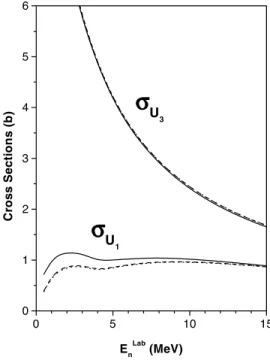
In Fig. 2, the effect of 3NF on the scalar amplitude for the quartet state, U3, is very small, while that for the doublet state, U1, is remarkable, particularly at low incident ener- FIG. 1. The total cross sections,0
tot, ⌬L, ⌬T, and20 tot, of the nd scattering as functions of incident neutron energy in labora- tory system for AV18共solid lines兲, AV18⫹BR-3NF共dashed lines兲, and AV18⫹GS-3NF共dotted lines兲. The dashed lines and the dotted ones overlap each other.
FIG. 2. The total cross sections,U1 andU3, of the nd scat- tering as functions of incident neutron energy in laboratory system for AV18 共solid lines兲, AV18⫹BR-3NF 共dashed lines兲, and AV18
⫹GS-3NF共dotted lines兲. The dashed lines and the dotted ones over- lap each other.
FIG. 3. The total cross sections,WT andWD, of the nd scat- tering as a function of incident neutron energy in laboratory system for AV18 共solid lines兲, AV18⫹BR-3NF 共dashed lines兲, and AV18
⫹GS-3NF共dotted lines兲.
S. ISHIKAWA, M. TANIFUJI, AND Y. ISERI PHYSICAL REVIEW C 64 024001
024001-4
gies. In the latter, however, we cannot distinguish the effect of the BR-3NF from that of the GS-3NF. This result corre- sponds to a well known correlation between calculations of the triton binding energy and those of the nd doublet scat- tering length关21,7兴, which means that the doublet scattering amplitude at low energies is governed essentially by a posi- tion of the 3N bound state pole.
The effect of 3NF on the tensor amplitude WT has an interesting feature as shown in Fig. 3, where the effect of the BR-3NF on WT is quite appreciable at large incident ener- gies, while that of the GS-3NF is almost negligible. This means that the BR-3NF contributes to Im(WT) as a nd ten- sor force due to the spin dependence. In the figure, WD
⫽3/
冑
220tot, which is newly introduced in the present paper, shows significant 3NF effects except for very low energies with the remarkable dependence on the choice of the 3NF.
The BR-3NF mostly reducesWD by a considerable amount
and changes the sign of WD around 4 MeV. Although the magnitude ofWD is small, refined measurements may iden- tify such 3NF effects.
In summary, we have shown that the four nonvanishing independent forward amplitudes in the nd elastic scattering consist of two scalar amplitudes and two tensor amplitudes, which are related to the two central interactions and the two tensor ones, respectively, and the imaginary parts of these scattering amplitudes are given by the four total cross sec- tions,0
tot, ⌬L, ⌬T, and20
tot. The Faddeev calculations are performed, by which the 3NF effects are shown to be clear in U1, WT, and WD for limited energy ranges, al- though the magnitude of the last cross section is small. It is also found that WTprovides the information of the nd ten- sor interaction effect of the 3NF. These predictions will be encouraging the measurements of the total cross sections to obtain significant information of the interaction between three nucleons.
关1兴W. Glo¨ckle, H. Witała, D. Hu¨ber, H. Kamada, and J. Golak, Phys. Rep. 274, 107共1996兲.
关2兴T. Sasakawa and S. Ishikawa, Few-Body Syst. 1, 3共1986兲; S.
Ishikawa and T. Sasakawa, ibid. 1, 143共1986兲.
关3兴H. Witała, W. Glo¨ckle, D. Hu¨ber, J. Golak, and H. Kamada, Phys. Rev. Lett. 81, 1183共1998兲.
关4兴E. J. Stephenson, H. Witała, W. Glo¨ckle, H. Kamada, and A.
Nogga, Phys. Rev. C 60, 061001共R兲 共1999兲.
关5兴H. Sakai, K. Sekiguchi, H. Witała, W. Glo¨ckle, M. Hatano, H.
Kamada, H. Kato, Y. Maeda, A. Nogga, T. Ohnishi, H. Oka- mura, N. Sakamoto, S. Sakoda, Y. Satou, K. Suda, A. Tamii, T.
Uesaka, T. Wakasa, and K. Yako, Phys. Rev. Lett. 84, 5288 共2000兲.
关6兴H. Witała, D. Hu¨ber, and W. Glo¨ckle, Phys. Rev. C 49, R14 共1994兲.
关7兴S. Ishikawa, Phys. Rev. C 59, R1247共1999兲.
关8兴A. Kievsky, M. Viviani, and S. Rosati, Phys. Rev. C 52, R15 共1995兲.
关9兴M. P. Rekalo and I. M. Sitnik, Phys. Lett. B 356, 434共1995兲. 关10兴G. G. Ohlsen, Rep. Prog. Phys. 35, 717共1972兲.
关11兴W. P. Abfalterer, F. B. Bateman, F. S. Dietrich, Ch. Elster, R.
W. Finlay, W. Glo¨ckle, J. Golak, R. C. Haight, D. Hu¨ber, G. L.
Morgan, and H. Witała, Phys. Rev. Lett. 81, 57共1998兲. 关12兴H. Witała, H. Kamada, A. Nogga, W. Glo¨ckle, Ch. Elster, and
D. Hu¨ber, Phys. Rev. C 59, 3035共1999兲.
关13兴H. Witała, W. Glo¨ckle, J. Golak, D. Hu¨ber, H. Kamada, and A.
Nogga, Phys. Lett. B 447, 216共1999兲.
关14兴M. Tanifuji, S. Ishikawa, and Y. Iseri, Phys. Rev. C 57, 2493 共1998兲.
关15兴M. Tanifuji and K. Yazaki, Prog. Theor. Phys. 40, 1023共1968兲. 关16兴A. de-Shalit and I. Talmi, Nuclear Shell Theory 共Academic,
New York/London, 1963兲, p. 209.
关17兴R. B. Wiringa, V. G. J. Stokes, and R. Schiavilla, Phys. Rev. C 51, 38共1995兲.
关18兴M. R. Robilotta and H. T. Coelho, Nucl. Phys. A460, 645 共1986兲.
关19兴S. Ishikawa, Nucl. Phys. A463, 145c共1987兲.
关20兴S. Ishikawa, Y. Wu, and T. Sasakawa, in Proceedings of the Few-Body Problems in Physics, Williamsburg, VA, 1994, ed- ited by F. Gross, AIP Conf. Proc. No. 334 共AIP, New York, 1995兲, p. 840.
关21兴J. L. Friar, B. F. Gibson, G. L. Payne, and C. R. Chen, Phys.
Rev. C 30, 1121共1984兲.