Japan Advanced Institute of Science and Technology
Title 推移フレーム上の様相命題演算子を持たない命題言語
とその埋め込み
Author(s) 鈴木, 康人
Citation
Issue Date 1999‑03
Type Thesis or Dissertation Text version author
URL http://hdl.handle.net/10119/878 Rights
Description Supervisor:小野 寛晰, 情報科学研究科, 博士
Non-modal propositional languages on transitive frames and their embeddings.
Yasuhito SUZUKI
March 23, 1999
Copyright c
1999byYasuhito SUZUKI
i
Abstract
This thesis reveals that many properties of the non-modal propositional language Land logics on Lwhich is interpreted on transitive frames.
We can nd that there are many unexpected phenomena inL and these logics on transitive frames as compared with them on quasi-ordered frames.
There are no dierences as for the properties of their model theory, for in- stance, the duality theorem holds, generated subframes and homomorphisms preserve validity from their original structures. However, by lacking reex- ivity, it is showed that the expressive powers of L are weaker than that of modal propositional language, and an induced conseqeuce relation of some logics (for instnace, basic propositional logic
BPL
) does not satisfy the de- duction theorem, etc. We gave one reason to dene extensions onBPL
not only as a formula-extension but also as a rule-extension, and discussed their model theory. We also indicate that these dierences disappear by adding a new implication to L.Acknowledgment
This paper is written on many persons' many supports. Firstly, I would like to express my thanks to my parents. They supported me for a long time. I would like to express my sincere gratitude to my supervisor Professor Hiroakira Ono, who encouraged me and was patient with my slow works and considerations. I am thankful to Dr. Kowalski Tomasz for his correction of my strange and poor English sentences and the contents of this thesis.
As far as I can, I followed his suggestions and comments, however, it is my responsible if you nd inappropriate contents in this thesis. Also, I would like to express my gratitude to Professors Naoki Yonezaki, Hajime Ishihara, Yoshihito Toyama and Nobu-Yuki Suzuki checked my drafts in detail. From many friends, in particular, I ought to express my thanks to Kentaro Kikuchi, Mitsuru Takahashi and Tomohiko Morioka. And, nally, I would like to my sincere gratitude to Dr. Michael Zakharyaschev and Dr. Frank Wolter. They not only invited me to this attractive subject but also led my investigations.
Contents
1 Introduction 1
1.1 Historical background: : : : : : : : : : : : : : : : : : : : : : : 1 1.2 Organization of the thesis : : : : : : : : : : : : : : : : : : : : 4
2 Intuitionistic logic and basic modal logic 9
2.1 Syntax of
Int
: : : : : : : : : : : : : : : : : : : : : : : : : : : 10 2.2 Semantics ofInt
: : : : : : : : : : : : : : : : : : : : : : : : : 11 2.2.1 Frame semantics ofInt
: : : : : : : : : : : : : : : : : : 11 2.2.2 Algebraic semantics ofInt
: : : : : : : : : : : : : : : : 14 2.2.3 Relations between the two semantics : : : : : : : : : : 15 2.3 Intermediate logics : : : : : : : : : : : : : : : : : : : : : : : : 17 2.4 Basic modal logicK4
and its extensions : : : : : : : : : : : : 19 2.4.1 Modal logicK
: : : : : : : : : : : : : : : : : : : : : : : 19 2.4.2 Modal logicK4
and its normal extensions : : : : : : : 21 2.5 Godel translation as an embedding : : : : : : : : : : : : : : : 24 2.5.1 Blok-Esakia theorem : : : : : : : : : : : : : : : : : : : 27 2.6 Notes: : : : : : : : : : : : : : : : : : : : : : : : : : : : : : : : 293 The basic system BPL 31
3.1 Transitive frame semantics : : : : : : : : : : : : : : : : : : : : 32 3.2 Natural deduction system of
BPL
: : : : : : : : : : : : : : : : 34 3.3 Hilbert style proof system ofBPL
: : : : : : : : : : : : : : : 36 3.3.1 Hilbert style proof systemHB
ofBPL
: : : : : : : : : 36 3.3.2 Some preparations : : : : : : : : : : : : : : : : : : : : 37 3.3.3 Completeness theorem : : : : : : : : : : : : : : : : : : 40 3.4 Sasaki's results : : : : : : : : : : : : : : : : : : : : : : : : : : 41 3.5 Notes: : : : : : : : : : : : : : : : : : : : : : : : : : : : : : : : 44iii
4 Frames and algebraic structures 47
4.1 Algebraic structures : : : : : : : : : : : : : : : : : : : : : : : 47 4.2 Duality theorem: : : : : : : : : : : : : : : : : : : : : : : : : : 50 4.3 Generated subframes : : : : : : : : : : : : : : : : : : : : : : : 54 4.4 Homomorphisms and isomorphisms : : : : : : : : : : : : : : : 55
5 Extensions of BPL 57
5.1 Expressive power of L and ML : : : : : : : : : : : : : : : : : 58 5.1.1 Local expressive power on quasi-ordered frame : : : : : 58 5.1.2 Global expressive power on quasi-ordered frame : : : : 59 5.1.3 Expressive powers on transitive frame: : : : : : : : : : 61 5.2 Extensions of
BPL
: : : : : : : : : : : : : : : : : : : : : : : : 63 5.3 Semantic consequence : : : : : : : : : : : : : : : : : : : : : : 65 5.4 Kripke completeness : : : : : : : : : : : : : : : : : : : : : : : 67 5.5 BetweenFPL
andGL
: : : : : : : : : : : : : : : : : : : : : : 706 Adding a new implication to the logic BPL 75
6.1 The logic
BiPL
: : : : : : : : : : : : : : : : : : : : : : : : : : 76 6.2 The calculus forBiPL
: : : : : : : : : : : : : : : : : : : : : : 77 6.2.1 Intuitionistic modal logicIntK
: : : : : : : : : : : : : 77 6.2.2 The calculus forBiPL
: : : : : : : : : : : : : : : : : : 80 6.3 Embedding : : : : : : : : : : : : : : : : : : : : : : : : : : : : 83 6.3.1 Embedding into classical bimodal logics: : : : : : : : : 84 6.3.2 Blok-Esakia Theorem for the transitive frames : : : : : 87 6.4 Expressive powers : : : : : : : : : : : : : : : : : : : : : : : : : 88 6.4.1 Local expressive power : : : : : : : : : : : : : : : : : : 88 6.4.2 Global expressive power : : : : : : : : : : : : : : : : : 897 Concluding remarks 93
7.1 Conclusions of this thesis : : : : : : : : : : : : : : : : : : : : : 93 7.2 Classication of proof systems : : : : : : : : : : : : : : : : : : 94 7.3 Semantic consequence relations in other researches: : : : : : : 96 7.4 Further works : : : : : : : : : : : : : : : : : : : : : : : : : : : 97
Chapter 1 Introduction
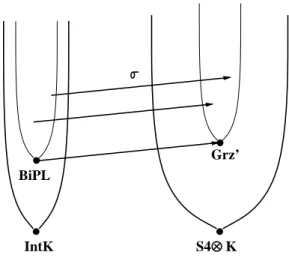
This thesis is a report on extensions of the non-modal propositional logic which is characterized by the class of transitive frames with an intuitionistic interpretation. We show that there exist unexpected dierences between those extensions and propositional intermediate logics and we introduce a way to remove these dierences.
1.1 Historical background
There exists a semantics called frame semantics in the logic. A frame F =
hW;Ri is a pair of a non-empty set W which elements are called possible world and a relationR on W. A frame semantics treats this frame structure.
This frame semantics is well-known in the research into the articial intelli- gence, and the frame structures which relation is transitive are treated very often in the computer and informaiton science. Our interests are this tran- sitive frame semantics and the propositional language which express these structures under the intuitionistic interpretation.
It is well-known that some logic is complete with respect to some class of frames. In particular, the intuitionistic logic
Int
and the modal logicS4
are complete with respect to the class of quasi-ordered frames, and the modal logicK4
is complete with respect to the class of transitive frames.There are many way to investigate properties of dierent logics which have similar models. One way of investigation is an embedding, and it is as follows: Suppose that two logics L1 and L2 are given. If there exists a function f from the language of L1 to the language ofL2 such that it maps
1
Int FPL
BPL K4
GL S4
Non-modal Modal
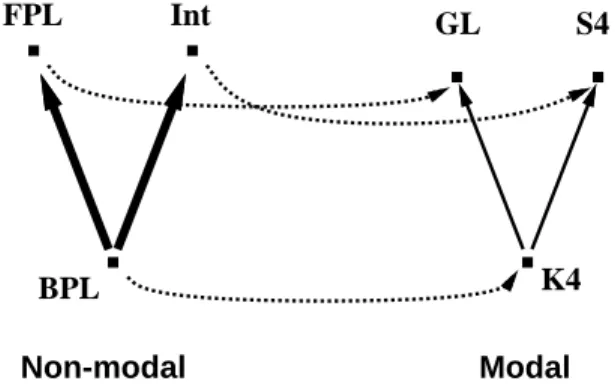
Figure 1.1: The relationship with propositional logics
all theorems and non-theorems of L1 to theorems and non-theorems of L2, respectively, we call this function an embedding of L1 into L2, and we say that L1 isembeddable into L2.
One of well-known embeddings is Godel translation ([God33]). Through- out the thesis, letTstand for Godel translation. Tis also known as McKinsey- Tarski translation, ([MT48]), and S. Maehara obtained the same result in- dependently ([Mae54]). T is an embedding of
Int
intoS4
. We can think of the modal operator 2 ofS4
as expressing informal provability, whereas, the modal operator 2 of Godel-Lob logicGL
expresses the provability of Peano arithmetic.GL
enjoys a xed point theorem, and we can also prove Godel's incompletness theorem from this fact. Modal logicK4
is sometimes called basic modal logic. BothS4
andGL
are normal extensions ofK4
. It is well-known that there are no normal extensions ofS4
which are consistent normal extensions ofGL
.A. Visser looked for a propositional logic that represents formal provabil- ity and enjoys a xed point theorem. In 1981, he found such a logic system and introduced it as a natural deduction proof system ([Vis81]). He called it Formal Propositional Logic
FPL
, and showed thatFPL
is embeddable intoGL
by T. He also introduced Basic Propositional LogicBPL
embeddable intoK4
byTand complete with respect to transitive frames again, as a nat- ural deduction proof system. The propositional logic which is characterized by the class of linear transitive frames is denotedBPLL
.Int
andFPL
(and alsoBPLL
) are extensions ofBPL
. Visser pointed out that there are no extensions ofInt
which are consistent extensions ofFPL
simultaneously.1.1. HISTORICAL BACKGROUND 3 The relationship with these propositional logics is shown in the gure 1.1 . The three arrows \ ", \ " and \ " denote respectively, embeddablity by T, extension by adding rules and extension by adding axioms.
The main results of this thesis are included in [SWZ97], [SO97] and [SWZ98].
We started our investigation by considering these notions introduced by Visser. Since any possible world of transitive frame is not need to be reexive on any possible worlds, we can easily nd models in which all formulas which the outer most connective is implication, for instance, :>, are true.
Throughout this thesis, we will divide the provability into aconsequence relation and a provability of theorem. Let a system L be given. When a formula ' is derived from a set , of formulas in this system L, this denoted by ,`L ', and we call`L aconsequence relation. This consequence relation is dierent from a provablity of theorem which is a possibilty of deducing a formula ' without any assumption in L ; `L ' This division of the prov- abilities yields that a division of modus ponens. Of course we explain this in the corresponding chapter, however we will also explain it here to emphasize this dierence of modus ponens. Usually, modus ponens is expressed as the following gure:
' '!
The modus ponens of consequence relation means that: ,`L'! ;`L ' implies ,;`L ; while, the modus ponens of provability means that
`L ';`L '! implies`L :
In this thesis, we call the later as modus ponens. The former is calledimpli- cation elimination as like an inference rule of natural deduction. The former property is known as the deduction theorem. It is well-known that the de- duction theorem holds in
Int
. We proved that the deduction theorem does not hold on the consequence relation ofBPL
not only on implication connec- tive but also on abstract implication connectives. In 1995, M. Ardeshir and W. Ruitenburg developed Gentzen style propositional sequent calculus forBPL
([AR95]). M. Ardeshir, in his doctoral thesis, introduced Gentzen type sequent calculus of Basic Predicate CalculusGBQC
and proved that cut- elimination theorem holds ([Ard95]). In 1996, M. Ardeshir and W. Ruiten- burg described fundamental properties of Gentzen style predicate calculi ofBQL
andBPL
([AR96]). In 1997, M. Ardeshir investigated strong per- sistence ofBPL
([Rui97]). We can introduce a Hilbert-style system which yields the provability of theorem by the axioms proposed by H. Ono ([Ono97], [SO97]). K. Sasaki also introduced a Hilbert-style system using the same ax- ioms ([Sas98]). In particular, he proved that the consequence relation ofBPL
cannot be introduced by using weak modus ponens. In this thesis, we quoted his results to clarify the provability of theorem inBPL
.It is useful that treating semantics when we discuss general properties of extensions of logic. We adopt the general frame semantics as Visser adopted ([Vis81]) and the algebraic semantics by Ardeshir and Ruitenburg ([AR95]).
The similar results of
Int
's case hold on semantic structures and their sub- structures, and the duality between frames and algebras also holds.There exists a question that what kind of extensions we ought to de- ne. For the case of
Int
, it is usual that any extension is dened by adding formulas as axioms toInt
. However, for the case ofBPL
, some problems occur by using such a extending way, and it is revealed by a notion of expres- sive powers. For quasi-ordered frame semantics, it is showed that expressive powers of the non-modal propositional language is same to that of the modal propositinoal language. It is proved, for instance, by using the embeddingT. While, for transitive frame semantics, it is revealed that expressive powers of the non-modal propositional language is weaker than that of the modal propositional language, and the class of quasi-ordered frames cannot be ax- iomatizable. But, Visser showed that the class of all quasi-ordered frames is axiomatizable by adding inference rules ([Vis81]). We also adopt Visser's way, that is, an extension ofBPL
is dened by adding inference rules. We showed that there exists a logic characterized by nite frames which is not Kripke complete, and there are not isomorphism between extensions ofFPL
and normal extensions of
GL
like the Blok-Esakia theorem.These dierences disappear, however, when we add a new implication connective.
1.2 Organization of the thesis
Our goal is to clarify dierent properties of non-modal propositional logics, which are characterized by a class of quasi-ordered frames and a class of transitive frames. It means that we will advance our research by a comparison with results that hold on intermediate logics and normal extensions of
S4
. In1.2. ORGANIZATIONOF THE THESIS 5 Chapter 2, we will review those results, which are related to our investigation, of intermediate logics, modal logics and their semantics.
In Chapter 3, we will introduce proof systems of
BPL
. Visser introducedBPL
because it is embeddable inK4
([Vis81]). He seems to dene his natural deduction proof system ofBPL
from transitive frame semantics. We will present it in Section 3.1 . Then we will briey mention Visser's natural deduction proof system ofBPL
. In his system, no implication elimination rule is introduced. It leads to the fact that ,; ` is, in general, not derivable from , ` '! and ` . Indeed, in Section 3.2, we will prove that deduction theorem hold neither for the implication!nor any formulas whatsoever. This result is forcing us to consider the consequence relation\`" when we investigate an extension of
BPL
. The question of a Hilbert style calculus forBPL
, which had been an open problem, is taken up in Section 3.3 . We introduce a systemHB
which is identical toBPL
([SO97]) with respect to the provability of theorems. In systemHB
, we showed that deduction theorem does not hold not only on usual implication but also on another complex connectives. In Section 3.4, we will address a result of Sasaki's related toHB
([Sas98]). Sasaki indicates that we can dene the consequence relation ofBPL
by axioms ofHB
and modus ponens without any sets of assumptions. He also stated that we cannot get the consequence relation ofBPL
by implicationeliminationrule alone. The results in Chapter 3 are also important when we discuss the extensions ofBPL
in Chapter 5.In Chapter 4, after introducing an algebraic semantics of
BPL
, we will analyse the relationship between transitive frames and algebraic structures.We will proved that these are similar to the case of
Int
. One of main results in Chapter 4 is a duality theorem, that is showed in Section 4.2 . Generated subframes and p-morphisms are discussed in Section 4.3 and 4.4, respectively.We need them in Chapter 5.
Then, we turn to the relationship between
BPL
and modal logic. It is well-known that there is a one-to-one correspondence between extensions ofInt
(intermediate logics) and normal extensions of Grzegorczyk logicGrz
. This result is called Blok{Esakia theorem ([Esa79a, Esa79b, Blo76]). The modal operator 2 ofGrz
corresponds to the provability in a set theory. We will discuss whether or not a similar relationship holds betweenFPL
andGL
, and we will clarify relations between extensions ofBPL
and normal extensions ofK4
in general. However, since inBPL
, implication elimination does not hold, some problem occurs. First we will introduce a notion of global expressive power to clarify the relationship betweenBPL
andK4
. ByFPL
BPL Cl
GL
K4 S4 Grz
Int
Blok-Esakia
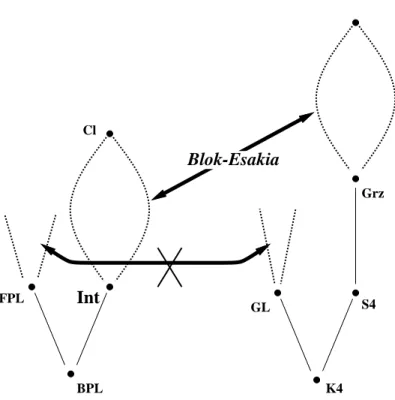
Figure 1.2: Lattice structures of extensions
this notion, it is proved that the frames of all quasi-ordered frames is not obtained by adding any number of axioms to
BPL
. This result leads us that not only axioms but also inference rules are good to dene an extension ofBPL
. Therefore, consequence relations play main role whenever we consider extensions ofBPL
. These results are introduced in Section 5.1 and 5.2 . In the case ofInt
and its extensions, we dene their semantics by using a validity on a class of frames (and, on a class of algebras). On the other hand, extensions ofBPL
will be dened by a consequence relation. Thus we have to introduce consequence relations in terms of semantics. They are discussed in Section 5.3 . Consequence relations ofBPL
and its extensions, and also consequence relations of semantic structures are dened, and Kripke completeness on some consequence relations is discussed in Section 5.4 . It is completely dierent from intermediate logics that there exists an extension, which is characterized by a nite general frame but Kripke incomplete. One object of this research is to clarify whether Blok-Esakia type theorem holds or not on extensions ofFPL
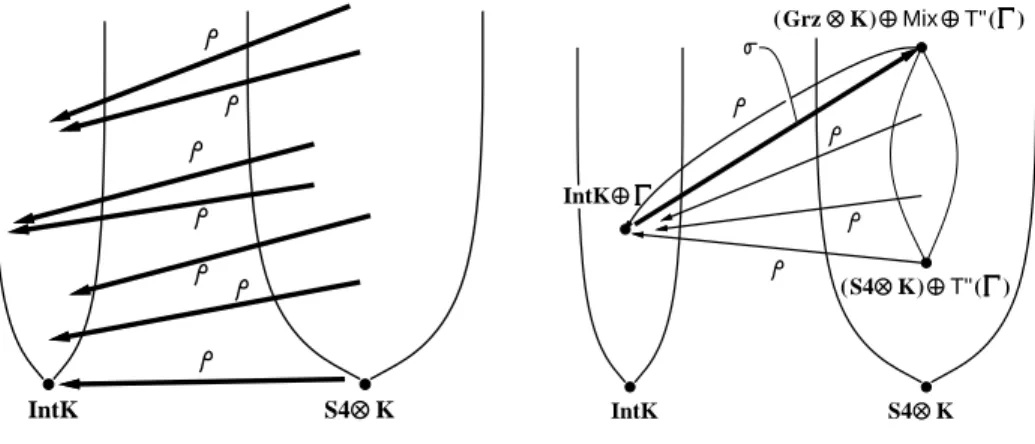
and normal extensions ofGL
. In Section 5.5, using these consequence relations and some caliculations, we show that there1.2. ORGANIZATIONOF THE THESIS 7
Int BPL
deduction theorem 0
duality theorem 0
generation theorem 0
substructures and
homomorphisms 0
Blok-Esakia theorem 0
Kripke completeness
with nite general frames 0
quasi-ordered frame transitive frame
global expressiveness 0 0
local expressiveness 0 0
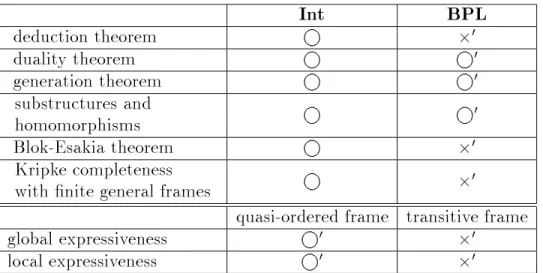
Table 1.1: Results of this thesis. (The symbols with 0 are our results.) is no isomorphism between extensions of
FPL
and normal extensions ofGL
. This result can be illustrated by Figure 1.2.In Chapter 6, it is proved that some properties which don't hold in
BPL
but hold in
Int
, hold by introducing another new implication \,!" to the propositional language. In Section 5.1, to clarify whatBPL
lacks in compar- ison withInt
, we will introduce a notion that local expressive power and we will show that a relationship between local expressiveness of quasi-ordered frames and local exrpressiveness of transitive frames. Conspicuous dierences occur because \!" in transitive frames is not able to talk about reexivity.Thus, our solution is simple. We will introduce a new implication which can talk about the reexivity and will show that the dierences among
BPL
andInt
are recovered by the help of this implication. The logic obtained fromInt
by adding axioms for ,! is denoted byBiPL
. It is proved thatBiPL
can be translated into an intuitionistic modal logic since the behavior of \,!"
is the same of the implication of
Int
. In Section 6.3, many properties hold onBiPL
as similar toInt
. For instance, it is proved that the Blok-Esakia theorem holds on transitive frames.In Chapter 7, we will discuss existing representative researches of
BPL
, its related logics, and further works. This attractive subject related toBPL
is not studied enough. The contents of the researches are classied into topics in terms of syntax and semantics.
Before closing Chapter 1, we put our results of this thesis into Table 1.1.
In the above table, our results is added a prime symbol.
Throughout this thesis, \Theorem" means a new result obtained in our thesis, whlie \Proposition" means a result which is shown already.
Chapter 2
Intuitionistic logic and basic modal logic
In this chapter, we will give a short survey on intuitionistic propositional logic
Int
, basic modal logicK4
and their extensions. Here, we will explain the terminology and notions which are used in this thesis. We will also recall basic properties in order to compare them withbasic propositional logicBPL
discussed in the present thesis. For the detail we refer here the reader e.g., to [CZ97] or [MR74].
We will start with
Int
. After introducing the Hilbert style proof system, we will explain both frame semantics and algebraic semantics forInt
. We will also give the notion of consistent extensions (intermediate logics) ofInt
. We will show that there exists a direct correspondence between frame semantics and algebraic sematnics.Sometimes, modal logic
K4
is called basic modal logic, since some impor- tant modal logics are extensions ofK4
. Modal logicK4
is itself an extension ofK
. Thus, we will rst give the Hilbert style proof system ofK
. In exten- sions of modal logics, some complex problems occur in treating the modal operator 2. Here, we will discuss only normal extension. After introducing the Hilbert style proof system ofK4
andS4
, we will mention a complete- ness theorem ofK4
andS4
, with respect to transitive frame semantics and quasi-ordered frame semantics, respectively.Modal logics
S4
andGodel-Lob Logic (GL
) are normal extensions ofK4
. An embedding of a logicL into another logic L0 is a function translating the- orems (and non-theorems) of L into theorems (and non-theorems) of another logic. One of well-known embeddings is the Godel translation T. T embeds9
Int
intoS4
, but it can also be regarded as an embedding of each extension ofInt
into a normal extension ofS4
. The study of this translation T is in- teresting, since some properties can be preserved byT. Also, we will explain the Blok-Esakia theorem without proofs.2.1 Syntax of Int
In the present thesis, we will x a (non-modal) propositional language L. Let Prop be the set of propositional variables. Letters p;q;r;::: will denote propositional variables. ForL denotes the set of formulas constructed from Prop;^;_;! and ? in the usual way. Greek letters '; ;;::: will denote formulas. When we want to emphasize that a given formula is an element of ForL, we will call it an L-formula. We consider >and the negation :' of a formula' as abbreviations of ?!?and '!?, respectively.
The Hilbert style proof system of
Int
consists of the following axiom schemes and inference rules:Axiom schemes:
(A1) '!( !'),
(A2) ('!( !))!(('! )!('!)), (A3) '^ !',
(A4) '^ ! ,
(A5) '!( !'^ ), (A6) '!'_ ,
(A7) !'_ ,
(A8) ('!)!(( !)!('_ !)), (A9) ?!';
Inference rule:
Modus ponens (MP): from ' and '! , infer .
2.2. SEMANTICS OF
INT
11 A derivability `Int of this system is dened in the usual way. We identify a systemL with the set of theorems of L in this chapter. Thus,Int
means the set f'2ForL:`Int 'g of theorems ofInt
.As for the consequence relation`Int, the following theorem is well-known:
Proposition 2.1 (deduction theorem)
Suppose , is a set of formulas, then ,;'`Int if and only if ,`Int'! :2.2 Semantics of Int
We will refer two kinds of sematics. In this section, we will introduce a frame semantics of
Int
, and then an algebraic semantics ofInt
. At the end of this section, we will show relationships between frame semantics and algebraic semantics.2.2.1 Frame semantics of Int
Let W be a non-empty set called a set of possible worlds, and R be a quasi- order (i.e., a reexive and transitive relation) on W. A subset of X of W is an R-cone whenx2X and xRy imply y 2X for any x, y in W. We denote the set of allR-cones in W by UpW. Note that the empty set; is a member of UpW.
Next, we will dene the following binary operation on W, and call it set implication:
X Y =fx2W :8y(xRy^y2X )y2Y )g: (2.1) It is easy to see that ;;=W, and X Y is an R-cone if both X and Y are so.
Anintuitionistic quasi-ordered frame F is a triplehW;R;Pi such that W is a non-empty set of possible worlds, R a quasi-order on W, and P is a set of R-cones which contains the empty set ; and which is closed under the set union, set intersection and set implication . Sometimes, we use the word an intuitionistic frameto denote a frame F(=hW;R;Pi) where P is a subset of the set of R-cones. For a given frame hW;R;Pi, if R is a partial order (i.e., a reexive, transitive and anti-symmetric relation) on W, we call it intuitionistic partially ordered frame.
If a given intuitionistic frameF is of the formhW;R;UpWi, we call it an intuitionistic Kripke frameand denote it by hW;Ri.
We often omit the prex word \intuitionistic". However, in the later sections, we will treat a frame structure for modal logic. To distinguish frames of non-modal propositional logic and modal propositional logic, we add the prex word \intuitionistic" (\modal") to the former (later) structures.
AvaluationVonF(=hW;R;Pi) is any function from Prop toP. Amodel
M based on F is dened to be a pair hF;Vi of a frame F and a valuation V on it.
The truth relation j= is dened as follows:
(M;x)6j=?; (2.2)
(M;x)j=p i x2V(p); (2.3)
(M;x)j='^ i (M;x)j=' and (M;x)j= ; (2.4) (M;x)j='_ i (M;x)j=' or (M;x)j= ; (2.5) (M;x)j='! i 8y 2W(xRy and (M;y)j=' imply
(M;y)j= ): (2.6)
A formula' is true atx in Mif (M;x)j='. A formula ' isfalse at x in M if ' is not true at x in M. If (M;x)j=' for any x2W, we say ' is true in
Mand denote it by Mj='. IfMj=' holds for all modelM based on F, we say ' isvalidin Fand denote it byF j='. For a given x2W, if (M;x)j=' for all modelsMbased on F, we say ' is valid at x inF and we denote it by (F;x)j='. LetC be a class of frames. If' is valid in all frames of C, we say that ' is validin C and denote it byCj='. The above notions of truth and validity can be extended to any set , of formulas. That is, if all formulas of , are true (valid) on a semantic structure, then , is true (valid) on that semantic structure. For instance, , is true at x in M if (M;x) j= ' for any formula' of ,, and we will denote it by (M;x)j= ,. A set , of formulas is valid in C if C j=' for any formula ' of ,, and is denoted by C j= ,. For a set , of formulas and a classCof frames, if , is equal to the setf' :Cj='g, then we say , is characterized (or determined) by C. For any intuitionistic frameF, any set , of formulas and any formula ', , j=F ' denotes that for any model Mbased on F and any possible world x of F, if (M;x)j= , holds then (M;x)j=' holds.
We can show the following completeness theorem.
2.2. SEMANTICS OF
INT
13Proposition 2.2
Let C be the class of intuitionistic partially ordered (or quasi-ordered) frames. Suppose that,is a set of formulas and'is a formula., `Int ' if and only if for any model M and any x, (M;x) j= , implies (M;x)j='.
Suppose F(=hW;R;Pi) and G(=hV;S;Qi) are given. Ahomomorphism f from F to G is a map from W to V which saties the following three conditions:
1. xRy )f(x)Sf(y),
2. f(x)Sz)9y2W(xRy^f(y) = z),
3. X 2Q)f,1(X)2P where f,1(X) =fx2W : f(x)2Xg. When a homomorphism from F to G is surjective, we call it a reduction (or a p-morphism). For given frames F and G, if there exists a homomorphism from F to G, we say that F is reducible to G. If a homomorphism f from F to G is a bijective map and f,1 is a homomorphism from G to F, we call f an isomorphismfromF to G. If there exists an isomorphism fromF to G, we denote this as F ' G, and say that F and G are isomorphic. A reduction f of F to G is called a reduction of a model M =hF;Vi to a model N=hG;Ui if V(p) = f,1(U(p)) for every p2Prop, i.e.,
(M;x)j=p i (N;f(x))j=p:
Models M(= hF;Vi) and N(= hG;Ui) are isomorphic if there is an isomor- phism f from F to G such that U(p) = f(V(p)) for every p 2 Prop, i.e., for every x2W,
(M;x)j=p i (N;f(x))j=p:
We denote it by M'N.
Proposition 2.3
Let f be a reduction of a model M = hF;Vi to a modelN=hG;Ui. Then, for any point x of F and any formula ', (M;x)j=' holds if and only if (N;f(x)) j= ' holds. If F is reducible to G, then for every formula ', Fj='implies Gj='.
Another structure-preserving notion is that of a substructure. The follow- ing is a substructure in the context of frame semantics. Agenerated subframe
G of a given frame F = hW;R;Pi is a structure hV;S;Qi such that V is an R-cone, S is the restriction of R to V and Q is the set fX \V : X 2Pg. It is easy to show that any generated subframe of intuitionistic quasi-ordered (partially ordered) frame is an intuitionisitc quasi-ordered (partially ordered) frame.
Proposition 2.4
Let G(=hV;S;Qi) be a generated subframe of F. Suppose thatMishF;ViandNishG;Ui, where U(p) =V(p)\V for every propositional variables p. Then, for any point x ofV and any formula', (M;x)j='holds if and only if (N;x)j=' holds. Thus, Fj='implies Gj='.2.2.2 Algebraic semantics of Int
Suppose hA;^;_;0;1iis a bounded distributive lattice. For elementsa;b of A, the greatest element of the setfx2A : a^xbg, if it exists, is called the relatively pseudo-complement of a with respect to b, and write it as a ! b.
A Heyting algebra A is a structurehA;^;_;!;0;1iwhere hA;^;_;0;1iis a bounded distributive lattice and ! is the relative pseudo-complement.
Avaluation VonAis any function from Prop toA. For a given valuation
V, we will associate any formulas to algebraic terms by putting V(?) = 0 and V(' ) =V(')V( ) where 2f^;_;!g.
A truth relation j= on Ais dened as follows: For any valuation Von A, if V(') = 1, we say that ' is valid in A and write Aj='. If A j= ' for all '2,, then we write it asAj= ,. For a class C of Heyting algebras, ifAj= , holds for any A2C, then we write Cj= ,.
Suppose , is a set of formulas. If , is nite,V, denotes the conjunction of all elements of ,. For any valuationVon A, if there exists a nite subset ,0of , such that V('^V,0) =V(V,0) (that is, V(V,0)V(')), we denote it by ,j=A '. If ,j=A ' for any A in a classC of Heyting algebras, then we denote this as ,j=C '.
For any A, it is trivial that A j= ' implies , j=A ' for every , and ', since V(') = 1 holds for any valuaion V on A.
Suppose formulas ' and are given. We call the form ' = equation of formulas ' and . Let , be a set of equation of formulas. In this set ,, we think of ' is the abbreviation for '^ = '. We write A j= ,, if
V(') = V( ) holds for any equation ' = of , and any valuationV on A, and we say , isvalid on A.
The following completeness theorem holds:
Proposition 2.5
Let C be the class of Heyting algebras. Suppose , is a set of formulas and 'is any formula. Then ,`Int 'holds if and only if,j=C ' holds.Suppose A(=hA;^A;_A;!A;0A;1Ai) and B(=hB;^B;_B;!B;0B;1Bi) are given. A homomorphism h from A into B is a map from A to B which
2.2. SEMANTICS OF
INT
15 preserves each operation: that is, h(aA b) = h(a)B h(b) for each 2f^;_;!g, h(0A) = 0B and h(1A) = 1B. If a homomorphism from A into
B is injective, it is called an embedding of A into B. If a homomorphism from A into B is surjective, it is called an epimorphism, and B is said to be homomorphic image of A. If an embedding of A into B is onto, we call it an isomorphism. If there exists an isomorphism of A onto B, we say A is isomorphic to B and denote it by A'B.
Proposition 2.6
Let A be a Heyting algebra, and B a homomorphic image of A. Then, for any formula ', Aj='implies Bj='.A subalgebra B of A = hA;^;_;!;0;1i is a structure hB;^;_;!;0;1i where B is a subset of A such that B is closed under each operation of A. It is easy to see that any subalgebra of Heyting algberba is Heyitng algebra.
Proposition 2.7
Let B be a subalgebra of A. Then, for any formula ',Aj=' implies Bj='.
Suppose a Heyting algebra A(=hA;^;_;!;0;1i) is given. A lter r in
A is a subset of A which satises 1) a;b2r impliesa^b2r, 2) a2r and ab imply b2r.
A proper lter r is a lter in Awhich satises 3) r6=A.
A prime lter r is a proper lter such that 4) a_b2r impliesa2r and b2r.
The dual notions of the above lters are ideal, proper ideal and prime ideal. That is, an ideal in A is a subset of A which satises
1') a;b2 impliesa_b2, 2') a2 and ba imply b2.
A proper ideal in A is an ideal in Awhich satises 3') 6=A,
A prime ideal in A is a proper ideal in Asuch that 4') a^b2 impliesa2 or b2.
When we discuss a representation of Heyting algebras, ideals and prime lters play the main role. We will show this in the next section.
2.2.3 Relations between the two semantics
By the completeness theorem of
Int
with respect to both semantics, we can show that ' is valid in any inutionisitic partially ordered frame if and onlyif ' is valid in any Heyting algebra. However, this result can be deduced in a more direct way. In the following, we will give a way of constructing a Heyting algebra from an intuitionistic partially ordered frame, and vice versa. Then, we will show that the validity of each formula is preserved by these constructions.
Suppose that an intuitionistic frameF(=hW;R;Pi) is given. Thedualof
F
+ is a structurehP;\;[;;;;Wi, where\, [and is the set-intersection, set-union and set-implication which is dened by (2.1), respectively. The following is well-known.
Proposition 2.8
For any intuitionistic partial-ordered frame F, F+ is a Heyting algebra. Moreover, for any formula ', Fj=' if and only if F+ j='. Conversely, suppose that a Heyting algebra A(= hA;^;_;!;0;1i) is given. Let WA be the set of all prime lters,p
be a map from A to the power set of WA such thatp
(a) = fr 2 WA : a 2 rg and PA be the setf
p
(a) : a2Ag. We will dene a relation RA on WA as follows:r
0RAr1 i 8a;b2A(a!b2r0 and a 2r1 imply b2r1):
The dual A+ of Ais a structure hWA;RA;PAi. The following result holds.
Proposition 2.9
For any Heyting algebra A, A is an intuitionistic partially ordered frame. Moreover, for any formula ', Aj=' if and only if A+j='.For a given intuitionistic frame F, the intuitionistic frame (F+)+ is called thebidual ofF. Similarly, for a given Heyting algebraA, the Heyting algebra (A+)+ is called the bidual of A. Both kinds of biduals are useful when we try to construct a counter model for a given formula. When we consider the bidual (A+)+ of a given algebraA=hA;^;_;!;0;1iwhere its universeA is nite, we may consider a possibility thatPA becomes uncountable. However, for Heyting algebras, the following representation result holds. We will call the following dualtiy theorem on Heyting algebras.
Proposition 2.10 (duality)
For any Heyting algebra A, A'(A+)+. In the case of general frames an analogous result does not hold in general as the following example shows.Example 2.11
Let F be hW;R;fW;;gi where W is the set fa;b;cg and R is the reexive and transitive closure of fha;bi;hb;cig. In this case, F+ is a 2-valued Boolean algebra. Therefore, (F+)+ consists of a single reexive point.2.3. INTERMEDIATE LOGICS 17 We need the following conditons for a given bidual of a frame to be isomorphic to an original frame. Let a set X be given. Suppose Y be a subset of the power set of X. Then, Y has the nite intersection propertyif for any nite subset Y0 of Y , TY06=;.
Denition 2.12
F=hW;R;Pi is descriptiveif 1) x = y i for any X 2P(x2X ,y2X),2) xRy i for any X;Y 2P(x2X Y and y2X )y2Y ),
3) hW;Pi is compact, i.e., for all X P and all Y fW ,X :X 2Pg if
X [Y has the nite intersection property then \(X [Y)6=;. Then, we have the following duality theorem on frames.
Proposition 2.13 (duality)
For any frame F, F ' (F+)+ if and only if F is descriptive.In fact, there exist the following relations between dual structures and homomorphisms.
Proposition 2.14
(i) If G = hV;S;Qi is a generated subframe of F =hW;R;Pithen the map f from P to Q dened by f(X) = X\V for X 2 P is a homomorphism from F+ onto G+.
(ii) If f is a homomorphism from A onto B then f+ from WB to WA dened by f+(r) = f,1(r) for a prime lter r of B, is an isomorphism from B+ onto a generated subframe of A+.
(iii) If h is a reduction of F = hW;R;Pi to G = hV;S;Qi then the map h+ from P to Q dened by h+(X) = h,1(X) for X 2Q, is an embedding of
G
+ into F+.
(iv) If B is a subalgebra of A then the map h dened by h(r) = r\B,
r a prime lter in A and B the universe of B, is a reduction of A+ to B+.
2.3 Intermediate logics
In this section, we will consider extensions of
Int
which are usually called superintuitionistic logic. Let us strat with the syntactic side. Any maps from Prop to ForLis called asubstitution. For any formula' and any substitution s, 's is dened inductively as follows:1) ps = s(p) for any p2 Prop, 2) ?s =?,
3) (' )s = 's s for 2f^;_;!g.
A setL of formulas is called asuperintuitionistic logic (si-logic), if it satises the following three conditions:
Int
L,L is closed under modus ponens (MP),
L is closed under substitution (Subst):
for any substitutions, ' 2L implies 's2L.
For any set , of formulas, s, is f's : ' 2 ,g, and S(,) is the substitution closure of ,, i.e.,S(,) =f's : s is any substitution g. A si-logic L is called intermediate logic if it is consistent (i.e., ? 62 L). We write Ext
Int
for the class of intermediate logics.It is well-known that Ext
Int
forms a lattice by using some operators. We dene + as a binary operator on ForLsuch that ,1 + ,2 is the smallest set containing the union ,1[,2which is closed under both MP and Subst. Since L =Int
+L always holds for any si-logic L, any si-logic L can be represented in the formInt
+ , for some set , of fomulas. For instance, the classical propositional logicCl
has the formInt
+p_(p!?). Let Li =Int
+,i for i = 1;2. Then L1+L2 is equal toInt
+ (,1 [,2).LetL be
Int
+ ,. For any and ', we write `L' if S(,[) `Int'.This is well-known that for all intermediatelogicsL1andL2, bothL1+L2and the intersectionL1\L2 become intermediate logics. Moreover the following holds.
Proposition 2.15
hExtInt
;\;+;Int
;Cl
iforms a bounded distribuitive lat- tice.Next, we will discuss semantics for extensions of
Int
. Let LogCbe the set of formulas which are valid in C, i.e., LogC=f' : Cj='g. An intermediate logic is Kripke complete if it is charcterized by some class of intuitionistic Kripke frames. An intermediate logic L is strongly characterized by C if for any set , of formulas and any formula',,`L' i ,j=F '; for every F inC:
Proposition 2.16
Every intermediate logic is characterized by a class of Heyting algebras. Hence, every intermediate logic is characterized by a class of intuitionistic general frames.2.4. BASIC MODAL LOGIC
K4
AND ITSEXTENSIONS 19 L is strongly Kripke complete ifL is strongly characterized by some class of Kripke frames. A logic L is said to be nitely approximable (or to have a nite model property) if L is characterized by a class of nite frames. It is known that there exists an intermediate logicL which is not Kripke complete or which is not nitely approximable. As forInt
, we have the following.Proposition 2.17 Int
is strongly Kripke complete and nitely approximable.2.4 Basic modal logic K4 and its extensions
Sometimes,modal logic
K4
is calledbasic modal logicsince some of important modal logics are extensions ofK4
. We will often use some properties which are associated with modal logicsK4
,S4
,Grz
,GL
and their extensions. In this section, we will recall an introductory information about these logics. We will begin with the Hilbert-type proof system ofK
, and its frame semantics.Here, we will consider onlynormal extensionsof
K4
. Then, we will introduce the syntax and frame semantics ofK4
andS4
. From the fact that each extension ofS4
has a quasi-ordered frame semantics, there will be a relation between intermediatelogics and extensions ofS4
. This topic will be discussed in the next section.2.4.1 Modal logic K
First, we will x a modal propositional language ML. The set ForML is constructed from Prop, ^, _, !, 2 and ? in the usual induction. We call each element of ForMLamodal formulaor aML-formula. We take3' and
2
+' to be the abbreviation of :2:' and 2'and', respectively, and 2n' to denote the following formula:
i) 20' = ',
ii) 2n+1' =22n'.
TheHilbert-style proof systemof
K
consists of the following axiom schemes and inference rules:Axiom schemes:
(
Int
) Axiom schemes (A1),::: , (A9) ofInt
, (Cl
) '_('!?),(dist) 2('! )!(2'!2 ).
Inference rules:
MP,
Necesitation (RN) : from a formula ', infer 2'.
As usual,`K' means1 that ' is derived from the above axiom schemes and inference rules.
Then, we will introduceframe semanticsforML. LetW be a non-empty set of possible worlds and R a relation on W. The box operator 2 on 2W (the power set ofW) is dened as follows. For any subset X of W,
2X =fx2W :8y(xRy)y 2X)g:
Amodal frameis a triplehW;R;PiwhereP is a subset of 2W which contains both W and ; and is closed under the set-dierence, set-intersection, set- union and 2 on 2W. If R is a transitive relation (or a quasi-order) on W, a frame hW;R;Pi is called a modal transitive frame (or a modal quasi-ordred frame). A modal Kripke frame is a frame of the form hW;R;2Wi, and we denote it by hW;Ri. A valuation V in a modal frameF(=hW;R;Pi) is any function from Prop to P. A model based on F is dened to be a pair hF;Vi of a frame F and a valuationVin it.
For a given valuationVin a given frameF, thetruth relationj= determined byVis dened as follows:
(M;x)6j=?; (2.7)
(M;x)j=p i x2V(p); (2.8)
(M;x)j='^ i (M;x)j=' and (M;x)j= ; (2.9) (M;x)j='_ i (M;x)j=' or (M;x)j= ; (2.10) (M;x)j='! i (M;x)6j=' or (M;x)j= ; (2.11) (M;x)j=2' i 8y 2W(xRy implies(M;y)j='): (2.12) Similar to Section 2.2, validity and all associated notions, in a given modal frame can be dened in a usual way. The following completeness theorem is known.
1Here, we will treat not only a consequence relation ofK but also the provability of theorems ofK.