The effect of sevoflurane or propofol with or without an
anti-emetic dose of droperidol on the QTc interval and the
transmural dispersion of repolarization
Ryuji Kajikawa, Hiromichi Kamamoto, Mayuka Shiba, Tomohisa Uchida, Toru Shirai, Kenji Hiramatsu, Koichi Futagawal, and Shinichi Nakao
Department of Anesthesiology, Kinki University Faculty of Medicine,
Osakasayama, Osaka 589-8511, Japan
'Department of Anesthesiology , Nara Hospital Kinki University Faculty of Medicine, Ikoma, Nara 630-0293, Japan
Abstract
Purpose : Sevoflurane and droperidol but not propofol induce QTc interval prolongation, but
there are several conflicting reports. We inves-
tigated the effects of sevoflurane and propofol
with or without an anti-emetic dose of droperidol
on the QTc interval and the transmural disper-
sion of repolarization for 2 hours, and the QT
interval was adjusted for the patient's heart rate
using 3 formulae.
Methods : One hundred two American Society of Anesthesiologists (ASA) physical status I-II
patients, aged 20-70, were randomly allocated to
one of four groups : Group 1 (n=25) receiving
sevoflurane anesthesia without droperidol (1.25 mg), Group 2 (n=26) receiving sevoflurane
anesthesia with droperidol, Group 3 (n= 25) receiving propofol anesthesia without droperidol,
or Group 4 (n=26) receiving propofol anesthesia
with droperidol. RR intervals, QT intervals, and Tp-e intervals, which indicates the dispersion of
ventricular repolarization (TDR), were mea-
Introduction
Prolongation of the QT interval on an electro- cardiogram (ECG) is associated with torsade de pointes (TdP), a malignant polymorphic
ventricular tachyarrhythmia. It has been report- ed that sevoflurane inhibits not only HERG
sured. The QT interval was adjusted for the patient's heart rate using the formulae of
Bazett, Fridericia, and Matsunaga.
Results : Sevoflurane significantly prolonged the QTc, but droperidol did not enhance sevo- flurane-induced QTc prolongation in all the formulae. Conversely, propofol did not affect the QTc in all formulae. Tp-e intervals were not affected in any of the groups.
Conclusion : Although it significantly prolongs the QTc interval, sevoflurane, even with droper- idol, does not seem to cause lethal arrhythmias associated with QT prolongation, because it does not induce Tp-e prolongation. Propofol is safer than sevoflurane in terms of arrhythmias as- sociated with QT interval prolongation.
Bazett's formula is reliable for detecting anes- thetic-induced QT prolongation.
Key words : QTc interval, Tp-e interval, sevo- flurane, droperidol, propofol
(human ether-a-go-go-related gene) currents (Ikr)' but also LQT1/minK currents (Iks) and Kv4.3 currents (Ito),2'3 and induces significant QT interval prolongation."5 Saussine et al.
reported that TdP occurred during sevoflurane anesthesia in a child with congenital long QT syndrome.6 however, there have been some con-
Received May 2, 2012 ; Accepted November 15, 2012
corresponding author : Shinichi Nakao Department of Anesthesiology, Kinki University Faculty of Medicine
flicting reports on sevoflurane-induced QT inter- val prolongation.7-9 In contrast, propofol is generally believed to have no effect on the QT interval."5 Droperidol is a butyrophenone antipsychotic drug and, at low doses (0.625-1.25 mg), droperidol has been widely used as an anti- emetic drug. In 2001, the United State Food and Drug Administration (FDA) issued a "black box" warning regarding the use of droperidol and the potential for drug-induced QT interval prolongation and TdP, and recommended that ECG monitoring be continued for 2-3 h after droperidol administration. Although droperidol blocks the Ikr and causes an increase in action potential duration (APD), reports on QT inter- val prolongation are also conflicting,"-'4 prob- ably because the observation times are so short (<30 min).
Recent studies have revealed that susceptibility to TdP arises from induction of early after de- polarization and increased dispersion of ventricular repolarization, rather than QT inter- val prolongation per Se.5'15-19 Transmural dis- persion of repolarization (TDR) across the myocardial wall can be measured on the ECG as the time interval from the peak to the end of the T wave (Tp-e).2° Shah argues that Bazett's QTc interval prolongation alone is a poor surrogate marker for the risk of TdP.2' Unlike the QTc interval, neither propofol nor sevoflurane have been reported to have any effect on the Tp-e interval.5 Furthermore, the use of Bazett's for- mula is rooted deeply in medical practice, but this equation has been criticized because of its inaccuracy,22 because it overcorrects the QT interval at fast heart rates and undercorrects the QT interval at slow rates, suggesting that the QTc would be prolonged if the heart rate increase and vice versa.
In this study, we recorded ECG monitoring under sevoflurane or propofol anesthesia, with or without droperidol (1.25 mg), for 2 hours and measured the QTc intervals using three different QTc formulae, Bazett's, Fridericia's, and Mat- sunaga's. The TDR was simultaneously calcu- lated using the Tp-e interval.
Methods
After obtaining institutional approval (H070128) form Kansai Medical University (Osaka, Japan) Human Subjects Review Com- mittee and written informed consent, we enrolled
102 patients classified as ASA physical status I or II. We recruited patients, aged between 20 and 70 y, undergoing various kinds of elective surgery such as abdominal, gynecological, urological, and otorhinolaryngological surgery, with an expected duration of more than 2 h.
Patients on medications known to prolong the QT interval and/or with an abnormal QTc prolongation (> 450 ms by Bazett's formula) were excluded. The patients were randomly allocated to one of four groups : Group 1 (n=
25) receiving sevoflurane anesthesia without droperidol, Group 2 (n=26) receiving sevoflur- ane anesthesia with droperidol, Group 3 (n=25) receiving propofol anesthesia without droper- idol, or Group 4 (n= 26) receiving propofol anesthesia with droperidol. An epidural catheter was inserted before anesthesia induction at the doctor's discretion. In all patients, the II lead was recorded throughout the operation. ECG signals were networked to a sever storage system and the ECG recordings were retrieved after the operation. In Group 1 and Group 2, anesthesia was induced with 2 mg/kg propofol, 100 ,u g fentanyl, with or without 1.25 mg droperidol, and intubation was carried out after administra- tion of 0.1 mg/kg vecuronium. Anesthesia was
maintained with 1.5-2.5% sevoflurane with 02 and air and intermittent fentanyl administration and/or epidural anesthesia. In Group 3 and Group 4, anesthesia was induced with TCI (tar- get control infusion) of propofol at a target concentration of 4 I/ g/ml, 100 ,ug fentanyl with or without 1.25 mg droperidol, and intubation was carried out after administration of 0.1 mg/kg vecuronium. Anesthesia was maintained with 2.5-3.5 du g/ml TCI propofol with 02 and air and intermittent fentanyl administration and/or epidural anesthesia. The RR interval, the QT interval (from the onset of QRS complexes to the end of the T wave), and the Tp-e interval were manually measured by two investigators. The QT interval was adjusted for the patient's heart rate using the formulae of Bazett (QTc= QT/
(RR/1000)1/2), Matsunaga (QTc= log 600x QT/
log RR, and Fridericia, (QTc = QTARR/
l000)"), where a unit of the RR interval is given as ms.23
The results are presented as the mean ± SD.
Age and the QTc and Tp-e intervals at the same time points (before, 30 min, 1 h, and 2 h after sevoflurane or propofol administration) among groups were composed using one-way analysis of
variance followed by the Bonferroni correction applied for multiple comparisons. The changes in the QTc and Tp-e intervals within groups were analyzed by one-way analysis of variance for repeated measures followed by the Bonfer- roni post hoc test. A p value of less than 0.05 was considered significant.
Results
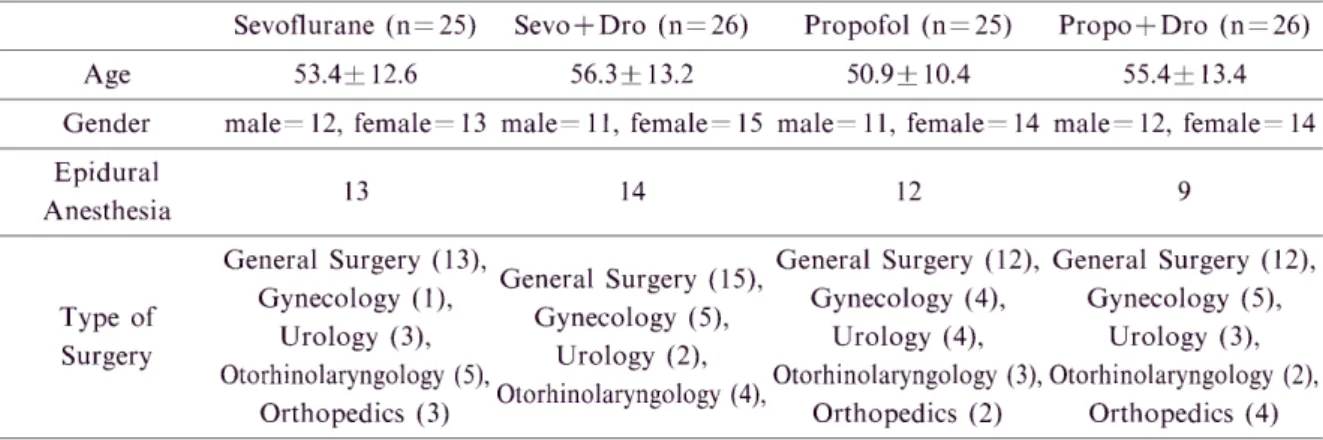
The four study groups were similar with respect to age and gender (Table 1). The QTc interval in each group before drug administra- tion was not significantly different. There were no significant differences in heart rates before and during anesthesia among the four groups.
No critical arrhythmias occurred and no electro- lyte abnormalities were observed in any of the group. When corrected using Bazett's and Fridericia's formulae, the QTc interval was sig- nificantly prolonged by sevoflurane alone only after 2 h (Figure lb) ; however, when corrected
using Matsunaga's formula, the QTc interval was already significantly prolonged 30 min after sevoflurane administration and this prolonga- tion continued at least for 2 h, but sevoflurane- induced QTc prolongation did not progress with time (Figure lc). Sevoflurane with droperidol
also significantly prolonged the QTc interval corrected using all three formulae (Figure la, b, c) ; however, droperidol did not enhance sevo-
flurane-induced QTc prolongation. Conversely, propofol did not affect the QTc (Figure la, b, c), but when droperidol was added to propofol anesthesia, the QTc interval was significantly prolonged only 2 h after propofol administration when corrected using Matsunaga's formula but not when using Bazett's and Fridericia's formu- lae (Figure lc). The Tp-e intervals were not affected in any of the groups (Figure 1d).
Discussion
The new findings of this study were that, in Table 1 Baseline Characteristics of the Study Population
Sevoflurane (n=25) Sevo+Dro (n=26) Propofol (n=25) Propo+Dro (n=26)
Age 53.4+ 12.6 56.3+13.2 50.9± 10.4 55.4+ 13.4
Gender male=12, female=13 male=11, female=15 male=11, female=14 male=12, female=14
Epidural 13 14 12 9
Anesthesia
General Surgery (13), G General Surgery (12), General Surgery (12), eneral Surgery (15),
G
ynecology (1), Gynecology (4), Gynecology (5),
Type of Gynecology (5)
,
Urology (3), Urology (4), Urology (3),
Surgery O Urology (2),
torhinolaryngology (5),Otorhinolaryngology ' O (3), Otorhinolaryngology (2), torhinolaryngology (4),
Orthopedics (3)Orthopedics (2) Orthopedics (4)
Sevo : sevoflurane, Dro : droperidol, Propo : propofol
Fig. 1 shows the QTc intervals (a-c) or Tp-e inter- vals (d) before anesthesia, 30 minutes, 1
hour, and 2 hours after sevoflurane alone,
sevoflurane with droperidol, propofol
alone, and propofol with droperidol admin-
istration. QT intervals are adjusted for
heart rate with Bazett's formula (a), Frider-
icia's formula (b), and Matsnaga's formula
(c). Sevo : Sevoflurane, Dro : Droperidol
*P<0 .05 vs. Pre-anesthesia, #P<0.05 vs.
Propo+Dro (1 h)
27
ordinary clinical settings in various kinds of surgery, sevoflurane significantly prolonged the QTc interval but did not affect the Tp-e interval.
Conversely, propofol did not affect either the QTc or the Tp-e interval. Droperidol, at an anti- emetic dose, neither prolonged QTc interval nor enhanced the sevoflurane-induced QTc prolon- gation. Of the correction formulae used to normalize the QT interval for heart rate (QTc), Matsunaga's formula seems more sensitive at detecting sevoflurane-induced QTc interval pro- longation.
Some investigators advocate that Matsunaga's and/or Fridericia's formulae would better pre- dict the net repolarization delay.23 In the present study, of the correction formulae used to normal-
ize the QT interval for heart rate, Matsunaga's formula seemed more sensitive at detecting sevo- flurane-induced QTc interval prolongation. In general, a QTc interval of > 450 ms is regarded as abnormal, and in individual patients an absolute QTc interval of > 500 ms or an increase of 60 ms from baseline is regarded as indicating an in- creased risk of TdP.24 If we used Bazett's for- mula, several patients were already categorized into an abnormal QTc interval group (> 450 ms) before drug administration (20/102) but not Matsunaga's (1/102) and Fridericia's (6/102).
We suggest this is becouse that the patients were anxious in the operation room before anesthetic induction and their heart rates were rather high, and the QT interval was overcorrected for heart Table 2 QTc intervals after sevoflurane or propofol with or without droperidol administration adjusted by
Bazett's, Fridericia's, or Matsunaga's formula
QTc (Bazett's formula)
Sevoflurane (n=25) Sevo+Dro (n=23) Propofol (n=25) Propo+Dro (n=23) Pre-anesthesia 0.433±0.027 (sec) 0.435+0.023 0.438+0.025 0.429+0.019
30 min 0.440 + 0.033 0.442+0.027 0.439+0.023 0.422+0.026
1 h 0.444+0.032 0.447+0.028# 0.442+0.027 0.423+0.028
2 h 0.450+0.036* 0.448+0.028* 0.442+0.021 0.429+0.023
QTc (Fridericia's formula)
Sevoflurane (n=25) Sevo+Dro (n=23) Propofol (n=25) Propo+Dro (n=23) Pre-anesthesia 0.425 ± 0.026 (sec) 0.425+0.023 0.426+0.027 0.418+0.019
30 min 0.438+0.033 0.434 + 0.026 0.432+0.023 0.418+0.026
1 h 0.440+0.030 0.437+0.030 0.433+0.028 0.420+0.024
2 h 0.443+0.034* 0.442+0.044* 0.435+0.021 0.429+0.023
*P< 0.05 vs. Pre-anesthesia, 3P < 0.05 vs. Propo+Dro (1 h)
QTc (Matsunaga's formula)
Sevoflurane Sevo + Dro Propofol Propo + Dro
Pre-anesthesia 0.386+0.026 (sec) 0.383+0.024 0.390 + 0.036 0.376+0.026
30 min 0.404+0.034* 0.395+0.030 0.399+0.032 0.382+0.028
1 h 0.405+0.031* 0.397+0.034* 0.400 + 0.033 0.385+0.028
2 h 0.406+0.033* 0.395 + 0.036 0.401+0.031 0.389+0.027*
*P < 0.05 vs. Pre-anesthesia Tp-e (msec)
Sevoflurane Sevo+ Dro Propofol Propo + Dro
Pre-anesthesia 97.2+ 14.0 96.7+ 10.5 98.4+ 12.5 96.2+ 9.4
30 min 98.8+ 12.4 100.4+ 10.8 100.0+ 12.6 94.6+6.5
1 h 99.2+ 13.2 99.2+8.8 101.2+ 12.4 94.2+5.8
2 h 100+ 14.7 100.4+ 11.2 102.0+ 14.4 94.2+7.8
rate using Bazett's formula, and conversely the QT interval was undercorrected using Bazett's formula during the operation when the anes- thetic depth was sufficient and the heart rate was low.
Recent studies have shown that the QTc inter- val alone is not a reliable indicator of TdP, and intramyocardial dispersion of repolarization appears to play a more important role both in electrical stability of the ventricles and arrth- ymogenesis.545-" In fact, Tanabe et al. reported that epinephrine significantly increased the Tp-e in both LQT 1 and LQT2 syndrome patients but not in control normal patients." Therefore, in addition to QTc interval measurements, we investigated the Tp-e interval changes and demonstrated that neither propofol nor sevoflur- ane and droperidol affected the Tp-e interval, i.
e., TDR ; however, since the Tp-e interval does not seem to be an established and absolutely reliable method of detecting the TDR, further studies will be required.
It is generally agreed that sevoflurane inhibits Ikr, Iks, and Ito and prolongs the QT interval.'-5 In the present study, we confirmed that sevoflur- ane significantly prolonged the QTc interval but, in contrast to previous reports,'" which showed that sevoflurane-induced QTc (Bazett's formula) interval prolongation occurred within 30 min after sevoflurane exposure, only the QTc interval (Bazett's formula) 2 h after sevoflurane exposure was significantly prolonged. This result may be due to insufficient statistical power, because we found a small, but not statistically significant, increase in the QTc interval both 30 minutes and 1 hour after sevoflurane exposure. Conversely, the QTc interval corrected using Matsunaga's formula was significantly prolonged within 30 minutes and this prolongation lasted for at least 2 h, suggesting that this formula should be more sensitive than Bazett's and Fridericia's formulae for detecting sevoflurane-induced QT interval prolongation. On the other hand, it is generally agreed that propofol has no effects on the QT interval"5 and we also confirmed this result.
Stuth et al. reported that droperidol led to a significant increase in the QTc interval that was still present at 15 min but had resolved within 30 min after the intravenous bolus injection.25 Also almost all reports observed the ECG for a maximum of 10 min after droperidol administra- tion.13,14,25 However, as serious cardiac adverse events or death have occurred later than 20 min
after droperidol administration in at least 4 out of the 10 cases," the FDA recommend that ECG monitoring be continued for 2-3 h after drug administration. In the present study, we con- firmed that droperidol neither induced QT inter- val prolongation nor enhanced sevoflurane-in-
duced QTc interval prolongation later than 30 minutes after its administration. Although sevo- flurane with and without droperidol significant- ly prolongs the QTc interval, sevoflurane, even with droperidol, does not seem to cause lethal arrhythmias, because droperidol does not enhance sevoflurane-induced QTc prolongation and sevoflurane does not affect the TDR. How- ever, patients who are susceptible to QT interval prolongation and increased dispersion of ventricular repolarization, e.g., patients with congenital long QT syndrome, or medicated with drugs known to prolong the QT interval, such as anti-arrhythmics, psychotherapeutics, and anti- histamines, with hypokalemia should be monitored carefully by the ECG for a long time when under sevoflurane anesthesia. In fact, we previously demonstrated that sevoflurane caused greater QTc interval prolongation in elderly patients than in younger patients .26 Propofol seems safer than sevoflurane in terms of arrhyth- mias associated with QT interval prolongation, but as it was reported that the QT interval was markedly prolonged even by propofol in a patient with acute myocardial infarction,27 care- ful observation of the ECG should also be made after propofol administration, especially when droperidol is co-administered.
Several potential limitations of our study should be considered. First, because we conduct- ed the study in ordinary clinical settings to measure the QT interval for 2 h, the anesthetic methods (e.g., with or without epidural anesthe- sia) and anesthetic concentrations were not strict- ly regulated, and the type of surgery was not limited ; paradoxically, we think that this is why our results are important because they may be applied to various types of anesthesia and sur- gery in the ordinary clinical setting. Further- more, the QTc interval is not likely to be greatly prolonged by stress and pain per se as long as the patient does not have LQT1 syndrome, in which Iks is blocked, because p-adrenergic stimulation by stress and pain activates not only Ca2+ chan- nels but also Iks channels,28 suggesting that the net cation flux through the cardiac cell mem- branes may not be changed greatly in phase 2
29
and 3. On the other hand, Ikr is exclusively inhibited by almost all drugs which are related to drug-induced QT prolongation ; however, both fentanyl at the doses we used and ropivacaine administered epidurally were unlike- ly to affect the QTc and Tp-e intervals directly, because their expected plasma concentrations seem too low to block the IKr. Second, propofol was used for anesthetic induction in all groups, but its effect did not influence the results because the effect is very short.
In conclusion, sevoflurane significantly pro- longed the QTc interval, but droperidol did not enhance sevoflurane-induced QTc prolongation.
Propofol did not affect the QTc interval at all.
Neither sevoflurane nor droperidol prolonged the Tp-e. Of the three formulae we investigated, although Matsunaga's formula seemed the most sensitive to detect sevoflurane-induced QTc interval prolongation, Bazett's and Fridericia's formulae were also sensitive. We anesth- esiologists should be aware of the QTc interval changes by anesthetics and/or anesthesia-related drugs.
References
1. Yamada M, et al. (2006) The effects of sevoflurane and propofol on QT interval and heterologously ex-
pressed human ether-a-go-go related gene currents in xenopus oocytes. Anesth Analg 102: 98-103 2. Kang J, et al. (2006) Mechanisms underlying the QT
interval-prolonging effects of sevoflurane and its inter- actions with other QT-prolonging drugs. Anesth- esiology 104: 1015-1022
3. Chae JE, Ahn DS, Kim MH, Lynch C 3rd, Park WK (2007) Electrophysiologic mechanics underlying action potential prolongation by sevoflurane in rat ventricular myocytes. Anesthesiology 107: 67-74
4. Kleinsasser A, et al. (2000) Sevoflurane, but not propofol, significantly prolongs the Q-T interval.
Anesth Analg 90 : 25-27
5. Whyte SD, Booker PD, Buckley DG (2005) The effects of propofol and sevoflurane on the QT interval and transmural dispersion of repolarization in chil- dren. Anesth Analg 100: 71-77
6. Saussine M, Massad I, Raczka F, Davy JM, Frapier JM (2006) Torsade de pointes during sevoflurane anes- thesia in a child with congenital long QT syndrome.
Pediatric Anesthesia 16 : 63-65
7. Aypar E, Karagoz AH, Ozer S, Celiker A, Ocal T (2007) The effects of sevoflurane and desflurane anes- thesia on QT interval and cardiac rhythm in children.
Pediatric Anesthesia 17 : 563-567
8. Giller N, Bilge M, Eryonucu B, Kati I, Demirel CB (1999) The effects of halothane and sevoflurane on QT
dispersion. Acta Cardiol 54 : 311-315
9. Karagoz AH, Basgul E, Celiker V, Aypar U (2005) The effect of inhalational anaesthetics on QTc interval.
Eur J Anaesthesiol 22: 171-174
10. Habib AS, Gan TJ (2003) Food and drug adminis- tration black box warning on the perioperative use of droperidol : A review of the cases. Anesth Analg 96 : 1377-1379
11. Schwoerer AP, et al. (2007) Molecular interaction of droperidol with human ether-a-go-go-related gene channels. Anesthesiology 106: 967-976
12. Charbit B, et al. (2005) Prolongation of QTc interval after postoperative nausea and vomiting treatment by droperidol or ondansetron. Anesthesiology 102: 1094 -1100
13. Lischke V, et al. (1994) Droperidol causes a dose- dependent prolongation of the QT interval. Anesth Analg 79 : 983-986
14. White PF, Song D, Abrao J, Klein KW, Navarette B (2005) Effect of low-dose droperidol on the QT interval during and after general anesthesia. Anesthesiology 102: 1101-1105
15. Belardinelli L, Antzelevitch C, Vos MA (2003) Assessing predictors of drug-induced torsade de pointes. Trend Pharmacol Sci 24 : 619-625
16. Hekkala AM, Swan H, Vaananen H, Viitasalo M, Toionen L (2007) The effect of antihistamine cetirizine on ventricular repolarization in congenital long QT syndrome. J Cardiovasc Electrophysiol 18 : 691-695 17. Mehta D, Sanatani S, Whyte SD (2010) The effects of
droperidol and ondansetron on d ispersion of myocar- dial repolarization in children. Pediatric Anesthesia 20 : 905-912
18. Ohashi J, et al. (2006) Prevention of life-threatening ventricular tachycardia by novel and pure class-III agent, nifekalant hydrochloride. J Cardiovasc Phar- macol 48 : 274-279
19. Tanabe Y, et al. (2001) Sympathetic stimulation produces a greater increase in both transmural and spatial dispersion of repolarization in LQT1 that LQT2 forms of congenital long QT syndrome. J Am Coll Cardiol 37 : 911-919
20. Yan GX, Antzelevitch C (1998) Cellular basis for the normal T wave and the electrocardiographic mani- festations of the long-QT syndrome. Circulation 98 : 1928-1936
21. Shah RR (2005) Drug-induced QT dispersion : does it predict the risk of torsade de poites ? J Electrocar- diol 38 : 10-18
22. Spence S, Soper K, Hoe CM, Coleman J (1998) The heart rate-corrected QT interval of conscious beagle dogs : a formula based on analysis of covariance.
Toxicol Sciences 45 : 247-258
23. Takahara A, Sugiyama A, Satoh Y, Hashimoto K (2006) Comparison of four rate-correction algorisms for the ventricular repolarization period in assessing net effects of Ikr blocker in dogs. J Pharmacol Sci 102 : 396-404
24. Roden DM (2008) Long-QT syndrome. N Engl J
Med 358: 169-176
25. Stuth EA, Stucke AG, Cava JR, Hoffman GM, Berens RJ (2004) Droperidol for perioperative sedation causes a transient prolongation of the QTc time in children under volatile anesthesia. Pediat Anesth 14 : 831-837
26. Nakao S, et al. (2010) Sevoflurane causes greater QTc interval prolongation in elderly patients than in
younger patients. Anesth Analg 110: 775-779 27. Sakabe M, Fujiki A, Inoue H (2002) Propofol in-
duced marked prolongation of QT interval in a patient with acute myocardial infarction. Anesthesiology 97 : 265-266
28. Walsh KB, Begenisich TB, Kass RS (1989) /3- adrenergic modulation of cardiac ion channels. J Gen Physiol 93 : 841-854