PAPER
Special Section on Cryptography and Information SecurityTo Get Lost is to Learn the Way: An Analysis of Multi-Step Social Engineering Attacks on the Web ∗
Takashi KOIDE†,††a),Nonmember, Daiki CHIBA†, Mitsuaki AKIYAMA†, Katsunari YOSHIOKA††,†††, andTsutomu MATSUMOTO††,†††,Members
SUMMARY Web-based social engineering (SE) attacks manipulate users to perform specific actions, such as downloading malware and ex- posing personal information. Aiming to effectively lure users, some SE attacks, which we call multi-step SE attacks, constitute a sequence of web pages starting from a landing page and require browser interactions at each web page. Also, different browser interactions executed on a web page of- ten branch to multiple sequences to redirect users to different SE attacks.
Although common systems analyze only landing pages or conduct browser interactions limited to a specific attack, little effort has been made to follow such sequences of web pages to collect multi-step SE attacks. We pro- pose StraySheep, a system to automatically crawl a sequence of web pages and detect diverse multi-step SE attacks. We evaluate the effectiveness of StraySheep’s three modules (landing-page-collection, web-crawling, and SE-detection) in terms of the rate of collected landing pages leading to SE attacks, efficiency of web crawling to reach more SE attacks, and accuracy in detecting the attacks. Our experimental results indicate that StraySheep can lead to 20% more SE attacks than Alexa top sites and search results of trend words, crawl five times more efficiently than a simple crawling module, and detect SE attacks with 95.5% accuracy. We demonstrate that StraySheepcan collect various SE attacks, not limited to a specific attack.
We also clarify attackers’ techniques for tricking users and browser inter- actions, redirecting users to attacks.
key words: social engineering attacks, browser automation, web crawler
1. Introduction
Attackers use social engineering (SE) techniques to lure users into taking specific actions. Modern web-based at- tacks leverage SE for malware infections[2],[3] and on- line frauds[4]–[6], which are called web-based SE attacks (or simplySE attacks). Attackers skillfully guide a user’s browser interaction through attractive web content or warn- ing messages to make users download malware or leak sen- sitive information. For example, to download pirated games, a user clicks a download button on an illegal downloading web page. Then, a popup window with a virus-infection alert is displayed. A user who believes the fake informa- tion clicks a “confirm” button and downloads fake anti-virus
Manuscript received March 13, 2020.
Manuscript revised September 23, 2020.
†The authors are with NTT Secure Platform Laboratories, To- kyo, 180-8585 Japan.
††The authors are with Graduate School of Environment and Information Sciences, Yokohama National University, Yokohama- shi, 240-8501 Japan.
†††The authors are with Institute of Advanced Sciences, Yoko- hama National University, Yokohama-shi, 240-8501 Japan.
∗This paper is the extended version of the paper presented at ASIA CCS ’20[1].
a) E-mail: [email protected] DOI: 10.1587/transfun.2020CIP0005
software[7].
Common systems to automatically collect SE attacks involve accessing web pages collected from search en- gines[5],[6],[8]. These systems use a web browser to crawl web pages and identify a particular SE attack by extracting features only from each web page. However, some types of SE attacks constitute a sequence of web pages starting from a landing page and require browser interaction (e.g., clicking an HTML element) at each web page to reach the attacks, which we call multi-step SE attacks. This is be- cause each web page gradually convinces a user by using different psychological tactics[3]. Also, different browser interactions executed on a web page often branch to mul- tiple sequences, redirecting users to different SE attacks, because there are multiple attack scenarios corresponding to a user’s interests or psychological vulnerabilities. Al- though current systems analyze only landing pages or con- duct browser interactions limited to a specific attack, little effort has been made to follow such sequences of web pages to collect multi-step SE attacks.
We propose StraySheep, a system to automatically crawl the sequence of web pages and detect diverse multi- step SE attacks derived from a landing page. StraySheep is based on two key ideas. The first idea is to simulate the multi-step browsing behaviors of users, that is, intention- ally follow the sequence of web pages by selecting possi- ble elements that psychologically attract users to lead them to SE attacks. StraySheep not only follows a single se- quence of web pages but also crawls multiple sequences derived from a landing page. The second idea is to ex- tract features from reached web pages as well as an en- tire sequence of web pages. Unlike previous approaches that extract features from a single web page they have vis- ited [5], [6] or identify malicious URL chains automati- cally caused without user interactions (i.e., URL redirec- tions) [9]–[11], StraySheep extracts features from the en- tire sequence of web pages it has actively and recursively followed. That is, StraySheepanalyzes image and linguis- tic characteristics of reached web pages, browser events (e.g., displaying popup windows and alerts) that occurred before reaching the web page, and browser interactions that lead users to SE attacks. These features represent common characteristics of all SE attacks, i.e., persuading and de- ceiving users. Therefore, by combining these features to classify sequences, StraySheep detects various multi-step SE attacks more accurately. We implemented StraySheep Copyright c2021 The Institute of Electronics, Information and Communication Engineers
with three distinct modules (landing-page-collection,web- crawling, andSE-detection) to automatically collect landing pages, crawl the web pages branching from them, and detect SE attacks using the results of web crawling, respectively.
To determine the effectiveness of StraySheep’s three modules, we conducted three evaluations: the rate of col- lected landing pages leading to SE attacks, the efficiency of web crawling to reach more SE attacks, and accuracy in detecting the attacks. The first evaluation demonstrated that landing pages gathered by the landing-page-collection module led to 20% more SE attacks than Alexa top sites and search results of trend words. The second evaluation demon- strated that the web-crawling module is five times more ef- ficient at crawling than simple crawling modules. The third evaluation revealed that the SE-detection module identified SE attacks with 95.5% accuracy.
We analyzed collected multi-step SE attacks StraySheep in detail. As a result of categorizing SE attacks, we found that StraySheepreached a variety of SE attacks such as mal- ware downloads, unwanted browser extension installs, sur- vey scams, and technical support scams. We also found that 30% of SE attacks were reached from 25 different advertis- ing providers.
The main contributions of this paper are as follows:
• We propose StraySheep, which detects multi-step SE attacks by automatically and recursively crawling se- quences of web pages branching from landing pages.
StraySheepcan crawl and detect these attacks by sim- ulating multi-step browsing behaviors of users and ex- tracting features from an entire sequence of web pages.
• We evaluated StraySheep’s three modules. The landing-page-collection module led to 20% more SE attacks than Alexa top sites and search results of trend words. The web-crawling module was five times more efficient at crawling than a simple crawling module.
The SE-detection module identified SE attacks with 95.5% accuracy.
• We conducted a detailed analysis of multi-step SE attacks collected using StraySheep. We found that StraySheep collected various SE attacks, not limited to a specific attack. We analyzed attackers’ techniques of luring users and browser interactions leading users to attacks.
2. Background
SE is used to manipulate people into performing a particular action by exploiting their psychology and has been widely used in various types of web-based attacks, such as mal- ware downloads[3],[12], malicious browser extension in- stalls [13]–[15], survey scams [6], and technical support scams[4],[5]. Malware downloads and malicious browser extension installs are achieved by masquerading as legiti- mate software. Survey scams recruit users attracted by fake survey rewards to trick them into providing sensitive infor- mation and accessing web pages controlled by attackers.
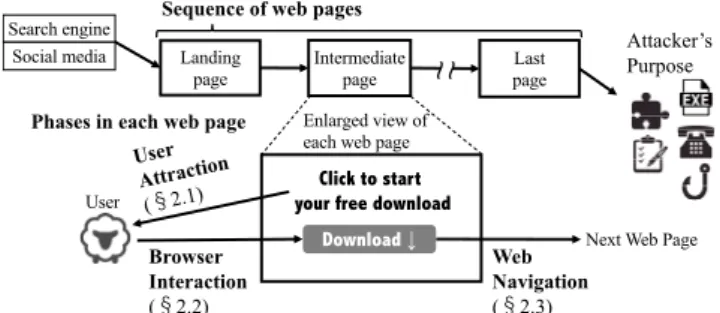
Fig. 1 Sequence of web pages in multi-step SE attacks and phases in each web page.
Technical support scams are carried out by persuading users to make a call to a fake technical support desk and install keystroke loggers, remote access tools, or malware.
Multi-step SE attacks use multiple web pages leverag- ing different psychological tactics to effectively lure users to the succeeding web page. Figure 1 shows a sequence of web pages in multi-step SE attacks and three simplified phases in each web page: user attraction,browser interaction, and web navigation. Therefore, the three phases can be repeated multiple times, starting from a landing page, which appears in response to clicking on a search-engine result or social- media link. Different user interactions on a single web page also lead to different SE attacks.
2.1 User Attraction
The user-attraction phase attracts a user psychologically by using the content of the web page to deceive and persuade the user to induce browser interaction [3]. For example, these web pages advertise free downloads of video games, threaten users with fake virus warnings, and request bogus software updates. The main purpose of this psychological attraction is to make the user interact with an HTML ele- ment (e.g.,aanddiv) that navigates to malware downloads or a web page controlled by an attacker. We call such HTML elementslure elements. What is common with lure elements is that they contain words or shapes indicating the behavior or category of an element. A lure element is characterized by its visual effects, such as easily understandable download buttons containing “Click here to download” and movie play buttons containing “WATCH NOW” or a triangle pointing right. A lure element is also characterized by containing words such as “download-btn” and “video-play-link”
in their text content and document object model (DOM) at- tributes such asid,class, andalt. Multiple lure elements may be arranged on a single web page. In this case, clicking these lure elements results in different SE attacks.
2.2 Browser Interaction
Users who are acted upon by the previous user-attraction phase are guided to interact with lure elements on the web page. This browser-interaction phase is mainly an explicit click on the lure element but also includes an unintended
click[8]. For example, unintended clicks include clicking an overlay on the entire web page, context menu, and the browser’s back button. These clicks are forcibly generated by JavaScript to redirect a user to a new web page or show a popup window against the user’s intention.
2.3 Web Navigation
In the web-navigation phase, browser events occur as a re- sult of browser interaction. These browser events redirect to another web page in the current window or a new window (popup), display alert dialogs, and download files. Web- page redirection occurs in an intermediate step of a multi- step SE attack, guiding the user to the next web page. On the next page, another user attraction, browser interaction, and web navigation could occur again. The purpose of re- peatedly making a user reach multiple web pages without completing the attack on one web page is to gradually con- vince the user and increase the success rate of the attack.
For example, to increase the attack-success rate of a user who watches a movie on an illegal streaming site, attackers display a popup that offers a dedicated video player with an alert dialog such as “Please install HD Player to continue.”
instead of providing an automatic software download on the first web page. Also, the multiple sequences of web pages in a multi-step SE attack often branch from the landing or in- termediate web pages because such web pages contain two or more lure elements leading to different pages.
2.4 Problems on Collecting SE Attacks
There are three approaches to automatically collect SE at- tacks: tracing web traffic, archiving with a crawler, and crawling with a web browser. We give a brief introduction of these approaches and their limitations then present the requirements of collecting SE attacks.
The first approach is of reconstructing SE attacks from web traffic obtained through passive network moni- toring[3]. To take measures against SE attacks, revealing a single SE attack reached from the landing page is use- ful, but uncovering all attacks that branch from web pages is more critical. However, this approach is used to observe only a single sequence of web pages accessed by the user.
Also, it cannot be used to observe SE attacks starting from arbitrary web pages. That is, it cannot be used to observe attacks from which a user was not affected but another user could be affected.
The second approach is to visit each web page us- ing crawlers such as Heritrix [16]and GNU Wget. Such crawlers extract links from a downloaded HTML source code of a web page and crawl them recursively. This ap- proach can solve the problem with the first approach, in which it cannot collect SE attacks that the user did not reach because it can input an arbitrary URL. However, these crawlers can only execute simple content downloads and static content parsing. SE attacks often use web content dy- namically generated by JavaScript, which require user inter-
actions to navigate to the next pages; thus, these types of crawlers cannot collect most SE attacks.
The third approach is of web-browser automation using a tool such as Selenium[17]. Web-browser automation en- ables us to simulate user interaction to all elements on each web page. With this approach, we can solve the problems with the second approach. If we apply the idea of following all links with the second approach to web-browser automa- tion, that is, clicking all elements on each web page, we can ideally collect all multi-step SE attacks derived from a land- ing page. However, recursively following all elements takes a significant amount of time because the browser requires time to run JavaScript and render web pages.
In summary, to efficiently observe multi-step SE at- tacks in a short time, the number of elements to crawl must be reduced by selecting possible lure elements from thou- sands of HTML elements on each web page. To analyze multi-step SE attacks in detail, it is also necessary to recur- sively follow multiple sequences of web pages that lead to SE attacks derived from a landing page rather than tracing only a single sequence of web pages. Therefore, require- ments for collecting and analyzing multi-step SE attacks are crawling with the web-browser-automation approach, se- lecting lure elements that will likely lead to SE attacks, and recursively interacting with lure elements.
3. StraySheep
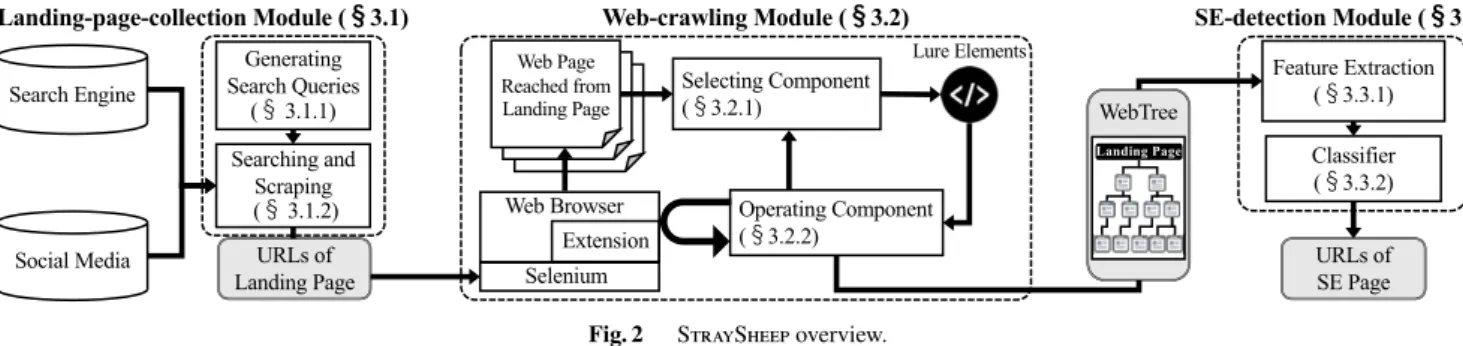
We propose a system called StraySheep that automati- cally collects landing pages that lead to SE attacks, crawls web pages, and detects multi-step SE attacks. StraySheep consists of three modules: landing-page-collection, web- crawling, andSE-detection. An overview of StraySheepis shown in Fig. 2. The landing-page-collection module gath- ers URLs of web pages leading to SE attacks by leveraging search engines and social media. The web-crawling mod- ule starts recursive web crawling from the URLs collected by the landing-page-collection module, selects and clicks on lure elements, and outputs a WebTree. A WebTree consists of tree-like abstract data, including logs such as web nav- igation, browser interaction, and snapshot (screenshot and HTML source code) observed at each web page branching from a landing page. The SE-detection module extracts fea- tures from a WebTree and identifies the multi-step SE attack using a classification model.
3.1 Landing-Page-Collection Module
The landing-page-collection module leverages search en- gines and social media to find landing pages as input for the web-crawling module. Many SE attacks use web pages that have copyright infringement, such as illegal downloads and free video streaming, to draw the attention of incau- tious users [8], [18]. To induce a user to access such web pages, attackers use search-engine-optimization tech- niques[19]–[21]and post messages on social media, which include links to the landing pages [22]–[24]. Examples of
Fig. 2 StraySheepoverview.
such social-media postings are an instruction video for ille- gally installing software and a message introducing a free game download site. To collect such landing pages ef- fectively, the landing-page-collection module uses a web- search-based approach consisting of two steps: generating search queriesandsearching and scraping.
3.1.1 Generating Search Queries
The landing-page-collection module generates search queries to search the URLs of possible landing pages lead- ing to SE attacks. To generate the search queries, we de- sign the module so that it collects core keywords, which stand for a title or name of paid content (e.g., “Godzilla” and
“Microsoft Office”) and concatenates them with predefined qualifiers(e.g., “free download,” “crack,” and “stream on- line”). To collect core keywords, the module automatically scrapes popular electronic commerce (EC) sites and online database sites by using predefined scraping logic in accor- dance with each site and groups the core keywords by con- tent category (e.g., video, software, and music). These core keywords can regularly be updated by recollecting ranking and new release information.
The aim of using qualifiers is (1) limiting the coverage of search results including illegal downloads and streaming, not legitimate sites, and (2) increasing the variation in search results. We manually prepare qualifiers in advance using au- tosuggest/related search functions on a search engine. When a user queries a certain word in a search engine, these search functions provide a list of corresponding keyword predic- tions. We input some titles of paid content to the search engine and collect qualifiers for each category because the qualifiers we require vary depending on the core keyword’s category. For example, qualifiers of video are “stream”,
“movie”, and “online”. For another example, qualifiers of the software category are “download”, “crack”, and “key”.
3.1.2 Searching and Scraping
This module retrieves URLs from a search engine or social media by using the generated search queries. It inputs them into the search engine and search forms on social media to widely collect corresponding URLs. Some social media do not always provide comprehensive search results due to a minimum required search function; thus, the module also
Fig. 3 Conceptual model of WebTree.
uses a search engine to collect social-media postings. Fi- nally, it outputs the URLs collected from the search results and links scraped from social media postings as input for the web-crawling module.
3.2 Web-Crawling Module
The web-crawling module automates a web browser to recursively crawl a URL collected by the landing-page- collection module and outputs a WebTree as a crawling re- sult. Figure 3 shows a conceptual model of a WebTree rep- resenting sequences of web pages derived from the land- ing page and visited by the web-clawing module. The web-crawling module starts from the landing page, clicks on multiple lure elements on the web pages, and recur- sively follows multiple web pages derived from the land- ing page. The depth indicates the recursion count of web crawls. The depth increases when this module reaches a web page that completes loading and is waiting for browser interaction. This module uses Selenium and our original browser extension to automatically control and monitor a web browser. For the prototype of our system, we chose Google Chrome as a browser, but Selenium can also con- trol other web browsers; thus, the web-crawling module can use different browsers. In the following section, we describe two components of the web-crawling module:selectingand operating.
3.2.1 Selecting Component
The selecting component collects a lure element that causes
web navigation leading to SE attacks by analyzing an HTML source code and a screenshot of a web page. As mentioned in Sect. 2.1, a word representing the category or action of an element tends to be used for the lure el- ement’s DOM attributes, text content, and the text drawn inside the button graphic, for example, “download” in
“download-btn” of the class attribute and “click” in
“Click Now” of the text drawn inside a clickable button.
To select elements containing such keywords as lure ele- ments, we design the selecting component so that it parses an HTML source code and executes image processing of a web page’s screenshot. The purpose of the selecting com- ponent is not to accurately detect elements leading to SE at- tacks but to select possible lure elements to reduce the num- ber of elements with which to interact. By following only selected elements, the web-crawling module can efficiently reach diverse SE attacks. Note that there could be multi- ple lure elements on the same web page; thus, this com- ponent analyzes all elements on the web page. The reason the selecting component also executes image processing is to complement the acquisition of character strings drawn in the button image (i.e.,imgelement), which cannot be ac- quired from the HTML source code. This component also identifies lure elements by their shape such as the triangular video play button.
We explain a statistical method of preparing keywords for selecting lure elements. We compare elements that have actually redirected users to SE attacks (lure elements) with other elements that have not redirected users to any SE at- tacks (non lure elements) and extract words specific to lure elements. More specifically, we extract attribute, text con- tent, and strings drawn on buttons from the collected ele- ments and divide these words into two documents: a docu- ment of lure elements and one of non lure elements. We then calculate the term frequency-inverse document frequency (tf-idf) of the two documents and manually choose words that have high tf-idf values from the lure-element document.
The process of keyword selection is shown in Sect. 4.2.
In the analysis of HTML source codes, if an element matches at least one of the following four rules, this compo- nent determines it to be a lure element.
• One of the keywords is used in the element’s text con- tent.
• A keyword is set inid,class, oraltDOM attributes.
• A keyword is used as the file name indicated by the URL of the link (aelement) or image (imgelement).
• An executable file (e.g.,.exeor.dmg) or a compressed file (e.g.,.zipor.rar) is used as a link extension.
The purpose of the analysis of image processing is to find rectangular buttons and video play buttons. This component extracts character strings written in each ele- ment from the screenshot and matches keywords used in the HTML source code analysis. This component leverages OpenCV to find rectangle contours representing the button areas in the screenshot and identify the coordinates and size of buttons. It also uses optical character recognition (OCR)
using Tesseract OCR[25]to extract character strings from the rectangles the component found. This component exe- cutes keyword matching with extracted character strings and determines an element containing one of the keywords in the area to be a lure element. To acquire video play buttons as lure elements, the module also finds a triangle contour pointing right. Finally, the component outputs multiple lure elements that may lead to SE attacks from the web page.
3.2.2 Operating Component
The operating component executes browser interactions (i.e., clicking on lure elements), monitors web navigation, and constructs a WebTree. It simulates clicking on lure el- ements with theCTRLkey pressed to open the web page in a new browser tab because the current page may be trans- ferred to another web page by a simple clicking. As a result, links or popup windows can be opened in new tabs with- out changing the original tab. The operating module also clicks abodyelement,bodyelement with context click, and the browser’s back button to simulate unintended clicks de- scribed in Sect. 2.2. When the new tab is opened, the select- ing component finds lure elements again, and the operating component executes browser interactions with a depth-first order, unless it reaches a predetermined maximum depth.
We explain the maximum depth we used in the following experiment in Sect. 4.2.
The operating component also monitors web naviga- tion. For monitoring JavaScript function calls, this com- ponent hooks the existing JavaScript function to detect the executed JavaScript function name and its argument. The JavaScript functions to be monitored by this component are alert(), window.open(), and the installation func- tion of the browser extension (e.g., chrome.webstore.
install()). The function alert()is frequently used in SE attacks that threaten a user by suddenly displaying dialog with messages inducing user anxiety. Thewindow.open() function opens a new browser window and is used for popup advertisements. This component also hooks the installa- tion function of the browser extension and detects what type of browser extension was installed from the argument.
This component also monitors URL redirection, which nav- igates a user to another URL. URL redirection is divided into client-side redirection and server-side redirection. A web browser may conduct client-side redirection such as JavaScript functionlocation.hrefwhen this component clicks the lure element. On the other hand, a web server conducts server-side redirection to navigate to another web page before loading a web page. This component monitors the URLs the browser passed during server-side redirection to identify the server that navigates users to SE attacks, such as advertising providers.
The operating component conducts browser interac- tions and monitors web navigation until it finishes clicking on all selected lure elements. This component aggregates information from sequences of web pages (i.e., screenshots, the HTML source codes of web pages, browser interactions,
and web navigation) and finally outputs a WebTree as input for the SE-detection module.
3.3 SE-Detection Module
The SE-detection module extracts features from a WebTree output by the web-crawling module and identifies multi-step SE attacks using a classification model. This module first extracts sequencesfrom the WebTree. A sequence is de- fined as a series of rendered web pages from the landing page (a root node) to the last pages (leaf nodes). Note that the sequence does not represent a URL redirection chain (an automatic process of forwarding a user to another URL mul- tiple times) but a series of displayed web pages through user interaction. This module then extracts features from each sequence that reaches web pages of depth of two or more.
Unlike conventional methods that examine structural simi- larity of URL redirection chains[9]–[11], this module ex- tracts features specific to multi-step SE attacks from the en- tire sequence: contents of web pages, browser interactions that trigger page transitions, and web navigation. Finally, it identifies whether the last page of each sequence is the SE page using a classifier and outputs URLs of the detected web pages. Ground truth data for identifying SE attacks is explained in Sect. 4.3.
3.3.1 Feature Extraction
To classify web pages that trick users into interacting, it is common to use information that can be acquired after visit-
ing the web page, such as image and HTML features[6],[8].
However, if a classifier uses such features, it cannot detect an SE page similar to the legitimate page, such as a fake software-update web page that closely resembles a legiti- mate Flash update page or fake infection-alert page using the logo of security vendors. Therefore, we designed feature vectors using not only features extracted from a single web page but also all features extracted from the entire sequence.
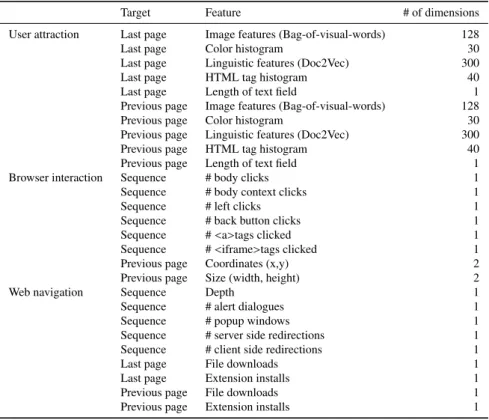
Specifically, it analyzes the last page of the sequence, page before the last page (previous page), and the entire sequence, as shown in Fig. 4. Table 1 shows features extracted from each sequence and grouped into the three phases of SE at- tacks: user attraction, browser interaction, and web naviga- tion. To the best of our knowledge, StraySheepis the first system that automatically collects these features from the entire sequence by recursively crawling web pages from the landing page. In terms of the user-attraction-based features, StraySheep extracts appearance, meaning of a document, and structure of HTML from the last and previous pages.
Fig. 4 Example of extracting features from a sequence.
Table 1 List of features SE-detection module uses.
Target Feature # of dimensions
User attraction Last page Image features (Bag-of-visual-words) 128
Last page Color histogram 30
Last page Linguistic features (Doc2Vec) 300
Last page HTML tag histogram 40
Last page Length of text field 1
Previous page Image features (Bag-of-visual-words) 128
Previous page Color histogram 30
Previous page Linguistic features (Doc2Vec) 300
Previous page HTML tag histogram 40
Previous page Length of text field 1
Browser interaction Sequence # body clicks 1
Sequence # body context clicks 1
Sequence # left clicks 1
Sequence # back button clicks 1
Sequence #<a>tags clicked 1
Sequence #<iframe>tags clicked 1
Previous page Coordinates (x,y) 2
Previous page Size (width, height) 2
Web navigation Sequence Depth 1
Sequence # alert dialogues 1
Sequence # popup windows 1
Sequence # server side redirections 1
Sequence # client side redirections 1
Last page File downloads 1
Last page Extension installs 1
Previous page File downloads 1
Previous page Extension installs 1
It then finds features based on browser interaction, such as actions performed on the web pages and lure elements from the previous page and entire sequence. The SE-detection module also analyzes web navigation that occurred on the last page, the previous page, and the entire sequence. We ex- plain a feature extraction method for each SE-attack phase below in detail.
User AttractionThe appearance of a web page and the se- mantic properties of text content include the intention of the attacker to trick a user. The HTML document struc- ture is also an important indicator for analyzing the simi- larity of web pages using the same document template. The SE-detection module extracts image and linguistic features from the last and previous pages of the sequence. It also calculates an HTML tag histogram, RGB color histogram, and the length of the text field from both the last and pre- vious pages. These features are useful for identifying web pages that use the same page templates and images as other malicious web pages. To extract image features, we use AKAZE[26], which is a bag-of-visual words algorithm that detects local image features. The SE-detection module ex- tracts 128-dimensional image features from the screenshots of the last and previous pages using a trained model we pre- viously constructed. We use Doc2Vec[27]as a document- modelling algorithm to extract linguistic features. The pur- pose of this is to capture attackers’ intentions, such as de- ceiving or threatening users, based on linguistic character- istics. The module extracts the 300-dimensional features from the text content of the last and previous pages by using a doc2vec model trained beforehand. The text content of a web-page document is extracted by cleaning out HTML tags from an HTML source code. The SE-detection module also calculates a histogram of the RGB (red, green, and blue) val- ues of the screenshot with ten bins for each color and a his- togram of HTML tags of the text content. This module uses up to 40 HTML tags (e.g.,a div, andimg) frequently ap- pearing on the web pages we collected in advance. It counts the number of characters in the text content.
Browser Interaction The SE-detection module analyzes lure elements and actions that caused SE attacks. Browser interaction is an important indicator that characterizes multi- step SE attacks because the destination web pages change depending on the types of actions taken by users and clicked elements. To extract features from browser interactions, we design this module so that it counts the number of left clicks and unintended clicks (body clicks, body-context clicks, and back-button clicks) the web-crawling module performed in the sequence. This module also counts the types of clicked lure elements (a andiframe) in the sequence and deter- mines the size (x,y) and coordinates (width, height) of lure elements on the previous page.
Web Navigation The SE-detection module analyzes browser events that occurred as a result of browser inter- action. File downloads and extension install indicate events that are directly related to SE attacks such as malware down- loads and unwanted extension installs. Since SE attacks are often delivered via advertising providers, redirection has
characteristics unique to SE attacks. The method of naviga- tion (e.g., redirection and popup window) is important for analyzing SE attacks. This module determines whether file downloads and extension installs occurred on the last and previous pages. It counts the times popup windows were displayed and the number of URLs observed during server- side and client-side redirection. It also checks the number of displayed alert dialogues and the length of the sequence, i.e., crawling depth.
3.3.2 Classifier
We combine the features extracted from sequences to create features vectors and construct a binary classifier to identify SE web pages. We use Random Forest as a learning algo- rithm because we can measure the importance of each fea- ture that contributes to the classification. Evaluation results compared with other algorithms are given in Sect. 4.5.
4. Evaluation
We evaluated the three modules of StraySheep (landing- page-collection, web-crawling, and SE-detection). We first evaluated the qualitative advantage of StraySheepby com- paring it with previous systems for collecting SE attacks.
We then evaluated the effectiveness of the landing-page- collection module by comparing its two collection methods (search engine and social media) to three baseline URL- collection methods in terms of the number of landing pages leading to SE attacks and total visited malicious pages and domain names. Also, we conducted a crawling experiment to determine the efficiency of the web-crawling module by comparing its crawling method with two baseline crawling methods in terms of the number of malicious domain names reached per unit of time. Finally, we confirmed the effec- tiveness of the SE-detection module in terms of detection accuracy.
4.1 Qualitative Evaluation
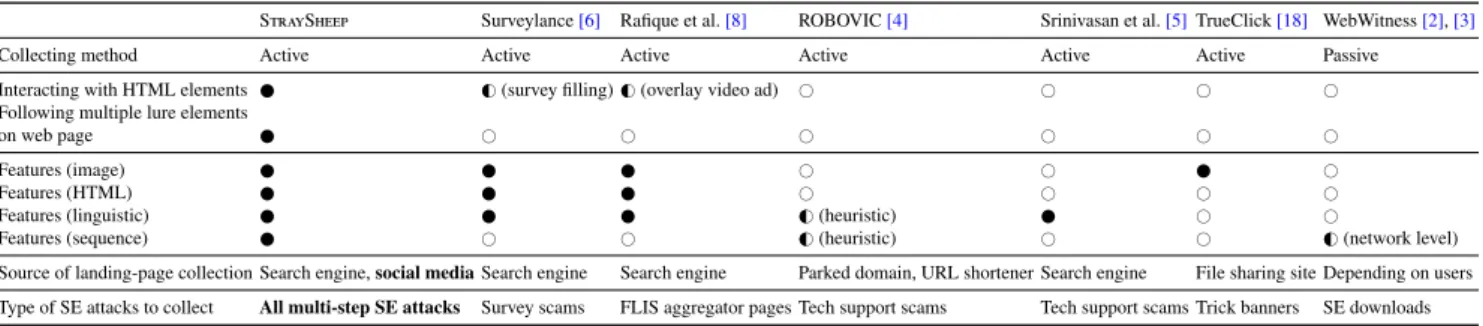
We qualitatively compared StraySheep with the previous systems to collect SE attacks from five perspectives. Table 2 summarizes the results.
Collecting method. The previous systems [2], [3] for passively observing HTTP traffic to analyze SE attacks, can only collect attacks triggered by users’ real download events. On the other hand, actively crawling arbitrary web pages with StraySheepenables us to proactively detect SE attacks before many users reach the web pages.
Interacting with elements. To observe multi-step SE at- tacks, we need to interact with HTML elements and recur- sively follow page transitions. Surveylance[6]is a system to detect survey gateways, which are landing pages display- ing survey requests, and interact with their survey content and survey publisher sites. A system proposed by Rafique et al. [8] detects free live streaming (FLIS) pages and in- teracts with overlay video ads on them. While these sys-
Table 2 Comparison between proposed and previous systems.
StraySheep Surveylance[6] Rafique et al.[8] ROBOVIC[4] Srinivasan et al.[5]TrueClick[18] WebWitness[2],[3]
Collecting method Active Active Active Active Active Active Passive
Interacting with HTML elements G#(survey filling)G#(overlay video ad) # # # #
Following multiple lure elements
on web page # # # # # #
Features (image) # # #
Features (HTML) # # # #
Features (linguistic) G#(heuristic) # #
Features (sequence) # # G#(heuristic) # # G#(network level)
Source of landing-page collection Search engine,social mediaSearch engine Search engine Parked domain, URL shortener Search engine File sharing site Depending on users Type of SE attacks to collect All multi-step SE attacks Survey scams FLIS aggregator pages Tech support scams Tech support scams Trick banners SE downloads
: Fully Covered,G#: Partially Covered,#: Not Covered
tems focus on survey scams or FLIS services, StraySheep can collect various SE attacks and observe different types of survey scams originating from web pages deeper than the landing pages (see Sect. 5.1).
Extracting features.As stated in Sect. 3.3, StraySheepex- tracts features such as images, HTML structures, and lin- guistic context from reached web pages and analyzes se- quences to accurately detect multi-step SE attacks. As shown in Table 2, none of the previous systems use all the features used in StraySheep.
Source of landing-page collection. StraySheep collects landing pages from two common platforms: search engines and social media. StraySheep is the only system that uses both platforms.
Type of SE attacks to collect. While the previous systems are limited to detecting a specific attack, StraySheep col- lects various multi-step SE attacks by following lure ele- ments on each web page.
In summary, StraySheepis the first system to collect multi-step SE attacks not limited to specific attacks by re- cursively following multiple lure elements on web pages.
StraySheepalso detects multi-step SE attacks by extracting various types of features from reached web pages and se- quences.
4.2 Experimental Setup
We implemented StraySheep for Google Chrome 69 with Ubuntu 16.04. It simultaneously ran up to 32 instances on a virtual machine assigned with Intel Xeon 32 logical proces- sors and 256-GB RAM. For the browser setting, a user agent was set as Google Chrome of Windows 7, and browser cook- ies were reset for every landing-page access. Our crawl- ing experiment spanned from November to December 2018, and StraySheepused a single IP address. We need to set a timeout for performance evaluation because the two base- line web-crawling modules mentioned in Sect. 4.4 require an enormous amount of time (a few weeks at most) to com- plete web crawling. About 90% of web crawling conducted with StraySheepfinished within an hour in our preliminary experiment (similar results are shown in Fig. 5); therefore, we set the timeout to one hour. To find the best maximum depth for collecting the most malicious domain names when we used the timeout, we changed the depth from two to six. The number of malicious domain names monotonically
increased up to depth four and decreased as the depth in- creased. Therefore, we set the maximum depth to four in the following experiments.
To determine keywords for selecting lure elements, we followed the statistical method described in Sect. 3.2.1.
First, we manually browsed landing pages (e.g., game download, movie streaming, and torrent sites) and clicked on various HTML elements. We also browsed intermediate pages navigated from them, such as fake virus alerts, file downloading, and advertising pages served by URL short- eners. We then gathered 1,447 lure elements from 978 web pages, which we confirmed finally led to SE attacks. To determine if the reached web pages contained SE attacks, we used URL/domain blacklists (Google Safe Browsing, Symantec DeepSight[28], and hpHosts[29]) to match vis- ited web pages and checked the MD5 hash values of the downloaded binaries with VirusTotal. We defined an SE page, which matched the blacklist whose label was associ- ated with SE attacks (e.g., phishing, tech support scam, and survey scam) or started downloading malware or potentially unwanted programs (PUPs) [30],[31]. We used the same method of checking SE pages in the following experiments.
We randomly selected 5,000 non-lure elements that did not redirect to any SE pages from the landing and intermediate pages. We created lure and non-lure elements’ documents containing words extracted from attributes and text content to calculate tf-idf. Finally, we chose 31 keywords specific to the lure elements by excluding proper nouns (e.g., game and movie titles) and words with zero tf-idf values.
4.3 Effectiveness of URL Collection
To show the effectiveness of StraySheep’s landing-page- collection module, we validated landing pages collected by this module; thus, we used the web-crawling module to re- cursively crawl the landing pages and identified whether vis- ited web pages caused SE attacks. We compared the number of collected landing pages that led to SE attacks across the five methods, i.e., the landing-page-collection module’s two methods (search engine and social media) and three baseline methods (Alexa top sites, trend words, and core keywords).
We collected 5k landing pages for each method.
Search Engine (StraySheep’s Method)This method col- lected a total of 3k core keywords from EC/database sites, such as amazon.com, steampowered.com, billboard.com,
Table 3 Results of web crawling starting from landing page collected with each method.
Search Engine (StraySheep) Social Media (StraySheep) Alexa Top Sites (Baseline) Trend Words (Baseline) Core Keywords (Baseline)
# of landing pages 5,000 5,000 5,000 5,000 5,000
# of landing pages lead to SE attacks 1,060 (21.2%) 808 (16.2%) 33 (0.7%) 65 (1.3%) 46 (0.9%)
# of unique visited URLs 50,587 25,722 27,818 16,240 30,133
# of unique URLs of visited SE pages 4,716 (9.3%) 1,633 (6.3%) 80 (0.3%) 105 (0.6%) 628 (2.1%)
# of unique visited domains 4,984 3,619 8,046 3,537 4,507
# of unique domains of visited SE pages 446 (8.9%) 151 (4.2%) 42 (0.5%) 27 (0.6%) 95 (2.1%)
# of unique downloaded Malware samples 160 186 50 3 41
and imdb.com, which we chose from Alexa top 500 sites.
These core keywords were divided into five categories: soft- ware (game and applications), video (movie, animation, and TV series), music, eBook, and comic. We can increase the variety of landing pages by collecting different types of core keywords, which are often used in illegal sites to lure users. This method generated 90k search queries by concatenating the core keywords with an average of 30 pre- defined qualifiers for each category. When we search for only core keywords, many legitimate sites, such as official sites of movies or games, are included in the search results.
However, we can collect more landings pages leading to SE attacks, including illegal sites, by adding qualifiers to core keywords. It searched the queries using Microsoft Bing Web Search API[32](Bing API) and collected about 1M unique URLs. In that web search, it gathered URLs from up to 30 search results for each search query. Note that the search queries containing the same core keywords with different qualifiers sometimes returned duplicate search results, and some search queries returned less than 30 search results. Fi- nally, we randomly sampled 5k URLs from the collected 1M URLs to crawl for the crawling experiment.
Social Media (StraySheep’s Method) This method also searched seven social-media platforms (Facebook, Twitter, Youtube, Dailymotion, Vimeo, Flickr, and GoogleMap) us- ing the same search queries as the above search-engine ex- periment. Attackers post fake messages on social media such as free downloads of games and streaming of movies to lure users into accessing their links. By collecting such social media posts, we can also gather landing pages that do not appear in search engine results. This method extracted links from posting messages (from Facebook, Twitter, and Flickr), descriptions of uploaded video (from Youtube, Dai- lymotion, and Vimeo), and descriptions of GoogleMap’s My Maps. It used search forms on Youtube, Dailymotion, and Facebook because they have flexible search mechanisms and searched Bing API for the other social-media platforms to gather up to 30 social media postings for each search query.
It searched for 10k search queries (sampled from 90k search queries) for each social-media platform and found a total of 130k unique social-media postings. These search queries often returned less than 30 search queries. This method then gathered 45k unique links by scraping these 130k social- media postings. Some social-media postings did not include any links or included multiple links. Finally, we randomly sampled 5k URLs from the 45k links for the crawling ex- periment.
Alexa Top Sites (Baseline Method)We gathered the top 5k domain names from Alexa top sites and converted them to 5k URLs by adding “http://” to the domain names.
Trend Words (Baseline Method)We searched the top 1k trend words collected from Google Trends using Bing API and randomly selected 5k URLs from the 30k search results (retrieved 30 results per query).
Core Keywords (Baseline Method) We simply searched the same set of 3k core keywords we used for the above Search Engine method and randomly sampled 5k URLs from the 90k search results (retrieved 30 results per query).
Table 3 lists the results of web crawling for each method. The landing pages that led to SE attacks and col- lected with the search-engine and social-media methods ac- counted for 21.2 and 16.2% for each 5k landing pages.
While, those of the three baseline methods (Alexa top sites, trend words, and core keywords) were much smaller, 0.7, 1.3, and 0.9%, respectively. From the results of the search- engine and social-media methods, the numbers of unique visited URLs and domain names were larger than those of the three baseline methods. Since StraySheep’s methods, which use qualifiers, collected about 20 times as many land- ing pages lead to SE attacks as the baseline method (Core Keywords) when using the same set of core keywords, qual- ifiers are effective in collecting landing pages. The number of malware samples reached from the URLs collected with the search-engine and social-media methods was also larger than that of the other three methods.
4.4 Efficiency of Web Crawling
To evaluate the efficiency of StraySheep’s web-crawling module, especially the function to follow lure elements se- lected by the selecting component, we compared the ratio of SE pages in visited web pages and the time to reach SE attacks among three web-crawling modules: that of StraySheep’s web-crawling module and two baseline web- crawling modules. Then, we compared the crawling perfor- mance of StraySheepwith that of TrueClick[18].
Comparison of crawling performance with baseline web- crawling modules and StraySheep We implemented the two baseline modules: ElementCrawler, which extracts all visible elements on the web pages and simply clicks them, and LinkCrawler, which purely selects all the link ele- ments (HTMLatag withhref attribute) and clicks them.
Note that elements selected by ElementCrawler contain all those selected by LinkCrawler or StraySheep’s web-
Table 4 Results for each web-crawling module.
StraySheep ElementCrawler LinkCrawler
SE pages Total SE pages Total SE pages Total
# of Total pages 9,374 (5.4%) 173,060 13,559 (2.4%) 562,708 19,241 (3.6%) 540,822
# of Unique visited pages 6,283 (8.5%) 73,906 5,998 (3.1%) 191,901 5,445 (3.0%) 180,920
# of Unique visited domains 513 (6.7%) 7,660 437 (3.2%) 13,545 335 (3.4%) 9,734
crawling module. ElementCrawler and LinkCrawler are alternative implementations of StraySheep’s web-crawling module, which are implemented by replacing the selecting component (see Sect. 3.2.1) with the function of selecting all elements or all links from an HTML source code. The landing pages we input to the three modules were the same 10k URLs as those collected by the landing-page-collection module, as mentioned in Sect. 4.3, which are the 5k URLs collected from a search engine and another 5k URLs col- lected from social media. We newly crawled the 10k land- ing pages using ElementCrawler and LinkCrawler under the same condition mentioned in Sect. 4.3. We compared these crawling results with those of the above experiment in which StraySheep’s web-crawling module crawled the 10k land- ing pages. In the same manner as the above experiment, we identified SE pages using blacklists and VirusTotal.
Table 4 shows the number of total pages, unique vis- ited pages, and domain names for each web-crawling mod- ule. The numbers of unique visited pages and domain names of SE pages visited with StraySheep’s web-crawling mod- ule were 6,283 pages and 513 domain names, which were larger than those of the baseline modules, and the percent- ages of pages and domain names of SE pages were also larger than those of the baseline modules (8.5 and 6.7%, respectively). Although the numbers of total pages of Ele- mentCrawler and LinkCrawler were three times larger than that with StraySheep’s web-crawling module, StraySheep’s web-crawling module had the best percentage (5.4%) for all SE pages. This is because StraySheep’s web-crawling module selected lure elements from thousands of elements to crawl web pages likely to cause SE attacks, while El- ementCrawler and LinkCrawler simply took turns to click elements and reached many benign web pages. In short, ElementCrawler may crawl all potential SE attacks by tak- ing an enormous amount of time; however, StraySheepcan reach SE attacks in a shorter time by selecting lure elements.
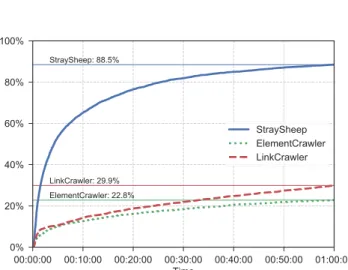
Next, we analyzed the efficiency of each web-crawling module by comparing the time taken to complete visit- ing web pages branching from the landing page. Figure 5 is a cumulative distribution function (CDF) of the time for each web-crawling module, which shows the percent- age of web crawling finished at a certain time out of all web crawling starting from 10k landing pages. We found that 88.5% of StraySheep’s web crawling module finished within one-hour timeout. In contrast, ElementCrawler fin- ished only 22.8% of web crawling within the timeout, and LinkCrawler finished 29.9%. The average time to complete the web crawling for each landing page was 14 minutes for StraySheep’s web-crawling module, 49 minutes for El-
Fig. 5 CDF of time taken to complete web crawling for each landing page within a 1-hour timeout. Horizontal lines mean the percentage of web crawling completed before timeout.
ementCrawler, and 47 minutes for LinkCrawler.
To measure the web-crawling modules’ ability to reach SE attacks per total crawling time, we calculatedcrawling efficiency.
Crawling Efficiency [/sec]= # Unique domains of visited SE pages Total crawling time [sec] . Crawling efficiency indicates the ability to reach the unique domain names of SE pages per unit of time. Higher crawling efficiency implies that the module can efficiently reach new SE pages.
We show the crawling efficiency for each web-crawling module in Table 5. Total crawling time in Table 5 repre- sents the sum of the times to complete crawling 10k land- ing pages. The crawling efficiency of StraySheep’s web- crawling module was 4.1 times higher than that of Ele- mentCrawler and 5.1 times higher than that of LinkCrawler, making it the most efficient module to reach SE attacks. As described in Sect. 3.2.1, since StraySheep’s web-crawling module detected lure elements that led to SE pages by using the selecting component, it visited more SE pages in less time than the two baseline modules.
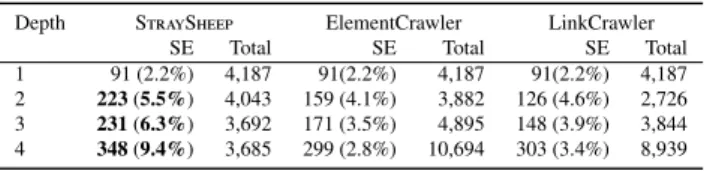
We also examined the ability to visit SE attacks that can be reached via multiple web pages. Table 6 shows the number of unique domain names observed at each depth.
Note that each depth may have duplicate domains because the web-crawling modules visited the same domains at dif- ferent depths. Also, the number of domain names observed at a depth of 1 was the same because each module visited the same landing pages. The number of domains of SE pages show that StraySheep’s web-crawling module efficiently
Table 5 Crawling efficiency of each web-crawling module.
StraySheep ElementCrawler LinkCrawler
# of unique domains of visited SE pages 513 437 335
Total crawling time [sec] 8,429,288 29,698,118 28,421,460 Crawling efficiency [/sec] 6.1·10−5 1.5·10−5 1.2·10−5
Table 6 Unique domain names observed at each depth.
Depth StraySheep ElementCrawler LinkCrawler
SE Total SE Total SE Total
1 91 (2.2%) 4,187 91(2.2%) 4,187 91(2.2%) 4,187 2 223(5.5%) 4,043 159 (4.1%) 3,882 126 (4.6%) 2,726 3 231(6.3%) 3,692 171 (3.5%) 4,895 148 (3.9%) 3,844 4 348(9.4%) 3,685 299 (2.8%) 10,694 303 (3.4%) 8,939
visited more domains of SE attacks at every depth than the baseline modules. As the depth became deeper, the per- centages of an SE page’s domains that ElementCrawler and LinkCrawler detected decreased. On the contrary, the per- centages of an SE page’s domains that StraySheep’s web- crawling module visited were 5.5% at a depth of 2, 6.3% at a depth of 3, and 9.4% at a depth of 4; thus, the deeper StraySheep’s web-crawling module crawled, the more it efficiently visited SE pages. As described in Sect. 3.2.1, StraySheep selects lure elements that lead to SE attacks so that the web-crawling module can reach more of an SE page’s domains even though it crawls deeper.
Comparison of crawling performance with TrueClick and StraySheep We also conducted an additional experi- ment comparing the crawling performance of StraySheep with that of TrueClick in terms of the ability to reach SE pages and collect malware executables. TrueClick is a tool that distinguishes fake advertisement banners (trick ban- ners) from genuine download links. TrueClick has the sim- ilar purpose as StraySheepfor finding HTML elements that are made to deceive users and direct to a malicious site or malware executable, but it only finds elements displayed by advertising providers regardless of the web site owner’s in- tention.
Since the source code of TrueClick has not been pub- lished, we re-implemented TrueClick based on the imple- mentation details of the paper [18] using a manually col- lected dataset containing 87 trick banners and 51 genuine banners, which is almost equivalent to the amount of the original dataset (165 trick banners and 94 genuine download links), to train a machine learning model. The trained model identifies trick banners with 98.6% accuracy. We then cre- ated a baseline crawling module by replacing StraySheep’s selecting component (Sect. 3.2.1) with TrueClick imple- mentation.
To equivalently compare the crawling results under the same experimental condition in terms of the period of landing-page collection and web crawling, we have col- lected 5k URLs in the same manner as that mentioned in Sect. 4.4 and crawled them using both StraySheep’s web- crawling module and the baseline module as of November 2019. Since this experiment was conducted at a differ-
Fig. 6 Overlap of SE pages’ domain names observed using StraySheep and TrueClick.
ent period than the one explained above, we newly col- lected 2.5k landing pages each from a search engine and social media as input URLs. Table 7 summarizes the re- sults. StraySheep visited more SE pages than TrueClick because it follows not only trick banners but also buttons and links intentionally placed by web site owners to lead to SE attacks. While StraySheepsuccessfully downloaded 266 malware samples, TrueClick downloaded only 1 malware sample. This is because, in most cases, genuine download links distribute malware samples instead of trick banners on web pages redirected from the first trick banners on land- ing pages. Table 8 shows the number of unique SE pages observed at each depth. Similar to the results in Table 6, Straysheepreached more SE attacks as it crawled deeper.
Conversely, the number of SE pages that TrueClick reached considerably decreased deeper than depth three. The reason for this is that as we crawl deeper from the landing page, the number of trick banners decreases. Additionally, intention- ally placed lure elements including genuine download links mainly lead to SE attacks at deeper depths. Figure 6 shows the overlap of SE pages’ domain names observed using each crawler. Although StraySheepdid not visit a small number of SE pages dynamically served by ads, it covered most of the SE pages observed by TrueClick. In summary, to collect more multi-step SE attacks, we need not only to detect trick banners but also follow lure elements.
4.5 Evaluating the SE Detection Module
We evaluated the effectiveness of StraySheep’s SE- detection module using WebTrees, which are the outputs of StraySheep’s web-crawling module. We used 30k Web- Trees constructed from the results of web crawling starting from 30k landing pages. These WebTrees consisted of the 10k landing pages crawled by StraySheep’s web-crawling module (Sect. 4.4) and additional 20k landing pages. The
Table 7 Results of web crawling using StraySheepand TrueClick.
Unique visited pages (domain names) Unique visited SE pages (domain names) Unique malware samples
StraySheep 48,524 (5,809) 3,897 (219) 266
TrueClick 7,917 (2,978) 523 (78) 1
Table 8 Unique SE pages observed at each depth by using StraySheepand TrueClick.
depth SE pages crawled using StraySheep (domain names)
SE pages crawled by TrueClick (domain names)
1 97 (44) 97 (44)
2 845 (86) 356 (35)
3 1068 (104) 48 (12)
4 2302 (106) 25 (12)
Unique SE pages 3,897 (219) 523 (78)
20k landing pages were collected and randomly sampled in the same manner as for the 10k landing pages mentioned in Sect. 4.3. We carried out the web crawling in the same en- vironment in the same period to output additional 20k Web- Trees.
To create datasets for evaluation, we extracted mali- cious and benign sequences from the 30k WebTrees. The 30k WebTrees contained a total of 243,914 unique web pages (13,415 unique domains) of visited web pages. To label these web pages as SE pages, we used blacklists (same as in Sects. 4.3 and 4.4) and VirusTotal. We labeled 51,501 unique web pages (unique 1,066 domains) as SE pages and extracted 1,066 sequences, which reached 1,066 different domain names from distinct landing pages. We excluded unreachable or parking domain pages and created 1,045 se- quences as the malicious dataset. To create a benign dataset, we randomly sampled 1,045 sequences that did not visit SE pages.
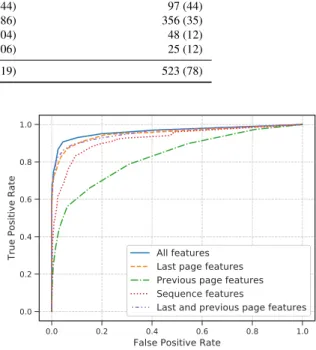
To evaluate the detection accuracy of the SE-detection module, we conducted a 10-fold cross-validation (CV) on the labeled dataset. The SE-detection module classified our dataset with a precision of 97.4%, recall of 93.5%, and ac- curacy of 95.5%. When we changed the learning algorithm from random forest to support vector machine, logistic re- gression, and decision tree, their accuracies were 93.6%, 90.8%, and 90.7%, respectively. The percentage of fea- ture importance accounted for 65.2% of features extracted from the last page (last page features), 28.2% of features extracted from the previous page (previous page features), and 6.6% of features extracted from the entire sequence (se- quence features), as shown in Table 1.
Although the SE-detection module can accurately iden- tify multi-step SE attacks, the evaluation result contained some false positives and false negatives. We discuss ideas for reducing these false positives and false negatives. The false positives included popular shopping and casino sites that were redirected from pop-up ads triggered by unin- tended click. We can reduce these false positives by ex- tracting long-term stable and popular domain names from domain lists such as Alexa to create a white list. We also found false negatives that were listed on blacklists but not
Fig. 7 ROC curves of SE detection results for each feature set.
detected by the SE-detection module. Since we only trained web pages written in English in this experiment, Some web pages written in non-English languages were included in false negatives. Ad providers may change web pages to serve depending on the region of a source IP address. There- fore, we can accurately detect multi-step SE attacks by au- tomatically translating web pages to English or by training web pages written in a specific language corresponding to the region of the source IP address.
To show the relationship between detection accuracy and features, we divided the features into four feature sets:
last page, previous page, sequence, and the combination of last and previous page (feature sets without our proposed se- quence features). We conducted 10-fold CVs using all fea- ture sets and four divided feature sets with the same dataset discussed in Sect. 4.5. Figure 7 shows the receiver operat- ing characteristic (ROC) curves for the classification results.
The most accurate result was the CV using all features in or- der of the combination of last and previous page, last page, sequence, and previous page feature sets. The area under the curve (AUC) for each result was 0.965, 0.955, 0.948, 0.923, and 0.829. This experiment revealed that our origi- nal page-level features that analyzed linguistic, image, and HTML characteristics were useful in detecting various types
of SE attacks, i.e., not limited to a specific SE attack. How- ever, we can classify more accurately by using the features of a previous page and sequence together that StraySheep automatically collects.
Some web pages had similar appearances to known SE pages but were not blacklisted. To find such poten- tially unknown SE pages, we leveraged the SE-detection module to classify the remaining 192,620 sequences of the 11,304 domain names not used in the evaluation. As a re- sult of manually excluding false positives (27 domains) from the classification results, we found 359 unknown domain names associated with SE attacks. We not only detected web pages where page contents were shared across multiple domain names to expand attack campaigns (e.g., Fig. 8 and Fig. 9), but also discovered unreported domain names asso- ciated with technical support scams and survey scams. This process was conducted by analyzing screenshots to check whether suggested software and extensions or login pages are associated with legitimate services. One example of the false positives was a Facebook login page opened by a popup that redirected from an illegal software-download blog by clicking a share button. Another example was a download page of legitimate anti-virus products that trans- ferred by clicking advertising in an iframe. We finally found a total of 1,404 unique domain names (the 1,045 blacklisted domain names and newly detected 359 domain names), and 56,922 sequences reached the 1,404 domain names. The number of sequences’ steps (i.e., the number of page transi- tions) from one to three is 11,855 (20.8%), 13,813 (24.3%), and 31,254 (54.9%), respectively.
5. Detailed Analysis of Detected Multi-Step SE Attacks We conducted a detailed analysis of the collected multi-step SE attacks mentioned in Sect. 4.5 (1,404 domain names and 56,992 sequences). To show that StraySheepfound a wide variety of SE attacks, we categorized the observed SE page’s domain names and investigated the attacker techniques to deceive and persuade users for each SE attack category.
We then analyzed the browser interactions and advertising providers that led to SE pages to clarify the cause of SE at- tacks. Finally, we investigated network infrastructures host- ing SE attacks.
5.1 SE Attack Categories
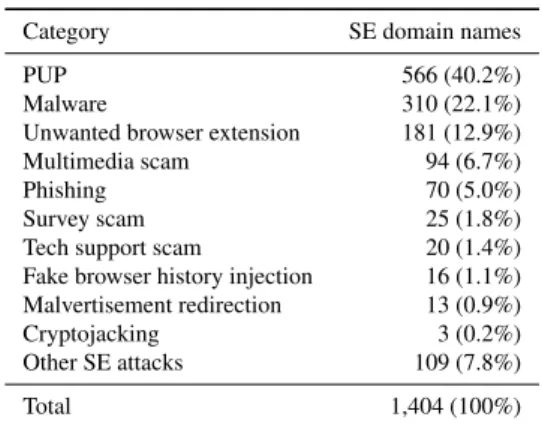
To clarify the types of multi-step SE attacks detected by StraySheep, we categorized the 1,404 domain names into 11 categories, as shown in Table 9. We used labels of blacklists (Google Safe Browsing, Symantec DeepSight, hpHosts) and virus scan results of VirusTotal to categorize the attacks.
We leveraged AVClass[33]to classify detected binaries as PUPs or malware. We also checked the appearance of these domain names’ web pages to complement categorization.
PUP and MalwareThe most common categories we iden- tified were PUP (566 domain names) and malware (310 domain names). These categories are SE attacks where
Table 9 SE attack categories.
Category SE domain names
PUP 566 (40.2%)
Malware 310 (22.1%)
Unwanted browser extension 181 (12.9%)
Multimedia scam 94 (6.7%)
Phishing 70 (5.0%)
Survey scam 25 (1.8%)
Tech support scam 20 (1.4%)
Fake browser history injection 16 (1.1%) Malvertisement redirection 13 (0.9%)
Cryptojacking 3 (0.2%)
Other SE attacks 109 (7.8%)
Total 1,404 (100%)
PUPs and malware were downloaded due to browser inter- actions. StraySheepdownloaded 6,924 unique binary exe- cutable files (e.g., .exeor.dmg). For example, we found that these binaries were disguised as fake game installers, fake anti-virus software, and fake Java/Flash updaters. Out of the 6,924 binaries, we detected 1,591 unique binaries in- cluding 1,090 malware samples and 501 PUPs by checking their MD5 hash in VirusTotal and using AVClass. We con- firmed that 3,336 unique binaries were never uploaded to VirusTotal. Although the remaining 1,997 unique binaries were already uploaded, they were not detected by any anti- virus software in VirusTotal.
The 2,141 out of the 3,336 binaries that were not up- loaded had 1,347 unique filenames, which were automat- ically set according to the previous page (e.g., “[the title of the previous page].exe.rename”). Figure 8 shows ex- amples of these web pages. The web pages that down- loaded these binaries contained instructions to entice users to remove “.rename” and execute them. We found 504 unique domain names downloading these binaries. The 175 out of these 504 domain names matched the blacklists and the other 329 domain names were newly detected by StraySheep. The reason for making users change the file extension is to circumvent the download-protection function of web browsers. Since the hash values of these binaries also changed at every downloading, none were ever uploaded to VirusTotal. To check whether these binaries were malicious, we chose ten samples from the binaries and uploaded them to VirusTotal. Then, all ten samples were detected as “Start- Surf” or “Prepscram” family names.
Unwanted Browser Extension We categorized 181 do- main names as distributing unwanted browser exten- sions. We confirmed that these domain names were de- tected as “Fake Browser Extension Download” or “Un- wanted Extension”, which led to install pages (https:/
/chrome.google.com/webstore) of 128 unique Google Chrome browser extensions. However, we found that 119 (93.0%) extensions were still available on the browser ex- tension install pages a month after the crawling. By investi- gating these browser extensions, we found that 18 (14.1%) extensions were search tool bars, and 14 (10.9%) extensions were file converters. Security vendor blog postings and on-