INVITED PAPER
Special Section on Enriched Multimedia—Creation of a New Society through Value-added Multimedia Content—Enhancing Stereo Signals with High-Order Ambisonics Spatial Information
Jorge TREVINO†a),Nonmember, Shuichi SAKAMOTO†b),Member, Junfeng LI††c),Nonmember, andYˆoiti SUZUKI†d),Fellow
SUMMARY There is a strong push towards the ultra-realistic presenta- tion of multimedia contents made possible by the latest advances in com- putational and signal processing technologies. Three-dimensional sound presentation is necessary to convey a natural and rich multimedia experi- ence. Promising ways to achieve this include the sound field reproduction technique known as high-order Ambisonics (HOA). While these advanced methods are now within the capabilities of consumer-level processing sys- tems, their adoption is hindered by the lack of contents. Production and coding of the audio components in multimedia focus on traditional formats such as stereophonic sound. Mainstream audio codecs and media such as CDs or DVDs do not support advanced, rich contents such as HOA encod- ings. To ameliorate this problem and speed up the adoption of spatial sound technologies, this paper proposes a novel way to downmix HOA contents into a stereo signal. The resulting data can be distributed using conven- tional methods such as audio CDs or as the audio component of an internet video stream. The results can be listened to using legacy stereo reproduc- tion systems. However, they include spatial information encoded as the inter-channel level and phase differences. The proposed method consists of a downmixing filterbank which independently modulate inter-channel differences at each frequency bin. The proposal is evaluated using simple test signals and found to outperform conventional methods such as matrix- encoded surround and the Ambisonics UHJ format in terms of spatial reso- lution. The proposal can be coupled with a previously presented method to recover HOA signals from stereo recordings. The resulting system allows for the preservation of full-surround spatial information in ultra-realistic contents when they are transferred using a stereo stream. Simulation re- sults show that a compatible decoder can accurately recover up to five HOA channels from a stereo signal (2nd order HOA data in the horizontal plane).
key words: spatial sound, high-order Ambisonics, spatialization, sur- round, sound signal encoding
1. Introduction
Sound plays a critical role in multimedia communications.
Realistic sound is necessary to convey the rich perceptual and affective information humans need to understand a per- ceptual scene. For this reason, the present paper focuses on the enrichment of multimedia contents, understood as their quality enhancement through signal processing, from
Manuscript received July 31, 2015.
Manuscript revised September 19, 2015.
Manuscript publicized October 21, 2015.
†The authors are with the Research Institute of Electrical Com- munication and the Graduate School of Information Sciences, To- hoku University, Sendai-shi, 980–8577 Japan.
††The author is with the Institute of Acoustics, Chinese Academy of Sciences, Beijing, 100190 China.
a) E-mail: [email protected] b) E-mail: [email protected] c) E-mail: [email protected] d) E-mail: [email protected]
DOI: 10.1587/transinf.2015MUI0001
the point of view of the auditory modality. Previous studies have found that the addition of even small amounts of lin- guistic information in the form of text can significantly en- hance the perception of an auditory scene[1]. The present research, on the other hand, focuses on media enhancements that are fully contained within the auditory modality.
An important function of the auditory system is to pro- vide the listener with spatial information, such as the ap- proximate positions of sound sources around them; this is known as spatial hearing[2]. The realistic presentation of multimedia contents must take this into account and con- vey spatial information through sound. The importance of this is highlighted by the fact that the auditory modality pro- vides the listener with information covering all directions around them, while vision covers only the front half-space.
Furthermore, the auditory modality plays a critical role in determining the affective aspects of multimedia perception, such as the sense-of-presence[3].
The processing and presentation of spatial sound infor- mation is now possible[4],[5], thanks to recent advances in computing and telecommunication technologies. There are three mainstream approaches to the problem of spatial sound reproduction: binaural, multi-channel surround and sound field reproduction.
Binaural sound reproduction attempts to control the sound pressure at the listener’s ears. There is a wide va- riety of binaural systems capable of presenting recorded or synthesized sounds using either headphones or loud- speakers[6]–[9]. Binaural techniques can accurately con- vey spatial sound information; however, they require indi- vidual measurements of the head-related transfer function (HRTF)[2]. Binaural systems must be coupled with sophis- ticated tracking and processing systems if the control points (the position of the listener’s ears) are allowed to move. This condition is, however, mandatory for the accurate presenta- tion of spatial sound[10]. Binaural recordings are commer- cially available, but they represent a niche market.
In a multi-channel surround sound system, a num- ber of loudspeakers are arranged into a predefined config- uration and used to present sounds from their respective directions[11], [12]. The reproduction stage of a multi- channel surround system, in general, does not require any special processing of the audio signals. This has made it a popular choice for mainstream spatial sound reproduction.
However, commercial systems such as 5.1-channel surround have very limited spatial resolution when compared to other Copyright c2016 The Institute of Electronics, Information and Communication Engineers
gory, sound field reproduction, represent a relatively new method made possible by faster signal processing and multi- channel technologies. They work by re-creating the sound pressure over an extended region surrounding the listen- ers[13]–[15]; this has several advantages over the other methods. Their focus on an extended region rather than two control points eliminates the required adjustments for each listener and their positions needed in binaural reproduction.
The sound field reproduction approach reaches higher spa- tial resolutions than multi-channel surround systems by us- ing the available loudspeakers more effectively. Until recent years, sound field reproduction was limited to research fa- cilities and technical demonstrations[16],[17]. These tech- nologies are now within the reach of modern consumer-level devices; however, there is only a handful of sound field recordings available to mainstream users. The lack of con- tents is due to the relative novelty of the method and the ab- sence of a standard way to encode sound field information for distribution using conventional media.
The present paper seeks to accelerate the adoption of rich multimedia technologies by filling the gap between con- ventional audio systems and new technologies that can con- vey enhanced spatial sound characteristics. In particular, we propose a new method to enhance stereo signals with spa- tial sound information. Our proposal relies on a technology known as high-order Ambisonics (HOA) to encode sound field information into a multi-channel stream[15]. This is then downmixed into a stereo signal by modulating the inter-channel level and phase differences. The results are a stereo mix that can be reproduced by legacy systems. In addition, the original HOA data can be recovered using a previously proposed spatialization algorithm for stereo sig- nals[18],[19].
The proposal focuses on two established technologies:
HOA and stereo sound. The main reason behind the first choice is the system-agnostic property of the HOA for- mat. Sound fields encoded using HOA can be reproduced by virtually any spatial audio system by adding a decod- ing stage[20]. It is also possible to reproduce them over headphones using binaural techniques[9]. The choice of a stereo signal as the output of the proposed algorithm is due to its widespread use, making it fully compatible with cur- rent technologies for broadcasting (radio, TV), distribution on physical media (audio CDs, DVDs) and internet stream- ing (MP3, FLAC, AAC).
An alternative method to represent HOA data using stereo and multi-channel signals is known as the Ambison- ics UHJ format[21], [22]. This approach is similar to the matrix-encoding of surround sound used to downmix multi-channel data into a stereo signal and upmix it at the
can achieve better spatial resolution than the Ambison- ics UHJ format, which is limited to first-order horizontal Ambisonics (the lowest spatial resolution above monaural sound) when applied to generate stereo signals.
Section 2 reviews existing technologies to represent spatial sound using stereo signals. Section 3 summarizes a previously presented method to synthesize HOA data from an extended stereo mix. Section 4 introduces a new algo- rithm to generate stereo signals from HOA data. The meth- ods of Sect. 3 and Sect. 4 are used together to evaluate the proposed system in Sect. 5. Finally, Sect. 6 summarizes the results and presents our conclusions.
2. Stereo Representation of Spatial Sound
Stereophonic sound is a well-established but limited method to convey spatial sound information. It uses two indepen- dent audio signals, a left and a right channel. In compar- ison with recent technologies, stereophonic systems have poor spatial resolution and cannot present sounds from all directions. Nevertheless, its long history and widespread adoption means that most sound systems can handle stereo signals.
The two-channel signals used in stereo systems can transport spatial information for more sophisticated repro- duction methods. Binaural systems use stereo signals where the left and right channels carry the sound pressure data for the left and right ears respectively. In this Section, we re- view some of the existing methods that use stereo signals to transport the data for multi-channel surround and sound field reproduction systems.
2.1 Stereo Panning
Conventional stereophonic systems consist of two loud- speakers placed in front of the listener at azimuth angles of
−30◦ and 30◦. A common signal presented on both loud- speakers at different levels results in a sound image located somewhere between the loudspeakers. The level differences required to present sound from different directions are char- acterized by apanning law. The design of panning laws has been extensively studied. It is common to use sinusoid or tangent functions to define optimal laws[27],[28].
Conventional stereo signals consider panning laws spanning only the −30◦ to 30◦ interval, which is the re- gion covered by the loudspeakers. Presenting sound images outside of this interval with only two front loudspeakers re- quires more sophisticated techniques[8].
Some modern techniques, however, consider the pan- ning law at directions outside of the loudspeaker coverage.
Fig. 1 Extended stereo panning law. Conventional stereophonic systems use similar laws restricted to angles between−30◦and 30◦from the frontal direction.
In these systems, the stereo signal is used to encode spatial information for reproduction using a more sophisticated sys- tem, such as multi-channel surround[23]. Figure 1 shows an extension of the conventional sinusoid panning law[23]
covering all directions in the horizontal plane. An impor- tant observation is that, systems relying on the full panning law of Fig. 1, will give opposite polarities to the left and right channels when the sound image is located outside of the front half-space. The panning law encodes the left-right position of the desired sound image as an inter-channel am- plitude difference, while its front-back position is encoded as an inter-channel phase difference.
2.2 Matrix-Encoded Surround
Panning laws similar to that of Fig. 1 can be used to en- code the data for multi-channel surround systems as stereo signals. Each loudspeaker position in a multi-channel sur- round system can be associated with a pair of inter-channel amplitude and phase differences by a panning law. Since the loudspeaker positions are fixed, the stereo downmix of multi-channel surround sound can be conveniently denoted as a matrix operation[24]:
SL(ω)
SR(ω)
=M
⎡⎢⎢⎢⎢⎢
⎢⎢⎢⎢⎢
⎢⎢⎢⎢⎢
⎣ S1(ω) S2(ω)
... SN(ω)
⎤⎥⎥⎥⎥⎥
⎥⎥⎥⎥⎥
⎥⎥⎥⎥⎥
⎦
. (1)
In Eq. (1), the stereo signalsSL(ω) andSR(ω) are linear com- binations ofN multi-channel surround signals. The gains and phase adjustments are summarized in an encoding ma- trix M of 2-by-Ncomplex elements. A simple example used to encode four-channel surround is[25]:
M=
0.92 0.38 0.46πi 0.19πi 0.38 0.92 −0.19πi −0.46πi
. (2)
Inverting Eq. (1) makes it possible to approximate the original multi-channel data from its stereo downmix:
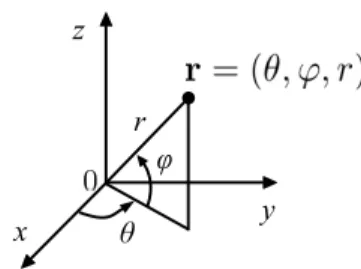
Fig. 2 The spherical coordinate system used in this paper. Anglesθand ϕare the azimuth and elevation angles, respectively. The radial coordinate is denoted byr.
⎡⎢⎢⎢⎢⎢
⎢⎢⎢⎢⎢
⎢⎢⎢⎢⎢
⎣ S1(ω) S2(ω)
... SN(ω)
⎤⎥⎥⎥⎥⎥
⎥⎥⎥⎥⎥
⎥⎥⎥⎥⎥
⎦
≈M+
SL(ω)
SR(ω)
. (3)
In this equation, the decoding matrix M+ is the pseudo- inverse of M. The decoding equation associated with the example in Eq. (2) is:
M+=
⎡⎢⎢⎢⎢⎢
⎢⎢⎢⎢⎢
⎢⎢⎣
0.33 0.21 0.21 0.33
−0.4i 0.05i
−0.05i 0.4i
⎤⎥⎥⎥⎥⎥
⎥⎥⎥⎥⎥
⎥⎥⎦. (4)
It is important to notice that these matrices are constant for all frequencies ω, since the panning law is not frequency dependent.
2.3 Sound Field Reproduction and the Ambisonics UHJ Format
High-order Ambisonics (HOA), a sound field reproduction technology, is a relatively new but promising method to present spatial sound where the sound pressure over an ex- tended region surrounding the listener is controlled by a loudspeaker array. Sound field reproduction methods are both listener-independent and system-agnostic. This means that no individual adjustments are needed, as is the case of binaural presentation, and there are no prescribed positions for the loudspeakers. A decoder is used to calculate the loudspeaker signals that a specific system must use to re- create the target sound field.
The input to a sound field reproduction system consists of a description of the target sound field. A widely used characterization of sound field information is known as the spherical harmonic expansion[15]:
ψk(r)=∞
n=0
n
m=−n
Bnm(k)Rn(kr)Ynm(θ, ϕ). (5) This equation uses the spherical coordinate system shown in Fig. 2. Equation (5) is expressed in the frequency domain through k, the wavenumber, which is related to the angu- lar frequencyωby the speed of soundcusing the formula k = ω/c. The radial functions Rn(kr) are combinations of spherical Bessel and spherical Hankel functions[15],[29].
It is common to ommit them to reduce system complexity
Ynm(θ, ϕ)=⎪⎪⎪⎪⎪⎨
⎪⎪⎪⎪⎪
⎪⎪⎩
(n−m)!
2n+1
4π Pn,0(sinϕ) m=0
(−1)m
2n+1
4π ·(n(n−+m)!m)!Pn,m(sinϕ)eimθ m>0 (6) The expansion coefficients Bnm(k) are referred to as the HOA encoding of the sound fieldψk(r). Practical systems consider these coefficients up to a maximum order Nmax.
An explicit formula for the HOA encoding of the sound field due to a plane wave incident from azimuthθincand el- evationϕincis given in[15]:
Bnm=−4πinY∗nm(θinc, ϕinc). (7) Here| · |∗denotes the complex conjugate.
Equations (5) and (7) are valid for all directions, in- cluding those outside of the horizontal plane. However, this paper will consider only the case where the elevation angle ϕ=0. This is justified since stereophonic systems, as well as the multi-channel surround systems considered in the pre- vious Subsection, are also limited to the horizontal plane. In this case, all of the expansion coefficients Bnm(k) for which
|m|nare zero. Therefore, a Nmax-order HOA encoding in the horizontal plane consists of 2Nmax+1 sets of coefficients in the frequency domain, or signals in the time domain.
The HOA format can encode the spatial sound infor- mation corresponding to any desired sound field as a multi- channel signal. These signals can be further downmixed into a stereo stream using Eq. (1) with a suitable encoding ma- trix. This reasoning led to a format known as Ambisonics UHJ[21],[22]. In particular, the encoding matrix used to represent first-order HOA data in the horizontal plane as a stereo signal is:
M=
0.47−0.086πi 0.93+0.128πi 0.328 0.47+0.086πi 0.93−0.128πi −0.328
. (8) The first column generates an omnidirectional component corresponding to B0,0; the second column encodes front- back information B1,1; the third column handles the left- right component B1,−1. The Ambisonics UHJ format can downmix HOA data for higher orders or data outside of the horizontal plane; however, in these cases it produces three or more output signals. Its application to stereo systems is limited to first-order data in the horizontal plane.
3. Synthesizing HOA Data from Extended Stereo Sig- nals
Conventional stereo signals encode sound source positions only in front of the listener. However, some stereo signals
tion of spatial sound.
3.1 Stable Inversion of the Stereo Panning Law
The techniques described in Sect. 2 are based on the concept of a panning law which represents the left-right positions of sound images as an inter-channel amplitude difference, and their front-back positions as an inter-channel phase differ- ence. Our proposed method attempts to recover these left- right and front-back coordinates by inverting the panning law. This is similar to Eq. (3); however, it considers all az- imuth angles.
The first step in our proposal consists of calculating the inter-channel level and phase differences. These inter- channel differences correspond to the inferred sound source position along the front-back (x), and the left-right (y) axes;
they can be calculated using the following formulas:
x(ω)=
1+arg{SL(ω)}−arg{SR(ω)}
π
mod 2−1. (9) y(ω)= |SL(ω)| − |SR(ω)|
max(|SL(ω)|,|SR(ω)|), (10) These formulas yield results in the interval [−1,1].
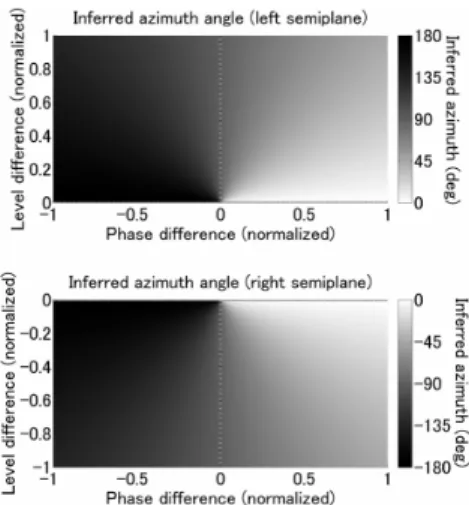
The inter-channel differences are enough to invert a panning law like that shown in Fig. 1. The result of do- ing this is shown in Fig. 3. However, this simple inversion does not result in stable positions for all sound images. Un- der some conditions, small variations in the stereo signals may lead to large changes in the inferred position for the sound image. The reason for this is that the inter-channel
Fig. 3 Simple inversion of a stereo panning law. The azimuth angle for the target sound image is shown as a function of the inter-channel level and phase differences. There is one unstable point corresponding to zero inter-channel differences (sound images directly in front of the listener).
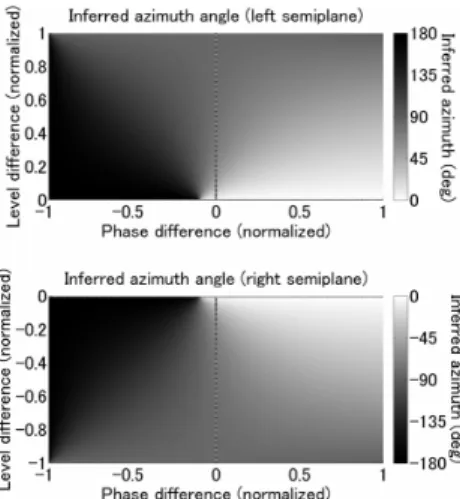
Fig. 4 Stable inversion of a stereo panning law after a non-linear warping of the horizontal plane. Inferred azimuth angles are shown in relation to the inter-channel differences. The unstable point is shifted to the back of the horizontal plane, ensuring the stable presentation of sound images in front of the listener.
differences may not be reliably calculated when they are small or may be undefined for sounds present in only one of the stereo channels. To remedy this, our proposal uses the non-linear warping of the coordinate system introduced in[18],[19].
ˆ
x=x+φ(1˜ −x2)−xy2, (11) yˆ=y+
dx3y−ex4y
−
f x3y3+gx4y3
. (12)
The first correction in Eq. (11) shifts a singularity at the cen- ter of Fig. 3, ensuring the stable presentation of sound im- ages at the front. This is achieved by a global shift along the front-back coordinatexof ˜φunits. The shift is removed for points away from the singularity by the x2 factor. The parameter ˜φmust be small; an appropriate value to use with typical stereo signals is 0.1[18]. The second correction, in- troduced by the−xy2term in Eq. (11), solves the problem of lateral sound images with undefined inter-channel phase dif- ferences. This correction places the sounds present in only one channel directly to the left of right, as appropriate.
Corrections along the left-right coordinateyare defined by four parametersd, e, f and g. The first two are used to expand the front half-space byd−ewhile shrinking the back half-space by d+e. Our proposal recommends the values ofd+e=0.9 andd−e=0.3 (i.e.d =0.6 ande= 0.3) for typical stereo contents[18]. The last two parameters remove the corrections for sound sources directly in front of the listener. Therefore, they must satisfy f+g=d−e. The differenceg− f can be adjusted to further stabilize sound sources directly behind the listener. A recommended value for this isg−f =0.1, and thereforef =0.1 andg=0.2[18].
The result of applying Eqs. (11) and (12) to the inversion of the panning law are shown in Fig. 4.
3.2 High-Order Ambisonic Encoding
Inverting the panning law yields an inferred azimuth angle,
θ(ω) =arctan[ ˆy(ω),x(ω)], for each frequency in the stereoˆ signal. This can be used in combination with Eq. (7) to gen- erate the HOA encoding. The corresponding sound field will contain all of the sound images present in the stereo signal as plane waves arriving from the directions encoded in the inter-channel differences.
Equation (7) deals with the spatial information of a plane wave field. The actual sound sources signals, however, must be extracted from the stereo data. This can be done by downmixing it to a monaural signal. Our method assumes the presence of important out-of-phase components; there- fore, the downmixing should be carried out in the frequency domain. The monaural downmix O(ω) can be calculated using the following formulas[18],[19]:
|O(ω)|=
|SL(ω)|2+|SR(ω)|2 (13) Ang [O(ω)]=⎧⎪⎪⎪⎨
⎪⎪⎪⎩
Ang [SR(ω)] θ <0
Ang [SL(ω)]+Ang [SR(ω)] θ=0
Ang [SL(ω)] θ >0
(14) The spatial information can be added by passing O(ω) through a filterbank calculated from Eq. (7). Considering that the elevation angleϕis zero, the formulas for the spher- ical harmonics simplify into complex exponentials depend- ing only on the degree m. The expansion coefficients are zero for all terms withn |m|. The resulting filters Fm(ω) are
Fm(ω)=
−sin [mθ(ω)] m<0
cos [mθ(ω)] m≥0 (15)
Multiplying these filters by O(ω) (equivalent to the convo- lution in the time domain) results in an HOA encoding in- ferred from the inter-channel differences of a stereo signal.
The case m = 0 is just the monaural downmix (the om- nidirectional component B0,0); the results for m = 1 are the front-back difference (the HOA component B1,1); when m=−1 the result is the left-right difference (corresponding to the HOA component B1,−1). The filters can be calculated to any desired order; however, the proposal does not yield significant improvements in spatial resolution above order 2[18],[19].
4. Stereo Encoding of HOA Data
The method detailed in Sect. 3 can synthesize HOA data from a stereo signal by looking at its inter-channel dif- ferences. The proposal, however, assumes that the stereo source was mixed using a panning law similar to the one shown in Fig. 1. Applying the panning law is straightfor- ward if the individual sound sources are available and their positions are known. However, this data is not directly avail- able if the target sound has been already encoded in the HOA format. Furthermore, a significant advantage of HOA is that it allows for the direct recording of spatial sound us- ing microphone arrays[31]. A method to downmix sound field recordings and HOA data to stereo while preserving
sound information found in the original HOA data.
Another alternative is to look at the sound field char- acterized by the HOA data and simulate its recording using virtual directional microphones. This approach uses a tech- nique known as beamforming[32]. It has been successfully used to extract sound sources and their directions from first- order Ambisonics data[33]. The method can be extended to higher orders; however the intermediate microphone simu- lation stage introduces additional parameters and sources of inaccuracy in the system.
In this Section, we propose a new method to represent HOA data as a stereo signal. The proposal follows the pro- cedure of Sect. 3 in reverse order and results in a stereo sig- nal that can be decoded back into the HOA format by our previously proposed method[18],[19].
4.1 Recovering Azimuth Angles from HOA Data
As previously stated, our proposal considers only sound sources in the horizontal plane. Therefore, the input to our system consists of 2Nmax+1 channels containing the HOA encoding of a sound field.
The omnidirectional component B0,0carries no spatial information; however, it is a common part of all channels in the HOA data. Ideally, the relationship between this and the other channels should be described by Eq. (15). This can be summarized in matrix notation:
⎡⎢⎢⎢⎢⎢
⎢⎢⎢⎢⎢
⎢⎢⎢⎢⎢
⎣ B0,0(ω) B1,−1(ω)
B1,1(ω) ...
⎤⎥⎥⎥⎥⎥
⎥⎥⎥⎥⎥
⎥⎥⎥⎥⎥
⎦
=
⎡⎢⎢⎢⎢⎢
⎢⎢⎢⎢⎢
⎢⎢⎢⎢⎢
⎣
−sin[θ(ω)]1 cos[θ(ω)]
...
⎤⎥⎥⎥⎥⎥
⎥⎥⎥⎥⎥
⎥⎥⎥⎥⎥
⎦
B0,0(ω). (16)
At a given frequency, Eq. (16) reduces to the multiplication of a vector by a scalar. This can be easily inverted; however, since the HOA coefficients are sound signals a more stable approach is to calculate the deconvolution of each channel by B0,0. This can be done by computing an inverse filter, through a Wiener filter or using more sophisticated, non- linear algorithms if required by the source signals[34]. An- other important consideration is the range of the sine and cosine functions; the results of the deconvolution must be wrapped inside the interval [−1,1]. The inverse of Eq. (16) is then
⎡⎢⎢⎢⎢⎢
⎢⎢⎢⎢⎢
⎢⎢⎢⎢⎢
⎣ 1 θ˜−1(ω)
θ˜1(ω) ...
⎤⎥⎥⎥⎥⎥
⎥⎥⎥⎥⎥
⎥⎥⎥⎥⎥
⎦
=
⎡⎢⎢⎢⎢⎢
⎢⎢⎢⎢⎢
⎢⎢⎢⎢⎢
⎣
1
−arcsin fracB
1,−1(ω)/B0,0(ω) arccos
fracB
1,1(ω)/B0,0(ω) ...
⎤⎥⎥⎥⎥⎥
⎥⎥⎥⎥⎥
⎥⎥⎥⎥⎥
⎦
. (17)
Where ·/· denotes the deconvolution of two signals and
n=−Nmax
n0
4.2 Generating the Stereo Signal
As previously stated, stereo signals can be generated by ap- plying a panning law to a common monaural signal. Ob- taining this common signal is straightforward since it corre- sponds to the omnidirectional component B0,0. The panning law consists of a weight and a phase shift set by a target azimuth angle.
Equation (18) provides an azimuth angle for each fre- quency. It is possible to apply the panning law in Fig. 1 frequency-by-frequency at these angles to generate a stereo signal. The results of this approach are accurate along the left-right axis; however, the simple panning law encodes the front-back axis as either positive or negative polarity. The HOA data is not limited to these two values and may con- tain sounds that should be presented from any position along the front-back axis. To account for this, we propose a new method to calculate the inter-channel amplitude and phase differences from the inferred azimuth angles in Eq. (18).
The goal is to ensure that the inter-channel differences can be used by the method in Sect. 3 to recover the original HOA data.
The first step is to calculate the front-back ( ˆx) and left- right (ˆy) coordinates that correspond to each azimuth angle:
ˆ
x=cos[θ(ω)],
yˆ=sin[θ(ω)]. (19)
These correspond to the values calculated in Eqs. (11) and (12). It is now necessary to perform the inverse of the spatial warping introduced by the method proposed in Sect. 3. Inverting a system of polynomial equations like Eqs. (11) and (12) is a difficult problem and a solution is not guaranteed. Numerical methods can yield some re- sults; however, a better approach is to consider the geomet- ric meaning behind each of the corrections introduced by the warping equations.
The first correction is the global shift by ˜φalong the xcoordinate. This can be easily reversed by changing the sign of the parameter ˜φ. The second correction stabilizes lateral sources; this is not a concern when generating the stereo signals as long as the amplitude differences are cal- culated correctly. Therefore, the normalized inter-channel phase differencexcan be calculated as
x=xˆ−φ(1˜ −xˆ2). (20) Once the value for x is established, Eq. (12) becomes a simple polynomial equation which can be solved by
factorization. This yields the normalized inter-channel am- plitude differencey. Finally, these inter-channel differences can be applied to the omnidirectional component to generate a stereo signal as follows:
SL(ω)
SR(ω)
=
1+y
2 e2x
1−y 2 e−x2
B0,0(ω). (21)
Some matrix-encoded surround methods take special care to avoid left and right channel signals of opposite po- larities[23]. This is not the case in the proposed downmix- ing method. The proposal intentionally retains phase differ- ences even if the resulting left and right channel signals have opposite polarities to improve front-back positioning of the sound sources. However, this adversely affects reproduction over typical stereo systems.
5. Evaluation
The method proposed in Sect. 4 can generate stereo signals from HOA encodings of sound fields. On the other hand, the method outlined in Sect. 3 does the opposite and synthe- sizes HOA data from stereo signals. Together, these meth- ods form a system that can downmix HOA data for its dis- tribution using conventional systems. On the receiving end, the stereo stream can be decoded back into an approxima- tion of the original HOA data.
To evaluate the performance of our proposal, we con- sider the simple signal shown in Fig. 5. It consists of a 1 kHz pure tone multiplied by a 10 ms Hanning window. This sig- nal was encoded using second-order HOA. The spatial in- formation corresponds to a plane-wave field incident from different directions in the horizontal plane taken at intervals of 1◦. The resulting HOA coefficients for a frequency of 1 kHz are shown in Fig. 6.
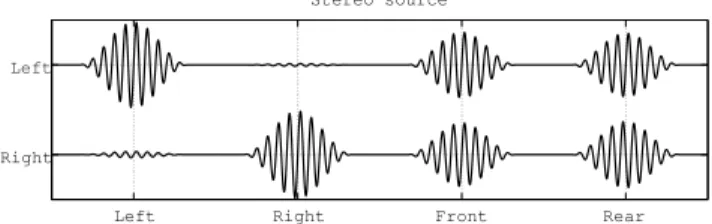
The HOA data for each of the 360 directions in the hor- izontal plane was downmixed to stereo using the method proposed in Sect. 4. Figure 7 shows four of the resulting stereo signals. These are consistent with the results expected from a panning law like that of Fig. 1. There are no inter- channel differences at the front, highly lateral signals ap- pear at 90◦and 270◦, signals of opposite polarity represent a sound source behind the listener. Small errors are visible in the signals for the left and right directions. These are not significant since their contribution to the inter-channel level difference is, at most,−26 dB (approx. 0.05 in a normalized
Fig. 5 The test signal used for evaluation: a 1 kHz pure tone multiplied by a 10 ms Hanning window.
linear scale).
The stereo signals obtained with the proposed method were then processed using the algorithm outlined in Sect. 3.
The reconstructed HOA signals for 1 kHz are shown in Fig. 8. The wider bands, compared to those of Fig. 6, in- dicate a slight loss in spatial resultion. Nevertheless, the
Fig. 6 The second-order HOA encoding coefficients for plane waves in the horizontal plane.
Fig. 7 The stereo signals generated by the proposed method for four rep- resentative directions.
Fig. 8 The second-order Ambisonics spatial data recovered by the pro- posed method.
Fig. 9 Difference between the original HOA data and the results after downmixing to stereo and later recovering the HOA data using the pro- posed methods.
From these results, we conclude that the methods described in Sect. 3 and 4 can be applied to generate stereo signals di- rectly from HOA data. Furthermore, it is possible to recover a good approximation of the original HOA data from the inter-channel differences in the resulting stereo signals.
6. Conclusions
We proposed a method to represent spatial sound infor- mation encoded in the HOA format using stereo signals.
The resulting signals are consistent with traditional panning laws. Furthermore, they preserve the spatial information available in the original HOA data encoded as inter-channel level and phase differences. This allows us to recover an approximation of the original HOA data using a previously proposed technique. Simulation results show that the pro- posed method retains adequate spatial resolution when ap- plied to second-order HOA encodings. In this way, the pro- posal outperforms other techniques such as the Ambison- ics UHJ format, which is limited to first-order HOA when downmixing to stereo signals.
Acknowledgments
This study was partly supported by Grant-in-Aid of JSPS for Scientific Research (no. A24240016) to SY and the A3 Foresight Program for “Ultra-realistic acoustic interactive communication on next-generation Internet.”
References
[1] K. Abe, K. Ozawa, Y. Suzuki, and T. Sone, “Comparison of the effects of verbal versus visual information about sound sources on the perception of environmental sounds,” Acta Acustica united with Acustica, vol.92, no.1, pp.51–60, 2006.
[2] J. Blauert, Spatial hearing: The psychophysics of human sound lo- calization, Revised ed., The MIT Press, Cambridge MA USA, 1997.
[3] K. Ozawa, S. Tsukahara, Y. Kinoshita, and M. Morise, “Instanta- neous Evaluation of the Sense of Presence in Audio-Visual Content,”
IEICE Trans. Inf. & Syst., vol.E98-D, no.1, pp.49–57, 2015.
[4] Y. Suzuki, J. Trevino, T. Okamoto, Z. Cui, S. Sakamoto, and Y.
Iwaya, “High Definition 3D auditory displays and microphone ar- rays for the use with future 3D TV,” Proc. of 3DSA 2013, paper no.132, June 2013.
[5] J. Trevino, T. Okamoto, C. Salvador, Y. Iwaya, Z. Cui, S. Sakamoto, and Y. Suzuki, “High-order Ambisonics auditory displays for the scalable presentation of immersive 3D audio-visual contents,” Proc.
ICAT 2013, paper no.D5, Dec. 2013.
[6] J. Kawaura, Y. Suzuki, F. Asano, and T. Sone, “Sound localization in headphone reproduction by simulating transfer functions from the sound source to the external ear,” J. Acoust. Soc. Jpn. (J), vol.45, pp.756–766, 1989 (in Japanese), English translation: J. Acoust. Soc.
Jpn. (E), vol.12, pp.203–216, 1991.
[7] S. Sakamoto, S. Hongo, and Y. Suzuki, “3D sound-space sensing
dio Eng. Soc. 24th Int. Conf. on Multichannel Audio, paper no.1, June 2003.
[10] Y. Iwaya, Y. Suzuki, and D. Kimura, “Effects of head movement on front-back error in sound localization,” Acoust. Sci. Technol., vol.24, no.5, pp.322–324, 2003.
[11] E. Torick, “Highlights in the History of Multichannel Sound,” J. Au- dio Eng. Soc., vol.46, no.1, pp.27–31, 1998.
[12] K. Hamasaki, T. Nishiguchi, R. Okumura, Y. Nakayama, and A. Ando, “A 22.2 Multichannel Sound System for Ultra-High- Definition TV (UHDTV),” SMPTE Motion Imaging J., vol.117, no.3, pp.40–49, 2008.
[13] A. Berkhout, “A holographic approach to acoustic control,” J. Audio Eng. Soc., vol.36, no.12, pp.977–995, Dec. 1988.
[14] S. Ise, “A principle of sound field control based on the Kirchhoff- Helmholtz integral equation and the theory of inverse systems,” Acta Acoust. united Ac., vol.85, pp.78–87, 1999.
[15] M.A. Poletti, “Three-dimensional surround sound systems based on spherical harmonics,” J. Audio Eng. Soc., vol.53, no.11, pp.1004–
1025, 2005.
[16] M. Noisternig, T. Carpentier, and O. Warusfel, “ESPRO 2.0 - Im- plementation of a surrounding 350-loudspeaker array for 3D sound field reproduction,” Proc. 4th Int. Symp. on Ambisonics and Spher- ical Acoust., paper no.13, March 2012.
[17] T. Okamoto, D. Cabrera, M. Noisternig, B. Katz, Y. Iwaya, and Y.
Suzuki, “Improving sound field reproduction in a small room based on high-order Ambisonics with a 157-loudspeaker array,” Proc. 2nd Int. Symp. on Ambisonics and Spherical Acoust., paper no.5, May 2010.
[18] J. Trevino, T. Okamoto, Y. Iwaya, J. Li, and Y. Suzuki, “Extrapola- tion of horizontal Ambisonics data from mainstream stereo sources,”
Proc. IIH-MSP 2013, pp.302–305, Oct. 2013.
[19] J. Trevino, T. Okamoto, Y. Iwaya, J. Li, and Y. Suzuki, “A spa- tial extrapolation method to derive high-order ambisonics data from stereo sources,” J. Inf. Hiding and Multimedia Sig. Proc., vol.6, no.6, pp.1100–1116, Nov. 2015.
[20] J. Trevino, T. Okamoto, Y. Iwaya, and Y. Suzuki, “Sound field repro- duction using Ambisonics and irregular loudspeaker arrays,” IEICE Trans. Fundamentals, vol.E97-A, no.9, pp.1832–1839, Sept. 2014.
[21] M.A. Gerzon, “Compatible 2-channel encoding of surround sound,”
Electron. Lett., vol.11, no.25, pp.615–617, Dec. 1975.
[22] M.A. Gerzon, “Ambisonics in Multichannel Broadcasting and Video,” J. Audio Eng. Soc., vol.33, no.11, pp.859–871, Nov. 1985.
[23] K. Gundry, “A New Active Matrix Decoder for Surround Sound,”
19th Audio Eng. Soc. Int. Conf. on Surround Sound, paper no.1905, 9-page manuscript, June 2001.
[24] D. Griesinger, “Multichannel Matrix Surround Decoders for Two- Eared Listeners,” Proc. 101th Audio Eng. Soc. Conv., preprint no.4402, Nov. 1996.
[25] E.G. Trendell, “The Choice of a Matrix for Quadraphonic Reproduc- tion from Disk Records,” Proc. 47th Audio Eng. Soc. Conv., paper no.E-7, March 1974.
[26] Dolby Surround Pro Logic II Decoder: Principles of Operation, Dolby Laboratories Technical Paper, 2000.
[27] D.M. Leakey, “Some measurements on the effects of interchannel in- tensity and time differences in two channel sound system,” J. Acoust.
Soc. Am., vol.31, no.7, pp.977–986, 1959.
[28] M. Poletti, “The design of encoding functions for stereophonic and polyphonic sound systems,” J. Audio Eng. Soc., vol.44, no.11, pp.948–963, 1996.
[29] E.G. Williams, Fourier Acoustics: Sound Radiation and Nearfield Acoustical Holography, Academic Press, London UK, 1999.
[30] J. Daniel, “Spatial sound encoding including near field effect: Intro- ducing distance coding filters and a viable, new ambisonics format,”
23rd Int. Conf. Audio Eng. Soc. Sig. Proc. in Audio Recording and Reproduction, 15-page manuscript, May 2003.
[31] S. Bertet, J. Daniel, and S. Moreau, “3D Sound Field Recording with Higher Order Ambisonics-Objective Measurements and Validation of Spherical Microphone,” Proc. 120 Audio Eng. Soc. Conv., paper no.6857, 2006.
[32] E. Tiana-Roig, F. Jacobsen, and E.F. Grande, “Beamforming with a circular microphone array for localization of environmental noise sources,” J. Acoust. Soc. Am., vol.128, no.6, pp.3535–3542, Dec.
2010.
[33] V. Pulkki, “Spatial Sound Reproduction with Directional Audio Coding,” J. Audio Eng. Soc., vol.55, no.6, pp.503–516, 2007.
[34] W.H. Press, B.P. Flannery, S.A. Teukolsky, and W.T. Vetterling,
“Convolution and Deconvolution Using the FFT,” Numerical Recipes in FORTRAN: The Art of Scientific Computing, 2nd Ed., Cambridge University Press, 1992.
Jorge Trevino graduated from the Monterrey Institute of Technology and Higher Education in 2005. He received the degree of M.Sc. in 2011 and a Ph.D. in information sci- ences in 2014, both from the Graduate School of Information Sciences of Tohoku University.
He is currently an assistant professor in the Re- search Institute of Electrical Communication of Tohoku University. His research interests in- clude sound field recording and reproduction, array signal processing and spatial audio.
Shuichi Sakamoto received his B.S., M.Sc.
and Ph.D. degrees from Tohoku University, in 1995, 1997, and 2004, respectively. He is cur- rently an associate professor at the Research Institute of Electrical Communication, Tohoku University. He was a Visiting Researcher at McGill University, Montreal, Canada during 2007–2008. His research interests include hu- man multi-sensory information processing in- cluding hearing, speech perception, and devel- opment of high-definition 3D audio recording systems. He is a member of ASJ, IEICE, VRSJ, and others.
Junfeng Li received the Ph.D. degree in Information Science from Japan Advanced In- stitute of Science and Technology (JAIST) in March 2006. From April 2006, he was a post- doctoral research fellow at Research Institute of Electrical Communication (RIEC), Tohoku Uni- versity. From April 2007 to July 2010, he was an Assistant Professor in School of Information Science, JAIST. Since August 2010, he has been a Professor in Institute of Acoustics, Chinese Academy of Sciences. His research interests in- clude psychoacoustics, speech signal processing and 3D audio technology.
Dr. Li received the best student award in Engineering Acoustics First Prize from the Acoustical Society of America in 2006, and the Best Paper Award from JCA2007 in 2007, and the Itakura Award from the Acoustical Society of Japan in 2012. Dr. Li is now serving as the Subject Editor for Speech Communication and the Editor for IEICE Trans. on Fundamentals of Elec- tronics, Communication and Computer Sciences.
Yˆoiti Suzuki graduated from Tohoku Uni- versity in 1976 and received his Ph.D. degree in electrical and communication engineering in 1981. He is currently a professor at the Re- search Institute of Electrical Communication, Tohoku University. His research interests in- clude psychoacoustics, multimodal perception, high-definition 3D auditory displays and digi- tal signal processing of acoustic signals. He re- ceived the Awaya Kiyoshi Award and Sato Prize from the Acoustical Society of Japan as well as FIT Funai Best Paper award.