The Role of the Dictionary in Learning English
journal or
publication title
Research reports of Tokyo Metropolitan College of Industrial Technology
volume 15
page range 10‑15
year 2021‑03
URL http://id.nii.ac.jp/1282/00000254/
General Education, Monozukuri Department, Tokyo Metropolitan College of Industrial Technology
The Role of the Dictionary in Learning English
Kiyoshi Nagamori
Abstract: I will overview the dictionaries available to the Japanese student learning English and comment on the strengths and weaknesses of a variety of popular works. One focus of this paper will be on the differences between bilingual (English-Japanese and Japanese-English) dictionaries and monolingual (English-English) works. I discuss the advantage of each sort of work for language learners, and in some cases I will draw conclusions which contradict common advice about dictionary use. I will also examine the results of a survey of Japanese students learning English in Oxford and summarize what they say about the most useful English dictionaries.
Keywords: Bilingual dictionary, Monolingual dictionary, English education
11 DDiiccttiioonnaarryy UUssaaggee SSuurrvveeyy
Last year I went to Oxford for improving my English. I have met a lot of Japanese university students and undergraduate students in Oxford. I have been investigating dictionaries for a few years. This source was university students and undergraduate students studying English in Oxford School of English. Most have seven to ten years of English instruction behind them, and since they are studying at a university that specializes in language, engineer, management and so on. Recently, electric dictionaries are used by students for studying English. Their dictionaries are as necessary for their work as saws, hammers and such are for carpenters.
Last summer, I asked oral questionnaires to students studying English in Oxford on their thoughts on the dictionaries they were using. The following statistics are the responses from them.
graduate 3
Seniors 2
Juniors 6
Sophomores 4
Freshman 2
TOTAL : 17
I am happy with the breakdown because it gives me a sample of the students’ responses. Although senior students tend to be considerably more mature and articulate in explaining their thoughts, it is rather difficult to pin point their explanations due to their English level. However, junior and sophomore students are able to clearly express themselves in English. For reason that are not obvious to me, a large percentage of students studying English are females, and so only 4 (or 24 %) of the respondents are males. The imbalance in sex does not appear to the results in any substantial way, although I do get the impression that the male students tend to be a bit blunter than the female students. 22 RReegguullaarr DDiiccttiioonnaarryy Below are the questions that are given to the students regarding the type of dictionary(s) they are using. There are two reasons as to why I ask these questions. My first reason is to get a general reaction about dictionaries and then to rephrase the questions focusing on two different contexts of use-the students’ carry-along dictionary and home-use dictionary. The other reason is to see if the students would have the same habit as I do, which is in this case students would employ different works at home and when outside, and that generally seem to be the case. 1. Which English and Japanese-English (English-Japanese) dictionaries do you regularly use? Please give the full title. 2. Which dictionary do you usually carry with you when you leave your house? Why do you prefer this dictionary? 3. Which dictionary do you use when you do schoolwork or other English using activities at home? Why do you use this dictionary? 33 PPooppuullaarr DDiiccttiioonnaarriieess Questions one, two, and three, show that 10 dictionaries are used, which comes out to an average of 4 dictionaries per student. The result also shows that large percentage of the students have electric dictionary. Table 1 below gives a much clearer result as to which dictionary is favorite among the students. Table 1: Votes among the 10 dictionaries that students use. Longman Dictionary of Contemporary English 12
Kenkyuusha’s Readers 8
Kenkyusha’s Lighthouse 7
Taishukan’s Genius 7
Sanseido Daily Concise 6
Gakushuukennkyuusha Anchor Cosmica 5
Obunsha’s OLEX 3
Shogakukan Progressive 2
Sanseido Wisdom 2
Oxford Advanced Learner’s Dictionary 2 4 TThhee LLoonnggmmaann CCoonntteemmppoorraarryy
As you can see, the Longman Dictionary of Contemporary English is the favorite among the students. Most students studying English say that they regularly use an English-English dictionary, most commonly the Longman Contemporary or the Oxford Advanced. Table 2 below highlights the student’s reasons of having these two particular dictionaries. Although there are positive responses regarding these dictionaries, many students say that these two dictionaries are not particularly pleasant to use because they take more time and effort than using a bilingual dictionary.
Table 2: Votes among mainly 3 reasons for using the Longman Dictionary of Contemporary English. 7 Because an English-English dictionary is useful for improving my English skills.
4 Because my teacher ( or friends ) recommended it, etc.
1 Because it has many example sentences I can use for writing homework, etc.
A lot of Japanese English teachers believe that it is best for English Second Language students to switch from bilingual to monolingual dictionaries as soon as possible because it encourages them to think in English. Fortunately, a fair number of students agree to the idea switching to monolingual dictionary and find it more effective.
Some students, on the other hand, explicitly believe that the Longman Contemporary is easier for them to use than other English-English dictionaries like Oxford Advanced Learner’s and the Collins CoBUILD. Unfortunately, I do not have hard evidence that this is truly the case, but it certainly matches my intuitions about these works.
General Education, Monozukuri Department, Tokyo Metropolitan College of Industrial Technology
The Role of the Dictionary in Learning English
Kiyoshi Nagamori
Abstract: I will overview the dictionaries available to the Japanese student learning English and comment on the strengths and weaknesses of a variety of popular works. One focus of this paper will be on the differences between bilingual (English-Japanese and Japanese-English) dictionaries and monolingual (English-English) works. I discuss the advantage of each sort of work for language learners, and in some cases I will draw conclusions which contradict common advice about dictionary use. I will also examine the results of a survey of Japanese students learning English in Oxford and summarize what they say about the most useful English dictionaries.
Keywords: Bilingual dictionary, Monolingual dictionary, English education
11 DDiiccttiioonnaarryy UUssaaggee SSuurrvveeyy
Last year I went to Oxford for improving my English. I have met a lot of Japanese university students and undergraduate students in Oxford. I have been investigating dictionaries for a few years. This source was university students and undergraduate students studying English in Oxford School of English. Most have seven to ten years of English instruction behind them, and since they are studying at a university that specializes in language, engineer, management and so on. Recently, electric dictionaries are used by students for studying English. Their dictionaries are as necessary for their work as saws, hammers and such are for carpenters.
Last summer, I asked oral questionnaires to students studying English in Oxford on their thoughts on the dictionaries they were using. The following statistics are the responses from them.
graduate 3
Seniors 2
Juniors 6
Sophomores 4
Freshman 2
TOTAL : 17
I am happy with the breakdown because it gives me a sample of the students’ responses. Although senior students tend to be considerably more mature and articulate in explaining their thoughts, it is rather difficult to pin point their explanations due to their English level. However, junior and sophomore students are able to clearly express themselves in English. For reason that are not obvious to me, a large percentage of students studying English are females, and so only 4 (or 24 %) of the respondents are males. The imbalance in sex does not appear to the results in any substantial way, although I do get the impression that the male students tend to be a bit blunter than the female students. 22 RReegguullaarr DDiiccttiioonnaarryy Below are the questions that are given to the students regarding the type of dictionary(s) they are using. There are two reasons as to why I ask these questions. My first reason is to get a general reaction about dictionaries and then to rephrase the questions focusing on two different contexts of use-the students’ carry-along dictionary and home-use dictionary. The other reason is to see if the students would have the same habit as I do, which is in this case students would employ different works at home and when outside, and that generally seem to be the case. 1. Which English and Japanese-English (English-Japanese) dictionaries do you regularly use? Please give the full title. 2. Which dictionary do you usually carry with you when you leave your house? Why do you prefer this dictionary? 3. Which dictionary do you use when you do schoolwork or other English using activities at home? Why do you use this dictionary? 33 PPooppuullaarr DDiiccttiioonnaarriieess Questions one, two, and three, show that 10 dictionaries are used, which comes out to an average of 4 dictionaries per student. The result also shows that large percentage of the students have electric dictionary. Table 1 below gives a much clearer result as to which dictionary is favorite among the students. Table 1: Votes among the 10 dictionaries that students use. Longman Dictionary of Contemporary English 12
Kenkyuusha’s Readers 8
Kenkyusha’s Lighthouse 7
Taishukan’s Genius 7
Sanseido Daily Concise 6
Gakushuukennkyuusha Anchor Cosmica 5
Obunsha’s OLEX 3
Shogakukan Progressive 2
Sanseido Wisdom 2
Oxford Advanced Learner’s Dictionary 2 4 TThhee LLoonnggmmaann CCoonntteemmppoorraarryy
As you can see, the Longman Dictionary of Contemporary English is the favorite among the students. Most students studying English say that they regularly use an English-English dictionary, most commonly the Longman Contemporary or the Oxford Advanced. Table 2 below highlights the student’s reasons of having these two particular dictionaries. Although there are positive responses regarding these dictionaries, many students say that these two dictionaries are not particularly pleasant to use because they take more time and effort than using a bilingual dictionary.
Table 2: Votes among mainly 3 reasons for using the Longman Dictionary of Contemporary English. 7 Because an English-English dictionary is useful for improving my English skills.
4 Because my teacher ( or friends ) recommended it, etc.
1 Because it has many example sentences I can use for writing homework, etc.
A lot of Japanese English teachers believe that it is best for English Second Language students to switch from bilingual to monolingual dictionaries as soon as possible because it encourages them to think in English. Fortunately, a fair number of students agree to the idea switching to monolingual dictionary and find it more effective.
Some students, on the other hand, explicitly believe that the Longman Contemporary is easier for them to use than other English-English dictionaries like Oxford Advanced Learner’s and the Collins CoBUILD. Unfortunately, I do not have hard evidence that this is truly the case, but it certainly matches my intuitions about these works.
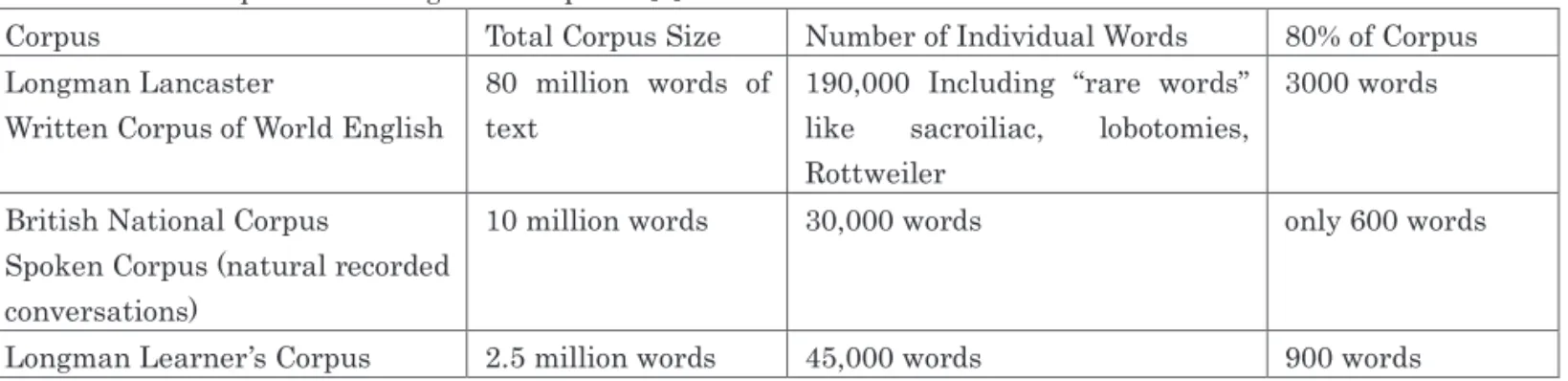
For example, when I’m writing my essay, I invariable use the Longman Contemporary because its definitions strike me as simpler and easier to understand than those in the Oxford Advanced Learner’s. The fact that the Longman Contemporary has carefully held its defining vocabulary down, to 2.000 common words, not counting proper names, is certainly a main reason for its relative ease-of-use. As you can see on table 3 below, note that corpus linguistics studies again and again indicate that English is made up of a lot of words but that we rely on the same thousand-odd words to express ourselves.
Table 3: Word frequencies in linguistic corpuses [1]
Corpus Total Corpus Size Number of Individual Words 80% of Corpus
Longman Lancaster
Written Corpus of World English
80 million words of text
190,000 Including “rare words”
like sacroiliac, lobotomies, Rottweiler
3000 words
British National Corpus
Spoken Corpus (natural recorded conversations)
10 million words 30,000 words only 600 words
Longman Learner’s Corpus 2.5 million words 45,000 words 900 words
I have to admit that I do place a good deal of reliance on the students’ opinions about the Longman Contemporary. Of course, a beginning-level or lower-intermediate-level student is not going to be able to use a monolingual dictionary, but if any of advance level students express an interest in choosing a dictionary, English teachers might do well to recommend that they try this method.
But University students studying English explain that it is highly important for them to figure out the meaning of an unfamiliar English word or a newly English word or when they have to figure out a way to say or write what they are actually thinking. I have to admit. I was once in their situation. Therefore, I certainly agree with their students’ opinions regarding the utility of having an English-Japanese and Japanese-English work.
Native English speakers recommend an English dictionary, they recommend the monolingual Longman Contemporary, Oxford Advanced, or Collins CoBUILD. They would also often recommend the new Cambridge Advanced Learner’s Dictionary to ESL students as they believe these two dictionaries appear to be of comparable value.
The following table lists the works which has five or more votes in students’ comments about which dictionary they use regularly at home.
Table 4: Votes among mainly 9 reasons for using a particular dictionary 14 Because I am used to the work as I have used it for a long time.
8 Because it has lots of sentence examples.
7 Because it’s easy to use, it’s easy to understand, it’s easy to read because of its big letters, and important words are highlighted in big letters.
5 Because it’s English-English and this helps me improve my vocabulary.
4 Because it’s English-Japanese, it’s easy to understand a word’s meaning, and does not take much time to check on a word.
3 Because it has many words.
3 Because it contains a lot of information, it is more detailed, and it is substantial.
2 Because my teacher recommended it.
1 Because it has grammar and usage notes.
The main reason of students’ feeling is that they want utility in a home/school-use dictionary. They want a work that covers a lot of words, has many examples, and detailed explanations. Other students, on the other hand, want a
“big” work. I also find it interesting that majority of the students use a work that comes from the English side- either and English-English (the ideal) or English-Japanese (the easier to use in practice) work.
G
Goooodd aanndd BBaadd PPooiinnttss ooff DDiiccttiioonnaarriieess
The next three questions include in the oral questionnaire focus on trying to find out what features students believe are the most important in the dictionaries they use when studying English.
4. Which features do you think are most important in a dictionary? (e.g . contains many words, has Japanese translations, has example sentences, has simple English definitions, has pronunciation guides, has grammar codes, has pictures, is light weight, is cheap, etc. …)
5. What things bother or frustrate you when you use your dictionary? (e,g . can’t find the word I’m looking for, definition is unclear, does not show how to use the word, etc. …)
6. If you could magically create a perfect English dictionary, what special features would it have? ( e .g . it would have every word in the English language, it would have a speaker, etc. …)
G
Goooodd FFeeaattuurreess
I am not surprised by these answers listed below, but I am surprised about how high some features ranked.
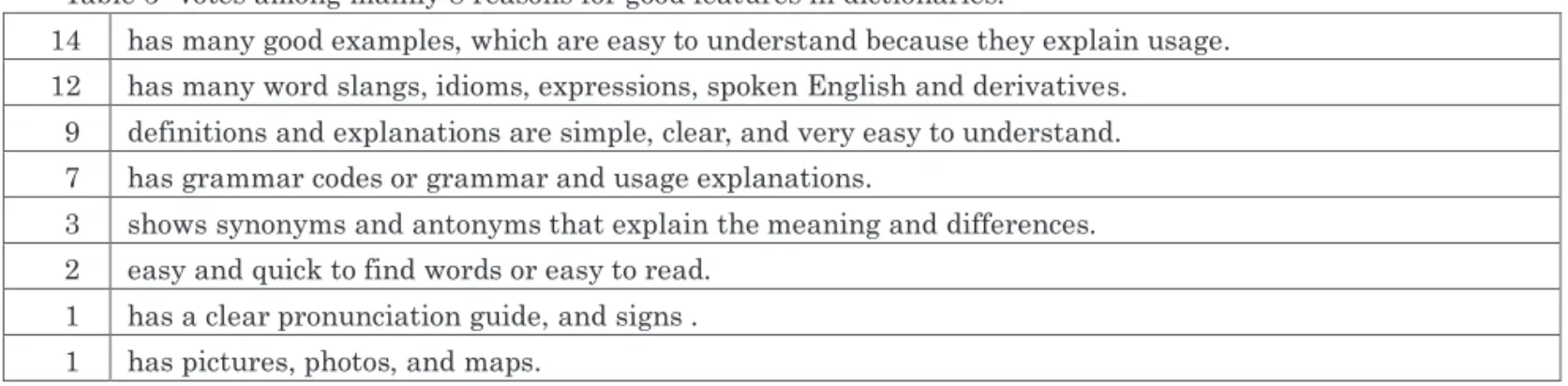
Clearly, the most important positive features are to cover many words and have lots of examples and definitions for those words.
Table 5: Votes among mainly 8 reasons for good features in dictionaries.
14 has many good examples, which are easy to understand because they explain usage.
12 has many word slangs, idioms, expressions, spoken English and derivatives.
9 definitions and explanations are simple, clear, and very easy to understand.
7 has grammar codes or grammar and usage explanations.
3 shows synonyms and antonyms that explain the meaning and differences.
2 easy and quick to find words or easy to read.
1 has a clear pronunciation guide, and signs . 1 has pictures, photos, and maps.
B
Baadd FFeeaattuurreess
Part of this research is to understand the students’ reasons from two different angles. For that reason, I also included questions in relate to frustrations when using dictionaries. As will see on the table 6 below, much of their answers are similar to previous tables. Perhaps, the most common complaints are failure to make word usage clear and unclear definitions.
Table 6: Votes among mainly 6 frustrations when using dictionaries.
7 definition is unclear; contain words that are not familiar; is too complex or too easy; has unclear word meaning when I need more explanation.
4 when I can’t find the word I’m looking for; does not have the word; not enough information; few words; no slang; colloquial; new; spoken words; and or idioms.
4 no, few, not enough examples.
3 when Japanese translation is strange, out-of-date, is not natural, contains kanji I don’t know, does not have a full or no suitable translation.
2 does not explain grammar usage of word: collocations, plurality, prepositions or morphology as in derivations, and unclear grammar codes.
2 does not explain differences between synonyms (words with a similar meaning) or antonyms, is not clear about which word to use.
For example, when I’m writing my essay, I invariable use the Longman Contemporary because its definitions strike me as simpler and easier to understand than those in the Oxford Advanced Learner’s. The fact that the Longman Contemporary has carefully held its defining vocabulary down, to 2.000 common words, not counting proper names, is certainly a main reason for its relative ease-of-use. As you can see on table 3 below, note that corpus linguistics studies again and again indicate that English is made up of a lot of words but that we rely on the same thousand-odd words to express ourselves.
Table 3: Word frequencies in linguistic corpuses [1]
Corpus Total Corpus Size Number of Individual Words 80% of Corpus
Longman Lancaster
Written Corpus of World English
80 million words of text
190,000 Including “rare words”
like sacroiliac, lobotomies, Rottweiler
3000 words
British National Corpus
Spoken Corpus (natural recorded conversations)
10 million words 30,000 words only 600 words
Longman Learner’s Corpus 2.5 million words 45,000 words 900 words
I have to admit that I do place a good deal of reliance on the students’ opinions about the Longman Contemporary. Of course, a beginning-level or lower-intermediate-level student is not going to be able to use a monolingual dictionary, but if any of advance level students express an interest in choosing a dictionary, English teachers might do well to recommend that they try this method.
But University students studying English explain that it is highly important for them to figure out the meaning of an unfamiliar English word or a newly English word or when they have to figure out a way to say or write what they are actually thinking. I have to admit. I was once in their situation. Therefore, I certainly agree with their students’ opinions regarding the utility of having an English-Japanese and Japanese-English work.
Native English speakers recommend an English dictionary, they recommend the monolingual Longman Contemporary, Oxford Advanced, or Collins CoBUILD. They would also often recommend the new Cambridge Advanced Learner’s Dictionary to ESL students as they believe these two dictionaries appear to be of comparable value.
The following table lists the works which has five or more votes in students’ comments about which dictionary they use regularly at home.
Table 4: Votes among mainly 9 reasons for using a particular dictionary 14 Because I am used to the work as I have used it for a long time.
8 Because it has lots of sentence examples.
7 Because it’s easy to use, it’s easy to understand, it’s easy to read because of its big letters, and important words are highlighted in big letters.
5 Because it’s English-English and this helps me improve my vocabulary.
4 Because it’s English-Japanese, it’s easy to understand a word’s meaning, and does not take much time to check on a word.
3 Because it has many words.
3 Because it contains a lot of information, it is more detailed, and it is substantial.
2 Because my teacher recommended it.
1 Because it has grammar and usage notes.
The main reason of students’ feeling is that they want utility in a home/school-use dictionary. They want a work that covers a lot of words, has many examples, and detailed explanations. Other students, on the other hand, want a
“big” work. I also find it interesting that majority of the students use a work that comes from the English side- either and English-English (the ideal) or English-Japanese (the easier to use in practice) work.
G
Goooodd aanndd BBaadd PPooiinnttss ooff DDiiccttiioonnaarriieess
The next three questions include in the oral questionnaire focus on trying to find out what features students believe are the most important in the dictionaries they use when studying English.
4. Which features do you think are most important in a dictionary? (e.g . contains many words, has Japanese translations, has example sentences, has simple English definitions, has pronunciation guides, has grammar codes, has pictures, is light weight, is cheap, etc. …)
5. What things bother or frustrate you when you use your dictionary? (e,g . can’t find the word I’m looking for, definition is unclear, does not show how to use the word, etc. …)
6. If you could magically create a perfect English dictionary, what special features would it have? ( e .g . it would have every word in the English language, it would have a speaker, etc. …)
G
Goooodd FFeeaattuurreess
I am not surprised by these answers listed below, but I am surprised about how high some features ranked.
Clearly, the most important positive features are to cover many words and have lots of examples and definitions for those words.
Table 5: Votes among mainly 8 reasons for good features in dictionaries.
14 has many good examples, which are easy to understand because they explain usage.
12 has many word slangs, idioms, expressions, spoken English and derivatives.
9 definitions and explanations are simple, clear, and very easy to understand.
7 has grammar codes or grammar and usage explanations.
3 shows synonyms and antonyms that explain the meaning and differences.
2 easy and quick to find words or easy to read.
1 has a clear pronunciation guide, and signs . 1 has pictures, photos, and maps.
B
Baadd FFeeaattuurreess
Part of this research is to understand the students’ reasons from two different angles. For that reason, I also included questions in relate to frustrations when using dictionaries. As will see on the table 6 below, much of their answers are similar to previous tables. Perhaps, the most common complaints are failure to make word usage clear and unclear definitions.
Table 6: Votes among mainly 6 frustrations when using dictionaries.
7 definition is unclear; contain words that are not familiar; is too complex or too easy; has unclear word meaning when I need more explanation.
4 when I can’t find the word I’m looking for; does not have the word; not enough information; few words; no slang; colloquial; new; spoken words; and or idioms.
4 no, few, not enough examples.
3 when Japanese translation is strange, out-of-date, is not natural, contains kanji I don’t know, does not have a full or no suitable translation.
2 does not explain grammar usage of word: collocations, plurality, prepositions or morphology as in derivations, and unclear grammar codes.
2 does not explain differences between synonyms (words with a similar meaning) or antonyms, is not clear about which word to use.
C
Coonncclluussiioonn
I’m going to conclude this paper by touching on a couple points that have not been mentioned. All, a lot of my students in my college use electric dictionary, English word book and i-phone for looking up an unfamiliar word.
They only check the meaning of the first written Japanese. But I found that a lot of European students studying English use paper English dictionaries, especially English-English dictionaries. I think it is a good idea to have (and use) a monolingual dictionary. For example:
[2]
A : The word-if the noun, verb or adjective are the same, they will have a separate entry.
B : The pronunciation C : The definition of the word.
D : Some dictionaries will also include synonyms.
E : What kind of word it is-verb, noun etc.
After verbs you will sometimes see [T][I][I,T]-this tells you if the verb is Transitive ( it has an object after it ), Intransitive ( there is no object after it ), or it can be both. For example, increase is Intransitive-you can’t increase something. After nouns, you will see [U],[C],[U,C]-this tells you if the noun is countable, uncountable or if it can be countable or uncountable.
F : Some dictionaries tell you how much people use the word-examples, ★ means we do not use the word very much, but ★ ★ ★ means we use it quite a lot.
G An example sentence to show you how to use the word.
The Common European Framework of Reference for Languages (CEFR) [3] is also included to show the clear indices of “What you can do in English” based on the six levels from A1 to C2 of the CEFR. The target levels should be set depending on learners’ levels.
Table7 : Some of the best dictionaries available are:
Dictionary CEFR Level
Oxford Wordpower Dictionary A1―B1
Oxford Advanced Leaner’s Dictionary B1―C2
Longman Active Study Dictionary A1―B1
Longman Dictionary of Contemporary B1―C2
Cambridge Essential English Dictionary A1―B1 Cambridge Advanced Learner’s Dictionary B1―C2
I’m sure using a monolingual dictionary for learners has benefited Japanese students. In my case, my passive vocabulary (words I can understand) has increasingly become an active vocabulary (words I actually use). When I use monolingual dictionary, I am repeatedly exposed to basic words and how they are used to explain objects and concepts. Because of this, I can express myself more easily in English than before. So I strongly recommend that you obtain a monolingual dictionary once you have command of a basic vocabulary.
References
[1] The table was taken from Della Summers : “Vocabulary Learning: Do Dictionaries Really Help?”, Language Teacher 19-2, p.26, 1995
[2] Oxford Wordpower Dictionary 4th Edition Pack, 2013 [3] Global scale - Table 1 (CEFR 3.3)Common Reference levels
https://www.coe.int/en/web/common-european-framework-reference-languages/table-1-cefr-3.3-commonreferenc e-levels-global-scale
PROFICIENT USER
C2
Can understand with ease virtually everything heard or read. Can summarise information from different spoken and written sources, reconstructing arguments and accounts in a coherent presentation. Can express him/herself spontaneously, very fluently and precisely, differentiating finer shades of meaning even in more complex situations.
C1
Can understand a wide range of demanding, longer texts, and recognise implicit meaning. Can express him/herself fluently and spontaneously without much obvious searching for expressions. Can use language flexibly and effectively for social, academic and professional purposes. Can produce clear, well-structured, detailed text on complex subjects, showing controlled use of organisational patterns, connectors and cohesive devices.
INDEPENDENT USER
B2
Can understand the main ideas of complex text on both concrete and abstract topics, including technical discussions in his/her field of specialisation. Can interact with a degree of fluency and spontaneity that makes regular interaction with native speakers quite possible without strain for either party. Can produce clear, detailed text on a wide range of subjects and explain a viewpoint on a topical issue giving the advantages and disadvantages of various options.
B1
Can understand the main points of clear standard input on familiar matters regularly encountered in work, school, leisure, etc. Can deal with most situations likely to arise whilst travelling in an area where the language is spoken. Can produce simple connected text on topics which are familiar or of personal interest. Can describe experiences and events, dreams, hopes & ambitions and briefly give reasons and explanations for opinions and plans
BASIC USER
A2
Can understand sentences and frequently used expressions related to areas of most immediate relevance (e.g. very basic personal and family information, shopping, local geography, employment). Can communicate in simple and routine tasks requiring a simple and direct exchange of information on familiar and routine matters. Can describe in simple terms aspects of his/her background, immediate environment and matters in areas of immediate need.
A1
Can understand and use familiar everyday expressions and very basic phrases aimed at the satisfaction of needs of a concrete type. Can introduce him/herself and others and can ask and answer questions about personal details such as where he/she lives, people he/she knows and things he/she has. Can interact in a simple way provided the other person talks slowly and clearly and is prepared to help.
C
Coonncclluussiioonn
I’m going to conclude this paper by touching on a couple points that have not been mentioned. All, a lot of my students in my college use electric dictionary, English word book and i-phone for looking up an unfamiliar word.
They only check the meaning of the first written Japanese. But I found that a lot of European students studying English use paper English dictionaries, especially English-English dictionaries. I think it is a good idea to have (and use) a monolingual dictionary. For example:
[2]
A : The word-if the noun, verb or adjective are the same, they will have a separate entry.
B : The pronunciation C : The definition of the word.
D : Some dictionaries will also include synonyms.
E : What kind of word it is-verb, noun etc.
After verbs you will sometimes see [T][I][I,T]-this tells you if the verb is Transitive ( it has an object after it ), Intransitive ( there is no object after it ), or it can be both. For example, increase is Intransitive-you can’t increase something. After nouns, you will see [U],[C],[U,C]-this tells you if the noun is countable, uncountable or if it can be countable or uncountable.
F : Some dictionaries tell you how much people use the word-examples, ★ means we do not use the word very much, but ★ ★ ★ means we use it quite a lot.
G An example sentence to show you how to use the word.
The Common European Framework of Reference for Languages (CEFR) [3] is also included to show the clear indices of “What you can do in English” based on the six levels from A1 to C2 of the CEFR. The target levels should be set depending on learners’ levels.
Table7 : Some of the best dictionaries available are:
Dictionary CEFR Level
Oxford Wordpower Dictionary A1―B1
Oxford Advanced Leaner’s Dictionary B1―C2
Longman Active Study Dictionary A1―B1
Longman Dictionary of Contemporary B1―C2
Cambridge Essential English Dictionary A1―B1 Cambridge Advanced Learner’s Dictionary B1―C2
I’m sure using a monolingual dictionary for learners has benefited Japanese students. In my case, my passive vocabulary (words I can understand) has increasingly become an active vocabulary (words I actually use). When I use monolingual dictionary, I am repeatedly exposed to basic words and how they are used to explain objects and concepts. Because of this, I can express myself more easily in English than before. So I strongly recommend that you obtain a monolingual dictionary once you have command of a basic vocabulary.
References
[1] The table was taken from Della Summers : “Vocabulary Learning: Do Dictionaries Really Help?”, Language Teacher 19-2, p.26, 1995
[2] Oxford Wordpower Dictionary 4th Edition Pack, 2013 [3] Global scale - Table 1 (CEFR 3.3)Common Reference levels
https://www.coe.int/en/web/common-european-framework-reference-languages/table-1-cefr-3.3-commonreferenc e-levels-global-scale
PROFICIENT USER
C2
Can understand with ease virtually everything heard or read. Can summarise information from different spoken and written sources, reconstructing arguments and accounts in a coherent presentation. Can express him/herself spontaneously, very fluently and precisely, differentiating finer shades of meaning even in more complex situations.
C1
Can understand a wide range of demanding, longer texts, and recognise implicit meaning. Can express him/herself fluently and spontaneously without much obvious searching for expressions. Can use language flexibly and effectively for social, academic and professional purposes. Can produce clear, well-structured, detailed text on complex subjects, showing controlled use of organisational patterns, connectors and cohesive devices.
INDEPENDENT USER
B2
Can understand the main ideas of complex text on both concrete and abstract topics, including technical discussions in his/her field of specialisation. Can interact with a degree of fluency and spontaneity that makes regular interaction with native speakers quite possible without strain for either party. Can produce clear, detailed text on a wide range of subjects and explain a viewpoint on a topical issue giving the advantages and disadvantages of various options.
B1
Can understand the main points of clear standard input on familiar matters regularly encountered in work, school, leisure, etc. Can deal with most situations likely to arise whilst travelling in an area where the language is spoken. Can produce simple connected text on topics which are familiar or of personal interest. Can describe experiences and events, dreams, hopes & ambitions and briefly give reasons and explanations for opinions and plans
BASIC USER
A2
Can understand sentences and frequently used expressions related to areas of most immediate relevance (e.g. very basic personal and family information, shopping, local geography, employment). Can communicate in simple and routine tasks requiring a simple and direct exchange of information on familiar and routine matters. Can describe in simple terms aspects of his/her background, immediate environment and matters in areas of immediate need.
A1
Can understand and use familiar everyday expressions and very basic phrases aimed at the satisfaction of needs of a concrete type. Can introduce him/herself and others and can ask and answer questions about personal details such as where he/she lives, people he/she knows and things he/she has. Can interact in a simple way provided the other person talks slowly and clearly and is prepared to help.