Government‑led Ecotourism and Resident‑led Ecotourism Time Series Analysing Stakeholder Subjectivity in Maha Ecotourism Site in
Pyeongchang, Korea
著者 Lee Jae‑hyuck, Son Yoon‑hoon journal or
publication title
International Review for Spatial Planning and Sustainable Development
volume 5
number 2
page range 47‑59
year 2017‑04‑15
URL http://hdl.handle.net/2297/47855
doi: 10.14246/irspsd.5.2_47
47
International review for spatial planning and sustainable development, Vol.5 No.2 (2017), 47-59 ISSN: 2187-3666 (online)
DOI: http://dx.doi.org/10.14246/irspsd.5.2_47 Copyright@ by authors, SPSD Press from 2010, Kanazawa
Government-led Ecotourism and Resident-led Ecotourism
Time Series Analysing Stakeholder Subjectivity in Maha Ecotourism Site in Pyeongchang, Korea
Lee, Jae-hyuck
1and Son, Yoon-hoon
2*1 Bureua of Ecological Research, National Institute of Ecology 2 Graduate School of Environmental Studies, Seoul National University
* Corresponding Author, Email: [email protected] Received: Sept 08, 2016; Accepted: Jan 14, 2017
Key words: Government, Resident, Ecotourism, Time-series, Q methodology
Abstract: Government-led ecotourism has advantages including a clear vision and quick outcome; nevertheless, it has stimulated conflicts between government and residents, owing to environmental degradation, stringent regulations, and operating deficits. Consequently, resident-led ecotourism, based on residents’
opinions, has emerged as an alternative to construct ecotourism sites;
however, this has stimulated chaos owing to the presence of numerous stakeholders. It is thus necessary to develop a collaborative management plan between two systems. This study analyses the subjectivities of the stakeholders of Maha Ecotourism Site, Pyeongchang, where the operating rights have been transferred to residents owing to the recent conflict between the government and residents. The findings reveal the issue of facility development in government-led ecotourism and the absence of an actual goal and consequently chaotic management in resident-led ecotourism.
Furthermore, both the systems face the issue of consensus with regard to the management of regulation, space, safety, land price, and industrial structure.
1. INTRODUCTION
Ecotourism began in the late 1900s as a way to activate the economy by bringing tourists to an ecologically sensitive region. It has since then been utilised in many regions (Su, M. M., Wall, & Ma, 2014). Developing countries in East Asia actively introduced ecotourism and applied it in many regions within their boundaries. In the process, a form of government-led ecotourism emerged and contributed to the rapid spread and development of ecotourism (Moswete, Thapa, & Child, 2012).
As ecotourism rapidly spread, government-led ecotourism, however, became centred on the construction of facilities for ecotourists.
Consequently, there was a lack of sufficient consideration of ecological
resources and the regional residents (Poudel, Nyaupane, & Budruk, 2016),
which often brought about negative effects such as damage to resources and
the migration of regional residents (Steelman & Maguire, 1999). Ecotourism
48 IRSPSD International, Vol.5 No.2 (2017), 47-59
should be the sort of tourism that teaches tourists the value of ecological resources and respect for the regional residents’ ecological lives (Coria &
Calfucura, 2012). Therefore, as an alternative to government-led ecotourism, resident-led ecotourism emerged, wherein the local residents participated in the planning and operation of ecotourism, thereby conserving and delivering to the tourists the micro ecological resources that local residents are aware of and also their ecological lives. Although this form of operation started with such desirable objectives, confusion has arisen due to the residents’
conflicting interests and insufficient perception of ecotourism (Cairns, Sallu,
& Goodman, 2014).
This study attempts to explore possible alternatives to the two forms of ecotourism. Specifically, this study chose the case of the Maha ecotourism site located in Pyeongchang, Korea (the host city of the 2018 Winter Olympic Games), in which the operating rights were transferred from government to residents due to a recent government-residents conflict, and conducted a comparison analysis on the stakeholders before and after the transfer of the operating rights.
2. LITERATURE REVIEW 2.1 Government-led Ecotourism
As government-led tour sites were constructed, many previous studies were conducted to understand which form of government structure would be efficient and sustainable. With regard to the role of the government, some authors were of the opinion that the government should work on environmental conservation and resource management, play a role of adviser, provide study and collaboration support, etc. (Wight, 2002), while some others argued that the government should present a blueprint and provide infrastructure from long-term perspectives (Ruhanen, 2013). Still others tried suggesting the role of the government through not just one but various role models (Su, D., Wall, & Eagles, 2007). All these studies argue for the absolute role of the government’s participation in the tour site, and therefore have a limitation in that the opinions of other stakeholders, who would actually experience the various issues addressed in the studies, were relatively neglected.
2.2 Resident-led Ecotourism
Subsequently, many studies were conducted to complement the limitation
and to explore alternatives to operate the ecotourism site by considering the
opinions of the stakeholders including the residents, and then qualitatively
(Pappas, 2008) or quantitatively (Boley et al., 2014; Sirivongs & Tsuchiya,
2012) analysing their various responses. An advantage of these studies was
that the complex replies of various stakeholders were systematically
organised. Furthermore, an opinion recently emerged that the residents and
stakeholders should participate in leading the operation of the tour site
(Buultjens, Shoebridge, & White, 2013). To implement the operating form,
the stages (Lawton & Weaver, 2015) or processes (Boley & McGehee, 2014)
of residents’ participation were discussed. Additionally, a natural or
compulsory composition of a council was comparatively analysed and the
pros and cons of each were discussed (Zahra, 2011). In addition, to broaden
Lee & Son 49 residents’ participation, education or counselling were stressed through an analysis of residents’ awareness (Liu et al., 2014), and a need for monitoring and evaluation was suggested (Holladay & Powell, 2013). The pros of the studies are that they discussed the advantages of resident participation in ecotourism and the methods to implement it. Nonetheless, the abovementioned studies have a limitation of neglecting the role of the government by emphasizing only the participation of residents rather than discussing the perspective of the coexistence of the government and residents.
2.3 Limitation of Government-led Ecotourism &
Resident-led Ecotourism Studies
Ecotourism has a characteristic of public goods, and therefore it cannot be achieved by the government alone or by the residents alone. Therefore, it is necessary to research on the relationship between and the role functions of the two bodies, government and residents, and on how they should work together in harmony. Accordingly, this study aimed to determine the kind of relationship the government and residents should have and the role that each body should play in the operation of ecotourism, by using the case of the Pyeongchang Maha ecotourism site, whose main operating agent recently changed from the government to residents.
3. METHODOLOGY 3.1 Study Area
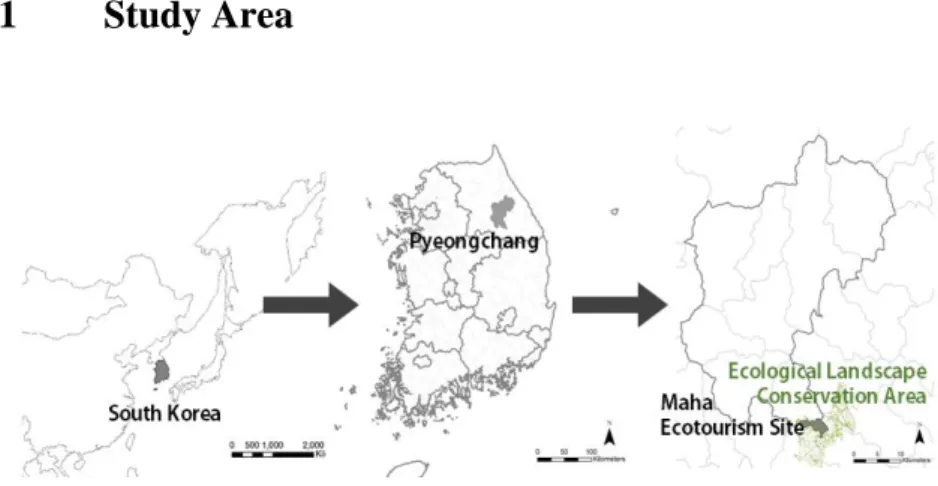
Figure 1. Location of Study Area (Reconstruction of Lee, Jae Hyuck and Son (2015) P6)
The study area of this study was the Pyeongchang Maha ecotourism site
in Korea (See Figure 1), wherein the operating system recently changed
from being government-led to being resident-led. The geology beneath the
Pyeongchang Maha ecotourism site is limestone, and the site has special
geological landscape features such as the Dong River and Pyeongchang
White Dragon Cave, preserved as a landscape ecological conservation
region. There was an attempt to build a dam in the Dong River in the 1990s
because of frequent floods. However, the local residents and academics
opposed the plan and, as an alternative, the government determined the area
as an ecotourism region. In the process, various ecotourism facilities,
including a freshwater ecology centre, were constructed under the
jurisdiction of regional officers with support from the Ministry of
50 IRSPSD International, Vol.5 No.2 (2017), 47-59
Environment, the Ministry of Agriculture, Food and Rural Affairs, and Gangwon Province. However, environmental degradation and many regulations resulted in a great deal of complaints and, more critically, led to a huge financial loss. Amidst all this, regional residents formed a residents’
cooperative, which was given the operating rights as it promised to operate the site at an economical pricing.
3.2 Time-series Q methodology
The study used a time-series Q method to compare government-led ecotourism and resident participation ecotourism. Q method is a research methodology in which real field issues are selected as survey statements by interviewing people in the field, and it is very effective in analysing conflicts (Phi, Dredge, & Whitford, 2014). Therefore, the study utilized a time-series Q method to systematically organise and comparatively analyse the conflicts and confusions during the two operating terms (Davies & Hodge, 2012).
Based on the findings, this study discussed the difficulties and alternatives in the two terms. The interviews and surveys were conducted in April 2013 and in November 2014, which were before and after the transference of the operating rights respectively (See Figure 2). The present study focused on the analysis of Distinguishing Statements and Consensus Statements in order to identify an option for an effective collaborative operational system.
4. TRANSITION OF OPERATION IN MAHA ECOTOURISM SITE, PYEONGCHANG 4.1 Government-led Ecotourism
The Pyeongchang Maha ecotourism site is a region with excellent ecological resources due to its special geological features. From an early point in time, many tourists have been visiting the region for white-water rafting. As floods occurred in the 1990s, there was a plan to build a dam in the Dong River, but regional residents, together with the academics and environmental NGOs, desperately opposed the plan. The opposition’s view was eventually accepted and the plan to build a dam in the Dong River was nullified in the 2000s, after which an alternative was suggested, which was to plan ecotourism in the area. Subsequently, in 2007, a freshwater fish ecology centre and basic tourism facilities were constructed. While such efforts were underway, the region was selected as one of the top 10 Korean ecotourism models in 2010 and one of the top 12 Korean ecotourism regions in 2013, receiving a large sum of financial support.
In the beginning, the government managed the financial support.
Government officers are evaluated on short-term outcomes and are
supported again based on the evaluation results, and therefore, they focused
on the construction of facilities, as the outcome would thus be visible. In
addition, because of a lack of sufficient experience in performing the job
functions involving facility construction, they relied on consultancies with
relevant expertise of construction and management. In the process,
consulting companies who competitively bid for lower costs were more
likely to be selected, which meant that for efficiency, they would uniformly
build ecotourism facilities all over the country. Residents protested against
such facilities, because they thought it would not help the region’s
Figure 2. Transition of Maha Ecotourism Site, Pyeongchang & Investigation Time (Reconstruction of Lee, J. H. (2016) P12)
ecotourism, would destroy the regional environment, and haphazardly waste the government grant.
Subsequently, a fish monument became a critical issue. The concerned village is famous for Korean barbel fish, and therefore the government officers asked a construction company to build a fish monument as a way to advertise the region. However, the residents hated the fact that a strange looking fish monument was erected, because according to their belief, fish should only be observed in their natural habitat. Further, they protested that more than 30 million won was spent without their consent, while they always worked on facility management jobs at a low wage due to budget constraints. Residents started to protest against various other facilities besides the fish monument. As, in this context, the number of tourists did not increase, the Pyeongchang county became concerned about it and considered new strategies.
4.2 Resident-led Ecotourism
The residents formed a residents’ cooperative to make tourism profitable on their own. As the Pyeongchang County was worried about the financial loss of the Pyeongchang Maha ecotourism site, the residents’ cooperative suggested that they would efficiently operate the site at a lower cost and they were thus given the operating rights in the form of a trust operating system.
The residents’ cooperative became more interested in the development of various programs that could actually bring in tourists rather than in facility construction. Additionally, they were aggressive in gaining more knowledge, by visiting other, more advanced ecotourism sites. Despite the efforts, they underwent trial and error because of their lack of experience in building management, financial management, advertisement, etc. A more serious difficulty was the divergence of opinions. Various opinions were present, e.g., the opinion that ecotourism should be run by supplementing it with leisure facilities and programs, the opinion that more investment should be made to develop the workforce required in the field, a scepticism that there may not be any change even if they take on new challenges, and so on.
5. Q ANALYSIS SETTING FOR TWO TERMS 5.1 Q statements
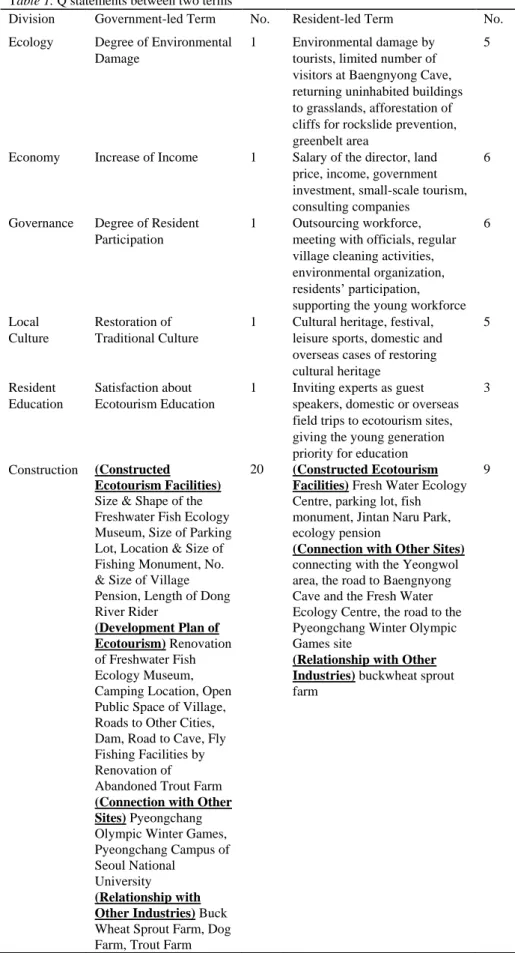
For statement selection, interviews were conducted by selecting the units
responsible for the areas of ecology, economy, governance, local culture,
education, and construction, which were the components of ecotourism. The
results of the interviews showed that construction-related matters were the
main issues in the government-led term, whereas diverse opinions in all
areas were derived in the residents-led term. Based on the results, the
following statements were selected (See Table1).
Lee & Son 53
Table 1. Q statements between two terms
Division Government-led Term No. Resident-led Term No.
Ecology Degree of Environmental Damage
1 Environmental damage by tourists, limited number of visitors at Baengnyong Cave, returning uninhabited buildings to grasslands, afforestation of cliffs for rockslide prevention, greenbelt area
5
Economy Increase of Income 1 Salary of the director, land price, income, government investment, small-scale tourism, consulting companies
6
Governance Degree of Resident Participation
1 Outsourcing workforce, meeting with officials, regular village cleaning activities, environmental organization, residents’ participation, supporting the young workforce
6
Local Culture
Restoration of Traditional Culture
1 Cultural heritage, festival, leisure sports, domestic and overseas cases of restoring cultural heritage
5
Resident Education
Satisfaction about Ecotourism Education
1 Inviting experts as guest speakers, domestic or overseas field trips to ecotourism sites, giving the young generation priority for education
3
Construction (Constructed
Ecotourism Facilities) Size & Shape of the Freshwater Fish Ecology Museum, Size of Parking Lot, Location & Size of Fishing Monument, No.
& Size of Village Pension, Length of Dong River Rider
(Development Plan of Ecotourism) Renovation of Freshwater Fish Ecology Museum, Camping Location, Open Public Space of Village, Roads to Other Cities, Dam, Road to Cave, Fly Fishing Facilities by Renovation of
Abandoned Trout Farm (Connection with Other Sites) Pyeongchang Olympic Winter Games, Pyeongchang Campus of Seoul National
University (Relationship with Other Industries) Buck Wheat Sprout Farm, Dog Farm, Trout Farm
20 (Constructed Ecotourism Facilities) Fresh Water Ecology Centre, parking lot, fish monument, Jintan Naru Park, ecology pension
(Connection with Other Sites) connecting with the Yeongwol area, the road to Baengnyong Cave and the Fresh Water Ecology Centre, the road to the Pyeongchang Winter Olympic Games site
(Relationship with Other Industries) buckwheat sprout farm
9
54 IRSPSD International, Vol.5 No.2 (2017), 47-59
5.2 P sample
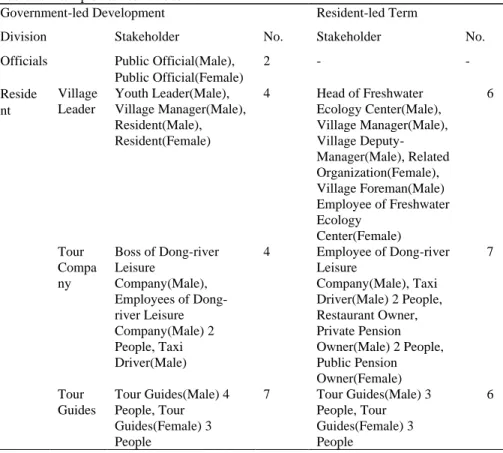
Government officers were included in the P sample for the 2013 investigation, and mainly entrusted regional residents were selected in 2014.
Surveying the same people both times would have been desirable, but in the case of officers, some were transferred to other regions, and the people who actually operated the ecotourism site were not the same either. Therefore, it was impossible to conduct the study with the same individuals. However, more than half of the people still overlapped between the two rounds of interviews (See Table2).
The result of a scree plot to examine the main factors showed that there was a large effect of factors with a value of 1.5 or more. Therefore, Q analysis was performed on the factors with a value of 1.5 or more, and based on the results of this analysis, three factors were extracted from the government-led term, and four factors were extracted from the resident participation term. The study concentrated on Distinguishing Statements and Consensus Statements from Standard Deviation of Survey in order to explore ways to reduce conflicts between the government and residents and identify strategies for collaboration, rather than to understand the nature of the factors based on the Q analysis results.
Table 2. P sample between two terms
Government-led Development Resident-led Term
Division Stakeholder No. Stakeholder No.
Officials Public Official(Male), Public Official(Female)
2 - -
Reside nt
Village Leader
Youth Leader(Male), Village Manager(Male), Resident(Male), Resident(Female)
4 Head of Freshwater Ecology Center(Male), Village Manager(Male), Village Deputy- Manager(Male), Related Organization(Female), Village Foreman(Male) Employee of Freshwater Ecology
Center(Female)
6
Tour Compa ny
Boss of Dong-river Leisure
Company(Male), Employees of Dong- river Leisure Company(Male) 2 People, Taxi Driver(Male)
4 Employee of Dong-river Leisure
Company(Male), Taxi Driver(Male) 2 People, Restaurant Owner, Private Pension Owner(Male) 2 People, Public Pension Owner(Female)
7
Tour Guides
Tour Guides(Male) 4 People, Tour Guides(Female) 3 People
7 Tour Guides(Male) 3 People, Tour Guides(Female) 3 People
6
6. RESULTS
6.1 Distinguishing Statement
In the government-led term, construction-related matters were found to
be the main issues. In order to focus on the conflicts by term, we examined
10 statements with a 2 or more standard deviation of a factor value, as they
Lee & Son 55
would show the greatest difference in opinion. The results showed that the issues causing conflict in the ecotourism construction process were about the construction of facilities. There were different opinions on the recently constructed facilities and the regions with a potential for future development.
Based on the findings, we believe that the construction of an ecotourism site with a focus on facilities can cause many conflicts in the study area (See Table 3).
Table 3. Distinguishing Statement in Government-led Term
Statement Standard
Deviation The size and structure of the freshwater fish ecology centre is suitable. 3.51 The road from the fresh water ecology centre to Baengnyong cave should be improved.
3.05 Tourism development should be linked with the Pyeongchang Olympic Winter Games area.
3.05
The dog farm must be maintained in the village. 3.05
The construction of Dong River Dam must be opposed. 2.89 Traditional forest lodging and restoration of roads are needed. 2.65 The freshwater fish ecology centre must be redesigned. 2.52
A fishing area should be built in the village. 2.31
The fish monument was well built. 2.31
The size of the parking lot built by the government is appropriate. 2.08
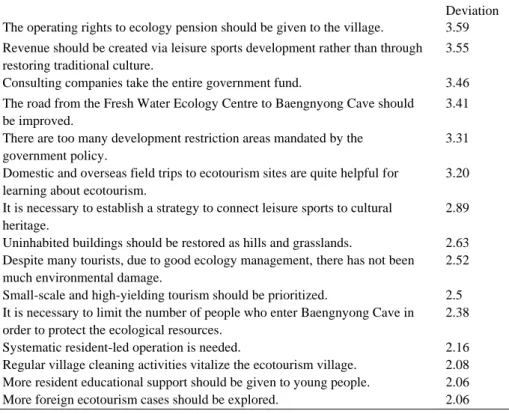
The main issues during the resident participation term were found to be operation-related matters. There were large differences in the opinions on the operating rights for ecological pensions, the direction of development, consulting companies, etc. Furthermore, among items related to facility construction, there was much discussion about public lands such as roads and limited development areas but not much about already constructed areas or areas with new plans for development (See Table 4).
Table 4. Distinguishing Statement in Resident-led Term
Statement Standard
Deviation The operating rights to ecology pension should be given to the village. 3.59 Revenue should be created via leisure sports development rather than through restoring traditional culture.
3.55 Consulting companies take the entire government fund. 3.46 The road from the Fresh Water Ecology Centre to Baengnyong Cave should
be improved.
3.41 There are too many development restriction areas mandated by the
government policy.
3.31 Domestic and overseas field trips to ecotourism sites are quite helpful for
learning about ecotourism.
3.20 It is necessary to establish a strategy to connect leisure sports to cultural
heritage.
2.89 Uninhabited buildings should be restored as hills and grasslands. 2.63 Despite many tourists, due to good ecology management, there has not been
much environmental damage.
2.52 Small-scale and high-yielding tourism should be prioritized. 2.5 It is necessary to limit the number of people who enter Baengnyong Cave in order to protect the ecological resources.
2.38
Systematic resident-led operation is needed. 2.16
Regular village cleaning activities vitalize the ecotourism village. 2.08 More resident educational support should be given to young people. 2.06
More foreign ecotourism cases should be explored. 2.06
56 IRSPSD International, Vol.5 No.2 (2017), 47-59
6.2 Distinguishing Statement
To examine the items for which the opinions converged, the items with less than 2 standard deviation and strongly in the same direction were extracted (See Table 5). For item extraction, we selected the statements that included at least one item with an absolute value of 2 or higher and no opposing opinion.
1An examination of the consensus statements across the two terms revealed items regarding overall management.
Table 5. Consensus Statement in Government-led Term
Statement Standard
Deviation
The village public announcement must be used. 0.58
The buckwheat farm must grow. 1.00
The level of resident education for ecotourism is suitable. 1.00 The number and size of the village pension is appropriate. 1.15
Length of Dong River Rider is suitable and safe. 1.53
The buckwheat farm must be actively linked with ecotourism. 1.53 The environment has deteriorated because of ecotourism. 1.53
In the government-led term, all agreed to using the village’s public land that was not meant to be used due to strict regulation. Moreover, they were hostile toward buckwheat farms that were doing business other than ecotourism, wanted more education to be provided, and had positive attitudes toward accommodation-related items. They were hostile toward rides which were facilities without guaranteed safety, and had the opinion that ecotourism had not damaged the environment. Given the findings, what the stakeholders wanted was strategic alternatives for the spaces which could not be used due to strict regulation, businesses other than ecotourism industry, and a higher level of educational support. Nevertheless, their need for facilities seemed to be satisfied just by ecological pensions. Additionally, they denied environmental degradation due to ecotourism; however, whether it causes environmental degradation or not cannot be determined in the present study because the issue would require an ecological investigation.
What this study suggests is that ecological monitoring should be frequently performed to prevent damage to ecological resources.
Table 6. Consensus Statement in Resident-led Term
Statement Standard
Deviation Environmental NGOs should have more interest in this area. 0.58 Opportunities of resident education should be offered to young people. 0.96
It is good that land price continues to go up. 0.96
Alternatives to prevent falling stones are needed, such as a green wall. 1.15 A young workforce should be brought to the area even if they are not from the
region. 1.26
The road should be connected to the Yeongwol region. 1.26 Jintan Naru Park, which is a part of the development restriction area, and has
been an empty lot since long, should be utilized.
1.83
The fish monument was well built. 1.92
1 We extracted either items from three groups with the same direction (with an absolute value of 2 or higher), or items from two groups with the same direction (with an absolute value of 2 or higher) and one neutral group (with an absolute value of 0).
Lee & Son 57
The results of the analysis of the resident participation term showed that all were negative toward the statement regarding environmental NGOs’
participation and preferred the statements about learning opportunities for young people (See Table 6). Further, negative attitude was observed toward rising land price because there would be no capital gain, as they are permanent residents. Positive attitudes were also observed toward the alternative use of places with the danger of falling rocks, migration of a young workforce, connecting with other regions, and use of Jintan Naru Park (empty space), whereas the attitude toward the fish monument was negative.
Given the findings, what the stakeholders wanted in the operation process was not new facilities, such as a fish monument, or interference from environmental NGOs, but educational support, migration of a young workforce, and an alternative for Jintan Naru Park which was under strong regulation. However, they wanted some physical facilities and found a way to prevent rocks from falling by constructing a green wall system and a system connecting to the region of Yeongwol. Finally, they were concerned about the land price, which demonstrates a need for strategic alternatives in the region rather than the construction of physical facilities.
7. DISCUSSION
The results of the comparison analysis across the two terms showed that conflicts present during the government-led term involved facility construction, and those present during the resident participation term involved operating rights and the direction of development. The conflict during the government-led term can be viewed as having started with the construction of numerous facilities. There was a need for alternatives for the spaces under strong regulation, for outbound migration of businesses other than ecotourism (which had little to do with the ecotourism industry), for education, etc., rather than building facilities. If facilities must be constructed despite other needs, a minimum number of facilities must be located for a maximal effect and safety too must be guaranteed. Further, in the process of ecotourism construction, spaces should be designed in a way that preserves ecological resources in the study area and benefits the lives of regional residents, and support for relevant education should be strengthened before the facilities are built. In this regard, although Ruhanen (2013) argued that a government’s role was to construct basic facilities, the present study confirmed that efforts should be made to guarantee safety, while minimizing the construction of basic ecotourism facilities.
Conflicts during the resident participation term seemed to have stemmed
from different opinions regarding operation methods (such as an expansion
of the residents’ operating rights) and the direction of development (such as
the construction of ports or a focus on traditional culture). It would appear
that before considering an operation method or direction of development,
matters that can be foundations in activating the region, e.g., the migration of
workforce, regulations of the region, alternatives for the increased land price,
and reinforcement, should be first pursued. In other words, rather than letting
different opinions on specific strategies to activate the village economy grow
into conflicts, a young workforce and facilities should be reinforced in order
to build unity. Therefore, it would appear that first, support, education, and
consultation should be strengthened to help a young workforce migrate and
work in the study area, rather than well planned ecotourism programs.
58 IRSPSD International, Vol.5 No.2 (2017), 47-59
Additionally, upon examining the statements of commonly perceived problems, it was found that there was a request for non-physical matters. The finding suggests that a government’s role should be to support not physical facilities but non-physical issues, and among the non-physical issues, especially through education, residents’ awareness of the goal should be raised. In these processes, the government plays the role of providing a field for residents to act on their own. Further, residents should be made aware that immediate gains, such as the operating rights, could be a cause of conflict. They should first receive education to help them set their goal of ecotourism and develop the ability to operate, before the operating rights can be transferred to them. It means that an education to solidify residents’
awareness of the goal should precede an overall education (Wight, 2002;
Lawton & Weaver, 2015) regarding residents’ participation in ecotourism.
8. CONCLUSION
An ecotourism site is for everyone. Collaboration is hence necessary to create an ecotourism site that everyone likes. The present study analysed the case of the Pyeongchang Maha ecotourism site with time-series Q method to investigate the status of collaboration between the government and residents.
It was clearly demonstrated that the role of the government is to provide a field for the residents to act on. From this perspective, ecotourism facilities should be constructed with a high level of residents’ awareness, and facilities that the residents do not ask for should not be constructed. First, sufficient education and support should be provided so that the residents can build the facilities they want, and help should be offered so that they can conduct the overall management of the facilities. In addition, residents should be able to determine their desired goal of ecotourism and should try to achieve it, rather than trying to gain benefits such as the operating rights. In the process of collaborating and performing the role given to each, an ecotourism site will become a place that everybody loves.
REFERENCES
Boley, B. B., & McGehee, N. G. (2014). "Measuring Empowerment: Developing and Validating the Resident Empowerment through Tourism Scale (Rets)". Tourism Management, 45, 85-94.
Boley, B. B., McGehee, N. G., Perdue, R. R., & Long, P. (2014). "Empowerment and Resident Attitudes toward Tourism: Strengthening the Theoretical Foundation through a Weberian Lens". Annals of Tourism research, 49, 33-50.
Buultjens, J., Shoebridge, A., & White, N. E. (2013). "Ecotourism and Indigenous Peoples".
In Ballantyne, R. & Packer, J. (Eds.), International Handbook on Ecotourism.
Cheltenham, UK: Edward Elgar Publishing.
Cairns, R., Sallu, S. M., & Goodman, S. (2014). "Questioning Calls to Consensus in Conservation: A Q Study of Conservation Discourses on Galápagos". Environmental Conservation, 41(1), 13-26.
Coria, J., & Calfucura, E. (2012). "Ecotourism and the Development of Indigenous Communities: The Good, the Bad, and the Ugly". Ecological Economics, 73, 47-55.
Davies, B. B., & Hodge, I. D. (2012). "Shifting Environmental Perspectives in Agriculture:
Repeated Q Analysis and the Stability of Preference Structures". Ecological Economics, 83, 51-57.
Holladay, P. J., & Powell, R. B. (2013). "Resident Perceptions of Social–Ecological Resilience and the Sustainability of Community-Based Tourism Development in the Commonwealth of Dominica". Journal of Sustainable Tourism, 21(8), 1188-1211.
Lee & Son 59
Lawton, L. J., & Weaver, D. B. (2015). "Using Residents’ Perceptions Research to Inform Planning and Management for Sustainable Tourism: A Study of the Gold Coast Schoolies Week, a Contentious Tourism Event". Journal of Sustainable Tourism, 23(5), 660-682.
Lee, J. H. (2016). "A Study on Conflict Analysis of Ecotourism Site for Management Plan - Focusing on Maha Ecotourism Site, Pyeongchang". (Doctoral Dissertation), Seoul National University.
Lee, J. H., & Son, Y. H. (2015). "Stakeholder Subjectives toward Ecotourism Development Using Q Methodology: The Case of Maha Ecotourism Site in Pyeongchang, Korea". Asia Pacific Journal of Tourism Research, 21(8), 931-951.
Liu, J., Qu, H., Huang, D., Chen, G., Yue, X., Zhao, X., & Liang, Z. (2014). "The Role of Social Capital in Encouraging Residents' Pro-Environmental Behaviors in Community- Based Ecotourism". Tourism Management, 41, 190-201.
Moswete, N. N., Thapa, B., & Child, B. (2012). "Attitudes and Opinions of Local and National Public Sector Stakeholders Towards Kgalagadi Transfrontier Park, Botswana".
International Journal of Sustainable Development & World Ecology, 19(1), 67-80.
Pappas, N. V. (2008). "City of Rhodes: Residents' Attitudes toward Tourism Impacts and Development". Anatolia, 19(1), 51-70.
Phi, G., Dredge, D., & Whitford, M. (2014). "Understanding Conflicting Perspectives in Event Planning and Management Using Q Method". Tourism Management, 40, 406-415.
Poudel, S., Nyaupane, G. P., & Budruk, M. (2016). "Stakeholders’ Perspectives of Sustainable Tourism Development: A New Approach to Measuring Outcomes". Journal of Travel Research, 55(4), 465-480.
Ruhanen, L. (2013). "Local Government: Facilitator or Inhibitor of Sustainable Tourism Development?". Journal of Sustainable Tourism, 21(1), 80-98.
Sirivongs, K., & Tsuchiya, T. (2012). "Relationship between Local Residents' Perceptions, Attitudes and Participation Towards National Protected Areas: A Case Study of Phou Khao Khouay National Protected Area, Central Lao Pdr". Forest policy and economics, 21, 92-100.
Steelman, T. A., & Maguire, L. A. (1999). "Understanding Participant Perspectives: Q- Methodology in National Forest Management". Journal of Policy Analysis and Management, 18(3), 361-388.
Su, D., Wall, G., & Eagles, P. F. (2007). "Emerging Governance Approaches for Tourism in the Protected Areas of China". Environmental Management, 39(6), 749-759.
Su, M. M., Wall, G., & Ma, Z. (2014). "Assessing Ecotourism from a Multi-Stakeholder Perspective: Xingkai Lake National Nature Reserve, China". Environmental Management, 54(5), 1190-1207.
Wight, P. A. (2002). "Supporting the Principles of Sustainable Development in Tourism and Ecotourism: Government's Potential Role". Current Issues in Tourism, 5(3-4), 222-244.
Zahra, A. L. (2011). "Rethinking Regional Tourism Governance: The Principle of Subsidiarity". Journal of Sustainable Tourism, 19(4-5), 535-552.