熊本大学学術リポジトリ
High pressure magnetophotoluminescence in
diluted magnetic semiconductors Cd1‑xMnxSe and Cd1‑xCoxSe
journal or
publication title
Physica status solidi. B
volume 198
number 1
page range 61‑70
year 1996‑11
URL http://hdl.handle.net/2298/10548
doi: 10.1002/pssb.2221980109
HPSP VII, Schwäbisch Gmünt, 1996, Phys. Stat. Solidi (b) 1 9 8, No.1 (1996).
High Pressure Magnetophotoluminescence
in Diluted Magnetic Semiconductors Cd1 - xMnxSe and Cd1 - xC oxS e
N. KURODA and Y. MATSUDA
Institute for Materials Research, Tohoku University, Katahira 2-1-1, Sendai 980-77, Japan
This paper reviews experimental studies on the magnetophotoluminescence in diluted magnetic semiconductors Cd1-xMnxSe of x=0.01, 0.05, 0.10 and 0.25 and Cd1-xCoxSe of x=0.012 at 1.4 and 4.2 K under hydrostatic pressures up to 2 GPa. The studies focus attention to the pressure dependence of the magnetic dichroism of the 1s exciton state under magnetic fields of 0 − 27 T.
Pressure strengthens the exciton-Mn(Co) and Mn(Co)-Mn(Co) exchange interactions. An analysis of these results in terms of the kinetic exchange theory shows that the on-site Coulomb energy U and the charge-transfer energy ∆ are reduced markedly by pressure.
PACS : 75.50.Pp, 75.30.Et, 78.20.Ls, 71.45.Gm
keywords : diluted magnetic semiconductors, magnetooptical effects, electron correlation, high pressure effects
corresponding author : N. Kuroda
Address : Institute for Materials Research, Tohoku University, Katahira 2-1-1, Sendai 980-77, Japan
FAX/Phone : +81-22-215-2073/+81-22-215-2072 e-mail : kuroda @ imr. tohoku. ac. jp
1. Introduction
Magnetooptical properties of diluted magnetic semiconductors (DMS) are useful for optical devices. An example of such application is the laser-light isolator for the fiber amplifier of optical telecommunication systems.[1] The giant magnetooptical effects in DMS originate from the exchange interaction of the exciton at the fundamental energy gap with transition-metal (TM) ions substituted for cations. This exchange interaction is dominated by the kinetic interactions of spins, [2,3] which arise from the transfer, that is, real space hopping, of electrons.
Superexchange interactions in TM compounds had long been treated in terms of the Anderson formula J = −2b2/U, [4] where J is the interaction constant; b and U are the effective transfer integral between TM ions and the on-site Coulomb energy of d electrons, respectively. As evident from this formula the kinetic exchange interactions are closely related to the electron correlation. Zaanen, Sawatzky and Allen [5] extended the Anderson model by introducing the electron transfer process between the anion p and TM d orbitals. They defined the energy needed for this transfer as the charge-transfer energy ∆. Introduction of this process allows us to describe the exchange interactions by explicitly taking account of the p-d covalent bonding.[6] Furthermore, a number of TM compounds can be classified into Mott-Hubbard insulators, charge-transfer semiconductors and p- or d-type metals according to the relative magnitude of U, ∆ and the half width of the anion valence band. Viewed from the band structures of CdTe and MnTe calculated by Wei and Zunger [7], many II-VI DMS satisfy the condition U > ∆, and thus belong to the regime of charge-transfer semiconductors.
The charge-transfer semiconductors are mostly antiferromagnetic. MnTe, for instance, is an antiferromagnetic semiconductor with Néel temperature TN of 307 K and an energy gap of 1.3 eV.
Interestingly, TN increases markedly with pressure.[8] The same is true for NiI2, in which TN is 75 K at 1 atm and increases up to 310 K at 19 GPa.[9] Since TN is determined by the d-d superexchange interactions understanding of its large pressure dependence requires knowledge of the behavior of U and ∆ under pressure. So far, however, only a little experimental information is available on the pressure dependencies of U and ∆. In recent years spin-related electronic properties of quantum structures of DMS have been the subject of extensive studies. Detailed knowledge of
the nature of the kinetic exchange interactions is also essential for those studies.
This paper presents the experimental data on the pressure dependence of the exciton-TM and TM-TM exchange interactions in bulk Cd1-xMnxSe of x = 0.01, 0.05, 0.10 and 0.25 and Cd1-xCoxSe of x = 0.012. The data have been obtained from magnetophotoluminescence measurements with respect to the A exciton under hydrostatic pressures. On the basis of these data we investigate how the contraction of the tetrahedral bond influences U and ∆ in II-VI DMS.
2. Experiment
The sample was subjected simultaneously to high hydrostatic pressure and high magnetic field at low temperatures. To measure the photoluminescence under these combined extreme conditions we made a cryogenic optical system consisting of a clamp-type diamond anvil cell, optical fibers and light-collecting and focusing optics.[10] Condensed argon was used as the pressure medium. The static magnetic field up to 27 T was generated with a hybrid magnet, and was applied parallel or perpendicular to the c-axis of the wurtzite structure of the sample. The diamond anvil cell was immersed in liquid He at 4.2 K or in pumped superfluid He at 1.4 K. The 514.5 nm line of an Ar-ion laser was used to excite photoluminescence.
3. Results and Data Analysis
The substances studied in this work can be classified into the following three categories: (1) Cd0.99Mn0.01Se and Cd0.988Co0.012Se, in which the content of TM ions is so small that TM ions are mostly isolated, (2) Cd0.95Mn0.05Se, in which a significant amount (~20 %) of TM ions are situated on the nearest-neighbor cation sites, (3) Cd0 . 9Mn0 . 1Se and Cd0.75Mn0.25Se; in these substances TM ions mostly form clusters.
Throughout this study the maximum pressure was limited to 2 GPa because a pressure- induced phase transition to a rock salt structure occurs irreversibly around 2.5 GPa.
3.1. Cd0 . 9 9Mn0 . 0 1Se and Cd0 . 9 8 8C o0 . 0 1 2S e
Figure 1 shows the magnetic field dependence of the photoluminescence spectrum in Cd0.99Mn0.01Se for H‖c at 4.2 K under 1 atm and 1.7 GPa, where H and c denote the external magnetic field and c axis of the crystal, respectively. The observed spectrum is comprised of two
bands separated by 4 meV. The higher energy band is attributed to free excitons, while the lower energy band to bound excitons.[11] Figure 2 shows a plot of the energy shift δEA of the free exciton band observed under various pressures at 4.2 K for H⊥c as well as H‖c.[12] A similar behavior of the free exciton band is observed also in Cd0.988Co0.012Se. [13,14,15]
The free exciton photoluminescence band arises from the lower magnetic sublevel of the A exciton formed by an electron of the lower magnetic sublevel of the conduction band and a hole of the upper magnetic sublevel of the A valence band. The field-dependent part of the Hamiltonian relevant to this state is given well by a combination of the s-d and p-d exchange interactions, the Zeeman energy of the electron-hole pair, the diamagnetic energy of the exciton, and the zero- wavevector valence band Hamiltonian including the spin-orbit interaction and hexagonal anisotropy.[15,16] Because of the high itinerancy of the electron and hole the mean-field approximation applies well to the present case. The magnetic-field-induced shift of the exciton energy is dominated by the exchange field due to the mean spin of TM ions.
For an external magnetic field applied along the z direction, the thermal average of Sz of the spin S of isolated TM ions can be expressed as
<Sz> = SBS( gMµBS H
k(T + T0) ) , (1)
where Bs is a modified Brillouin function of index S, gM the g-parameter of the TM ion, µB the Bohr magneton, k the Boltzman constant, T the sample temperature, and T0 an effective temperature representing the influence of weak interactions between distant-neighbor TM ions. The value of gM is known to be 2.0 for Mn2+ and 2.3 for Co2+. The typical value of T0 is 1 and 3 K in Cd1-xMnxSe and Cd1-xCoxSe, respectively, of x≈0.01, showing that the distant-neighbor interactions tend to suppress the magnetization of individual ions. If the magnetic field exceeds 10 T, <Sz> is almost saturated to be ~S. As a consequence the diamagnetic shift, which is given by σH2 with σ = 0.7−0.8×10⁻⁵ eV/T2, becomes obvious above 10 T.
It is apparent from Fig.2 that the shift of the photoluminescence line is strongly influenced by pressure. Let the density of the cation sites be N0, and the electron-TM s-d and hole-TM p-d
exchange constants be N0α and N0β, respectively. In the case of H‖c, the exchange interactions can be characterized by a parameter N0(α−β). If the contributions from pairs and clusters are neglected, δEA is given by
δEA = − 1
2 N0(α − β )x <Sz> − 1
2 | ge − gh| µBH + σH2 , (2) where g e and g h are the g- parameters of the electron and hole, respectively. Clearly, the pressure dependence of δEA observed for H‖c arises mainly from the change in N0(α−β). For H⊥c, the total Hamiltonian is nondiagonal, so that the change of the hexagonal anisotropy ∆c of the valence band contributes additionally to the pressure dependence of δEA. In Fig.2 the theoretical curves of δEA vs. H are shown along with the experimental data.
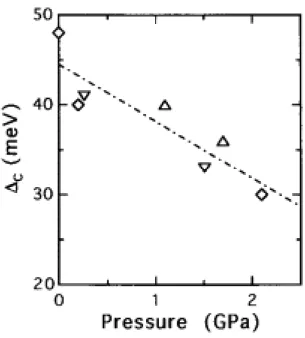
Figures 3 and 4 respectively show pressure dependencies of ∆c and N0(α−β) obtained. In both Cd0.99Mn0.01Se and Cd0.988Co0.012Se, ∆c turns out to be reduced by pressure at a rate of
−6×10⁻³ eV/GPa. Almost the same value is obtained also for Cd0.90Mn0.10Se.[17] The exchange parameter N0(α−β) increases with pressure P at a rate of dlnN0(α−β)/dP=7×10-2 GPa-1 in both substances. Since the volume compressibility of these substances is 1.8×10⁻² GPa-1 the Grüneisen parameter of N0(α−β) amounts to ~4.
In this analysis the pressure dependence of T0 is ignored, because our study gives weight to the behavior of δEA for H >10 T, where <Sz> is almost saturated and thereby insensitive to T0. In principle, however, T0 should depend on pressure. According to (1) the influence of pressure on T0 is reflected by the curvature of the δEA vs. H curve in the low field region. Meyer et al.[18] have observed a pressure-induced change of the curvature, which suggests dT0/dP=1.1-1.3 K/GPa, in a single-quantum-well structure of CdTe/Cd0.91Mn0.09Te.
3.2. Cd0 . 9 5Mn0 . 0 5S e
When TM ions with different spin forms coexist, <Sz> in (2) is replaced by <Sz> = ∑
m
fm<Szm> , (3)
where fm is the probability that a TM ion belongs to the form m and <Szm> the thermal average of Sz of the form m. If the mole fraction of TM ions is raised to the order of 0.05, a significant amount of the ions are situated on the nearest-neighbor cation sites to form antiferromagnetic spin pairs.
These spin pairs manifest themselves as a series of weak and stepwise development of magnetization under high magnetic fields and low temperatures. Given exchange interaction
−2JNNSi・Sj between TM spins on the nearest-neighbor i- and j-th sites, the steps occur at
Hn = − 2nJNN
gMµB
+ Hd , n = 1, 2, ..., 2S , (4)
where Hd is a small correction (~1 T) due to distant-neighbor interactions. According to Forner et al.[19] H1=12.8 T, H2=24.1 T and JNN= −7.6±0.2 K in Cd0.951Mn0.049Se at 1 atm.
Figure 5 shows a plot of δEA vs. H observed in Cd0.95Mn0.05Se at 1.4 K under various pressures.[20] Since the sample temperature is very low, δEA is already saturated around 6 T. The flatness of δEA above 10 T results from cancellation of the diamagnetic shift by the exchange-field shift due to paired Mn ions. We see that δEA undulates slightly for H higher than 10 T. The undulation is clearly visualized if the derivative of δEA with respect to H is plotted, as shown in the inset of Fig.5. This plot shows that at 1 atm there occurs a stepwise increase of δEA around 13 T and 24 T, in good agreement with the magnetization data reported by Forner et al.[19] At 4.2 K the stepwise anomalies are thermally smeared out.[14,15] The point to observe is the fact that H1 and H2 shift toward higher magnetic field with increasing pressure. The values of |JNN| and N0(α−β) obtained from this experiment are plotted in Fig.4 for comparison with the pressure dependence of N0(α−β) in Cd0.99Mn0.01Se and Cd0.988Co0.012Se. It emerges that |JNN| increases with pressure at a rate of ~20 %/GPa. The corresponding Grüneisen parameter is as great as ~11.
3.3. Cd0 . 9 0Mn0 . 1 0Se and Cd0 . 7 5Mn0 . 2 5S e
The results on paired Mn ions lead us to envisage that the saturation field of magnetization of clusters is appreciably higher than 20 T and that the saturation field increases with pressure. As a consequence, in the substances with comparatively large values of x, <Sz> at a given external
magnetic field is expected to decrease with pressure. Figure 6 shows the experimental results for Cd0.90Mn0.10Se[13,17] and Cd0.75Mn0.25Se at 4.2 K.[13,15] For both substances δEA is not saturated even above 20 T, as expected. In the case of Cd0.90Mn0.10Se the effect of pressure is very weak. This is ascribed to the accidental cancellation of two competitive effects, namely, an increase in N0(α−β) and a decrease in <Sz> . In the case of Cd0.75Mn0.25Se, in which more than 90 % of Mn ions participate in clusters, the effect of decrease in <Sz> predominates over the effect of increase in N0(α−β), and therefore δEA is reduced by pressure.
4. Pressure Dependence of Exchange Interactions
Figure 7 schematically shows energies of the conduction and valence bands relative to the energies of d states of TM ions. Here the spin-orbit splitting and a small hexagonal anisotropy ∆c of the valence band are ignored. In the ground state of Cd1-xMnxSe every Mn atom is ionized into Mn2+ with S = 5
2. The d electrons of the Mn2+ ion consist of three dε and two dγ electrons, and form the lower Hubbard state. The dε electrons hybridize with the Se 4p electrons forming the topmost valence band.[7] The upper Hubbard state lies above the Cd 5s-like conduction band edge since the effective on-site Coulomb energy U is satisfactorily large. The charge-transfer energy ∆ corresponds to the energy gap between the upper Hubbard state and the valence band. In this scheme the energy gap Λ between the valence band and the lower Hubbard state is equal to U−∆.
If the interaction between a hole spin Sh and Mn spins is written as −Jpdx <Sz> Shz, the interaction constant Jpd is given by [2,3]
Jpd = − 16 S
t2pdU
∆Λ
, (5)
where tpd is the transfer integral between the Se p and Mn d orbitals. The ordinary potential term of the exchange interaction of the hole with TM ions is nearly equal to that of the conduction electron, and is much smaller than the kinetic term. Consequently one can write to a good approximation Ν0(α−β) = −Jpd . (6)
The exchange interaction of paired Mn ions is a fourth order transfer process. The interaction constant JNN is given by [2,6]
JNN = − 1 2S2
t4pd(U + ∆)
∆3U
. (7)
When ∆ >> U, (7) is reduced to the Anderson formula with b = t2pd/(2S∆).
The transfer integral tpd scales with the bond length l as l −3 . 5.[21] In view of the bulk modulus of Cd1-xMnxTe obtained by Strössner et al.,[22] the compressibility of the Mn-Se bond is expected to be almost equal to the compressibility, 0.62×10⁻² GPa-1, of the Cd-Se bond. Then substitution of the experimental values of N0(α−β) and JNN in Cd0.95Mn0.05Se shown in Fig. 4 into (5) and (7) enables us to evaluate the pressure-induced variations of U, ∆ and Λ from their atmospheric values U=7.6 eV, ∆=4.2 eV and Λ=3.4 eV [2]. The results are shown in Fig.8. It turns out that all the energy parameters decrease with increasing pressure. Within the experimental accuracy their variations are linear to pressure. The least-squares fit to the data gives dU/dP =
−0.18 eV/GPa, d∆/dP = −0.12 eV/GPa and dΛ/dP = −0.06 eV/GPa. The decreasing rate of U, dlnU/dP = −2.4×10⁻² GPa-1, is of the same order in magnitude as the increasing rate of the transfer integral, dlntpd/dP=2.2×10-2 GPa-1. Presumably, an increase in the p-d hybridization causes an enhancement of the effective screening of Coulomb interactions by valence electrons to reduce U.
The changes of ∆ and Λ are the results of the reduction of U and relative shifts of the lower Hubbard state and valence band. These effects will occur generally in TM compounds. Therefore, a significant part of the pressure dependence of TN observed in TM compounds mentioned in section 1 may be induced by the changes of U, ∆ and Λ.
5. Conclusions
High-field magnetophotoluminescence due to the A exciton has been studied in diluted magnetic semiconductors Cd1-xMnxSe and Cd1-xCoxSe with x ranging from 0.01 to 0.25 under high hydrostatic pressures at 1.4 and 4.2 K. The results demonstrate that the p-d and d-d antiferromagnetic exchange interactions are strengthened significantly by pressure. These
observations allow us for the first time to look quantitatively into the pressure dependence of the effective on-site Coulomb energy U and the charge-transfer energy ∆ of the Zaanen-Sawatzky- Allen scheme. It emerges from an analysis in terms of the kinetic exchange theory that both U and
∆ are reduced by pressure. The value of |dlnU/dP| is about 4 times as great as the linear compressibility of lattice and is comparable to the increasing rate of the p-d transfer integral. These findings suggest that not only the transfer but also the electron correlation in TM compounds is generally sensitive to a change in bond lengths.
Acknowledgements
The authors are grateful to Prof. J. R. Anderson, Dr. W. Giriat and Dr. I. Mogi for providing single crystals. The magnetophotoluminescence experiments were carried out at the High Field Laboratory for Superconducting Materials, Tohoku University.
References
[1] K. ONODERA, T. MASUMOTO, and M. KIMURA, Electron. Lett. 3 0, 1954 (1994).
[2] B. E. LARSON, K. C. HASS, H. EHRENREICH, and A. E. CARLSSON, Solid State Commun.
5 6, 347 (1985); Phys. Rev. B 3 7, 4137 (1988).
[3] A. K. BHATTACHARJEE, Phys. Rev. B 4 6, 5266 (1992).
[4] P. W. ANDERSON, Phys. Rev. 1 1 5, 2 (1959).
[5] J. ZAANEN, G. A. SAWATZKY, and J. W. ALLEN, Phys. Rev. Lett. 5 5, 418 (1985).
[6] J. ZAANEN and G. A. SAWATZKY, Can. J. Phys. 6 5, 1262 (1987).
[7] S. H. WEI and A. ZUNGER, Phys. Rev. B 3 5, 2340 (1987).
[8] H. SUGIURA, A. SAWAOKA, S. SAITO, and K. INOUE, J. Phys. Chem. Silids 4 0, 701 (1979).
[9] M. P. PASTERNAK, R. D. TAYLOR, A. CHEN, C. MEADE, L. M. FALICOV, A. GIESEKUS, R.
JEANLOZ, and P. Y. YU, Phys. Rev. Lett. 6 5, 790 (1990).
[10] Y. MATSUDA, N. KURODA, and Y. NISHINA, Rev. Sci. Instrum. 6 3, 5764 (1992).
[11] D. HEIMAN, P. BECLA, R. KERSHAW, D. RIDGLEY, K. DWIGHT, A. WOLD, and R. R.
GALAZKA, Phys. Rev. B 3 4, 3961 (1986).
[12] N. KURODA and Y. MATSUDA, Sci. Rep. RITU A 42, 263 (1996).
[13] Y. MATSUDA, N. KURODA, I. MOGI, G. KIDO, and Y. NISHINA, Physica B 2 0 1, 411 (1994).
[14] Y. MATSUDA, N. KURODA, and I. MOGI, Proc. 22nd Int. Conf. Phys. Semicond., Vancouver, 1994, edited by D. J. Lockwood (World Scientific, Singapore, 1995), p.2513.
[15] Y. MATSUDA and N. KURODA, Phys. Rev. B 5 3, 4471 (1996).
[16] R. L. AGGAWAL, S. N. JASPERSON, J. STANKIEWICZ, Y. SHAPIRA, S. FORNER, B.
KHAZAI, and A. WOLD, Phys. Rev. B 2 8, 6907 (1983).
[17] Y. MATSUDA, N. KURODA, I. MOGI, G. KIDO, Y. NISHINA, Y. NAKAGAWA, J. R.
ANDERSON, and W. GIRIAT, Proc. 5th Int. Conf. High Pressure in Semiconductor Physics, Kyoto, 1992; Jpn. J. Appl. Phys. Suppl. 3 2-1, 270 (1993).
[18] R. MEYER, M. DAHL, G. SHAACK, and R. BOEHLER, Solid State Commun. 9 6, 271 (1995).
[19] S. FORNER, Y. SHAPIRA, D. HEIMAN, P. BECLA, R. KERSHAW, K. DWIGHT, and A.
WOLD, Phys. Rev. B 3 9, 11793 (1989).
[20] N. KURODA and Y. MATSUDA, Phys. Rev. Lett. (1996) (to be published).
[21] W. A. HARRISON, Electronic Structure and Properties of Solids (Freeman, San Francisco, 1980) p.451.
[22] K. STRÖSSNER, S. VES, W. DIETERICH, W. GEBHARDT, and M. CARDONA, Solid State Commun. 5 6, 563 (1985).
Fig. 1. Photoluminescence spectrum in Cd0.99Mn0.01Se under various magnetic fields for H‖c at 4.2 K under 1 atm and 1.7 GPa. The features B and F are due to bound and free excitons, respectively.
Fig. 2. Exciton energy shift vs. magnetic field in Cd0.99Mn0.01Se for H‖c and H⊥c at 4.2 K under various pressures. The solid lines are theoretical curves.
Fig. 3. Pressure dependence of the hexagonal anisotropy energy ∆c of the valence band in (◇)Cd0.99Mn0.01Se, (△)Cd0.988Co0.012Se and (▽)Cd0.90Mn0.10Se. The dash-dotted line is the least squares fit of a straight line to the experimental data.
Fig. 4. Pressure dependence of the exchange constant N0(α−β) in (◇)Cd0.99Mn0.01Se, (
△)Cd0.988Co0.012Se and (■)Cd0.95Mn0.05Se and JNN in (●)Cd0.95Mn0.05Se. The data of N0(α−β) are normalized by the atmospheric value 1.37 eV and 2.52 eV in Mn- and Co-based substances, respectively. The solid line is the least-squares fit of a straight line to the experimental data of N0(α−β). The dash-dotted line is the curve of JNN calculated from (7) with tpd(P=0)=0.79 eV and the values of U(P), ∆(P) and Λ(P). As for the values of U(P), ∆(P) and Λ(P) see section 4.
Fig. 5. Exciton energy shift vs. magnetic field for H‖c in Cd0.95Mn0.05Se at 1.4 K under various pressures. The inset shows the derivative of the energy shift with respect to H. The solid lines are the guide for eyes. Arrows show the field positions of H1 and H2.
Fig. 6. Exciton energy shift vs. magnetic field in Cd0.90Mn0.10Se under (○)1 atm and (×)1.1 GPa, and in Cd0.75Mn0.25Se under (●)1 atm and (◇)1.4 GPa for H‖c at 4.2 K. The solid lines are the guide for eyes.
Fig. 7. Schematic representation of the single particle density of states. CB and VB denote the conduction and valence band, respectively.
Fig. 8. Pressure dependence of (○)U, (▽)∆ and (□)Λ in Cd0.95Mn0.05Se. The solid, dashed and dash-dotted lines are the least-squares fits of a straight line to the experimental data of U, ∆ and Λ, respectively.
Fig. 1
Fig. 2
Fig. 4 Fig. 3
Fig. 5
Fig. 6
Fig. 7
Fig. 8