Contrasting P-T records of the metamorphic rocks at the Oyayubi ridge of Brattnipene, Sør Rondane Mountains, East Antarctica.
Tatsuro Adachi1, Tetsuo Kawakami2, Masaoki Uno3, Fumiko Higashino4 and Noriyoshi Tsuchiya3
1Kyushu University, 2Kyoto University, 3Tohoku University, 4Okayama University of Science
In the Sør Rondane Mountains (SRM), the past lower crustal rocks are continuously exposed and traces of crustal fluid activity can be observed (e.g. Kawakami et al., 2017, Uno et al., 2017, Higashino et al., 2019). The generation and movement of the crustal fluid is one of the important factors in the evolution process of the crust, it is therefore important to understand the actual behavior and its role of the crustal fluid. Also it is essential to clarify processes involved in the crustal fluid in relationship to the temperature-pressure-time record of rocks and geological structure.
The SRM comprise medium to high-grade metamorphic rocks with granitic, syenitic and minor mafic dikes (e.g. Shiraishi et al., 1997). Based on recent metamorphic and geochronological studies, this region is divided into the NE terrane and the SW terrane by the Main Tectonic Boundary (MTB, Osanai et al., 2013). The NE terrane is characterized by clockwise P-T path and detrital zircons older than 1200Ma, the SW terrane by counter-clockwise P-T path and detrital zircons younger than 1200Ma, and both terranes have collided at 600-650Ma during which the thrust up movement of the NE terrane took place over the SW terrane (Osanai et al., 2013). In both of the NE and SW terranes, granulite-facies rocks and amphibolite- and/or greenschist- facies rocks are distributed. The granulite-facies rocks are located on both sides of the NE and SW terranes across the MTB. The lower-grade metamorphic rocks are interpreted to be less affected by the granulite facies metamorphism during the collision of the NE and SW terranes, because they were located near the surface at the time of the peak metamorphism (Osanai et al., 2013).
In this case, the lower-grade rocks must be distributed structurally upper than the granulite-facies rocks.
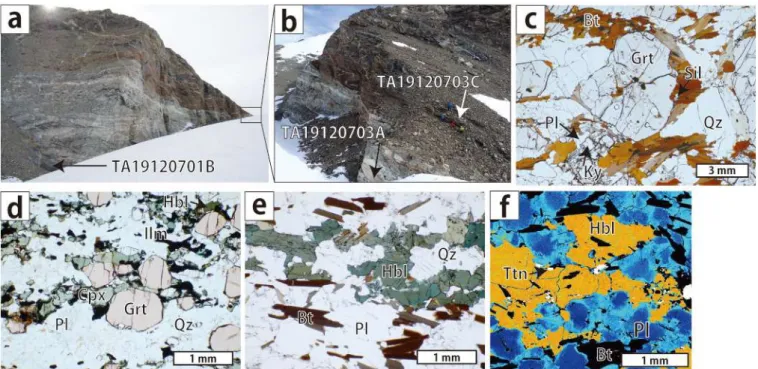
At the eastern slope of the Oyayubi ridge, Brattnipene, pelitic gneiss and felsic gneisses are in contact with each other by low angle boundary (Figs. 1a, 1b). The pelitic gneiss (sample No. TA19120703C), distributed in structurally upper side, comprises garnet, biotite, kyanite/sillimanite, plagioclase, quartz with minor amount of ilmenite, apatite, zircon and monazite (Fig. 1c). The garnet in this rock is replaced by biotite at the rim portion, indicating hydration during retrograde metamorphism. Kyanite and sillimanite commonly occur with biotite replacing garnet. This texture is interpreted as retrograde products during hydration near the phase transition boundary between kyanite and sillimanite (Adachi et al., 2013). Oriented rutile needles are found in quartz.
This texture is interpreted as exsolution of titanium during retrogression, which are commonly found in the retrogressed rocks in the central SRM (Adachi et al., 2010, 2013). Ti-in-quartz thermometer (Wark and Watson, 2006) was applied to quartz grains with rutile exsolution using the method of Adachi et al. (2010), which reconstruct pre-exsolution Titanium concentration in quartz with wide diameter electron beam. Assuming aTiO2=0.6 because of presence of ilmenite in the matrix, the thermometer gives 800°C and this condition is interpreted as the near peak temperature. Such a high temperature condition and the texture of retrograde hydration near kyanite/sillimanite transition are typical feature of the rock which experienced granulite facies metamorphism in the Brattnipene area.
Conversely, the felsic gneisses, which are located structurally lower side, hardly show textures of retrograde hydration. Garnet- clinopyroxene felsic gneiss (TA19120701B) comprises garnet, clinopyroxene, plagioclase and quartz, ilmenite with minor amount of hornblende, apatite and zircon (Fig. 1d). Garnet and clinopyroxene shows homogeneous chemical composition, suggesting that mafic minerals in this rock preserve information acquired under the peak metamorphic conditions. Hornblende- biotite felsic gneiss (TA19120703A) comprises hornblende, biotite, plagioclase and quartz with minor amount of ilmenite, titanite, apatite, and zircon (Fig. 1e). Hornblende shows homogeneous chemical composition. Calcium concentration in plagioclase increases rimward (Fig. 1f), suggesting temperature increase.
Garnet-clinopyroxene thermometer (Nakamura, 2009) and garnet-clinopyroxene-plagioclase-quartz barometer (Newton and Perkins, 1982) of garnet-clinopyroxene felsic gneiss gives 700-750 °C and 5.4-7.3 kbar. Hornblende-plagioclase thermometry (Holland and Blundy, 1994) and barometry (Bhadra and Bhttacharya, 2007) of hornblende-biotite felsic gneiss gives 700-750 °C and 5.6-9.1 kbar. Ti-in-quartz thermometry (Wark and Watson, 2006) assuming aTiO2=0.6 because of presence of ilmenite/titanite in the matrix gives 740 °C for garnet-clinopyroxene felsic gneiss and 700 °C for hornblende-plagioclase felsic gneiss. These conditions are interpreted as peak metamorphic conditions of felsic gneisses, and are close to the peak conditions of the amphibolite facies rocks in the areas such as Lunckeryggen and northern Menipa (Adachi et al., 2013) although the temperature is slightly high.
As mentioned above, the rocks experienced granulite facies condition are distributed structurally upper side than the lower grade rocks at the Oyayubi ridge. If such a relationship can be observed widely in the SRM, the tectonic model for the SRM needs to be reconsidered.
References
Adachi, T., Hokada, T., Osanai, Y., Nakano, N., Baba, S., Toyoshima, T., 2013, Contrasting metamorphic records and their implications for tectonic process in the central Sør Rondane Mountains, eastern Dronning Maud Land, East Antarctica Geological Society Special Publication, 383 (1), 113-133.
Adachi, T., Hokada, T., Osanai, Y., Toyoshima, T., Baba, S., Nakano, N., 2010, Titanium behavior in quartz during retrograde hydration: Occurrence of rutile exsolution and implications for metamorphic processes in the Sør Rondane Mountains, East Antarctica, Polar Science, 3 (4), 222-234.
Bhadra, S., Bhattacharya, A., 2007, The barometer tremolite + tschermakite + 2 albite = 2 pargasite + 8 quartz: Constraints from experimental data at unit silica activity, with application to garnet-free natural assemblages, American Mineralogist, 92 (4), 491-502.
Higashino, F., Kawakami, T., Tsuchiya, N., Satish-Kumar, M., Ishikawa, M., Grantham, G., Sakata, S., Hirata, T., 2019, Brine Infiltration in the Middle to Lower Crust in a Collision Zone: Mass Transfer and Microtexture Development Through Wet Grain-Boundary Diffusion, Journal of Petrology, 60 (2), 329-358.
Holland, T., Blundy, J., 1994, Non-ideal interactions in calcic amphiboles and their bearing on amphibole-plagioclase thermometry, Contributions to Mineralogy and Petrology, 116 (4), 433-447.
Kawakami, T., Higashino, F., Skrzypek, E., Satish-Kumar, M., Grantham, G., Tsuchiya, N., Ishikawa, M., Sakata, S., Hirata, T., 2017, Prograde infiltration of Cl-rich fluid into the granulitic continental crust from a collision zone in East Antarctica (Perlebandet, Sør Rondane Mountains), Lithos, 274-275, 73-92.
Newton, R.C., Perkins III, D., 1982, Thermodynamic calibration of geobarometers based on the assemblages garnet - plagioclase - orthopyroxene (clinopyroxene) – quartz, American Mineralogist, 67 (3-4), 203-222.
Nakamura, D., 2009, A new formulation of garnet-clinopyroxene geothermometer based on accumulation and statistical analysis of a large experimental data set, Journal of Metamorphic Geology, 27 (7), 495-508.
Osanai, Y., Nogi, Y., Baba, S., Nakano, N., Adachi, T., Hokada, T., Toyoshima, T., Owada, M., Satish-Kumar, M., Kamei, A., Kitano, I., 2013, Geologic evolution of the Sør Rondane Mountains, East Antarctica: Collision tectonics proposed based on metamorphic processes and magnetic anomalies, Precambrian Research, 234, 8-29.
Shiraishi, K., Osanai, Y., Ishizuka, H., Asami, M., 1997, Antarctic Geological Map Series (Sheet 35, Sør Rondane Mountains). National Institute of Polar Research, Japan.
Uno, M., Okamoto, A., Tsuchiya, N., 2017, Excess water generation during reaction-inducing intrusion of granitic melts into ultramafic rocks at crustal P–T conditions in the Sør Rondane Mountains of East Antarctica, Lithos, 284-285, 625-641.
Wark, D.A., Watson, E.B., 2006, TitaniQ: A titanium-in-quartz geothermometer, Contributions to Mineralogy and Petrology, 152 (6), 743-754.
Figure 1. Mode of occurrence and photomicrographs of analyzed samples. (a, b) Mode of occurrences and geological relations of analyzed samples. Brownish pelitic gneiss (TA19120703C) is distributed structurally upper than grayish felsic gneisses (TA19120701B and TA19120703A). (c) Photomicrograph of TA19120703C. Garnet is replaced by biotite, and kyanite and sillimanite are accompanying this biotite. (d) Photomicrograph of TA19120701B. (e) Photomicrograph of TA19120703A. (f) Calcium mapping of TA19120703A. Calcium concentration in plagioclase increase rimward, suggesting temperature increase.