• 検索結果がありません。

阪南大学学術リポジトリ

N/A
N/A
Protected

Academic year: 2021

シェア "阪南大学学術リポジトリ"

Copied!
30
0
0

読み込み中.... (全文を見る)

全文

(1)

Abstract

 Research on the count/noncount distinction of English nouns has a long history, but the distinction has never been sufficiently described. Count and noncount nouns are defined in two domains:

morpho-syntax and semantics. The definition, however, varies from linguist to linguist. In this research, we take the view that the distinction is essentially syntactic, and count nouns are defined morpho-syntactically as those that satisfy two conditions: i) to inflect for number to mark a singular- plural contrast and take both a singular and a plural verb that agree with the number of a subject NP (including those with identical singular and plural forms); ii) to occur in direct construction with the cardinal numerals. Noncount nouns are defined as those that do not satisfy these two conditions.

 Research on the count/noncount distinction has been mainly on concrete nouns. Various semantic criteria have been proposed (e.g. atomicity, homogeneity, arbitrary divisibility, boundedness) to identify referential properties that are to be shared by all count nouns or all noncount nouns. For proto-typical count and noncount nouns, a noun’s semantic, syntactic and morphological properties are aligned, and the proposed criteria work very well. However, mismatches between count- noncount syntax and semantics are often observed: some nouns have the semantics of a count noun but the syntax of a noncount noun (e.g. furniture, toast) while others have the semantics of a noncount noun but the syntax of a count noun (e.g. cloud, mountain, ripple). None of the proposed criteria sufficiently accounts for the mismatches. Conceptualization (or alternative construals) and communicative function are proposed to account for the mismatches. However, there are some nouns whose count or noncount status cannot be explained by alternative construals or communicative function. When all these criteria fail, grammatical convention remains as the only solution.

 Little research has been done on abstract nouns, and the proposed criteria for the count/noncount distinction of concrete nouns do not apply to abstract nouns because abstract nouns provide no perceptual information about their referential properties. Also, researchers use their own intuitions to provide examples to support their arguments. It is not hard to find counter-examples since their arguments are based on a very limited number of data. It is necessary to use large corpora such as the Bank of English to explore the count/noncount distinction of abstract nouns by looking into collocational patterns.

Ⅰ Introduction

 The purpose of this article is to review various criteria that have been proposed to account for the

KODERA, Masahiro

An Overview of the Count/Noncount Distinction

of English Nouns

(2)

count/noncount distinction (hereafter referred to as C/NC distinction) of English nouns and to look into the mismatches between syntax and semantics that prevent a clear description of the distinction.

It is often observed that the grammatical form of a noun does not reflect its referential properties and/or construals. For example, toast is perceptually and conceptually countable, but the noun toast is noncount, and you cannot say *two toasts to mean two slices of toast.

 Languages can be classified into two types with respect to number: mass-count languages and classifier languages (Gil 2008).

1)

English is a mass-count language, in which nouns of high countability

(i.e. count nouns such as car, dog and pencil) generally occur in direct construction with numerals

(e.g. one car, two dogs, three pencils), whereas nouns of low countability (i.e. noncount nouns such as water and sand) typically do not occur in direct construction with numerals and need a numeral classifier, or measure word (e.g. one glass of water, two pounds of sand) to indicate a unit of measure.

2)

Classifier languages, such as Japanese, Korean and Chinese, do not mark plurality morpho- syntactically, and a bare noun can have a singular or plural reading. Sortal numeral classifiers are used when nouns are in construction with numerals: e.g. two dogs are referred to in Japanese as ni- hiki-no inu (two-CLASSIFIER-GENITIVE dog), where a sortal numeral classifier hiki is required to indicate non-human animals (Muromatsu 2003: 87).

 In English, common nouns (as opposed to proper nouns) are divided into three types in terms of countability (i.e. based on the types of restrictions on the usage of nouns): count nouns, noncount nouns and mass-count flexible nouns (e.g. rope, stone), which have both a count and a noncount use with the same meaning (Gillon 1999: 52, Barner & Snedeker 2005).

3)

Count nouns can be divided into three groups in terms of their grammatical behavior: typical count nouns (e.g. cup, pen), base plural nouns (e.g. sheep, aircraft) with identical singular and plural forms, and collective singular nouns

(e.g. government, committee), which can take either a singular or a plural verb. Noncount nouns can be divided into five groups in terms of their referential properties: homogeneous mass nouns

(aka substance mass nouns: e.g. water, mud), which typically denote an unindividuated substance;

heterogeneous mass nouns (aka object-mass nouns or superordinate mass nouns: e.g. furniture, footwear), which denote sets of individuated objects; plural mass nouns (e.g. groceries, remains);

lexical plural nouns (aka uninflected plural-only nouns: e.g. police, cattle), whose denotation is thought of en masse (Payne & Huddleston 2002: 345); abstract noncount nouns (e.g. advice, information, knowledge).

 A prototypical count noun (e.g. cup, pen) denotes an individuated, separate object that can be counted while a prototypical noncount noun (e.g. water, mud) denotes an unindividuated substance that cannot be counted without a numeral classifier (e.g. two bottles of water). In between typical count and noncount nouns are nouns of various degrees of countability. Clear boundaries between count and noncount nouns are hard to draw in both semantics and morpho-syntax, and mismatches between count-noncount syntax and semantics (i.e. between grammatical behavior and referential properties and/or construals) are often observed.

 Object mass nouns (e.g. furniture) and mass-count flexible nouns (e.g. rope) cause mismatches.

Furniture, for example, denotes a collection of discrete objects (e.g. chairs, tables), and it is possible

to count its referents (Nicolas 2004: 134, Barner & Snedeker 2005: 51, Bale & Barner 2009, Chierchia

2010: 151, Wiese 2012: 58)

4)

. However, morpho-syntactically it behaves as a noncount noun, and it

(3)

does not combine directly with a numeral (*three furnitures). Rope is a mass-count flexible noun, which can be used as both a count and a noncount noun with the same meaning. The same physical entity can be referred to as some rope (noncount noun) or some ropes (count noun). Referential properties (i.e. perceptual characteristics of a referent) have some influence on the categorization of a noun into count or noncount, but they do not determine whether a noun is used as a count noun or a noncount noun.

 In the following sections, we will review various criteria, both syntactic and semantic, that have been proposed to account for the C/NC distinction. First, we will define count and noncount nouns morpho-syntactically. Then, based on this definition, we will review various semantic criteria for the C/NC distinction to show that none of the criteria sufficiently accounts for mismatches between count-noncount syntax and semantics. In the last section, we will show that the proposed criteria for the C/NC distinction of concrete nouns do not apply to abstract nouns, and will propose to use large corpora such as the Bank of English to investigate the C/NC distinction of abstract nouns by looking into collocational patterns.

Ⅱ Criteria for the C/NC distinction

 Various criteria have been proposed to account for the C/NC distinction of English nouns since it was first recognized by Jespersen (1909-49, vol. 2, ch. 5.2) (Gillon 1992: 597, Cowie 1999: 57, Lasersohn 2011: 1133). The research has been mainly on concrete nouns (Grimm 2014), and the C/

NC distinction is explained in three domains: morphology (i.e. inflection for singular-plural contrast), syntax (i.e. determiner-head combination restrictions and subject-verb agreement), and semantics

(i.e. referential properties, alternative construals, communicative function). It is forbiddingly difficult to sufficiently describe the distinction since a noun’s semantic, syntactic and morphological properties are not always aligned. Mapping failure between syntax (including morphology) and semantics is often observed, and no criteria sufficiently account for the mismatches. First, we will propose our morpho-syntactic definition of count and noncount nouns, and then we will review morpho-syntactic restrictions that different linguists employ to distinguish count nouns from noncount nouns. Next, we will review semantic criteria that have been proposed to identify referential properties that are to be shared by all count nouns or all noncount nouns. We will see that none of the proposed criteria sufficiently accounts for the mismatches between count-noncount syntax and semantics. Then, we will review the ideas of alternative construals and communicative function that are proposed to account for the mismatches.

2.1. Morpho-syntactic accounts for the C/NC distinction

 Morphologically, the English language has two types of nouns in terms of inflection for number:

nouns that inflect for number to mark a singular-plural contrast (e.g. car/cars), and nouns that do

not, which are further divided into three groups: pluralia tantum (e.g. police, oats, scissors, clothes),

singularia tantum (e.g. rice, garbage, furniture, information, knowledge), and those with identical

singular and plural forms (e.g. sheep, aircraft, barracks, headquarters).

5)

Nouns with singular-

plural contrast and those with identical singular and plural forms are defined as count nouns in this

(4)

research while pluralia tantum and singularia tantum are noncount.

 Syntactically (i.e. in terms of subject-verb agreement and determiner-head combination), English nouns can be divided into several types. There are three types of nouns in terms of subject-verb agreement (aka singular-plural concord): those nouns that occur only with a singular verb (e.g.

typical noncount nouns such as water and object mass nouns such as furniture), those that occur only with a plural verb (e.g. pluralia tantum), and those that can occur with both a singular and a plural verb (e.g. typical count nouns such as dog and car, collective nouns such as committee and family, mass-count flexible nouns such as rope and stone). Nouns that can occur with both a singular and a plural verb are defined as count nouns in this research, and the other two types are noncount.

 In terms of determiner-head combination restrictions, there are two types of nouns: typical count nouns that combine with the following count determiners: cardinal numerals (one, two, three to infinity), the indefinite article (a/an), indefinite quantifiers (e.g. (a) few, several, many, high round numbers), distributive determiners (e.g. another, each, every, either, neither), and typical noncount nouns that combine with the following noncount determiners: zero determiner (ø), all, much, (a)

little, enough, less, more, sufficient. In this research, nouns that can combine with cardinal numerals are defined as count nouns since they admit all other count determiners. Nouns that do not combine with cardinal numerals are noncount, including those nouns that combine with a/an (e.g. knowledge)

and indefinite quantifiers (e.g. livestock). Some pluralia tantum, which Payne & Huddleston (2002:

345) call ‘quasi-count nouns’ (e.g. cattle, police) and ‘exceptional count nouns’ (e.g. people), can directly combine with cardinal numerals other than one (e.g. Two police were killed. Smiling Alem led two cattle in chains into the tent).

6)

These nouns are defined as noncount in this research since they neither mark a singular-plural contrast nor combine with a numeral one.

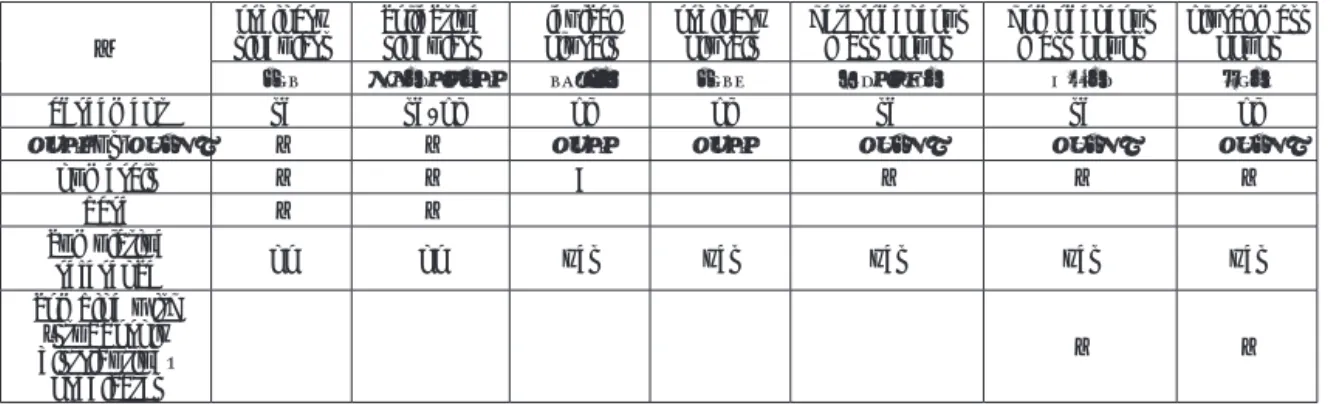
 Morpho-syntactically, count nouns are defined in this research as those nouns that satisfy the following two conditions: i) to inflect for number to mark a singular-plural contrast and take both a singular and a plural verb that agree with the number of a subject NP (including those with identical singular and plural forms); ii) to occur in direct construction with the cardinal numerals.

Table 1 .Summary of the C/NC Distinction Classification Singular/Plural Contrast

Noun Type Examples

Count/

Noncount

Morphology Syntax Semantics Cardinal Numerals Inflection Subject-

Verb Agreement

Referential

Properties one two to infinity

C + + + + + Typical Count Nouns book, car, cat, pencil

C − + + + + Identical SG/PL Nouns sheep, barracks

C + + + + + Collective Nouns committee, crew, family

C/NC + / − + + / − + / − + / − Flexible Nouns rope, stone, difficulty

NC − − (PL) − − + Pluralia Tantum Ⅰ people

NC − − (PL) + − + Pluralia Tantum Ⅱ police, cattle

NC − − (PL) + − − (?) Pluralia Tantum Ⅲ oats, scissors, groceries

NC − − (SG) + − − Singularia Tantum Ⅰ rice, garbage

NC − − (SG) + − − Singularia Tantum Ⅱ advice, information

NC − − (SG) − − − Singularia Tantum Ⅲ courage, knowledge

NC − − (SG) + − − Object-Mass Nouns cutlery, equipment, furniture

NC − − (SG) − − − Substance Nouns water, mud, gold

(5)

Noncount nouns are defined as those that do not satisfy these two conditions. Table 1 lists twelve types of nouns that are identified as either count or noncount nouns according to our morpho- syntactic definition of the C/NC distinction. In the leftmost column, count nouns are marked as C, and noncount nouns are marked as NC. In the four columns under Singular/Plural Contrast, nouns that show a singular/plural contrast are marked ‘+’ while those that do not are marked ‘−’.

 Semantic coercion is not considered in Table 1.

7)

Huddleston (1984: 248) and Payne & Huddleston

(2002: 337), for example, accept the noncount use of book (e.g. The termite was living on a diet of book). In Table 1, book is included in Typical Count Nouns. There are at least four types of semantic coercion: ground-noun coercion, aka universal grinder (e.g. too many apples vs. too much apple), packaging coercion (e.g. too much beer vs. too many beers), individuation-by-cause coercion (e.g. too much anxiety vs. too many anxieties), and individuation-by-instance coercion (e.g. too much kindness vs. too many kindnesses) (Bale & Barner 2009: 227-228).

8)

The first two types of coercion apply to concrete nouns, and they are not considered in Table 1. The last two types apply to abstract nouns

(e.g. anxiety, kindness), and they are included in Flexible Nouns.

 Determiner-head combination restrictions are not listed except for cardinal numerals since disagreement is expected on the restrictions. Huddleston (1984: 245) says: “judgements concerning the acceptability of relevant determiner-head combinations are not always clear or constant from speaker to speaker.” Also, linguists do not always agree on the count-noncount classification. For example, Payne & Huddleston (2002: 345) classify police as a noncount noun whereas Gillon (1999:

53) classifies police as a count noun.

 Nouns such as advice and information (Singularia Tantum Ⅱ) are classified as semantically countable since they allow their referents to be counted with numeral classifiers (e.g. one piece of advice, two pieces of advice). On the other hand, nouns such as knowledge and courage (Singularia Tantum Ⅲ) are semantically noncount since they do not generally combine with numerals with or without classifiers.

9)

Five types of nouns have mismatches between semantics and syntax: Pluralia Tantum Ⅱ and Ⅲ , Singularia Tantum Ⅰ and Ⅱ , and Object-mass nouns.

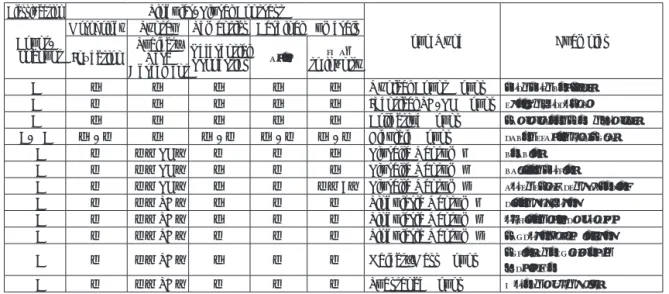
 In the following section, we will review morpho-syntactic restrictions that several linguists employ to distinguish count nouns from noncount nouns. Nouns can be classified into several levels of countability based on different criteria, and classification varies from linguist to linguist. Morpho- syntactically, Gillon (1999: 51) classifies nouns into two groups, mass nouns and count nouns, based on seven criteria (Table 2). The modification by much and less is the only criterion to positively identify noncount nouns. However, the C/NC distinction is not so simple. For example, neither knowledge nor police marks a singular/plural contrast, but knowledge admits a/an while police can combine with cardinal numerals (except one) and other quantifiers such as many and few.

Table 2 .Morpho-syntactic criteria for mass/count distinction

MORPHO-SYNTACTIC CRITERIA MASS NOUN COUNT NOUN

modified by cardinal numerals - +

modified by quasi-cardinal numerals (e.g. several) - +

modified by indefinite article - +

modified by many and few - +

modified by much and less + -

SG/PL contrast - +

one antecedent - +

(6)

 To avoid the binary opposition between count and noncount nouns, efforts have been made to classify nouns in terms of the degrees of countability, using different syntactic restrictions as criteria, especially determiner-head combination restrictions. Huddleston (1984: 245) and Downing & Locke

(2002: 422-424) classify nouns into six levels, Lasersohn (2011: 1135), seven types, Allan (1980), eight levels, and Wierzbicka (1988: 555-560), fourteen types. Classification depends on how much in detail each linguist intends to describe the syntactic behavior of nouns, i.e. how many restrictions they provide to distinguish the syntactic behavior of one group of nouns from that of another.

The problem is that the more restrictions they use, the more likely they face disagreement on the restrictions. The syntactic behavior of nouns, especially in terms of determiner-head combination restrictions, is extremely complex, and it is practically impossible to provide an exhaustive list of syntactic restrictions that distinguish one group of nouns from another in terms of countability.

 Huddleston’s classification (Table 3) is based on the following four groups of co-occurrence restrictions between determiners and nouns (i-iv). Nouns are identified as count nouns when they satisfy all four criteria (V), and all the other nouns are noncount with varying degrees of countability

(I-IV). The syntactic feature of subject-verb agreement is not considered, and equipment (a singulare tantum) and outskirts (a plurale tantum) are placed in the same group (Ⅰ).

 i the cardinal numerals one, two, three, etc.

 ii other numerically quantifying expressions such as both, a dozen, etc.

 iii the ‘fuzzy’ quantifiers many, several, few.

 iv a, another, each, every, either, neither, which take singular heads.

Table 3 .Determiner-head combinations

  Degree Examples Determiners permitted from list (i-iv)

Uncountable

I equipment, outskirts None II (α) knowledge, phonetics a

(β) clothes, dregs many, few

III cattle many, few, and relatively large round numbers IV police, people (“persons”) All except those requiring a singular head

Fully countable V cake, dog All

Downing & Locke (2002: 420-428) divide nouns into six levels (A-F in Table 4) based on the following eight criteria of grammatical markers (i-viii). Their criteria are different from Huddleston’s.

For example, the criterion of cardinal numerals is missing in Downing & Locke. On the other hand, in Huddleston, zero determiner, the determiner all, noncount quantifiers (much, little, a little), and singular/plural contrast are missing.

 (a) Grammatical markers of mass nouns

  (i) The singular form of the noun with zero determiner: e.g. beauty, coffee.

  (ii) The singular form of the noun preceded by all: e.g. all sincerity.

  (iii) The singular form of the noun, quantified by much, little, a little: e.g. much room, little

furniture.

(7)

 (b) Grammatical markers of count nouns

  (iv) The singular form of the noun determined by a(n): e.g. a new job.

  (v) The singular form of the noun determined by each, every: e.g. each day, every year.

  (vi) With number contrast marked on the noun: e.g. lion/lions; child/children.

  (vii) Invariable or plural form of the noun preceded by a plural determiner: e.g. many choices;

those sheep.

  (viii) Plural number concord with verb or pronoun: e.g. People like to be happy, don’t they?

Table 4 .Distribution of countability markers of English nouns (Downing & Locke 2002: 423)

Type

MASS COUNT

1 2 3 4 5 6 7 8

+ 0 N.SG

all + N.SG

much, little N.SG +

a

( n)

N.SG +

each, every, either N.SG +

Number contrast on noun

many,

( a) few N.PL +

Number concord with verb,

pronoun.

A FULLY MASS (some with a(n)) + + + (+)

drinking; luck, advice; furniture B FULLY MASS

(some with a(n) or pluralised) + + + (+) (+)

rain; happiness; help; education

C FULLY MASS, FULLY COUNT cake; building; truth; kindness, love + + + + + + + + D Never mass, Partially count people, police, (the)Alps, goods; scissors + +

E FULLY COUNT, Never mass

(except number contrast on noun) + + + +

sheep, aircraft; barracks, means

F FULLY COUNT, Rarely mass car; deed, fault; way, look (+) (+) (+) + + + + + NOTE: The plus sign ‘+’ indicates that most nouns in the set admit the given mass or count marker, and the

bracketed sign ‘(+)’ indicates that some do not admit it.

Lasersohn (2011: 1135) adds ‘cumulative reference’ and ‘stubbornly distributive predicates’ as

criteria

10)

in addition to determiner-head combination restrictions and subject-verb agreement, and

he classifies nouns into seven types (Table 5). The following criteria are missing: singular/plural

contrast, the determiner all, the indefinite article a/an, distributive determiners (e.g. another, each,

every, either, neither).

(8)

Table 5 .Summary of patterns distinguishing subclasses of singular, plural and mass nouns

  ordinary

singulars collective

singulars lexical

plurals ordinary

plurals heterogeneous

mass nouns homogeneous

mass nouns plural mass nouns

cup government police cups furniture water dues

agreement sg sg/pl pl pl sg sg pl

many vs much * * many many much much much

numerals * * ?  * * *

bare * *     

cumulative

reference no no yes yes yes yes yes

combine with

“stubbornly distributive”

predicates

     * *

 Allan (1980: 562) classifies nouns into eight levels (Table 6), based on five criteria (or NP environments): EX-PL (subject-verb and pronoun-antecedent agreement), A + N (a ( n ) , one + singular noun), All + N (all + singular noun), F + Ns (fuzzy denumerators + plural noun: ( a ) few, several, many, about fifty, etc.), and O-DEN (other denumerators: e.g. each, every, either, both, natural numbers from one to infinity). The following criteria are missing: zero determiner, singular/plural contrast.

Table 6 .Countability Preferences NOUN

ENVIRONMENT car oak cattle Himalayas scissors mankind admiration equipment

EX-PL + + + + + +

A + N + + + + +

All + N + + + +

F + N + + + ?

O-DEN + +

(+ indicates that the given NP environment defines the head noun as countable)

(In the All + N Test, it is FAILURE that gets a plus, not success.)

 Different linguists employ different criteria to classify nouns into several groups in terms of the degrees of countability. Allan’s list, for example, has a class for nouns that are fully noncount (e.g.

equipment) which does not admit a/an, but Downing & Locke’s list does not. On the other hand, Allan does not list the Type B nouns of Downing & Locke, which are fully NC but may admit pluralization as well as a/an. Also missing in Allan’s list are Type C nouns, which are fully C and fully NC. There are also some disagreements among linguists. Allan claims that scissors is not clearly grammatical in the F+Ns environment ( ( a ) few, several, many, etc.), whereas Downing & Locke claim that scissors (Type D) admit such plural determiners as many and a few. Another example of disagreement is on the countability of (the) Alps (Type D) and Himalayas. Downing & Locke claim that (the) Alps admits many and a few but not a/an, whereas Allan claims that Himalayas admits a/an but not many, a few and other fuzzy denumerators.

 The morpho-syntactic distinction of nouns in terms of the degrees of countability varies from linguist to linguist. The differences in their classifications are not caused by morphological criteria

(i.e. inflection for singular-plural contrast) or subject-verb agreement, but by determiner-head

combination restrictions, i.e. whether a noun combines with certain determiners such as many, few,

(9)

much, little, low numerals, high round numerals, etc., on which disagreement is expected. To avoid expected disagreement on determiner-head combination restrictions, we define count and noncount nouns in terms of inflection for singular-plural contrast and subject-verb agreement. We add the criterion of cardinal numerals in order to make it clear that a referent can be counted with numerals from one to infinity. Our definition is cited here again: Count nouns are defined morpho-syntactically as those nouns that satisfy the following two conditions: i) to inflect for number to mark a singular- plural contrast and take both a singular and a plural verb that agree with the number of a subject NP (including those with identical singular and plural forms); ii) to occur in direct construction with the cardinal numerals. Noncount nouns are defined as those that do not satisfy these two conditions.

 It is true that the binary opposition between count and noncount nouns is characteristic not of the nouns, but of the NP’s which they head (Allan 1980), but the binary opposition, not degrees of countability, is expected when discussing the mismatches between count-noncount syntax and semantics. For example, when we say, “In English, many mass nouns (like furniture and equipment)

denote individuals” (Bale & Barner 2012: 239), “mass nouns” means noncount nouns as opposed to count nouns (i.e. binary opposition); it does not mean noncount nouns of varying degrees of countability. Also, from a pedagogical point of view, the binary opposition is preferred. L2 learners of English need to know, first and foremost, whether a particular noun allows only a count use or a noncount use or both because it is essential that they know if a noun takes a zero determiner singular form (øN), an indefinite article singular form (aN) or a zero determiner plural form (øNs). It sounds very strange when we hear ungrammatical forms such as *I have dog, *I have an information, or *I have informations. Knowledge of some basic quantifiers (e.g. many vs. much, few vs. little) may be important, but detailed information on determiner-head combination restrictions is not essential: e.g.

some nouns combine with high round numerals but not with low numerals (e.g. livestock, poultry).

2.2. Semantic accounts for the C/NC distinction

 It is generally agreed that count/noncount syntax is related to referential properties of nouns.

Taylor (2002: 367) says: “The conceptual basis of the count-mass distinction is fairly transparent; it has to do with the distinction between an individuated ‘object’ and an unindividuated ‘substance’.”

Semantically, count nouns denote individuated entities that can be counted (e.g. car, cat), while noncount nouns denote undifferentiated substances (e.g. water, meat) or heterogeneous aggregates

(e.g. furniture, cutlery). Homogeneity of substances and heterogeneity of aggregates prevent counting.

 A prototypical count noun denotes an atomic entity, i.e. a bounded, individuated entity with internal structure, which cannot be divided into smaller parts of the same kind (Taylor 2002: 367, Croft & Cruse 2004: 64). A cat, for example, is internally structured with its legs, head, tail and body linked with one another to constitute a connected whole (Nicolas 2004: 126). “An individuated object has its own internal structure and composition—split it up and it loses its identity. Dismantle a car and you have car parts, not a car any more” (Taylor 2002: 367).

11)

On the other hand, a prototypical noncount noun denotes a physical substance, which is not atomic, or atomless (i.e. internally homogenous) and can be divided arbitrarily into parts without losing their qualitative identity (e.g.

water, meat). It does not have parts linked with one another in a specific fashion, although substances

(10)

may be heterogenous with internal structure at the molecular level, e.g. H

2

O molecules (Pelletier 2012: 16). Meat is also atomless; “if you divide up a quantity of meat you still have meat, and if you put two quantities of meat together you have, again, meat” (Taylor 2002: 367).

 In the world with only prototypical count and noncount nouns, a noun’s semantic, syntactic and morphological properties are aligned (Corbett 2019: 95). There are, however, many nouns whose syntax does not reflect their semantics. Table 7 (Corbett 2000: 172) shows a basic singular-plural system. Corbett classifies nouns into four levels to show the possible combinations of singular/plural contrast in semantics (i.e. referential properties), syntax (i.e. noun-verb agreement) and morphology

(i.e. inflection for singular-plural contrast). Dog and friendliness have no mismatch between semantics, syntax and morphology. Dog marks a singular/plural contrast in all three domains while friendliness marks a contrast in none of them. Sheep is semantically countable, and it marks a singular/plural contrast syntactically but not morphologically. Scissors is semantically countable, but syntactically plural, and it does not mark a singular/plural contrast morphologically.

Table 7 .Different indicators of number-differentiability (Corbett 2000: 172)

Different indicators of number-differentiability

  dog sheep scissors friendliness

semantics + + + -

syntax + + - -

morphology + - - -

 In Table 1 (cited here again), there are at least six types of nouns whose morpho-syntax does not reflect their semantics: 1) Nouns with identical singular and plural forms (e.g. sheep), 2) Pluralia Tantum Ⅱ (e.g. police), 3) Pluralia Tantum Ⅲ (e.g. scissors), 4) Singularia Tantum Ⅰ (e.g. rice), 5) Singularia Tantum Ⅱ (e.g. advice), and 6) Object-Mass Nouns (e.g. furniture). The dog type, the sheep type, and the friendliness type in Table 7 correspond to Typical Count Nouns, Identical SG/PL Nouns, and Singularia Tantum Ⅲ respectively in Table 1.

Table 1 .Summary of the C/NC Distinction Classification Singular/Plural Contrast

Noun Type Examples

Count/

Noncount

Morphology Syntax Semantics Cardinal Numerals Inflection Subject-

Verb Agreement

Referential

Properties one two to infinity

C + + + + + Typical Count Nouns car, cat, pencil

C − + + + + Identical SG/PL Nouns sheep, barracks

C + + + + + Collective Nouns committee, crew, family

C/NC + / − + + / − + / − + / − Flexible Nouns rope, stone, difficulty

NC − − (PL) − − + Pluralia Tantum Ⅰ people

NC − − (PL) + − + Pluralia Tantum Ⅱ police, cattle

NC − − (PL) + − − (?) Pluralia Tantum Ⅲ oats, scissors, groceries

NC − − (SG) + − − Singularia Tantum Ⅰ rice, garbage

NC − − (SG) + − − Singularia Tantum Ⅱ advice, information

NC − − (SG) − − − Singularia Tantum Ⅲ courage, knowledge

NC − − (SG) + − − Object-Mass Nouns cutlery, equipment,

furniture

NC − − (SG) − − − Substance Nouns water, mud, gold

(11)

 For example, oats and scissors (Pluralia Tantum Ⅲ) are syntactically plural. However, semantically they show a singular-plural contrast: they denote individual entities, although they need classifiers to count (e.g. one grain of oats, two pairs of scissors). In the same way, police (Pluralia Tantum Ⅱ)

is syntactically plural, but semantically they show a singular-plural contrast, denoting individual entities. Police can denote one police officer as in (1-2).

 1) The police came to the scene. When they arrived, there was only one police officer at first.

Then, two additional officers came later. (Bernice Rathe by Bea Giovanni)

 2) “You should know that I was almost apprehended yesterday. The police came to my door.”

“They are supposed to check on you periodically,” said Adnan. “That is normal.” “It is usually only one police officer,” said the man. “This time it was two with one of them having a weapon drawn.” (The Migrants by Richard M. Bridges)

Perceptually (i.e. in terms of perceptual characteristics of referential properties of a noun) similar entities may be designated by either count or noncount nouns (e.g. lentils vs. rice), and the same entity can be designated by either a count or a noncount noun (e.g. Remove your shoes vs. footwear)

or by a count or a noncount use of the same noun (e.g. some ropes vs. some rope). Object-mass nouns such as furniture and silverware are syntactically singular, but they denote countable entities. Nicolas

(2004: 134) says as follows:

   As remarked by Gillon (personal communication), furniture and silverware can also be counted.

The linguistics department chair could ask someone to count the furniture in the main office.

This person could straightforwardly answer: ten chairs, five tables, and six lamps. Likewise, the chair’s wife may ask him to count the silverware that they have.

 Observing these mismatches between count-noncount syntax and semantics, some linguists argue that the C/NC distinction is arbitrary, unprincipled, or idiosyncratic (Bloomfield 1933: 266, Gleason 1955: 144-145, 1965: 135, McCawley 1975, Markman 1985, Palmer 1938: vi, 1971: 34-35, Ware 1975:

387, Whorf 1956: 141-142). Palmer (1938: vi) says: “There are many cases in which the noun stands for things countable or uncountable often according to the sense in which it is used, but often quite arbitrarily.” Other linguists argue that grammatical forms are semantically motivated (Bloom 1996, Langacker 1987a, 1987b, 1991a, 1991b, 2008, Soja et al. 1991, Wierzbicka 1988, Wisniewski et al. 1996, Wisniewski et al. 2003, Wisniewski 2010). Wierzbicka (1988: 528) says: “while they [grammatical forms] are not necessarily correlated with any ‘real world attributes’, they ARE correlated with different conceptualizations.”

 Linguists have been trying to identify referential properties that are to be shared by all count nouns or all noncount nouns, and no one seems to have been successful. Various criteria have been proposed to account for the C/NC distinction: e.g. atomicity (Gillon 1999: 54, Chierchia 1998: 54, Rothstein 2010), cumulativity (Quine 1960: 91), divisity (Cheng 1973: 286-288), arbitrary divisibility

(Wierzbicka 1988: 506-508), internal homogeneity, which includes divisibility, replicability and

inherent boundedness (Taylor 2002: 367), boundedness, homogeneity, expansibility/contractibility

(12)

and replicability (Langacker 1991a: 69-70), contiguity and functional unity (Wierzbicka 1988: 543, Wisniewski et al. 1996: 297, Lee 2001: 142, Payne & Huddleston 2002: 336, Barner & Snedeker 2005:

63). Some theorists put cumulativity and divisiveness (i.e. divisity and arbitrary divisibility) together under the name of homogeneity (Pelletier 2012: 12).

 A perceptual distinction between count and noncount nouns is clear when a count noun denotes prototypical objects, which are discrete, bounded entities (e.g. car, cat) and when a noncount noun denotes a prototypical substance, which are continuous, unbounded, and arbitrarily divisible entities

(e.g. mud, water). Perceptual affordance influences the C/NC distinction. Imai & Masuda (2013: 20)

argue on the object-substance categorization as follows:

   When the perceptual affordance of a given entity strongly suggested the entity’s individuation status, then there was little room for language to affect people’s default construal for that entity

(cf. Gentner, 1982). When the perceptual affordance of the entity was weak and ambiguous, language influenced the construal, pushing the boundary between object kinds and substance kinds one way or the other (cf. Gentner & Boroditsky, 2001; Malt, 1995; Medin, Lynch, Coley, &

Atran, 1997).

 Count and noncount nouns denote diverse things, and there are mismatches between count- noncount syntax and semantics. Some count nouns denote perceptually uncountable entities (e.g. tear, cloud) while some noncount nouns denote perceptually countable entities (e.g. toast, bacon, furniture).

The grammatical behavior of these nouns suggest that the C/NC distinction cannot be fully defined in terms of referential properties (e.g. atomicity, individuability, boundedness, arbitrary divisibility, internal homogeneity, etc.). In the following section, we will see how the proposed semantic criteria for the C/NC distinction work or do not work.

2.2.1. Referential properties: atomicity, individuability and boundedness

 Atomicity, inherent individuability and inherent boundedness are proposed to identify count nouns

(or count use of nouns). However, these criteria do not account for the count status of nouns that denote entities which are perceptually hard to count (e.g. tear, mountain, ripple) and the noncount status of nouns that denote perceptually countable entities (e.g. aspirin, toast, bacon). Tear is a liquid, and it is hard to count the number of tears, although it may be possible to count the number of teardrops. The Bank of English finds only two cardinal numerals that occur with tear(s), one and two: e.g. one tear trickled down my cheek; Two tears rolled down her cheeks. Tear, when combining with numerals, refers not to teardrops but to streams of tears sliding down the cheeks from each eye, which makes the maximum number two. Mountains and ripples are hard to count as well.

Usually more than one mountain makes a row of mountains. You may be able to count the number of mountain peaks, but it is hard to count the number of mountains. Ripples are moving too quickly to count.

 On the other hand, toast, bacon and aspirin clearly denote individual countable entities, but they are morpho-syntactically noncount, requiring a classifier to be counted: e.g. a piece of toast and a slice/

rasher of bacon (Ware 1975: 390-391, Wisniewski et al. 2003: 610). In the same way, atomicity and

(13)

other criteria do not sufficiently account for the C/NC distinction of nouns that refer to perceptually similar entities (e.g. rice vs. lentils, spaghetti vs. noodles, gravel vs. pebbles, sweat vs. tears) and nouns that refer to the same collection of entities (e.g. foliage vs. leaves, clothing vs. clothes/garments, kitchenware vs. kitchen utensils).

2.2.2. Referential properties: cumulativity, divisity, arbitrary divisibility, internal homogeneity

 Cumulativity, divisity, arbitrary divisibility and internal homogeneity are proposed to identify noncount nouns (or noncount use of nouns). However, these criteria do not account for the grammatical behavior of homogeneous count nouns (e.g. fence, line) and mass-count flexible nouns

(e.g. cloud, rope). Cumulativity, which indicates that any sum of parts which are X (e.g. water) is X (Quine 1960: 91), does not distinguish count nouns from noncount nouns since it applies to plural count nouns as well: e.g. “if the animals in this camp are horses and the animals in that camp are horses, then the animals in the two camps are horses” (Link 1983: 128).

 Divisity, arbitrary divisibility, and internal homogeneity indicate that a portion of X (e.g. water)

divided in two is still X, whereas a cat divided in two is neither two cats nor one (Barner & Snedeker 2005: 45). These criteria do not account for the count use of nouns that denote homogeneous entities:

e.g. homogeneous count nouns (e.g. fence, line, twig, wall), mass-count flexible nouns with both a count and a noncount use (e.g. cord, cloud, forest, rope, sky, steak, stone, rock) (Nicolas 2004: 128). For example, two adjoining fences can make one fence (Rothstein 2017: 97), and the minimal part (i.e.

atom) of a line is unstable and context-dependent (Rothstein 2017: 98). In the same way, mass-count flexible nouns keep their count status when they refer to arbitrarily divided pieces. When a rope is cut into four pieces, you will have four ropes (Gillon 1999: 52). Cloud is a visible mass of particles of condensed vapor, and it is perceptually similar to puddles of water. Cloud should be a noncount noun in terms of its referential properties. However, it has a count use as well as a noncount use: e.g. the sun appeared from behind a black cloud; the sun disappeared behind black clouds, and it can combine with cardinal numerals as in No two clouds are alike.

2.2.3. Alternative construals

 The proposed criteria to account for the C/NC distinction in terms of referential properties

(atomicity, homogeneity, arbitrary divisibility, etc.) do not sufficiently distinguish count nouns from noncount nouns. The cognitive individuation hypothesis is proposed to offer a comprehensive account of the conceptual basis of the C/NC distinction, and it is expected to account for the mismatches between syntax and semantics. It assumes that there is a systematic relationship between count/

noncount syntax and how people conceptualize entities in the world. A central aspect of the cognitive individuation hypothesis is the process of construal (Wisniewski et al. 2003: 588). It emphasizes the role of the human or cognitive agent: i.e. how we interact with things, our focus of attention, etc.

influence our interpretation of the perceptual input, which motivates us to refer to an entity with a count or a noncount noun (Bloom 1996, Langacker 1987a, 1987b, 1991a, 1991b, 2008, Soja et al. 1991, Wierzbicka 1988, Wisniewski et al. 1996, Wisniewski et al. 2003, Wisniewski 2010).

 The typical example is object-mass nouns such as furniture and cutlery, which are syntactically

noncount but semantically count.

12)

Furniture and cutlery have perceptually countable individuals in

(14)

their denotations (Barner & Snedeker 2005: 45, Bale & Barner 2012: 246, Pelletier 2012: 15). Furniture, for example, refers to a collection of movable articles, and it is atomic (i.e. inherently individuated).

13)

Two pieces of furniture does not refer to pieces, but to two minimal instances of furniture (i.e.

atoms) such as a table and a chair (Wiese 2012: 58). Arbitrarily divided furniture (e.g. half a chair, a table leg) is not furniture (Chierchia 1998: 68, Gillon et al. 1999: 206, Payne & Huddleston 2002: 336, Middleton et al. 2004: 372, Barner & Snedeker 2005: 45, Murphy 2010: 159). On the basis of referential properties, furniture should be a count noun (Gordon 1985: 211). However, furniture never allows a count use, and it cannot be used in such forms as *a furniture or *furnitures regardless of the perceptual characteristics of the referent. This applies to cutlery and other object-mass nouns as well.

 The noncount status of furniture and cutlery is explained in terms of our ways of interacting with things. For example, we use a collection of eating utensils (e.g. knives, forks, spoons) for a particular purpose (i.e. for eating) in one place at one time. The unitary function (i.e. being united by a common purpose) and the spatio-temporal contiguity make cutlery noncount (Wierzbicka 1988: 513, Wisniewski et al. 1996: 297, Lee 2001: 142, Payne & Huddleston 2002: 336, Barner & Snedeker 2005:

63). Furniture and cutlery are noncount because they are construed as a unitary entity with a single function. Lee (2001: 141) explains as follows:

   The motivation for their [cutlery, furniture, crockery, etc.] assimilation to the mass category has to do with the level at which the concept applies. A set of knives, forks, and spoons can either be construed as a collection of separate objects performing different functions (cutting food, picking up food, stirring liquids) or as a collection of objects which manifest themselves contiguously and which all perform the same function (facilitating the consumption of food). At this level, any part of the phenomenon counts as equivalent to any other part. Similarly, a collection of chairs, tables, and cupboards is subject to alternative construals. We can think of them either as a group of separate objects or as a unitary entity with a single function—that is, as ‘furniture’.

 Functional unity and contiguity, however, do not necessarily lead to a noncount interpretation of a collection of individual entities. For example, toy is a superordinate count noun like animal and vehicle, which refers to objects of different kinds that provide amusement (e.g. dolls, toy cars, toy blocks, video game devices, etc.), usually placed in a limited space. However, a collection of toys is not construed as a unitary entity with a single function. Another example is a golf set with clubs of different kinds (e.g. drivers, woods, irons, putters, etc.), which are usually placed in a golf bag, thus satisfying contiguity, and are used for playing golf, thus satisfying a unitary function. A set of golf clubs are very similar to cutlery in that both refer to a collection of items used for a particular purpose. However, a set of golf clubs is not construed as a unitary entity whereas a collection of eating utensils is. If grammatical behavior is semantically motivated, a set of golf clubs should allow a noncount construal.

 Functional unity and contiguity may be conceptual bases of the C/NC distinction, but they do not

seem to have predictive power. It is argued that the same set of entities (e.g. hammers, screwdrivers,

drills, etc.) can be designated by a noncount noun (e.g. equipment) or a count noun (e.g. tool)

(15)

depending on how the set is construed, i.e. whether foregrounding the unitary nature or the diverse nature (Lee 2001: 141). The question remains to be answered: what causes some nouns to accept a noncount construal (e.g. equipment, kitchenware, footwear) and other nouns to resist (e.g. tools, kitchen utensils, shoes).

2.2.4. Communicative function

 There are some nouns whose count or noncount status can be explained by neither referential properties nor alternative construals (or conceptualization). Their mismatches between count- noncount syntax and semantics are explained in terms of communicative function of language, which postulates that speakers flexibly construe the referents of nouns as individuated or nonindividuated entities depending on what aspect of an entity speakers find important to communicate (Wisniewski 2010). Mashed potatoes and scrambled eggs, for example, denote substances, and they are uncountable both perceptually and conceptually. They are, however, usually used in the plural form in American English, although they do not denote multiple entities. Wisniewski (2010: 186) argues that mashed potatoes, scrambled eggs, chopped radishes and other items of food that transform the original entities in their cooking process (e.g. eggs to make scrambled eggs) are used in the plural form because the information about the origin of the substance and the process that produced the substance is more important than the information about the perceptual characteristics (i.e. unindividuated substance).

The plural form is chosen to communicate a message that the transformation (mashing, scrambling, etc.) is applied not to a substance but to multiple individuals (i.e. potatoes, eggs, etc.).

 Another example is pine needle, which is perceptually countable but conceptually noncount

(Wisniewski et al. 2003, Wisniewski 2010). Needles and pine needles are perceptually similar, and both are count nouns. However, they are conceptually different. We interact with needles one at a time, which motivates us to use needle as a count noun. On the other hand, we see multiple entities of pine needles on the ground (or on a pine tree) in very close proximity (i.e. contiguous), and we interact with multiple pine needles at a time. These characteristics of pine needles are similar to those of cutlery (and other object-mass nouns), which is construed as a unitary entity with a single function. Conceptually, pine needle should be noncount. However, the count syntax of needle is retained because the resemblance to needles is more important than the information that pine needles are construed as aggregates consisting of nonindividuated entities. As a result, the count syntax of needle is retained.

 Communicative function may not account for mismatches between count-noncount syntax and semantics. For example, both mail and e-mail have a meaning of e-mail messages, which are perceptually countable. However, mail is noncount, denoting e-mail messages collectively, whereas e-mail has both a count and a noncount use, denoting e-mail messages individually or collectively.

Checking five learner’s dictionaries (see the reference section) indicates that e-mail used to be a noncount noun until around the mid 1990s. LDOCE 3rd Edition (1995) defines it as “[uncountable]

a system that allows people to send messages to each other by computer.” Its 4th edition (2003)

adds a second meaning: “[uncountable and countable] a message that is sent from one person to

another using the email system.” OALD 7th Edition (2005), CALD 2nd Edition (2005) and other

dictionaries follow LDOCE. E-mail has gained both a count and a noncount use to denote e-mail

(16)

messages individually or collectively whereas mail in the sense of e-mail is still noncount. If the case of pine needle applies to e-mail, e-mail should retain the original noncount use of mail whether it is conceptually count or noncount.

 Bathroom scale(s) is another example. Scales takes the plural form, reflecting the bipartite structure of scales. A bathroom weighing device, however, does not have a bipartite structure. It is a device with a unitary structure and is perceptually countable. It is conceptually countable as well since we interact with a device one at a time. These characteristics of bathroom scales cause a mismatch between the grammatical form (i.e. plural form) and the referential properties (a unitary device).

14)

To redress this mismatch, American English has opted for a change in grammatical form, from the plural scales to the singular scale, to reflect a perceptually proper construal of the device with a unitary structure. Semantics (i.e. perception of referential properties) has caused a change in syntax. On the other hand, British English has opted for a change in conceptualization to retain the original plural form, construing the device as an object with a multiple structure. Wierzbicka (1996:

388) once asked a number of children and teenagers in Australia why they thought the device was called scales rather than scale. To her surprise, they all came up with the same answer: it is because of all the little numbers they see on the device. In British English, syntax has caused a change in semantics (i.e. conceptualization). In other words, semantics is motivated by syntax. If grammatical form is semantically motivated, digital alarm clock should take the plural form since it is perceptually and conceptually similar to a bathroom weighing device with little numbers displayed on it.

 The communicative function does not account for the plural status of bathroom scales. It is doubtful that British English speakers use the plural form because they want to communicate a message that a bathroom weighing device has a multiple structure. Imagine a device that announces your weight without displaying numbers visually. It is not hard to speculate that British English speakers still call the device as bathroom scales in the plural form. It is simply a case that the grammatical convention of the original word (i.e. scales) is retained.

 It is difficult to maintain that a communicative purpose is involved when the C/NC distinction cannot be explained in terms of referential properties or alternative construals. Toast, for example, is a noncount noun, but it clearly refers to an individual entity, which is perceptually and conceptually countable. We interact with toast one at a time, and English speakers do not construe toast as an unindividuated substance but as a singular individual (Wisniewski et al. 2003: 610, Wisniewski 2010:

185). This may apply to bacon, but in the case of bacon, it could be argued that bacon has retained

the syntax that reflects the perceptual characteristics of its original referent (i.e. cured meat from

the back or sides of a pig) (Wisniewski 2010: 185). This way of reasoning, however, does not apply

to toast in that it used to be a count noun as in He had stopped taking cereals after the age of sixty but

after 85 he had to re-start on medical advice taking two toasts or some cornflakes (1978, cited from

The Oxford English Dictionary). Somehow, the current usage does not allow toast to be used as a

count noun although it is perceptually and conceptually countable. Again, it could be argued that

toast is noncount because it reflects how its original referent (i.e. bread) is conceptualized. However,

toast and bread are different nouns, and it is hard to support this argument.

(17)

2.2.5. Grammatical convention

 In the discussion of the C/NC distinction of concrete nouns, it is generally agreed that count/

noncount syntax is related to referential properties of nouns, and there is a tendency to use count-noun syntax to refer to an individuated entity and noncount-noun syntax to refer to a nonindividuated entity. However, there are many nouns whose count or noncount status cannot be explained in terms of referential properties: e.g. object-mass nouns, mass-count flexible nouns, homogeneous count nouns, etc., not to mention abstract nouns. When there is a mismatch between the grammatical behavior of a noun and its referential properties, the mismatch is explained in terms of alternative construals (or conceptualization). When the mismatch cannot be explained in terms of alternative construals, the mismatch is explained in terms of communicative function of language.

There are still some nouns whose grammatical behavior cannot be explained semantically (e.g. toast).

These observations suggest that the C/NC distinction is a grammatical and not an ontological or a conceptual distinction (Rothstein 2010: 361), and that the distinction is essentially, but not exclusively syntactic (Gordon 1985: 227). This is supported by the experiments conducted by developmental psychologists.

 Psychologists (Gordon 1985, Gentner & Boroditsky 2001, Barner & Snedeker 2006) cast doubt on the claim that children’s acquisition of the C/NC distinction is based on an object/substance distinction. A lot of research has been done by psychologists to determine whether the C/NC distinction is rooted in prelinguistic knowledge, or syntax provides the foundations for the conceptual development of the distinction (Wynn 1992, Spelke 1994, Imai & Gentner 1997, Hauser 2000, Wynn et al. 2002). Their studies deny the Quinian view of empiricism (Quine 1960) and indicate that the object/substance distinction and the concept of individuation are prelinguistic. On the other hand, children do not have a clear semantic categorization of mass nouns prelinguistically, and they acquire it as they grow older with more linguistic experience and syntactic information (Gordon 1985, Soja et al. 1991, Bloom & Kelemen 1995, Yoshida & Smith 2005, Kouider et al. 2006, Barner & Snedeker 2006). Children become sensitive to the count/mass and singular/plural distinction at the age of two and become able to extend the semantic categorization of mass nouns to novel words at around five.

Children acquire the semantic categorization of mass nouns through syntactic information, but not through semantic analysis. Gordon (1985) says that syntactic cues are clearly the most effective and predominate over semantic cues as a basis for the C/NC distinction. Grammatical convention takes precedence over perception of referential properties for mass nouns (i.e. concrete noncount nouns).

2.3. Abstract nouns and boundedness

 Concrete nouns are conceptualized in physical space whereas abstract nouns are generally conceptualized in other spaces, such as quality space and temporal space (e.g. love, difficulty, experience, etc.).

15)

None of the criteria proposed to account for the C/NC distinction of concrete nouns applies to abstract nouns. Abstract nouns provide no perceptual information about their referential properties since they are not conceptualized in physical space. Criteria such as atomicity and internal homogeneity are not applicable.

 Alternative construals may or may not work for abstract nouns. They work for abstract nouns

that have both a count and a noncount use (e.g. many difficulties vs. much difficulty, many experiences

(18)

vs. much experience). Those nouns are like mass-count flexible nouns (e.g. rope, stone), and the same referent can be referred to as count or noncount depending on whether it is construed as countable or uncountable as in (3-4).

 3) Andrew Walshe ’02, from Herndon, VA, spent a year at the London School of Economics. “…, but it was a good experience.” […] On all, it was good experience and a good time. …”

     (http://blogs.hsc.edu/international/category/other-experiences/page/2/)

 4) As is well known, after decades of writing impersonal science fiction Ballard wrote Empire of the Sun (1984), a novel dealing with his childhood experiences in a Japanese prisoner-of-war camp. The most inscrutable of novelists, Ballard confides that he cannot explain why it took him 40 years to come to terms with this primal experience. (Wordbanks Online)

In (3), both a good experience and ø good experience refer to the same spatio-temporally bounded event (a year at the London School of Economics) in the singular form with a/an and with ø respectively. In the same way, his childhood experiences and this primal experience in (4) refer to the same experience in the plural and in the singular form respectively. These examples show that nouns that have both a count and a noncount use can be used as a count or a noncount noun depending on how their referents are construed, either as countable or uncountable entities. An alternative construal (a countable interpretation or an uncountable interpretation) causes a change in syntax, e.g. from count (a good experience) to noncount (ø good experience). On the other hand, alternative construals do not work for those abstract nouns that have only a noncount use. They do not allow a change in syntax (i.e. from noncount syntax to count syntax) when their referents are construed as countable entities. Advice, for example, can be construed as countable entities as in one final advice, but it never allows the count syntax.

 Advice is a typical noncount noun in the current usage with the meaning of an opinion or a suggestion.

16)

However, it combines with a numeral one as in (5) and ordinal numerals such as first and second as in ( 6- 7), which indicates that advice is construed as individual countable entities.

Also, advice used to be a count noun, reflecting its construal, which is similar to the case of toast. A quick look at The Corpus of Historical American English (with more than 400 million words of text from the 1810s to 2000s) shows that advice used to admit a/an and pluralization until around the 1950s (8-9). The Oxford English Dictionary also has an example of advices in the plural form (10).

At a certain point in history, advice shifted from a count noun to a noncount noun even though it has always retained the denotation of an individual opinion or suggestion. Alternative construals do not account for the noncount status of advice since it is noncount whether its referent is construed as countable or uncountable. Communicative function fails to account for the noncount status of advice as well, since it does not make sense to communicate a message that speakers construe advice as noncount while they allow it to combine with ordinal numerals.

 5) Since time is running out, would you like to give one final advice to all of us about how we can keep our marriages alive? (Hello! Just Married Or About To Marry? by P. Bhalla. 2004)

 6) My first advice to him was to get the best possible staff he could possibly find. (BOE)

(19)

 7) This prompted me to ask the trivial question: “What would be your advice today for a young woman who would like to do science and have a family too?” Mildred responded: “The first thing I would suggest is, marry the right man. That’s the most important thing. You have to have a husband who is fully supportive. That he does more than paying lip service to equality.

My husband was really a feminist. He liked women and respected them. My second advice is that whatever decision they make they shouldn’t feel guilty.”

      (Women Scientists: Reflections, Challenges, and Breaking Boundaries by Magdolna Hargittai. 2015)

 8) If you had taken an advice from me, it would have been to buy that suit.

     (The Big-Town Round-Up by William MacLeod Raine. 1920)

 9) I knew you were leaving. My brother told me he had given advices to you to go without delay.

     (Below the Salt by Thomas B. Costain. 1957)

 10) To read with attention, exactly to define the expressions of our author, never to admit a conclusion without comprehending its reason, often to pause, reflect, and interrogate ourselves;

these are so many advices which it is easy to give, but difficult to follow. (The Miscellaneous Works of Edward Gibbon, Esq. by Edward Gibbon. 1761)

 Among various criteria proposed to account for the C/NC distinction of concrete nouns, bounding

(or boundedness) is perhaps the only criterion that may apply to abstract nouns. Cognitive linguists argue that the C/NC distinction depends on whether a referent is construed as being bounded

(Langacker 1991a, 2008, Talmy 2000, Radden & Dirven 2007, Lee 2001, Croft & Cruse 2004), and that it applies to abstract nouns (Langacker 1987b: 207). It is generally agreed that an abstract noun is used as a count noun when its referent is construed as bounded in temporal, quality or some other spaces. For example, abstract nouns that describe episodic events are count nouns (e.g. jump, walk), while those that do not describe a single episode of the process are noncount (e.g. jumping, walking)

(Langacker 1987b: 207). Radden & Dirven (2007: 81) argue that abstract nouns that describe episodic situations are construed as discrete episodes and are used as count nouns because they are thought of as holding for a limited time. Episodic situations include events that take place or come up (e.g.

attack, protest, objection) and certain states that can suddenly arise (e.g. disease, idea, doubt). On the other hand, abstract nouns that describe steady situations (e.g. knowledge), which are construed as lasting indefinitely, are mostly used as noncount nouns.

 It is somewhat misleading to argue that an abstract noun is used as a count noun when its referent is construed as bounded. It leads us to believe that a bounded entity (in temporal or other spaces) is designated by a count noun (or a count use of a noun) and that an unbounded entity is designated by a noncount noun (or a noncount use of a noun). In fact, it goes the other way around. It is count syntax that gives the meaning of boundedness. Boundedness does not force count syntax as shown by the following examples of silence (11-13).

 11) There was a silence for a moment, except for the faint scratching of the pen. (BOE)

 12) There was silence for a moment before the sound of a car starting. (BOE)

 13) There was absolute silence for a moment, a silence with no time and no feeling. I could hear the

(20)

world ticking inside my head — tick, tick, tick ... (The Road of the Dead by Kevin Brooks.

2006)

A silence in (11) and ø silence in (12) are both temporally bounded, continuing for a moment. In (13), both ø absolute silence and a silence refer to the same silence that continued for a moment, which is spatio-temporally bounded. At the same time, a silence is described as with no time, which suggests that the silence is temporally unbounded and should be designated by a noncount use. These examples of experience (3, 4), advice (5-10) and silence (11-13) show that temporal boundedness does not force count syntax. A temporally bounded event can be designated by a singular noun with a/an (aN), a plural count noun (øNs) or a zero determiner singular noun (øN). Grammatical form (i.e.

the count or noncount syntax) is not determined by bounding in objective reality.

 Every silence is experienced as temporally bounded in our daily lives. In this sense, silence is construed as an individual entity, and it should be a count noun. However, silence has both a count and a noncount use, and it allows all three forms (øN, aN and øNs) as in (14-16). When all three forms are available for a noun, the speaker chooses a particular form to represent his/her construal.

The noun allows alternative construals (i.e. a single individual entity, plural individual entities or an uncountable entity) to cause a change in syntax (i.e. aN, øNs, or øN). Silence may be conceptualized as bounded in physical space (17) as well as in temporal space (18) and can be used as a count noun.

When the quality of silence is foregrounded, the silence is construed as unbounded and is designated by a noncount use as in (14) (Hewson 1972: 90).

 14) Everyone stood in stunned silence. (Buffalo Man by Calvin C. Clawson. 2009)

 15) Everyone stood in a stunned silence. (Electos: Sophomore Year by Jonathan Smith. 2019)

 16) Everyone stood in stunned silences. (The Empress Angelina’ s Quest: A Beary Maxumus Adventure by Charles Nickerson and Irene Nickerson. 2015)

 17) Canine excrement, I have learned, is referred to only as “poop” by the dog people. I once made the mistake of using a more colorful term, and was met by stunned silences all around. But now that I’ve got the lingo straight, the other dog people and I talk every morning.

    (Howl: A Collection of the Best Contemporary Dog Wit by Bark Editors. 2007)

 18) They are not used to silences in conversation and don’t know how to manage them skilfully.

      (Critical Thinking Skills: Developing Effective Analysis and Argument, 2nd Edition by Stella Cottrell. 2011)

Ⅲ Summary and concluding remarks

 Count and noncount nouns are defined in two domains: morpho-syntax and semantics. The

morpho-syntactic distinction varies from linguist to linguist, and the semantic distinction has never

been sufficiently described. Morpho-syntactically, it is generally agreed that the binary opposition

between count and noncount nouns is characteristic not of the nouns, but of the NP’s which they

head (Allan 1980). Nouns are classified into several levels of countability depending on their

morpho-syntactic behavior: i.e. inflection for singular-plural contrast, subject-verb agreement and

Table  1 .Summary of the C/NC Distinction Classification Singular/Plural Contrast
Table  3 .Determiner-head combinations
Table  4 .Distribution of countability markers of English nouns (Downing & Locke 2002: 423)
Table  5 .Summary of patterns distinguishing subclasses of singular, plural and mass nouns   ordinary singulars collective singulars lexical plurals ordinary plurals heterogeneous
+3

参照

関連したドキュメント

In the study of dynamic equations on time scales we deal with certain dynamic inequalities which provide explicit bounds on the unknown functions and their derivatives.. Most of

In section 3 all mathematical notations are stated and global in time existence results are established in the two following cases: the confined case with sharp-diffuse

We have formulated and discussed our main results for scalar equations where the solutions remain of a single sign. This restriction has enabled us to achieve sharp results on

We shall see below how such Lyapunov functions are related to certain convex cones and how to exploit this relationship to derive results on common diagonal Lyapunov function (CDLF)

We prove that for some form of the nonlinear term these simple modes are stable provided that their energy is large enough.. Here stable means orbitally stable as solutions of

Abstract. The backward heat problem is known to be ill possed, which has lead to the design of several regularization methods. In this article we apply the method of filtering out

We use operator-valued Fourier multipliers to obtain character- izations for well-posedness of a large class of degenerate integro-differential equations of second order in time

L. It is shown that the right-sided, left-sided, and symmetric maximal functions of any measurable function can be integrable only simultaneously. The analogous statement is proved