Introduction
Reducing and recycling household food waste is an important issue pertaining to food waste in Japan. In 2013, household food waste accounted for 52 % of Japanese food waste, a higher percentage than industrial (16 %) and general commercial food waste (33%). However, recycling household food waste has yet to be promoted sufficiently.
In 2013 , the rate of recycling household food waste was 7 %, lower than that of industrial (81 %) and general commercial food waste (26 %) (Annual Report on the Environment in Japan 2016 ). Moreover, in 2014 , food waste accounted for 30 % of household waste (wet weight) (by MOE, Outline of Survey on Usage and Emission of Containers and Packaging Waste 2014 ). As such, the recycling of household food waste is an important issue in establishing a recycling-based society.
However, the following problems have been identified for the recycling of household food waste. First, the Japanese summer is high in humidity; therefore, raw garbage rots quickly, creating the problems of bad odors and insects. Furthermore, most Japanese residences are narrow, making it difficult to preserve unprocessed raw garbage at home in the long term. Sasaki (2001) suggested two problems pertaining to the recycling of household food waste.
First, the cost of collecting waste is high, and second, household food waste comprises many materials such as oil, salt, knives, spoons, and paper.
Under such circumstances, Ushikubo (2003 ) suggests two types of social recycle systems for household food waste. One is a recycle system at a large facility, and the other is a recycle system inside the household. The large facility type is a method whereby the local government collects food waste from each household and recycles it in a large facility. The inside household type is a method whereby food waste is treated in a small raw garbage processing machine and the compost then used in the household. Problems have been identified for both types. For the large facility type, a system must be constructed to collect waste from households, which increases collection costs. Furthermore, processing facilities must be invested in, and the problem of profitability could arise. Therefore, in 2015 , 82 % of local governments collected household food waste mixed with garbage (by MOE). The inside household type requires finances to buy the raw garbage processing machine and running costs for households. In addition, if the household is located in an urban area or is an apartment, it is difficult to use dried raw garbage. For example, based on a web-based Internet questionnaire conducted in 2001 by MAFF, Ushikubo (2003) noted that 13%
of respondents (N=269 ) take out the dried raw garbage to burn, and this rate was higher for those living in apartments.
As there are many problems pertaining to the two types, another approach is being developed for the recycling of household food waste in some areas. This collecting system exchanges vegetables with dried food waste in households, after which the food waste is used as compost. Kusube (2014) analyzed evaluations of the economy and environment load in terms of the system to recycle food waste treated by the small garbage-processing machine in Bull. Fac. Agric. & Life Sci. Hirosaki Univ. No.20 : 1‒5, 2018
Status and Issues of Exchange Systems for Dried Food Waste and Vegetables in the Recycling of Household Food Waste
Masami I
ZUMIYA*1, Mai T
AMARU*2and Akihisa N
ONAKA*3*1Faculty of Agriculture and Life Science, Hirosaki University, Hirosaki 036‒8561, Japan
*2graduate with a degree in Faculty of Agriculture and Life Science, Hirosaki University, Japan
*3Agricultural Radiation Research Center, Tohoku Agricultural Research Center, Naro, Fukushima 024‒2156, Japan
(Received for publication November 17, 2017)
households. This article uses the exchange system as one case of household recycling methods, although it does not analyze the exchange system.
In this paper, we clarify the status and issues of a recycling system that exchanges vegetables with dried household food waste. We selected five cities that have implemented the exchange project and conducted an interview survey of the city governments and related organizations from 2015 to 2016.
Analysis
In this section, we clarify the status and issues of the exchange system based on the results of the case study.
This system began as a public project in the 2000s. The project was initiated in city A” at the beginning of the 2000s (2004), earlier than in the others. However, in other cities, it was launched in the 2010s (B:2010, C:2013, D:2014, E:2012).
We now describe the background of this project in each city. In all cities, to reduce household waste, the city governments subsidized the purchase of electric garbage processing machines, which became widely used in households. However, since many userʼs responded that it was difficult to use the treated materials (dry food waste), which became burnable garbage, the governments initiated the exchange project for the effective use of the treated materials.
In city A, the city government launched a campaign to reduce waste in 1999, and subsidized the purchase of electric garbage processing machines from 2000. However, in a questionnaire completed by users of the processing machines in 2003, 10% of respondents indicated having no use for the treated waste. Therefore, in 2004, the city government initiated this project. In city B”, the city government set up collection sites for recyclables (waste paper, plastic bottles, cans, and batteries) before the exchange project was implemented. They began subsidizing expenses related to the purchase of electric garbage processing machines from 2003. However, based on opinions that processed waste becomes burnable garbage, they initiated the exchange project in 2011. In city “C”, citizensʼ groups were working on reducing household and general commercial waste. To this end, they made cardboard box compost bins, and proposed implementing the exchange project. In city D” , reducing the volume of burnable garbage was a big issue. In city E”, the city government introduced a subsidy system and promoted the use of the machines in households. However, in the questionnaire survey, 40 % of respondents indicated throwing away the processed waste as burnable garbage. Consequently, they implemented the exchange project.
It was a prerequisite and the background of this project to diffuse the use of electric garbage processing machines in households. Next, we explain the contents of the subsidy system of each city and the status of diffusion of the machine. The subsidy system was launched from 1998 to 2003 (A:2000, B:2003, C:1999, D2002, E:1998). During this period, the proportion of municipal governments in Japan that began subsidizing the machine increased.
According to the nationwide survey of The Japan Electrical Manufacturersʼ Association (JEMA), the rate of municipalities that subsidized the machine increased from 35 % in 2000 to 61 % in 2002 . The number of machines bought after receiving subsidies increased from several thousand to nearly 10 ,000 , depending on the aggregation period of each city. In these cities, the subsidy is 1/2 (only A is 3/5) of the purchase price (about 60,000 yen), and the maximum is 20 ,000 to 30 ,000 yen. According to the JEMA survey in 2015 , of the 1 ,053 municipalities that implemented the subsidy system, 74 % have a subsidy rate of 50 % to 60 %. Furthermore, the maximum subsidy amount of 46% of municipalities is 20,000 to 30,000 yen. Therefore, the subsidy amount of the cities used as the case in this paper is standard in Japan.
This project is closely related to starting to charge for household garbage collection. In Japan, the garbage collection fee is determined by the volume of garbage, which provides an incentive for residents to try to reduce the amount of garbage. Since drying reduces the volume of garbage, this provides an incentive for residents to use the electric garbage processing machine. Cities A and E increased the subsidy for the purchase of machines when they started charging for household garbage collection. As a result, the number of applications for subsidies increased. In city A, the amount of garbage exchanged for vegetables or points increased. When city B started charging for household garbage collection, the number of applications for subsidies increased sharply.
While all cities collect dry food waste, only city C collects cardboard box compost bins. Collecting stations can be a city government facility related to the environment, morning farmers markets and stores where farm products
are sold directly. Cities C and E are increasing the number of collection stations. City government facilities and stores where farm products are sold directly are open during the day on weekdays. At the morning market and reuse market of the city government, garbage is collected about once a month. Dry food waste is brought in a plastic bag, weighed, and exchanged with vegetables or stamped according to the weight. The dry food waste is kept at the collection station, and users pick it up during a certain period.
All cities use a store loyalty card system, whereby users get stamps according to the weight of the dry food waste taken in. It is possible to exchange goods of about 100 yen with dry food waste up to 1 kg. In city A, by adopting the loyalty card system, the number of users of the project increased greatly. The points obtained can be exchanged for vegetables, or coupons that can be used for obtaining various goods at stores where farm products are sold directly or at shopping centers. They can also be exchanged for new cardboard box compost bins. In city B, the collection volume is dramatically increasing by changing the exchange items from ecological goods to coupons for goods. In city A, these can be exchanged for designated waste bags including a city disposal charge. The amount of dry food waste collected is increasing in cities that have just implemented the project, but decreasing in other cities where the project has been running for some time.
The uses of dry food waste are classified as the following three types. First, the dry waste is used in city government facilities. In city A, some is composted at composting facilities of the city government. In city B, it becomes raw material for methane fermentation together with general food waste at city government facilities.
Second, when used by farmers, a womenʼs group of an agricultural cooperative uses the dry waste in one case.
Third, when used in a welfare facility for persons with disability, the dry waste is used on farms in each facility.
Here, vegetables are used as exchange goods or used for cooking at welfare facilities, or sold directly to citizens.
Expenses related to the exchange project are borne by the city government. First, expenses related to collecting and composting dried food waste are paid to each user as outsourcing expenses. Second, the city governments bear expenses related to the purchase of vegetables, gift certificates, and goods, in addition to promotion costs. Third, the city governments bear the expenses of the purchase of electric garbage processing machines in the form of grants. Several tens of million yen are spent by cities that continue to subsidize the purchase of electric garbage processing machines for long periods. Fourth, each household bears the electricity costs and part of the machine purchase cost.
This project involves many future challenges. First, each city wants to increase the amount recovered. To do that, each city must increase the number of collection stations, locate them where it is easier for users to deliver the waste, extend the opening hours, change these to more convenient times, and raise awareness of the project.
Second, electrical energy is necessary for the production of dried food waste. However, the amount required must be reduced, because using electricity has an increasing environmental impact. One method is the use of cardboard box compost bins as in city C. Another is to produce dry food waste by using renewable energy such as solar power.
Discussion and conclusion
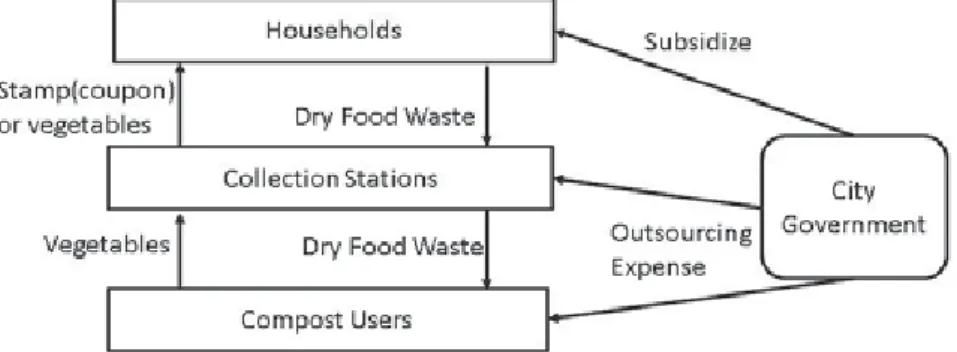
From these cases, the exchange systems for dried food waste and vegetables is shown in figure 1.
Figure 1. The exchange systems for dried food waste and vegetables
This project began when city governments started charging for household garbage collection, at which time the aim was to diffuse the use of electric garbage processing machines in households. At home, residents have reduced household garbage by using energy and money, and part of this waste is treated as burnable garbage. Through the method of exchanging dried food waste with products, they were able to use them. As such, this system, supported by the public sector, is an effective approach to forming the market of dried food waste, which is difficult to recycle.
Reference
Izumiya, M (2005) Characteristics of the Recycling Channels for Apple Pomace. BULLETIN of the FACULTY OF AGRICULTURE AND LIFE SCIENCE HIROSAKI UNIVERSITY. 8 : 58‒63.
Izumiya, M (2015) Distribution for biomass recycling. Tsukuba shobo [in Japanese].
Kusube, T (2014) Cooperation between resource circulation and agriculture through home garbage disposal under declining population. 25th Conference of the Japan Society of Material Cycles and Waste Management-Abstract 2014. : 191‒192 [in Japanese].
Sasaki, T (2001) A Study on the Society Recycling Natural Waste Materials for Organic Farming. The Special Issue of the Journal of Rural Economics 2001. : 77‒82 [in Japanese].
Ushikubo, A (2003) Food Industry and Household Waste: Current Situation and Future Trends. Journal of the Japan Society of Waste Management Experts. 14(4) : 216‒227 [in Japanese].
食品廃棄物の削減において家庭系生ごみの削減は重要である。それは食品廃棄物全体に占める家庭系の割合は高いにも かかわらず,そのリサイクルが進んでいないためである。また,家庭ごみに占める生ごみの割合も高いため,循環型社会形 成のためにはそのリサイクルが重要である。しかし,家庭系の生ごみはさまざまな種類の生ごみが混合しているだけでなく,
異物混入のリスクも高く,さらに家庭という広範囲に分散する排出源から少量ずつ排出されるため,その収集に費用がかか るために利用が困難なのが現状である。
このような中で,家庭系生ごみのリサイクルは,①地方自治体が設置した生ごみリサイクル施設において集中的に処理さ れるタイプと,②小型の電動式生ごみ処理機や段ボールコンポストによる処理のように家庭内で分散的に処理されるタイプ の二つの方法で主に行われてきた。しかし,前者は家庭からの収集システムの構築が必要であり,排出する家庭の負担や自 治体の収集費用が増加すること,自治体のリサイクル施設への投資と運営のための費用が必要になるという課題がある。こ れに対して家庭内での分散処理では,処理機の導入費用や電気代などのランニングコストが各家庭の負担になることや,処 理を行った後の生ごみ処理物の利用先が都市部や集合住宅では少なく,結果として可燃ごみとして処理される場合がみら れるという課題がある。
このようにそれぞれに課題がある中で,これらの欠点をうめる方法として「家庭系生ごみ処理物の交換制度」の取り組み が進んでいる。これは,家庭内で電動式生ごみ処理機や段ボールコンポストなのを利用して処理した「生ごみ処理物」を,
商品券や野菜等と交換することで収集し,大量化した上で利用する仕組みである。本論文では,家庭系生ごみ処理物の交 換制度の現状と課題を検討する。具体的には,交換事業を行っている5つの市を取り上げ,2015〜2016年に行った市役所 及び関係機関の聞き取り調査結果を用いて分析を行う。
その現状についてみると,例えば,A市では1999年から家庭用の電動式生ごみ処理機や屋内設置型の生ごみ処理容器の 購入費への補助事業を自治体が開始し,2002年からNPO法人が主体となって地域の野菜市で生ごみ処理物と野菜の交換制 度を開始している。さらに,2004年には野菜との交換制度を全区に拡大し,2008年からはスタンプカード制度を導入し,ポ イント数に応じて,ごみ・リサイクル関連グッズと交換できる仕組みを導入している。
この仕組みは,家庭ごみ有料化と電気式生ごみ処理機の普及を背景としている。そして,家庭での生ごみ減量化の取り 組みがエネルギーとコストをかけて行われているものの,その生成物の利用先がないために燃やせるごみとして処理されて いるという問題を解決するために行われている。そこでは,「交換」という仕組みを通して堆肥として利用することで,市の 追加経費を抑えながらその利用を進めるという仕組みである。そして,自治体によって負担される交換に際して必要とされ る費用は,①家庭からの自発的な持ち込みによる収集コストの削減にとどまらず,②用途が確保されることで家庭内での処 理が促進され,自治体のごみ処理費用が削減できるという二重の効果をもたらしている。すなわち公的領域の支援によって 家庭系食品廃棄物の市場形成を進める取り組みとして評価できる。
弘大農生報 No.20:1 − 5, 2018
家庭系食品廃棄物リサイクルにおける生ごみ処理物交換制度の現状と課題
泉谷 眞実
*・田丸 真衣
**・野中 章久
****弘前大学,**元弘前大学学部生,***農研機構 東北農業研究センター
(2017 年 11 月 17 日受付)