The Applicability of Carl Rogers’ Educational Theory in Higher Education
カール・ロジャーズ教育理論の高等教育に おける適用性について
Masahiko Hirano
Office of Faculty Affairs (Faculty of International Liberal Arts), Soka University
平野 正彦
創価大学学事部学事課(国際教養学部設置準備室)
Abstract
The present study examined the applicabil- ity of Rogers’educational theory in higher edu- cation using quantitative methods. Independ- ent variables (time spent studying, the fre- quency of students’ informal interactions with faculty, teachers’ attitudinal qualities, and aca- demic self-efficacy) and dependent variables (academic self-efficacy and students’ academic achievement) were measured based on self- reports from undergraduate students of a lib- eral arts college. The frequency of students’in- formal interactions with faculty and teachers’
attitudinal qualities were strongly related to academic self-efficacy. Also, academic self-
efficacy was the most significant predictor of students’ academic achievement. Overall, find- ings from the present study did not fully con- firm the applicability of Rogers’ educational theory in higher education.
Introduction
Carl Rogers, a renowned American psycholo- gist who advocated client-centered therapy in the twentieth century, was also a prominent educator. His educational theory was based upon the philosophy of student-centered learn- ing, which articulated that the primary pur- pose of education should be the facilitation of learning. According to Rogers (1967), the facili- tation of learning requires the interpersonal re-
研究論文
Keywords : Carl Rogers, Facilitation of Learning, Academic Self-Efficacy キーワード:カール・ロジャーズ、学習促進、学習における自己効力感
研究論文 83
lationship between the facilitator and the learner and teachers’ attitudinal qualities―a) realness, b) prize, acceptance, trust, and c) em- pathic understanding . Although Rogers claimed the applicability of his educational the- ory to students at any educational level, he pro- vided only qualitative evidence to support his theory, failing to test the theory through quan- titative approaches that employ statistical methods with reasonable measurements.
Therefore, the objective of the present study was to examine the applicability of the educa- tional theory of Carl Rogers in higher educa- tion using quantitative methods.
Educational Theory of Carl Rogers
Carl Rogers (1967) asserted that the facilita- tion of learning should be the primary purpose of education. He claimed that educated indi- viduals are those who have learned to learn.
This means that to become educated, individu- als should rely on the process of learning rather than static knowledge. He thus empha- sized that rather than traditional knowledge- transferring education, the facilitation of learn- ing should be the center of education to encour- age learners to constantly seek knowledge and adapt to change in their environment.
In his theory of the facilitation of learning, Rogers (1967) emphasized the importance of in- terpersonal relationships between the facilita- tor and the learner, suggesting that the rela- tionship promotes student learning. He stressed that “I can only be passionate in my statement that people count, that interpersonal relationships are important, that we know something about releasing human potential, that we could learn much more” (p. 320). Op- posing the traditional education which neglects
personal interactions between teachers and students, Rogers theorized that students can truly be educated and learn more through in- terpersonal relationships with the facilitator.
Thus, Rogers asserted that interpersonal rela- tionships between the facilitator and the learner are indispensable to the facilitation of learning, which promotes students’ personal and intellectual growth.
To establish interpersonal relationships, Rogers (1967) claimed that in order to actualize the facilitation of learning, the facilitator should possess three attitudinal qualities : a) realness, b) prize, acceptance, trust, and c) empathic un- derstanding. Rogers described realness as an attitudinal quality where a teacher frankly ex- presses his or her own feelings to students.
The teacher is no longer a person who system- atically transfers knowledge to students to sat- isfy curricular requirements, but a person who shares his or her feelings and opinions with stu- dents as a human being. Rogers explained that
“she [the teacher] comes into a direct personal encounter with the learner, meeting her on a person-to-person basis. It means that she is be- ing herself, not denying herself”(p. 306). Rogers asserted that when the facilitator possesses the attitudinal quality of realness, the facilitation of student learning is enhanced. Rogers also con- sidered prize, acceptance, and trust as one group of attitudinal qualities necessary for the facilitation of learning. According to Rogers, teachers who possesses these attitudinal quali- ties understand a student as a “separate per- son, having worth in her [and his] own right”(p.
309). Such attitudes toward learners mean to fundamentally accept and trust learners as im- perfect human beings with limitless potential.
Lastly, empathic understanding, in Rogers’
view, is an attitudinal quality where a teacher
84
attempts to accurately perceive students’ feel- ings and understand students from the stu- dents’ points of view. He described empathic understanding as the attitude of “standing in the other’s shoes, of viewing the world through the student’s eyes” (p. 311). The teacher who has the attitudinal quality of empathic under- standing does not evaluate or judge students but simply understands them.
Rogers (1967) asserted that in a classroom with a teacher who possesses these three atti- tudinal qualities, students can acquire knowl- edge more easily. He emphasized that“in class- rooms approaching such a psychological cli- mate, children learn more of the conventional subjects”(p. 321). In order to prove the positive effect of this approach on students, Rogers in- troduced some qualitative data that showed how students’ academic motivation is in- creased in response to the presence of the teacher who possesses the facilitative attitudi- nal qualities. Based on the research, Rogers (1977) claimed that“politics of this humane sort foster all kinds of constructive learning, both personal and intellectual”(p. 330). Thus, the fa- cilitator who possesses the essential attitudinal qualities enhances student learning.
Rogers also asserted that the presence of the facilitator who possesses such attitudinal quali- ties inspires students to become self-disciplined learners. According to Rogers (1977), the pre- condition of fostering self-disciplined learners is that a teacher“is sufficiently secure within her- self [or himself] and in her [or his] relationship to others that she [or he] experiences an essen- tial trust in the capacity of others to think for themselves, to learn for themselves” (p. 327).
This precondition indicated that the teacher must be a“facilitative teacher”who fundamen- tally trusts that students will gain more auton-
omy and possesses the essential attitudinal qualities he addressed. Rogers explained that with this precondition, students become self- disciplined learners. According to Rogers, the student’s self-discipline which is facilitated by the teacher is not only“the discipline necessary to reach the student’s goal,” but also“is a self- discipline and is recognized and accepted by the learner as being her own responsibility. Self -discipline replaces external discipline” (p. 327).
He also described that in the facilitative mode of education, the learner “regulates the modes of feeling, thought, behavior and values through her [or his] own self-discipline”(p. 328).
Therefore, the demonstration of realness, prize, acceptance, trust, and empathic understanding by the facilitator consequently enables learners to become self-disciplined in every realm of their lives.
Rogers (1977) insisted that the effect of facili- tative teaching can be observed at any educa- tional level. He proposed that “if this precondi- tion exists, then the other features listed [such as self-discipline] may be experienced or ob- served at any educational level, from kinder- garten through graduate school” (p. 326). This signified that his theory of the facilitation of learning can be applied to students at any edu- cational level. Furthermore, he stressed that“if we focus on the facilitation of learning...we might be on a much more profitable track”
(1967, p. 320). Since the educational role of “fa- cilitator”and“learner”does not change accord- ing to educational levels, the applicability of Rogers’theory would persist through all educa- tional levels.
Finally, Rogers (1967) presented much quali- tative evidence to support his theory, yet he did not provide quantitative evidence. In order to support his theory, he cited a range of inter-
研究論文 85
views from teachers and students who had ex- perienced the facilitation of learning and illus- trated its psychological effects on teachers and students. According to Rogers, he intentionally provided only qualitative evidence in order to emphasize how the facilitation of learning im- pacts students’ feelings and attitudes toward learning. He explained the reason stating :
“I have intentionally gone beyond the empirical findings to try to take you into the inner life of the student-elementary, college, and graduate- who is fortunate enough to live and learn in such an interpersonal relationship with a facili- tator, in order to let you see what learning feels like when it is free, self-initiated, spontaneous”
(p. 321).
Therefore, although Rogers provided much qualitative data to demonstrate the effective- ness of his theory in application, he did not pre- sent quantitative evidence to support his the- ory.
Since Rogers maintained that his educational theory can be applied to students at any educa- tional level, and at the same time he did not test his theory using quantitative methods, the present study examined the applicability of Rogers’ educational theory in higher education using quantitative methods.
Literature Review
The present study examined the correla- tions between four independent variables (time spent studying, the frequency of students’ in- formal interactions with faculty, teachers’ atti- tudinal qualities, and academic self-efficacy) and two dependent variables (academic self- efficacy and students’ academic achievement).
Time spent studying was added as a control in order to compare its effect on dependent vari-
ables with other main independent variables.
To examine interpersonal relationships be- tween the facilitator and the learner, the fre- quency of students’ informal interactions with faculty was measured. Also, students’ aca- demic achievement was measured based on college cumulative grade point average (GPA).
Existing literature shows how these variables correlate with each other.
Time Spent Studying
Many researchers have investigated the cor- relation between time spent studying and stu- dent academic achievement. In general, re- searchers have agreed that students who study more attain higher intellectual achieve- ment (Britton & Tesser, 1991). For example, Van Den Berg and Hofman (2005) studied the factors that affect study progress of university students. Findings showed that “time devoted to study has positive effect on study success”
(p. 437). George, Dixon, Stansal, Gelb, and Pheri (2008) also examined the predictors of GPA in higher education, and found out that time spent studying is one of the greatest predictors of GPA. Also, Brint and Cantwell (2008) investi- gated the relationships between various time uses and college GPA. Findings revealed that time spent attending and studying for classes strongly affects students’academic attainment.
On the other hand, some studies have re- vealed no or little correlation between time spent studying and students’ academic per- formance. For instance, Nonis and Hudson (2006) examined the influence of time spent studying and working on semester grade point average. The results of their study indicated that time spent studying and working has no direct effect on academic outcomes. Ruban and Nora (2002) also investigated the predictors of
86
academic outcome in college, and they con- cluded that the self-reported amount of study- ing is not a significant contributor to academic achievement.
Although some studies showed the insignifi- cant influence of time spent studying on aca- demic performance of undergraduate students, the majority of research has supported the positive correlation between the two variables.
Frequency of Students' Informal Interactions with Faculty
Researchers have conducted empirical stud- ies regarding the relationship between stu- dents’ informal interactions with faculty and their academic outcomes in college. Many of them agreed that informal student-faculty in- teraction has considerable impact on student academic achievement (Halawah, 2006). Ac- cording to Astin (1993), faculty plays a vital role in intellectually and personally developing un- dergraduate students, and student-faculty in- teraction has a significant positive correlation with students’ academic attainment, such as college GPA. A study conducted by McShan- non (2001) also suggested that student-faculty interaction increases students’ course grades, which were especially noted for female stu- dents. Also, Halawah (2006) examined how student-faculty informal interpersonal relation- ships impact students’ intellectual develop- ment, and found out that the relationships posi- tively influence students’ academic perform- ance. On the contrary, some of the researchers found only a slight connection between infor- mal student-faculty interaction and students’
academic achievement. Kuh, Pace, and Vesper (1997) studied the correlation through three types of academic levels―Bachelor, Master, and Doctorate―and found that student-faculty
interaction lacks influence on students’ aca- demic performance for Bachelor level students.
Although a number of studies have been conducted on the topic, the approach research- ers took to investigate the informal student- faculty interaction has varied. Some focused on how students’ satisfaction of their interactions with faculty relates to their academic attain- ment. They found a significant correlation be- tween the students’ satisfaction of interaction with faculty and their academic performance (Graunke & Woosley, 2005 ; Ullah & Wilson, 2007). Others investigated how the frequency of informal interactions with faculty influences students’ academic achievement. Pascarella and Terenzini (1991) explored a range of em- pirical studies regarding the association be- tween the frequency of students’informal con- tact with faculty and students’ academic per- formance, and they concluded that there is a significantly positive correlation between the two factors. Bernier, Larose, and Soucy (2005) also stressed the importance of frequent infor- mal contact with faculty for students’ intellec- tual development, asserting that “empirical re- search has supported these claims by showing that informal contacts (outside the classroom) between college students and faculty have a positive impact on students’academic perform- ance”(p. 30).
In terms of the frequency of students’ infor- mal interactions with faculty, researchers have discussed how to promote informal contact be- tween students and faculty in order to improve student academic performance. Some research- ers have found that mentoring increases the students’informal interactions with faculty and enhances students’academic achievement. For example, Campbell and Campbell (1997) exam- ined the difference between mentored stu-
研究論文 87
dents and students without a mentor in terms of their college GPA. Their study revealed that mentored students demonstrated higher GPA than students without a mentor. Miller and Webster (1997) studied the effect of instructors’
interest, teaching skills, and personal interac- tion with learners on student academic per- formance, and they concluded that regardless of delivery method, teachers should have per- sonal contact with learners. They suggested that any type of informal student-faculty inter- actions promotes student learning, and thus in- structors should attempt to increase informal interactions with students.
Overall, the literature supports positive cor- relations between students’ informal interac- tions with faculty, especially its frequency, and student academic achievement in college.
Teachers' Attitudinal Qualities
A range of studies have examined how teacher’s attitudinal qualities affect students’
academic performance. Most of the studies have supported the idea that certain attitudes or personal characteristics of teachers posi- tively affect student’s academic achievement.
Butland and Beebe (1992) investigated the asso- ciation between verbal and nonverbal teacher immediacy and student learning, and found that students learn more when instructors em- ploy positive messages to gain compliance in the classroom. Halawah (2006) revealed that in- terpersonal characteristics of faculty and class- room atmosphere significantly affect college students’ academic outcome, and academically successful students consistently rated profes- sors“as friends, helpers, and assistants”(p.670).
Moreover, Bernier et al. (2005) revealed that the academic achievement of college students is not affected by professors’professional traits,
such as experience or position in school, but
“rather by [professors’] personal characteristics such as friendliness and flexibility, accessibility and availability, empathy and respect, as well as honesty and tolerance”(p. 31). These studies indicated that friendly, supportive, and recep- tive professors positively influence college stu- dents’academic performance.
Researchers have also addressed that teach- ers’ attitudinal qualities are closely related to students’academic self-efficacy. Strohkirch and Hargett (1998) reported that adult students, in- cluding college students, should have the right to present their opinions and to be heard by faculty members, indicating that the violation of such expectation results in lowering stu- dents’ confidence in academic performance.
The authors revealed that although autocratic instructors tend to lessen students’ academic self-efficacy, teachers who are friendly, suppor- tive, and receptive to students increase their levels of academic self-efficacy. Lowman (1984) examined how instructors’ communicational approaches impact students’ attitudes toward learning. In his study, an instructor who has the high level of interpersonal rapport with stu- dents is described as an instructor who “ap- pears to have strong interest in the students as individuals,” “acknowledges students’feelings...
and encourages them to express such feelings,”
“encourages students to ask questions and seems to eager for them to express personal viewpoints,” “communicates both openly and subtly,”etc. (p. 511). His study revealed that the high level of interpersonal rapport between an instructor and college students“increase[s] mo- tivation, enjoyment, and independent learning”
of the students (p. 510). These studies indicated that certain teachers’attitudinal qualities, such as friendliness, supportiveness, and receptive-
88
ness, enhance students’ academic self-efficacy by promoting students’independent learning.
Academic Self-Efficacy
Self-efficacy refers to “beliefs about one’s ability to successfully execute a behavior re- quired to produce a certain outcome” (Ramos- Sanchez & Nichols, 2007, p. 8). If a person pos- sesses a lower level of self-efficacy in a particu- lar activity, he or she may exert less effort into the activity. On the other hand, a higher level of self-efficacy in a particular activity augments a person’s performance and perseverance in the activity (Ramos-Sanchez & Nichols, 2007).
Researchers have asserted that one’s level of academic self-efficacy determines the person’s quality of self-disciplined learning. According to Zimmerman (2002), self-regulated learning is
“the self-directive process by which learners transform their mental abilities into academic skills” (p. 65). This indicated that since self- disciplined learning requires psychological abilities, its quality varies depending on one’s level of self-efficacy. Moreover, Zimmerman (1989) asserted that self-regulated learning
“must involve the use of specified strategies to achieve academic goals on the basis of self- efficacy perceptions” (p. 329). Other research- ers have also shown that students who have higher academic self-efficacy are better at self- disciplined learning (Chemers, Hu, & Garcia, 2001 ; Ruban & Nora, 2002). Thus, highly self- disciplined learners should possess higher aca- demic self-efficacy, and vice versa.
The relationship between students’ aca- demic self-efficacy and their academic achieve- ment in higher education has been widely in- vestigated by researchers. For example, Klomegah (2007) examined correlations be- tween variables in the goal-efficacy model, such as self-efficacy, and college GPA. He found a
significant positive correlation between stu- dents’ self-efficacy and their GPA, which ap- peared stronger than other variables in the goal-efficiency model. Zajacova, Lynch, and Espenshade (2005) compared how much aca- demic self-efficacy and stress predict academic success, including college GPA. They reported that academic self-efficacy was a more robust predictor of academic achievement than stress.
Chemers et al. (2001) investigated predictors of first-year college student academic perform- ance, and they revealed that “academic self- efficacy was significantly and directly related to academic expectations and academic per- formance”(p. 61). In their study, also, academic self-efficacy was the strongest predictor among other independent variables.
Although many studies have supported the strong positive correlation between academic self-efficacy and academic performance of col- lege students, some did not identify academic self-efficacy as a significant predictor. For in- stance, Choi (2005) examined how general self- efficacy, academic self-efficacy, and specific self -efficacy relate to college students’ term grades, and found that “of the three self- efficacy variables, specific self-efficacy was the only significant predictor of term grades” (p.
203). However, overall, researchers have agreed that a level of college students’ aca- demic self-efficacy is associated with their aca- demic outcomes.
Study Questions & Hypotheses
As literature shows, contemporary research has found that self-disciplined learning requires high academic self-efficacy. Therefore, these findings are applied in the formation of study questions and hypotheses of the present study.
研究論文 89
Based on Carl Rogers’ educational theory, the present study attempted to answer the follow- ing questions : 1) Does the presence of the fa- cilitator who possesses three attitudinal attitudes-a) realness, b) prize, acceptance, trust, and c) empathic understanding-inspire stu- dents to become self-disciplined learners who have high academic self-efficacy? 2) Do inter- personal relationships between the facilitator and the learner promote student learning? 3) Does the presence of the facilitator who pos- sesses the facilitative attitudes enhance stu- dent learning? Given the findings from existing literature, the following hypotheses were con- structed : 1) The presence of the facilitator who possesses the facilitative attitudes inspires students to become self-disciplined learners who have high academic self-efficacy. 2) Inter- personal relationships between the facilitator and the learner promote student learning. 3) The presence of the facilitator who possesses the facilitative attitudes enhances student learning. In this study, these hypotheses can be supported if : 1) students demonstrate higher academic self-efficacy when teachers possess the facilitative attitudes 2) students who have more informal interactions with faculty obtain higher college GPA 3) students obtain higher college GPA when teachers possess facilitative attitudes.
Method
The participants in the present study were undergraduate students at Soka University of America, Aliso Viejo, California. An electronic survey was created for this study in order to elicit student self-reports regarding time spent studying, the frequency of students’ informal interactions with faculty, teachers’ attitudinal
qualities, students’ perceived academic self- efficacy, and their college GPA. The survey was electronically sent to 170 randomly chosen undergraduate students in the spring semester 2009 through their student email accounts.
Each survey was preceded by the explanation of the purpose of the study (i.e.,“to explore fac- tors that may affect student academic achieve- ment in higher education based on Carl Rogers’
educational theory”) and included information regarding informed consent. Only participants 18 years of age or older were allowed to partici- pate in this study. As an added incentive for participation in the study, all participants were eligible for a lottery drawing for gift certifi- cates, including five $20 prizes. Students were informed that participation was completely vol- untary and all responses would be kept confi- dential and anonymous.
Participants
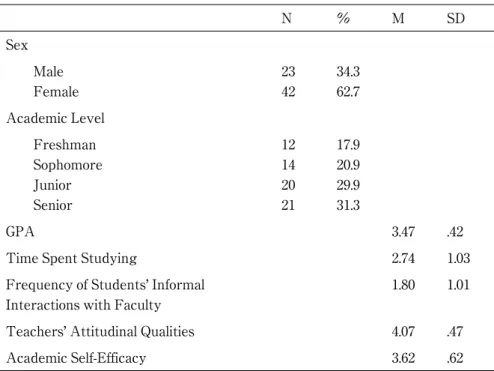
The participants were 65 undergraduate stu- dents at Soka University of America. The par- ticipants were restricted to the age of 18 or older. Table 1 provides the demographic char- acteristics of the sample. The sample included 34.3% males and 62.7% females. In terms of aca- demic level, the students of the sample in- cluded 17.9% freshman, 20.9% sophomore, 29.9% junior, and 31.3% senior.
Measures
College GPA. Participants voluntary pro- vided the survey with their college cumulative grade point average (GPA). College GPA is measured on a 4-point scale with a maximum of 4.0.
Time spent studying. The measure was cre- ated for the present study. Participants were asked to answer following question : “how
90
many hours do you spend studying outside of class in a day on average?” (see Appendix).
They responded on a 5-point scale (1 = 0-1 hours, 2 = 2-3 hours, 3 = 4-5 hours, 4 = 6-7 hours, 5 = 8 hours or more).
Frequency of students’ informal interactions with faculty. The frequency of students’ infor- mal interactions with faculty was measured with a scale developed for this study. Partici- pants were asked to answer following ques- tion : “how many times do you informally inter- act with faculty members outside of class for ten minutes or more in a week?” (see Appen- dix). They responded on a 5-point scale (1 = 0-1 times, 2 = 2-3 times, 3 = 4-5 times, 4 = 6-7 times, 5 = 8 times or more).
Teachers’ attitudinal qualities. A nine-item measure was developed for the present study based on a study conducted by Feldman (1997).
In the original study conducted by Feldman, the first three items, the second three items, and the third three items were respectively used to measure“personality characteristics of
the teacher,” “teacher’s concerns and respect for students ; friendliness of the teacher,” and
“teacher’s encouragement of questions and dis- cussion, and openness in options of others.”For this study, instead, these items were used to ask if professors possess three attitudinal quali- ties―a) realness, b) prize, acceptance, trust, and c) empathic understanding―according to students’ perceptions. Participants were given the following statement : “please answer how much you agree with the statement, from 1 = strongly disagree, to 5 = strongly agree.” The nine items that participants rated were the fol- lowing (see Appendix A) :
1, In general, professors who I have had were sincere and honest
2, In general, professors who I have had were not autocratic and did not try to force us to ac- cept his or her ideas and interpretations
3, In general, professors who I have had exhib- ited a casual, informal attitude
4, In general, professors who I have had seemed to have a genuine interest in and con-
Table 1
Descriptive Statistics
N % M SD
Sex
Male 23 34.3
Female 42 62.7
Academic Level
Freshman 12 17.9
Sophomore 14 20.9
Junior 20 29.9
Senior 21 31.3
GPA 3.47 .42
Time Spent Studying 2.74 1.03
Frequency of Students’Informal Interactions with Faculty
1.80 1.01
Teachers’Attitudinal Qualities 4.07 .47
Academic Self-Efficacy 3.62 .62
研究論文 91
cern for students
5, In general, professors who I have had took students seriously
6, In general, professors who I have had estab- lished good rapport with students
7, In general, professors who I have had en- couraged students to express differences of opinions and to evaluate each other’s ideas 8, In general, professors who I have had invited criticism of his or her own ideas
9, In general, professors who I have had ap- peared receptive to new ideas and the view- points of others
The nine items were combined into a meas- ure of teachers’attitudinal qualities. The Cron- bach’s alpha was .82 (α = .82) in the present study.
Academic self-efficacy. Academic self- efficacy was measured by an instrument devel- oped by Zajacova et al. (2005). The instrument was composed of 27 items with regard to college-related academic tasks. Participants were given the following statement : “please answer how confident you are that you can successfully complete the tasks, from 1 = not confident, to 5 = very confident.” Examples of the items included the following : “Studying,”
“Asking questions in class,” “Keeping up with the required readings,” etc. (see Appendix A).
The 27 items were combined into a measure of academic self-efficacy. In the present study, the Cronbach’s alpha was .92 (α= .92).
Results
Table 1 presents the means and standard de- viations of variables. The mean of college GPA was 3.47, and the standard deviation was .42.
The mean of time spent studying was 2.74,
meaning that the students of the sample spend approximately four hours for studying in a day on average, and the standard deviation was 1.03. The mean of the frequency of student’s in- formal interactions with faculty was 1.80, signi- fying that the students of the sample infor- mally interact with faculty outside of class for ten minutes or more approximately twice in a week on average, and the standard deviation was 1.01. The mean and standard deviation of teacher’s attitudinal qualities were respec- tively 4.07 and .47. This shows that samples somewhat agreed that, in general, teachers who they have had possessed three attitudinal qualities. The mean and standard deviation of academic self-efficacy were respectively 3.62 and .62. This means that the students of the sample possessed the level of academic self- efficacy between neutral and somewhat confi- dent.
Table 2 presents zero-order correlations be- tween all of the observed variables, and Table 3 and 4 respectively provides the regression of academic self-efficacy and college cumulative grade point average. Results showed some sta- tistically significant correlations among vari- ables at .05 or 01 alpha level (see Table 2).
There were positive and moderate correlations between academic self-efficacy and the fre- quency of students’ informal interactions with faculty (r=.41, p<.01) and teacher’s attitudinal qualities (r =.32,p< .01). There were also posi- tive and moderate correlations between GPA and academic self-efficacy (r=.38, p<.01) and time spent studying (r=.28, p<.05). On the other hand, the frequency of student’s informal interactions with faculty and teacher’s attitudi- nal qualities had almost no effect on college GPA.
The regressions of academic self-efficacy and
92
college GPA further explained the characteris- tics of the correlations. The regression of aca- demic self-efficacy (see Table 3) showed some statistical correlations between variables with high statistical confidence. There were positive and moderate correlations between academic self-efficacy and the frequency of students’ in- formal interactions with faculty (standardized
beta=.356, p<.01) and teacher’s attitudinal qualities (standardized beta=.339,p<.01). These results revealed that the frequency of students’
informal interactions with faculty and teachers’
attitudinal qualities almost equally had a mod- erate effect on academic self-efficacy. Aca- demic self-efficacy also had a weak correlation with academic level (standardized beta=.191,
Table 2
Correlations among All Variables
Variable 1 2 3 4 5
1. GPA −
2. Academic Self-Efficacy .38** −
3. Time Spent Studying .28* .17 −
4. Frequency of Students’ Informal Interac- tion with Faculty
-.01 .41** .09 −
5. Teachers' Attitudinal Qualities -.01 .32** -.06 .02 −
Note. *p< .05, **p< .01,
Table 3
Regression of Academic Self−Efficacy
Predictors Stan.β p
Gender -.027 .813
Academic Level .191 .096
Time Spent Studying .102 .372
Frequency of Students’Informal Interactions with Faculty .356 .003
Teachers’Attitudinal Qualities .339 .003
Note. R2=.33,p<.001, N=62
Table 4
Regression of College Cumulative Grade Point Average (GPA)
Predictors Stan.β p
Gender .006 .960
Academic Level .002 .987
Time Spent Studying .214 .093
Frequency of Students’Informal Interactions with Faculty -.203 .136
Teachers’Attitudinal Qualities -.124 .331
Academic Self-Efficacy .458 .002
Note. R2=.23,p<.05, N=61
研究論文 93
ns), but it showed only marginal statistical con- fidence (p<.10) and cannot be generalized. The data from the regression of college GPA (see Table 4) showed substantially larger effect of academic self-efficacy on college GPA than other variables. There was a positive and mod- erate correlation between college GPA and academic self-efficacy with high statistical con- fidence (standardized beta=.458, p<.01). Com- pared to the academic self-efficacy, other vari- ables showed weaker correlations with college GPA, and these correlations could not also be generalized. Time spent studying showed a positive and weak correlation with college GPA with the only marginal statistical confidence (standardized β=.214, p<.10). There were also negative and weak correlations, which could not be generalized, between college GPA and the frequency of students’informal interactions with faculty (standardized β=-.203, ns) and teacher’s attitudinal qualities (standardized β= -.124,ns).
Discussion
The major objective of this study was to ex- amine the applicability of the educational the- ory of Carl Rogers in higher education using quantitative methods. Rogers’ educational the- ory dictates that the presence of the facilitator who possesses three attitudinal qualities―a) realness, b) prize, acceptance, trust, and c) em- pathic understanding―inspires students to be- come self-disciplined learners who have high academic self-efficacy ; interpersonal relation- ships between the facilitator and the learner promote student learning ; and the presence of the facilitator who possesses the facilitative at- titudes enhances student learning (Rogers, 1967). These three major arguments in Rogers’
educational theory were specifically investi- gated in the present study, and they were not fully confirmed based on the pattern observed in the correlation coefficients among five pre- dictor variables and the findings from the two multiple regressions in this study.
The first hypothesis that the presence of the facilitator who possesses three attitudinal qualities―a) realness, b) prize, acceptance, trust, and c) empathic understanding―inspires students to become self-disciplined learners who have high academic self-efficacy was sup- ported based on a positive and moderate corre- lation between teachers’ attitudinal qualities and academic self-efficacy. Similar to the find- ings of Lowman (1984) and Strohkirch and Har- gett (1998), the correlation suggested that stu- dents tend to demonstrate higher academic self-efficacy when teachers possess the three attitudinal qualities. Moreover, unexpectedly, the frequency of students’informal interactions with faculty also had a positive and moderate correlation with academic self-efficacy. This in- dicated that students’academic self-efficacy be- comes higher as they informally interact with faculty more frequently. The second hypothe- sis that interpersonal relationships between the facilitator and the learner promote student learning was not supported due to the lack of a positive and statistically significant correlation between the frequency of students’informal in- teractions with faculty and college GPA. The results indicated that students who have more frequent informal interactions with faculty do not necessarily obtain higher college GPA, which contradicted the findings of studies con- ducted by Pascarella and Terenzini (1991) and Bernier et al. (2005), that the frequency of infor- mal contacts between college students and fac- ulty have a positive influence on students’aca-
94
demic performance. The third hypothesis that the presence of the facilitator who possesses the facilitative attitudes enhances student learning was not supported because a signifi- cant positive correlation was not found be- tween teacher’s attitudinal qualities and col- lege GPA, meaning that college students can achieve academic excellence without profes- sors possessing these attitudinal qualities.
These results were inconsistent with the find- ings reported by Bernier et al. (2005) and Ha- lawah (2006). Based on the results, two main ar- guments of Roger’s theory―interpersonal rela- tionships between the facilitator and the learner promote student learning, and the pres- ence of the facilitator who possesses the facili- tative attitudes enhances student learning―
were not sufficiently supported by this quanti- tative study.
Before drawing conclusions, some caution should be exercised because the present study offers a problem of reciprocal causation. The methodology of this study generated ambigu- ity of whether students’ initial motivation and high academic attainment led to the frequent informal interactions with faculty and the posi- tive perception of teachers’ attitudes, or stu- dents were stimulated to work hard by the in- teraction with teachers and their facilitative at- titudes (Halawah, 2006 ; Lamport, 1993). Pas- carella and Terenzini (1991) pointed out the problem, stating that “it is ambiguous if quan- tity and quality of interactions with faculty eventually improve students’ academic compe- tence, or initial perceptions of gains in aca- demic knowledge lead students to seek infor- mal contact with faculty and also positively perceive teacher performance” (p. 426). Due to the lack of affirmed causality between vari- ables observed in this study, the possibility of
spurious elements that create ambiguity in in- terpretation and generalization were not ruled out.
With the caution, assuming that causality ex- isted between variables, the results could pre- sent two key findings. The first was that col- lege students’academic self-efficacy can be en- hanced not only through improving the teach- ers’ attitudinal qualities but also through in- creasing the frequency of students’informal in- teractions with faculty. This was an unex- pected finding. The finding indicated that both the quantity and quality of interpersonal inter- actions between students and teachers are sig- nificant in predicting the level of students’aca- demic self-efficacy. Thus, although the demon- stration of the three attitudinal qualities by teachers and the frequent informal contacts with faculty independently enhance students’
academic self-efficacy, the combination of both can magnify the effect. Based on the possible existence of causality, therefore, the findings suggest that in order to elevate the level of col- lege students’ academic self-efficacy, teachers should exert effort to demonstrate the facilita- tive attitudes in interactions with students, while students should attempt to seek more op- portunities to have informal interactions with teachers.
On a related note, it is not difficult to imagine that professors’teaching behaviors are closely connected with their accessibility to students, which increases informal interactions between students and faculty. This indicates that fac- ulty influence both the quantity and quality of student-teacher interactions, for teachers who possess the facilitative attitudes also tend to ex- tend their informal contact with students to nonclassroom situations. According to Pas- carella and Terenzini (1991), professors who
研究論文 95
frequently interact with students outside of class tend to“give cues as to their accessibility for such interaction through their in-class teaching behaviors” (p. 423). Therefore, teach- ers who demonstrate facilitative attitudes also tend to show accessibility to students, so stu- dents naturally interact more with those teach- ers outside of class. This perspective elicits an- other possible suggestion that the improve- ment in teaching behaviors should be priori- tized in order to directly raise college students’
academic self-efficacy and enhance teachers’
accessibility at the same time.
The second major finding was that among independent variables, academic self-efficacy was the most significant predictor of college students’ academic performance. This finding was consistent with the reports from Klomegah (2007), Zajacova et al. (2005), and Chemers et al. (2001), that revealed the signifi- cant positive correlation between students’
academic achievement and academic self- efficacy. Time spent studying correlated with students’ academic performance as expected, yet only weakly and not significantly. The fre- quency of students’ informal interactions with faculty and the teacher’s attitudinal qualities unexpectedly lacked a direct correlation with students’ academic achievement, being inde- pendent of self-efficacy. Thus, the significance of academic self-efficacy in this study sug- gested its appropriateness as a predictor of stu- dents’academic achievement.
Assuming that there were causal relation- ships between variables, the fusion of these two major findings from the results suggest that both frequent informal interactions with teachers and the presence of teachers who pos- sess the three attitudinal qualities of realness, trust, and empathic understanding indirectly
enhance students’ academic performance through raising students’ academic self- efficacy. Although the direct positive effects of frequent informal interactions with teachers and teachers’ facilitative attitudes on students’
academic performance were not observed, these factors indirectly promoted student learning through increasing students’ aca- demic self-efficacy. The findings supported the reports from a study conducted by Hativa (2000), which revealed that“the good /effective teacher induces a relaxed and enjoyable atmos- phere in class ; communicates confidence in students’ ability to learn ; boosts their self- esteem as learners...and eventually promotes their learning” (p. 34). Thus, the findings showed the process of how frequent informal student-faculty interactions and teachers’facili- tative attitudes boost students’ academic self- efficacy and eventually contribute to students’
higher academic achievement.
A practical implication that can be drawn from the findings in this study relate to the im- portance of teacher training programs for col- lege professors that are designed to promote informal contact with students and develop the facilitative attitudes presented in Rogers’ the- ory in their teaching behaviors. Since student’s academic self-efficacy seems to be constantly influenced by interpersonal relationships with teachers and their attitudinal qualities based on the assumption of the existence of causality, it might be crucial for college professors to fos- ter greater awareness of how the development of facilitative teaching behaviors significantly impacts college students’ academic self- efficacy, which, in turn, serve to enhance their academic achievement. Thus, designing higher education teacher training programs that re- flect these findings would benefit college stu-
96
dents.
The findings from the current study were clear and significant, yet it is prudent to be aware of some limitations of this study. Firstly, nearly 60% of the participants in this study were upperclassmen who generally tend to have more informal contact with faculty than underclassmen because of the larger number of classes they have taken, which augmented familiarity with faculty. Due to the overrepre- sentation of upperclassmen in the sample, the average of the frequency of students’informal interactions with faculty might not have accu- rately represented the student body. Secondly, the findings from the present study were based on self-reports, which might not provide accurate data. Some answers might not have represented the correct information of partici- pants, such as GPA. Thirdly, student samples in this study were from undergraduate stu- dents of a small liberal arts college with less than 400 students. Because of the nature of this study, the findings in replicated studies for stu- dent samples in larger undergraduate institu- tions or in some other areas of study, such as medicine, business or law, might not parallel the findings in this study. Lastly, although the data showed some clear relationships between variables, they might not be causal relation- ships but merely correlations. Other third fac- tors, such as the age of participants, might af- fect both independent and dependent vari- ables, and also the time order was not estab- lished in this study. The replication of the pre- sent study should modify the methodology based on these limitations.
The findings of the present study revealed that Rogers’ educational theory might lack plausibility and would not be applicable to higher education. Although one of three main
possible arguments of the theory, the presence of the facilitator who possesses three attitudi- nal qualities―a) realness, b) prize, acceptance, trust, and c) empathic understanding―inspires students to become self-disciplined learners who have high academic self-efficacy, was sup- ported based on the results, other two argu- ments, interpersonal relationships between the facilitator and the learner promote student learning ; and the presence of the facilitator who possesses the facilitative attitudes en- hances student learning, were not supported.
Because not all three Rogers’ arguments were supported, the applicability of Rogers’theory in higher education seems dubious, even though some methodological problems that might lessen the validity of findings were identified in this study.
The examination of the applicability of Rogers’educational theory in higher education is only one step in thoroughly investigating his theory. More quantitative studies in larger un- dergraduate institutions and other academic levels, such as elementary and graduate, are needed to examine the applicability of the the- ory. In order to solve the problem of reciprocal causation, future studies should establish causational relationships with time order and carefully include some other student-related variables, such as students’ academic motiva- tion, which might affect the frequency of stu- dents’informal interactions with faculty, teach- ers’ attitudinal qualities, and students’ aca- demic achievement. The results of the present study provide us confidence that such research would yield significant and meaningful findings that contribute to the further examination of Rogers’educational theory.
研究論文 97
Appendix : Survey Questions
Gender Male, Female
Academic level
Freshmen, Sophomore, Junior, Senior
Time spent studying
“How many hours do you spend studying out- side of class in a day on average?”
(1=0-1 hours, 2=2-3 hours, 3=4-5 hours, 4=6-7 hours, 5=8 hours or more)
Frequency of students’ informal interactions with faculty
“How many times do you informally interact with faculty members outside of class for ten minutes or more in a week?”
(1=0-1 times, 2=2-3 times, 3=4-5 times, 4=6-7 times, 5=8 times or more)
Teachers’ Attitudinal Qualities [Modified model from Feldman (1997)]
“Please answer how much you agree with the statement, from 1=strongly disagree, to 5=
strongly agree”
(1=strongly disagree, 2=somewhat disagree, 3
=undecided, 4=somewhat agree, 5=strongly agree)
Realness
“In general, professors who I have had were sincere and honest”
“In general, professors who I have had were not autocratic and did not try to force us to ac-
cept his or her ideas and interpretations”
”In general, professors who I have had exhib- ited a casual, informal attitude”
Prize, acceptance, trust
“In general, professors who I have had seemed to have a genuine interest in and concern for students”
“In general, professors who I have had took students seriously”
“In general, professors who I have had estab- lished good rapport with students”
Empathic understanding
“In general, professors who I have had encour- aged students to express differences of opin- ions and to evaluate each other’s ideas”
“In general, professors who I have had invited criticism of his or her own ideas”
“In general, professors who I have had ap- peared receptive to new ideas and the view- points of others”
Academic Self-efficacy [Model from Zajacova, Lynch, and Espenshade (2005)]
“Please answer how confident you are that you can successfully complete the tasks, from 1=
not confident, to 5=very confident”
(1=not confident, 2=somewhat not confident, 3
=undecided, 4=somewhat confident, 5=very confident)
Studying
Asking questions in class
Keeping up with the required readings Understanding my professors
Writing term papers
My parents’expectation of my grades Making friends at school
98