• 検索結果がありません。

福島県立医科大学 学術機関リポジトリ

N/A
N/A
Protected

Academic year: 2021

シェア "福島県立医科大学 学術機関リポジトリ"

Copied!
11
0
0

読み込み中.... (全文を見る)

全文

(1)

Fukushima Medical University

This document is downloaded at: 2021-11-08T00:22:26Z

Title Reinfection of cytomegalovirus in renal transplantation

Author(s) Ishibashi, Kei; Yamaguchi, Osamu; Suzutani, Tatsuo

Citation Fukushima Journal of Medical Science. 57(1): 1-10

Issue Date 2011

URL http://ir.fmu.ac.jp/dspace/handle/123456789/278

Rights © 2011 The Fukushima Society of Medical Science

DOI 10.5387/fms.57.1

Text Version publisher

(2)

Fukushima J. Med. Sci., Vol. 57, No. 1, 2011

1

石橋 啓,山口 脩,錫谷達夫

Corresponding author : Kei Ishibashi MD, PhD E

-

mail address : [email protected] http://www.jstage.jst.go.jp/browse/fms http://fmu.ac.jp/home/lib/F

-

igaku/

[Review]

REINFECTION OF CYTOMEGALOVIRUS IN RENAL TRANSPLANTATION

KEI ISHIBASHI, OSAMU YAMAGUCHI and TATSUO SUZUTANI

Department of Urology, Department of Microbiology, Fukushima Medical University, Fukushima, JAPAN

(Received February 9, 2011, accepted April 18, 2011)

Abstract : Cytomegalovirus (CMV) is the most important pathogen affecting the outcome of renal transplantation. Reinfection of CMV can occur in CMV

-

seropositive donors and CMV seropositive recipients (D+/R+) settings because the protection against CMV conferred by preexisting immu- nity is limited due to its strain

-

dependent immune responses. To analyze the influence of CMV reinfection in renal transplantation, ELISA using fusion proteins encompassing epitope of glycopro- tein H(gH) from both AD169 and Towne strains was employed before transplantation. The CMV

-

gH seropositive rate increased with increases in age and the rate of samples which contained antibodies against both AD169 and Towne were significantly high in the age of 50 years or over. Antibodies from HLA

-

DR10 and DR11 were associated with a significantly lower response rate against CMV

-

gH. In renal transplantation, the high degrees of antigenemia and high inci- dences of CMV disease are more prevalent in the CMV gH antibody

-

mismatched group in D+/R+

setting. The nucleotide sequence of the region of the gH epitope in the CMV

-

DNA extracted from the transplant recipients who showed high degree of antigenemia revealed the CMV reinfection from the donors. As a CMV indirect effect, the incidence of acute rejection in the mismatched gH antibody group was higher than that observed in the matched and D+/R− groups. The adverse events were more likely to occur in cases of D+/R+ renal transplantation with mismatched strain

-

specific antibodies which would indicates the risk of CMV reinfection after transplantation.

Key words : cytomegalovirus, renal transplantation, glycoprotein H, reinfection

INTROdUCTION

Renal transplantation is a most valuable treat- ment for patients with chronic renal failure. How- ever, despite significant advances in the field of renal transplantation, long

-

term graft survival has not markedly increased 1) . Among the varied reasons of this, cytomegalovirus (CMV) infection continues to be a potential contributor to graft failure, and a cause of severe mortality and morbidity. Several studies have suggested that CMV infection can lead to allograft rejection 1−5) and an episode of acute trans- plant rejection can lead to allograft loss and can affect the recipient’s survival.

Historically, CMV serostatus influences clinical outcome in renal transplantation. The combination

of CMV

-

seronegative transplant recipients with

CMV

-

seropositive transplant donors (D+/R−) leads

to the highest risk of CMV infection. However, the

analyzed data from United States Renal Data System

and United Network of Organ Sharing revealed that

the D+/R+ group, not the D+/R−, had the worst

graft and patient survival by 3 years 6,7) . The reason

for this has not been clear. However, it may reflect

the prevalence of multiple CMV virotypes and the

D+/R+ recipients may have a double CMV expo-

sure with different CMV strain. Studies of CMV

reinfection will provide clues for future strategies in

prevention and treatment of CMV disease and acute

rejection in renal transplantation.

(3)

CYTOMEGALOVIRUS VIROLOGY

CMV, a member of the beta herpes virus family, one of the DNA viruses and is a widespread oppor- tunistic pathogen. Primary CMV infection usually occure during the first decades of life and lead to a latent infection that can persist throughout the entire life of the host. The principal reservoirs of latent CMV are white blood cells and CD13

-

positive cells 8) and the latent virus has been detected in most tissues in the body. CMV is transmitted via saliva, body fluid, cells and tissues 9) .

The envelope of CMV contains lipoproteins and structural proteins some of which are glycopro- teins. To date, at least 57 potential glycoproteins are encoded by laboratory strain of CMV AD169 and several glycoproteins have been characterized 10) . They are used for cellular entry of the virus, are the targets of virus

-

neutralizing antibody. Among the CMV glycoproteins, the genes encoding the glyco- protein H and B often show genetic polymorphism.

Glycoprotein H

Glycoprotein H (gH) is one of the immunologi- cally dominant envelope glycoproteins of CMV. CMV

-

gH has been proposed to mediate viral/host cell membrane fusion in the initial step of infectivity 11) and is essential for virus replication in cell cul- ture 12) . Anti

-

CMV gH antibodies exhibit virus neu- tralizing activity and the gH is considered a major antigen for the humoral immune response 13) .

There is sequence heterogeneity which was found in the first 37aa of gH between two laboratory strains of CMV, AD169 and Towne 14) . This region is recognized by virus

-

neutralizing antibodies as strain

-

specific epitope. This heterogeneity influ- ences CMV susceptibility to host neutralizing anti- bodies. A recent report on congenital CMV infec- tion provided clear evidence that exposure to CMV with a different genotype caused congenital infec- tion, even in seropositive mothers 15) .

Glycoprotein B

Glycoprotein B (gB) is one of the most abundant envelope components. Serological responses to the CMV gB are detected in individuals with past CMV infection. The antigenicity of gB is well stud- ied. Linear and conformation

-

dependent epitopes of neutralizing and non

-

neutralizing antibodies have been defined on gB 16,17) . Of the epitopes, antigen domain 1 (AD1) is located between aa positions 560 and 640 of gB 18) . The AD1 is one of the most highly conserved regions of gB and recognized as a target

of virus

-

neutralizing antibodies.

The second antibody binding site on gB is the antigen domain 2 (AD2), which is located between aa 28 and 84 of gB 16) . Two antibody binding sites, AD2 site I and site II, have been identified within the AD2 domain. Site I is located between aa 68 and 77 in the AD2 of the AD169 strain. This region is conserved between CMV isolates and is the target of neutralizing antibodies. Site II is located between aa 50 and 54. Site II binds non

-

neutraliz- ing antibodies and is strain specific 16) .

CYTOMEGALOVIRUS STRAIN

-

SPECIFIC SEROEPIdEMIOLOGY

Glycoprotein

-

specific antibody responses

There are several reports on the rate of women positive for CMV antibodies which had usually ana- lyzed at the time of pregnancy. According to these reports, the percentage of women who are CMV seropositive varies from 82.5% in the United States 19) , to 93.8% in Japan and 86.7% in Chile 20) . It has been reported that symptomatic congenital infection is rare in the infants of women with pre- conceptional immunity to CMV. However, the pro- tection conferred by preconceptional immunity is limited because of its strain

-

dependent immune responses 15) . Reinfection can occur during organ transplantation from a donor with preexisting immu- nity against one strain of CMV to a recipient with antibodies against another strain, resulting in CMV transmission 21) . Thus, it is crucial to obtain infor- mation about preexisting strain

-

specific immunity and the glycoproteins have been used to determine preexisting strain

-

specific antibodies to CMV 15,21−23) . The preexisting strain

-

specific immu- nity can be estimated by the presence of antibodies against glycoproteins of CMV. In our seroepidemi- ological analysis, which was approved by the institu- tional ethics committee, we employed the ELISA using GST

-

fusion proteins containing the strain

-

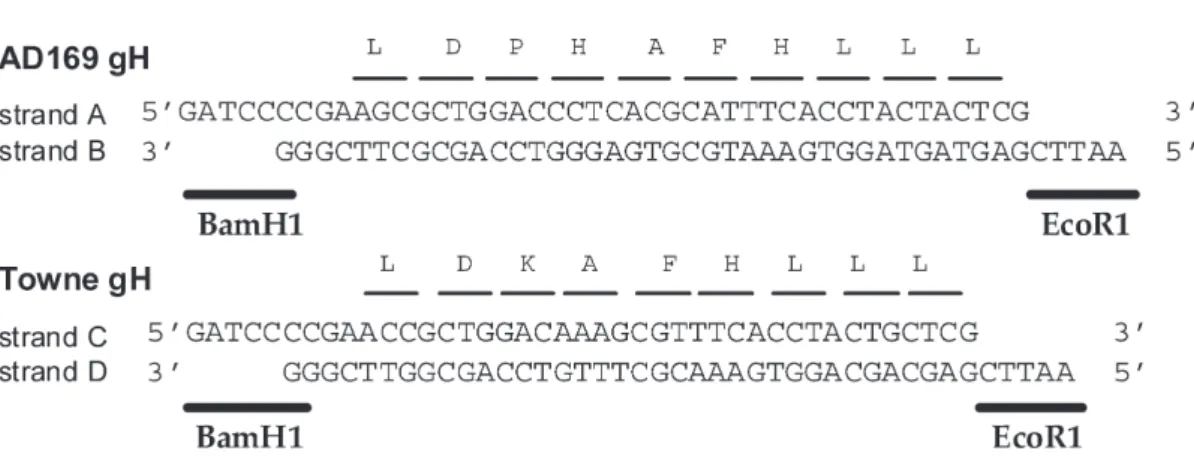
specific gH epitopes from AD169 and Towne strains (Figure 1) to detect strain

-

specific antibodies in tra- nsplant recipients. The antibodies against strain

-

specific gB AD2 site II epitopes and the strain

-

com- mon AD2 site I epitope were also investigated.

The distributions of antibody response against gly-

coproteins in Japan are summarized in Figure

2A. The ELISA usi ng these fusion proteins was

evaluated by a panel of sera obtained from 352 blood

donors whose ser ostatus had been diagnosed using a

conventional commercial ELISA kit. Among the

(4)

REINFECTION OF CYTOMEGALOVIRUS IN RENAL TRANSPLANTATION 3

255 serum samples with antibodies against gH and/

or gB, 178(69.8%) were reactive with the gB AD2 site I ELISA and 207(81.2%) with the gH ELISA, with 132 samples reactive with both gB and gH. Strain

-

specific antibody responses among the 207 gH seropositive samples showed 44 samples were reactive with the gH of both AD169 and Towne (Figure 2B). Figure 3 shows the correlation bet- ween CMV serostatus and age. The CMV seropos- itive rate was lower in subjects aged in their teens (50%) and 20’s (62%) than in the other age groups, and the rate increased significantly with increases in age, reaching 80

-

90% in subjects aged 30 years or

over. Of the 44 donors whose serum contained antibodies against both AD169 and Towne, 27 (61%) were aged 50 years or over (Figure 3 : closed col- umns). This dual

-

positive rate was significantly higher than that for donors under 50 years (p<0.01). It will indicate that organ transplantation from older donors to younger recipients ; for exam- ple, from father or mother to one of their children as is common in living related transplantation, can increase the risk of reinfection with CMV.

Association between gH antibodies and HLA

-

DR In the age

-

related distribution of strain

-

specific Fig. 1. Oligonucleotides containing CMV gH epitopes from AD169 and Towne strains used for the expression of gH

epitopes (shown at the top of the oligonucleotides) as GST fusion proteins. Each cassette has BamHI and EcoRI sites at the ends for cloning. (Ref. 21)

Fig. 2. A : Summary of number and distribution of samples according to antibody responses against strain

-

specific

gH epitopes, and gB AD2. B : Number and percentage of samples from subjects that reacted with strain

-

spe-

cific antibodies against gH and gB AD2 siteII. (Ref. 23)

(5)

antibodies against CMV gH, we found that some population of CMV

-

seropositive individuals did not have strain

-

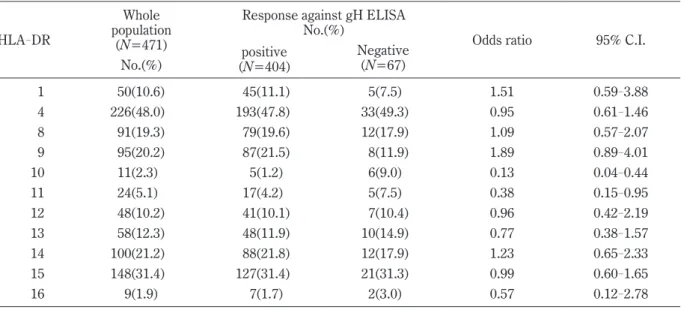
specific gH antibodies. There reported that certain HLA alleles may be associated with antibody responses against CMV glycoprotein B 24) . HLA allele distribution and positive antibod- ies against CMV gH ELISA in the total of 471 sub- jects are listed in Table 1. Positive rates were over 80% in most HLA subpopulations. HLA

-

DR9 sho- wed the highest positivity rate against CMV gH ELISA, and on the contrary, HLA

-

DR10 and DR11 were found to be associated with a significantly lower response rate against CMV gH ELISA com- pared with other groups (Figure 4) 25) . Because immune responses against CMV are so complex, the mechanisms underlying the relationship between HLA

-

DR10 or DR11 and anti

-

CMV gH antibodies are indefinite. However, in the case of lack of strain

-

specific antibodies against a donor’s CMV str- ain, CMV disease can be caused in recipients after renal transplantation 21) . Besides, carriers of HLA

-

DR11 alleles are more susceptible to active CMV infection in the case of solid organ transplanta-

tion 26,27) . An attractive hypothesis to explain this is that organ transplant recipients with HLA

-

DR11 are unlikely to have strain

-

specific antibodies against CMV gH. Further studies with larger numbers are needed.

INFLUENCE OF CYTOMEGALOVIRUS REINFEC- TION IN RENAL TRANSPLANTATION CMV infections in solid organ transplant recipi- ents induce serious direct and indirect conseque- nces. The direct clinical effects of CMV include CMV infection, CMV disease and end

-

organ dis- eases i.e. gastrointestinal disease, hepatitis, retinitis, nephritis, cystitis, myocarditis, pancreatitis and the like. In addition to the directly effects, CMV is associated with graft rejection, accelerated athero- sclerosis, and fungal or bacterial superinfection, which are known as the “indirect effects” of CMV 28) . All of these effects increase the cost of care after transplantation.

Classically, because of its high rate of CMV pri- mary infection, concern was mainly focused in CMV Fig. 3. Seroprevalence of CMV. Closed triangles indicate CMV seostatus analyzed using a conventional ELISA

kit. Rate of positive antibodies against gH (open columns) and rate of positive strain

-

specific antibodies against

both AD169 and Towne strains (closed columns) according to age. Age group and number of serum samples are

shown on the holizontal axis. (Ref. 23)

(6)

REINFECTION OF CYTOMEGALOVIRUS IN RENAL TRANSPLANTATION 5

D+/R− transplantation. However, in the D+/R+

transplantation, the presence of antibodies against matched CMV gH epitopes had influences to the outcome of transplantation. More adverse event was observed in the case of reinfection of different

CMV strain.

Classification of patients according to CMV gH anti- body responses

On the basis of the combinations of antibody Table 1. Distribution of subjects carrying at least one given HLA allele in the whole population and

response against CMV gH ELISA (Ref. 25)

HLA

-

DR

Whole population

(N=471)

Response against gH ELISA No.(%)

Odds ratio 95% C.I.

positive

(N=404) Negative

(N=67) No.(%)

1 50(10.6) 45(11.1) 5(7.5) 1.51 0.59

-

3.88

4 226(48.0) 193(47.8) 33(49.3) 0.95 0.61

-

1.46

8 91(19.3) 79(19.6) 12(17.9) 1.09 0.57

-

2.07

9 95(20.2) 87(21.5) 8(11.9) 1.89 0.89

-

4.01

10 11(2.3) 5(1.2) 6(9.0) 0.13 0.04

-

0.44

11 24(5.1) 17(4.2) 5(7.5) 0.38 0.15

-

0.95

12 48(10.2) 41(10.1) 7(10.4) 0.96 0.42

-

2.19

13 58(12.3) 48(11.9) 10(14.9) 0.77 0.38

-

1.57

14 100(21.2) 88(21.8) 12(17.9) 1.23 0.65

-

2.33

15 148(31.4) 127(31.4) 21(31.3) 0.99 0.60

-

1.65

16 9(1.9) 7(1.7) 2(3.0) 0.57 0.12

-

2.78

Fig. 4. Percentages of serum samples which had no response against CMV gH ELISA in each HLA type subpopula-

tion. *Subjects with HLA

-

DR10 showed significantly lower response rate against gH ELISA compared with

subjects with HLA

-

DR1, DR4, DR8, DR9, DR12, DR13 DR14 and DR15. **Subjects with HLA

-

DR11 showed

significantly lower response rate compared with subjects with HLA

-

DR1, DR9 and DR14. (Ref. 25).

(7)

responses against the strain

-

specific gH epitopes, the conventional CMV D+/R+ pairings are classi- fied into two groups. When a recipient received an organ graft from a donor who has the same strain

-

specific gH antibody of CMV as the recipient, the pairing classified as ‘matched gH’ pairing. The pai- rings that the recipients do not have the strain

-

spe- cific gH antibodies which matched to their donor’s are classified as ‘mismatched gH’ pairings. Our data which analysed 101 pairings of renal transplan- tation showed the differences among the D+/R−, matched gH and mismatched gH pairings in the clin- ical course after renal transplantation.

CMV disease and antigenemia

The data which analyzed consecutive 77 D+/

R+ transplant recipients showed that the recipients in the gH

-

matched group were more likely to be protected from CMV disease compared with those in the gH

-

mismatched group or D+/R− group (Table 2). Although statistical differences in the incidence of CMV infection were not observed, CMV disease was significantly more prevalent in the mismatched group than in the matched group. The proportion of cases of CMV infection that progressed to CMV disease in the strain

-

specific antibody

-

mismatched and antibody

-

matched groups were 64% and 17%, respectively (P=0.0038). Among the D+/R−

pairs, 67% of recipients had CMV infection, and 54%

of them developed CMV disease.

The maximum numbers of pp65

-

positive cells obtained during the follow up antigenemia assay after renal transplantation are plotted in Figure 5. The difference in the maximum positive cell numbers in the gH antibody

-

matched group was sta- tistically significant compared with gH antibody

-

mismatched group and D+/R− group. These find- ings indicate the relationship between the degree of neutralization and outcome of transplantation in the D+/R+ setting. In addition to the gH antibody, the absence of antibody responses against gB AD2 can

be a good indicator for CMV disease 29) .

CMV strain

-

specific ELISA can reveal the str- ain

-

specific sero

-

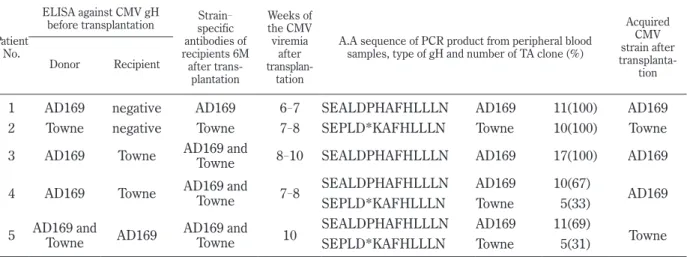
status and it also allow us to esti- mate the type of CMV glycoprotein H persisting in the subject. The nucleotide sequence of the region of the glycoprotein H epitope in the CMV

-

DNA extracted from the transplant recipients who showed high degree of antigenemia during the follow up revealed that CMV strains causing infection were of donor origin (Table 3).

The combination of strain

-

specific CMV

-

gH antibody responses in transplant donors and recipi- ent can predict the possibility of CMV reinfection after transplantation. The high degrees of antigen- emia and high incidences of CMV disease are more prevalent in the case of reinfection of CMV after transplantation.

Acute rejection and CMV serostatus

The indirect CMV effects result in organ injury and damage. Several studies have implicated CMV in acute rejection after renal transplantation. A large retrospective study of renal and pancreas

-

renal transplantation found that the risk of renal allograft loss was increased in the presence of CMV dis- ease 5) . A prospective study of 106 renal transplant recipients concluded that CMV disease, but not asymptomatic CMV infection, was independently associated with biopsy

-

proven acute allograft rejec- tion 30) .

Classically, renal allografts in D+/R− settings were considered to be at higher risk of acute rejec- tion and graft loss 31) . However, some of the recipi- ents in the conventionally classified D+/R+ pairings experience different outcomes after transplantation than was expected according to CMV gH strain

-

spe- cific antibody matching. The occurrence of acute rejection after transplantation are prevalent in the cases of D+/R+ transplantation with mismatched gH antibodies (Figure 6) 21) . The reason why the incidence of acute rejection in the mismatched gH

Table 2. CMV infection and CMV disease after renal transplantation (Ref. 21) CMV status/

strain

-

specific Ab status

D+/R+

D+/R− total

matched mismatched

No. of patients 45 32 24 101

Mean weeks (range) of the initial

antigenemia detection 7(1

-

20) 7(4

-

13) 8(1

-

20) 7(1

-

20)

No.(%) of positive antigenemia 23(51) 14(44) 16(67) 53(52)

No.(%) of CMV disease 4(9) 9(28) a 13(54) b 26(26)

a p=0.026 vs. matched, b p=0.0008 vs. matched

(8)

REINFECTION OF CYTOMEGALOVIRUS IN RENAL TRANSPLANTATION 7

antibody group has been higher than that observed in the matched group is not entirely clear. It is pos- sible that acute rejection is the consequence of strong recipient

-

derived cytotoxic T lymphocyte

responses against ongoing CMV activities that had escaped humoral responses. Lack of CMV specific memory T cells may contribute to the lower rate of acute rejection in D+/R− setting.

Fig. 5. Antigenemia in the transplant recipients. Maximum number of pp65

-

positive cells during the monitoring period (6 months) for each recipient with CMV infection was plotted. The broken bars in the box plot indicate the median of the pp65

-

positive cells. (Ref. 21)

Table 3. Strain

-

specific antibody responses and amino acid sequences of CMV glycoprotein H (Ref. 23)

Patient No.

ELISA against CMV gH

before transplantation Strain

-

specific antibodies of recipients 6M

after trans- plantation

Weeks of the CMV viremia

after transplan-

tation

A.A sequence of PCR product from peripheral blood samples, type of gH and number of TA clone (%)

Acquired CMV strain after transplanta- Donor Recipient tion

1 AD169 negative AD169 6

-

7 SEALDPHAFHLLLN AD169 11(100) AD169

2 Towne negative Towne 7

-

8 SEPLD*KAFHLLLN Towne 10(100) Towne

3 AD169 Towne AD169 and

Towne 8

-

10 SEALDPHAFHLLLN AD169 17(100) AD169

4 AD169 Towne AD169 and

Towne 7

-

8 SEALDPHAFHLLLN AD169 10(67)

AD169

SEPLD*KAFHLLLN Towne 5(33)

5 AD169 and

Towne AD169 AD169 and

Towne 10 SEALDPHAFHLLLN AD169 11(69)

Towne

SEPLD*KAFHLLLN Towne 5(31)

(9)

Prophylaxis strategies, rather than preemptive therapies, can have efficacy on preventing CMV indirect effect. Kleim et al. 32) reported that univer- sal CMV prophylaxis with oral gancyclovir improved long

-

term renal graft survival compared with pre- emptive therapy. The most significant effect was observed in D+/R+ subgroup. The recipients of the D+/R+ group with gH mismatch antibodies are most likely to have benefits of CMV prophylaxis strategy.

CONCLUSION

Among the CMV D+/R+ renal transplant recip- ients, more adverse events were observed when the CMV gH antibodies were mismatched, indicating that reinfection with a different CMV strain may increase complications. The ELISA using the anti- gens of recombinant gH and gB will provide useful

information regarding antibody responses against CMV, predicting CMV reinfection.

ACKNOwLEdGEMENT

This work was supported by a Grant

-

in

-

Aid for Scientific Research from the Japan Society for the Promotion of Science (No. 16591609) and a grant from the Fukushima Society for the Promotion of Medicine.

CONFLICT OF INTEREST STATEMENT No authors have any conflicts of interest to declare.

REFERENCES

1. Meier

-

Kriesche HU, Schold JD, Srinivas TR and Fig. 6. (A) Summary of incidences of acute rejection. a p=0.014 vs. mismatched, b p=0.0051 vs. mismatched (B)

Kaplan

-

Meier curves for the cumulative probability of freedom from biopsy

-

proven acute rejection. The inci- dence of acute rejection in the CMV strain

-

specific antibody mismatched group was significantly higher than those in the D+/R− and strain

-

specific antibody matched group (p=0.002). (Ref.21)

CMV status/

strain

-

specific Ab status

D+/R+

D+/R− total

matched mismatched

No. patients 45 32 24 101

No.(%) of recipients with

acute rejection 10 (22) a 17 (53) 5 (21) b 32 (32) Mean±SD of days of rejection

after transplantation 16±9 23±34 39±42 25±32

a p=0.0051, b p=0.014

A

B

(10)

REINFECTION OF CYTOMEGALOVIRUS IN RENAL TRANSPLANTATION 9

Kaplan B. Lack of improvement in renal allograft survival despite a marked decrease in acute rejec- tion rates over the most recent era. Am J Transplant, 4 : 378

-

383, 2004.

2. Lautenschlager I, Soots A, Krogerus L, Kauppinen H, Saarinen O, Bruggeman C and Ahonen J. Eff- ect of cytomegalovirus on an experimental model of chronic renal allograft rejection under triple

-

drug treatment in the rat. Transplantation, 64 : 391

-

398, 1997.

3. Humar A, Gillingham KJ, Payne WD, Dunn DL, Sutherland DE and Matas AJ. Association between cytomegalovirus disease and chronic rejection in kidney transplant recipients. Trans- plantation, 68 : 1879

-

1883, 1999.

4. McLaughlin K, Wu C, Fick G, Muirhead N, Hollo- mby D and Jevnikar A. Cytomegalovirus sero- mismatching increases the risk of acute renal allo- graft rejection. Transplantation, 74 : 813

-

816, 2002.

5. Nett PC, Heisey DM, Fernandez LA, Sollinger HW and Pirsch JD. Association of cytomegalovirus disease and acute rejection with graft loss in kid- ney transplantation. Transplantation, 78 : 1036

-

1041, 2004.

6. Schnitzler MA, Woodward RS, Brennan DC, Spitz- nagel EL, Dunagan WC and Bailey TC. Impact of cytomegalovirus serology on graft survival in liv- ing related kidney transplantation : implications for donor selection. Surgery, 121 : 563

-

568, 1997.

7. Schnitzler MA, Woodward RS, Brennan DC, Spitz- nagel EL, Dunagan WC and Bailey TC. The effects of cytomegalovirus serology on graft and recipient survival in cadaveric renal trans- plantation : implications for organ allocation. Am J Kidney Dis, 29 : 428

-

434, 1997.

8. Larsson S, Soderberg

-

Naucler C and Moller E.

Productive cytomegalovirus (CMV) infection exc- lusively in CD13

-

positive peripheral blood mono- nuclear cells from CMV

-

infected indivi- duals : implications for prevention of CMV transmission. Transplantation, 65 : 411

-

415, 1998.

9. Egli A, Binggeli S, Bodaghi S, Dumoulin A, Funk GA, Khanna N, Leuenberger D, Gosert R and Hirsch HH. Cytomegalovirus and polyomavirus BK posttransplant. Nephrol Dial Transplant, 22 Suppl 8 : viii72

-

viii82, 2007.

10. Britt WJ and Mach M. Human cytomegalovirus glycoproteins. Intervirology, 39 : 401

-

412, 1996.

11. Keay S and Baldwin B. Anti

-

idiotype antibodies that mimic gp86 of human cytomegalovirus inhibit viral fusion but not attachment. J Virol, 65 : 5124

-

5128, 1991.

12. Hobom U, Brune W, Messerle M, Hahn G and Koszinowski UH. Fast screening procedures for random transposon libraries of cloned herpesvirus

genomes : mutational analysis of human cytomeg- alovirus envelope glycoprotein genes. J Virol, 74 : 7720

-

7729, 2000.

13. Urban M, Klein M, Britt WJ, Hassfurther E and Mach M. Glycoprotein H of human cytomegalovi- rus is a major antigen for the neutralizing humoral immune response. J Gen Virol, 77(Pt 7) : 1537

-

1547, 1996.

14. Chou S. Molecular epidemiology of envelope gly- coprotein H of human cytomegalovirus. J Infect Dis, 166 : 604

-

607, 1992.

15. Boppana SB, Rivera LB, Fowler KB, Mach M and Britt WJ. Intrauterine transmission of cytomega- lovirus to infants of women with preconceptional immunity. N Engl J Med, 344 : 1366

-

1371, 2001.

16. Meyer H, Sundqvist VA, Pereira L and Mach M.

Glycoprotein gp116 of human cytomegalovirus contains epitopes for strain

-

common and strain

-

specific antibodies. J Gen Virol, 73(Pt 9) : 2375

-

2383, 1992.

17. Ohlin M, Sundqvist VA, Mach M, Wahren B and Borrebaeck CA. Fine specificity of the human immune response to the major neutralization epit- opes expressed on cytomegalovirus gp58/116 (gB), as determined with human monoclonal antibod- ies. J Virol, 67 : 703

-

710, 1993.

18. Schoppel K, Hassfurther E, Britt W, Ohlin M, Borrebaeck CA and Mach M. Antibodies specific for the antigenic domain 1 of glycoprotein B (gpUL55) of human cytomegalovirus bind to differ- ent substructures. Virology, 216 : 133

-

145, 1996.

19. Fowler KB, Stagno S and Pass RF. Maternal immunity and prevention of congenital cytomega- lovirus infection. Jama, 289 : 1008

-

1011, 2003.

20. Lagasse N, Dhooge I and Govaert P. Congenital CMV

-

infection and hearing loss. Acta Otorhino- laryngol Belg, 54 : 431

-

436, 2000.

21. Ishibashi K, Tokumoto T, Tanabe K, Shirakawa H, Hashimoto K, Kushida N, Yanagida T, Inoue N, Yamaguchi O, Toma H et al. Association of the outcome of renal transplantation with antibody response to cytomegalovirus strain

-

specific glyco- protein H epitopes. Clin Infect Dis, 45 : 60

-

67, 2007.

22. Klein M, Schoppel K, Amvrossiadis N and Mach M. Strain

-

specific neutralization of human cyto- megalovirus isolates by human sera. J Virol, 73 : 878

-

886, 1999.

23. Ishibashi K, Tokumoto T, Shirakawa H, Hashimoto K, Kushida N, Yanagida T, Shishido K, Aikawa K, Yamaguchi O, Toma H et al. Strain

-

specific sero- epidemiology and reinfection of cytomegalovirus.

Microbes Infect, 10 : 1363

-

1369, 2008.

24. Wada K, Mizuno S, Ohta H and Nishiyama Y.

Immune response to neutralizing epitope on

human cytomegalovirus gylcoprotein B in Japa-

(11)

nese : correlation of serologic response with HLA

-

type. Microbiol Immunol, 41 : 841

-

845, 1997.

25. Ishibashi K, Tokumoto T, Shirakawa H, Hashimoto K, Kushida N, Yanagida T, Shishido K, Aikawa K, Yamaguchi O, Toma H et al. Association between antibody response against cytomegalovirus strain

-

specific glycoprotein H epitopes and HLA

-

DR. Microbiol Immunol, 53 : 412

-

416, 2009.

26. Retiere C, Lesimple B, Lepelletier D, Bignon JD, Hallet MM and Imbert

-

Marcille BM. Association of glycoprotein B and immediate early

-

1 genotypes with human leukocyte antigen alleles in renal tran- splant recipients with cytomegalovirus infection.

Transplantation, 75 : 161

-

165, 2003.

27. Fan J, Meng XQ, Yang MF, Zhou L, Chen XM, Hu MJ, Fan WW, Ma WH and Li LJ. Association of cytomegalovirus infection with human leukocyte antigen genotypes in recipients after allogeneic liver transplantation. Hepatobiliary Pancreat Dis Int, 5 : 34

-

38, 2006.

28. Ljungman P, Griffiths P and Paya C. Definitions of cytomegalovirus infection and disease in transplant recipients. Clin Infect Dis, 34 : 1094

-

1097, 2002.

29. Ishibashi K, Tokumoto T, Shirakawa H, Hashimoto

K, Ikuta K, Kushida N, Yanagida T, Shishido K, Aikawa K, Toma H et al. Lack of antibodies against the antigen domain 2 epitope of cytomega- lovirus (CMV) glycoprotein B is associated with CMV disease after renal transplantation in recipi- ents having the same glycoprotein H serotypes as their donors. Transpl Infect Dis. 2010 Aug 30. [Epub ahead of print]

30. Reischig T, Jindra P, Svecova M, Kormunda S, Opatrny K, Jr. and Treska V. The impact of cytomegalovirus disease and asymptomatic infec- tion on acute renal allograft rejection. J Clin Virol, 36 : 146

-

151, 2006.

31. McLaughlin K, Sandhu S, Wu C, Muirhead N, Hollomby D and Jevnikar A. Transplanting kid- neys from CMV

-

seropositive donors to CMV

-

seronegative recipients is not associated with poorer renal allograft function or survival.

Nephrol Dial Transplant, 20 : 176

-

180, 2005.

32. Kliem V, Fricke L, Wollbrink T, Burg M,

Radermacher J and Rohde F. Improvement in

long

-

term renal graft survival due to CMV prophy-

laxis with oral ganciclovir : results of a randomized

clinical trial. Am J Transplant, 8 : 975

-

983, 2008.

Fig. 2.  A : Summary of number and distribution of samples according to antibody responses against strain - specific  gH epitopes, and gB AD2
Fig. 4.  Percentages of serum samples which had no response against CMV gH ELISA in each HLA type subpopula- subpopula-tion
Table 2.  CMV infection and CMV disease after renal transplantation (Ref. 21) CMV status/
Table 3.  Strain - specific antibody responses and amino acid sequences of CMV glycoprotein H (Ref

参照

関連したドキュメント

2 Combining the lemma 5.4 with the main theorem of [SW1], we immediately obtain the following corollary.. Corollary 5.5 Let l &gt; 3 be

It is suggested by our method that most of the quadratic algebras for all St¨ ackel equivalence classes of 3D second order quantum superintegrable systems on conformally flat

This paper develops a recursion formula for the conditional moments of the area under the absolute value of Brownian bridge given the local time at 0.. The method of power series

Answering a question of de la Harpe and Bridson in the Kourovka Notebook, we build the explicit embeddings of the additive group of rational numbers Q in a finitely generated group

Then it follows immediately from a suitable version of “Hensel’s Lemma” [cf., e.g., the argument of [4], Lemma 2.1] that S may be obtained, as the notation suggests, as the m A

In our previous paper [Ban1], we explicitly calculated the p-adic polylogarithm sheaf on the projective line minus three points, and calculated its specializa- tions to the d-th

Our method of proof can also be used to recover the rational homotopy of L K(2) S 0 as well as the chromatic splitting conjecture at primes p &gt; 3 [16]; we only need to use the

In this paper we focus on the relation existing between a (singular) projective hypersurface and the 0-th local cohomology of its jacobian ring.. Most of the results we will present