POLICY STUDY No.9
A Study on Conditions and Promotion Policy for Successful Regional Innovation
- Developing Japanese-Type Sustainable Regional Clusters -
Summary May 2004
Third Policy-Oriented Research Group
National Institute of Science and Technology Policy (NISTEP)
1. Framework
We analyzed conditions and ideal promotion policies for developing Japanese regional clusters.
We considered whether or not advanced overseas clusters were applicable to the Japanese society.
In our preliminary report released in March 2003, (see http://www.nistep.go.jp/index-j.html) we argued that the deep involvement of academic institutions, including universities, constituted an important condition for developing regional clusters in Europe and North America. We also argued that research-and-development-type start-ups were important for clusters to be connected with their regions.
Here, we identified conditions of successful regional clusters and also presented policy recommendations for developing Japanese-type clusters, taking into account the unique features of the Japanese administration, society, and culture.
2. The Strengths of Potential Japanese Clusters and Conditions Necessary for Short-Term Cluster Growth
Few of the conditions of overseas success can be applied to Japanese regional clusters. We identified the following fifteen conditions of success in Japan, based on the findings of our field studies. We compared these conditions with the conditions of overseas success. We divided the conditions unique to Japan into three steps, formation, promotion, and output. It should be noted that clusters do not necessarily follow these steps, but develop in a variety of ways, reflecting regions’ characteristics.
≪Conditions of Success in Japan≫
《Formation Conditions》No less than one
1. Whether or not there is intellectual agglomeration (Tsukuba, Kyoto)
2. Whether or not the cluster has world-class high technologies (rare sugar in Kagawa, experimental animals in Kumamoto, and organic EL [electro-luminescence] in Yamagata)
3. Whether or not the cluster has local industries and technologies being connected with their regions (Fukui, Higashi Osaka, and Tama)
4. Whether or not the cluster has mid-sized corporations that can play a leading role (pharmaceutical companies in Tokushima)
5. Whether or not the cluster has start-ups that can play a leading role (Sapporo, Hamamatsu, Toyohashi)
6. Whether or not rcluster members share a sense of economic crisis (Kobe)
《Promotion Conditions》
7. Whether or not local governments are taking the initiative in regional cluster formation
8. Whether or not supporting infrastructure is sufficient (incubation facilities, start-up capital, coordination function)
9. Whether or not there is R&D collaboration among universities, laboratories, and regional industries
10. Whether or not the cluster has core leaders in the region
11. Whether or not the cluster collaborates with large corporations targeting the global market 12. Whether or not the regional cluster collaborates and/or competes with its counterparts elsewhere
《Output Conditions》
13. Whether or not groups of start-ups are emerging in the regional cluster 14. Whether or not the cluster attracts attention within the region and from outside 15. Whether or not there are corporate and human resource migrations from other clusters (3)
(4) (2) (1)
Note: (1), (2), (3), and (4) above applies to the formation bases of regional clusters, (1) intellectual agglomeration, (2) corporate agglomeration, (3) core start-ups, and (4) sense of economic crisis.
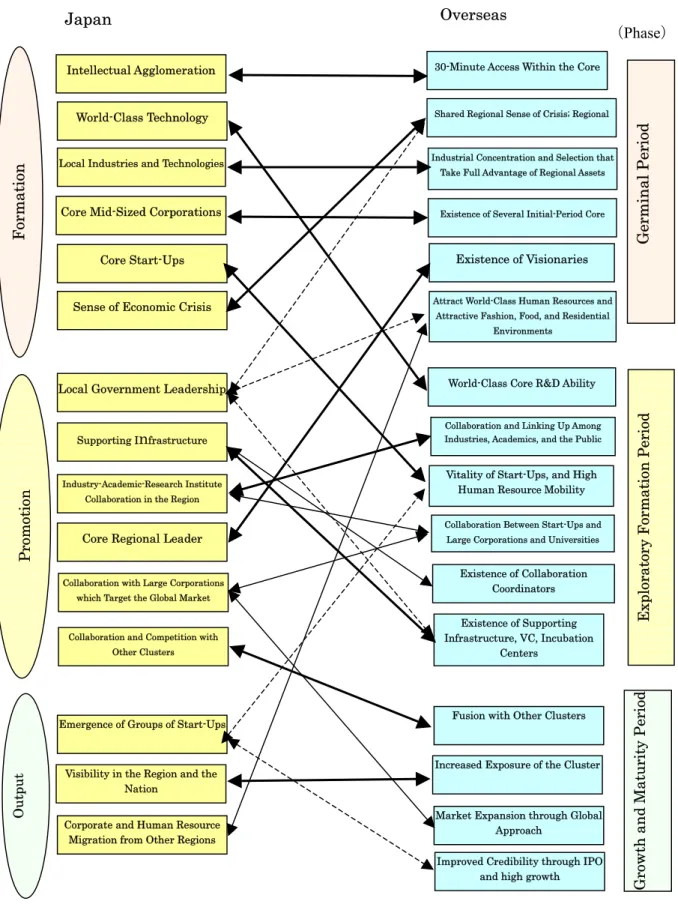
Figure 1 shows the relationship between conditions of success in Japan and overseas. All of these conditions correspond with each other either directly or indirectly. The difference in emphasis appears to be the result of differences in national and social characteristics among the respective countries.
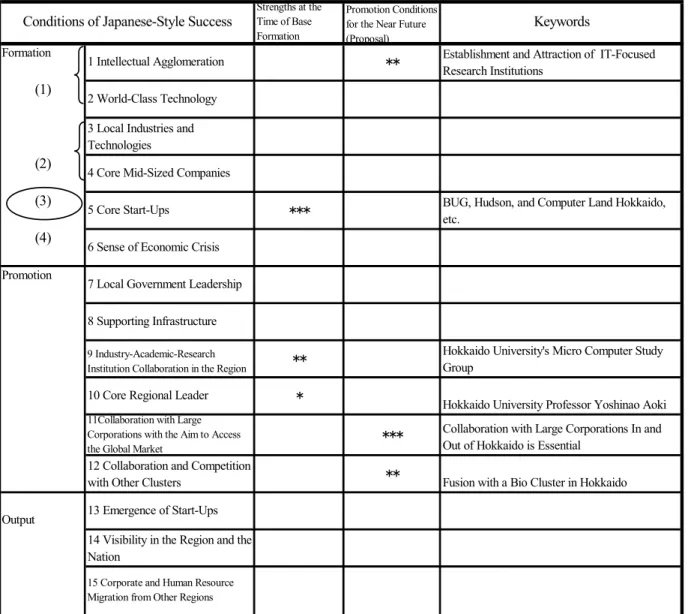
Comparative Analysis Chart: Strengths at the Time of Cluster Formation and Conditions Necessary for Short-Term Cluster Growth. The chart covers the seventeen Japanese regions subject to this study. This chart lists three strengths and three weaknesses for each regional cluster, selected from the list of the conditions of Japanese success, with the marks ***, ** and *, in order of intensity. It should be noted that the lists were decided through discussions by all the researchers involved. These discussions were based on the analysis of researchers’ field studies in each region, as well as other relevant materials. Our Proposal for the Promotion Conditions for the Near Future in the chart should be construed as our suggestion and message based on the finding of field studies.
In Figure 2, we showed our comparative analysis chart for four Japanese regions based on four distinctive cluster formation conditions, (1) intellectual agglomeration, (2) corporate agglomeration, (3) core start-ups, and (4) having a sense of economic crisis. Each of these conditions corresponds to the following regions, and is a central formation condition in: (1) Kagawa, (2) Fukui, (3) Sapporo, and (4) Kobe.
Figure 1 Conditions for Successful Regional Clusters in Japan and Overseas
Intellectual Agglomeration
World-Class Technology
Local Industries and Technologies
Core Mid-Sized Corporations
Core Start-Ups
Sense of Economic Crisis
Local Government Leadership
Supporting Infrastructure
Industry-Academic-Research Institute Collaboration in the Region
Core Regional Leader
Collaboration with Large Corporations which Target the Global Market
Collaboration and Competition with Other Clusters
Emergence of Groups of Start-Ups
Visibility in the Region and the Nation
Corporate and Human Resource Migration from Other Regions
30-Minute Access Within the Core
Shared Regional Sense of Crisis; Regional
Industrial Concentration and Selection that Take Full Advantage of Regional Assets
Existence of Several Initial-Period Core
Attract World-Class Human Resources and Attractive Fashion, Food, and Residential
Environments
World-Class Core R&D Ability
Vitality of Start-Ups, and High Human Resource Mobility
Collaboration Between Start-Ups and Large Corporations and Universities
Existence of Collaboration Coordinators
Existence of Supporting Infrastructure, VC, Incubation
Centers
Market Expansion through Global Approach
Improved Credibility through IPO and high growth Existence of Visionaries
Collaboration and Linking Up Among Industries, Academics, and the Public
Fusion with Other Clusters
Increased Exposure of the Cluster
Germinal Period Exploratory Formation Period Growth and Maturity Period Overseas
(Phase)
Japan
Formation Promotion Output
Figure 2
Comparative Analysis Chart for Strengths at the Time of Cluster Formation and Conditions Necessary for Short-Term GrowthSapporo IT Cluster Formation Base:(3) Core Start-Ups
Formation
(3) (4) Promotion
7 Local Government Leadership
Fusion with a Bio Cluster in Hokkaido
15 Corporate and Human Resource Migration from Other Regions 14 Visibility in the Region and the Nation
**
Hokkaido University's Micro Computer Study Group
Hokkaido University Professor Yoshinao Aoki 9 Industry-Academic-Research
Institution Collaboration in the Region
11Collaboration with Large Corporations with the Aim to Access the Global Market
1 Intellectual Agglomeration 2 World-Class Technology
4 Core Mid-Sized Companies
Output
12 Collaboration and Competition with Other Clusters
**
***
**
* 3 Local Industries and
Technologies
5 Core Start-Ups
13 Emergence of Start-Ups 10 Core Regional Leader
***
Establishment and Attraction of IT-Focused Research Institutions
Collaboration with Large Corporations In and Out of Hokkaido is Essential
BUG, Hudson, and Computer Land Hokkaido, etc.
Conditions of Japanese-Style Success
8 Supporting Infrastructure
Keywords
6 Sense of Economic Crisis
Promotion Conditions for the Near Future (Proposal) Strengths at the
Time of Base Formation
(1)
(2)
Kagawa Rare Sugar Cluster
Formation Base: (1) Intellectual Agglomeration
Formation
Promotion (1)
(2)
(3) (4)
Leaders who can lead the region with their global perspectives are needed
Collaboration with life science-focused large corporations in the surrounding area 4 Core Mid-Sized Companies
5 Core Start-Ups
Prefectural Sugar Quality Bio-Cluster Concept
Intellectual/Industry Cluster Operations
**
*
15 Corporate and Human Resource Migration from Other Regions
14 Noticeability in the Region and the Nation
Conditions of Japanese-Style Success Strengths at the Time of Base Formation
13 Emergence of Start-Ups 10 Core Regional Leader 9 Industry-Academic-Research Institution Collaboration in the Region
11Collaboration with Large
Corporations with the Aim of Accessing the Global Market
***
**
6 Sense of Economic Crisis 7 Local Government Leadership
Output
12 Collaboration and Competition with Other Clusters
* 3 Local Industries and
Technologies
8 Supporting Infrastructure 1 Intellectual Agglomeration 2 World-Class Technology
Keywords
***
Mass Production Technology of Rare Sugar
Emergence of Start-Ups Promotion Conditions
for the Near Future (Proposal)
Fukui Nano-Cluster Formation Base: (2) Corporate Agglomeration
Formation
Promotion
Textile Industry and Galvanizing Technology
***
**
* 6 Sense of Economic Crisis
7 Local Government Leadership 8 Supporting Infrastructure
Coordinated Efforts by the Prefecture Government, Prefectural Foundations, and Prefectural Laboratories
15 Corporate and Human Resource Migration from Other Regions
14 Visibility in the Region and the Nation
13 Emergence of Start-Ups
Conditions of Japanese-Style Success Strengths at the Time of Base Formation
Collaboration Between Fukui University and Local Industries (Urban Area Operations, etc.) Leaders who can lead the region with their global perspectives are needed
There are only few potential customers among local large corporations (Large companies in Osaka)
1 Intellectual Agglomeration 2 World-Class Technology
4 Core Mid-Sized Companies 5 Core Start-Ups
Output
12 Collaboration and Competition with Other Clusters
* 3 Local Industries and
Technologies
10 Core Regional Leader 9 Industry-Academic-Research Institution Collaboration in the Region
11Collaboration with Large
Corporations with the Aim of Accessing the Global Market
Keywords
**
Emergence of Start-Ups
***
Promotion Conditions for the Near Future (Proposal)
(1)
(3) (4) (2)
Kobe Bio Cluster Formation Base: (4) Sense of Economic Crisis
Formation
Promotion (1)
(2)
(3) (4)
Keywords
***
Would the pickup group of start-ups be able to produce successful results?
Would the collaboration between large corporations and start-ups progress?
Promotion Conditions for the Near Future (Proposal)
Output
12 Collaboration and Competition with Other Clusters
3 Local Industries and Technologies
Conditions of Japanese-Style Success
15 Corporate and Human Resource Migration from Other Regions
Strengths at the Time of Base Formation
13 Emergence of Start-Ups 10 Core Regional Leader 9 Industry-Academic-Research Institution Collaboration in the Region
14 Noticeability in the Region and the Nation
11Collaboration with Large
Corporations with the Aim of Accessing the Global Market
1 Intellectual Agglomeration 2 World-Class Technology
4 Core Mid-Sized Companies 5 Core Start-Ups
6 Sense of Economic Crisis 7 Local Government Leadership 8 Supporting Infrastructure
**
***
*
Would the Kobe University be able to play a central role?
**
Riken and its Center for Developmental Biology
Basic Concept by Bechtel, Inc.
Starting point was the Great Hanshin-Awaji Earthquake in 1995
*
3. Human Resource Mobility and Improvement of “The Ability to Attract”
- Making Region into an Attractive Venue for both the Japanese and Non-Japanese
As most central functions in Japan are concentrated in the Tokyo Metropolitan area, science and technology resources are also very heavily agglomerated in the area. However, in defiance of this trend, certain agglomerations have started forming in certain regional cities, including Sapporo, Yokosuka, Kobe, Kita Kyushu and Fukuoka, where research institutes and corporations have migrated.
One of the noteworthy conditions for such R&D function agglomeration is human resource mobility, which is supported by regional diversity and openness. This is a very important element for cluster formation. Also, creation of an environment into which foreigners can move easily and have cultural exchange would further improve regional diversity and openness.
One of the promotion conditions for successful formation of regional clusters, identified by overseas success, is “nation-wide recognition,” in other words “increasing reputation of the cluster,” and we consider this important in creating a region-wide sense of solidarity, an active approach, or sharing sense of crisis. In fact, the Sapporo Valley, which can be recognized as the only existing established cluster in Japan, is well known all over the nation since the publication of the book “The Birth of Sapporo Valley” in 2000. In addition, considering the necessity for Japanese clusters to collaborate with the rest of the world in the terms of human resources and markets, actively exchanging information in English is highly important.
4. Formation of Public R&D Bases and Strengthening of Their Functions - Universities and Public Research Institutes as a Core of Knowledge Creation
In advanced overseas clusters, universities and public research institutes are deeply involved in developing clusters; on the other hand, in Japan, weak organized efforts on the part of universities in industry-academic-government collaboration, as well as excessive concentration of national research institutes in the Tokyo Metropolitan area, have hindered effective regional cluster formations.
For developing clusters designed for promoting chain-reactive innovation, a sustainable knowledge creation process becomes essential. Universities in each region can play a leading role in this regard and also serves as sources of knowledge and human resources.
For developing human resources at universities, aimed at creating chain-reactive innovation, it is important to raise new talents capable of launching and managing new organizations, in addition to having science and technology backgrounds. This is to improve the entrepreneurial
spirit among them, and also to produce young talent that has the potential to become CEO candidates at technology-related start-ups. Also, it is necessary to offer multiple interdisciplinary graduate programs that teach students to integrate different type of knowledge since new human resources who can thrive in frontier/germinal arenas are in demand in many advanced clusters.
When developing and strengthening such an interdisciplinary talent-raising system, it becomes extremely important to improve and strengthen education and research at the graduate school, rather than at undergraduate. Especially, at regional universities whose required education and research resources are unlikely to reach critical mass, in comparison with their top-level counterparts, the pursuit of inter-collegial collaboration with neighboring areas could become an important survival measure.
Public research institutes, along with universities, could become a part of the core of regional clusters. Their research activities, with clarified goals based on public needs, are attractive from corporate perspectives. Attracting new core institutes and positioning existing public research institutes as core institutes would encourage the incoming migration of corporations that desire using state-of-the-art technologies.
5. Creating Venue and Deepening Collaboration Through Network Building - Securing Sustainability and the Importance of Inter-Sector Collaboration
In the formation of regional clusters through industry-academic-government collaboration, as well as the promotion of sustainable innovation, the following conditions will become important:
human resources, tangible assets, and financing; information that facilitates a positive feedback loop among industries, academics, and the government; the sustainability for each of those conditions. Major features of the essence of sustainability can be described as follows:
≪Major Features of Sustainability in Each Regional Innovation Factor≫
Factor Features of Sustainability
Human Resources
・ Sustainable training of technology and science human resources with diverse skills and qualifications at the region’s higher education institutions, including universities and vocational schools
・ Maintenance and agglomeration of human resources with practical ability and experience, as well as those individuals with rich start-up drive (including those who return to their home areas from urban centers)
Assets analysis/measuring equipment, trial manufacturing plant, and incubation facilities
・Real-time and continuous provisions of “technology seeds” which are based on knowledge creation by universities and other sources, and also are expected to lead to successful businesses
Financing
・ Utilizing public funds and programs as an initial-phase trigger
・ Securing large sums of money which are sufficient to fund trial manufacturing development, and mass production tests (venture capital, stock markets, and taking full advantage of various investment and financing systems)
・ Reinvesting business profits in the knowledge creation cycle
Information
・ Building regional common venues and networks for sharing and disseminating information regarding the following:
- major players in the industries, academics, and government who are involved in developing clusters
- operative technology and business seeds originated in corporations and universities, and developed by spin-off start-ups
The essence of the effect of the collaboration between industry, academia and the government is the maintenance of the above sustainability through cooperation and joint-creation among different sectors. In this scheme, the following become important: the formation of common venue, network-building, and intra-sector collaboration and functional reform through deepening collaborations among different sectors.
Specific examples of collaboration within sectors include the following: the collaboration between universities including comprehensive collaboration with corporations; the collaboration between industries that includes the vertical integration of different kinds of industries and collaborative innovation by high-tech companies of mid- and small-sizes; and the collaboration within government which involves, for example, joint utilization of R&D resources in the fields of agriculture, forestry, and commerce.
6. The Ideal for Japanese-Style Leadership by Diverse Key Persons (Visionaries)
-Insights, Clear Vision, and Centripetal Force That Enable Formation of Effective Future Strategies
The cluster in Austin, Texas, in the United States is facing difficulties in its search for direction in the short- and long-term after the death of Dr. George Kozmetsky, who exercised strong leadership in developing the cluster, in the post-IT bubble period in 2003. This suggests that relying solely on the insights and leadership of a single leader on one hand enables effective cluster development, but on the other hand, it could pose questions of vulnerability.
The existence of a leader with insights and clear vision for future strategies, and a centripetal charm that attracts quality talent, is essential. However, in Japan, industries, universities, and the government each make use of a multiple and diverse leadership to formulate clusters, without relying on a single leader. This form of cluster leadership tends to result in slower development compared to overseas cases. However, we believe that it is an outstanding system that can flexibly meet social changes and also paradigm changes in the business environment. In this scheme, the formation of a human network through collaboration-promotion organizations for the promotion of collaboration between industry, academic and government, with local governments as focal points, would play an important role.
7. The Role and Importance of High-Tech Start-Ups
- New Actors That Cross Organizational Borders and can Mediate between Involved Parties
A major difference between simple industrial agglomerations and clusters is that industrial agglomeration focuses on increasing productive effectiveness through inter-corporate cooperation and collaboration in a region, whereas clusters are focused on the promotion of sustainable innovation. The basis of clusters is collaboration with intellectual institutions.
Clusters place emphasis on competitive collaboration as their “ecosystem,” rather than on just increasing efficiency. Start-ups that take brave risks play a major role in this scheme.
Figure 3 Promotion of Science and Technology Innovation and Regional Cluster (Visual Concept) Science and Technology Innovation Regional Cluster
Ecosystem
Rooted in the region?
Autonomous growth into an industry?
Financial Assistance from Public Agencies
Patents
Science Papers
Intellectual Infrastructure (Research Staff, Facility, Equipment, etc.)
Support/Catalyst for Starting New Business
Figure 3 metaphorically depicts the promotion of science and technology and innovation, as
environment.
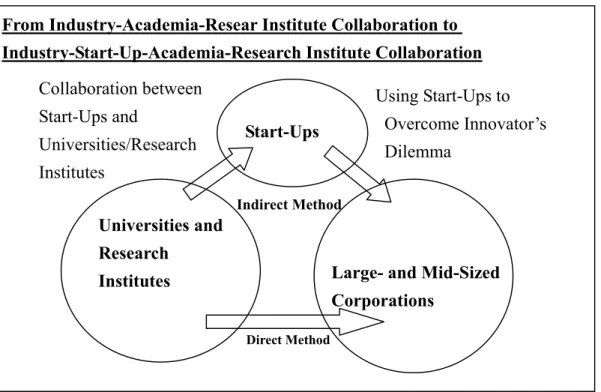
An astounding number of joint research projects are conducted by regional start-ups, mid-sized corporations, universities, and public research institutes in successful clusters overseas, outnumbering joint studies that involve large corporations. An investigation into the popularity of collaborations that involve start-ups reveals undercurrent collaborations between large corporations and research institutes, including universities and public research institutes, via start-ups (Figure 4).
Large corporations find it difficult to take the decision to launch a business based only on the raw results of basic research at universities and research institutes. Therefore, in collaborations between industries, start-ups, academia and research institutes, using start-ups as an outlet for such businesses has become a dominant condition in the successes of advanced overseas clusters.
This is precisely the largest reason for the necessity to include high-tech start-ups in clusters. In this scheme, it becomes essential for clusters to have sufficient support mechanisms for growth.
Such mechanisms may include access to venture capital, the presence of non-profit organizations aimed at supporting business start-ups and industry-academic collaboration, as well as the services of patent agents and tax accountants.
Figure 4 New Way of Collaboration with Start-Ups
any advanced clusters in the United States, a number of spin-offs originated in the s
From Industry-Academia-Resear Institute Collaboration to Industry-Start-Up-Academia-Research Institute Collaboration
Large- and Mid-Sized Corporations
Universities and Research Institutes
Start-Ups
Using Start-Ups to Overcome Innovator’s Dilemma
Direct Method Indirect Method
Collaboration between Start-Ups and
Universities/Research Institutes
In m
o-called anchor companies or regional core corporations, in the initial and middle phases of
cluster formation and growth. This has resulted in forming “spin-off trees” in which such anchor companies spin off several tens of companies over a twenty-year period. In Japan, such long-term spin-off trees can be clearly observed only in the Sapporo Valley and the Hamamatsu area.
Many managers of start-ups in Hamamatsu used to be engineers of Yamaha Motor Co., Ltd.
Furthermore, those independent start-ups and Yamaha Motor are mutually benefiting from each other in their collaborations. In Figure 5, we show part of spin-off trees in Hamamatsu region.
Figure 5 Spin-Off Tree of Hamamatsu Region
Pulsetec Industrial Co., Ltd.
1999
Precise Gauges Co., Ltd. (Musubu Koishi)
* Listed companies
Source: Third Policy-Oriented Research Group, NISTEP, in cooperation with the Hamamatsu Chamber of Commerce and Industry
Designing, manufacturing, and marketing of electronics and electric measuring devices (Joint Venture)
(Affiliate)
Koa Electronics Industries K.K.
1969
Manufacturing of applied electronic equipment
1960
Development of medical agents, etc.
Photochemical Co.
1999
(Kazuya Inoue)
Development and manufacturing of optical measuring devices
Scientex K.K.
1992
Manufacturing and marketing of electronic equipment parts, semiconductor transport robots, and medical equipment
Acty System K.K.
Production of electron tubes, laser
semiconductor device, optical measurement systems, etc.
(Teruo Hiruma) Hamamatsu Photonics K.K.*
Renamed in 1983
Development and production of measuring devices
Designing and manufacturing of module products
Hamamatsu Kohden Co., Ltd.
1967 (Affiliate)
(Heihachiro Tsubouchi) Hamamatsu TV Co., Ltd.
(Minoru Kawai) 1985 1953
Sanmatch Co.,
Placement and human resources services, technology consulting, and graphic/industrial designing
(Morihiro Matsuda) 1999
Import and marketing of electric carts, and lease of welfare equipment (Yorio Nakajima) Serio K.K.
1996
Agent for patent applications in and out of Japan, research, evaluation, and patent management advising (Takao Koshikawa)
Koshikawa & Co.
1991
(Currently Polaris Japan, Inc.)
Export, import, and marketing of outboard and inboard motors, and watercraft
(Masanori Tokuno) 1987
Marine Power
International Japan, Ltd.
Designing of production equipment and automated machinery, motorcycle parts, and creation of CAD plans
(Yoshiaki Shiroki) Shiroki, Inc.
1975
* Listed companies
Source: Third Policy-Oriented Research Group, NISTEP, in cooperation with the Hamamatsu Chamber of Commerce and Industry
Zodiac Co., Ltd.
2003
Computer software R&D (Toshimasa Kodera)
Elysium Co., Ltd.
1999
Tech-software development, technology consulting, and education for new technology development
(Akira Miura) Amelio K.K.
1997 Cap Co., Ltd.
Technology development for medical and manufacturing fields (Takashi Kosugi)
R Tech Co., Ltd.
1998
1984
Development of tech-software and consulting
(Akira Miura, Masahiro Akiyama)
Armonicos Co., Ltd.
Manufacturing and processing of transport equipment, etc.
(Takashi Harada)
1987
Harada Seiki Co., Ltd.
Machinery designing, manufacturing of labor-saving equipment, technology consulting, and development of order-made products
(Kuniaki Aoki)
Space Creation Co., Ltd.
1990
Die design and production, and development and marketing of die software
(Mitsuo Takai) 1991
Integra Research Co., Ltd.
Technology consulting, support operations for new product development and introduction of IT, and support for ISO certification and establishment (Mitsuhiro Okutsu)
1993 Altea Corp.
Software development, CAD/CAM system marketing and support
(Tomonori Suzuki) 1970
Development of automobile parts and light-related products (Masahiro Kosugi)
Yamato Industrial Co., Ltd.
1944 (in 1955 became an affiliate) Yamaha Motor Co., Ltd. *
1955 Nippon Gakki Co., Ltd. (Presently Yamaha Corp.)
1887
Consulting service, system planning, and designing, with tech-software as core (Jun Hotta)
8. Promotion of Multi-Layered Clusters
- Phase-Progression Based on Market and Human Resource Globalization
Progressive development of clusters can be constructed, based on the advanced overseas cases, as a model of a series of development phases from germinal to exploratory to growth and maturity periods.
One of the inevitable outcomes of a mature cluster is decline caused by internal conditions, such as decreased motivation for business start-up and innovation from internal rigidity. Another outcome is the decline caused by external conditions, such as a sudden neutralization of the cluster’s advantages by rapid technological changes. This means that unless innovations are made incessantly, the cluster itself may decline.
Most of the prospective regional clusters in Japan presently have long-term plans which focus on one of the four priority areas (life science, information and communication technology, environment, and nanotechnology & materials) in the Japanese Government’s Second Science and Technology Basic Plan. Given this situation, it is important for a cluster, from the mid- and long-term point of view, to diversify into new peripheral and related technology areas so that it can flexibly meet an intensifying competition environment and changes in business environments, as well as taking measures to materialize a multi-layered cluster which enables the emergence of synergy effects from such a diversification.
9. Suggestions for Construction of a National Innovation System - A Grand Design for the Formation of World-Level Clusters
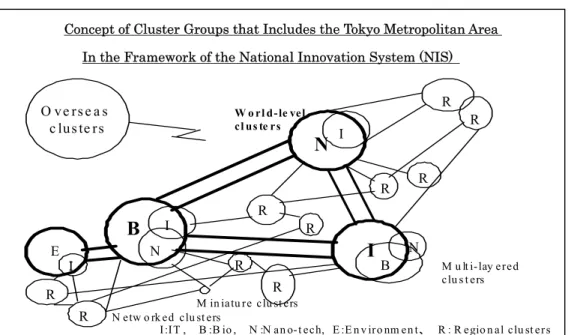
Overseas plans for cluster creation and growth, more than its purported aim of vitalizing industries that are rooted in cluster-base regions, appear to be a strategic built-in mechanism within nation’s overall innovation systems. In Japan, too, now is an appropriate time to strategically review the nation’s ideal of regional clusters as a form of its national innovation system (NIS), from a national perspective which not only includes non-Metropolitan areas but also the Tokyo Metropolitan area, when regional clusters in Japan have started to compete.
In order to carry out this task, we need to precisely identify the industrial and technological areas where Japan excels, and with that strength as a core, we need to build concepts of world-class cluster groups that serve as a center of the Japanese industrial innovation system, which also covers the Tokyo Metropolitan area (some prospective fields include robots, mobile communications, fuel cells and solar energy, in addition to the four priority areas in the Basic Plan). However, it is estimated that only few domestic locations need and are able to foster the
growth of such clusters, and also that it would take at least ten to fifteen years for successful cluster formation, based on the experiences of overseas success. Furthermore, it would be an effective strategy for other regional clusters to secure their competitiveness by utilizing their respective unique features in order to connect and network with world-level clusters through technological, information, business, and human resource exchanges.
When reviewing grand designs for such world-level and also miniature cluster building, it is important to effectively coordinate related measures of the national and local governments, and to build in firm assessment systems for cluster results and performance in terms of cost effectiveness, and at the same time not be excessively concerned solely with short-term results.
Chain-reactive innovations brought about by world-level clusters which are based on the doctrines of competitiveness and collaborative functions have a large potential to drastically transform Japanese industrial structure and economic/geographic patterns. For that reason, it has the potential to become a core element of the Japanese national innovation system that would open up a new era.
Figure 6 Cluster Groups in Japan
I N
B
N I
R R
B I
N R R
R
R R
R
E R
R
W o rl d-le vel cl us te rs
M u lt i-lay ered clu s t ers N etw o rk ed clu st ers
O ve rs e a s c lus te rs
I:IT , B :B io , N :N an o-t ech, E :E n v iro nm en t、 R:R egio n al clu st ers M in iatu re clu st ers
I
Concept of Cluster Groups that Includes the Tokyo Metropolitan Area In the Framework of the National Innovation System (NIS)
10.Conclusion
- Toward Genuinely Sustainable Development of Regional Clusters
As an environment for promoting innovation is steadily developed through national and local governments’ related programs, deregulation, and the transformation of national universities into
development.
1. Discover an outstanding leader(s) by abandoning the idea that everyone should advance together at the same pace, and share free regional community proposals, as well as enthusiastic ambitions for materialization of concepts.
2. Enhance the utility and influence of universities, which play an important role in the creation of new forms of knowledge and the training of motivated young entrepreneurs.
Also enhance the utility and influence of public research institutes that are expected to function as a meeting place and catalyst for increasing human resource mobility among industries, start-ups, academics, and research institutes.
3. Actively communicate each respective cluster’s comparative advantages and unique attractiveness both inside and outside Japan in order to invite outstanding human resources and organizations both domestically and from overseas. Furthermore, in addition to maintaining and improving international competitiveness, a wide variety of communication channels and the development of human networks are essential to secure human resources and sustainable funding.