Setting up an Extensive Reading Course:
The Beginning, the Middle, and the End
Andrew BOON
Abstract
This article provides an outline of an extensive reading elective reading course for second year students at Toyo Gakuen University.It describes the decisions that were made when designing the course,the in-class activities that helped foster learner confidence and motivation,and the evaluation of the course from the perspectives of both the students and the teacher.
1. Introduction
Extensive Reading (ER)aims at building learner fluency and motivation for reading so that students may eventually become competent, enthusiastic, and independent readers of the L2. In an ER program, learners are encouraged to read as much as possible and as quickly as possible from a range of materials within their specific language level for information or entertainment, general understanding of the text, and for pleasure. Through exposure to large quantities of comprehensible text, ER can help learners to develop automatic recognition of lexical items, increase their lexical knowledge, increase their formal and content schemata, and also, provide them with initial and ongoing opportunities to experience success in and develop more positive attitudes towards L2 reading (Day& Bamford,1998;Grabe,1991).This article provides an outline of an ER elective course for second year students at Toyo Gakuen University. It describes the decisions that were made by the teacher while designing the course, the in-class activities that helped foster learner confidence and motivation, and the evaluation of the course from the perspectives of both the students and the teacher. Just like a story,the ER course has a beginning, a middle, and an end. Let me begin.
2. The beginning
2.1 Introducing ER to the students
As Japanese students may be unfamiliar with ER having usually experienced intensive reading or grammar-translation reading programs, it is important to begin the first lesson by
orienting the learners of the course to the major differences between ER and the more traditional approaches to the teaching of L2 reading. To do this, Welch (1997)suggests building up a chart on the chalkboard to contrast the typical goals of an intensive course with an ER course in order to help:
students come to understand that the class will be conducted differently from their other reading classes (but)will help them develop into more fluent foreign language readers (p.53).
Adapting this idea, I created a PowerPoint slide show to bring to studentsʼattention the main differences of ER and intensive reading.In slide one,students were asked what extensive reading is to help me discover whether anyone in the class had any previous knowledge or experience of ER. As expected, although having had prior access to a course syllabus and having had decided to select the course,the students who attended knew very little if not anything about ER.In the next two slides,to build understanding,students were shown dictionary definitions of the lexical items “intensive”and “extensive”. In slide four, I tried to elicit from students the different purposes of an intensive reading and ER course;the former being to focus on formal language study, and the latter to focus on general text understanding and enjoyment. The next slide contrasted the difference in the level of reading material of the two courses with intensive reading often involving the use of texts that have been written for native speakers while ER courses tend to use graded readers. In slide six, students were asked about the amount of texts they would expect to read in both courses. From the earlier dictionary definitions, students were able to determine that in intensive reading courses learners focus on one or two books while in ER courses they read many. Slide seven introduced students to the speed of reading to be expected in an ER course. Whereas in intensive reading classes students may read slowly, translating or looking up unknown lexical items as they go,ER is concerned with students reading texts quickly and fluently. The final slide introduced students to the class goal for the course (See figure 2.1.
1).
Figure 2.1.1:PowerPoint Slide 8― Setting the class goal
How many books can we read?
1?
2?
10?
15?
20?
More than 20?
As a class―400 books in one semester!
As I clicked on the mouse to reveal each of the figures one by one on the screen, I elicited responses of“more”from the students until we reached the figure of 20.With 20 students having registered for the course, I set a realistic target of requiring each student to read 20 graded readers thus creating an end of semester group goal of 400 books in total.This class goal could then be used throughout the semester as a “critical motivating tool”(Boon,2007,p.41)helping to focus the ER groupʼs attentions, efforts, and persistence on its successful attainment by the completion of the course. Throughout the PowerPoint slide show, students were asked to write down the information regarding the objectives and methodology of the ER course on a separate handout I provided (See figure 2.1.2).
Students then had a written record which they could refer back to at any time during the course.
2.2 Introducing students to graded readers
After orienting students to the principles of ER,I passed around a number of graded readers that I had borrowed from the university library or received as sample copies in order to familiar- ize students with the various levels,publishers,and types of books available.Then,at the end of the first lesson, I took the students to the university library in order to show them where additional graded reading materials for the course could be located, if needed.
2.3 Introducing students to “book swap”
Unlike normal English elective courses which often require students to purchase one set coursebook for the class, the ER course involves establishing a substantial library of material.
From this, students can choose what they would like to read from a range of different books.
However, with only a limited supply of graded readers in the university library and no specific budget available,buying materials for the exclusive use and convenient access of the students of the ER class throughout the duration of the course appeared problematic at first.However,Day and Bamford (1998)suggest asking:
What is extensive reading?
1. Purpose:
2. Level:
3. Amount:
4. Speed:
5. How many books can you read in one semester?
Figure 2.1.2:Excerpt from lesson one handout
students to contribute the cost of one or two books...in return for this individual outlay,the students are able to read a whole library of books (p. 108).
Taking this idea on board, at the end of the first lesson,I explained to students that they would each pay for one graded reader to help establish a class library and asked them to bring 750 yen along to the next class. I told them that for this small, one-off payment, they would have the opportunity to read not one but many books.Between lessons one and two,I went to a bookstore to obtain the class readers and by purchasing graded readers in special discount packs,I was able to reduce the overall cost for each student to 500 yen.At the beginning of lesson two,I spread the readers out on a table at the back of the classroom and asked each student to browse through the books and choose one.I then collected the money from each student recording their name and the title of the book they had chosen and checking offtheir payment on a form I had created to act as a receipt (See figure 2.3.1).
I then explained the “book swap”rules to the class and provided students with written instruc- tions on a handout (See figure 2.3.2).First,I asked students to write their names on the inside of the front cover of the graded reader they had selected.I told them that after reading the book and completing their book report (See figure 2.4.1),they were to return the reader to me either in class time or at my office,choose another book from the ER class library,and write their names under the names of the previous students who had read the book.In this way,the graded readers would be in constant circulation amongst the course members and also,there would be a written record of which students had read which books.To ensure that there were always enough new books in the class library for students who were reading at a quicker pace or for those students who occasionally forgot to bring their books to class,I purchased 30 graded readers for a class of 20 students. The cost of the additional 10 readers came out of my university research allowance.
Finally, I advised students to borrow graded readers from the university library in order to supplement the“book swap”system for times when they had finished reading books but could not get access to the ER class library to swap their readers (e.g. weekends, holidays, the teacher is in a class or meeting).
NAME:
Kenji Suzuki BOOK TITLE:
Escape PAID:
Figure 2.3.1:Example of receipt of student payment
2.4 Introducing students to book reports
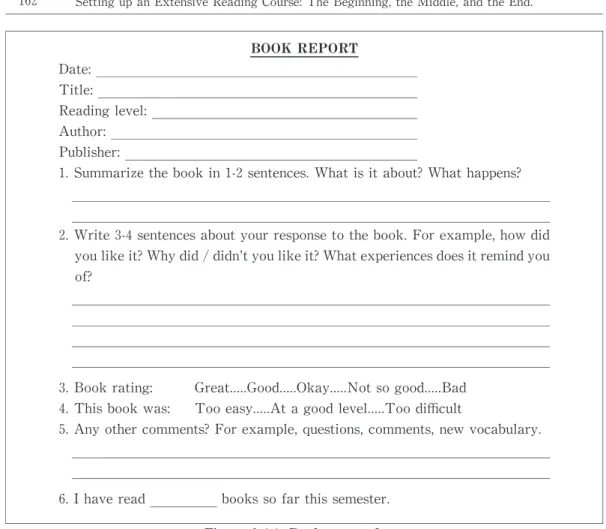
As a substantial part of the ER course assessment, students were instructed to write brief book reports for each graded reader they read in a B5 notebook to be submitted at the end of the course.In lesson two,I provided students with a sample book report form and then explained how to complete each section. Adapted from Schmidt (2004), the report (See figure 2.4.1) raises studentsʼawareness of the different levels of readers which often vary from publisher to publisher (Figure 2.4.1:Reading level/Publisher). It also provides the opportunity for students to demon- strate that they have read and understood each book by summarizing the story (Figure 2.4.1:
Question 1).Question 2 is the “heart of the report”(Schmidt,2004,p.138)and allows students to reflect more deeply on their reading experience through giving opinions of each book or making connections from each story to their own individual lives. The report also gives students the chance to reflect on the level of the reader and thus guide them in their next selection from the ER class library(Figure 2.4.1:Part 4).Question 5 provides students with the option of making any additional comments they feel may be useful or relevant or to record new vocabulary encounter- ed. Finally, part 6 allows students to track their progress.
After introducing students to the book report task, they were then given class time to read quietly and to complete their first report by copying the form into the first page of their B5
Figure 2.3.2:Excerpt from lesson two handout
BOOK SWAP RULES
1. Write your name in the front cover.
2. Read the book in class and at home.
3.When you finish reading,write a book report about the graded reader in your B5 notebook.
4. When you finish the book report, hand the graded reader back to Andy.
5. Pick up another reader from Andy and write your name in the front cover under the name of the other students who have read the book and repeat stages 2-5.
IF YOU LOSE YOUR READER, YOU WILL HAVE TO BUY ANOTHER ONE TO REPLACE IT OTHERWISE YOU WILL BE OUT OF THE BOOK SWAP
notebooks and filling in the sections.As students were engaged in this activity,I discovered there was some uncertainty about how to complete each section of the book report.I therefore quickly modeled the exercise myself by reading a graded reader,completing a report,and then photocopy- ing it for each student to take away from the class. Students were then able to make use of the example I had created in class as a guide when writing their own book reports.
2.5 Establishing class routines (1):Sustained silent reading
One of the key principles of ER is for students to be provided with a set period of class time to read individually and silently.Sustained silent reading (SSR)provides the opportunity for class members to focus completely on the task of reading;of making sense of the incoming data, the lexical items, the grammar, the rhetorical organization, and cohesive relations in the text, mapping this against their own experiences and background knowledge of the world whilst working to achieve a coherent and personal interpretation of what the text means to them.From an outsiderʼs perspective looking in,it may appear that students are merely reading and that little
BOOK REPORT
Date:
Title:
Reading level:
Author:
Publisher:
1. Summarize the book in 1-2 sentences. What is it about?What happens?
2. Write 3-4 sentences about your response to the book. For example, how did you like it?Why did/didnʼt you like it?What experiences does it remind you of?
3. Book rating: Great...Good...Okay...Not so good...Bad 4. This book was: Too easy...At a good level...Too difficult
5. Any other comments?For example, questions, comments, new vocabulary.
6. I have read books so far this semester.
Figure 2.4.1:Book report form
language learning and instruction is taking place. On the contrary, through the process of SSR, students are making initial crucial steps to becoming fluent and independent readers of the L2.As Grabe (1991)argues:
Sustained silent reading should be encouraged to build fluency(automaticity),confidence,and appreciation of reading...longer concentrated periods of silent reading (are needed).Students learn to read by reading (p. 396).
Starting in lesson two and continuing throughout the ER course, I provided student with 30 minutes of SSR every lesson.This regular period of class time helped to transform the classroom environment into a place of uninterrupted and focused activity. Each week, when I gave the instruction, the students took their readers from their bags, opened them and spent the allotted time reading,writing book reports,asking me text-related questions,or swapping books they had finished with new ones from the ER class library. During this time, I could demonstrate to the class the importance I place on reading, ER and SSR by joining in with the busy community of silent readers and reading the graded readers as well. In order to engage in the dual role of ER class participant and teacher,I read graded readers whilst walking around the class,monitoring students,and stopping to answer questions when asked.Not only was this a valuable opportunity as teacher to act as a highly visible “role model of a reader for students”(Day& Bamford,1998, p.8),but by becoming familiar with each book in the ER class library,I could encourage studentsʼ motivation for reading by making comments on and giving advice about their next selection of graded reader during the book swap. For example:
“Oh! That bookʼs good. Itʼs a true story.”
“Have you tried this one? Itʼs a bit like ʻPrison Breakʼ.”
“Oh! I just read that one. It has a really good ending―very funny!”
2.6 Establishing class routines (2):Progress reports
Goal-setting can have a significant effect on stimulating L2 motivation.A goal can establish a standard by which an individual can evaluate his or her behavior whilst working towards its attainment and focus the individual to work hard and keep at a certain activity until it has been accomplished (Boon, 2007; Dornyei, 2001; Oxford & Shearin, 1994). In this respect, to help
generate initial learner motivation from lesson one, I set the ER group an individual goal of reading 20 graded readers and a group goal of reaching 400 graded readers in total (See figure 2.1.1). From lesson four, I then introduced a warm-up activity which was repeated at the beginning of every subsequent ER class:
Step 1:Group the students in fours and give one student a piece of chalk.
Step 2:Write on the board―How many books have you read so far?
Step 3:Instruct student 1 to ask the question to student 2 and to write his or her answer on the chalkboard. Student 2 then asks the question to student 3 and writes his or her answer on the chalkboard.Student 3 asks the question to student 4 and writes his or her answer on the chalkboard. Finally, student 4 asks the question to student 1 and writes his or her answer on the chalkboard.
Step 4:Add up all of the numbers and write the class total on the board.
Step 5:Provide feedback on studentsʼcurrent progress towards the class goal.
Step 6:Give students the lesson handout and ask them to record the class total in section 1.
The aim of the ʻprogress reportʼactivity was to provide weekly opportunities for both students and teacher to reflect on the groupʼs current progress towards the final goal,to encourage feelings of individual importance and responsibility amongst group members for helping to increase the class total and to get the number ever nearer to the goal (Boon, 2007), and to help maintain the motivation of the group through positive words of encouragement from the teacher (Step 5).Each lesson handout also included a space for students to record the class total so that they had a written record of the ER groupʼs progression to take away from the class ( see figure 2.6.1).
Figure 2.6.1:Excerpt from lesson four to twelve handouts
So far, the extensive reading class has read books!
1. Progress Report:
3. The middle
3.1 Getting students talking about the graded readers
Once the class routine of progress reports,sustained silent reading,and writing book reports had been established, I began to introduce post-reading activities in which students could talk together about the graded readers in the ER class library.In lesson four,students were provided with a handout of a sample dialogue in which two people discuss a graded reader (See figure 3.
1.1).Students read through the dialogue in pairs and then used it to structure their own conversa- tions by replacing the italicized parts of the dialogue with their own responses about the books they had been reading in the SSR period. In lesson five, students were given a list of additional questions,and active listening phrases(See figure 3.1.2 )that could be used when discussing books.
Students were then placed in rotating pairs to practice talking about their graded readers.
The post-reading activities served a number of important pedagogic purposes. First, they provided students with the opportunity to improve oral fluency as well as reading fluency during the course.Second,by monitoring pair work discussions,they gave the teacher an indirect method of checking how much reading students had done during SSR and how much understanding was taking place during the reading process. Third, they helped “turn the individual solitary act of reading into a community event”(Day & Bamford, 1998, p. 141)facilitating group cohesion and motivation by students coming together to share their personal reading experiences.Finally,they helped to prepare students for the mid-semester assessed task (lesson six)in which students were asked to discuss with a partner one of the graded readers they had read.
Figure 3.1.1:Excerpt from lesson four handout
Task 2:Talking about books Practice the dialogue in pairs:
A]Hey!What book did you read?
B]I read“Alice in Moscow”. A]Oh really?What kind of story was it?
B]It was a love story.
A]I see. What was it about?
B]Well, it was about a dancer called Alice who went to Moscow to do a show. She met a guy called Nikolai and he invited her on a picnic. He fell in love with Alice but she had to go back to England.
A]Right. What happened at the end?
B]Nikolai went to the airport as Alice was leaving and gave her his address.They promised to meet in England.
A]Romantic ending, yeah!Who were the main characters?
B]Well,Alice and Nikolai really. A]What did you think of Nikolai?
B]He was very brave to ask Alice on a date. He seemed a nice person.
A]Did you like the book?
B]Yeah. It wasnʼt bad. I liked the relationship between Alice and Nikolai but I would like to know more about what happens to them next.
A]You mean when he gets to England, right?
B]Yeah, I want to know whether their relationship will last or not.
How about you?What book did you read?
Task 3-In pairs,talk about the book you have read.Use the dialogue above to help you
REACTIONS:
Right.
Uh huh.
Oh really?
I see.
Wow!
Oh no!
Too bad!
How interesting!
Wow!So romantic!
QUESTIONS:
1] Whtat did you read?
2] Where does the story take place?
3] Who are the Characters?
4] What is[name]like?
5] What happened?
6] Did you like it?
7] Have you experienced anything similar in your life?
8] So, what did you learn from the story?
Figure 3.1.2:Excerpt from lesson five handout
3.2 The mid-semester assessed task
In lesson six, students were assessed on their ability to ask and answer questions, share information, and keep a conversation going on a graded reader they had read.After completing progress reports (See 2.6), I gave the group the rest of the class time to do SSR. While students were engaged in reading, I drew two random names from a hat and asked these students to sit at a table at the front of the class to do an eight-minute timed assessed conversation (four minutes per graded reader). The process was then repeated until all students had undergone the assess- ment task.
3.3 Preparing students for poster presentations
In lesson seven,I introduced students to the end-of-semester assessed task in which students were to give a short five-minute individual poster presentation on one of the graded readers they had read (a different reader to the one they had discussed in the mid-semester assessed task).
Students were provided a handout and were asked to match presentation phrases to their functions (See figure 3.3.1).In lesson eight,students listened to an MP3 recording of a presenta- tion I created based on my reading of a graded reader that was not part of the ER class library selection.This material provided the students with an example of a presentation with a four-part structure in which the presenter talked about the characters,the story,the ending,and why he had liked the story.Whilst listening,students completed a gapped handout and answered comprehen- sion questions (See figure 3.3.2). At the end of the lesson, I then uploaded the MP3 file to the course lecture folder for students to download and listen to on their MP3 players outside of the class. Finally, in lessons nine to twelve, students were provided with class time to prepare and practice their presentations and were given advice on designing posters that would act as both a visual support for the audience and as a ʻcrib sheetʼfor the presenters during their 5-minute talks.
4. The end
4.1 The end-of-semester assessed task
In the final lesson of the semester (lesson 13), I arrived to class early in order to rearrange the furniture. All the desks were pushed to one side and the chairs were grouped into twos or threes in front of the large chalkboard and small whiteboard in the ER classroom. As students arrived,I asked them to submit their final book reports (See 2.4).Students were then divided into presenters (I chose around 6-7 students to give the first presentations)or audience members (the remainder of the class).I provided each presenter with a designated space and number for his or her presentation and blu-tack to stick his or her poster to the chalkboard or whiteboard.Audience members were then assigned seats by presentation number. Presenters were instructed to start presenting to their audience of two or three students and encouraged to invite questions from them at the end of their talks.After five minutes had elapsed,the presentations were stopped and audience members were asked to move to the next presentation (i.e. audience members of presentation#1 moved to presentation#2 and so on). The first presenters then repeated their presentations three more times with audience members being rotated on each different occasion.
Figure 3.3.1:Excerpt from lesson seven handout
Look at the following functions for giving presentations and match phrases to each different number:
1. Welcome, introduce yourself and outline your presentation 2. Introduce the first subject of your presentation
3. Start other subjects of your presentation 4. Give examples
5. Summarize and conclude 6. Thank your audience
7. Invite questions from the audience
⎜⎜⎜⎜⎜⎜⎜⎜⎜⎜⎜⎜⎜⎜⎜⎜⎜⎜⎜⎜⎜⎜⎜⎜⎜⎜⎜⎜⎜⎜⎜⎜⎜⎜⎜⎜⎜
a]To conclude..../In conclusion..../To sum up....
b]For example..../A good example of this is....
c]Do you have any questions?/Now Iʼll try to answer any questions you may have.
d]Now Iʼll move on to..../Now, letʼs turn to..../Letʼs look now at....
e]To start with, Iʼll.... Then, Iʼll.... After that, Iʼll....Finally, Iʼll....
f]Good Afternoon.My name is Andy Boon and today Iʼm going to talk about/
discuss....
g]Many thanks for your attention.
h]Ok, Iʼd like to start by..../Ok, first of all, letʼs look at....
A] Listen to part 1 of the presentation and fill in the blanks.
Okay. Good Morning. My name is and today Iʼm going to talk about . To start with, Iʼ ll talk about
Then, Iʼll talk about , after that, Iʼll talk about and finally, Iʼll talk about .
B] Listen to part 2 of the presentation and answer the questions.
Okay. Iʼd like to start by talking about .
There are main characters.
Who are the characters and what do you hear about them?
Character 1 Character 2 Character 3
C] Listen to part 3 of the presentation and answer the questions.
Now letʼs turn to .
1]What does Andrew want Sally to wear?
2]What does Sally buy?
3]Where does she go next?
4]What happens in the coffee shop?
D] Listen to part 4 of the presentation and answer the questions.
1]What happens when Andrew calls Sally?
2]What happens when Paulʼs Mum calls Paul?
3]What do Paul and Sally decide to do?
E] Listen to part 5 of the presentation and answer the questions.
Okay. Now Iʼd like to turn to .
1]Where do Paul and Sally meet?
2]What do they realize?
3]What happens when Andrew calls Sally?
4]What happens at the end?
F] Listen to part 6 of the presentation and answer the questions.
To conclude my presentation, Iʼll talk about
1]Why does Andy like the book?
Thank you very much for listening. Do you have any questions?
Figure 3.3.2:Excerpt from lesson eight handout
The rationale of having students present four times in total was threefold.Firstly,it allowed me enough time to walk around,observe,and assess each individual presentation.Secondly,it gave students the opportunity to gain in confidence through repeated performance of the same presen- tation material. Finally, students were able to learn from each other by seeing and listening to a selection of the presentations.Once finished,the first set of presenters took down their posters and switched roles with members of the audience (six or seven of the remaining students yet to present).The process was then repeated until all members of the class had delivered their poster presentations.
4.2 Course evaluation:A note on procedure
In lesson 12, I asked students to complete a course feedback form in order to obtain their evaluation of the first semester ER course and to determine what modifications were needed for the second semester.To ensure longer and more insightful answers,I asked students to complete the form in Japanese and then had their responses translated later into English. I was able to collect information from 16 out of the 20 students who had registered for the course as four students were absent on the day.
4.3 Course evaluation:Student responses
Students stated that the course had offered them either their first experience or renewed opportunities to read books in English.They found the class to be enjoyable and were pleased that it offered them the chance to work on other areas of English study such as speaking, grammar, listening, and writing as well as reading. Several students indicated that as the class was quiet when reading, it promoted a positive and comfortable learning environment.
Half of the students responded to this question with the answer,“nothing.”However,several students remarked on the difficulty of writing the book reports,the required amount of reading, and difficulties processing unknown lexical items in some of the graded readers as being problem- atic aspects of the course.One student indicated being uncomfortable with speaking in the class whereas another student wished group members had contributed more to class discussions rather than being reticent.Another student wrote that she wanted the teacher to use more of the L1 in the class.
Students gave the book swap system an average score of 4. Most students commented that they liked the book swap as it provided them with easy access to many different books at a low price and facilitated their achievement of the class goal of reading 20 graded readers.One student mentioned that it made him feel competitive and that without it,he may not have read as many books as he did.Another student enjoyed finding out who else in the ER class had read the books by reading the names of students in the inside front cover of each particular graded reader (See 2.3)before adding her own name to the list.However,one student stated that the system did not work for her as she needed to supplement her reading by borrowing books from the library.
Another student only scored the book swap with a ʻ2ʼas he wished for a better selection of books in the ER class library.
Sustained silent reading as a weekly class activity scored an average of 4.3. Nearly all students stated that the advantage of SSR was the quiet classroom environment which helped them to focus wholly on the task of reading. One student commented that as SSR became an established part of the ER class routine, that reading became a conditioned response for her.
Normally easily distracted in class, once the instruction was given to start SSR, the student opened her book and just got on with the task at hand. Finally, one student who scored silent reading with a relatively low score of ʻ3ʼ, may have at least taken away from the class an understanding of the pedagogical importance of SSR as he took the opportunity in the feedback form to write an apology to the teacher for having often talked to other classmates during the SSR periods.
The book report assessment task scored an average of 3.9. Although most students acknowledged the difficulty of writing 20 book reports in English, some students stated that the reports were fun to write, good practice for improving writing skills, and gave them the opportunity to express their opinions about the books they had read.One student mentioned that it was difficult for her at first to be able to construct sentences to summarize and provide opinions, but the task got easier for her throughout the semester.Finally,one student suggested reducing the workload from 20 to 15 books.
Students gave the mid-term oral test and end-of-semester poster sessions an average score of 3.2.Most students stated that speaking in English about the books was difficult and that they had been nervous during the tests. In fact,several students wrote that they had not prepared for the first oral test but then later regretted this. On the other hand, 5 students believed that the tests were a good idea and had given them the opportunity to try to output to their peers the knowledge they had acquired through reading.
Students evaluated the teaching of the ER class with an average score of 4.6.Students stated that lessons were interesting and enjoyable.They also commented that the teacher had shown a great deal of enthusiasm throughout the course and had provided information and explanations that were easy to understand.
Students evaluated their own performance during the ER course with an average score of 2.
9.Several students indicated a perceived lack of vocabulary as having created difficulty for them during the various reading,writing,and speaking activities.One student scored herself a ʻ 2ʼas she had been consistently late for class.
/
13 students answered that their reading skills had improved having noticed an increase in their overall reading fluency and vocabulary knowledge.One student was undecided but failed to provide a reason.Two students stated that there had been no noticeable change to their reading ability.
/
14 students answered that the weekly progress reports had encouraged them to read more books. Several students commented that progress reports had motivated them to maintain the same pace of reading. Another student argued that the fact he had achieved the goal of reading 20 books in one semester was evidence that the progress reports had had a positive effect on him.
Two students answered that the reports had not influenced their rate of reading.Ironically,these two students were often late for the class and missed the progress report warm-up activity nearly every week.
/
Five students answered that they intended to continue reading English books after the first semester course:
“Yes, because I will read books on the train.”
“Yes. I would like to continue to read to improve my skills.”
“Yes. I would like to read different kinds of books in the future.”
“Yes, because I want to try harder next time”
“Yes. If I have chance, I will try it.”
Four students stated that they might be interested in reading English books in their free time but were unsure whether they would. Two students replied that without being part of the ER course, they would definitely not continue reading English books. Unfortunately, five students misunderstood the question and answered about past tasks they had completed as homework for the ER course.
15 out of 16 students provided additional comments on the course feedback form taking the opportunity to thank the teacher (or apologize for having been late for or lethargic in lessons)and to reflect positively on their learning experience during the ER course. For example:
“I think English is a difficult thing but I have changed my opinion. I feel reading books is fun.”
“I thought English class was more fun than before. The teacher worked hard and explained a lot. I could feel motivated.”
“I got good strategies by attending this course.”
5. Conclusion
My aim with the second year university elective ER course was to create a pleasant, supportive,and productive learning environment in which students could feel encouraged to read a large amount of comprehensible texts at a level within their particular“comfort zone”(Waring, 2006, p. 46) in order to build their reading fluency, increase their experiences of success with reading in English, engage in post-reading activities to help improve other skill areas such as speaking, listening, and, writing and ultimately, to increase their motivation for continued L2 learning. To advance claims that the ER course positively affected studentsʼmotivation is somewhat premature without further research. This article describes how the course evolved over its 13-week period in respect of its design, content, methodology, and assessment only.
However,from the student responses in the course feedback form (See 4.2)and my own observa-
tions of each class, it is possible to argue that the first semester course achieved what it set out to do.Firstly,students adapted well to the ER experience using the weekly SSR periods to read graded readers at their own pace,write book reports,and ask questions or seek advice from the teacher when required. Furthermore, students tended to participate actively together in the post-reading activities. Secondly, most students were able to achieve or nearly achieve the set goal of reading 20 graded readers and writing 20 book reports (See 2.1 & 2.4). Although the reading pace of the class was slow at the beginning,weekly progress reports may have helped to keep the class goal firmly in the minds of the group members and encourage them to read more books.When grading the submitted book reports,I was pleased to discover that students had read a final class total of 335 graded readers (See table 5.1 ):The original class goal was changed in week 10 to a total of 380 books as a result of one of the 20 group members failing the course due to her repeated absence. The remaining 19 students therefore successfully achieved a collective score of 88 percent of the set target by the end of the course. Thirdly, in the last lesson of the first semester,each student was able to deliver an interesting and informative poster presentation based on one of the graded readers he or she had read during the ER course. Finally, 14 out of the 20 first semester group members felt motivated enough to sign up for the second semester ER course.
However, a number of problems did occur in the first semester course which I will address in the second semester.Firstly,the non-attendance and lateness of several students throughout the first semester resulted in them missing the SSR period or important post-reading activities.The next issue was discovering that some students had plagiarised the blurbs on the back of the graded readers when writing their own summaries or had used translation software when writing their personal responses to their reading in their book reports. Lastly, some students failed to
0 ‑Failed due to lack of attendance 1
4
1 12
1 15
2 16
2 17
1 19
1 20
101 Number of graded readers read21 :
Table 5.1:Final reading total of the ER class
Number of Students:
submit their book reports on the final day of class which involved me having to track them down during the last week of the first semester to avoid having to fail them.
To echo the words of Rob Waring,I believe extensive reading should be a fundamental part of any English language program. Waring (2006)states:
language programs that do not have an extensive reading or graded reading program component...will hold back their learners...Extensive reading is the only way in which learners can get access to language at their own comfort level,to read something they want to read,at the pace they feel comfortable with,which allows them to meet the language often enough to pick up a sense of how the language fits together and to consolidate what they know (p.46).
In this respect, I would like to thank Toyo Gakuen University for giving me the opportunity to design and teach the ER course, and for giving our students the opportunity to put away their dictionaries,to pick up their graded readers,and to simply read.This is the end of the story,but for the ER students of the class who have acquired the skills,knowledge and belief in themselves to carry on reading in the L2, I hope it is the beginning of a wonderful new adventure.
References
Boon, A. (2007). Mission possible: Goal-setting as a tool for increasing student motivation.
Modern English Teacher, 16 (2), 40-47.
Day, R. & Bamford, J. (1998).Extensive reading in the second language classroom.Cambridge:
Cambridge University Press.
Dornyei, Z. (2001).Teaching and researching motivation. Essex:Pearson Education Ltd.
Grabe, W. (1991). Current developments in second language reading research.TESOL Quarterly, 25(3), 375-406.
Oxford, R., & Shearin, J. (1994). Language learning motivation: Expanding the theoretical framework.The Modern Language Journal,78 (1), 12-28.
Schmidt, K. (2004). Quick book report forms. In J. Bamford & R. Day (Eds), Extensive
reading activities for language teachers.(pp.137-138).Cambridge:Cambridge University Press.
Waring, R. (2006). Why extensive reading should be an indispensable part of all language programs.The Language Teacher,30 (7), 44-47.
Welch, R.A. (1997). Introducing extensive reading.The Language Teacher,21(5), 51-53.