令和元年度9月修了
京 都 大 学 大 学 院 理 学 研 究 科
修 士 論 文 発 表 会
修 士 論 文 要 旨 集
2019年7月17日(水)
物 理 学 第 一 分 野
物理学第一分野修士論文発表会
場所:理学研究科5号館 4階・401号室 発表:15分(別に質問時間5分程度)
2019年7月17日(水)9:00~10:20
目 次
1.微小機械振動子による超流動ヘリウム4中の量子渦線密度測定
徐 則榘( 9:00)・・・・・ 1 2.非弾性X線散乱によるリチウムの電子密度揺らぎ
鄭 允敦( 9:20)・・・・・ 2 3.Numerical simulation of dense suspensions with lattice Boltzmann method
Pradipto( 9:40)・・・・・ 3
4.キタエフスピン液体における平行磁場下の半整数量子熱ホール効果
馬 斯嘯(10:00)・・・・・ 4
微小機械振動子による超流動ヘリウム4中の 量子渦線密度測定
低温物理学研究室 Xu Zeju
Abstract We found spontaneous rise and fall of vortex line density in superfluid helium 4 through linewidth measurement of immersed quartz tuning fork. We also observed temperature dependent decaying time constant of vortex line density after a generation of intense vortex tangle. © 2019 Department of Physics, Kyoto University
機械振動子が超流動ヘリウム 4 の中で微小振動するとき,振動子は粘性のある常流動成 分から摩擦力を受け,粘性がない超流動成分からは摩擦力を受けないことが予想される。し かし,超流動ヘリウム 4 中の quartz tuning fork(QTF)の振動実験によって,周りの液体か ら受ける摩擦力を反映する線幅Γが自発的
に時間変動する現象を発見した(図 1)。こ の現象は温度や圧力の変動といった外部要 因では説明できず,超流動成分の量子渦が 関与しているものと考えられる。量子渦か ら QTF に働く力は,QTF 表面から粘性侵入長
の範囲内で QTF と共に運動するρnと QTF 表面を逆位相で流れるρs中の量子渦の衝突から 発生する。また,この考えは,超流動ヘリウムの充填後十分に時間が経って(~半日)量子 渦が消失していると考えられる状況下では,同種の時間変動が観測されないことでも裏付 けられる(図 2)。本研究では,この摩擦力の変化を,QTF 周りの量子渦線密度の変化と捉え
て,量子渦線密度が自発的に増減する現象を発見したものと考える。
この現象は次のように説明される。超流動ヘリウム4をサンプルセルに充填するときの 流れにより発生した渦タングルがセル内に偏在し,周りの流れによって運動しながら成長 或いは減衰する。運動する渦タングルが QTF に接近するとき,QTF 表面の常流動成分と衝突 することでΓの増加を引き起こす。長時間経過後は,渦タングルがほぼ消えてしまうので,
QTF は常流動成分から働く摩擦力だけ受けて,Γは一定になる。
また,サンプルの圧力を急変動させることでサンプルセル内に 急激な流れを作り,それによって量子渦を大量生成することに成 功した。その結果,図 3 に示すように量子渦線密度 L が時間と共 に減衰する様子を観測することに成功した。この減衰は渦タング ルの移動により起こされるものではなく。渦タングル中の量子渦線
密度の時間変化を反映したものであると考えている。この減衰時間が温度降下と共に増加 していくことより,量子渦密度の減衰機構について議論する。
0 50 100 150
7.5 8 8.5 9
t[min]
Γ[Hz]
T=1.6K
図 1 充填した直後のΓの時間変化 図 2 充填して半日後のΓの時間変化
図 3 量子渦線密度減衰曲線
0 1 2 3 4 5 6
7.5 8 8.5 9
t[h]
Γ[Hz]
T=1.57K
0 2 4 6 8 10
0 1 2 3 [1010]4
L[m-2]
t[h]
T=1.57K
非弾性 X 線散乱によるリチウムの電子密度揺らぎ
不規則系物理学研究室 鄭 允敦
Abstract Inelastic x-ray scattering measurements for solid and liquid lithium were conducted in the range of momentum transfer 0.3<q<3.5Å and energy transfer 0<ħω<350eV. The electron density fluctuations were determined from IXS spectra. They indicate the existence of the screening effects such as the Friedel oscillations in both solid and liquid.
© 2019 Department of Physics, Kyoto University
金属中の価電子は自由電子的に振る舞い、その特徴の一つとして遮蔽効果がある。外部より電荷が加 えられると、この電荷によるポテンシャルは自由電子によって遮蔽される。また、長距離に及ぶフリー デル振動も観測されている。金属内の価電子による遮蔽効果は、理論的には電子ガスモデルを用いて議 論されることが多い。一方で、実験的には、固体表面などで観測例が報告されている[1]。本研究では、
バルクの単体金属固体、及び金属液体中における電子遮蔽効果の微視的様相を明らかにするため,非弾 性X 線散乱(IXS)実験に着目した。近年、IXS 測定より得られる動的構造因子S(q,ω)用い、パルス外場 に対する応答を表す電子密度応答関数χ(q,ω),さらにはその実空間・実時間表現χ(r,t)を導出することが 行われている。実際,実験的に得られた,水やグラフェンのχ(q,ω)をフーリエ変換してχ(r,t)を求め,そ の時間発展を示した例が報告されている[2,3]。線形応答理論に基づくと、外部ポテンシャルによる電子 の密度揺らぎ δn(q,ω)は,δn(q,ω)=χ(q,ω)Vext(q,ω)で表すことができる。このことから、χ(q,ω)をフーリエ 解析することによって,任意の外部電荷のポテンシャルにより誘起された電子密度の実空間・実時間挙 動を決定することができる。測定対象として,電子ガスモデルに最も近いとされるアルカリ金属、その 中でも金属Liを取り上げ,その固体(室温)及び液体(220℃)状態においてIXS実験を行い,測定結果よ り電子密度揺らぎを決定した。本報告では,主に空間的な密度揺らぎに着目して解析を行い,遮蔽とフ リーデル振動の様相に関する考察を行った。
実験は大型放射光施設SPring-8のビームライン
BL12XUで行った。入射X線エネルギーは19.98
[keV]で、運動量移行 0.3<q<3.5[Å-1]、エネルギー
移行0<ħω<350 [eV]の領域で測定した。その結果
(Fig.1)、r < 4 [Å]の距離内で外部電荷がよく遮蔽 されていることがわかる。固体と液体における電 子密度揺らぎに関しては、固体と液体とも に
r~3[Å]付近に dip が観測されたが、液体の方が固
体に比べて浅い。一方、4<r<12[Å]の中長距離領域 で固体、液体ともに振動が観測された。振幅は r が大きくなるにつれて減衰していたが、液体の方 が固体より速く減衰している。これらの周期を見 積もるとフリーデル振動の周期である2kFに近い ことが判明した。
References
[1] 長谷川幸雄 他、日本物理学会誌、67、6 (2012).
[2] P. Abbamonte, K. D. Finkelstein, M. D. Collins et al., Phys. Rev. Lett. 92, 237401 (2004).
[3] J. P. Reed, B. Uchoa, Y. I. Joe, Y. Gan, D. Casa, E. Fradkin, P. Abbamonte, Science 330, 805 (2010).
Fig.1. The spatial fluctuations of the electron density, δn(r), of solid and liquid Li, around the external positive point charge.
Numerical simulation of dense suspensions with lattice Boltzmann method
Physics of Matter: Statistical Dynamics Pradipto
Abstract Dense suspensions are simulated under simple and oscillatory shears. We have successfully reproduced the discontinuous shear thickening under simple shear and the shear jammed state under oscillatory shear. We have confirmed that the stress anisotropy and angular distributions of the contact forces play important roles.
© 2019 Department of Physics, Kyoto University
One of the interesting phenomena observed in suspensions is the discontinuous shear thickening (DST), which is the jump of viscosity at a critical shear rate above a critical solid volume fraction[1]. Dense suspensions can have the finite rigidity under isotropic and infinitesimal compression above the (isotropic) jamming point.
However, it is known that the density to appear the rigidity can become lower than the isotropic jamming density under a shear (shear jamming). Furthermore, there is another exotic state known as the fragile state where the jammed state is unstable and is highly anisotropic state[2]. Note that these exotic states can be likely observed if the friction between particles exists.
It is believed that the DST under a simple shear is a transition from a lubricated state to a state with frictional contacts among particles. Although the definitions of the shear-jammed and the fragile states become clear for dry granular materials under oscillatory shears, the applicability of their definitions for suspensions is still an open question.
In this study we have performed the Molecular dynamics (MD) simulations with the hydrodynamic, contact, and electrostatic repulsive forces among particles. We adopt the lattice Boltzmann method (LBM) with the lubrication correction for small inter-particle gaps for the hydrodynamic interactions. We apply the oscillatory shear by controlling the shear strain as , and have adopted the protocol in which we reduce the strain amplitude for the observation of the storage modulus and the loss modulus after we add cyclic shears with large strain amplitude [3]. We evaluate the stress anisotropy as the difference between the maximum and the minimum eigenvalues of the stress tensor and the angular distributions of the normal and tangential contact forces, and respectively to characterize the rheology of the suspensions.
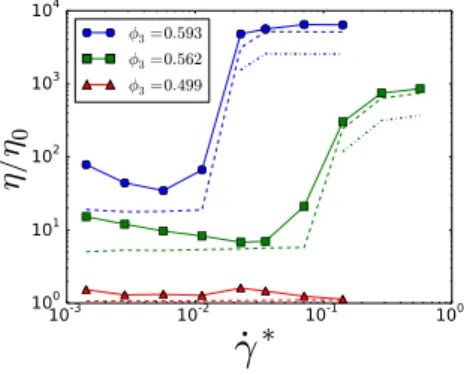
We define the fragile state as the state where both the solid-like and fluid-like responses can be observed at the same volume fraction and initial strain amplitude depending on the initial phase for the strain. We find that the stress anisotropy also has a peak in this state (Fig. 1). The phenomenology based on and can also reproduce the shear modulus in the shear jammed state. The viscosity above the critical shear rate for DST under simple shear also shows an agreement with the prediction of this phenomenology (Fig. 2) [4].
References
[1] M. M. Denn, et al., Soft Matter 14, 170 (2018).
[2] D. Bi, et al., Nature 480, 355, (2011).
[3] M. Otsuki and H. Hayakawa, arXiv:1810.03846.
[4] Pradipto and H. Hayakawa, arXiv:1904.02929 γ·
γ(t) =γ0[cosΘ −cos(ωt +Θ)]
G′ G′′
ζN ζT
ϕ γ0I Θ
ζN ζT γ·
Fig. 1. Plots of the storage modulus against initial strain amplitude with various initial phase in the oscillatory shear. The line represents the stress anisotropy. The
shaded region indicates the fragile state. Fig. 2. Plots of viscosities against the shear rate for various volume fractions. Dashed lines are obtained from the phenomenology.
キタエフスピン液体における
平行磁場下の半整数量子熱ホール効果
量子凝縮物性研究室 馬斯嘯
Abstract Recently, an observation of half-integer thermal Hall conductance plateau under titled magnetic field has been reported in α-RuCl3, which provides a direct signature of chiral Majorana edge current.
Here we show that the thermal Hall plateau appears even in the absence of out-of-plane magnetic field.
Moreover, a field-angular variation of the quantized thermal Hall conductance has the same sign structure of the topological Chern number, which is either ±1. These results demonstrate that the Kitaev interaction is responsible for the quantized thermal Hall effect.
© 2019 Department of Physics, Kyoto University
2006年、A. Kitaevにより二次元ハニカム格子における量子スピン模型が提案された [1]。このキタエ
フ模型における基底状態は厳密解を持つ量子スピン液体状態である。キタエフスピン液体では、電子ス ピンが相互作用により分数化し、遍歴的なマヨラナ粒子と局在したマヨラナ粒子を形成し、後者は有限 温度においても物性に寄与すると期待されている。キタエフ模型はマヨラナ粒子と非アーベルエニオン を実験的に検出することのできる有力な系であると考えられる。
現実物質では、強いスピン軌道相互作用を持つモット絶縁体 α-RuCl3がキタエフ模型の候補物質とし て注目され、盛んに研究されている [2]。α-RuCl3はゼロ磁場においてTN = 7 Kでジグザグ型反強磁性秩 序を示すが、面内磁場により反強磁性秩序が完全に抑制される [3]。そこで、傾斜磁場により反強磁性 秩序を抑制した状態で熱ホール効果測定を行った結果、熱ホール伝導度の量子化が起こり、その量子化 値は整数量子ホール効果で期待される値の 1/2 倍になること(半整数量子化)が観測された [4]。これ はキタエフスピン液体状態におけるマヨラナ粒子のカイラルエッジ流および非可換エニオンの存在を 示す強力な証拠である。
しかしながら、観測された半整数量子化がキタエフ相互作用に由来するものであるか、現実物質に おける理想模型では考慮されていない相互作用(非キタエフ相互作用)に対して半整数量子化がどの程 度安定であるかは明らかになっていない。
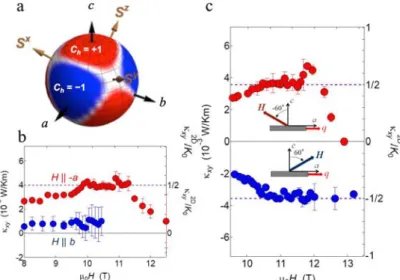
これらの謎を解明するためには、トポロジ カル不変量(チャーン数)の詳細な構造を 明らかにする必要がある。熱ホール効果測 定を様々な磁場方向で行った結果、面内磁 場のみでの熱ホール効果測定においても、
半整数量子熱ホール伝導度が観測された。
また、チャーン数の磁場角度依存性は非キ タエフ相互作用のない模型と同じ符号をと ることが明らかになった。以上の結果は、
α-RuCl3 における半整数量子化がキタエフ
相互作用を起源とする決定的な証拠を与え、
キタエフ量子スピン液体におけるトポロジ カル秩序が非キタエフ相互作用の影響下で も保たれていることを示している。
References [1] A. Kitaev, Ann. Phys. 321, 2-111 (2006).
[2] K. W. Plumb et al., Phys. Rev. B 90, 041112(R) (2014).
[3]A. Banerjee et al., npj Quant. Mater. 3, 8 (2018) [4] Y. Kasahara et al., Nature, 559 227-231 (2018).
Fig. 1. a: Field-angular variation of Chern number Ch in pure Kitaev model. b: Field dependence of thermal Hall conductivity for H || -a (red) and H || b (blue) at 4.8 K. c: Field dependence of thermal Hall at 4.3 K in titled field of θ = 60° (red) and θ = -60° (blue).